



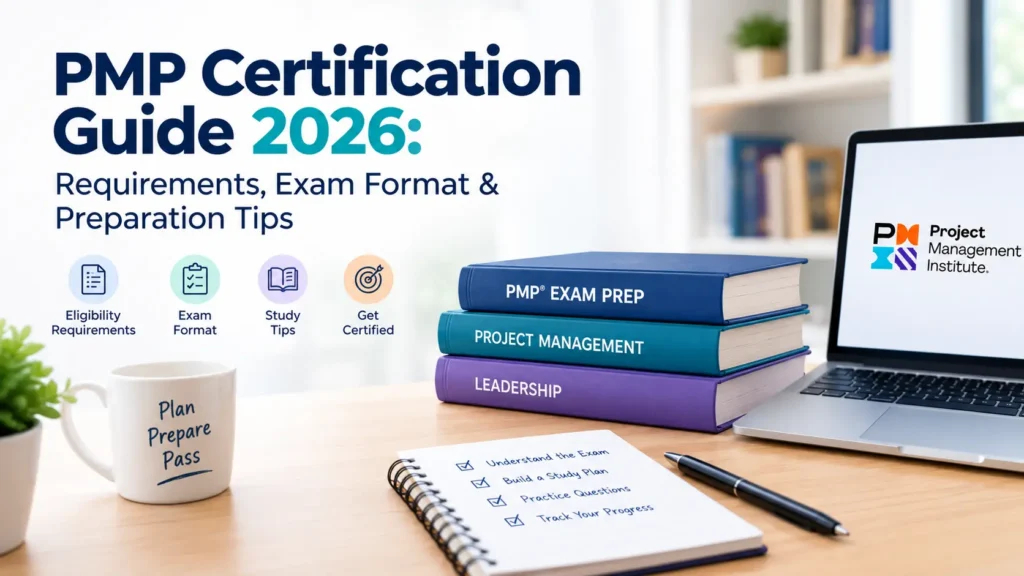
The Project Management Professional (PMP) credential remains one of the most widely held project management credentials. PMI launched an updated PMP examination on 9 July 2026, with more focus on business value, AI, sustainability, stakeholder engagement, and real project situations. PMI reports that more than 1.7 million professionals hold the PMP certification worldwide, making it the world’s most widely held project management certification. The 2026 PMP examination has 180 questions and gives you four hours to finish. The eligibility rules have also been updated, including a wider 10-year experience window. This guide explains the current PMP certification requirements, application steps, exam format, costs, study methods, and renewal rules.
PMP Certification Guide 2026
What Changed In The PMP Exam In 2026?
The biggest change came in July 2026. PMI shifted the exam toward how projects create value for an organization. The three exam domains now carry these weights:
| Domain | 2026 weighting |
| People | 33% |
| Process | 41% |
| Business Environment | 26% |
The Business Environment section has therefore become much larger than it was under the previous exam structure. The updated exam also includes AI, sustainability, stakeholder engagement and questions based on practical project situations. This means your study plan should cover project delivery, leadership and business decision-making. Reading process definitions alone is unlikely to cover the full scope of the current exam.

- Practice Mode
- Exam Mode
- Flashcards
The Most Trending Certification Exams
- PMI-CPMAI exam prep: PMI Certified Professional in Managing AI
- PMI-001 exam prep: Project Management Professional V5
- DASSM exam prep: Disciplined Agile Senior Scrum Master
Show More... (7)
- PMI-PMOCP exam prep: PMI Project Management Office Certified Professional (PMI-PMOCP)
- CA0-001 exam prep: Certified Associate in Project Management
- CAPM-German exam prep: Certified Associate in Project Management (CAPM Deutsch Version)
- CAPM-JPN exam prep: Certified Associate in Project Management (CAPM日本語版)
- PfMP-Deutsch exam prep: Portfolio Management Professional (PfMP) (PfMP Deutsch Version)
- PgMP exam prep: Program Management Professional
- PMI-002 exam prep: Certified Associate in Project Management (CAPM) Certification
Why choose Certification Exam for PMP?
Practice with realistic certification exams, clear explanations and flexible study modes designed to help you improve faster.
- Updated questions and exam-style simulations
- Instant feedback with detailed explanations
- Study online or from the mobile app
Requirements, Exam Format & Preparation Tips
Lorem ipsum dolor sit amet, consectetur adipiscing elit. Integer editors can replace this introduction with a short overview that appears between the first H2 and the first H3 heading.
Do You Need Project Management Training?
You generally need 35 hours of project management training. An active CAPM certification can also satisfy this training requirement. Self-paced training can come from any organization under the current rules. There is an important change coming on 1 December 2026. From that date, live instructor-led training will need to come from a PMI Authorized Training Partner, China Registered Education Provider, or an eligible accredited academic program. Training completed before 1 December 2026 remains eligible under the current rules. So, check the provider’s status before paying for a live course later in 2026.
How To Apply for the PMP
The application starts through your PMI account. You will provide information about:
- Your education.
- Your project management education or training.
- Your project professional training.
- Your preferred exam option.
Keep your records ready before you start. Your experience entries should clearly show the projects you managed and the responsibilities you held. PMI may select an application for an audit. An audit can require documents such as your degree, supervisor or manager verification of experience, and training certificates. PMI gives candidates 90 days to submit the requested audit documents. Once your application is approved, you pay the exam fee and schedule your test. Your eligibility period is one year, during which you can take the exam up to three times.
PMP Examination Format In 2026
The current exam has:
- 180 total questions
- 170 scored questions
- 10 unscored pretest questions
- 240 minutes of exam time
- Two 10-minute breaks
The questions can use several formats. These include multiple-choice questions, multiple-response questions, matching or drag-and-drop tasks, pull-down selections, and practical case-based questions. The 2026 Exam Content Outline also describes hands-on testing that can involve tools, data, and case studies. The 10 unscored questions are mixed into the exam. You are not told which questions are unscored. There are also two breaks. Once you review a section and begin a break, you cannot return to the questions from that completed section. You can take the test at a Pearson VUE testing center or through PMI’s online proctored option, subject to the applicable testing rules.
How Much Does the PMP Test Cost In 2026?
The current listed fee is:
- PMI member: US$405
- Non-member: US$655
The PMP test cost is paid after your application has been accepted and you are ready to schedule the exam. Remember that the total amount you spend can be higher than the exam fee. You may also pay for training, study materials, practice tests, PMI membership, and a retake if needed. PMI membership is separate from certification. Do not assume that buying membership automatically makes the certification cheaper overall. Compare the membership price, exam fee, and other benefits before deciding.
How To Prepare For The 2026 Exam
Your PMP test prep should match the new exam rather than an older course built around the previous domain percentages. Start with the official 2026 PMP Exam Content Outline. It tells you what the exam covers and how the questions are structured. Then build your study plan around five areas:
1. Learn the concepts
Understand project planning, delivery, risk, stakeholders, teams, governance, value, and business context. Do not try to memorize every line from a study book. Focus on why a project manager would choose one action over another.
2. Study all three domains
People now represents 33% of the exam. Process represents 41%. Business Environment represents 26%. Do not treat Business Environment as a small final topic. It now represents over one-quarter of the exam.
3. Practice scenario questions
The current exam uses practical situations. Read each question carefully before looking at the answer choices. Ask yourself:
- What is the project problem?
- What should the project manager do first?
- Who needs to be involved?
- What information is missing?
- What action protects project value?
- Is the situation predictive, agile, or hybrid?
4. Review every wrong answer
Practice questions are useful only when you study your mistakes. Keep a simple error log. Record the topic, your answer, the correct answer, and why your reasoning was wrong. This can show you patterns in your mistakes.
5. Use timed practice
Do full-length practice sessions before the actual exam. Practice taking breaks at the same points you will use on test day. The goal is not simply to answer questions quickly. You need to maintain accuracy during a four-hour exam. PMI itself recommends using the Exam Content Outline and its official preparation resources when planning your studies.
Sample Practice Questions
Try these sample questions before moving to the full interactive quiz below. Each question includes the correct answer and explanation, similar to what you will experience in a complete PMP.
1. A project team with members from many different countries is struggling to cooperate The project manager accepted these difficulties during the storming phase of team development, but the team has not moved to the next phase The project is beginning to fall behind schedule What can the project manager do to move the team to the norming phase?
- Plan social activities to help foster stronger interpersonal relationships and identify shared goals.
- Speak with the project sponsor about changing the team composition
- Figure out who is behind the issues and apply progressive disciplinary techniques.
- Show the team the schedule impact of their communication issues and encourage them to put their differences aside
According to the Project Management Professional (PMP) Reference Materials, the norming stage of team development is when the team members start to respect each other, collaborate effectively, and work towards a common vision1. One of the ways to facilitate this stage is to plan social activities that can help the team members bond, build trust, and appreciate their diversity2. By engaging in social activities, the team can also identify shared goals and values that can motivate them to perform better on the project3. The other options, B, C, and D, are not effective ways to move the team to the norming stage. Speaking with the project sponsor about changing the team composition may disrupt the team dynamics and cause more conflicts4. Figuring out who is behind the issues and applying progressive disciplinary techniques may create resentment and fear among the team members and damage their morale5. Showing the team the schedule impact of their communication issues and encouraging them to put their differences aside may not address the root causes of the problems and may lead to further misunderstandings and frustrations. Reference: 1: A Guide to the Project Management Body of Knowledge (PMBOK® Guide) – Sixth Edition, Chapter 9.4.2.2, "Team Development Stages". 2: The Five Stages of Team Development and the Role of the Project Manager, Section "Norming". 3: Manager’s Guide to Navigating The Four Stages of Team Development, Section "Norming Stage". 4: Climbing to Performance: Four Stages of Team Development, Section "Storming". 5: Project Human Resource Management, Section "Managing Project Teams".: How To Move The Team Through The Stages Of Team Development, Section "Storming".
2. To estimate the costs of a new project that is similar to a project that was implemented last year, the project manager meets with a group of experts from the previous project The group uses a three- point estimating technique The project manager submits the estimated budget to the project sponsor for approval The project sponsor, who is new to the company, is concerned because the budget exceeded their expectations What should the project manager do?
- Review the organizational process assessment to determine if a contingency reserve was considered in the budget estimate
- Review the historical information and lessons learned from last year’s project to justify the new budget estimate
- Change the budgeting technique to a more accurate, bottom-up cost estimation.
- Use soft skills to convince the project sponsor to approve the new budget estimate
The project manager should review the historical information and lessons learned from last year’s project to justify the new budget estimate. This is because the project manager used an analogous estimating technique, which is based on the costs of similar projects in the past. By reviewing the historical information and lessons learned, the project manager can explain to the project sponsor how the costs of the new project were derived, what assumptions and risks were considered, and how the three-point estimating technique was applied. This can help the project sponsor understand the rationale behind the budget estimate and increase their confidence in its accuracy and validity. The project manager can also use this opportunity to discuss the benefits and value of the new project and how it aligns with the organizational strategy and objectives. Reference: PMBOK Guide, 6th edition, section 7.2.2.4, page 262, Free PMP® Exam Sample Question 04 (Earned Value)
What Happens After You Pass?
Passing the exam does not mean you need to take it again every few years. Instead, PMI uses its Continuing Certification Requirements program. A PMP holder must earn 60 Professional Development Units (PDUs) during each three-year cycle. At least 35 must come from Education, while up to 25 can come from Giving Back activities. You also need at least eight PDUs in each area of PMI’s Talent Triangle: Ways of Working, Power Skills, and Business Acumen. You record your PDUs through PMI’s Continuing Certification Requirements System. The renewal process is:
- Earn the required 60 PDUs.
- Report them in the CCR system.
- Pay the certification renewal fee.
- Start the next three-year cycle.
The certification renewal fee is currently listed as US$60 for PMI members and US$150 for non-members. This is separate from PMI membership renewal.
Common Mistakes To Avoid
A few mistakes can make preparation harder than it needs to be:
- Using a study course based on the old exam structure.
- Ignoring Business Environment.
- Memorizing terms without understanding project situations.
- Skipping practice questions.
- Not reviewing wrong answers.
- Waiting until the final weeks to attempt a full-length mock test.
- Buying live training without checking the provider rules that apply after 1 December 2026.
- Recording overlapping project experience twice on the application.
- Forgetting that renewal requires PDUs after certification.
Conclusion
The 2026 PMP certification process is different from older versions in several important ways. The exam now places greater weight on Business Environment and includes AI, sustainability, stakeholder engagement, and practical project scenarios. The eligibility framework also uses a 10-year experience window. Before applying, check the current PMP certification requirements on PMI’s official website. Then confirm your training eligibility, prepare your application records, and use the current Exam Content Outline as the base for your study plan. The PMP exam cost is only one part of your budget. Include training, study resources, membership, and possible retake costs when planning. For structured exam information and preparation resources, Certification Exam can also be used as an additional reference while you build your study plan.
Requirements, Exam Format & Preparation Tips
The Project Management Professional (PMP) credential remains one of the most widely held project management credentials. PMI launched an updated PMP examination on 9 July 2026, with more focus on business value, AI, sustainability, stakeholder engagement, and real project situations. PMI reports that more than 1.7 million professionals hold the PMP certification worldwide, making it the world’s most widely held project management certification. The 2026 PMP examination has 180 questions and gives you four hours to finish. The eligibility rules have also been updated, including a wider 10-year experience window. This guide explains the current PMP certification requirements, application steps, exam format, costs, study methods, and renewal rules.
1. How many questions are on the PMP exam in 2026?
The exam has 180 questions. Of these, 170 are scored and 10 are unscored pretest questions. You have 240 minutes to complete the exam, with two 10-minute breaks.
2. Can I take the PMP exam without a project management degree?
Yes. PMI does not require a specific project management degree. Your education level affects the amount of project management experience required. Candidates can qualify through a high school diploma, associate degree, bachelor’s degree, or a qualifying PMI GAC program.
3. Is PMP training still required in 2026?
Yes. The standard requirement is 35 hours of project management training, unless you have an active CAPM certification that satisfies the training requirement. From 1 December 2026, new rules will apply to live instructor-led training providers.
4. How long is a PMP certification valid?
The certification is maintained through a three-year renewal cycle. During each cycle, PMP holders need 60 PDUs, report them through PMI’s CCR system, and pay the applicable renewal fee.