AWS Certification Guide 2026: Which AWS Certification Should You Choose?
6 min.
15/10/2026
16/10/2026
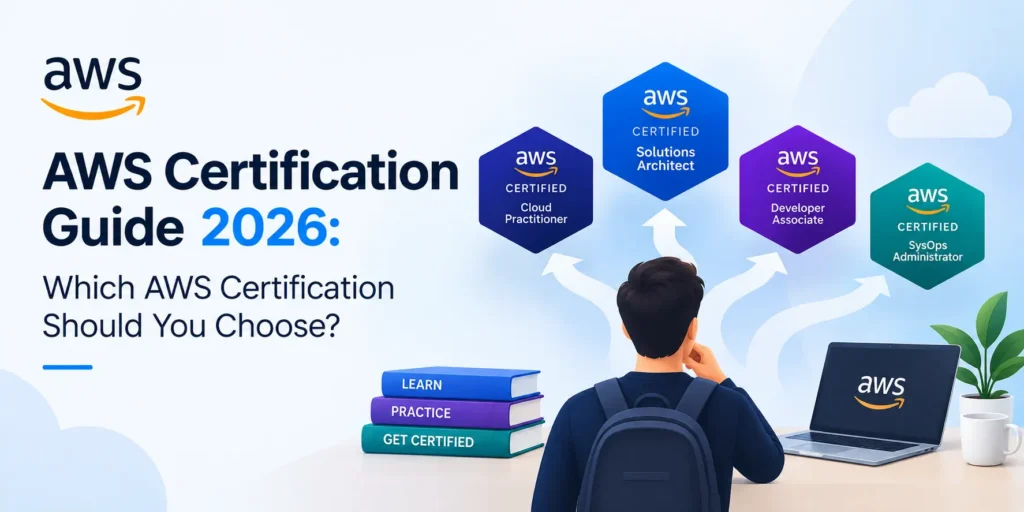
Picking an AWS certification is easier with a clear map. AWS offers four levels and twelve active exams. Each exam fits a different role and a different budget. For students competing for tech giants, AWS certification is an important one to have. This guide explains every level in plain words. It also shows which exam suits your goal. By the end, you will know where to start and how to prepare.
How the Four Levels Work
AWS sorts every exam by depth and experience. The levels build on each other. You do not need to take them all. Most people pick one Associate exam and then add a Professional or Specialty exam. The table below shows the basics.
Cloud Practitioner covers the basics. It explains core services, billing, and security in simple terms. It suits students, sales staff, and managers. Technical skills are not required. Preparation often takes two to four weeks.
AI Practitioner covers AI basics. It explains machine learning and generative AI concepts. It fits anyone who works near AI projects. Both Foundational exams cost $100. Either one is a calm way to enter the AWS certification path.
This level also helps teams that work with cloud engineers every day. A project manager can follow technical talks much better after one of these exams. A sales lead can explain cloud services with more confidence.
Associate Level: The Best Place for Most Careers
This level is the sweet spot for job seekers. It proves you can build and run real workloads. Five exams are available. Solutions Architect Associate is the most popular pick. It teaches broad service knowledge. It also opens doors in many roles. The CloudOps exam was formerly called SysOps Administrator. Associate preparation usually takes six to ten weeks.
Pick the exam that matches your daily work. A developer gains more from the Developer exam than from a general one. An operations engineer gains more from the CloudOps exam. Hands-on tasks at work then double as study time.
Professional Level: For Experienced Engineers
Professional exams test deep design and operations skills. Each one expects about two years of hands-on work. Three options are open. Solutions Architect Professional covers complex designs. It focuses on large systems across many accounts. DevOps Engineer Professional covers automation. It includes pipelines, monitoring, and recovery. Generative AI Developer Professional covers production AI apps. It centers on services like Amazon Bedrock. AWS opened registration for this newest exam in 2026.
Each Professional exam costs $300. Preparation often takes three to five months. Senior roles often ask for this level, so it pays to plan the timeline early.
Specialty Level: Depth in One Area
Specialty exams focus on one skill area. AWS has retired most older ones, so only two remain. Security Specialty suits security engineers. AWS refreshed it with added AI security topics. Advanced Networking Specialty suits network engineers. It covers complex hybrid and multi-region connections. Both cost $300. Take them after you have real project experience. Most engineers add a Specialty exam after a Professional one. This order keeps the study load manageable.
Which AWS Certification Fits Your Goal
Your goal decides the best path. Use this table as a quick guide.
For the AI path, AWS suggests earning an Associate exam first. Solutions Architect, Data Engineer, and Machine Learning Engineer all help.
Validity, Renewal, and Cost Planning
Plan for renewal early. An AWS certification stays valid for three years. You can renew by passing the latest version of your exam. Some higher exams also renew lower ones. Passing DevOps Engineer Professional, for example, renews the CloudOps Engineer Associate.
Plan your budget in steps. AWS often gives a 50% voucher after you pass an exam. That lowers the cost of your next attempt. A path of Cloud Practitioner, Solutions Architect Associate, and Solutions Architect Professional costs about $550 in exam fees. Study materials come on top of that. Set aside a small budget for them early.
Sample Practice Questions
Try these sample questions before moving to the full interactive quiz below. Each question includes the correct answer and explanation, similar to what you will experience in a complete AWS-Certified-Solutions-Architect-Associate-SAA-C03.
1. A social media company wants to store its database of user profiles, relationships, and interactions in the AWS Cloud. The company needs an application to monitor any changes in the database. The application needs to analyze the relationships between the data entities and to provide recommendations to users. Which solution will meet these requirements with the LEAST operational overhead?
Use Amazon Neptune to store the information. Use Amazon Kinesis Data Streams to process changes in the database.
✓ Use Amazon Neptune to store the information. Use Neptune Streams to process changes in the database.
Use Amazon Quantum Ledger Database (Amazon QLDB) to store the information. Use Amazon Kinesis Data Streams to process changes in the database.
Use Amazon Quantum Ledger Database (Amazon QLDB) to store the information. Use Neptune Streams to process changes in the database.
Amazon Neptune: Neptune is a fully managed graph database service that is optimized for storing and querying highly connected data. It supports both property graph and RDF graph models, making it suitable for applications that need to analyze relationships between data entities. Neptune Streams: Neptune Streams captures changes to the graph and streams these changes to other AWS services. This is useful for applications that need to monitor and respond to changes in real-time, such as providing recommendations based on user interactions and relationships. Least Operational Overhead: Using Neptune Streams directly with Amazon Neptune ensures that the solution is tightly integrated, reducing the need for additional components and minimizing operational overhead. This integration simplifies the architecture by eliminating the need for a separate service like Kinesis for change processing. Reference: Amazon Neptune Documentation Neptune Streams Documentation
2. A company needs to optimize its Amazon S3 storage costs for an application that generates many files that cannot be recreated Each file is approximately 5 MB and is stored in Amazon S3 Standard storage. The company must store the files for 4 years before the files can be deleted The files must be immediately accessible The files are frequently accessed in the first 30 days of object creation, but they are rarely accessed after the first 30 days. Which solution will meet these requirements MOST cost-effectively?
Create an S3 Lifecycle policy to move the files to S3 Glacier Instant Retrieval 30 days after object creation. Delete the files 4 years after object creation.
Create an S3 Lifecycle policy to move the files to S3 One Zone-Infrequent Access (S3 One Zone-IA) 30 days after object creation Delete the files 4 years after object creation.
✓ Create an S3 Lifecycle policy to move the files to S3 Standard-Infrequent Access (S3 Standard-IA) 30 days after object creation Delete the files 4 years after object creation.
Create an S3 Lifecycle policy to move the files to S3 Standard-Infrequent Access (S3 Standard-IA) 30 days after object creation. Move the files to S3 Glacier Flexible Retrieval 4 years after object creation.
Amazon S3 Standard-IA: This storage class is designed for data that is accessed less frequently but requires rapid access when needed. It offers lower storage costs compared to S3 Standard while still providing high availability and durability. Access Patterns: Since the files are frequently accessed in the first 30 days and rarely accessed afterward, transitioning them to S3 Standard-IA after 30 days aligns with their access patterns and reduces storage costs significantly. Lifecycle Policy: Implementing a lifecycle policy to transition the files to S3 Standard-IA ensures automatic management of the data lifecycle, moving files to a lower-cost storage class without manual intervention. Deleting the files after 4 years further optimizes costs by removing data that is no longer needed. Reference: Amazon S3 Storage Classes S3 Lifecycle Configuration
Build a Simple Study Plan
A steady plan beats a last-minute rush. The table below shows typical preparation time for each level.
Study a little each day. Short daily sessions work better than one long weekend session. Split your time between reading and doing. Read the topic first. Then try it in a free AWS account. Track your weak areas. Write down every topic you miss in practice. Return to those topics each week.
How to Prepare With Practice Exams
Good practice makes exam day calmer. Start with the official exam guide. It lists every topic and its weight. Then build skills in a free AWS account. Hands-on work makes service names stick. Finish with timed practice tests. Certification-Exam’s AWS practice exams offer questions in Practice Mode, Exam Mode and as Mock Exams. Each question comes with an explanation and you can practice on the go on your mobile or on the web.
Smart Habits for Exam Day
AWS exams allow you to choose between taking the exams at a testing center or at a proctored location. Pick the option that helps you relax the most. Prep your space and ID the day before. A valid ID and a quiet space help calm your nerves the day of the exam. Read each question twice and make sure to review all the details. Flag questions you’re not sure about and come back to them with the time you have saved.
FAQs
Which AWS certification is best for beginners?
Cloud Practitioner is the usual first step. AI Practitioner suits beginners who want an AI focus.
How much does an AWS certification cost?
Exams cost $100, $150, or $300 depending on the level. Check the AWS site for the latest fee before you book.
How long does an AWS certification last?
Each one stays valid for three years. You can renew by passing the latest exam version or a higher exam that renews it.
Do I need Cloud Practitioner before an Associate exam?
No, it is optional. Candidates with some cloud experience can start at the Associate level.
Which AWS certification has the best career value?
Solutions Architect Associate is widely recognized across many roles. The best choice still depends on your job goal and your daily work.
Final Words
Pick one exam and set a date this week. A clear target turns study time into steady progress. Start with the level that matches your experience today. Add the next exam when you feel ready. Each step builds skills that employers value. Your first AWS certification is closer than it looks. Make your preparation easier with Certification-Exam! Check out our study bundles today!
Here are the most popular certification exams... Try them now!