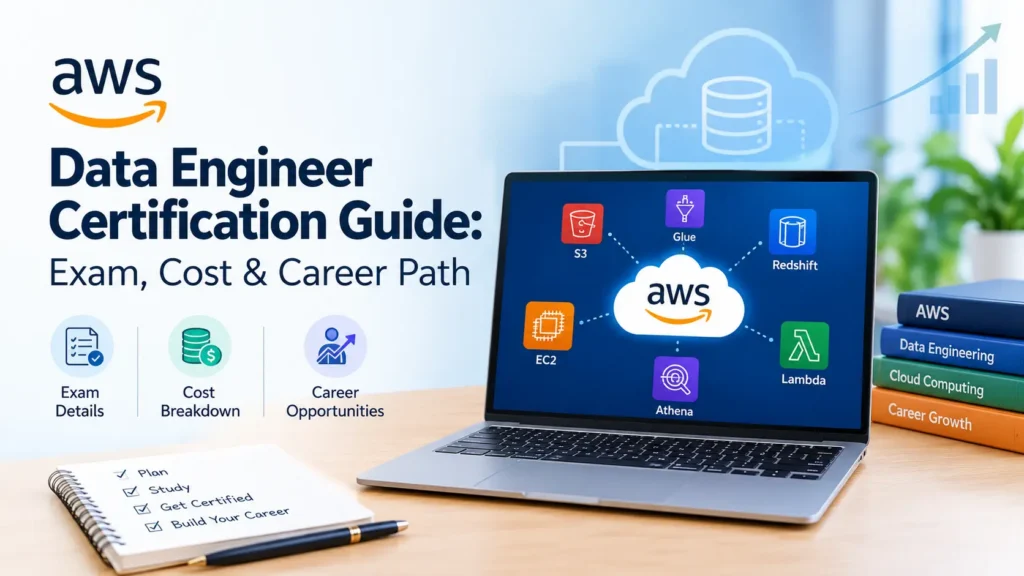
AWS Data Engineer Certification Guide: Exam, Cost & Career Path
6 min.
16/10/2026
05/11/2026
Data is now a key part of many businesses. Companies need people who can collect and manage data in the cloud. This has increased the need for skilled data engineers. An AWS certification can help you show your knowledge of cloud-based data work.
The AWS data engineer certification is designed for people who work with data pipelines, data stores, security, and data quality. The current associate-level exam is called AWS Certified Data Engineer – Associate, with the exam code DEA-C01. This guide will cover the exam and a simple career path.
What Is the AWS Data Engineer Certification?
The AWS Certified Data Engineer – Associate certification checks your ability to work with data on AWS. The exam focuses on practical data engineering tasks. These include building data pipelines, and checking data quality. It also covers security and data governance.
The exam is aimed at people who already have some data engineering or AWS knowledge. AWS recommends around two to three years of data engineering or data architecture experience. It also recommends one to two years of hands-on work with AWS services.
You don’t need to wait until you have this exact amount of work experience. However, practical knowledge can make preparation easier.
The AWS Data Engineer Associate exam is designed to test your knowledge across four main areas. The exam has 65 questions. These include multiple-choice and multiple-response questions. The exam time is 130 minutes.
Here is a quick view:
Exam detail
Information
Exam
AWS Certified Data Engineer – Associate
Code
DEA-C01
Questions
65
Duration
130 minutes
Passing score
720/1,000
Exam fee
$150 USD
Validity
3 years
The exam has 50 scored questions and 15 unscored questions. Unanswered questions are marked incorrect. But there is no penalty for guessing.
Main Topics in DEA-C01
The AWS DEA-C01 exam has four content areas.
1. Data Ingestion and Transformation
This is the largest section. It makes up 34% of the scored content. You need to understand how data enters a system and how it is changed for use.
You should study:
Data ingestion
Data transformation
Data pipelines
Pipeline orchestration
Programming concepts
Data quality
This section is important because data engineers often work with data from many sources.
2. Data Store Management
This makes up 26% of the scored content. You need to know how to select and manage the right place to store data. Topics include:
Data stores
Data models
Data catalogs
Data schemas
Data life cycles
Schema changes
You should understand why one data store may work better than another for a given task.
3. Data Operations and Support
This section makes up 22% of the scored content. It focuses on keeping data systems working properly. You should understand how to:
Monitor data pipelines
Find problems
Improve performance
Control costs
Check data quality
Maintain data workflows
You should also know how to respond when a pipeline doesn’t work as expected.
4. Data Security and Governance
This section makes up 18% of the scored content. Security is important when you work with business data.
You should study:
Access control
Authentication
Authorization
Data encryption
Privacy
Governance
Logging
The exam also checks your understanding of how security controls can be used in data pipelines.
AWS Services You Should Know
The exam covers several AWS services. You don’t need to memorise every service in the AWS catalog. Focus on services that are relevant to data engineering. The exam guide includes services across areas such as analytics and data processing. Your preparation should help you understand what each service does and when to use it.
Do not study service names alone. Learn the reason for choosing one service over another. That type of understanding can help with scenario-based questions.
AWS Data Engineering Certification Cost
The current associate-level AWS certification exam costs $150 USD. Local prices can vary based on currency and applicable taxes. AWS lists the current INR price for an Associate exam as ₹12,829.50 through its Pearson Mindhub voucher store.
You may also spend money on study material or training. These costs depend on how you choose to prepare.
AWS says that people who already hold an active AWS Certification can receive a 50% discount on their next AWS Certification exam. Still, always check the current price before booking your exam.
Sample Practice Questions
Try these sample questions before moving to the full interactive quiz below. Each question includes the correct answer and explanation, similar to what you will experience in a complete AWS-Certified-Solutions-Architect-Associate-SAA-C03.
1. A social media company wants to store its database of user profiles, relationships, and interactions in the AWS Cloud. The company needs an application to monitor any changes in the database. The application needs to analyze the relationships between the data entities and to provide recommendations to users. Which solution will meet these requirements with the LEAST operational overhead?
Use Amazon Neptune to store the information. Use Amazon Kinesis Data Streams to process changes in the database.
✓ Use Amazon Neptune to store the information. Use Neptune Streams to process changes in the database.
Use Amazon Quantum Ledger Database (Amazon QLDB) to store the information. Use Amazon Kinesis Data Streams to process changes in the database.
Use Amazon Quantum Ledger Database (Amazon QLDB) to store the information. Use Neptune Streams to process changes in the database.
Amazon Neptune: Neptune is a fully managed graph database service that is optimized for storing and querying highly connected data. It supports both property graph and RDF graph models, making it suitable for applications that need to analyze relationships between data entities. Neptune Streams: Neptune Streams captures changes to the graph and streams these changes to other AWS services. This is useful for applications that need to monitor and respond to changes in real-time, such as providing recommendations based on user interactions and relationships. Least Operational Overhead: Using Neptune Streams directly with Amazon Neptune ensures that the solution is tightly integrated, reducing the need for additional components and minimizing operational overhead. This integration simplifies the architecture by eliminating the need for a separate service like Kinesis for change processing. Reference: Amazon Neptune Documentation Neptune Streams Documentation
2. A company needs to optimize its Amazon S3 storage costs for an application that generates many files that cannot be recreated Each file is approximately 5 MB and is stored in Amazon S3 Standard storage. The company must store the files for 4 years before the files can be deleted The files must be immediately accessible The files are frequently accessed in the first 30 days of object creation, but they are rarely accessed after the first 30 days. Which solution will meet these requirements MOST cost-effectively?
Create an S3 Lifecycle policy to move the files to S3 Glacier Instant Retrieval 30 days after object creation. Delete the files 4 years after object creation.
Create an S3 Lifecycle policy to move the files to S3 One Zone-Infrequent Access (S3 One Zone-IA) 30 days after object creation Delete the files 4 years after object creation.
✓ Create an S3 Lifecycle policy to move the files to S3 Standard-Infrequent Access (S3 Standard-IA) 30 days after object creation Delete the files 4 years after object creation.
Create an S3 Lifecycle policy to move the files to S3 Standard-Infrequent Access (S3 Standard-IA) 30 days after object creation. Move the files to S3 Glacier Flexible Retrieval 4 years after object creation.
Amazon S3 Standard-IA: This storage class is designed for data that is accessed less frequently but requires rapid access when needed. It offers lower storage costs compared to S3 Standard while still providing high availability and durability. Access Patterns: Since the files are frequently accessed in the first 30 days and rarely accessed afterward, transitioning them to S3 Standard-IA after 30 days aligns with their access patterns and reduces storage costs significantly. Lifecycle Policy: Implementing a lifecycle policy to transition the files to S3 Standard-IA ensures automatic management of the data lifecycle, moving files to a lower-cost storage class without manual intervention. Deleting the files after 4 years further optimizes costs by removing data that is no longer needed. Reference: Amazon S3 Storage Classes S3 Lifecycle Configuration
A Simple Certification Roadmap
You must not study everything at once and a simple plan can make your preparation easier.
Step 1: Learn Data Engineering Basics
Start with basic data concepts. Learn about:
Databases
SQL
Data pipelines
ETL
Data lakes
Data warehouses
Data quality
Make sure you understand these ideas before moving to exam-specific topics.
Step 2: Build AWS Knowledge
Next, learn the AWS services covered by the exam. Focus on what each service does and then learn when you should use it. Hands-on practice can help here. Try building small data workflows instead of only reading notes.
Step 3: Study the DEA-C01 Domains
Use the four exam domains as your study checklist. Start with Data Ingestion and Transformation, then study the other three sections. Also, keep notes on topics you find difficult.
Step 4: Take Practice Tests
Practice questions can show where you need more work. Do not focus only on your final score. Read the explanation for every question you get wrong. Make a list of weak areas. Review those topics before taking another test.
Step 5: Check Your Readiness
AWS provides official preparation resources. This includes practice questions and an official practice exam. Before booking your test, make sure you can explain the main topics without relying on notes.
Career Path After Certification
An AWS data engineering certification can support a career in several data and cloud roles. You may work toward roles such as:
Data Engineer
Cloud Data Engineer
Data Architect
Analytics Engineer
Cloud Engineer
Data Platform Engineer
The certification doesn’t replace work experience, but practical skills still matter. You can strengthen your profile by building small projects. For example, create a data pipeline and monitor it to gain practical skills for interviews.
Is AWS DEA-C01 Right for You?
This certification suits you if you have basic data skills and want stronger AWS knowledge. It may suit you if you:
Work with data pipelines
Use cloud services
Have SQL knowledge
Work with databases
Want a cloud data role
Plan to move into data architecture
Want to validate your AWS skills
It may be better to learn the basics first if you are completely new to data engineering.
FAQs
1. What is the AWS DEA-C01 exam?
AWS DEA-C01 is the exam code for the AWS Certified Data Engineer – Associate certification. It tests skills related to data pipelines and data governance.
2. How much does the AWS Data Engineer Associate exam cost?
The standard Associate exam price is $150 USD. Local prices and taxes can vary. AWS currently lists ₹12,829.50 for an Associate exam voucher in INR through Pearson Mindhub.
3. How long is the certification valid?
The AWS Certified Data Engineer – Associate certification is valid for three years.
4. Do you need work experience for the exam?
AWS recommends 2–3 years of data engineering or architecture experience and 1–2 years of hands-on AWS work. These are recommended background levels rather than a stated exam eligibility requirement.
Final Thoughts
The AWS data engineer certification helps data engineers build cloud skills. Start with data basics and then learn AWS services and focus on the four DEA-C01 domains. Also, use practice questions to find weak areas before the exam.
The AWS Data Engineer Associate credential can also fit into a wider cloud career plan. Build hands-on projects along with your study. This will help you connect exam topics with real work.
The AWS data engineering certification path is easier to manage when you follow a clear plan and study one topic at a time. Certification Exam is another resource to consider for exam preparation.
Here are the most popular certification exams... Try them now!