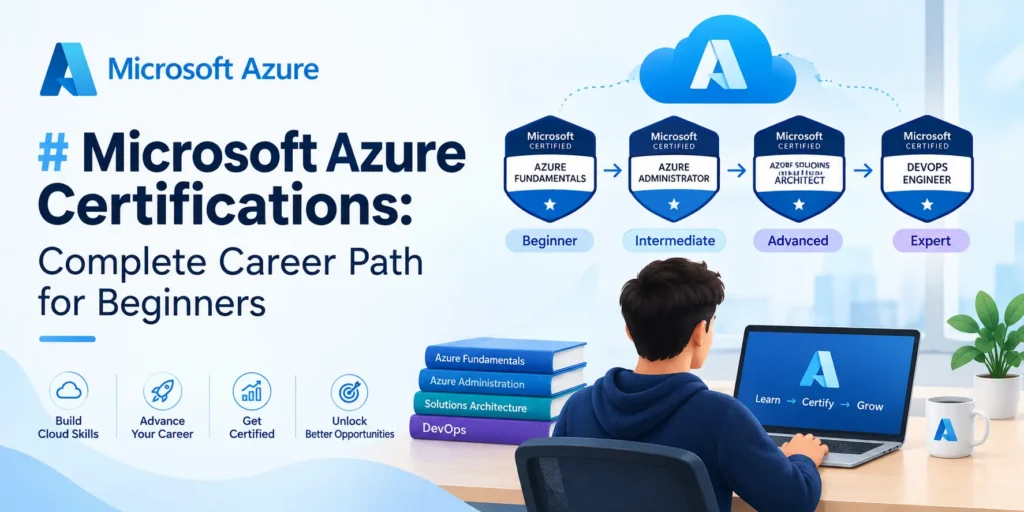
Microsoft Azure Certifications: Complete Career Path for Beginners
11 min.
14/10/2026
16/10/2026
Many businesses store files and carry out their work using cloud services, and they require individuals who can arrange these services and ensure that the data is kept safe.
Microsoft Azure is a platform which provides tools for computing and security. If you learn Azure it may prepare you for positions in IT support and in other technical areas.
You won’t need years of experience in the IT field. If you want to get started, just begin with the fundamentals and select a path that aligns with your career objectives.
An Azure certification can demonstrate to employers the knowledge that you have and it also provides you with a clear outline of the subjects you should study. Yet it doesn’t ensure that you will get a job, since you also need practical skills and the ability to solve problems.
The guide will explain the various certification routes and the steps you can take in order to prepare for a career in the cloud.
What Constitutes Microsoft Azure Certification?
The Microsoft Azure certifications examine your knowledge of cloud services, with some of the exams focusing on concepts and the others assessing the skills required for a job.
You can choose from levels:
Basics: Learn about cloud and Azure.
Associate: Build job-specific skills.
As an expert, one should prepare and manage cloud systems.
Speciality: Concentrate on a single technical field.
Microsoft provides Applied Skills credentials as well, with an emphasis on practical tasks and requiring you to take tests in order to demonstrate that you are able to carry out certain tasks.
It’s unnecessary to obtain all the credentials; you should select those that correspond with your objectives. Moreover, it’s important to look over the exam details before you begin, since the names of the exams and the rules might change.
Best Microsoft Azure Certification Path for Beginners
The level you choose depends on your present skills. Start with cloud basics if you’re new. If you work in IT, consider a role-based exam.
1. Start With Azure Fundamentals (AZ-900)
AZ-900 serves as a starting point for those who are beginning their journey, and it includes content on cloud computing and basic management.
You should learn:
The meaning of cloud computing.
The distinction between private clouds and hybrid clouds.
The way in which cloud services support applications and business tasks.
The fundamental principles of computing and networks.
The way in which cloud costs function.
Methods of protecting resources.
You need no knowledge of programming to get started. Some basic familiarity with computers would be useful. You can pick up the main points as you are studying.
Start with the AZ-900 study guide to review exam topics and their score weight. Plan your study time based on it.
Before you start, read the guide and then check it once more before your exam to make sure the topics have not changed.
2. Select a career path
After you have learned the basics, consider what kind of work you would like to do. You might enjoy sorting out system problems or ensuring that computer systems are protected.
You can use the table to compare the options.
Career goal
Certification to consider
focus
Cloud administrator
Azure Administrator Associate (AZ-104)
Manage cloud resources
Cloud architect
Azure Solutions Architect Expert (AZ-305)
Plan cloud systems
Data
Azure Data Fundamentals (DP-900)
Learn data basics
AI Beginner
Check the Azure AI certification options
Learn AI concepts
Security beginner
Security and Identity Fundamentals (SC-900)
Learn security basics
The various options don’t adhere to a fixed sequence. So, you should select a path according to your own abilities and plans.
Before you book an exam, check the Microsoft certification directory as it may help you to confirm the exam name and any requirements.
3. Switch to a role-based exam
Once you have acquired the basic knowledge you can go on to take an exam associated with a job. Select one that corresponds to the kind of work you want to do.
Azure Administrator Associate (AZ-104)
The exam is aimed at those who wish to manage cloud systems; this work can involve user access and system checks.
You need to do these exercises in a test environment, and you should learn how to set up resources as well as how to check the system’s health.
Azure Solutions Architect Expert (AZ-305)
If you are planning your cloud systems, then this route is the one for you; it includes decisions relating to computing and other services.
It is important that you acquire some knowledge before sitting for this exam, and previous experience in cloud administration or in a similar IT position. It can aid your understanding of the subject matter.
Azure Data Fundamentals (DP-900)
The exam is an introduction for those who wish to work with data and includes topics on data concepts and data analysis and also, it explains how businesses handle data and puts you on the path towards more advanced data subjects.
Azure AI Fundamentals
This route will enable you to learn the fundamentals of AI services. It is advisable to look at the exam guide prior to beginning. The exam codes and the available credentials might change.
It’s unnecessary to examine all the different paths; instead, select a single area and then develop your skills gradually.
4. Practice While You Study
You learn terms through reading and come to understand how cloud services work through practice. Begin with the tasks since there’s no need to set up the entire system at once.
Try these activities:
Make a test resource and then check its settings.
Arrange the storage and get used to handling access.
Find out how virtual machines work.
Set up different user roles and verify their permissions.
Look at the review monitoring tools and the basic reports.
Set a budget alert
Record the steps that you carry out for each task. Before setting up any resources make it a point to check the costs as some services charge you while they are running. When you no longer need them, be sure to remove the resources, and also check your account to see if there are any services.
Make sure to keep records of your work, and also prepare brief summaries of your projects. This will enable you to explain your abilities during a job interview. Don’t include any personal data in your project notes.
5. Prepare a study plan
It’s not necessary to study for several hours each day; instead, you can follow a simple plan to keep yourself on track by allocating some time for reading and then some for revision.
Here is a plan spanning six weeks for a beginner’s exam like AZ-900.
Six‑week study plan
Week 1: Learn the basics of the cloud and understand the shared responsibility.
Week 2: Learn about the core services, looking at computing and the various Azure services.
Week 3: Study security. Find out about identity and the basic security rules.
Week 4: Go over management tools and resource management.
Week 5: Do the practice questions and go over all the answers you got wrong.
Week 6: Prepare by reviewing the topics and taking timed practice tests.
The time you need might be reduced. Modify the plan to match your available schedule and present level of knowledge.
Study is usually necessary for associate-level exams, and you should allocate some time to the technical subjects and practical exercises.
6. Use good study materials
Begin with the study material since it aids your concentration on the topics that are included in the exam.
Your study routine can include:
Study guides: go over the skills listed for your exam.
The lessons are self-paced: focus on one topic at a time.
Use practice tests to identify the areas where your knowledge is lacking.
Hands-on labs: Carry out the tasks until you are able to explain each step.
Revision notes: Include notes on the main terms and concepts.
Microsoft Learn provides lessons on exams and practice tests so that you can check your knowledge and spot your weak areas. Study practice questions by understanding why each answer is right or wrong, so you can handle different wording.
Make your notes as simple as possible by writing the idea along with an example and then frequently review them.
Sample Practice Questions
Try these sample questions before moving to the full interactive quiz below. Each question includes the correct answer and explanation, similar to what you will experience in a complete AZ-104.
1. You are tasked with managing access to Azure resources for a team that includes contractors. Your organization uses Microsoft Entra ID for identity management. You need to grant the contractors temporary access to a specific resource group for three months, after which their access should automatically expire without manual intervention. Which Azure feature should you use to implement this requirement?
Permanent role assignment with a scheduled deletion reminder
✓ Azure role-based access control (RBAC) with a time-limited assignment using privileged identity management (PIM)
Azure resource locks combined with access reviews
Management groups with conditional access policies
Correct Answer: Azure role-based access control (RBAC) with a time-limited assignment using privileged identity management (PIM) Privileged Identity Management (PIM) allows you to create time-bound role assignments that automatically expire after a specified duration. You can assign contractors a specific Azure RBAC role (such as Contributor) on a resource group with an expiration date of three months, and the access will be revoked automatically without requiring manual intervention. Why the other options are incorrect: l Permanent role assignment with a scheduled deletion reminder: This requires manual action to remove the assignment and relies on someone remembering to do so. It does not provide automatic expiration. l Azure resource locks combined with access reviews: Resource locks prevent accidental deletion or modification but do not control access permissions. Access reviews help audit access but do not automatically expire role assignments. l Management groups with conditional access policies: Management groups are for organizing subscriptions hierarchically, and conditional access is primarily for authentication conditions (device state, location, etc.), not for automatic permission expiration.
2. Your organization is deploying a set of virtual machines in Azure using a standardized template. You have several different configurations needed for development, staging, and production environments, each with different VM sizes, storage types, and network security group rules. Rather than creating separate templates for each environment, you want to use a single parameterized template that can be deployed multiple times with different values. What approach should you use to deploy these VMs efficiently?
Create separate ARM templates for each environment and deploy them manually through the Azure portal
✓ Use a single Bicep file with parameters that define environment-specific values and deploy it with a parameters file for each environment
Create one large Azure Resource Manager (ARM) JSON template and manually edit the JSON before each deployment
Use Azure DevOps pipelines to deploy VMs without any template infrastructure
Correct Answer: Use a single Bicep file with parameters that define environment-specific values and deploy it with a parameters file for each environment Bicep is the modern Azure Infrastructure as Code (IaC) language that is more readable and maintainable than ARM JSON templates. By creating a single Bicep template with parameters (such as vmSize, environment, storageType, and nsgRules), you can deploy the same template to multiple environments by providing different parameters files. This approach is efficient, repeatable, version-controllable, and reduces template duplication and the risk of configuration drift. Why the other options are incorrect: l Separate templates for each environment: This creates duplication and maintenance overhead. When you need to update the template logic, you must do so in multiple places, increasing the risk of inconsistencies. l Manually editing JSON before each deployment: This is error-prone, time-consuming, and does not follow Infrastructure as Code best practices. It also makes it difficult to track what changed between deployments. l Using Azure DevOps pipelines without templates: While DevOps pipelines are useful for automation, they do not replace the need for Infrastructure as Code templates. Pipelines should orchestrate the deployment of well-defined templates.
7. Getting ready for the exam
Before booking your exam, go over the study guide and take a practice test to see the topics on which you lose marks.
Use this checklist:
I’ve looked at every topic.
I can explain the main ideas.
I have done related tasks.
Have looked over the errors that I made.
I am familiar with the format and rules of the exam.
Exam fees vary from country to country or region to region. For the most up-to-date price and booking information, see the exam page. Read each question carefully and focus on words like “first” and “most cost-effective” before choosing an answer.
If a question takes too long, move on as soon as the exam rules let you. Go back to that question later if you have time left. Make sure you get adequate rest before the exam. Have your exam information at hand. Also, check the rules for your test centre or online exam.
8. Use your skills when applying for jobs
Getting through an exam is only one step, since employers might also want to see evidence of your practical skills. Create projects that correspond to the position you wish to get.
If you’re taking the cloud support route, try to fix problems and check the resources. If the role is administration, then focus on access and carry out cost checks. If it’s a data role, study how databases store and organise information.
You can consider entry‑level roles such as:
support associate
Junior system administrator
IT support technician
Cloud operations trainee
Junior data support analyst
The appropriate role will vary according to your skills and the requirements of each employer. You should look at job advertisements and use the common requirements as a guide to your studies.
Include your certificates and projects when preparing your CV. Explain the things that you built, and how you resolved them. Also, providing clear examples can reveal your capabilities.
An Azure certification eases your job search but, practical skills are also important, and you should continue learning while you’re applying for jobs.
9. Mistakes Beginners Should Avoid
A common mistakes can slow your progress. But, you can avoid them with a plan.
Choosing an exam too soon: Start with a level that matches your knowledge. Move ahead when you understand the basics.
Skipping work: Reading alone may leave gaps in your skills. Practise tasks as you study.
Using mock tests: Practice questions can show weak areas. But, they should not replace learning the topics.
Ignoring exam updates: Exam content can change. Check the study guide before you book.
Collecting certificates without a goal: More certificates don’t always lead to job options. So, choose credentials that fit your target role.
Forgetting cloud costs: Test resources can create charges. Review your usage and remove anything you no longer need.
Studying without a plan: Trying to learn every topic can make it hard to track your progress. Set goals and review them each week.
10. What to Do After Your First Certification
After you pass your exam review what you have learned. Think about the tasks you enjoyed and the skills you want to build.
Follow these steps:
Read entry‑level job listings in your chosen field.
List the skills employers often ask for.
Build one or two projects that show those skills.
Practise explaining your work in terms.
Choose your exam based on your career goal.
You may not need another exam. Some people will gain more from work. Others may need a role‑based credential to move forward. Review your skills and decide what needs work. Then choose your step.
Conclusion
A cloud career begins with goals and regular practice. Learn the basics pick a role and build skills that fit the work you want to do. Check the exam guides before booking. Use projects to apply your knowledge.
For exam preparation resources, visitCertification Exam. Choose a path that fits your goals and give yourself time to build the skills you need.
Frequently Asked Questions
Which Azure certification should a beginner take first?
AZ‑900 is a starting point. It covers cloud basics and security. It can help you understand cloud computing before you choose a role.
Can I learn Azure without coding?
Yes. Many cloud support and administration tasks don’t need coding skills. Basic command‑line skills and simple scripts can help as you progress.
How long does it take to prepare for an Azure exam?
The time depends on your skills and study hours. A beginner may need weeks to prepare for a fundamentals exam. A role‑based exam may need time for technical study and practice.
Does an Azure certification guarantee a job?
No. An Azure certification shows that you have studied topics. But employers may also look at your skills and interview performance. An Azure certification doesn’t guarantee a job.
Here are the most popular certification exams... Try them now!