Quiz AI-103: Microsoft Developing AI Apps and Agents on Azure
Quiz
both text inquiries and image-based support requests (e.g., photos of product issues). The solution requires
real-time conversation tracking across agent interactions, access to a product knowledge base, and the
ability to call legacy APIs for order management. You need to select the appropriate model types and tool
integration strategy.
Which combination of decisions best addresses this requirement?
Quiz
ingests large volumes of customer documents daily, performs semantic search for retrieval-augmented
generation, and serves responses via REST API endpoints. You need to establish monitoring and cost
management controls to prevent budget overruns while ensuring solution reliability.
Which monitoring and management strategies should you implement? (Select two.)
Quiz
review. The agent must extract specific entities and structured data from documents, apply company
policies to flag risky clauses, and maintain an audit trail for regulatory purposes. You are deciding how to
implement entity extraction, policy enforcement, and audit requirements.
What is the best approach to meet these requirements?
Quiz
marketing content. The workflow must accept text prompts from users, generate short videos, allow editing
operations such as inpainting and prompt-driven modifications, and enforce company brand guidelines
including watermark application and symbol detection.
Which combination of capabilities and controls should you configure?
Quiz
mixed content: structured text, scanned PDFs with tables, and embedded images. The ingested data must
be searchable, and the retrieval must support both semantic and hybrid search to ground LLM responses
accurately. You need to configure the ingestion and indexing strategy.
Which approach should you use to optimize data ingestion, enrichment, and search quality?
Quiz
conversation history, and must support approval workflows for sensitive operations. You need to implement
safeguards and operationalize the agent with proper observability.
Which implementation strategies align with best practices? (Select two.)
Quiz
must meet the business requirements.
What should you do?
Quiz
must meet the business requirements.
What should you do?
Quiz
compliance requirements.
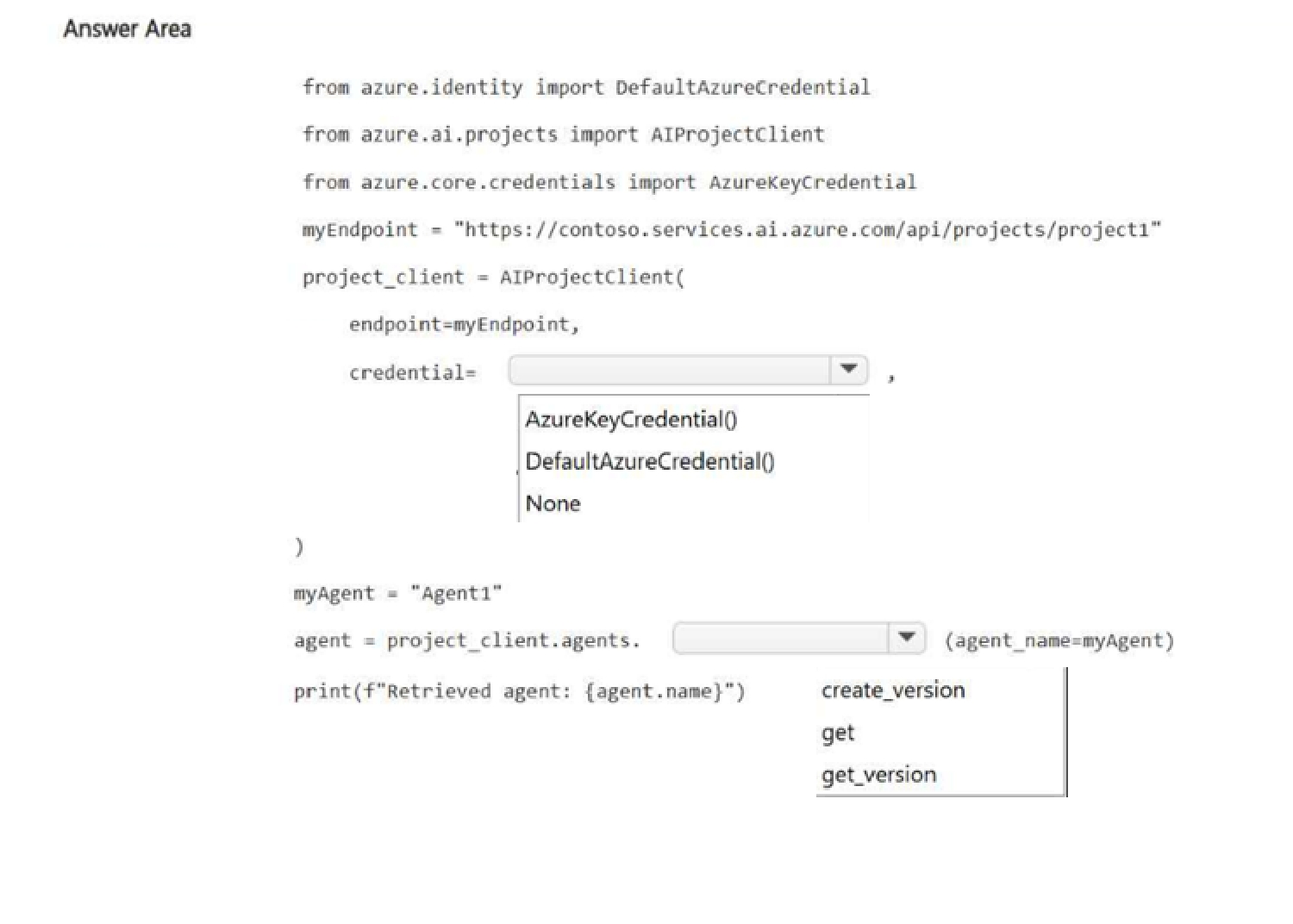
How should you complete the Python code? To answer, select the appropriate options in the answer area.
NOTE: Each correct selection is worth one point.
QUESTION IMAGE:
ANSWER: CORRECT AREA HIGHLIGHTED
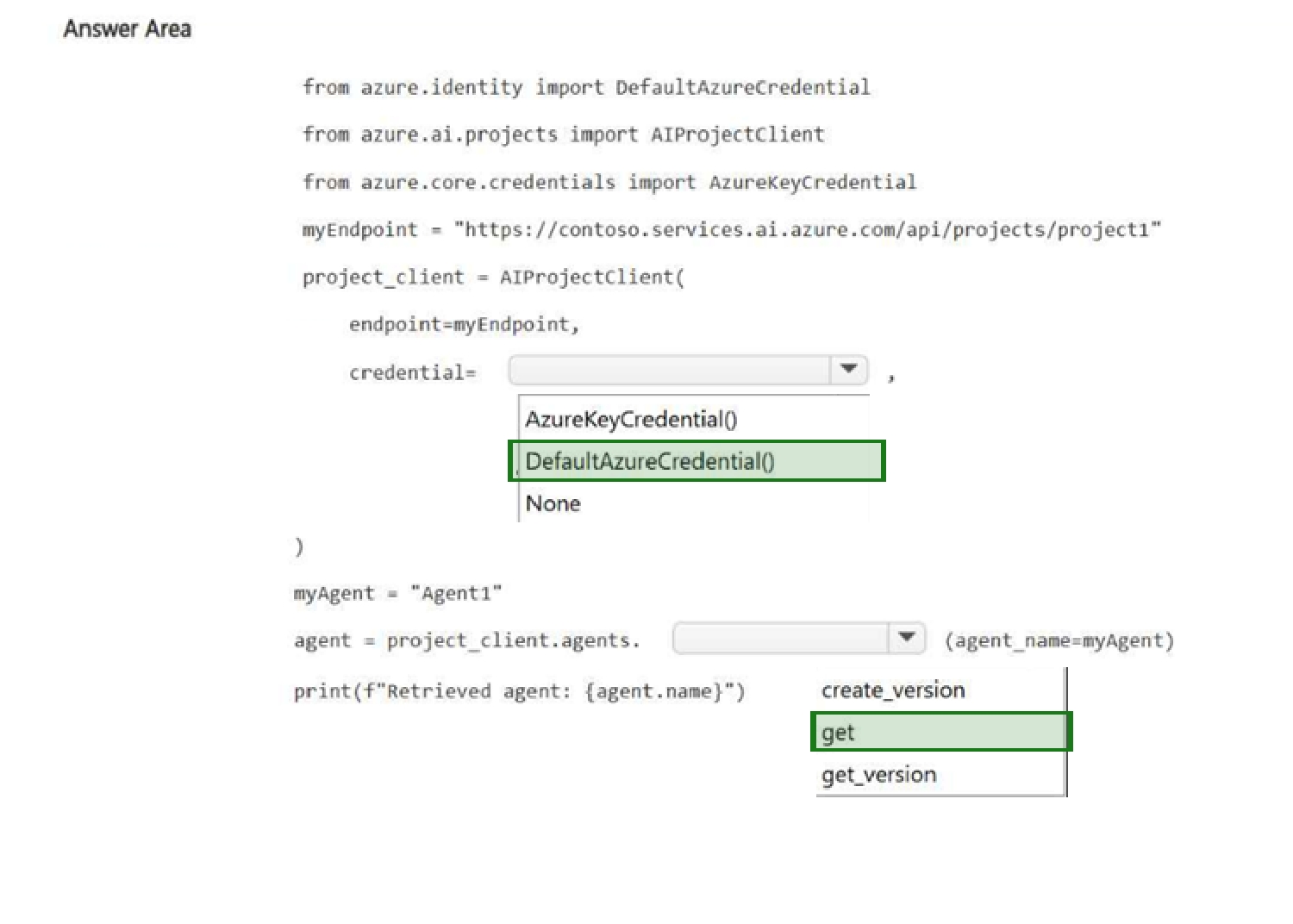
Agent1Dev Team should be given access through Microsoft Entra ID and Azure role-based access control (RBAC), rather than by sharing an API key or another user’s credentials. Assign the team the least-privileged role that allows its members to use Agent1, at the scope containing the agent, such as the relevant Azure AI project.
This approach meets the security and compliance requirements because access is tied to the team’s identities, can be audited, and can be revoked centrally by changing the team’s membership or role assignment. It also avoids embedding shared secrets in the Python code. The code should authenticate using an Entra ID credential, such as `DefaultAzureCredential`; authorization for the team is handled by the RBAC assignment, not by passing a secret to the agent.
Quiz
department.
What should you include in the recommendation?
AI-103: Microsoft Developing AI Apps and Agents on Azure Practice test unlocks all online simulator questions
Thank you for choosing the free version of the AI-103: Microsoft Developing AI Apps and Agents on Azure practice test! Further deepen your knowledge on Microsoft Simulator; by unlocking the full version of our AI-103: Microsoft Developing AI Apps and Agents on Azure Simulator you will be able to take tests with over 84 constantly updated questions and easily pass your exam. 98% of people pass the exam in the first attempt after preparing with our 84 questions.
BUY NOWWhat to expect from our AI-103: Microsoft Developing AI Apps and Agents on Azure practice tests and how to prepare for any exam?
The AI-103: Microsoft Developing AI Apps and Agents on Azure Simulator Practice Tests are part of the Microsoft Database and are the best way to prepare for any AI-103: Microsoft Developing AI Apps and Agents on Azure exam. The AI-103: Microsoft Developing AI Apps and Agents on Azure practice tests consist of 84 questions and are written by experts to help you and prepare you to pass the exam on the first attempt. The AI-103: Microsoft Developing AI Apps and Agents on Azure database includes questions from previous and other exams, which means you will be able to practice simulating past and future questions. Preparation with AI-103: Microsoft Developing AI Apps and Agents on Azure Simulator will also give you an idea of the time it will take to complete each section of the AI-103: Microsoft Developing AI Apps and Agents on Azure practice test . It is important to note that the AI-103: Microsoft Developing AI Apps and Agents on Azure Simulator does not replace the classic AI-103: Microsoft Developing AI Apps and Agents on Azure study guides; however, the Simulator provides valuable insights into what to expect and how much work needs to be done to prepare for the AI-103: Microsoft Developing AI Apps and Agents on Azure exam.
BUY NOWAI-103: Microsoft Developing AI Apps and Agents on Azure Practice test therefore represents an excellent tool to prepare for the actual exam together with our Microsoft practice test . Our AI-103: Microsoft Developing AI Apps and Agents on Azure Simulator will help you assess your level of preparation and understand your strengths and weaknesses. Below you can read all the quizzes you will find in our AI-103: Microsoft Developing AI Apps and Agents on Azure Simulator and how our unique AI-103: Microsoft Developing AI Apps and Agents on Azure Database made up of real questions:
Info quiz:
- Quiz name:AI-103: Microsoft Developing AI Apps and Agents on Azure
- Total number of questions:84
- Number of questions for the test:50
- Pass score:80%
You can prepare for the AI-103: Microsoft Developing AI Apps and Agents on Azure exams with our mobile app. It is very easy to use and even works offline in case of network failure, with all the functions you need to study and practice with our AI-103: Microsoft Developing AI Apps and Agents on Azure Simulator.
Use our Mobile App, available for both Android and iOS devices, with our AI-103: Microsoft Developing AI Apps and Agents on Azure Simulator . You can use it anywhere and always remember that our mobile app is free and available on all stores.
Our Mobile App contains all AI-103: Microsoft Developing AI Apps and Agents on Azure practice tests which consist of 84 questions and also provide study material to pass the final AI-103: Microsoft Developing AI Apps and Agents on Azure exam with guaranteed success. Our AI-103: Microsoft Developing AI Apps and Agents on Azure database contain hundreds of questions and Microsoft Tests related to AI-103: Microsoft Developing AI Apps and Agents on Azure Exam. This way you can practice anywhere you want, even offline without the internet.
BUY NOW