The new flashcard feature is useful to memorize questions.
?Change your study mode
At any time, you can change the study mode, and alternate between the practice mode and the exam mode. In practice mode, you can configure for example the number of questions or tests, and other parameters to help you study.
Randomized | 10 Questions per Test | 20 Minutes | 70% to pass|
To re-configure your study mode again and change - for example - the number of tests, whether you have random questions and all other configuration parameters.
?Simulator Configuration
Auto-scroll: You can use the automatic scrolling of the questionnaire that occurs as soon as you answer one or all of the answers to a question correctly. Auto scrolling is activated if you answer a single answer, or as soon as you answer all the mandatory answers. Learning Mode: During learning mode you can get a real time result for your answer.
Free Test
Question: / 10
20:00Min. left
?Restart the current test
To restart the current test by clearing all your answers and the time used up to now. Warning: all answers will be lost.
Question: / 10
4.7(132 Votes)
Quiz
Question 1/101/10
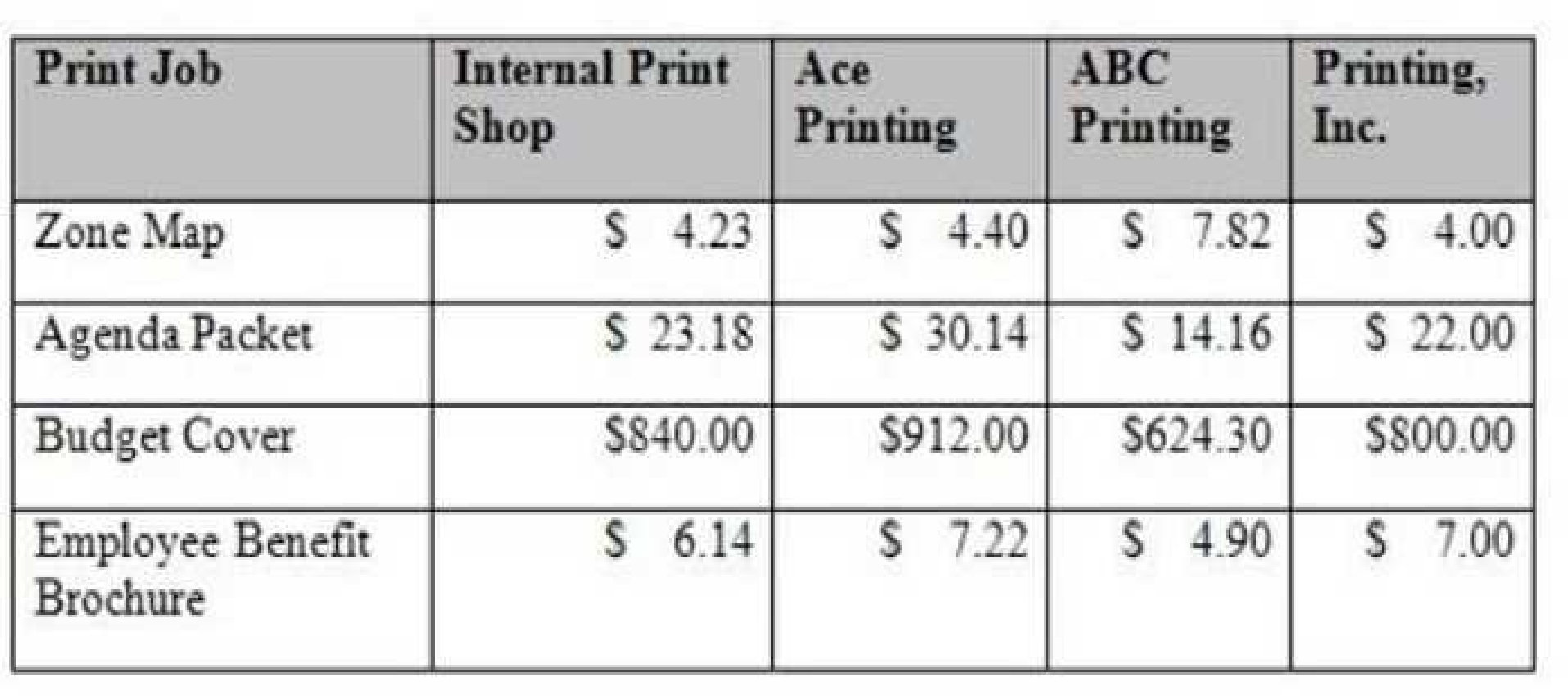
Based on the data below, what can be concluded about outsourcing print job?
Select the answer:Select the answer
1 correct answer
A.
It is better to keep the printing in-house.
B.
Outsourcing printing is feasible.
C.
Outsourcing printing is necessary.
D.
ABC Printing should be awarded the outsourcing contract.
Understanding the Scenario: The table compares the costs of four printing jobs performed by an "Internal Print Shop" versus three external vendors (Ace Printing, ABC Printing, and Printing, Inc.). Each vendor's pricing varies by print job type. The task is to evaluate whether outsourcing (hiring external vendors) is a reasonable alternative to keeping the work in-house. Key Considerations in Outsourcing: According to governmental accounting principles and budgeting practices outlined by the Association of Government Accountants (AGA), the decision to outsource should consider: Cost-effectiveness: Does outsourcing reduce costs without compromising quality or service delivery? Operational efficiency: Can outsourcing free up internal resources for other priorities? Comparative pricing: How do external vendor rates compare to internal costs for identical services? Analysis of the Print Jobs: Let’s break down the cost comparison for each print job: Zone Map: Internal cost = $4.23. Cheapest vendor = Printing, Inc., at $4.00. Outsourcing is cheaper for this job. Agenda Packet: Internal cost = $23.18. Cheapest vendor = Printing, Inc., at $22.00. Outsourcing is cheaper for this job. Budget Cover: Internal cost = $840.00. Cheapest vendor = ABC Printing, at $624.30. Outsourcing is significantly cheaper for this job. Employee Benefit Brochure: Internal cost = $6.14. Cheapest vendor = ABC Printing, at $4.90. Outsourcing is cheaper for this job. Conclusion Based on Analysis: Across all four print jobs, the lowest-cost external vendor always beats the Internal Print Shop's costs. From a budgetary perspective, outsourcing is feasible as it offers cost savings across all jobs. Why Not A, C, or D?: Option A (Keep printing in-house): Incorrect, as in-house costs are consistently higher than the cheapest external vendor. Option C (Outsourcing is necessary): Incorrect, as feasibility doesn’t mean necessity; internal printing is still an option if other factors (like quality or control) outweigh costs. Option D (Award contract to ABC Printing): Incorrect, since the best vendor depends on the job (e.g., Printing, Inc. is cheaper for Zone Map and Agenda Packet). Reference: Association of Government Accountants (AGA), Government Financial Manager Certification Study Guide: Budgeting, Cost Accounting, and Auditing Principles. Government Finance Officers Association (GFOA), Best Practices in Outsourcing and Procurement. Federal Accounting Standards Advisory Board (FASAB), Cost Accounting Standards for Governmental Operations.
Right Answer: B
Quiz
Question 2/102/10
The ratios used to determine an organization's ability to meet its creditor's demands are
Select the answer:Select the answer
1 correct answer
A.
budgetary cushion ratios.
B.
liquidity ratios.
C.
debt burden ratios.
D.
turnover ratios.
What Are Liquidity Ratios? Liquidity ratios are financial metrics used to measure an organization’s ability to meet its short-term financial obligations as they come due. These ratios assess whether the organization has sufficient liquid assets (like cash, receivables, or short-term investments) to cover its current liabilities (debts or obligations due within a year). Why Are They Relevant to Creditors? Creditors care deeply about an entity's ability to repay its debts in a timely manner. Liquidity ratios provide a snapshot of the organization's financial health and give insight into its capacity to meet short-term demands. They are essential tools in evaluating whether a government entity (federal, state, or local) or any other organization can pay its creditors without needing to secure additional financing or liquidate long-term assets. Common Liquidity Ratios: The most commonly used liquidity ratios are: Current Ratio: This measures the organization’s ability to pay off its current liabilities with current assets. Formula: Current Assets ÷ Current Liabilities Quick Ratio (Acid-Test Ratio): A stricter version of the current ratio, it excludes less liquid assets (like inventory) to assess the organization’s immediate ability to pay short-term debts. Formula: (Current Assets - Inventory) ÷ Current Liabilities Cash Ratio: Focuses only on the most liquid assets, such as cash and cash equivalents. Formula: Cash + Cash Equivalents ÷ Current Liabilities How Do Liquidity Ratios Apply to Governmental Accounting? In governmental accounting, liquidity ratios are crucial for determining whether a governmental entity has the financial flexibility to manage short-term obligations like accounts payable, payroll, and other operating costs. For example: State and local governments use liquidity ratios to show stakeholders their ability to sustain operations without financial strain. Government-wide financial statements (under GASB standards) often emphasize liquidity to demonstrate fiscal health to bondholders and credit rating agencies. Why Not Other Ratios? A . Budgetary Cushion Ratios: These focus on the organization’s ability to withstand revenue shortfalls and maintain budgetary reserves, not specifically on meeting creditor demands. C . Debt Burden Ratios: These measure the overall burden of debt on the organization but don’t directly address short-term liquidity or solvency. D . Turnover Ratios: These evaluate operational efficiency (e.g., how quickly assets like inventory are converted into revenue), which doesn’t directly relate to creditor demands. Reference and Documents: Government Financial Manager (GFM) Competency Framework by the Association of Government Accountants (AGA): Section on “Financial Analysis” emphasizes the importance of liquidity ratios in assessing short-term solvency for government entities. GASB Concepts Statement No. 1: Discusses the need for governmental financial reporting to provide information on financial condition, including short-term liquidity. AGA Performance Management Framework Guide (2023): Highlights liquidity ratios as critical tools for demonstrating fiscal responsibility and transparency in public sector financial management.
Right Answer: B
Quiz
Question 3/103/10
Performance measurement assists management in
Select the answer:Select the answer
1 correct answer
A.
identifying weaknesses in disaster response preparedness.
B.
tracking actual results against targets.
C.
determining allocation of capital appropriations.
D.
monitoring performance of certified professionals in regulatory fields.
The correct answer is B. tracking actual results against targets. Performance measurement is the process of evaluating how well an organization, program, or employee is doing by comparing actual outcomes with planned goals, objectives, or standards. Management uses this information to see whether performance is on track, where improvements are needed, and whether corrective action should be taken. Why B is correct: - It directly describes the main purpose of performance measurement. - Managers set targets or benchmarks first, then measure actual results against them. - This helps identify gaps between expected and actual performance. Why the other options are incorrect: - A. identifying weaknesses in disaster response preparedness. This is too specific. While performance measurement could be used in disaster preparedness, it is not the general purpose of performance measurement. - C. determining allocation of capital appropriations. Budget allocation may be informed by performance data, but this is not the primary function of performance measurement. - D. monitoring performance of certified professionals in regulatory fields. This is a specific application of monitoring or regulation, not the broad managerial purpose of performance measurement. In summary: Performance measurement helps management compare actual results with desired targets, making B the best answer.
Right Answer: B
Quiz
Question 4/104/10
A city decides to invest in a new piece of equipment and wants to know how long it will take to recover the amount invested by using the payback analysis technique. The city uses the following assumptions in its analysis: The cost of the equipment is $500,000. The equipment will generate $200,000 in revenue per year. The variable costs of operating the equipment will be $100,000 per year. The depreciation on the equipment will be $20,000 per year. How long will it take the city to recover the amount invested in the new equipment?
Select the answer:Select the answer
1 correct answer
A.
2 years and 6 months
B.
2 years and 9 months
C.
Syears
D.
6 years and 3 months
To solve this using payback analysis, we need to find the annual net cash inflow generated by the equipment and then divide the initial investment by that amount. Step 1: Find annual net cash inflow Payback analysis uses cash flows, so depreciation is not included because it is a non-cash expense. Annual revenue = $200,000 Annual variable costs = $100,000 Annual net cash inflow = $200,000 - $100,000 = $100,000 Step 2: Divide initial investment by annual net cash inflow Initial cost = $500,000 Annual net cash inflow = $100,000 Payback period = $500,000 / $100,000 = 5 years Why depreciation is ignored Depreciation affects accounting profit, but it does not represent an actual cash outflow. Since payback analysis measures how long it takes to recover the cash invested, only cash inflows and cash outflows are considered. Therefore, the correct answer is: C. 5 years
Right Answer: C
Quiz
Question 5/105/10
In an internal control evaluation, what are the roles of management and the auditor regarding the risk of fraud, waste and abuse?
Select the answer:Select the answer
1 correct answer
A.
Management identifies risks, auditors assess control effectiveness.
B.
Auditors identify risks, management implements control measures.
C.
Both management and auditors determine risk tolerance levels.
D.
Management mitigates risks, auditors monitor compliance with controls.
Role of Management in Internal Control Evaluation: Responsibility for Risk Identification: Management has the primary responsibility for designing, implementing, and maintaining an effective system of internal controls. As part of this process, management identifies the risks related to fraud, waste, and abuse that could impact financial reporting or operational efficiency. Mitigating Risks: Once risks are identified, management is responsible for mitigating them by developing appropriate policies, procedures, and controls. Role of the Auditor in Internal Control Evaluation: Assessing Control Effectiveness: Auditors are not responsible for designing or implementing controls; rather, their role is to evaluate whether the controls put in place by management are effective. They do this through testing, observation, and other audit procedures. Fraud Risk Assessment: As part of their duties under Generally Accepted Government Auditing Standards (GAGAS), auditors must assess the risk of material misstatement due to fraud and evaluate how management’s controls address those risks. Why Other Options Are Incorrect: B . Auditors do not identify risks—this is management's job. Auditors evaluate and assess the controls already in place. C . Determining risk tolerance is a governance and management responsibility, not the joint responsibility of auditors and management. D . Management mitigates risks, but auditors don’t monitor compliance with controls—they test and evaluate the controls as part of their audit procedures. Reference and Documents: GAGAS (Yellow Book) by GAO: Emphasizes management’s responsibility for risk identification and the auditor’s responsibility for assessing control effectiveness. COSO Internal Control Framework (2013): Highlights management’s responsibility for risk assessment and control design, while auditors provide independent assurance.
Right Answer: A
Quiz
Question 6/106/10
For financial audits, generally accepted auditing standards require that auditors accomplish all of the following tasks EXCEPT
Select the answer:Select the answer
1 correct answer
A.
adequately plan the work.
B.
make the audit report available to the public.
C.
obtain sufficient appropriate audit evidence.
D.
supervise any assistants.
What Do Generally Accepted Auditing Standards (GAAS) Require for Financial Audits? GAAS outlines specific requirements for auditors conducting financial audits, including: Adequately Planning the Work (Option A): Proper planning ensures that audits are efficient and thorough. Obtaining Sufficient, Appropriate Audit Evidence (Option C): This is critical to support the auditor’s opinion on the financial statements. Supervising Assistants (Option D): Supervising any audit staff ensures that work is performed in accordance with standards. What Does GAAS Not Require? GAAS does not specifically require auditors to make the audit report available to the public (Option B). While making reports available to the public may be required by other laws, regulations, or organizational policies, it is not a standard requirement under GAAS. The decision to make the report public often lies with the audited entity or governing bodies. Reference and Documents: AICPA Statements on Auditing Standards (SAS): The foundational standards that define GAAS requirements. GAGAS (Yellow Book): While GAGAS may have additional reporting requirements, it does not mandate public access to the audit report unless stipulated by law.
Right Answer: B
Quiz
Question 7/107/10
The first step when gathering data for making strategic sourcing decisions is
Select the answer:Select the answer
1 correct answer
A.
contacting vendors to submit bids under the request for bid process.
B.
researching spend data by category for each business unit.
C.
contacting business units to find out if there are existing purchasing contracts in place.
D.
developing supplier performance measures to add into the purchase agreements.
What Is Strategic Sourcing? Strategic sourcing is a systematic process aimed at optimizing an organization’s purchasing activities to maximize value and minimize costs. It involves analyzing spending, selecting suppliers, and negotiating contracts strategically rather than reactively. Why Start with Spend Data? Analyzing Spend Data: The first step is to understand the organization’s current spending patterns by analyzing spend data by category and by business unit. This helps identify high-cost areas, redundancies, and opportunities for cost savings. Importance of Data-Driven Decisions: Without knowing where and how money is being spent, it’s impossible to make informed strategic sourcing decisions. Why Other Options Are Incorrect: A . Contacting Vendors: Vendors are contacted later in the process after the spend analysis is complete and sourcing strategies are determined. C . Contacting Business Units: While checking for existing contracts is part of the process, it happens after analyzing spend data. D . Developing Supplier Performance Measures: This step occurs much later, typically after supplier selection and contract execution. Reference and Documents: GAO Guide to Strategic Sourcing (2013): Recommends starting with a detailed spend analysis as the foundation for effective sourcing decisions.
Right Answer: B
Quiz
Question 8/108/10
A material weakness in internal control over financial reporting is defined as a deficiency that
Select the answer:Select the answer
1 correct answer
A.
results in a misstatement to the basic financial statements.
B.
results in a material misstatement in other accompanying financial information.
C.
did not allow management to perform their assigned responsibility to prevent, detect and correct misstatements in a timely manner.
D.
creates a reasonable possibility of a material misstatement to the financial statements that will not be detected in a timely manner.
Definition of a Material Weakness: According to auditing standards, a material weakness in internal control over financial reporting is a deficiency or combination of deficiencies that creates a reasonable possibility of a material misstatement in the financial statements that will not be prevented or detected on a timely basis. Key Characteristics of a Material Weakness: Reasonable Possibility: The likelihood of a misstatement is more than remote but less than certain. Material Misstatement: The error or omission could impact the decisions of users relying on the financial statements. Timely Detection: The deficiency allows errors to go undetected for an extended period, potentially affecting financial statement reliability. Why Other Options Are Incorrect: A . A misstatement in the basic financial statements may result from a material weakness, but the definition focuses on the reasonable possibility, not the actual result. B . A material weakness impacts the financial statements, not "other accompanying financial information." C . While timely detection is part of the issue, the definition focuses on the reasonable possibility of a misstatement, not management’s inability to perform specific duties. Reference and Documents: GAAS (AICPA SAS No. 115): Provides the formal definition of material weaknesses and guidance for auditors in evaluating control deficiencies. COSO Framework: Emphasizes the need for effective internal controls to mitigate material misstatement risks.
Right Answer: D
Quiz
Question 9/109/10
An agency uses pavement rating scores as a key indicator for a street maintenance program. If the legislature provided the agency with an additional $5 millionjthe new resources should be allocated based upon
Select the answer:Select the answer
1 correct answer
A.
the number of intersections.
B.
historical budgeted amounts.
C.
lane miles rated as acceptable by the citizens.
D.
lane miles with unmet needs.
Understanding Resource Allocation in Street Maintenance: When additional resources are provided for street maintenance, their allocation should address the most pressing infrastructure needs to maximize impact and public benefit. Key Indicator (Pavement Rating Scores): Pavement rating scores are used to evaluate the condition of roads. Areas with the lowest scores (representing unmet needs) require prioritized funding to bring the infrastructure to acceptable levels. Explanation of Answer Choices: A . Number of intersections: The number of intersections is not directly related to road conditions or pavement scores. B . Historical budgeted amounts: Allocating based on past budgets does not address current infrastructure conditions or unmet needs. C . Lane miles rated as acceptable by citizens: Roads already rated as "acceptable" do not require immediate attention. D . Lane miles with unmet needs: Correct, as this aligns with addressing the most critical deficiencies based on the pavement scores. Reference: Government Finance Officers Association (GFOA), Best Practices in Capital Asset Management. Federal Highway Administration (FHWA), Performance-Based Planning and Programming Guidebook.
Right Answer: D
Quiz
Question 10/1010/10
The goal of shared gervices is to
Select the answer:Select the answer
1 correct answer
A.
reduce current staffing levels.
B.
transfer responsibilities to another entity.
C.
efficiently aggregate resources.
D.
provide private business opportunities.
Understanding Shared Services: Shared services involve consolidating and centralizing resources, personnel, or processes to achieve efficiency and cost savings. This is common in government organizations looking to optimize operations. Explanation of Answer Choices: A . Reduce current staffing levels: While staff reductions may occur as a result, this is not the primary goal. B . Transfer responsibilities to another entity: This describes outsourcing, not shared services. C . Efficiently aggregate resources: Correct, as shared services aim to centralize resources for improved efficiency. D . Provide private business opportunities: This is unrelated to shared services, which focus on internal government operations. Reference: Association of Government Accountants (AGA), Shared Services in Government.
GFMC: AGA Examination 3: Governmental Financial Management and Control (GFMC) Practice test unlocks all online simulator questions
Thank you for choosing the free version of the GFMC: AGA Examination 3: Governmental Financial Management and Control (GFMC) practice test! Further deepen your knowledge on AGA Simulator; by unlocking the full version of our GFMC: AGA Examination 3: Governmental Financial Management and Control (GFMC) Simulator you will be able to take tests with over 113 constantly updated questions and easily pass your exam. 98% of people pass the exam in the first attempt after preparing with our 113 questions.
What to expect from our GFMC: AGA Examination 3: Governmental Financial Management and Control (GFMC) practice tests and how to prepare for any exam?
The GFMC: AGA Examination 3: Governmental Financial Management and Control (GFMC) Simulator Practice Tests are part of the AGA Database and are the best way to prepare for any GFMC: AGA Examination 3: Governmental Financial Management and Control (GFMC) exam. The GFMC: AGA Examination 3: Governmental Financial Management and Control (GFMC) practice tests consist of 113 questions and are written by experts to help you and prepare you to pass the exam on the first attempt. The GFMC: AGA Examination 3: Governmental Financial Management and Control (GFMC) database includes questions from previous and other exams, which means you will be able to practice simulating past and future questions. Preparation with GFMC: AGA Examination 3: Governmental Financial Management and Control (GFMC) Simulator will also give you an idea of the time it will take to complete each section of the GFMC: AGA Examination 3: Governmental Financial Management and Control (GFMC) practice test . It is important to note that the GFMC: AGA Examination 3: Governmental Financial Management and Control (GFMC) Simulator does not replace the classic GFMC: AGA Examination 3: Governmental Financial Management and Control (GFMC) study guides; however, the Simulator provides valuable insights into what to expect and how much work needs to be done to prepare for the GFMC: AGA Examination 3: Governmental Financial Management and Control (GFMC) exam.
GFMC: AGA Examination 3: Governmental Financial Management and Control (GFMC) Practice test therefore represents an excellent tool to prepare for the actual exam together with our AGA practice test . Our GFMC: AGA Examination 3: Governmental Financial Management and Control (GFMC) Simulator will help you assess your level of preparation and understand your strengths and weaknesses. Below you can read all the quizzes you will find in our GFMC: AGA Examination 3: Governmental Financial Management and Control (GFMC) Simulator and how our unique GFMC: AGA Examination 3: Governmental Financial Management and Control (GFMC) Database made up of real questions:
Info quiz:
Quiz name:GFMC: AGA Examination 3: Governmental Financial Management and Control (GFMC)
Total number of questions:113
Number of questions for the test:50
Pass score:80%
You can prepare for the GFMC: AGA Examination 3: Governmental Financial Management and Control (GFMC) exams with our mobile app. It is very easy to use and even works offline in case of network failure, with all the functions you need to study and practice with our GFMC: AGA Examination 3: Governmental Financial Management and Control (GFMC) Simulator.
Use our Mobile App, available for both Android and iOS devices, with our GFMC: AGA Examination 3: Governmental Financial Management and Control (GFMC) Simulator . You can use it anywhere and always remember that our mobile app is free and available on all stores.
Our Mobile App contains all GFMC: AGA Examination 3: Governmental Financial Management and Control (GFMC) practice tests which consist of 113 questions and also provide study material to pass the final GFMC: AGA Examination 3: Governmental Financial Management and Control (GFMC) exam with guaranteed success.
Our GFMC: AGA Examination 3: Governmental Financial Management and Control (GFMC) database contain hundreds of questions and AGA Tests related to GFMC: AGA Examination 3: Governmental Financial Management and Control (GFMC) Exam. This way you can practice anywhere you want, even offline without the internet.