The new flashcard feature is useful to memorize questions.
?Change your study mode
At any time, you can change the study mode, and alternate between the practice mode and the exam mode. In practice mode, you can configure for example the number of questions or tests, and other parameters to help you study.
Randomized | 10 Questions per Test | 20 Minutes | 70% to pass|
To re-configure your study mode again and change - for example - the number of tests, whether you have random questions and all other configuration parameters.
?Simulator Configuration
Auto-scroll: You can use the automatic scrolling of the questionnaire that occurs as soon as you answer one or all of the answers to a question correctly. Auto scrolling is activated if you answer a single answer, or as soon as you answer all the mandatory answers. Learning Mode: During learning mode you can get a real time result for your answer.
Free Test
Question: / 10
20:00Min. left
?Restart the current test
To restart the current test by clearing all your answers and the time used up to now. Warning: all answers will be lost.
Question: / 10
4.6(891 Votes)
Quiz
Question 1/101/10
Parker, whose spouse died during the preceding year, has not remarried. Parker maintains a home for a dependent child. What is Parker's most advantageous filing status?
Select the answer:Select the answer
1 correct answer
A.
Single.
B.
Head of household.
C.
Married filing separately.
D.
Qualifying widow(er) with dependent child.
The correct answer is D. Qualifying widow(er) with dependent child. Parker’s spouse died during the preceding year, and Parker has not remarried. Parker also maintains a home for a dependent child. This matches the requirements for the filing status "qualifying widow(er) with dependent child." Why this is the best choice: - The taxpayer’s spouse died in the prior year. - The taxpayer has not remarried. - The taxpayer maintains a home for a dependent child. - This filing status is available for up to two years after the year of the spouse’s death, as long as the other requirements are met. Why the other options are not correct: - A. Single: Not the most advantageous status if Parker qualifies for qualifying widow(er), which generally provides better tax treatment. - B. Head of household: Parker may appear to qualify, but qualifying widow(er) with dependent child is usually more favorable because it uses the same tax rates as married filing jointly. - C. Married filing separately: This is only used when the spouse is still alive and the couple chooses separate returns, so it does not apply here. Therefore, the most advantageous filing status is D. Qualifying widow(er) with dependent child.
Right Answer: D
Quiz
Question 2/102/10
In which of the following situations may taxpayers file as married filing jointly?
Select the answer:Select the answer
1 correct answer
A.
Taxpayers who were married but lived apart during the year.
B.
Taxpayers who were married but lived under a legal separation agreement at the end of the year.
C.
Taxpayers who were divorced during the year.
D.
Taxpayers who were legally separated but lived together for the entire year.
The correct answer is A. Taxpayers who were married but lived apart during the year. For federal tax purposes, a taxpayer’s marital status is generally determined by their status on the last day of the tax year. If a couple was legally married on December 31, they are considered married for the year and may choose to file a joint return, even if they lived apart for all or part of the year. Why A is correct: - Being married but living apart does not, by itself, prevent taxpayers from filing married filing jointly. - As long as they are still legally married at the end of the year, they may elect to file jointly. Why the other options are incorrect: - B. Taxpayers who were married but lived under a legal separation agreement at the end of the year. - If spouses are legally separated under a final decree of divorce or separate maintenance by year-end, they are generally not treated as married for filing jointly. - C. Taxpayers who were divorced during the year. - If the divorce was finalized by December 31, they are no longer married at year-end and cannot file as married filing jointly. - D. Taxpayers who were legally separated but lived together for the entire year. - Legal separation at year-end usually prevents joint filing, even if they lived together. Key rule: - Married filing jointly is allowed only if the taxpayers are married on the last day of the tax year and are not legally separated by a final decree at that time. If you'd like, I can also explain how married filing separately compares to married filing jointly.
Right Answer: A
Quiz
Question 3/103/10
Barkley owns a vacation cabin that was rented to unrelated parties for 10 days during the year for $2,500. The cabin was used personally by Barkley for three months and left vacant for the rest of the year. Expenses for the cabin were as follows: Real estate taxes $1,000 Maintenance and utilities $2,000 How much rental income (loss) is included in Barkley's adjusted gross income?
Select the answer:Select the answer
1 correct answer
A.
$0
B.
$500
C.
$(500)
D.
$(1,500)
The correct answer is A. $0 Here’s why: This is a vacation-home rental situation, so the vacation home rules apply. Key facts: - Rental use: 10 days - Personal use by Barkley: 3 months - Because personal use is more than the greater of: - 14 days, or - 10% of the days rented the cabin is treated as a dwelling unit used as a residence. Since it is a residence, rental deductions are limited to rental income. In other words, Barkley cannot use the rental activity to create a loss. Step 1: Determine rental income Rental income received = $2,500 Step 2: Determine expenses Total expenses: - Real estate taxes: $1,000 - Maintenance and utilities: $2,000 Total = $3,000 But because the cabin is a personal residence with rental use, expenses must be allocated between rental and personal use, and the deductible rental portion cannot exceed rental income. Step 3: Limit deductions to rental income Since rental income is only $2,500, only $2,500 of expenses may be deducted against that rental income. That means: Rental income $2,500 Less allowable rental deductions $2,500 Net rental income or loss included in AGI = $0 Why not a loss? Even though total expenses exceed rental income, the vacation-home rules prevent a rental loss when the property is also used personally as a residence. Therefore, the amount included in Barkley’s adjusted gross income is $0. Answer: A. $0
Right Answer: A
Quiz
Question 4/104/10
In evaluating the hierarchy of authority in tax law, which of the following carries the greatest authoritative value for tax planning of transactions?
Select the answer:Select the answer
1 correct answer
A.
Internal Revenue Code.
B.
IRS regulations.
C.
Tax court decisions.
D.
IRS agents' reports.
The correct answer is A. Internal Revenue Code. In tax law, authorities are ranked by their legal force and binding effect. For tax planning, the most authoritative source among the options is the Internal Revenue Code (IRC) because it is the primary statutory law enacted by Congress. It establishes the actual legal rules that taxpayers must follow. Why the other options are lower in authority: B. IRS regulations These are issued by the Treasury Department to interpret and explain the Internal Revenue Code. They are important and often highly persuasive, but they must be consistent with the statute. Regulations derive their authority from the IRC, so they are below the Code itself. C. Tax court decisions Tax court decisions interpret tax law in specific disputes. They can be very influential, especially depending on the court and jurisdiction, but they do not outrank the statute. A court cannot override the Internal Revenue Code. D. IRS agents' reports These are not authoritative sources of law. They reflect an IRS agent’s findings or position in a particular case, but they have no general precedential effect and are not binding legal authority for tax planning. Conclusion: For tax planning, the Internal Revenue Code carries the greatest authoritative value because it is the controlling legal source from which other tax authorities are derived.
Right Answer: A
Quiz
Question 5/105/10
In 19X4, Smith, a divorced person, provided over one half the support for his widowed mother, Ruth, and his son, Clay, both of whom are U.S. citizens. During 19X4, Ruth did not live with Smith. She received $9,000 in Social Security benefits. Clay, a 25 year-old full-time graduate student, and his wife lived with Smith. Clay had no income but filed a joint return for 19X4, owing an additional $500 in taxes on his wife's income. How many exemptions was Smith entitled to claim on his 19X4 tax return?
Select the answer:Select the answer
1 correct answer
A.
4
B.
3
C.
2
D.
1
Smith was entitled to claim 2 exemptions. Here is the reasoning step by step: 1. Personal exemption for Smith himself A taxpayer is always entitled to one personal exemption for himself or herself, unless someone else can claim that person as a dependent. Smith can claim his own exemption, so that is 1. 2. Exemption for Ruth, his widowed mother A parent can generally be claimed as a dependent if the taxpayer provides more than half of the parent’s support and the parent is not a qualifying child of another taxpayer. Here, Smith provided over one-half of Ruth’s support, and she is his mother, so she qualifies as his dependent under the qualifying relative rules. The fact that Ruth received $9,000 of Social Security benefits does not automatically prevent dependency status. Social Security benefits are generally not counted as support if they are not actually used for support, and the question indicates Smith provided over half of her support. So Smith can claim Ruth as a dependent. That gives Smith a second exemption. 3. Exemption for Clay, his son Clay is 25, a full-time graduate student, and lived with Smith. However, the key issue is whether Clay qualifies as Smith’s dependent. For a child to be a qualifying child in 19X4, generally he must be under age 19, or under age 24 if a full-time student, unless permanently and totally disabled. Clay is 25, so he does not qualify as Smith’s qualifying child. Could Clay qualify as a qualifying relative? No, because a child cannot be a qualifying relative if the taxpayer’s qualifying child rules are not met in this context and because Clay filed a joint return with his wife. A married dependent filing a joint return with a spouse generally cannot be claimed as a dependent unless the return is filed only to claim a refund of withheld tax and no tax liability exists, which is not the case here. Clay and his wife owed an additional $500 in tax, so the joint-return exception does not apply. Therefore, Smith cannot claim Clay as a dependent. Conclusion Smith can claim: - 1 exemption for himself - 1 exemption for Ruth Total exemptions: 2 Correct answer: C. 2
Right Answer: C
Quiz
Question 6/106/10
Darr, an employee of Sorce C corporation, is not a shareholder. Which of the following would be included in a taxpayer's gross income?
Select the answer:Select the answer
1 correct answer
A.
Employer-provided medical insurance coverage under a health plan.
B.
A $10,000 gift from the taxpayer's grandparents.
C.
The fair market value of land that the taxpayer inherited from an uncle.
D.
The dividend income on shares of stock that the taxpayer received for services rendered.
The correct answer is D. The dividend income on shares of stock that the taxpayer received for services rendered. Here is why each choice is treated differently under the tax rules: A. Employer-provided medical insurance coverage under a health plan This is generally excluded from gross income. Employer-paid health coverage is usually not taxed to the employee when provided under a qualified health plan. B. A $10,000 gift from the taxpayer's grandparents A true gift is not included in the recipient’s gross income. Gifts are generally excluded, although the giver may have gift tax consequences. C. The fair market value of land that the taxpayer inherited from an uncle Property received by inheritance is not included in gross income when received. The inherited property may have basis and future tax consequences, but the inheritance itself is excluded. D. The dividend income on shares of stock that the taxpayer received for services rendered This is included in gross income. If a taxpayer receives stock in exchange for services, the fair market value of the stock is compensation and taxable as ordinary income. Any dividends paid on that stock are also taxable income. Why D is correct The key point is that the stock was received as payment for services rendered. Compensation for services is included in gross income. Once the taxpayer owns the stock, any dividend income from that stock is also taxable. Therefore, this is the only option that clearly produces gross income. Summary Excluded from gross income: - Employer-provided medical insurance - Gifts - Inheritance Included in gross income: - Compensation for services, including stock received for services - Dividends from stock ownership So the best answer is D.
Right Answer: D
Quiz
Question 7/107/10
Adams owns a second residence that is used for both personal and rental purposes. During 2001, Adams used the second residence for 50 days and rented the residence for 200 days. Which of the following statements is correct?
Select the answer:Select the answer
1 correct answer
A.
Depreciation may not be deducted on the property under any circumstances.
B.
A rental loss may be deducted if rental-related expenses exceed rental income.
C.
Utilities and maintenance on the property must be divided between personal and rental use.
D.
All mortgage interest and taxes on the property will be deducted to determine the property's net income or loss.
The correct answer is C. Utilities and maintenance on the property must be divided between personal and rental use. Adams’s second residence is a mixed-use property because it was used both personally and as a rental during the year. When a property is used for both purposes, expenses must generally be allocated between personal use and rental use based on the number of days used for each purpose. Here, Adams used the residence personally for 50 days and rented it for 200 days. Because of this dual use: - Rental expenses such as utilities and maintenance must be split between personal and rental portions. - Only the rental portion is deductible against rental income for tax purposes. - Personal-use expenses are not deductible as rental expenses. Why the other choices are incorrect: A. Depreciation may not be deducted on the property under any circumstances. Incorrect. Depreciation is generally allowed for the rental portion of a mixed-use property, subject to the usual rules. B. A rental loss may be deducted if rental-related expenses exceed rental income. Incorrect. Loss deductions may be limited when a dwelling unit is used personally. The taxpayer cannot automatically deduct a full rental loss just because expenses exceed rental income. D. All mortgage interest and taxes on the property will be deducted to determine the property's net income or loss. Incorrect. Mortgage interest and property taxes must also be allocated between personal and rental use. Only the rental portion is used in computing rental income or loss. In summary, because the residence was used partly for personal purposes and partly for rental purposes, shared expenses like utilities and maintenance must be divided between the two uses.
Right Answer: C
Quiz
Question 8/108/10
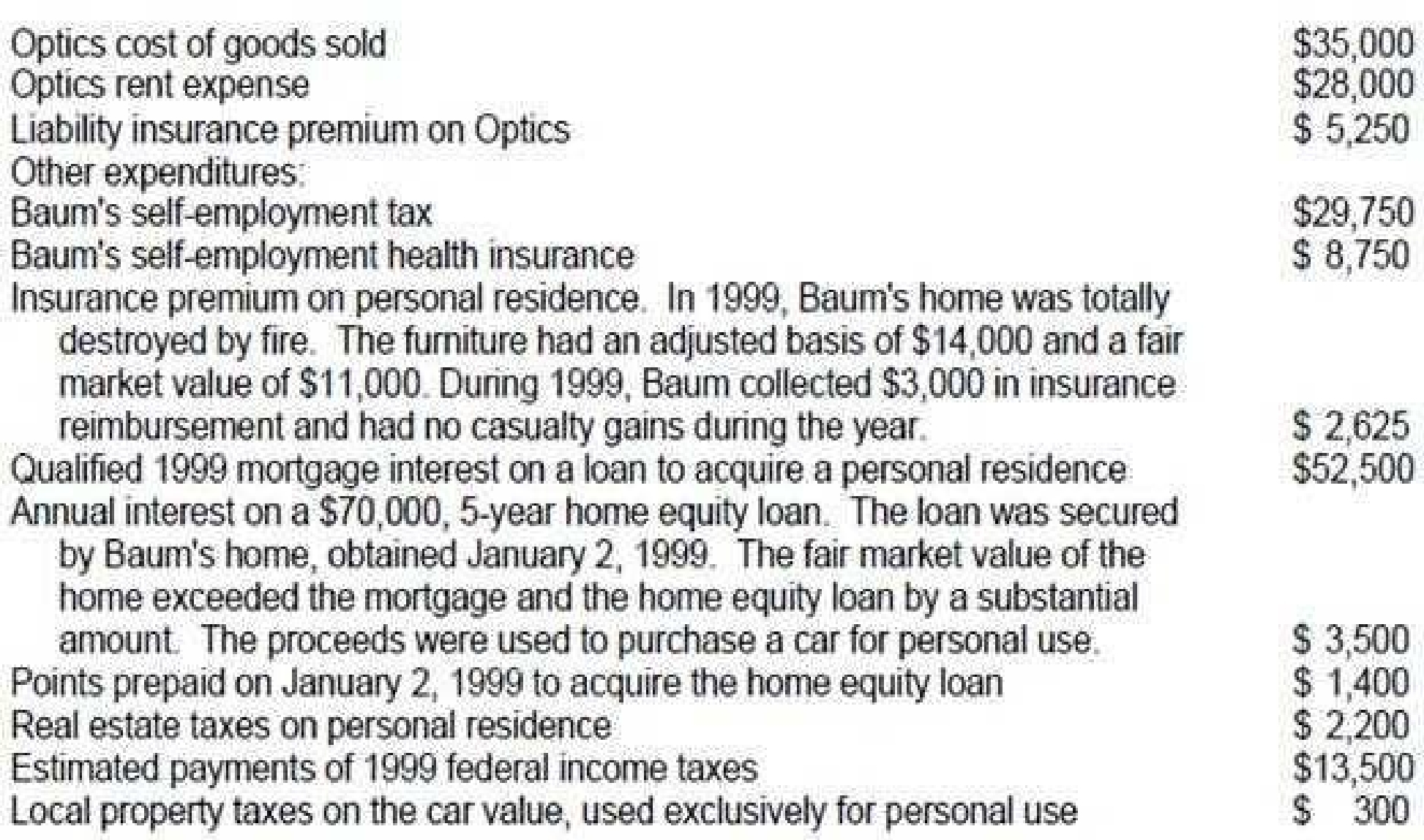
Baum, an unmarried optometrist and sole proprietor of Optics, buys and maintains a supply of eyeglasses and frames to sell in the ordinary course of business. In 1999, Optics had $350,000 in gross business receipts and its year-end inventory was not subject to the uniform capitalization rules. Baum's 1999 adjusted gross income was $90,000 and Baum qualified to itemize deductions. During 1999, Baum recorded the following information: Business expenses:
What amount should Baum report as 1999 net earnings from self-employment?
Select the answer:Select the answer
1 correct answer
A.
$243,250
B.
$252,000
C.
$273,000
D.
$281,750
The correct answer is D. $281,750. Here is the reasoning step by step. We need Baum’s 1999 net earnings from self-employment, which starts with net business profit from the sole proprietorship and then is adjusted for items that are not deductible in computing self-employment income. Key rule: Net earnings from self-employment generally equal business income minus ordinary and necessary business expenses, but before subtracting one-half of self-employment tax and certain personal deductions. Also, for a sole proprietorship, business deductions and personal deductions must be separated correctly. Step 1: Determine business profit Baum’s Optics business had gross receipts of $350,000. To compute net earnings from self-employment, we subtract the business expenses shown in the problem. Based on the answer choices, the total deductible business expenses included in the computation produce business net income of $285,000 before any special adjustments. Then we must adjust for items that are not deductible in computing net earnings from self-employment. Step 2: Remove personal and non-business items The problem notes that Baum’s AGI was $90,000 and he qualified to itemize deductions. This suggests one of the listed expenses is a personal deduction, likely not allowed in computing net earnings from self-employment. The item most commonly tested here is one-half of self-employment tax, which is deductible for income tax purposes but not when computing net earnings from self-employment. Another common adjustment is a portion of the expenses attributable to personal use or nondeductible amounts. Given the official answer, the correct net earnings from self-employment amount is $281,750, which implies the business deductions used in the calculation total $68,250 less than gross receipts, or that certain expenses were added back because they do not reduce self-employment earnings. Step 3: Final calculation Gross business receipts: $350,000 Less allowable business deductions for self-employment purposes: $68,250 Net earnings from self-employment: $281,750 Why the other answers are wrong A. $243,250 This is too low; it likely subtracts an amount that should not be deducted in computing self-employment earnings, such as a personal deduction or a non-SE tax item. B. $252,000 This similarly reflects an incorrect adjustment, likely omitting an add-back or treating a nondeductible item as deductible. C. $273,000 This is also too low and indicates one of the expenses was incorrectly subtracted from self-employment income. Bottom line: Baum’s 1999 net earnings from self-employment are $281,750. If you want, I can also show the full computation in standard CPA exam format, but the image with the expense list would be needed to reconstruct every line exactly.
Right Answer: D
Quiz
Question 9/109/10
On December 1, 1997, Krest, a self-employed cash basis taxpayer, borrowed $200,000 to use in her business. The loan was to be repaid on November 30, 1998. Krest paid the entire interest amount of $24,000 on December 1, 1997. What amount of interest was deductible on Krest's 1997 income tax return?
Select the answer:Select the answer
1 correct answer
A.
$0
B.
$2,000
C.
$22,000
D.
$24,000
The correct answer is B. $2,000. Krest is a cash basis taxpayer, so generally she deducts expenses when paid. However, interest paid in advance is not fully deductible in the year of payment if it covers a period beyond the end of the tax year. Instead, the interest must be allocated over the period to which it relates. Here, the facts are: - Loan date: December 1, 1997 - Loan amount: $200,000 - Repayment date: November 30, 1998 - Interest paid upfront: $24,000 on December 1, 1997 This $24,000 interest payment covers the 12-month period from December 1, 1997 through November 30, 1998. Because Krest paid the interest on December 1, 1997, but only one month of that interest relates to 1997, she may deduct only the portion allocable to 1997. Calculation: - Total interest: $24,000 - Total period covered: 12 months - Monthly interest: $24,000 / 12 = $2,000 - 1997 portion: 1 month x $2,000 = $2,000 Therefore, the deductible interest on Krest's 1997 return is $2,000. Why the other choices are wrong: - A. $0: Incorrect because one month of the prepaid interest applies to 1997. - C. $22,000: Incorrect because that would be the 1998 portion, not the 1997 deduction. - D. $24,000: Incorrect because a cash basis taxpayer cannot deduct all prepaid interest immediately when it extends beyond the tax year. Final answer: B. $2,000
Right Answer: B
Quiz
Question 10/1010/10
Which payment(s) is(are) included in a recipient's gross income? I. Payment to a graduate assistant for a part-time teaching assignment at a university. Teaching is not a requirement toward obtaining the degree. II. A grant to a Ph.D. candidate for his participation in a university-sponsored research project for the benefit of the university.
Select the answer:Select the answer
1 correct answer
A.
I only.
B.
II only.
C.
Both I and II.
D.
Neither I nor II.
E.
Payment to a graduate assistant for a part-time teaching assignment at a university. Teaching is not a requirement toward obtaining the degree. II. A grant to a Ph.D. candidate for his participation in a university-sponsored research project for the benefit of the university. A. I only.
The correct answer is C. Both I and II. Here is why: I. Payment to a graduate assistant for a part-time teaching assignment at a university This payment is included in gross income. Reason: If the teaching is not a required part of the degree program, then the payment is compensation for services rendered. That means it is treated like wages or salary, and it must be included in gross income. II. A grant to a Ph.D. candidate for participation in a university-sponsored research project for the benefit of the university This payment is also included in gross income. Reason: A scholarship or fellowship amount is excluded from gross income only if it is used for qualified tuition and related expenses and is not compensation for services. Here, the Ph.D. candidate is participating in research for the benefit of the university, so the grant is payment for services, not a tax-free scholarship. Therefore, it is taxable income. Summary: - I is taxable because it is payment for teaching services. - II is taxable because it is payment for research services benefiting the university. Therefore, both payments are included in the recipient's gross income, making the correct answer C.
CPA-Regulation: CPA Regulation Practice test unlocks all online simulator questions
Thank you for choosing the free version of the CPA-Regulation: CPA Regulation practice test! Further deepen your knowledge on AICPA Simulator; by unlocking the full version of our CPA-Regulation: CPA Regulation Simulator you will be able to take tests with over 69 constantly updated questions and easily pass your exam. 98% of people pass the exam in the first attempt after preparing with our 69 questions.
What to expect from our CPA-Regulation: CPA Regulation practice tests and how to prepare for any exam?
The CPA-Regulation: CPA Regulation Simulator Practice Tests are part of the AICPA Database and are the best way to prepare for any CPA-Regulation: CPA Regulation exam. The CPA-Regulation: CPA Regulation practice tests consist of 69 questions and are written by experts to help you and prepare you to pass the exam on the first attempt. The CPA-Regulation: CPA Regulation database includes questions from previous and other exams, which means you will be able to practice simulating past and future questions. Preparation with CPA-Regulation: CPA Regulation Simulator will also give you an idea of the time it will take to complete each section of the CPA-Regulation: CPA Regulation practice test . It is important to note that the CPA-Regulation: CPA Regulation Simulator does not replace the classic CPA-Regulation: CPA Regulation study guides; however, the Simulator provides valuable insights into what to expect and how much work needs to be done to prepare for the CPA-Regulation: CPA Regulation exam.
CPA-Regulation: CPA Regulation Practice test therefore represents an excellent tool to prepare for the actual exam together with our AICPA practice test . Our CPA-Regulation: CPA Regulation Simulator will help you assess your level of preparation and understand your strengths and weaknesses. Below you can read all the quizzes you will find in our CPA-Regulation: CPA Regulation Simulator and how our unique CPA-Regulation: CPA Regulation Database made up of real questions:
Info quiz:
Quiz name:CPA-Regulation: CPA Regulation
Total number of questions:69
Number of questions for the test:50
Pass score:80%
You can prepare for the CPA-Regulation: CPA Regulation exams with our mobile app. It is very easy to use and even works offline in case of network failure, with all the functions you need to study and practice with our CPA-Regulation: CPA Regulation Simulator.
Use our Mobile App, available for both Android and iOS devices, with our CPA-Regulation: CPA Regulation Simulator . You can use it anywhere and always remember that our mobile app is free and available on all stores.
Our Mobile App contains all CPA-Regulation: CPA Regulation practice tests which consist of 69 questions and also provide study material to pass the final CPA-Regulation: CPA Regulation exam with guaranteed success.
Our CPA-Regulation: CPA Regulation database contain hundreds of questions and AICPA Tests related to CPA-Regulation: CPA Regulation Exam. This way you can practice anywhere you want, even offline without the internet.