The new flashcard feature is useful to memorize questions.
?Change your study mode
At any time, you can change the study mode, and alternate between the practice mode and the exam mode. In practice mode, you can configure for example the number of questions or tests, and other parameters to help you study.
Randomized | 10 Questions per Test | 20 Minutes | 70% to pass|
To re-configure your study mode again and change - for example - the number of tests, whether you have random questions and all other configuration parameters.
?Simulator Configuration
Auto-scroll: You can use the automatic scrolling of the questionnaire that occurs as soon as you answer one or all of the answers to a question correctly. Auto scrolling is activated if you answer a single answer, or as soon as you answer all the mandatory answers. Learning Mode: During learning mode you can get a real time result for your answer.
Free Test
Question: / 10
20:00Min. left
?Restart the current test
To restart the current test by clearing all your answers and the time used up to now. Warning: all answers will be lost.
Question: / 10
4.7(431 Votes)
Quiz
Question 1/101/10
The primary benefit that results from the cross-training of employees is:
Select the answer:Select the answer
1 correct answer
A.
improved flexibility.
B.
improved capacity.
C.
shortened lead time.
D.
effective problem-solving.
Cross-training employees is the process of training employees for skills and job roles they weren’t initially hired for. This allows them to switch between different tasks and roles when needed, which increases the flexibility and adaptability of the workforce. Cross-training also enhances the problem- solving, communication, and collaboration skills of the employees, but the primary benefit is improved flexibility12 Reference: 1: 9 Major Benefits of Cross-Training Employees Effectively 2: Employee cross-training: 8 benefits you can’t afford to miss
Right Answer: A
Quiz
Question 2/102/10
A company has a demand for 30 units of A, 40 units of B, and 50 units of C. These products are scheduled to run daily in batches of 10 as follows: ABC, ABC, ABC, CBC. What is this scheduling technique called?
Select the answer:Select the answer
1 correct answer
A.
Mixed-model
B.
Matrix
C.
These products are scheduled to run daily in batches of 10 as follows: ABC, ABC, ABC, CB
D.
Line balancing
Mixed-model scheduling is a technique that allows multiple products to be produced on the same assembly line without changeovers, and then sequences those products in a way that smoothes the demand for upstream components12. In this case, the company is using mixed-model scheduling to produce three different products (A, B, and C) on the same line, and then alternating them in a pattern that minimizes the variation in the workload and the inventory levels. The other options are not correct because: • Matrix scheduling is a technique that assigns tasks to workers based on their skills and availability3. • Synchronized scheduling is a technique that coordinates the production and delivery of materials and components to match the demand of the final assembly4. • Line balancing is a technique that distributes the workload evenly among the workers or machines on a production line5. Reference := 1 Create Mixed Model Flow in 5 Steps | Industrial Equipment News 2 Mixed Model Scheduling - Mountain Home Academy 3 Matrix Scheduling - an overview | ScienceDirect Topics 4 Synchronized Scheduling - an overview | ScienceDirect Topics 5 Line Balancing - an overview | ScienceDirect Topics
Right Answer: A
Quiz
Question 3/103/10
Under which of the following conditions is excess capacity most likely a good substitute for safety stock?
Select the answer:Select the answer
1 correct answer
A.
The cost of excess capacity is less than the cost of an additional unit of safety stock in the same period.
B.
The cost to maintain one unit in inventory for a year is less than the direct labor cost.
C.
The service level with safety stock is more than the service level with excess capacity.
D.
Lead time for the product is longer than customers are willing to wait.
Excess capacity is the amount of capacity that is available beyond the normal or expected demand. Safety stock is the inventory that is held to protect against uncertainties in demand, supply, or lead time. Excess capacity can be a good substitute for safety stock when the cost of excess capacity is less than the cost of an additional unit of safety stock in the same period. This means that the opportunity cost of having idle resources is lower than the carrying cost of holding extra inventory. In this case, excess capacity can be used to produce more units in response to demand fluctuations, rather than relying on safety stock to meet customer orders. Reference: • [CPIM Part 1 Learning System, Module 4: Inventory Management, Section 4.2: Inventory Management Policies and Objectives] • [CPIM Part 2 Learning System, Module 1: Supply Chain Strategy, Section 1.3: Capacity Management]
Right Answer: A
Quiz
Question 4/104/10
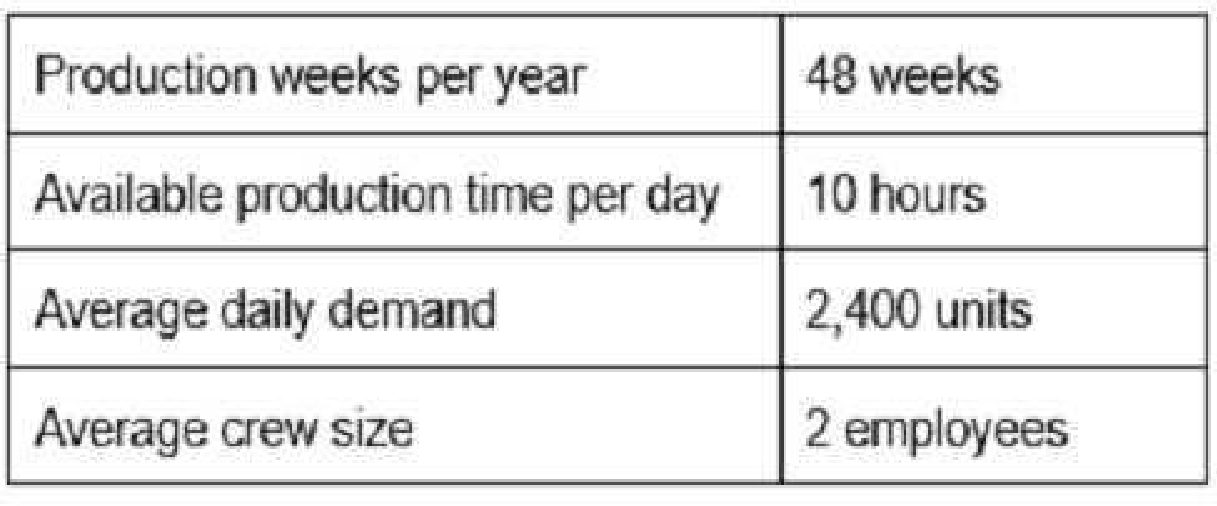
Given the following data, calculate the appropriate takt time:
Select the answer:Select the answer
1 correct answer
A.
0.25 minutes
B.
1 minute
C.
2 minutes
D.
4 minutes
Takt time is the rate at which a product should be produced to meet customer demand. It is calculated by dividing the available production time by the customer demand. In this case, the available production time is 10 hours per day, and the customer demand is 2,400 units per day. Converting 10 hours to minutes gives us 600 minutes of production time per day. So, takt time = 600 minutes / 2400 units = 0.25 minutes per unit. However, this is not one of the answer choices, so we need to look for more information or context. According to the CPIM Part 1 Study Guide, takt time is usually rounded up to the nearest whole number to allow for some buffer time and to simplify the calculation. Therefore, the appropriate takt time for this question is 1 minute per unit, which is option B1. Reference := 1 CPIM Part 1 Study Guide, page 77
Right Answer: B
Quiz
Question 5/105/10
If all other factors remain the same, when finished goods inventory investment is increased, service levels typically will:
Select the answer:Select the answer
1 correct answer
A.
remain the same.
B.
increase in direct (linear) proportion.
C.
increase at a decreasing rate.
D.
increase at an increasing rate.
Increasing finished goods inventory investment will improve service levels by reducing the probability of stockouts. However, the relationship between inventory and service level is not linear, but rather asymptotic. This means that as inventory increases, service level increases at a decreasing rate, approaching a maximum value. Therefore, option C is correct. Option A is incorrect because service level will not remain the same when inventory changes. Option B is incorrect because service level will not increase in direct proportion to inventory. Option D is incorrect because service level will not increase at an increasing rate as inventory increases. Reference: CPIM Part 2 Exam Content Manual, Version 8.0, Section A: Demand Management, Subsection A.3: Demand Management and Customer Service, p. 10.
Right Answer: C
Quiz
Question 6/106/10
A low-cost provider strategy works best when which of the following conditions are met?
Select the answer:Select the answer
1 correct answer
A.
Price competition among rivals is similar.
B.
Buyers are more price sensitive.
C.
There are many ways to achieve product differentiation.
D.
There are few industry newcomers.
A low-cost provider strategy is a business strategy where a company aims to become the most cost- efficient player in its industry, often by producing goods or providing services at a lower cost than its competitors. The overall goal is to increase market share or achieve higher profitability. The low-cost leader in an industry often sets the price that other companies have to match or beat to stay competitive12. A low-cost provider strategy works best when buyers are more price sensitive, meaning they are more likely to switch to cheaper alternatives if the price of a product or service increases. This condition creates a strong demand for low-priced products or services, and gives the low-cost leader a competitive advantage over rivals who have higher costs and prices. Buyers are more price sensitive when34: • The product or service is standardized or undifferentiated, and there are few switching costs. • The product or service represents a significant portion of the buyer’s budget or income. • The product or service has low quality, performance, or image attributes that limit the buyer’s satisfaction or loyalty. • The product or service is not crucial to the buyer’s well-being or enjoyment. The other options are not correct because: • A. Price competition among rivals is similar. This condition does not favor a low-cost provider strategy, because it implies that the industry is already highly competitive and there is little room for differentiation. A low-cost leader would have to lower its prices even further to gain an edge over rivals, which could erode its profitability and sustainability. • C. There are many ways to achieve product differentiation. This condition does not favor a low-cost provider strategy, because it implies that the industry is diverse and dynamic, and there are many opportunities for innovation and value creation. A low-cost leader would have to invest more in research and development, marketing, and customer service to keep up with the changing customer preferences and expectations, which could increase its costs and reduce its efficiency. • D. There are few industry newcomers. This condition does not favor a low-cost provider strategy, because it implies that the industry is mature and stable, and there are few threats from new entrants. A low-cost leader would have to rely on its existing customer base and market share, which could limit its growth potential and expose it to the risk of obsolescence. Reference := 1 Low-cost leadership strategy: Explained with examples2 2 Low-Cost Producer: Definition, Strategies, Examples - Investopedia4 3 Low Cost Strategy - Definition, Factors & Example - MBA Skool5 4 Generating Advantage – Strategic Management - Open Educational Resources1
Right Answer: B
Quiz
Question 7/107/10
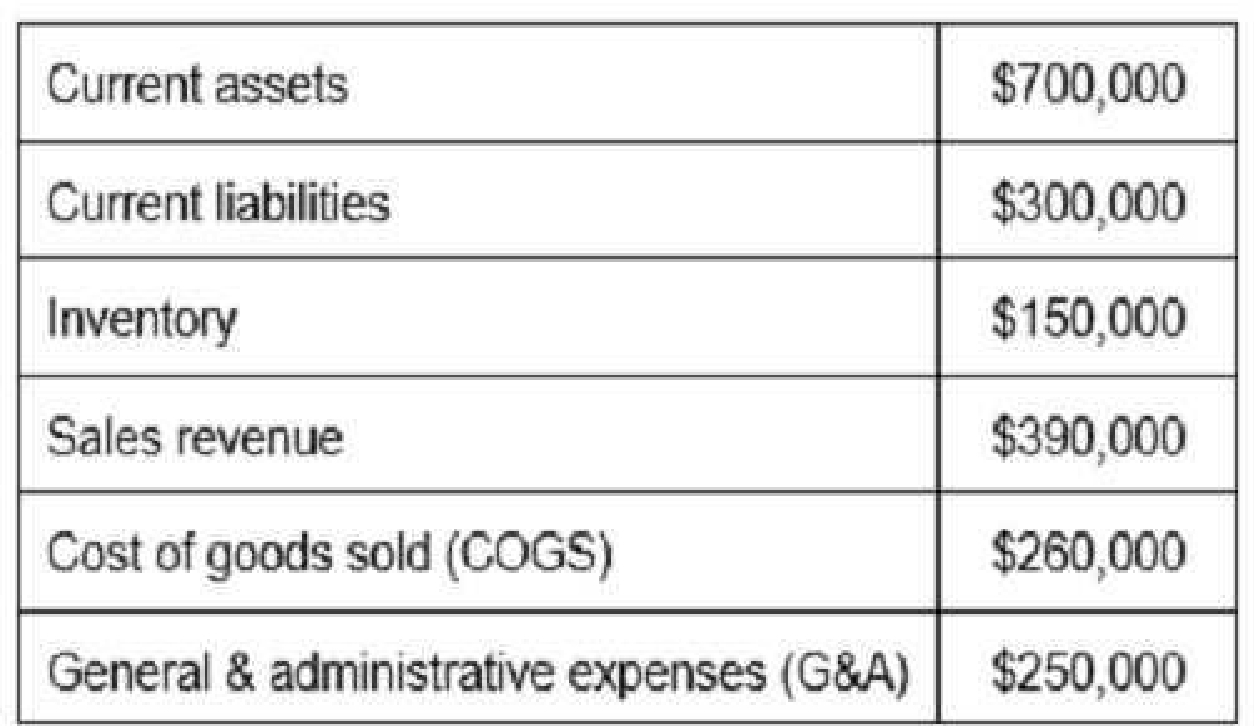
Based on the values reported in the table below, what is the inventory turnover?
Select the answer:Select the answer
1 correct answer
A.
0.50
B.
0.58
C.
1.73
D.
2.60
Inventory turnover is a ratio that measures how many times a company sells and replaces its inventory in a given period. It is calculated by dividing the cost of goods sold (COGS) by the average inventory value. A higher inventory turnover indicates a more efficient use of inventory, while a lower turnover implies excess inventory or poor sales1. Based on the values reported in the table, we can calculate the inventory turnover as follows: Inventory Turnover = COGS / Average Inventory Value = $260,000 / $150,000 = 1.73 Therefore, the correct answer is C. Reference := 1 Inventory Turnover - How to Calculate Inventory Turns2
Right Answer: C
Quiz
Question 8/108/10
Which of the following actions hinders the transition from a push system to a pull system?
Select the answer:Select the answer
1 correct answer
A.
Using standardized containers
B.
Using work orders as a backup
C.
Introducing kanban cards as authorization for material movement
D.
Maintaining a constant number of kanban cards during minor changes in the level of production
A push system is a production system that relies on forecasts and schedules to plan the production and distribution of goods and services. A pull system is a production system that responds to actual customer demand and signals to trigger the production and distribution of goods and services. A transition from a push system to a pull system requires a change in the mindset and the processes of the organization, as well as the adoption of new tools and techniques to enable a demand-driven production system12. One of the tools that is commonly used in a pull system is kanban, which is a visual signal that indicates the need for replenishment of materials or products. Kanban cards are attached to standardized containers that hold a fixed amount of inventory. When a container is empty, the kanban card is sent back to the upstream process as a signal to produce more. This way, the inventory level is controlled by the actual consumption of the downstream process, and the production is synchronized with the demand13. One of the actions that hinders the transition from a push system to a pull system is using work orders as a backup. Work orders are documents that authorize the production of a certain quantity of a product or a service, based on a forecast or a schedule. Work orders are typical of a push system, as they are not triggered by the actual customer demand, but by the planned production. Using work orders as a backup means that the organization is not fully committed to the pull system, and still relies on the push system to ensure the availability of inventory. This can create confusion, inconsistency, and inefficiency in the production system, as well as increase the inventory holding costs and the risk of obsolescence1 . Therefore, using work orders as a backup is the correct answer, as it is an action that hinders the transition from a push system to a pull system. The other options are actions that support the transition, as they are aligned with the principles and practices of a pull system.
Right Answer: B
Quiz
Question 9/109/10
For a company that uses first in, first out (FIFO) inventory accounting, the actual use in production of a recently arrived shipment of more expensive components rather than lower-cost components previously received will have which of the following results?
Select the answer:Select the answer
1 correct answer
A.
Higher cost of goods sold (COGS)
B.
Lower COGS
C.
No change to COGS
D.
A violation of FIFO rules
FIFO inventory accounting assumes that the first items purchased or produced are the first ones sold or used. Therefore, the cost of goods sold reflects the oldest costs of inventory. If a company uses a more expensive shipment of components instead of the lower-cost ones that were previously received, it will increase the cost of goods sold and reduce the gross profit margin. This is because the newer components have a higher unit cost than the older ones, and the cost of goods sold is calculated by multiplying the unit cost by the number of units sold or used. Reference: • CPIM Part 1 Exam Content Manual, page 17, section 3.2.1: “Explain the impact of inventory valuation methods (for example, first in, first out [FIFO], last in, first out [LIFO], average cost, standard cost) on financial statements and taxes.” • CPIM Part 1 Study Guide, page 63, section 3.2.1: “The FIFO method assumes that the first goods purchased or produced are the first goods sold. The cost of goods sold is based on the oldest costs, and the ending inventory is based on the most recent costs. The FIFO method results in a higher net income and a higher ending inventory value in a period of rising prices.”
Right Answer: A
Quiz
Question 10/1010/10
Increased use of third-party logistics (3PL) services is likely to have which of the following effects on a firm's balance sheet?
Select the answer:Select the answer
1 correct answer
A.
Decreased fixed assets
B.
Decreased retained earnings
C.
Increased accounts receivable
D.
Increased intangible assets
Third-party logistics (3PL) services are external providers that handle various supply chain functions for a firm, such as transportation, warehousing, inventory management, and order fulfillment. By outsourcing these functions to a 3PL, a firm can reduce its investment in fixed assets, such as trucks, trailers, warehouses, and equipment. This can improve the firm’s liquidity and return on assets Questions PDF 9/108 ratios, as well as lower its depreciation and maintenance costs. However, using a 3PL does not necessarily affect the firm’s retained earnings, accounts receivable, or intangible assets, which are influenced by other factors, such as profitability, sales, and goodwill. Reference: • Third-Party Logistics (3PL) Guide: Process, Resources, And Benefits • 3PLs, Explained: The Complete Guide to Third-Party Logistics • Understanding 3PL: The Role of Third-Party Logistics in 2024
CPIM-8.0: APICS Certified in Planning and Inventory Management (CPIM 8.0) Practice test unlocks all online simulator questions
Thank you for choosing the free version of the CPIM-8.0: APICS Certified in Planning and Inventory Management (CPIM 8.0) practice test! Further deepen your knowledge on APICS Simulator; by unlocking the full version of our CPIM-8.0: APICS Certified in Planning and Inventory Management (CPIM 8.0) Simulator you will be able to take tests with over 140 constantly updated questions and easily pass your exam. 98% of people pass the exam in the first attempt after preparing with our 140 questions.
What to expect from our CPIM-8.0: APICS Certified in Planning and Inventory Management (CPIM 8.0) practice tests and how to prepare for any exam?
The CPIM-8.0: APICS Certified in Planning and Inventory Management (CPIM 8.0) Simulator Practice Tests are part of the APICS Database and are the best way to prepare for any CPIM-8.0: APICS Certified in Planning and Inventory Management (CPIM 8.0) exam. The CPIM-8.0: APICS Certified in Planning and Inventory Management (CPIM 8.0) practice tests consist of 140 questions and are written by experts to help you and prepare you to pass the exam on the first attempt. The CPIM-8.0: APICS Certified in Planning and Inventory Management (CPIM 8.0) database includes questions from previous and other exams, which means you will be able to practice simulating past and future questions. Preparation with CPIM-8.0: APICS Certified in Planning and Inventory Management (CPIM 8.0) Simulator will also give you an idea of the time it will take to complete each section of the CPIM-8.0: APICS Certified in Planning and Inventory Management (CPIM 8.0) practice test . It is important to note that the CPIM-8.0: APICS Certified in Planning and Inventory Management (CPIM 8.0) Simulator does not replace the classic CPIM-8.0: APICS Certified in Planning and Inventory Management (CPIM 8.0) study guides; however, the Simulator provides valuable insights into what to expect and how much work needs to be done to prepare for the CPIM-8.0: APICS Certified in Planning and Inventory Management (CPIM 8.0) exam.
CPIM-8.0: APICS Certified in Planning and Inventory Management (CPIM 8.0) Practice test therefore represents an excellent tool to prepare for the actual exam together with our APICS practice test . Our CPIM-8.0: APICS Certified in Planning and Inventory Management (CPIM 8.0) Simulator will help you assess your level of preparation and understand your strengths and weaknesses. Below you can read all the quizzes you will find in our CPIM-8.0: APICS Certified in Planning and Inventory Management (CPIM 8.0) Simulator and how our unique CPIM-8.0: APICS Certified in Planning and Inventory Management (CPIM 8.0) Database made up of real questions:
Info quiz:
Quiz name:CPIM-8.0: APICS Certified in Planning and Inventory Management (CPIM 8.0)
Total number of questions:140
Number of questions for the test:50
Pass score:80%
You can prepare for the CPIM-8.0: APICS Certified in Planning and Inventory Management (CPIM 8.0) exams with our mobile app. It is very easy to use and even works offline in case of network failure, with all the functions you need to study and practice with our CPIM-8.0: APICS Certified in Planning and Inventory Management (CPIM 8.0) Simulator.
Use our Mobile App, available for both Android and iOS devices, with our CPIM-8.0: APICS Certified in Planning and Inventory Management (CPIM 8.0) Simulator . You can use it anywhere and always remember that our mobile app is free and available on all stores.
Our Mobile App contains all CPIM-8.0: APICS Certified in Planning and Inventory Management (CPIM 8.0) practice tests which consist of 140 questions and also provide study material to pass the final CPIM-8.0: APICS Certified in Planning and Inventory Management (CPIM 8.0) exam with guaranteed success.
Our CPIM-8.0: APICS Certified in Planning and Inventory Management (CPIM 8.0) database contain hundreds of questions and APICS Tests related to CPIM-8.0: APICS Certified in Planning and Inventory Management (CPIM 8.0) Exam. This way you can practice anywhere you want, even offline without the internet.