The new flashcard feature is useful to memorize questions.
?Change your study mode
At any time, you can change the study mode, and alternate between the practice mode and the exam mode. In practice mode, you can configure for example the number of questions or tests, and other parameters to help you study.
Randomized | 10 Questions per Test | 20 Minutes | 70% to pass|
To re-configure your study mode again and change - for example - the number of tests, whether you have random questions and all other configuration parameters.
?Simulator Configuration
Auto-scroll: You can use the automatic scrolling of the questionnaire that occurs as soon as you answer one or all of the answers to a question correctly. Auto scrolling is activated if you answer a single answer, or as soon as you answer all the mandatory answers. Learning Mode: During learning mode you can get a real time result for your answer.
Free Test
Question: / 10
20:00Min. left
?Restart the current test
To restart the current test by clearing all your answers and the time used up to now. Warning: all answers will be lost.
Question: / 10
5.0(120 Votes)
Quiz
Question 1/101/10
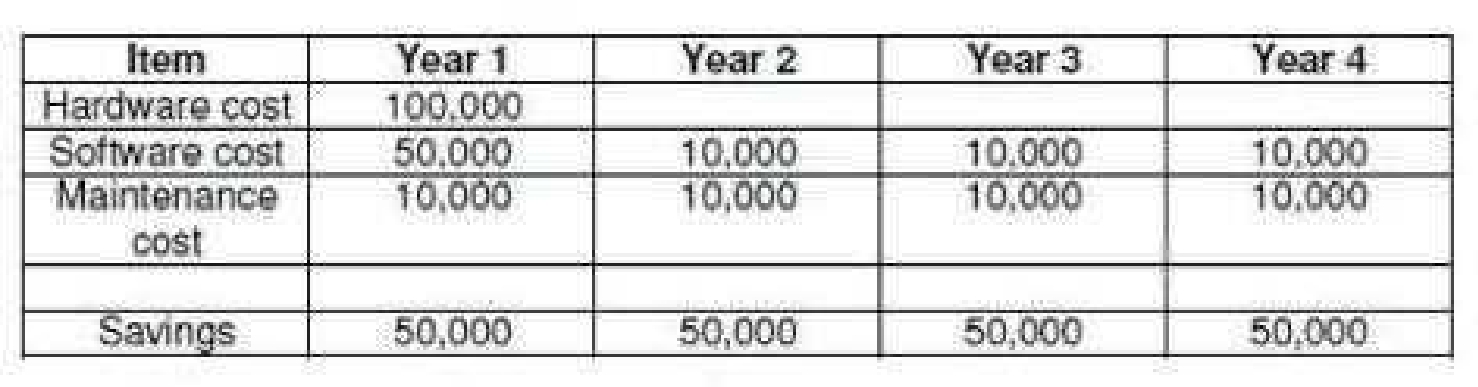
Given the cashflows below, which of the following is correct?
Select the answer:Select the answer
1 correct answer
A.
The project pays back in year 4 of the project.
B.
The project does not pay back within the four year period.
C.
The project pays back in year 2 of the project.
D.
The project pays back in year 3 of the project.
The correct answer is B. The project does not pay back within the four year period. To determine the payback period, you add the cash inflows year by year until the cumulative cash flow turns positive and fully recovers the initial investment. The cash flows in the table are: - Year 0: initial outflow - Years 1 to 4: cash inflows Using the cashflows shown, the total inflows over the four years are not enough to recover the original cash outflow by the end of year 4. That means the cumulative cash flow remains negative throughout the whole four-year period. Why the other options are incorrect: - A. Pays back in year 4: Incorrect, because the investment is still not fully recovered by the end of year 4. - C. Pays back in year 2: Incorrect, because the accumulated inflows by year 2 are far too small to cover the initial outlay. - D. Pays back in year 3: Incorrect, because the cumulative inflows by the end of year 3 still do not reach the initial investment. So the project never reaches the payback point within the four years given, which makes B the correct choice.
Right Answer: B
Quiz
Question 2/102/10
The required competencies of a business analyst are classified into three categories. Which of the following is one of these three categories?
Select the answer:Select the answer
1 correct answer
A.
Management Qualities.
B.
Business Knowledge.
C.
IT Skills
D.
Project Skills.
The correct answer is B. Business Knowledge. A business analyst needs a broad set of competencies, but these are commonly grouped into three main categories: 1. Business Knowledge This refers to understanding how the organization works, including its goals, processes, industry, market, and strategy. A business analyst must know enough about the business domain to identify problems, evaluate needs, and recommend effective solutions. 2. Business Analysis Skills These include skills such as gathering requirements, analyzing processes, communicating with stakeholders, and documenting and validating needs. 3. Behavioral Characteristics or Personal Attributes These involve qualities like critical thinking, adaptability, leadership, and interpersonal communication. Why B is correct: Business Knowledge is one of the recognized competency categories because a business analyst must understand the business context in order to make useful recommendations. Why the other options are not correct: A. Management Qualities This is too general and is not usually listed as one of the main competency categories. C. IT Skills While useful in many roles, IT skills are not one of the standard three competency categories for a business analyst. D. Project Skills Project skills can help a business analyst work effectively on initiatives, but they are not one of the three core competency categories. So, the best answer is B. Business Knowledge.
Right Answer: B
Quiz
Question 3/103/10
When should benefits realisation be carried out?
Select the answer:Select the answer
1 correct answer
A.
Immediately at the end of the project.
B.
At the beginning of the project.
C.
At the end of the finalised feasibility study.
D.
Months or years after the end of the project. Questions & Answers PDF P-3
Benefits realisation is the process of checking whether the expected benefits of a project, programme, or change initiative are actually achieved in practice. This often cannot be done straight away when the project finishes, because many benefits only appear after the new product, service, or process has been used for a period of time. Why D is correct: Benefits realisation should often be carried out months or even years after the end of the project. This is because: - Some benefits take time to materialise. - Users may need time to adopt the new change. - Business performance improvements may only become visible after sustained use. - The true impact of the project may not be measurable at closure. Why the other options are incorrect: A. Immediately at the end of the project. - This is too early for many benefits to be assessed. - At project end, you may only be able to confirm deliverables, not real business outcomes. B. At the beginning of the project. - At the start, benefits are only anticipated or planned. - Realisation means measuring actual benefits, which cannot happen before implementation. C. At the end of the finalised feasibility study. - A feasibility study is about assessing whether the project is viable. - It does not involve delivering the project or measuring real-world outcomes. In summary: Benefits realisation is usually done after the project has been completed and the change has been in use long enough for benefits to be observed, which is why the correct answer is D.
Right Answer: D
Quiz
Question 4/104/10
Which of the following statement is TRUE about the process view of an organisation?
Select the answer:Select the answer
1 correct answer
A.
It focuses on the customer of the organisation.
B.
It focuses solely on the internal view of the organisation.
C.
It focuses on the functions of an organisation.
D.
It focuses on the organisational structure.
The correct answer is A. It focuses on the customer of the organisation. The process view of an organisation looks at the organisation from the perspective of how value is created and delivered to customers. It emphasizes the flow of activities and processes that transform inputs into outputs that satisfy customer needs. Why A is correct: A process view is centered on outcomes for the customer. It asks questions like: - What does the customer want? - How do the organisation’s processes create value for the customer? - How efficiently and effectively are customer needs being met? Why the other options are incorrect: B. It focuses solely on the internal view of the organisation. - This is incorrect because the process view is not limited to internal activities. While internal processes matter, the main emphasis is on the end result delivered to the customer. C. It focuses on the functions of an organisation. - This describes a functional view, where the organisation is divided into departments such as marketing, finance, and operations. The process view crosses functional boundaries. D. It focuses on the organisational structure. - This refers more to how the organisation is formally arranged, such as hierarchy and reporting lines, not the process view. In short: The process view is customer-oriented and focuses on how the organisation’s processes work together to create value for the customer.
Right Answer: A
Quiz
Question 5/105/10
As part of an investigation a Business Analyst has devised a form for users of an existing system to use to keep track of the tasks they undertake during their working day. Which of the following describes this investigation technique?
Select the answer:Select the answer
1 correct answer
A.
Special purpose records,
B.
Scenario analysis.
C.
Questionnaires.
D.
Activity sampling.
The correct answer is A. Special purpose records. Special purpose records are a type of fact-finding technique where people involved in a process are asked to record specific information over a period of time. In this case, the Business Analyst has created a form for users of an existing system to fill in while they work, so they can track the tasks they perform during the day. That is exactly what special purpose records are used for: collecting tailored information about actual activities as they happen. Why the other options are incorrect: B. Scenario analysis This involves exploring possible future situations or outcomes, often to understand how a system or process might respond under different conditions. It is not about users recording their daily tasks. C. Questionnaires A questionnaire is a set of questions sent to people to gather their opinions or information. The key difference is that questionnaires ask respondents to answer questions, whereas special purpose records ask them to log events or activities over time. D. Activity sampling Activity sampling is an observational technique used to estimate how time is spent by looking at activities at random intervals. It does not involve a form designed for users to complete themselves throughout the day. In summary, because the analyst has created a form specifically for users to record their work activities during the day, the technique is special purpose records.
Right Answer: A
Quiz
Question 6/106/10
On a class diagram, what do the multiplicities represent?
Select the answer:Select the answer
1 correct answer
A.
The number of attributes held within each class.
B.
The minimum and maximum number of operations in each class.
C.
The minimum and maximum number of objects in each class.
D.
The business rules for an association between two classes.
The correct answer is D. The business rules for an association between two classes. In a UML class diagram, multiplicity describes how many instances of one class can be associated with instances of another class. It is shown near the ends of an association line and is used to express constraints such as: - 1 meaning exactly one - 0..1 meaning zero or one - * meaning many - 1..* meaning one or more - 0..5 meaning from zero to five Why D is correct: Multiplicity is essentially part of the business logic or business rules for the relationship between classes. For example, a company might require that one Department has many Employees, while each Employee belongs to exactly one Department. That rule is represented using multiplicities. Why the other options are incorrect: A. The number of attributes held within each class. This is incorrect because multiplicity does not describe class attributes. It describes relationships between classes. B. The minimum and maximum number of operations in each class. This is incorrect because operations are methods, and multiplicity does not apply to them. C. The minimum and maximum number of objects in each class. This is partially misleading. Multiplicity does not describe how many objects exist in a class overall. It describes how many objects of one class can be linked to objects of another class through an association. Summary: Multiplicity in a class diagram defines the allowed number of related objects in an association, which reflects business rules. Therefore, D is the best answer.
Right Answer: D
Quiz
Question 7/107/10
A well formed requirement is said to comply with which of the following acronyms?
Select the answer:Select the answer
1 correct answer
A.
MOSCOW.
B.
SMART.
C.
OSCAR.
D.
MOST. Questions & Answers PDF P-4
The correct answer is A. MOSCOW. A well-formed requirement is often described using the MoSCoW prioritization method, which is commonly used in requirements engineering to classify requirements by importance. The acronym stands for: Must have Should have Could have Won’t have this time This helps teams decide which requirements are essential and which can be deferred if needed. Why not the other options? B. SMART SMART is used to evaluate goals or objectives. It stands for: Specific Measurable Achievable Relevant Time-bound It is not the standard acronym for classifying requirements. C. OSCAR This is not a standard acronym used for well-formed requirements in this context. D. MOST MOST is sometimes used in business analysis or strategy contexts, but it is not the acronym referred to here for well-formed requirements. Therefore, the correct choice is A. MOSCOW.
Right Answer: A
Quiz
Question 8/108/10
Which stage in the waterfall model is considered as several separate stages in the V model?
Select the answer:Select the answer
1 correct answer
A.
Development.
B.
Analysis.
C.
Testing.
D.
Design.
The correct answer is C. Testing. In the waterfall model, testing is usually treated as one broad phase that happens after implementation. It is a single stage in the overall sequence of development. In the V model, however, testing is broken down into several separate stages that correspond to different development phases. Instead of having just one general testing phase, the V model includes multiple testing levels such as: - Unit testing - Integration testing - System testing - Acceptance testing These testing stages are mapped directly to the earlier stages of requirement analysis and design. This is why testing in the waterfall model is considered as several separate stages in the V model. Why the other options are incorrect: A. Development Development is a broad activity in both models, but it is not the stage that becomes several separate stages in the V model. B. Analysis Analysis is important in both models, but it is not divided into several separate stages in the V model in the same way testing is. D. Design Design is also important in both models, but it is not the phase that is split into multiple separate testing stages. So, the correct choice is C. Testing.
Right Answer: C
Quiz
Question 9/109/10
Which of the following terms may be used to describe the attitude of a stakeholder who is NOT in favour of the project but is probably not actively opposed to it?
Select the answer:Select the answer
1 correct answer
A.
Opponent.
B.
Neutral.
C.
Critic.
D.
Blocker.
The correct answer is C. Critic. Here is why: A stakeholder’s attitude toward a project can range from supportive to strongly opposed. The question asks for a person who is not in favor of the project, but also is probably not actively trying to stop it. A critic fits this description because: - They are not supportive of the project. - They may point out problems, concerns, or weaknesses. - They are not necessarily taking direct action to block or defeat the project. Why the other options are not the best fit: A. Opponent An opponent is generally more actively against the project. This suggests stronger resistance than simply not being in favor. B. Neutral A neutral stakeholder is neither for nor against the project. The question says the stakeholder is not in favour, so this does not fit. D. Blocker A blocker is actively opposed and may try to prevent the project from moving forward. This is stronger than the attitude described in the question. Therefore, C. Critic is the best answer because it describes someone who is unfavorable toward the project without necessarily being actively hostile.
Right Answer: C
Quiz
Question 10/1010/10
It has been suggested that five clerical posts can be abolished when a new computer system is implemented. Under which category of costs or benefits will this be recorded?
Select the answer:Select the answer
1 correct answer
A.
Tangible costs.
B.
Tangible benefits.
C.
Intangible costs.
D.
Intangible benefits.
The correct answer is B. Tangible benefits. When a new computer system is implemented, the effect of abolishing five clerical posts can be measured in financial terms. If staff positions are no longer needed, the organization saves salary and related employment costs. Because this saving can be quantified in money, it is classified as a tangible benefit. Why the other options are incorrect: A. Tangible costs This would refer to measurable expenses, such as the purchase price of the system, installation costs, or training costs. Abolishing staff posts is a saving, not a cost. C. Intangible costs These are negative effects that are difficult to measure in money, such as reduced morale or resistance to change. The abolishment of clerical posts is not an intangible effect in this context. D. Intangible benefits These are advantages that are real but not easy to quantify, such as improved customer satisfaction or better decision-making. Staff cost savings are measurable, so they are not intangible. In summary, the removal of five clerical posts creates a measurable financial saving, so it is recorded as a tangible benefit.
BA15: Foundation Certificate in Business Analysis Practice test unlocks all online simulator questions
Thank you for choosing the free version of the BA15: Foundation Certificate in Business Analysis practice test! Further deepen your knowledge on BCS Simulator; by unlocking the full version of our BA15: Foundation Certificate in Business Analysis Simulator you will be able to take tests with over 160 constantly updated questions and easily pass your exam. 98% of people pass the exam in the first attempt after preparing with our 160 questions.
What to expect from our BA15: Foundation Certificate in Business Analysis practice tests and how to prepare for any exam?
The BA15: Foundation Certificate in Business Analysis Simulator Practice Tests are part of the BCS Database and are the best way to prepare for any BA15: Foundation Certificate in Business Analysis exam. The BA15: Foundation Certificate in Business Analysis practice tests consist of 160 questions and are written by experts to help you and prepare you to pass the exam on the first attempt. The BA15: Foundation Certificate in Business Analysis database includes questions from previous and other exams, which means you will be able to practice simulating past and future questions. Preparation with BA15: Foundation Certificate in Business Analysis Simulator will also give you an idea of the time it will take to complete each section of the BA15: Foundation Certificate in Business Analysis practice test . It is important to note that the BA15: Foundation Certificate in Business Analysis Simulator does not replace the classic BA15: Foundation Certificate in Business Analysis study guides; however, the Simulator provides valuable insights into what to expect and how much work needs to be done to prepare for the BA15: Foundation Certificate in Business Analysis exam.
BA15: Foundation Certificate in Business Analysis Practice test therefore represents an excellent tool to prepare for the actual exam together with our BCS practice test . Our BA15: Foundation Certificate in Business Analysis Simulator will help you assess your level of preparation and understand your strengths and weaknesses. Below you can read all the quizzes you will find in our BA15: Foundation Certificate in Business Analysis Simulator and how our unique BA15: Foundation Certificate in Business Analysis Database made up of real questions:
Info quiz:
Quiz name:BA15: Foundation Certificate in Business Analysis
Total number of questions:160
Number of questions for the test:50
Pass score:80%
You can prepare for the BA15: Foundation Certificate in Business Analysis exams with our mobile app. It is very easy to use and even works offline in case of network failure, with all the functions you need to study and practice with our BA15: Foundation Certificate in Business Analysis Simulator.
Use our Mobile App, available for both Android and iOS devices, with our BA15: Foundation Certificate in Business Analysis Simulator . You can use it anywhere and always remember that our mobile app is free and available on all stores.
Our Mobile App contains all BA15: Foundation Certificate in Business Analysis practice tests which consist of 160 questions and also provide study material to pass the final BA15: Foundation Certificate in Business Analysis exam with guaranteed success.
Our BA15: Foundation Certificate in Business Analysis database contain hundreds of questions and BCS Tests related to BA15: Foundation Certificate in Business Analysis Exam. This way you can practice anywhere you want, even offline without the internet.