The new flashcard feature is useful to memorize questions.
?Change your study mode
At any time, you can change the study mode, and alternate between the practice mode and the exam mode. In practice mode, you can configure for example the number of questions or tests, and other parameters to help you study.
Randomized | 10 Questions per Test | 20 Minutes | 70% to pass|
To re-configure your study mode again and change - for example - the number of tests, whether you have random questions and all other configuration parameters.
?Simulator Configuration
Auto-scroll: You can use the automatic scrolling of the questionnaire that occurs as soon as you answer one or all of the answers to a question correctly. Auto scrolling is activated if you answer a single answer, or as soon as you answer all the mandatory answers. Learning Mode: During learning mode you can get a real time result for your answer.
Free Test
Question: / 10
20:00Min. left
?Restart the current test
To restart the current test by clearing all your answers and the time used up to now. Warning: all answers will be lost.
Question: / 10
4.8(272 Votes)
Quiz
Question 1/101/10
An upstream system has been configured to pass the date for a given batch of data to the Databricks Jobs API as a parameter. The notebook to be scheduled will use this parameter to load data with the following code: df = spark.read.format("parquet").load(f"/mnt/source/(date)") Which code block should be used to create the date Python variable used in the above code block?
Select the answer:Select the answer
1 correct answer
A.
date = spark.conf.get("date")
B.
input_dict = input() date= input_dict["date"]
C.
import sys date = sys.argv[1]
D.
date = dbutils.notebooks.getParam("date")
E.
dbutils.widgets.text("date", "null") date = dbutils.widgets.get("date")
The code block that should be used to create the date Python variable used in the above code block is: dbutils.widgets.text(“date”, “null”) date = dbutils.widgets.get(“date”) This code block uses the dbutils.widgets API to create and get a text widget named “date” that can accept a string value as a parameter1. The default value of the widget is “null”, which means that if no parameter is passed, the date variable will be “null”. However, if a parameter is passed through the Databricks Jobs API, the date variable will be assigned the value of the parameter. For example, if the parameter is “2021-11-01”, the date variable will be “2021-11-01”. This way, the notebook can use the date variable to load data from the specified path. The other options are not correct, because: Option A is incorrect because spark.conf.get(“date”) is not a valid way to get a parameter passed through the Databricks Jobs API. The spark.conf API is used to get or set Spark configuration properties, not notebook parameters2. Option B is incorrect because input() is not a valid way to get a parameter passed through the Databricks Jobs API. The input() function is used to get user input from the standard input stream, not from the API request3. Option C is incorrect because sys.argv1 is not a valid way to get a parameter passed through the Databricks Jobs API. The sys.argv list is used to get the command-line arguments passed to a Python script, not to a notebook4. Option D is incorrect because dbutils.notebooks.getParam(“date”) is not a valid way to get a parameter passed through the Databricks Jobs API. The dbutils.notebooks API is used to get or set notebook parameters when running a notebook as a job or as a subnotebook, not when passing parameters through the API5. Reference: Widgets, Spark Configuration, input(), sys.argv, Notebooks
Right Answer: E
Quiz
Question 2/102/10
The Databricks workspace administrator has configured interactive clusters for each of the data engineering groups. To control costs, clusters are set to terminate after 30 minutes of inactivity. Each user should be able to execute workloads against their assigned clusters at any time of the day.
Assuming users have been added to a workspace but not granted any permissions, which of the following describes the minimal permissions a user would need to start and attach to an already configured cluster.
Select the answer:Select the answer
1 correct answer
A.
"Can Manage" privileges on the required cluster
B.
Workspace Admin privileges, cluster creation allowed. "Can Attach To" privileges on the required cluster
C.
Cluster creation allowed. "Can Attach To" privileges on the required cluster
D.
"Can Restart" privileges on the required cluster
E.
Cluster creation allowed. "Can Restart" privileges on the required cluster
When scheduling Structured Streaming jobs for production, which configuration automatically recovers from query failures and keeps costs low?
Select the answer:Select the answer
1 correct answer
A.
Cluster: New Job Cluster; Retries: Unlimited; Maximum Concurrent Runs: Unlimited
B.
Cluster: New Job Cluster; Retries: None; Maximum Concurrent Runs: 1
C.
Cluster: Existing All-Purpose Cluster; Retries: Unlimited; Maximum Concurrent Runs: 1
D.
Cluster: Existing All-Purpose Cluster; Retries: Unlimited; Maximum Concurrent Runs: 1
E.
Cluster: Existing All-Purpose Cluster; Retries: None; Maximum Concurrent Runs: 1
The configuration that automatically recovers from query failures and keeps costs low is to use a new job cluster, set retries to unlimited, and set maximum concurrent runs to 1. This configuration has the following advantages: A new job cluster is a cluster that is created and terminated for each job run. This means that the cluster resources are only used when the job is running, and no idle costs are incurred. This also ensures that the cluster is always in a clean state and has the latest configuration and libraries for the job1. Setting retries to unlimited means that the job will automatically restart the query in case of any failure, such as network issues, node failures, or transient errors. This improves the reliability and availability of the streaming job, and avoids data loss or inconsistency2. Setting maximum concurrent runs to 1 means that only one instance of the job can run at a time. This prevents multiple queries from competing for the same resources or writing to the same output location, which can cause performance degradation or data corruption3. Therefore, this configuration is the best practice for scheduling Structured Streaming jobs for production, as it ensures that the job is resilient, efficient, and consistent. Reference: Job clusters, Job retries, Maximum concurrent runs
Right Answer: D
Quiz
Question 4/104/10
The data engineering team has configured a Databricks SQL query and alert to monitor the values in a Delta Lake table. The recent_sensor_recordings table contains an identifying sensor_id alongside the timestamp and temperature for the most recent 5 minutes of recordings.
The below query is used to create the alert:
The query is set to refresh each minute and always completes in less than 10 seconds. The alert is set to trigger when mean (temperature) > 120. Notifications are triggered to be sent at most every 1 minute. If this alert raises notifications for 3 consecutive minutes and then stops, which statement must be true?
Select the answer:Select the answer
1 correct answer
A.
The total average temperature across all sensors exceeded 120 on three consecutive executions of the query
B.
The recent_sensor_recordingstable was unresponsive for three consecutive runs of the query
C.
The source query failed to update properly for three consecutive minutes and then restarted
D.
The maximum temperature recording for at least one sensor exceeded 120 on three consecutive executions of the query
E.
The average temperature recordings for at least one sensor exceeded 120 on three consecutive executions of the query
This is the correct answer because the query is using a GROUP BY clause on the sensor_id column, which means it will calculate the mean temperature for each sensor separately. The alert will trigger when the mean temperature for any sensor is greater than 120, which means at least one sensor had an average temperature above 120 for three consecutive minutes. The alert will stop when the mean temperature for all sensors drops below 120. Verified Reference: [Databricks Certified Data Engineer Professional], under “SQL Analytics” section; Databricks Documentation, under “Alerts” section.
Right Answer: E
Quiz
Question 5/105/10
A junior developer complains that the code in their notebook isn't producing the correct results in the development environment. A shared screenshot reveals that while they're using a notebook versioned with Databricks Repos, they're using a personal branch that contains old logic. The desired branch named dev-2.3.9 is not available from the branch selection dropdown.
Which approach will allow this developer to review the current logic for this notebook?
Select the answer:Select the answer
1 correct answer
A.
Use Repos to make a pull request use the Databricks REST API to update the current branch to dev-2.3.9
B.
Use Repos to pull changes from the remote Git repository and select the dev-2.3.9 branch.
C.
Use Repos to checkout the dev-2.3.9 branch and auto-resolve conflicts with the current branch
D.
Merge all changes back to the main branch in the remote Git repository and clone the repo again
E.
Use Repos to merge the current branch and the dev-2.3.9 branch, then make a pull request to sync with the remote repository
Option B is correct. This is the correct answer because it will allow the developer to update their local repository with the latest changes from the remote repository and switch to the desired branch. Pulling changes will not affect the current branch or create any conflicts, as it will only fetch the changes and not merge them. Selecting the dev-2.3.9 branch from the dropdown will checkout that branch and display its contents in the notebook. Verified Reference: [Databricks Certified Data Engineer Professional], under “Databricks Tooling” section; Databricks Documentation, under “Pull changes from a remote repository” section.
Right Answer: B
Quiz
Question 6/106/10
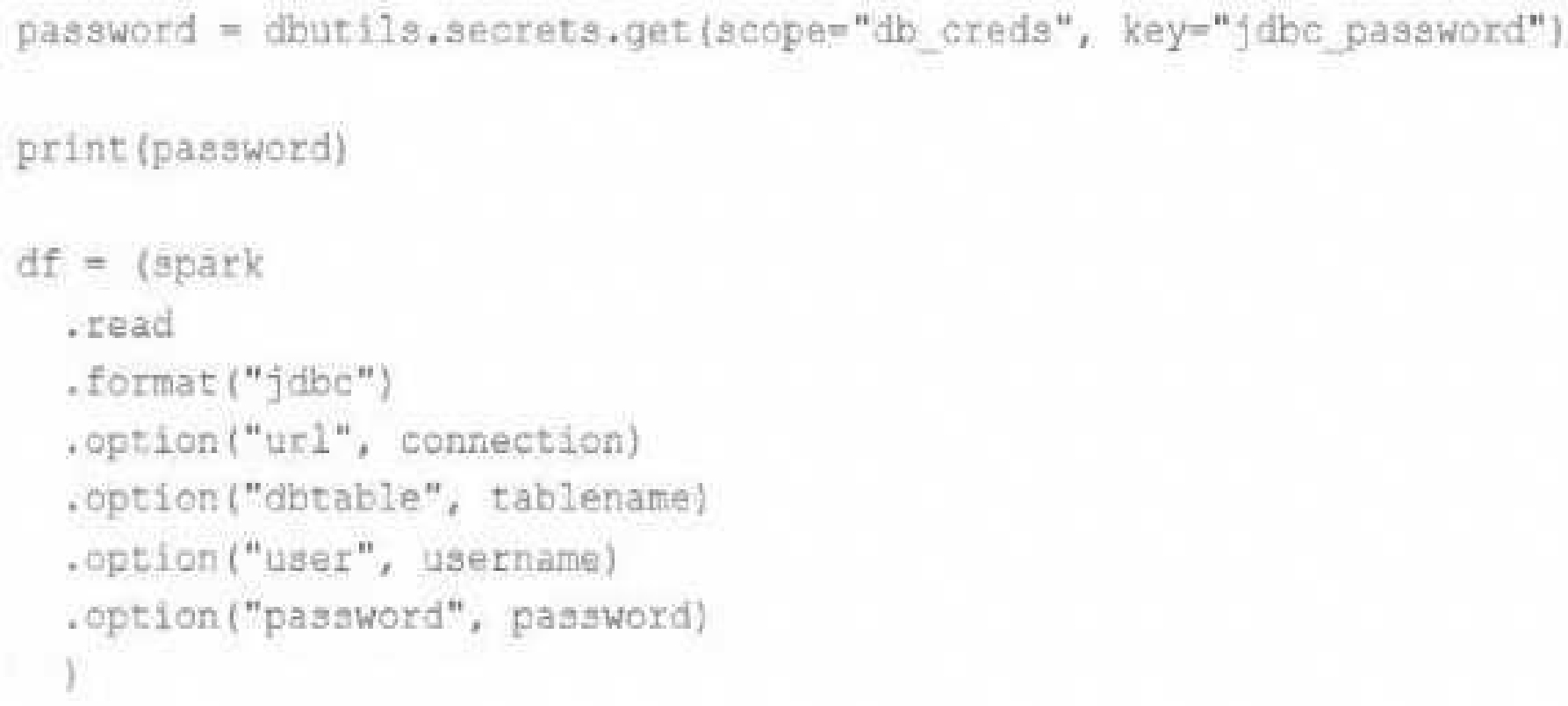
The security team is exploring whether or not the Databricks secrets module can be leveraged for connecting to an external database. After testing the code with all Python variables being defined with strings, they upload the password to the secrets module and configure the correct permissions for the currently active user. They then
modify their code to the following (leaving all other variables unchanged).
Which statement describes what will happen when the above code is executed?
Select the answer:Select the answer
1 correct answer
A.
The connection to the external table will fail; the string "redacted" will be printed.
B.
An interactive input box will appear in the notebook; if the right password is provided, the connection will succeed and the encoded password will be saved to DBFS.
C.
An interactive input box will appear in the notebook; if the right password is provided, the connection will succeed and the password will be printed in plain text.
D.
The connection to the external table will succeed; the string value of password will be printed in plain text.
E.
The connection to the external table will succeed; the string "redacted" will be printed.
This is the correct answer because the code is using the dbutils.secrets.get method to retrieve the password from the secrets module and store it in a variable. The secrets module allows users to securely store and access sensitive information such as passwords, tokens, or API keys. The connection to the external table will succeed because the password variable will contain the actual password value. However, when printing the password variable, the string “redacted” will be displayed instead of the plain text password, as a security measure to prevent exposing sensitive information in notebooks. Verified Reference: [Databricks Certified Data Engineer Professional], under “Security & Governance” section; Databricks Documentation, under “Secrets” section.
Right Answer: E
Quiz
Question 7/107/10
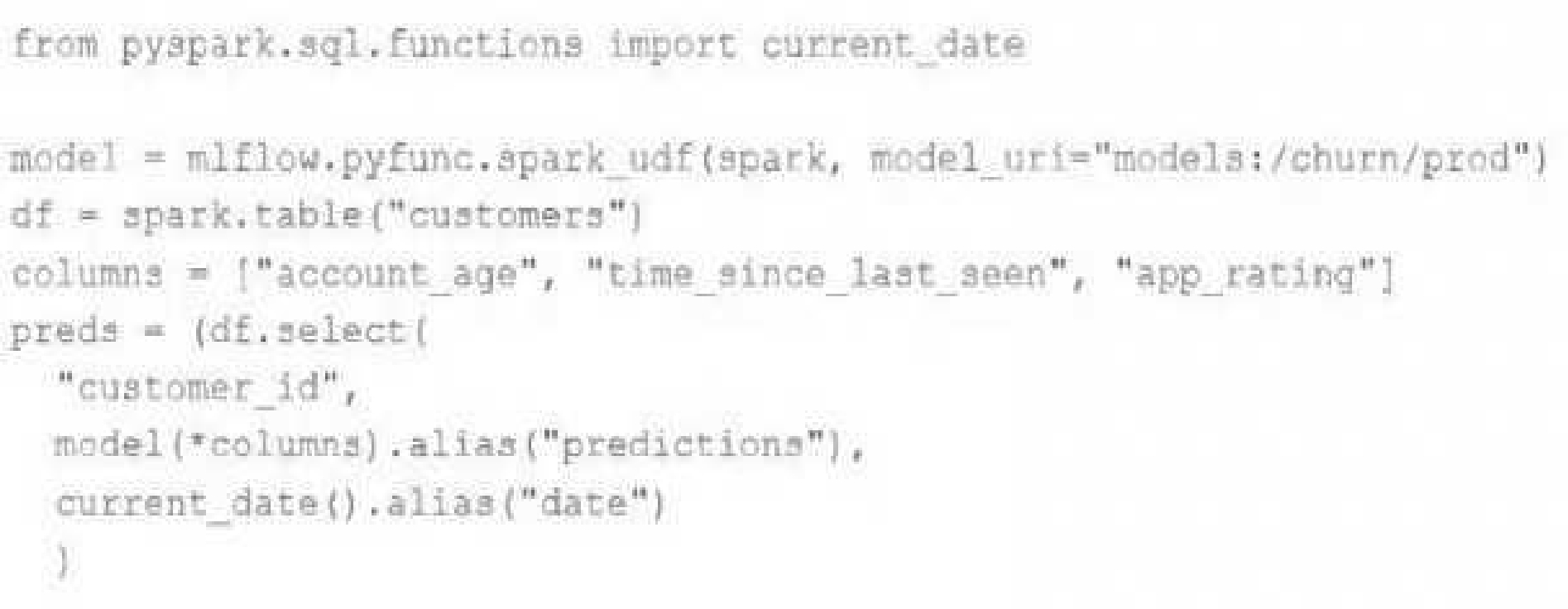
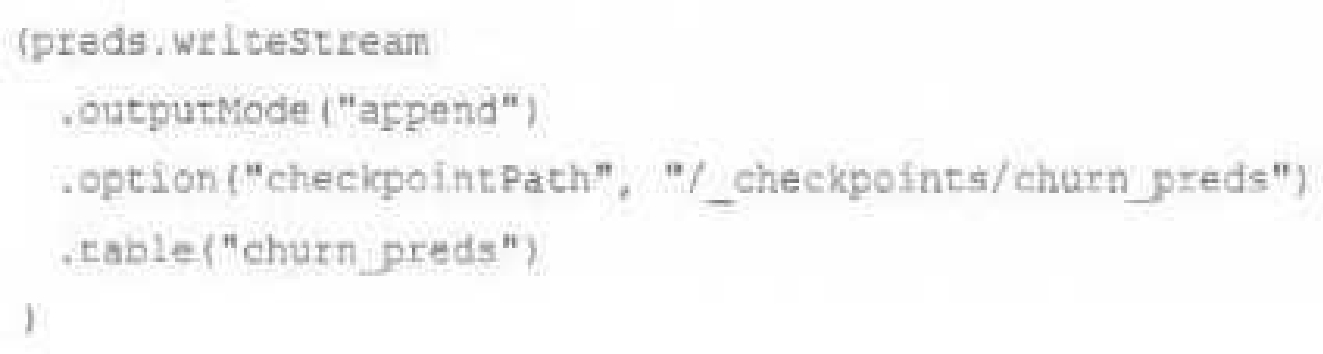
The data science team has created and logged a production model using MLflow. The following code correctly imports and applies the production model to output the predictions as a new DataFrame
named preds with the schema "customer_id LONG, predictions DOUBLE, date DATE".
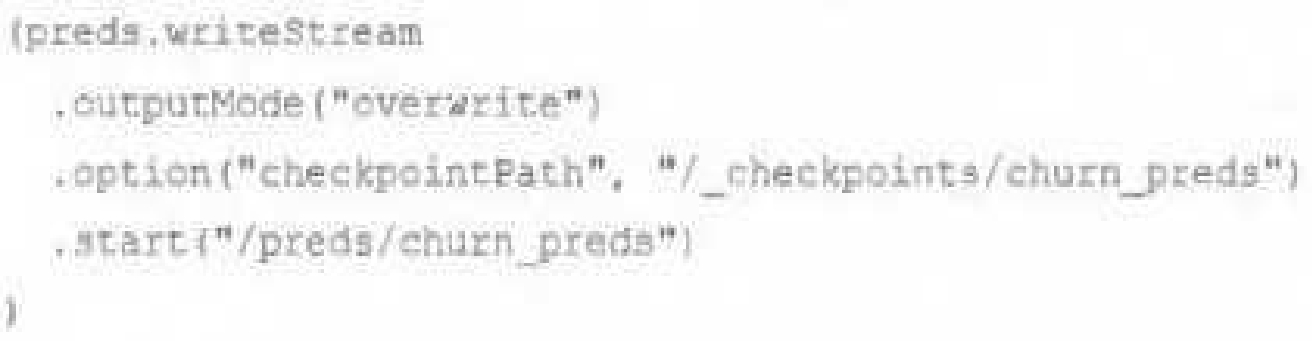
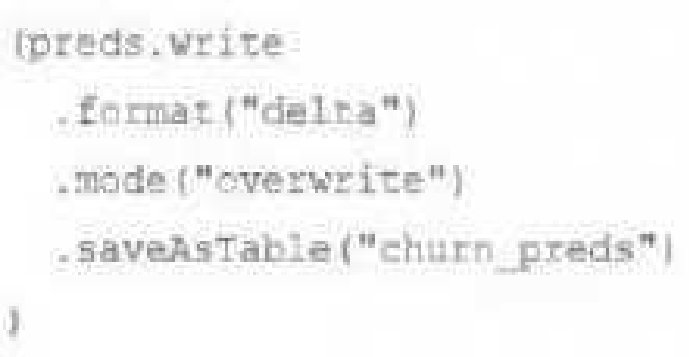
The data science team would like predictions saved to a Delta Lake table with the ability to compare all predictions across time. Churn predictions will be made at most once per day. Which code block accomplishes this task while minimizing potential compute costs? A) preds.write.mode("append").saveAsTable("churn_preds") B) preds.write.format("delta").save("/preds/churn_preds")
C)
D)
E)
Select the answer:Select the answer
1 correct answer
A.
Option A
B.
Option B
C.
Option C
D.
Option D
E.
Option E
The correct answer is A. Why A is correct The requirement is to save predictions to a Delta Lake table and preserve all predictions over time so they can be compared historically. Since predictions are made at most once per day, the simplest and most cost-efficient approach is to append each new day’s predictions into the same table. Option A: preds.write.mode("append").saveAsTable("churn_preds") This works because: - append adds new prediction rows without overwriting prior results - saveAsTable stores the data as a managed table, which is convenient for querying and historical comparison - if the table is backed by Delta in the environment, this supports Delta Lake storage and ACID behavior - it minimizes compute costs because it only writes the new batch of predictions rather than rewriting existing data Why the other options are not best Option B: preds.write.format("delta").save("/preds/churn_preds") This writes to a Delta path, but by itself it does not create a table that is as easy to query for cross-time comparison. It also does not explicitly indicate append behavior, so depending on how it is used, it may not meet the historical accumulation requirement as cleanly as option A. The remaining options likely involve: - overwriting data instead of appending - unnecessary partitioning or repartitioning - more complex logic than needed - higher compute or maintenance cost than simple append writes Key idea Because predictions arrive once per day and need to be retained for comparison over time, the best pattern is: - append new predictions to the same table - avoid rewriting old data - use a table format that supports efficient querying and history So the most appropriate and cost-efficient choice is A.
Right Answer: A
Quiz
Question 8/108/10
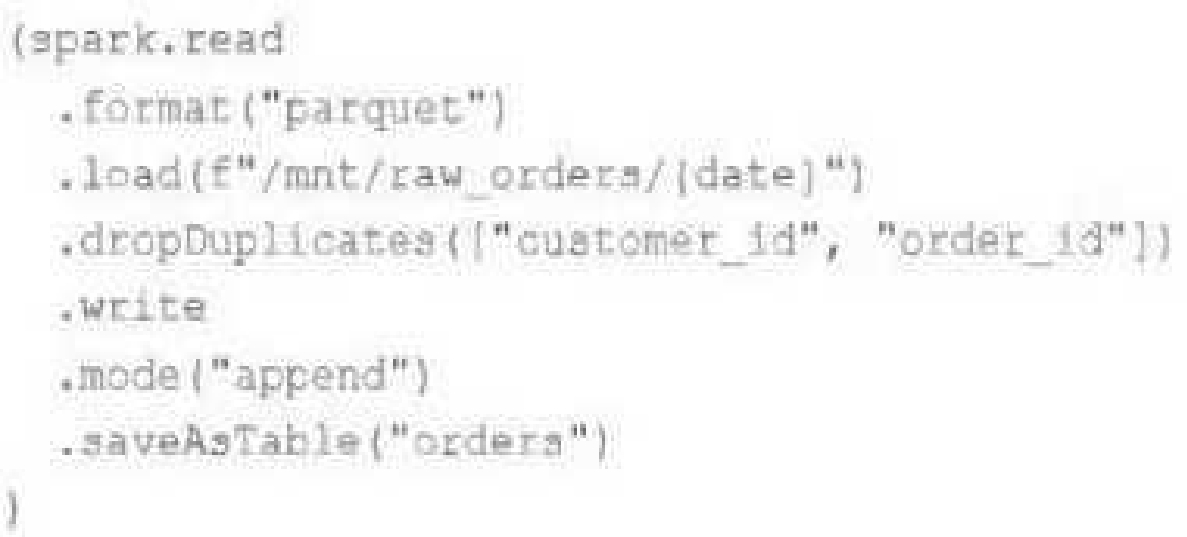
An upstream source writes Parquet data as hourly batches to directories named with the current date. A nightly batch job runs the following code to ingest all data from the previous day as indicated
by the date variable:
Assume that the fields customer_id and order_id serve as a composite key to uniquely identify each order. If the upstream system is known to occasionally produce duplicate entries for a single order hours apart, which statement is correct?
Select the answer:Select the answer
1 correct answer
A.
Each write to the orders table will only contain unique records, and only those records without duplicates in the target table will be written.
B.
Each write to the orders table will only contain unique records, but newly written records may have duplicates already present in the target table.
C.
Each write to the orders table will only contain unique records; if existing records with the same key are present in the target table, these records will be overwritten.
D.
Each write to the orders table will only contain unique records; if existing records with the same key are present in the target table, the operation will tail.
E.
Each write to the orders table will run deduplication over the union of new and existing records, ensuring no duplicate records are present.
This is the correct answer because the code uses the dropDuplicates method to remove any duplicate records within each batch of data before writing to the orders table. However, this method does not check for duplicates across different batches or in the target table, so it is possible that newly written records may have duplicates already present in the target table. To avoid this, a better approach would be to use Delta Lake and perform an upsert operation using mergeInto. Verified Reference: [Databricks Certified Data Engineer Professional], under “Delta Lake” section; Databricks Documentation, under “DROP DUPLICATES” section.
Right Answer: B
Quiz
Question 9/109/10
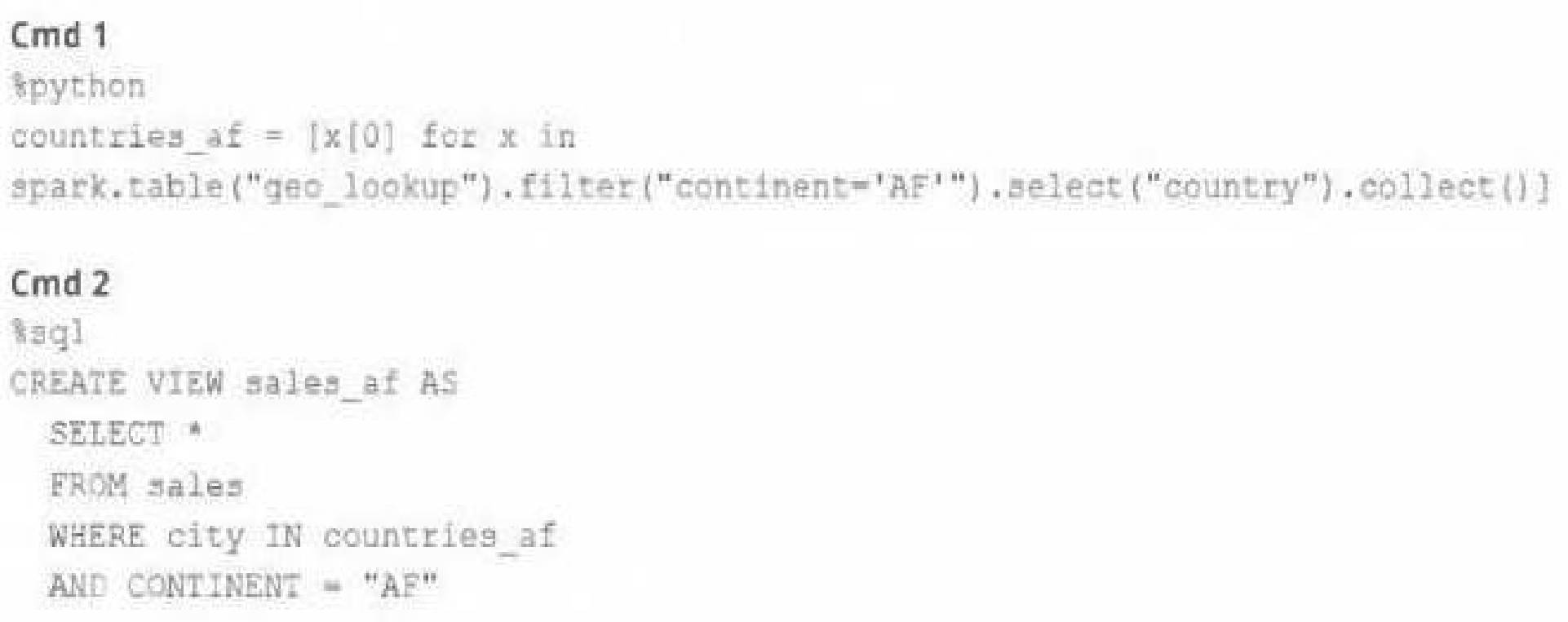
A junior member of the data engineering team is exploring the language interoperability of Databricks notebooks. The intended outcome of the below code is to register a view of all sales that occurred in countries on the continent of Africa that appear in the geo_lookup table. Before executing the code, running SHOW TABLES on the current database indicates the database
contains only two tables: geo_lookup and sales.
Which statement correctly describes the outcome of executing these command cells in order in an interactive notebook?
Select the answer:Select the answer
1 correct answer
A.
Both commands will succeed. Executing show tables will show that countries at and sales at have been registered as views.
B.
Cmd 1 will succeed. Cmd 2 will search all accessible databases for a table or view named countries af: if this entity exists, Cmd 2 will succeed.
C.
Cmd 1 will succeed and Cmd 2 will fail, countries at will be a Python variable representing a PySpark DataFrame.
D.
Both commands will fail. No new variables, tables, or views will be created.
E.
Cmd 1 will succeed and Cmd 2 will fail, countries at will be a Python variable containing a list of strings.
This is the correct answer because Cmd 1 is written in Python and uses a list comprehension to extract the country names from the geo_lookup table and store them in a Python variable named countries af. This variable will contain a list of strings, not a PySpark DataFrame or a SQL view. Cmd 2 is written in SQL and tries to create a view named sales af by selecting from the sales table where city is in countries af. However, this command will fail because countries af is not a valid SQL entity and cannot be used in a SQL query. To fix this, a better approach would be to use spark.sql() to execute a SQL query in Python and pass the countries af variable as a parameter. Verified Reference: [Databricks Certified Data Engineer Professional], under “Language Interoperability” section; Databricks Documentation, under “Mix languages” section.
Right Answer: E
Quiz
Question 10/1010/10
A Delta table of weather records is partitioned by date and has the below schema: date DATE, device_id INT, temp FLOAT, latitude FLOAT, longitude FLOAT To find all the records from within the Arctic Circle, you execute a query with the below filter: latitude > 66.3 Which statement describes how the Delta engine identifies which files to load?
Select the answer:Select the answer
1 correct answer
A.
All records are cached to an operational database and then the filter is applied
B.
The Parquet file footers are scanned for min and max statistics for the latitude column
C.
All records are cached to attached storage and then the filter is applied
D.
The Delta log is scanned for min and max statistics for the latitude column
E.
The Hive metastore is scanned for min and max statistics for the latitude column
Option D is correct. This is the correct answer because Delta Lake uses a transaction log to store metadata about each table, including min and max statistics for each column in each data file. The Delta engine can use this information to quickly identify which files to load based on a filter condition, without scanning the entire table or the file footers. This is called data skipping and it can improve query performance significantly. Verified Reference: [Databricks Certified Data Engineer Professional], under “Delta Lake” section; [Databricks Documentation], under “Optimizations - Data Skipping” section. In the Transaction log, Delta Lake captures statistics for each data file of the table. These statistics indicate per file: - Total number of records - Minimum value in each column of the first 32 columns of the table - Maximum value in each column of the first 32 columns of the table - Null value counts for in each column of the first 32 columns of the table When a query with a selective filter is executed against the table, the query optimizer uses these statistics to generate the query result. it leverages them to identify data files that may contain records matching the conditional filter. For the SELECT query in the question, The transaction log is scanned for min and max statistics for the price column
Certified-Data-Engineer-Professional: Certified Data Engineer Professional Practice test unlocks all online simulator questions
Thank you for choosing the free version of the Certified-Data-Engineer-Professional: Certified Data Engineer Professional practice test! Further deepen your knowledge on Databricks Simulator; by unlocking the full version of our Certified-Data-Engineer-Professional: Certified Data Engineer Professional Simulator you will be able to take tests with over 120 constantly updated questions and easily pass your exam. 98% of people pass the exam in the first attempt after preparing with our 120 questions.
What to expect from our Certified-Data-Engineer-Professional: Certified Data Engineer Professional practice tests and how to prepare for any exam?
The Certified-Data-Engineer-Professional: Certified Data Engineer Professional Simulator Practice Tests are part of the Databricks Database and are the best way to prepare for any Certified-Data-Engineer-Professional: Certified Data Engineer Professional exam. The Certified-Data-Engineer-Professional: Certified Data Engineer Professional practice tests consist of 120 questions and are written by experts to help you and prepare you to pass the exam on the first attempt. The Certified-Data-Engineer-Professional: Certified Data Engineer Professional database includes questions from previous and other exams, which means you will be able to practice simulating past and future questions. Preparation with Certified-Data-Engineer-Professional: Certified Data Engineer Professional Simulator will also give you an idea of the time it will take to complete each section of the Certified-Data-Engineer-Professional: Certified Data Engineer Professional practice test . It is important to note that the Certified-Data-Engineer-Professional: Certified Data Engineer Professional Simulator does not replace the classic Certified-Data-Engineer-Professional: Certified Data Engineer Professional study guides; however, the Simulator provides valuable insights into what to expect and how much work needs to be done to prepare for the Certified-Data-Engineer-Professional: Certified Data Engineer Professional exam.
Certified-Data-Engineer-Professional: Certified Data Engineer Professional Practice test therefore represents an excellent tool to prepare for the actual exam together with our Databricks practice test . Our Certified-Data-Engineer-Professional: Certified Data Engineer Professional Simulator will help you assess your level of preparation and understand your strengths and weaknesses. Below you can read all the quizzes you will find in our Certified-Data-Engineer-Professional: Certified Data Engineer Professional Simulator and how our unique Certified-Data-Engineer-Professional: Certified Data Engineer Professional Database made up of real questions:
Info quiz:
Quiz name:Certified-Data-Engineer-Professional: Certified Data Engineer Professional
Total number of questions:120
Number of questions for the test:50
Pass score:80%
You can prepare for the Certified-Data-Engineer-Professional: Certified Data Engineer Professional exams with our mobile app. It is very easy to use and even works offline in case of network failure, with all the functions you need to study and practice with our Certified-Data-Engineer-Professional: Certified Data Engineer Professional Simulator.
Use our Mobile App, available for both Android and iOS devices, with our Certified-Data-Engineer-Professional: Certified Data Engineer Professional Simulator . You can use it anywhere and always remember that our mobile app is free and available on all stores.
Our Mobile App contains all Certified-Data-Engineer-Professional: Certified Data Engineer Professional practice tests which consist of 120 questions and also provide study material to pass the final Certified-Data-Engineer-Professional: Certified Data Engineer Professional exam with guaranteed success.
Our Certified-Data-Engineer-Professional: Certified Data Engineer Professional database contain hundreds of questions and Databricks Tests related to Certified-Data-Engineer-Professional: Certified Data Engineer Professional Exam. This way you can practice anywhere you want, even offline without the internet.