The new flashcard feature is useful to memorize questions.
?Change your study mode
At any time, you can change the study mode, and alternate between the practice mode and the exam mode. In practice mode, you can configure for example the number of questions or tests, and other parameters to help you study.
Randomized | 10 Questions per Test | 20 Minutes | 70% to pass|
To re-configure your study mode again and change - for example - the number of tests, whether you have random questions and all other configuration parameters.
?Simulator Configuration
Auto-scroll: You can use the automatic scrolling of the questionnaire that occurs as soon as you answer one or all of the answers to a question correctly. Auto scrolling is activated if you answer a single answer, or as soon as you answer all the mandatory answers. Learning Mode: During learning mode you can get a real time result for your answer.
Free Test
Question: / 10
20:00Min. left
?Restart the current test
To restart the current test by clearing all your answers and the time used up to now. Warning: all answers will be lost.
Question: / 10
4.6(638 Votes)
Quiz
Question 1/101/10
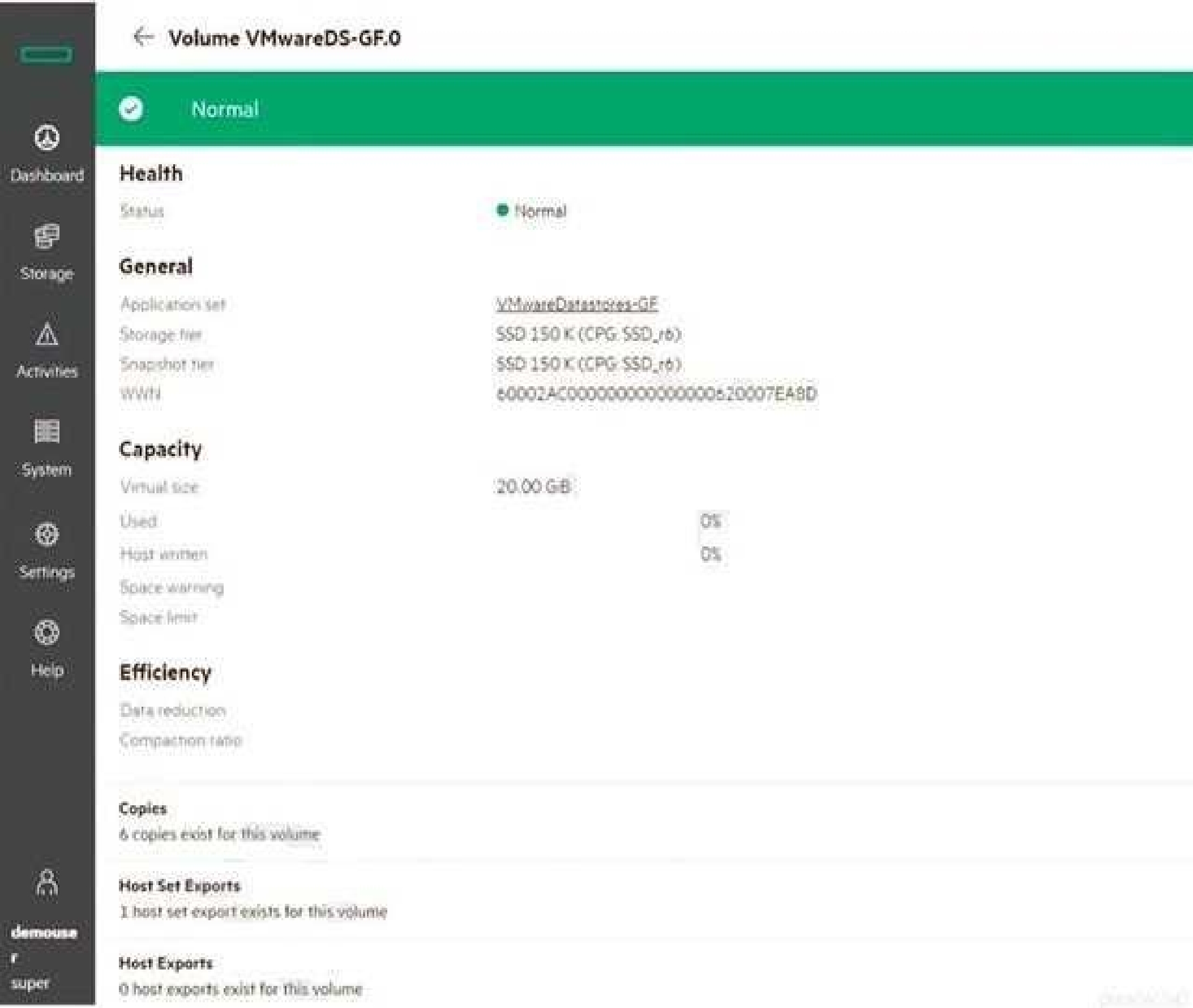
Refer to the exhibit.
You are configuring a new HPE array and verifying properties of a set of volumes. Which RAID level is used on the VMwareDatastores-GF volume?
Select the answer:Select the answer
1 correct answer
A.
RAID 0
B.
RAID 6
C.
Triple Parity+
D.
RAID 5
The exhibit refers to a configuration scenario where properties of a volume set, specifically VMwareDatastores-GF, are being verified. The question focuses on identifying the RAID level used on this volume. RAID 5 is a common configuration in many storage arrays because it provides a balance of performance, capacity, and data protection. In RAID 5, data is striped across multiple disks with parity information distributed among the disks. This parity allows for the recovery of data in the event of a single disk failure, making it a preferred choice for environments that require efficient storage utilization with a degree of fault tolerance. HPE storage solutions, such as HPE Nimble Storage and HPE 3PAR, often employ RAID 5 for use cases involving virtualized environments like VMware datastores. These solutions are optimized for high performance and data protection, ensuring that even with a single drive failure, the data remains accessible and the system can continue to operate without significant performance degradation. Reference: HPE Storage Products HPE Flash and Hybrid Storage HPE Nimble Storage These resources provide comprehensive information on HPE's RAID configurations, data protection mechanisms, and how they integrate with enterprise storage environments.
Right Answer: D
Quiz
Question 2/102/10
You have proposed that a customer replace their legacy SAN switches with new ?-Series switches. They are concerned about the management of all the devices, so you have included SANnav in the proposal. What are the benefits of SANnav that you should emphasize to this customer? (Choose two.)
Select multiple answer: (Choose 2)Select the answer
2 correct answers
A.
It runs in a dedicated JVM
B.
It offers automated SPOCK validation
C.
It runs in a browser
D.
It provides a global View
E.
It provides fine-grain visibility into Storage Fabrics (FC + Ethernet)
Right Answer: D, E
Quiz
Question 3/103/10
A customer has completely virtualized their datacenter with VMware. You propose a SimpliVity solution to replace their aging hardware. Which SimpliVity features should you emphasize in your presentation? (Choose two.)
Select multiple answer: (Choose 2)Select the answer
2 correct answers
A.
It uses native hypervisor management tools for management
B.
It utilizes the Storage Management Utility for management and monitoring
C.
It utilizes a unified ASIC for performance
D.
It includes deduplication and backup capabilities
E.
It provides S3 file access
When proposing a SimpliVity solution for a customer who has fully virtualized their datacenter with VMware, it is essential to highlight the features that will offer the most value in a virtualized environment. Native Hypervisor Management Tools: SimpliVity integrates seamlessly with existing hypervisor management tools, such as VMware vCenter, allowing customers to manage their virtualized infrastructure using familiar interfaces. This integration simplifies operations and reduces the learning curve for IT staff. Deduplication and Backup Capabilities: SimpliVity's built-in data efficiency features, including inline deduplication, compression, and optimization, significantly reduce the amount of data stored and transferred. This results in cost savings and improved backup performance, which are critical in a virtualized environment where storage efficiency is paramount. These features directly address the needs of a virtualized datacenter, providing enhanced data protection, simplified management, and improved performance. Reference: HPE SimpliVity Overview HPE SimpliVity for Virtualized Environments
Right Answer: A, D
Quiz
Question 4/104/10
You want to deploy Recovery Manager Central to a customer environment. How can you accomplish this? (Choose two.)
Select multiple answer: (Choose 2)Select the answer
2 correct answers
A.
Install RMC on top of the virtual or physical RHEL system using the GUI wizard
B.
Deploy an RMC virtual appliance to Microsoft Hyper-V hypervisor
C.
Deploy RMC on top of the virtual CentOS system using the CLI
D.
Deploy RMC on top of the virtual CentOS system using the GUI wizard
E.
Install RMC on the top of the virtual or physical RHEL system using the CLI
F.
Deploy an RMC virtual appliance to VMware ESXi hypervisor
Recovery Manager Central (RMC) is a powerful tool that integrates with HPE storage solutions to provide efficient and effective data protection. When deploying RMC in a customer environment, there are multiple options available depending on the infrastructure: Installing RMC on RHEL Systems: RMC can be installed on top of a virtual or physical Red Hat Enterprise Linux (RHEL) system using the GUI wizard. This method is user-friendly and offers flexibility in deployment across different types of RHEL environments. Deploying RMC on VMware ESXi: Another common deployment method is to deploy the RMC as a virtual appliance on a VMware ESXi hypervisor. This allows for seamless integration with virtualized environments, providing comprehensive data protection capabilities. These deployment options provide flexibility for various customer environments, ensuring that RMC can be effectively integrated into their existing infrastructure. Reference: HPE Recovery Manager Central (RMC) HPE RMC Deployment Guide
Right Answer: A, F
Quiz
Question 5/105/10
A customer uses Veeam to backup their entire datacenter. Which Veeam feature allows them to recover a single email from their Exchange server?
Select the answer:Select the answer
1 correct answer
A.
Changed block tracking
B.
Explorer for Storage Snapshots
C.
Data Mover Service
D.
SureBackup
Veeam's integration with HPE storage solutions, particularly in backup and recovery scenarios, includes features that allow granular recovery of data, such as individual emails. Explorer for Storage Snapshots is a feature within Veeam that enables customers to perform granular recovery from storage snapshots, including individual items such as emails from an Exchange server. This feature is crucial for minimizing downtime and ensuring quick recovery of specific data without the need to restore entire databases or systems. This capability provides an efficient and user-friendly way to handle data recovery tasks, which is particularly valuable in environments where data availability and quick recovery are critical. Reference: Veeam and HPE Integration Veeam Explorer for Storage Snapshots
Right Answer: B
Quiz
Question 6/106/10
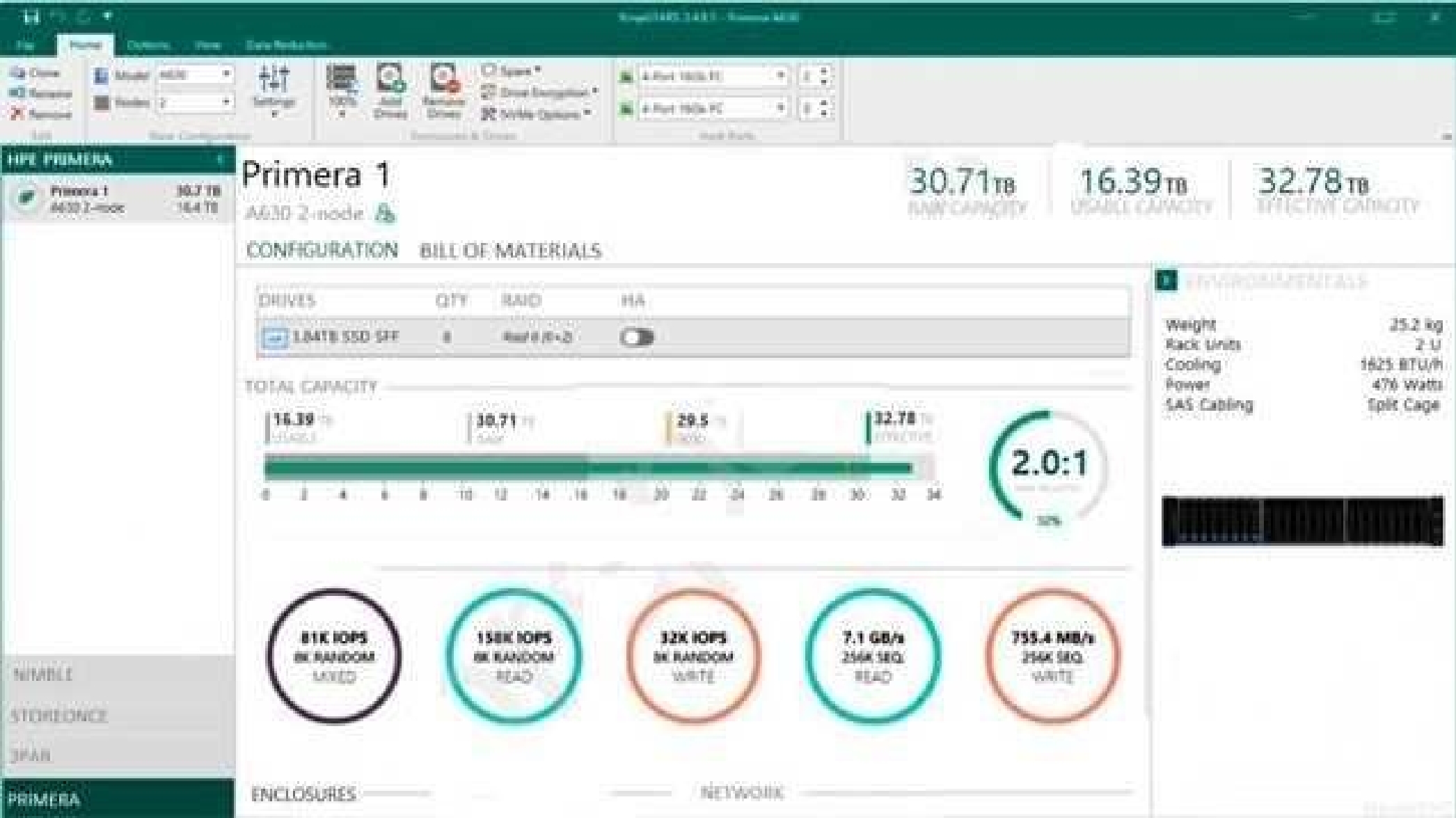
Refer to the exhibit.
You are designing a new Primera solution and demonstrating performance numbers to the customer. The customer reviews the configuration and requests a change to the configuration that will increase Random Write IOPS. Which action will satisfy the customer request?
Select the answer:Select the answer
1 correct answer
A.
Add more disks of smaller capacity
B.
Upgrade the HPE Primera base model
C.
Change to larger SSDs
D.
Add more FC Ports
In the scenario presented, the customer requests an increase in Random Write IOPS for their HPE Primera solution. To achieve this, adding more disks of smaller capacity is the most effective approach (Option A). By increasing the number of disks, the storage system can distribute the write operations across more disks, thereby reducing the write latency and improving the overall Random Write IOPS performance. Smaller capacity disks typically allow for better IOPS performance per GB due to their higher spindle speed and lower data density, which reduces seek times. This strategy also aligns with best practices in storage design, where increasing the number of spindles (disks) generally enhances the performance of random workloads, particularly in write- intensive environments. Reference: HPE Primera Overview HPE Storage Products Overview HPE Flash and Hybrid Storage Solutions
Right Answer: A
Quiz
Question 7/107/10
Which of the following are part of the SimpliVity Data Virtualization Platform architecture? (Choose two.)
Select multiple answer: (Choose 2)Select the answer
2 correct answers
A.
Presentation Layer
B.
User Management Layer
C.
Security Layer
D.
Data Management Layer
The HPE SimpliVity Data Virtualization Platform is designed with a modular architecture that includes several key layers. Among these, the Presentation Layer and the Data Management Layer are fundamental components (Options A and D). The Presentation Layer is responsible for the user interface and the interaction between the user and the system. It provides the tools necessary for administrators to manage and monitor the storage environment efficiently. The Data Management Layer handles the core functions of the SimpliVity platform, including data deduplication, compression, and optimization. This layer ensures that data is stored and managed efficiently, reducing storage costs and improving performance. These layers work together to deliver the full capabilities of the SimpliVity platform, enabling simplified management and robust data services in a hyper-converged infrastructure environment. Reference: HPE SimpliVity Overview HPE SimpliVity Data Virtualization
Right Answer: A, D
Quiz
Question 8/108/10
A customer is implementing a new high performance database environment. What type of storage should you recommend?
Select the answer:Select the answer
1 correct answer
A.
scale-out storage
B.
object store
C.
system-defined storage
D.
network-attached storage
For a high-performance database environment, scale-out storage (Option A) is the recommended solution. Scale-out storage architectures allow for the expansion of storage capacity and performance by adding more nodes to the storage cluster. This approach provides linear scalability, enabling the environment to grow as the database's demands increase. It is particularly effective for high-performance workloads because it balances the load across multiple nodes, reducing bottlenecks and ensuring consistent performance. Scale-out storage also supports high availability and resilience, which are critical for maintaining uptime and reliability in database environments that require rapid data access and processing. Reference: HPE Scale-Out Storage Solutions HPE Storage Overview ==================
Right Answer: A
Quiz
Question 9/109/10
You are designing a new enterprise array solution. The customer is interested in a caching tier that provides extremely low-latency and persistent storage at the same time. They also need to support more than 500GB. Which technology should you recommend?
Select the answer:Select the answer
1 correct answer
A.
DRAM
B.
SRAM
C.
NVMe SCM
D.
NAND SSD
For the customer requiring a caching tier that offers extremely low-latency and persistent storage, NVMe Storage Class Memory (SCM) (Option C) is the ideal technology. NVMe SCM provides the performance characteristics of DRAM with the persistence of traditional storage, making it suitable for caching applications where ultra-low latency is crucial. NVMe SCM also supports capacities exceeding 500GB, which aligns with the customer's requirement. This technology is particularly advantageous in environments where quick access to data is critical, such as in financial services or real-time analytics applications. It bridges the gap between volatile DRAM and slower NAND SSDs, providing a highly responsive and durable storage solution. Reference: HPE NVMe Storage Solutions HPE Storage Class Memory
Right Answer: C
Quiz
Question 10/1010/10
A customer is implementing an SAP HANA environment and is looking for an alternative to an entirely in-memory database. Which storage technology should you recommend?
Select the answer:Select the answer
1 correct answer
A.
SAS SSD
B.
NVMe SSD
C.
NVMe SCM
D.
Intel Optane
In an SAP HANA environment, the speed and latency of storage are critical for performance, especially when dealing with large datasets. While SAP HANA is designed to run entirely in memory, some customers may seek alternatives that offer a balance between performance and cost. NVMe SCM (Storage Class Memory) is a cutting-edge storage technology that offers extremely low latency and high performance, making it an ideal alternative for environments like SAP HANA. NVMe SCM provides faster data access speeds than traditional SSDs and even NVMe SSDs, making it a perfect fit for workloads that demand high-speed data processing, such as SAP HANA. Reference: HPE Storage for SAP HANA HPE NVMe Storage Solutions
HPE0-J68: HPE Storage Solutions Practice test unlocks all online simulator questions
Thank you for choosing the free version of the HPE0-J68: HPE Storage Solutions practice test! Further deepen your knowledge on HP Simulator; by unlocking the full version of our HPE0-J68: HPE Storage Solutions Simulator you will be able to take tests with over 280 constantly updated questions and easily pass your exam. 98% of people pass the exam in the first attempt after preparing with our 280 questions.
What to expect from our HPE0-J68: HPE Storage Solutions practice tests and how to prepare for any exam?
The HPE0-J68: HPE Storage Solutions Simulator Practice Tests are part of the HP Database and are the best way to prepare for any HPE0-J68: HPE Storage Solutions exam. The HPE0-J68: HPE Storage Solutions practice tests consist of 280 questions and are written by experts to help you and prepare you to pass the exam on the first attempt. The HPE0-J68: HPE Storage Solutions database includes questions from previous and other exams, which means you will be able to practice simulating past and future questions. Preparation with HPE0-J68: HPE Storage Solutions Simulator will also give you an idea of the time it will take to complete each section of the HPE0-J68: HPE Storage Solutions practice test . It is important to note that the HPE0-J68: HPE Storage Solutions Simulator does not replace the classic HPE0-J68: HPE Storage Solutions study guides; however, the Simulator provides valuable insights into what to expect and how much work needs to be done to prepare for the HPE0-J68: HPE Storage Solutions exam.
HPE0-J68: HPE Storage Solutions Practice test therefore represents an excellent tool to prepare for the actual exam together with our HP practice test . Our HPE0-J68: HPE Storage Solutions Simulator will help you assess your level of preparation and understand your strengths and weaknesses. Below you can read all the quizzes you will find in our HPE0-J68: HPE Storage Solutions Simulator and how our unique HPE0-J68: HPE Storage Solutions Database made up of real questions:
Info quiz:
Quiz name:HPE0-J68: HPE Storage Solutions
Total number of questions:280
Number of questions for the test:50
Pass score:80%
You can prepare for the HPE0-J68: HPE Storage Solutions exams with our mobile app. It is very easy to use and even works offline in case of network failure, with all the functions you need to study and practice with our HPE0-J68: HPE Storage Solutions Simulator.
Use our Mobile App, available for both Android and iOS devices, with our HPE0-J68: HPE Storage Solutions Simulator . You can use it anywhere and always remember that our mobile app is free and available on all stores.
Our Mobile App contains all HPE0-J68: HPE Storage Solutions practice tests which consist of 280 questions and also provide study material to pass the final HPE0-J68: HPE Storage Solutions exam with guaranteed success.
Our HPE0-J68: HPE Storage Solutions database contain hundreds of questions and HP Tests related to HPE0-J68: HPE Storage Solutions Exam. This way you can practice anywhere you want, even offline without the internet.