Quiz AB-620: Designing and Building Integrated AI Agent Solutions in Copilot Studio
Quiz
Background
Current Environment:
Fabrikam Inc. is a Canada-based manufacturer with a growing service organization that supports field
technicians and internal operations teams. Fabrikam Inc. plans to launch a new internal agent
solution named Operations Concierge to reduce time spent
searching policy content, retrieving operational metrics, and executing routine transactions.
The agent will be used by three groups:
Service coordinators who triage incoming service requests
Field technicians who need guided procedures and parts availability
Operations managers who monitor KPIs and exceptions
The agent solution must work in real-world operational conditions. Users often ask questions mid-
call with a customer or while
coordinating parts shipments. The agents require quick, reliable outcomes. As a result, Fabrikam Inc.
requires the solution to:
Provide grounded answers with traceability when it provides guidance.
Retrieve real-time metrics when users ask for operational status,
Execute authenticated updates when users initiate a flow (such as creating a parts request).
Fabrikam Inc. also expects the solution to be maintained by multiple makers and developers across
the year. The company has experienced duplicated logic and inconsistent behavior across different
agents. This project emphasizes reuse, governance, and maintainability across teams.
Business Requirements:
Fabrikam Inc. runs three Microsoft Power Platform environments for agent development and
release: Dev, Test, and Prod.
The team plans to build the agent and validate it in Dev and Test, then promote to Prod by using a
controlled release process that supports repeatable deployments.
Fabrikam Inc. already has two assets the team wants to reuse:
A partially completed Copilot Studio agent named Service Desk Agent, used by IT to create internal
tickets and route requests
A Microsoft Foundry agent created by a central AI team that performs specialized summarization and
classification for long-form text (for example, summarizing call transcripts into an incident narrative)
Fabrikam Inc. also has operational and knowledge data sources:
A curated policy library (internal SOPs, service warranty rules, escalation criteria, and standard
operating procedures)
A set of indexed documents and procedures in an Azure AI Search service that supports vector search
for the policy library
A Microsoft Fabric workspace that includes a semantic model used by operations leadership for
reporting
Business Requirements:
Fabrikam Inc. requires Operations Concierge to meet the following business requirements:
Traceability requirement: When the agent provides policy guidance or procedural recommendations,
users must be able to see where the answer came from.
Metrics requirement: When users ask about service performance (backlog, SLA risk, parts shortages,
dispatch delays), the solution must return up-to-date metrics in a structured format that operations
managers can use in weekly reviews.
Transaction requirement: The solution must support authenticated updates initiated during
conversations, including creating a parts request and updating a service case status.
In addition, Fabrikam Inc. wants to avoid duplicating common assets across agents:
The team must reuse the same set of escalation topics, MCP tool definitions, and a standard safety
disclaimer across three different agents.
Only the platform engineering group is allowed to edit shared assets. However, all agent authors
must be able to use them.
Technical Requirements:
The Fabrikam Inc.'s solution architecture uses a multi-agent approach so that specialist
responsibilities are isolated and can evolve independently.
The Operations Concierge (primary agent) must coordinate the following specialist capabilities:
Policy and procedure Q&A: Use an enterprise knowledge source that supports indexed retrieval
across the curated policy library and service procedures.
Operational metrics: Delegate metric queries to a Fabric Data Agent that reads governed business
data through the Fabric semantic model.
Authenticated updates: Use tools exposed by an existing internal Model Context Protocol (MCP)
server that provides transactional operations for the service organization.
Specialized processing: Delegate summarization and classification requests to an existing Microsoft
Foundry agent.
Fabrikam Inc. will onboard two MCP servers as tools:
PartsOps MCP server: exposes tools for parts availability checks and parts request creation. The
server requires per-user authentication because actions must be traceable to the requesting user.
WarrantyRules MCP server: exposes a read-only tool for validating warranty coverage. The server
uses an API key shared by the agent team.
Fabrikam Inc. has also defined a collaboration requirement with the existing Service Desk Agent:
The primary agent must delegate IT-specific requests to the existing Service Desk Agent rather than
reimplement ticket creation logic.
Finally, Fabrikam Inc. plans to support a partner integration:
For shipment tracking inquiries, Fabrikam Inc. will delegate to a partner-provided agent that is only
available through a standardized agent-to-agent endpoint.
Issues and constraints
During early testing, Fabrikam Inc. found three recurring problems:
Makers are copying and modifying the same components across agents, resulting in inconsistent
disclaimers and duplicated tools.
Users can obtain a correct answer, but the response is not consistently traceable to a source when
the agent uses knowledge.
The primary agent can route some requests, but specialist capabilities are not consistently delegated
(for example, some metric questions are answered generatively instead of being routed to the Fabric
Data Agent).
You are part of the engineering team responsible for correcting the design and configuration to meet
the preceding requirements and constraints.
Inc.'s defined architecture and business requirements
Which capability should Operations Concierge use?
Quiz
Background
Current Environment:
Fabrikam Inc. is a Canada-based manufacturer with a growing service organization that supports field
technicians and internal operations teams. Fabrikam Inc. plans to launch a new internal agent
solution named Operations Concierge to reduce time spent
searching policy content, retrieving operational metrics, and executing routine transactions.
The agent will be used by three groups:
Service coordinators who triage incoming service requests
Field technicians who need guided procedures and parts availability
Operations managers who monitor KPIs and exceptions
The agent solution must work in real-world operational conditions. Users often ask questions mid-
call with a customer or while
coordinating parts shipments. The agents require quick, reliable outcomes. As a result, Fabrikam Inc.
requires the solution to:
Provide grounded answers with traceability when it provides guidance.
Retrieve real-time metrics when users ask for operational status,
Execute authenticated updates when users initiate a flow (such as creating a parts request).
Fabrikam Inc. also expects the solution to be maintained by multiple makers and developers across
the year. The company has experienced duplicated logic and inconsistent behavior across different
agents. This project emphasizes reuse, governance, and maintainability across teams.
Business Requirements:
Fabrikam Inc. runs three Microsoft Power Platform environments for agent development and
release: Dev, Test, and Prod.
The team plans to build the agent and validate it in Dev and Test, then promote to Prod by using a
controlled release process that supports repeatable deployments.
Fabrikam Inc. already has two assets the team wants to reuse:
A partially completed Copilot Studio agent named Service Desk Agent, used by IT to create internal
tickets and route requests
A Microsoft Foundry agent created by a central AI team that performs specialized summarization and
classification for long-form text (for example, summarizing call transcripts into an incident narrative)
Fabrikam Inc. also has operational and knowledge data sources:
A curated policy library (internal SOPs, service warranty rules, escalation criteria, and standard
operating procedures)
A set of indexed documents and procedures in an Azure AI Search service that supports vector search
for the policy library
A Microsoft Fabric workspace that includes a semantic model used by operations leadership for
reporting
Business Requirements:
Fabrikam Inc. requires Operations Concierge to meet the following business requirements:
Traceability requirement: When the agent provides policy guidance or procedural recommendations,
users must be able to see where the answer came from.
Metrics requirement: When users ask about service performance (backlog, SLA risk, parts shortages,
dispatch delays), the solution must return up-to-date metrics in a structured format that operations
managers can use in weekly reviews.
Transaction requirement: The solution must support authenticated updates initiated during
conversations, including creating a parts request and updating a service case status.
In addition, Fabrikam Inc. wants to avoid duplicating common assets across agents:
The team must reuse the same set of escalation topics, MCP tool definitions, and a standard safety
disclaimer across three different agents.
Only the platform engineering group is allowed to edit shared assets. However, all agent authors
must be able to use them.
Technical Requirements:
The Fabrikam Inc.'s solution architecture uses a multi-agent approach so that specialist
responsibilities are isolated and can evolve independently.
The Operations Concierge (primary agent) must coordinate the following specialist capabilities:
Policy and procedure Q&A: Use an enterprise knowledge source that supports indexed retrieval
across the curated policy library and service procedures.
Operational metrics: Delegate metric queries to a Fabric Data Agent that reads governed business
data through the Fabric semantic model.
Authenticated updates: Use tools exposed by an existing internal Model Context Protocol (MCP)
server that provides transactional operations for the service organization.
Specialized processing: Delegate summarization and classification requests to an existing Microsoft
Foundry agent.
Fabrikam Inc. will onboard two MCP servers as tools:
PartsOps MCP server: exposes tools for parts availability checks and parts request creation. The
server requires per-user authentication because actions must be traceable to the requesting user.
WarrantyRules MCP server: exposes a read-only tool for validating warranty coverage. The server
uses an API key shared by the agent team.
Fabrikam Inc. has also defined a collaboration requirement with the existing Service Desk Agent:
The primary agent must delegate IT-specific requests to the existing Service Desk Agent rather than
reimplement ticket creation logic.
Finally, Fabrikam Inc. plans to support a partner integration:
For shipment tracking inquiries, Fabrikam Inc. will delegate to a partner-provided agent that is only
available through a standardized agent-to-agent endpoint.
Issues and constraints
During early testing, Fabrikam Inc. found three recurring problems:
Makers are copying and modifying the same components across agents, resulting in inconsistent
disclaimers and duplicated tools.
Users can obtain a correct answer, but the response is not consistently traceable to a source when
the agent uses knowledge.
The primary agent can route some requests, but specialist capabilities are not consistently delegated
(for example, some metric questions are answered generatively instead of being routed to the Fabric
Data Agent).
You are part of the engineering team responsible for correcting the design and configuration to meet
the preceding requirements and constraints.
You need to design a solution that provides Fabrikam Inc. with a multi-agent design approach with
existing agents.
Which approach should you use for each requirement? To answer, move the appropriate approaches
to the correct requirements. You may use each approach once, more than once, or not at all. You may
need to move the split bar between panes or scroll to view content.
NOTE: Each correct selection is worth one point.

data-access agent; Transaction requirements → Delegate to a tools-first agent.
Comprehensive and Detailed Explanation From Microsoft AB-620 Study Guide: The architecture
should separate responsibilities according to the kind of work each specialist performs. Policy and
procedure questions depend on retrieval from curated, indexed content and therefore belong with a
knowledge-focused agent. Operational measures such as backlog, SLA exposure, and parts shortages
require governed, current business data; a data-access specialist, represented in this case by the
Fabric Data Agent, is the correct destination. Creating a parts request or changing a service-case
status is different from answering a questio n: it is an authenticated transaction and should be
delegated to a tools-first agent that can invoke approved MCP operations. Putting all three
responsibilities into one agent would increase the number of competing tools and knowledge
sources, weaken routing precision, and duplicate logic already owned by specialist teams. The
selected pattern also matches Fabrikam's requirement that capabilities evolve independently. Clear
names, descriptions, inputs, and outputs remain essential because generative orchestration uses
that metadata to decide which connected agent to invoke. This division gives the primary agent a
coordination role while each specialist retains its own knowledge, privileges, release lifecycle, and
audit boundary. Study Guide alignment: Integrate and extend agents in Copilot Studio > Configure
multi-agent collaboration from Copilot Studio > Design multi-agent solutions in Copilot Studio
Quiz
Background
Current Environment:
Fabrikam Inc. is a Canada-based manufacturer with a growing service organization that supports field
technicians and internal operations teams. Fabrikam Inc. plans to launch a new internal agent
solution named Operations Concierge to reduce time spent
searching policy content, retrieving operational metrics, and executing routine transactions.
The agent will be used by three groups:
Service coordinators who triage incoming service requests
Field technicians who need guided procedures and parts availability
Operations managers who monitor KPIs and exceptions
The agent solution must work in real-world operational conditions. Users often ask questions mid-
call with a customer or while
coordinating parts shipments. The agents require quick, reliable outcomes. As a result, Fabrikam Inc.
requires the solution to:
Provide grounded answers with traceability when it provides guidance.
Retrieve real-time metrics when users ask for operational status,
Execute authenticated updates when users initiate a flow (such as creating a parts request).
Fabrikam Inc. also expects the solution to be maintained by multiple makers and developers across
the year. The company has experienced duplicated logic and inconsistent behavior across different
agents. This project emphasizes reuse, governance, and maintainability across teams.
Business Requirements:
Fabrikam Inc. runs three Microsoft Power Platform environments for agent development and
release: Dev, Test, and Prod.
The team plans to build the agent and validate it in Dev and Test, then promote to Prod by using a
controlled release process that supports repeatable deployments.
Fabrikam Inc. already has two assets the team wants to reuse:
A partially completed Copilot Studio agent named Service Desk Agent, used by IT to create internal
tickets and route requests
A Microsoft Foundry agent created by a central AI team that performs specialized summarization and
classification for long-form text (for example, summarizing call transcripts into an incident narrative)
Fabrikam Inc. also has operational and knowledge data sources:
A curated policy library (internal SOPs, service warranty rules, escalation criteria, and standard
operating procedures)
A set of indexed documents and procedures in an Azure AI Search service that supports vector search
for the policy library
A Microsoft Fabric workspace that includes a semantic model used by operations leadership for
reporting
Business Requirements:
Fabrikam Inc. requires Operations Concierge to meet the following business requirements:
Traceability requirement: When the agent provides policy guidance or procedural recommendations,
users must be able to see where the answer came from.
Metrics requirement: When users ask about service performance (backlog, SLA risk, parts shortages,
dispatch delays), the solution must return up-to-date metrics in a structured format that operations
managers can use in weekly reviews.
Transaction requirement: The solution must support authenticated updates initiated during
conversations, including creating a parts request and updating a service case status.
In addition, Fabrikam Inc. wants to avoid duplicating common assets across agents:
The team must reuse the same set of escalation topics, MCP tool definitions, and a standard safety
disclaimer across three different agents.
Only the platform engineering group is allowed to edit shared assets. However, all agent authors
must be able to use them.
Technical Requirements:
The Fabrikam Inc.'s solution architecture uses a multi-agent approach so that specialist
responsibilities are isolated and can evolve independently.
The Operations Concierge (primary agent) must coordinate the following specialist capabilities:
Policy and procedure Q&A: Use an enterprise knowledge source that supports indexed retrieval
across the curated policy library and service procedures.
Operational metrics: Delegate metric queries to a Fabric Data Agent that reads governed business
data through the Fabric semantic model.
Authenticated updates: Use tools exposed by an existing internal Model Context Protocol (MCP)
server that provides transactional operations for the service organization.
Specialized processing: Delegate summarization and classification requests to an existing Microsoft
Foundry agent.
Fabrikam Inc. will onboard two MCP servers as tools:
PartsOps MCP server: exposes tools for parts availability checks and parts request creation. The
server requires per-user authentication because actions must be traceable to the requesting user.
WarrantyRules MCP server: exposes a read-only tool for validating warranty coverage. The server
uses an API key shared by the agent team.
Fabrikam Inc. has also defined a collaboration requirement with the existing Service Desk Agent:
The primary agent must delegate IT-specific requests to the existing Service Desk Agent rather than
reimplement ticket creation logic.
Finally, Fabrikam Inc. plans to support a partner integration:
For shipment tracking inquiries, Fabrikam Inc. will delegate to a partner-provided agent that is only
available through a standardized agent-to-agent endpoint.
Issues and constraints
During early testing, Fabrikam Inc. found three recurring problems:
Makers are copying and modifying the same components across agents, resulting in inconsistent
disclaimers and duplicated tools.
Users can obtain a correct answer, but the response is not consistently traceable to a source when
the agent uses knowledge.
The primary agent can route some requests, but specialist capabilities are not consistently delegated
(for example, some metric questions are answered generatively instead of being routed to the Fabric
Data Agent).
You are part of the engineering team responsible for correcting the design and configuration to meet
the preceding requirements and constraints.
You need to configure generative answers so the agent meets Fabrikam Inc.'s business requirements
Which solutions should you use? To answer, move the appropriate solutions to the correct
requirements. You may use each solution once, more than once, or not at all. You may need to move
the split bar between panes or scroll to view content.
NOTE: Each correct selection is worth one point.

from the centralized index → Configure Azure AI Search as the grounding data source; Use an
enterprise-approved foundation model → Select a model from the Foundry model catalog.
Comprehensive and Detailed Explanation From Microsoft AB-620 Study Guide: Each requirement is
controlled by a different configuration layer. Source traceability is a presentation and grounding
requirement, so citations must be enabled or explicitly required for knowledge-based responses.
That allows users to inspect the material used to support a policy answer; it is not achieved merely
by choosing a model. Centralized retrieval is provided by connecting the existing Azure AI Search
vector index as the knowledge source. This preserves the curated index, semantic or vector retrieval
behavior, and enterprise management of the policy corpus instead of copying documents into the
agent. Model governance is handled in the prompt configuration by selecting the approved model
from the Microsoft Foundry model catalog. Publishing does not automatically replace an unapproved
model, and Azure AI Search does not enforce the foundation-model selection. Together, the three
settings form a complete RAG path: Azure AI Search retrieves authoritative passages, the governed
model produces the response, and citation settings expose provenance. The configuration should
then be tested with representative policy questions to confirm that the response is grounded and
that the cited source actually supports the answer. Study Guide alignment: Integrate and extend
agents in Copilot Studio > Integrate agents with Azure > Configure generative answers by using Azure
AI Search with Foundry; Configure custom prompts to use the Foundry model catalog.
===============
Quiz
Background
Current Environment:
Fabrikam Inc. is a Canada-based manufacturer with a growing service organization that supports field
technicians and internal operations teams. Fabrikam Inc. plans to launch a new internal agent
solution named Operations Concierge to reduce time spent
searching policy content, retrieving operational metrics, and executing routine transactions.
The agent will be used by three groups:
Service coordinators who triage incoming service requests
Field technicians who need guided procedures and parts availability
Operations managers who monitor KPIs and exceptions
The agent solution must work in real-world operational conditions. Users often ask questions mid-
call with a customer or while
coordinating parts shipments. The agents require quick, reliable outcomes. As a result, Fabrikam Inc.
requires the solution to:
Provide grounded answers with traceability when it provides guidance.
Retrieve real-time metrics when users ask for operational status,
Execute authenticated updates when users initiate a flow (such as creating a parts request).
Fabrikam Inc. also expects the solution to be maintained by multiple makers and developers across
the year. The company has experienced duplicated logic and inconsistent behavior across different
agents. This project emphasizes reuse, governance, and maintainability across teams.
Business Requirements:
Fabrikam Inc. runs three Microsoft Power Platform environments for agent development and
release: Dev, Test, and Prod.
The team plans to build the agent and validate it in Dev and Test, then promote to Prod by using a
controlled release process that supports repeatable deployments.
Fabrikam Inc. already has two assets the team wants to reuse:
A partially completed Copilot Studio agent named Service Desk Agent, used by IT to create internal
tickets and route requests
A Microsoft Foundry agent created by a central AI team that performs specialized summarization and
classification for long-form text (for example, summarizing call transcripts into an incident narrative)
Fabrikam Inc. also has operational and knowledge data sources:
A curated policy library (internal SOPs, service warranty rules, escalation criteria, and standard
operating procedures)
A set of indexed documents and procedures in an Azure AI Search service that supports vector search
for the policy library
A Microsoft Fabric workspace that includes a semantic model used by operations leadership for
reporting
Business Requirements:
Fabrikam Inc. requires Operations Concierge to meet the following business requirements:
Traceability requirement: When the agent provides policy guidance or procedural recommendations,
users must be able to see where the answer came from.
Metrics requirement: When users ask about service performance (backlog, SLA risk, parts shortages,
dispatch delays), the solution must return up-to-date metrics in a structured format that operations
managers can use in weekly reviews.
Transaction requirement: The solution must support authenticated updates initiated during
conversations, including creating a parts request and updating a service case status.
In addition, Fabrikam Inc. wants to avoid duplicating common assets across agents:
The team must reuse the same set of escalation topics, MCP tool definitions, and a standard safety
disclaimer across three different agents.
Only the platform engineering group is allowed to edit shared assets. However, all agent authors
must be able to use them.
Technical Requirements:
The Fabrikam Inc.'s solution architecture uses a multi-agent approach so that specialist
responsibilities are isolated and can evolve independently.
The Operations Concierge (primary agent) must coordinate the following specialist capabilities:
Policy and procedure Q&A: Use an enterprise knowledge source that supports indexed retrieval
across the curated policy library and service procedures.
Operational metrics: Delegate metric queries to a Fabric Data Agent that reads governed business
data through the Fabric semantic model.
Authenticated updates: Use tools exposed by an existing internal Model Context Protocol (MCP)
server that provides transactional operations for the service organization.
Specialized processing: Delegate summarization and classification requests to an existing Microsoft
Foundry agent.
Fabrikam Inc. will onboard two MCP servers as tools:
PartsOps MCP server: exposes tools for parts availability checks and parts request creation. The
server requires per-user authentication because actions must be traceable to the requesting user.
WarrantyRules MCP server: exposes a read-only tool for validating warranty coverage. The server
uses an API key shared by the agent team.
Fabrikam Inc. has also defined a collaboration requirement with the existing Service Desk Agent:
The primary agent must delegate IT-specific requests to the existing Service Desk Agent rather than
reimplement ticket creation logic.
Finally, Fabrikam Inc. plans to support a partner integration:
For shipment tracking inquiries, Fabrikam Inc. will delegate to a partner-provided agent that is only
available through a standardized agent-to-agent endpoint.
Issues and constraints
During early testing, Fabrikam Inc. found three recurring problems:
Makers are copying and modifying the same components across agents, resulting in inconsistent
disclaimers and duplicated tools.
Users can obtain a correct answer, but the response is not consistently traceable to a source when
the agent uses knowledge.
The primary agent can route some requests, but specialist capabilities are not consistently delegated
(for example, some metric questions are answered generatively instead of being routed to the Fabric
Data Agent).
You are part of the engineering team responsible for correcting the design and configuration to meet
the preceding requirements and constraints.
Which two actions should you perform? Each correct answer presents part of the solution Choose
two. NOTE: Each correct selection is worth one point
Quiz
Background
Current Environment:
Fabrikam Inc. is a Canada-based manufacturer with a growing service organization that supports field
technicians and internal operations teams. Fabrikam Inc. plans to launch a new internal agent
solution named Operations Concierge to reduce time spent
searching policy content, retrieving operational metrics, and executing routine transactions.
The agent will be used by three groups:
Service coordinators who triage incoming service requests
Field technicians who need guided procedures and parts availability
Operations managers who monitor KPIs and exceptions
The agent solution must work in real-world operational conditions. Users often ask questions mid-
call with a customer or while
coordinating parts shipments. The agents require quick, reliable outcomes. As a result, Fabrikam Inc.
requires the solution to:
Provide grounded answers with traceability when it provides guidance.
Retrieve real-time metrics when users ask for operational status,
Execute authenticated updates when users initiate a flow (such as creating a parts request).
Fabrikam Inc. also expects the solution to be maintained by multiple makers and developers across
the year. The company has experienced duplicated logic and inconsistent behavior across different
agents. This project emphasizes reuse, governance, and maintainability across teams.
Business Requirements:
Fabrikam Inc. runs three Microsoft Power Platform environments for agent development and
release: Dev, Test, and Prod.
The team plans to build the agent and validate it in Dev and Test, then promote to Prod by using a
controlled release process that supports repeatable deployments.
Fabrikam Inc. already has two assets the team wants to reuse:
A partially completed Copilot Studio agent named Service Desk Agent, used by IT to create internal
tickets and route requests
A Microsoft Foundry agent created by a central AI team that performs specialized summarization and
classification for long-form text (for example, summarizing call transcripts into an incident narrative)
Fabrikam Inc. also has operational and knowledge data sources:
A curated policy library (internal SOPs, service warranty rules, escalation criteria, and standard
operating procedures)
A set of indexed documents and procedures in an Azure AI Search service that supports vector search
for the policy library
A Microsoft Fabric workspace that includes a semantic model used by operations leadership for
reporting
Business Requirements:
Fabrikam Inc. requires Operations Concierge to meet the following business requirements:
Traceability requirement: When the agent provides policy guidance or procedural recommendations,
users must be able to see where the answer came from.
Metrics requirement: When users ask about service performance (backlog, SLA risk, parts shortages,
dispatch delays), the solution must return up-to-date metrics in a structured format that operations
managers can use in weekly reviews.
Transaction requirement: The solution must support authenticated updates initiated during
conversations, including creating a parts request and updating a service case status.
In addition, Fabrikam Inc. wants to avoid duplicating common assets across agents:
The team must reuse the same set of escalation topics, MCP tool definitions, and a standard safety
disclaimer across three different agents.
Only the platform engineering group is allowed to edit shared assets. However, all agent authors
must be able to use them.
Technical Requirements:
The Fabrikam Inc.'s solution architecture uses a multi-agent approach so that specialist
responsibilities are isolated and can evolve independently.
The Operations Concierge (primary agent) must coordinate the following specialist capabilities:
Policy and procedure Q&A: Use an enterprise knowledge source that supports indexed retrieval
across the curated policy library and service procedures.
Operational metrics: Delegate metric queries to a Fabric Data Agent that reads governed business
data through the Fabric semantic model.
Authenticated updates: Use tools exposed by an existing internal Model Context Protocol (MCP)
server that provides transactional operations for the service organization.
Specialized processing: Delegate summarization and classification requests to an existing Microsoft
Foundry agent.
Fabrikam Inc. will onboard two MCP servers as tools:
PartsOps MCP server: exposes tools for parts availability checks and parts request creation. The
server requires per-user authentication because actions must be traceable to the requesting user.
WarrantyRules MCP server: exposes a read-only tool for validating warranty coverage. The server
uses an API key shared by the agent team.
Fabrikam Inc. has also defined a collaboration requirement with the existing Service Desk Agent:
The primary agent must delegate IT-specific requests to the existing Service Desk Agent rather than
reimplement ticket creation logic.
Finally, Fabrikam Inc. plans to support a partner integration:
For shipment tracking inquiries, Fabrikam Inc. will delegate to a partner-provided agent that is only
available through a standardized agent-to-agent endpoint.
Issues and constraints
During early testing, Fabrikam Inc. found three recurring problems:
Makers are copying and modifying the same components across agents, resulting in inconsistent
disclaimers and duplicated tools.
Users can obtain a correct answer, but the response is not consistently traceable to a source when
the agent uses knowledge.
The primary agent can route some requests, but specialist capabilities are not consistently delegated
(for example, some metric questions are answered generatively instead of being routed to the Fabric
Data Agent).
You are part of the engineering team responsible for correcting the design and configuration to meet
the preceding requirements and constraints.
You need to integrate Fabrikam Inc.'s existing Foundry agent so Operations Concierge can delegate
summarization requests
Which action should you perform for each requirement? To answer, move the appropriate actions to
the correct requirements. You may use each action once, more than once, or not at all. You may need
to move the split bar between panes or scroll to view content.
NOTE: Each correct selection is worth one point.

Foundry project and agent → Enter the Foundry project endpoint URL to create the connection.
Comprehensive and Detailed Explanation From Microsoft AB-620 Study Guide: The existing specialist
should be connected as a Microsoft Foundry agent, not converted into indexed knowledge. A
connected agent remains callable and can execute its own summarization and classification behavior
when Operations Concierge delegates a matching request. During connection creation, Copilot
Studio uses the Microsoft Foundry project endpoint URL to identify the project context and make the
relevant agent available for selection. This is distinct from a model endpoint used directly by a
custom prompt and from a knowledge-source connection used only for retrieval. Publishing the
Copilot Studio agent is part of making a completed design available to users, but it is not the action
that establishes the Foundry connection. Adding the Foundry output to an index would turn prior
output into retrievable content and would not invoke the specialist on demand. The connected agent
should receive a precise description covering long-form transcript summarization and classification,
and the integration should be tested with representative inputs to confirm that delegation occurs,
the correct Foundry agent runs, and the returned result is incorporated into the main conversation.
Study Guide alignment: Integrate and extend agents in Copilot Studio > Configure multi-agent
collaboration from Copilot Studio > Integrate a Foundry agent.
===============
Quiz
Background
Current Environment:
Fabrikam Inc. is a Canada-based manufacturer with a growing service organization that supports field
technicians and internal operations teams. Fabrikam Inc. plans to launch a new internal agent
solution named Operations Concierge to reduce time spent
searching policy content, retrieving operational metrics, and executing routine transactions.
The agent will be used by three groups:
Service coordinators who triage incoming service requests
Field technicians who need guided procedures and parts availability
Operations managers who monitor KPIs and exceptions
The agent solution must work in real-world operational conditions. Users often ask questions mid-
call with a customer or while
coordinating parts shipments. The agents require quick, reliable outcomes. As a result, Fabrikam Inc.
requires the solution to:
Provide grounded answers with traceability when it provides guidance.
Retrieve real-time metrics when users ask for operational status,
Execute authenticated updates when users initiate a flow (such as creating a parts request).
Fabrikam Inc. also expects the solution to be maintained by multiple makers and developers across
the year. The company has experienced duplicated logic and inconsistent behavior across different
agents. This project emphasizes reuse, governance, and maintainability across teams.
Business Requirements:
Fabrikam Inc. runs three Microsoft Power Platform environments for agent development and
release: Dev, Test, and Prod.
The team plans to build the agent and validate it in Dev and Test, then promote to Prod by using a
controlled release process that supports repeatable deployments.
Fabrikam Inc. already has two assets the team wants to reuse:
A partially completed Copilot Studio agent named Service Desk Agent, used by IT to create internal
tickets and route requests
A Microsoft Foundry agent created by a central AI team that performs specialized summarization and
classification for long-form text (for example, summarizing call transcripts into an incident narrative)
Fabrikam Inc. also has operational and knowledge data sources:
A curated policy library (internal SOPs, service warranty rules, escalation criteria, and standard
operating procedures)
A set of indexed documents and procedures in an Azure AI Search service that supports vector search
for the policy library
A Microsoft Fabric workspace that includes a semantic model used by operations leadership for
reporting
Business Requirements:
Fabrikam Inc. requires Operations Concierge to meet the following business requirements:
Traceability requirement: When the agent provides policy guidance or procedural recommendations,
users must be able to see where the answer came from.
Metrics requirement: When users ask about service performance (backlog, SLA risk, parts shortages,
dispatch delays), the solution must return up-to-date metrics in a structured format that operations
managers can use in weekly reviews.
Transaction requirement: The solution must support authenticated updates initiated during
conversations, including creating a parts request and updating a service case status.
In addition, Fabrikam Inc. wants to avoid duplicating common assets across agents:
The team must reuse the same set of escalation topics, MCP tool definitions, and a standard safety
disclaimer across three different agents.
Only the platform engineering group is allowed to edit shared assets. However, all agent authors
must be able to use them.
Technical Requirements:
The Fabrikam Inc.'s solution architecture uses a multi-agent approach so that specialist
responsibilities are isolated and can evolve independently.
The Operations Concierge (primary agent) must coordinate the following specialist capabilities:
Policy and procedure Q&A: Use an enterprise knowledge source that supports indexed retrieval
across the curated policy library and service procedures.
Operational metrics: Delegate metric queries to a Fabric Data Agent that reads governed business
data through the Fabric semantic model.
Authenticated updates: Use tools exposed by an existing internal Model Context Protocol (MCP)
server that provides transactional operations for the service organization.
Specialized processing: Delegate summarization and classification requests to an existing Microsoft
Foundry agent.
Fabrikam Inc. will onboard two MCP servers as tools:
PartsOps MCP server: exposes tools for parts availability checks and parts request creation. The
server requires per-user authentication because actions must be traceable to the requesting user.
WarrantyRules MCP server: exposes a read-only tool for validating warranty coverage. The server
uses an API key shared by the agent team.
Fabrikam Inc. has also defined a collaboration requirement with the existing Service Desk Agent:
The primary agent must delegate IT-specific requests to the existing Service Desk Agent rather than
reimplement ticket creation logic.
Finally, Fabrikam Inc. plans to support a partner integration:
For shipment tracking inquiries, Fabrikam Inc. will delegate to a partner-provided agent that is only
available through a standardized agent-to-agent endpoint.
Issues and constraints
During early testing, Fabrikam Inc. found three recurring problems:
Makers are copying and modifying the same components across agents, resulting in inconsistent
disclaimers and duplicated tools.
Users can obtain a correct answer, but the response is not consistently traceable to a source when
the agent uses knowledge.
The primary agent can route some requests, but specialist capabilities are not consistently delegated
(for example, some metric questions are answered generatively instead of being routed to the Fabric
Data Agent).
You are part of the engineering team responsible for correcting the design and configuration to meet
the preceding requirements and constraints.
You need to add Fabrikam Inc.'s MCP servers as a tool so the agent can perform the required
operations during conversations.
Which setting should you configure for each requirement? To answer, move the appropriate settings
to the correct requirements. You may use each setting once, more than once, or not at all. You may
need to move the split bar between panes or scroll to view content
NOTE: Each correct selection is worth one point.
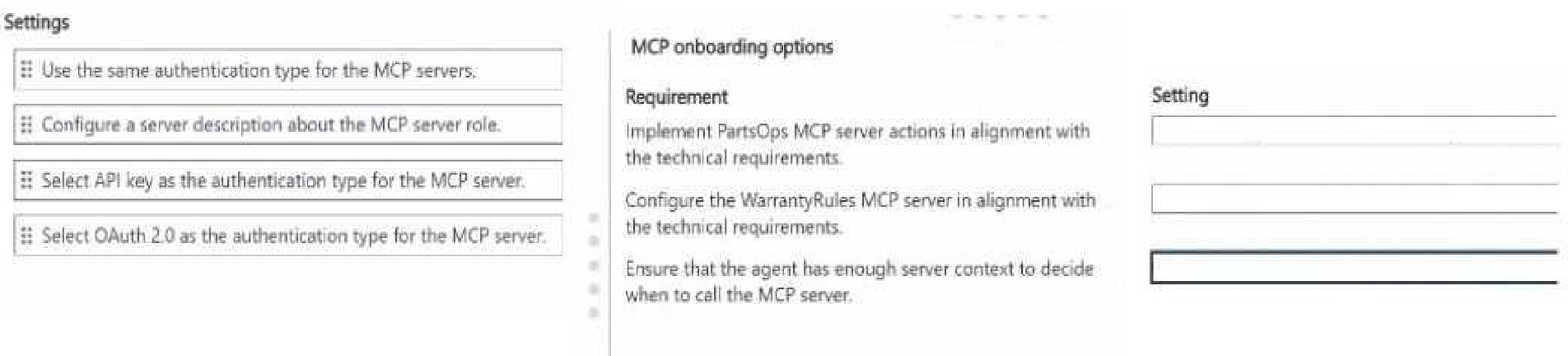
Tool-selection context → Configure a server description that explains the MCP server's role.
Comprehensive and Detailed Explanation From Microsoft AB-620 Study Guide: The authentication
choices must follow the identity requirements of each server. PartsOps performs attributable actions,
including parts-request creation, so OAuth 2.0 is the appropriate mechanism for individual users to
authorize access without sharing their credentials with the agent. That preserves user context and
supports accountability for each transaction. WarrantyRules is explicitly read-only and uses a key
shared by the agent team; it should therefore be configured with API-key authentication using the
required header or query parameter. Applying the same authentication method to both servers
would contradict the stated server designs. Authentication alone does not tell the orchestrator when
a server is relevant. A concise, discriminating server description should identify PartsOps as the
source for availability checks and parts-request creation and WarrantyRules as the source for
warranty validation. Copilot Studio uses the names and descriptions of agents, topics, tools, and
knowledge sources during generative orchestration. Accurate metadata reduces accidental calls,
prevents the wrong server from handling a request, and makes the multi-agent plan more
predictable during testing. Study Guide alignment: Integrate and extend agents in Copilot Studio >
Add tools to agents > Configure MCP tools.
===============
Quiz
Background
Current Environment:
Fabrikam Inc. is a Canada-based manufacturer with a growing service organization that supports field
technicians and internal operations teams. Fabrikam Inc. plans to launch a new internal agent
solution named Operations Concierge to reduce time spent
searching policy content, retrieving operational metrics, and executing routine transactions.
The agent will be used by three groups:
Service coordinators who triage incoming service requests
Field technicians who need guided procedures and parts availability
Operations managers who monitor KPIs and exceptions
The agent solution must work in real-world operational conditions. Users often ask questions mid-
call with a customer or while
coordinating parts shipments. The agents require quick, reliable outcomes. As a result, Fabrikam Inc.
requires the solution to:
Provide grounded answers with traceability when it provides guidance.
Retrieve real-time metrics when users ask for operational status,
Execute authenticated updates when users initiate a flow (such as creating a parts request).
Fabrikam Inc. also expects the solution to be maintained by multiple makers and developers across
the year. The company has experienced duplicated logic and inconsistent behavior across different
agents. This project emphasizes reuse, governance, and maintainability across teams.
Business Requirements:
Fabrikam Inc. runs three Microsoft Power Platform environments for agent development and
release: Dev, Test, and Prod.
The team plans to build the agent and validate it in Dev and Test, then promote to Prod by using a
controlled release process that supports repeatable deployments.
Fabrikam Inc. already has two assets the team wants to reuse:
A partially completed Copilot Studio agent named Service Desk Agent, used by IT to create internal
tickets and route requests
A Microsoft Foundry agent created by a central AI team that performs specialized summarization and
classification for long-form text (for example, summarizing call transcripts into an incident narrative)
Fabrikam Inc. also has operational and knowledge data sources:
A curated policy library (internal SOPs, service warranty rules, escalation criteria, and standard
operating procedures)
A set of indexed documents and procedures in an Azure AI Search service that supports vector search
for the policy library
A Microsoft Fabric workspace that includes a semantic model used by operations leadership for
reporting
Business Requirements:
Fabrikam Inc. requires Operations Concierge to meet the following business requirements:
Traceability requirement: When the agent provides policy guidance or procedural recommendations,
users must be able to see where the answer came from.
Metrics requirement: When users ask about service performance (backlog, SLA risk, parts shortages,
dispatch delays), the solution must return up-to-date metrics in a structured format that operations
managers can use in weekly reviews.
Transaction requirement: The solution must support authenticated updates initiated during
conversations, including creating a parts request and updating a service case status.
In addition, Fabrikam Inc. wants to avoid duplicating common assets across agents:
The team must reuse the same set of escalation topics, MCP tool definitions, and a standard safety
disclaimer across three different agents.
Only the platform engineering group is allowed to edit shared assets. However, all agent authors
must be able to use them.
Technical Requirements:
The Fabrikam Inc.'s solution architecture uses a multi-agent approach so that specialist
responsibilities are isolated and can evolve independently.
The Operations Concierge (primary agent) must coordinate the following specialist capabilities:
Policy and procedure Q&A: Use an enterprise knowledge source that supports indexed retrieval
across the curated policy library and service procedures.
Operational metrics: Delegate metric queries to a Fabric Data Agent that reads governed business
data through the Fabric semantic model.
Authenticated updates: Use tools exposed by an existing internal Model Context Protocol (MCP)
server that provides transactional operations for the service organization.
Specialized processing: Delegate summarization and classification requests to an existing Microsoft
Foundry agent.
Fabrikam Inc. will onboard two MCP servers as tools:
PartsOps MCP server: exposes tools for parts availability checks and parts request creation. The
server requires per-user authentication because actions must be traceable to the requesting user.
WarrantyRules MCP server: exposes a read-only tool for validating warranty coverage. The server
uses an API key shared by the agent team.
Fabrikam Inc. has also defined a collaboration requirement with the existing Service Desk Agent:
The primary agent must delegate IT-specific requests to the existing Service Desk Agent rather than
reimplement ticket creation logic.
Finally, Fabrikam Inc. plans to support a partner integration:
For shipment tracking inquiries, Fabrikam Inc. will delegate to a partner-provided agent that is only
available through a standardized agent-to-agent endpoint.
Issues and constraints
During early testing, Fabrikam Inc. found three recurring problems:
Makers are copying and modifying the same components across agents, resulting in inconsistent
disclaimers and duplicated tools.
Users can obtain a correct answer, but the response is not consistently traceable to a source when
the agent uses knowledge.
The primary agent can route some requests, but specialist capabilities are not consistently delegated
(for example, some metric questions are answered generatively instead of being routed to the Fabric
Data Agent).
You are part of the engineering team responsible for correcting the design and configuration to meet
the preceding requirements and constraints.
Fabrikam Inc.'s defined architecture and technical requirements.
Which integration approach should you use?
Quiz
Background
Current Environment:
Fabrikam Inc. is a Canada-based manufacturer with a growing service organization that supports field
technicians and internal operations teams. Fabrikam Inc. plans to launch a new internal agent
solution named Operations Concierge to reduce time spent
searching policy content, retrieving operational metrics, and executing routine transactions.
The agent will be used by three groups:
Service coordinators who triage incoming service requests
Field technicians who need guided procedures and parts availability
Operations managers who monitor KPIs and exceptions
The agent solution must work in real-world operational conditions. Users often ask questions mid-
call with a customer or while
coordinating parts shipments. The agents require quick, reliable outcomes. As a result, Fabrikam Inc.
requires the solution to:
Provide grounded answers with traceability when it provides guidance.
Retrieve real-time metrics when users ask for operational status,
Execute authenticated updates when users initiate a flow (such as creating a parts request).
Fabrikam Inc. also expects the solution to be maintained by multiple makers and developers across
the year. The company has experienced duplicated logic and inconsistent behavior across different
agents. This project emphasizes reuse, governance, and maintainability across teams.
Business Requirements:
Fabrikam Inc. runs three Microsoft Power Platform environments for agent development and
release: Dev, Test, and Prod.
The team plans to build the agent and validate it in Dev and Test, then promote to Prod by using a
controlled release process that supports repeatable deployments.
Fabrikam Inc. already has two assets the team wants to reuse:
A partially completed Copilot Studio agent named Service Desk Agent, used by IT to create internal
tickets and route requests
A Microsoft Foundry agent created by a central AI team that performs specialized summarization and
classification for long-form text (for example, summarizing call transcripts into an incident narrative)
Fabrikam Inc. also has operational and knowledge data sources:
A curated policy library (internal SOPs, service warranty rules, escalation criteria, and standard
operating procedures)
A set of indexed documents and procedures in an Azure AI Search service that supports vector search
for the policy library
A Microsoft Fabric workspace that includes a semantic model used by operations leadership for
reporting
Business Requirements:
Fabrikam Inc. requires Operations Concierge to meet the following business requirements:
Traceability requirement: When the agent provides policy guidance or procedural recommendations,
users must be able to see where the answer came from.
Metrics requirement: When users ask about service performance (backlog, SLA risk, parts shortages,
dispatch delays), the solution must return up-to-date metrics in a structured format that operations
managers can use in weekly reviews.
Transaction requirement: The solution must support authenticated updates initiated during
conversations, including creating a parts request and updating a service case status.
In addition, Fabrikam Inc. wants to avoid duplicating common assets across agents:
The team must reuse the same set of escalation topics, MCP tool definitions, and a standard safety
disclaimer across three different agents.
Only the platform engineering group is allowed to edit shared assets. However, all agent authors
must be able to use them.
Technical Requirements:
The Fabrikam Inc.'s solution architecture uses a multi-agent approach so that specialist
responsibilities are isolated and can evolve independently.
The Operations Concierge (primary agent) must coordinate the following specialist capabilities:
Policy and procedure Q&A: Use an enterprise knowledge source that supports indexed retrieval
across the curated policy library and service procedures.
Operational metrics: Delegate metric queries to a Fabric Data Agent that reads governed business
data through the Fabric semantic model.
Authenticated updates: Use tools exposed by an existing internal Model Context Protocol (MCP)
server that provides transactional operations for the service organization.
Specialized processing: Delegate summarization and classification requests to an existing Microsoft
Foundry agent.
Fabrikam Inc. will onboard two MCP servers as tools:
PartsOps MCP server: exposes tools for parts availability checks and parts request creation. The
server requires per-user authentication because actions must be traceable to the requesting user.
WarrantyRules MCP server: exposes a read-only tool for validating warranty coverage. The server
uses an API key shared by the agent team.
Fabrikam Inc. has also defined a collaboration requirement with the existing Service Desk Agent:
The primary agent must delegate IT-specific requests to the existing Service Desk Agent rather than
reimplement ticket creation logic.
Finally, Fabrikam Inc. plans to support a partner integration:
For shipment tracking inquiries, Fabrikam Inc. will delegate to a partner-provided agent that is only
available through a standardized agent-to-agent endpoint.
Issues and constraints
During early testing, Fabrikam Inc. found three recurring problems:
Makers are copying and modifying the same components across agents, resulting in inconsistent
disclaimers and duplicated tools.
Users can obtain a correct answer, but the response is not consistently traceable to a source when
the agent uses knowledge.
The primary agent can route some requests, but specialist capabilities are not consistently delegated
(for example, some metric questions are answered generatively instead of being routed to the Fabric
Data Agent).
You are part of the engineering team responsible for correcting the design and configuration to meet
the preceding requirements and constraints.
You need to plan how Fabrikam Inc. will reuse shared components across multiple agents while
limiting who can change the shared components in Copilot Studio Lite.
Which approach should you use for each requirement? To answer, move the appropriate
components to the correct requirements. You may use each component once, more than once, or
not at all. You may need to move the split bar between panes or scroll to view content
NOTE: Each correct selection is worth one point
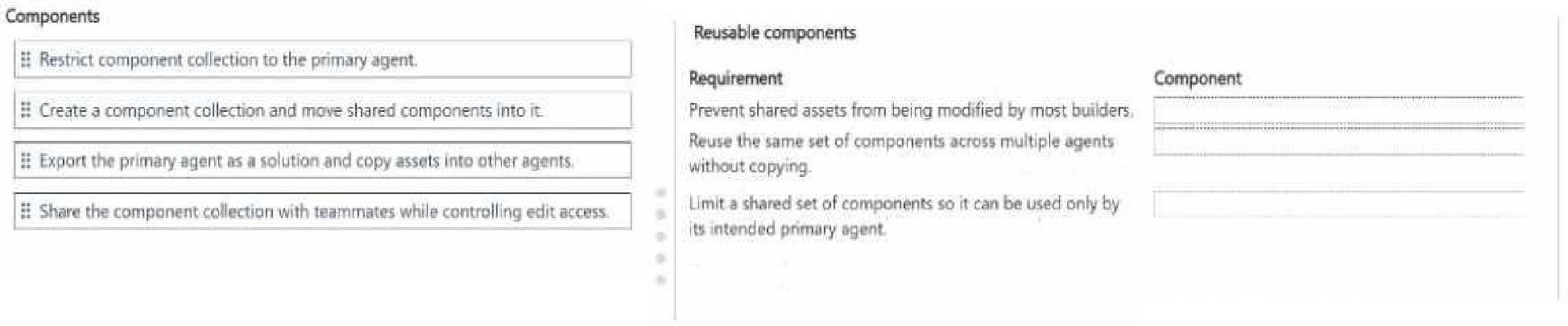
controlling edit access; Reuse components without copying → Create a component collection and
move the shared components into it; Limit use to the intended primary agent → Restrict the
component collection to the primary agent.
Comprehensive and Detailed Explanation From Microsoft AB-620 Study Guide: A component
collection is the correct reusable unit for the escalation topics, MCP definitions, and safety
disclaimer. Moving those assets into one collection creates a maintained source that multiple agents
can consume without copying and later diverging. Sharing the collection with teammates while
controlling edit access separates use permission from modification permission, allowing agent
authors to reference the assets while reserving changes for platform engineering. If a sensitive or
tightly coupled collection must be usable only by one designated primary agent, the collection can
be restricted accordingly. Exporting the primary agent and copying its components would recreate
the duplication problem that Fabrikam is trying to eliminate, while restricting every collection to the
primary agent would prevent the required cross-agent reuse. The collection should be versioned and
tested after changes because a shared update can affect several consumers. Ownership, review, and
release responsibilities should also be documented so that reuse does not become an uncontrolled
dependency. This design provides consistency, centralized governance, and a smaller maintenance
surface across the three agents. Study Guide alignment: Plan and configure agent solutions > Plan an
agent solution > Plan reusable agent components.
===============
Quiz
Background
Current Environment:
Fabrikam Inc. is a Canada-based manufacturer with a growing service organization that supports field
technicians and internal operations teams. Fabrikam Inc. plans to launch a new internal agent
solution named Operations Concierge to reduce time spent
searching policy content, retrieving operational metrics, and executing routine transactions.
The agent will be used by three groups:
Service coordinators who triage incoming service requests
Field technicians who need guided procedures and parts availability
Operations managers who monitor KPIs and exceptions
The agent solution must work in real-world operational conditions. Users often ask questions mid-
call with a customer or while
coordinating parts shipments. The agents require quick, reliable outcomes. As a result, Fabrikam Inc.
requires the solution to:
Provide grounded answers with traceability when it provides guidance.
Retrieve real-time metrics when users ask for operational status,
Execute authenticated updates when users initiate a flow (such as creating a parts request).
Fabrikam Inc. also expects the solution to be maintained by multiple makers and developers across
the year. The company has experienced duplicated logic and inconsistent behavior across different
agents. This project emphasizes reuse, governance, and maintainability across teams.
Business Requirements:
Fabrikam Inc. runs three Microsoft Power Platform environments for agent development and
release: Dev, Test, and Prod.
The team plans to build the agent and validate it in Dev and Test, then promote to Prod by using a
controlled release process that supports repeatable deployments.
Fabrikam Inc. already has two assets the team wants to reuse:
A partially completed Copilot Studio agent named Service Desk Agent, used by IT to create internal
tickets and route requests
A Microsoft Foundry agent created by a central AI team that performs specialized summarization and
classification for long-form text (for example, summarizing call transcripts into an incident narrative)
Fabrikam Inc. also has operational and knowledge data sources:
A curated policy library (internal SOPs, service warranty rules, escalation criteria, and standard
operating procedures)
A set of indexed documents and procedures in an Azure AI Search service that supports vector search
for the policy library
A Microsoft Fabric workspace that includes a semantic model used by operations leadership for
reporting
Business Requirements:
Fabrikam Inc. requires Operations Concierge to meet the following business requirements:
Traceability requirement: When the agent provides policy guidance or procedural recommendations,
users must be able to see where the answer came from.
Metrics requirement: When users ask about service performance (backlog, SLA risk, parts shortages,
dispatch delays), the solution must return up-to-date metrics in a structured format that operations
managers can use in weekly reviews.
Transaction requirement: The solution must support authenticated updates initiated during
conversations, including creating a parts request and updating a service case status.
In addition, Fabrikam Inc. wants to avoid duplicating common assets across agents:
The team must reuse the same set of escalation topics, MCP tool definitions, and a standard safety
disclaimer across three different agents.
Only the platform engineering group is allowed to edit shared assets. However, all agent authors
must be able to use them.
Technical Requirements:
The Fabrikam Inc.'s solution architecture uses a multi-agent approach so that specialist
responsibilities are isolated and can evolve independently.
The Operations Concierge (primary agent) must coordinate the following specialist capabilities:
Policy and procedure Q&A: Use an enterprise knowledge source that supports indexed retrieval
across the curated policy library and service procedures.
Operational metrics: Delegate metric queries to a Fabric Data Agent that reads governed business
data through the Fabric semantic model.
Authenticated updates: Use tools exposed by an existing internal Model Context Protocol (MCP)
server that provides transactional operations for the service organization.
Specialized processing: Delegate summarization and classification requests to an existing Microsoft
Foundry agent.
Fabrikam Inc. will onboard two MCP servers as tools:
PartsOps MCP server: exposes tools for parts availability checks and parts request creation. The
server requires per-user authentication because actions must be traceable to the requesting user.
WarrantyRules MCP server: exposes a read-only tool for validating warranty coverage. The server
uses an API key shared by the agent team.
Fabrikam Inc. has also defined a collaboration requirement with the existing Service Desk Agent:
The primary agent must delegate IT-specific requests to the existing Service Desk Agent rather than
reimplement ticket creation logic.
Finally, Fabrikam Inc. plans to support a partner integration:
For shipment tracking inquiries, Fabrikam Inc. will delegate to a partner-provided agent that is only
available through a standardized agent-to-agent endpoint.
Issues and constraints
During early testing, Fabrikam Inc. found three recurring problems:
Makers are copying and modifying the same components across agents, resulting in inconsistent
disclaimers and duplicated tools.
Users can obtain a correct answer, but the response is not consistently traceable to a source when
the agent uses knowledge.
The primary agent can route some requests, but specialist capabilities are not consistently delegated
(for example, some metric questions are answered generatively instead of being routed to the Fabric
Data Agent).
You are part of the engineering team responsible for correcting the design and configuration to meet
the preceding requirements and constraints.
with Fabrikam Inc.'s architectural requirements
Which two actions should you perform? Each correct answer presents part of the solution. Choose
two.
NOTE: Each correct selection is worth one point
Quiz
Background
Current Environment:
Fabrikam Inc. is a Canada-based manufacturer with a growing service organization that supports field
technicians and internal operations teams. Fabrikam Inc. plans to launch a new internal agent
solution named Operations Concierge to reduce time spent
searching policy content, retrieving operational metrics, and executing routine transactions.
The agent will be used by three groups:
Service coordinators who triage incoming service requests
Field technicians who need guided procedures and parts availability
Operations managers who monitor KPIs and exceptions
The agent solution must work in real-world operational conditions. Users often ask questions mid-
call with a customer or while
coordinating parts shipments. The agents require quick, reliable outcomes. As a result, Fabrikam Inc.
requires the solution to:
Provide grounded answers with traceability when it provides guidance.
Retrieve real-time metrics when users ask for operational status,
Execute authenticated updates when users initiate a flow (such as creating a parts request).
Fabrikam Inc. also expects the solution to be maintained by multiple makers and developers across
the year. The company has experienced duplicated logic and inconsistent behavior across different
agents. This project emphasizes reuse, governance, and maintainability across teams.
Business Requirements:
Fabrikam Inc. runs three Microsoft Power Platform environments for agent development and
release: Dev, Test, and Prod.
The team plans to build the agent and validate it in Dev and Test, then promote to Prod by using a
controlled release process that supports repeatable deployments.
Fabrikam Inc. already has two assets the team wants to reuse:
A partially completed Copilot Studio agent named Service Desk Agent, used by IT to create internal
tickets and route requests
A Microsoft Foundry agent created by a central AI team that performs specialized summarization and
classification for long-form text (for example, summarizing call transcripts into an incident narrative)
Fabrikam Inc. also has operational and knowledge data sources:
A curated policy library (internal SOPs, service warranty rules, escalation criteria, and standard
operating procedures)
A set of indexed documents and procedures in an Azure AI Search service that supports vector search
for the policy library
A Microsoft Fabric workspace that includes a semantic model used by operations leadership for
reporting
Business Requirements:
Fabrikam Inc. requires Operations Concierge to meet the following business requirements:
Traceability requirement: When the agent provides policy guidance or procedural recommendations,
users must be able to see where the answer came from.
Metrics requirement: When users ask about service performance (backlog, SLA risk, parts shortages,
dispatch delays), the solution must return up-to-date metrics in a structured format that operations
managers can use in weekly reviews.
Transaction requirement: The solution must support authenticated updates initiated during
conversations, including creating a parts request and updating a service case status.
In addition, Fabrikam Inc. wants to avoid duplicating common assets across agents:
The team must reuse the same set of escalation topics, MCP tool definitions, and a standard safety
disclaimer across three different agents.
Only the platform engineering group is allowed to edit shared assets. However, all agent authors
must be able to use them.
Technical Requirements:
The Fabrikam Inc.'s solution architecture uses a multi-agent approach so that specialist
responsibilities are isolated and can evolve independently.
The Operations Concierge (primary agent) must coordinate the following specialist capabilities:
Policy and procedure Q&A: Use an enterprise knowledge source that supports indexed retrieval
across the curated policy library and service procedures.
Operational metrics: Delegate metric queries to a Fabric Data Agent that reads governed business
data through the Fabric semantic model.
Authenticated updates: Use tools exposed by an existing internal Model Context Protocol (MCP)
server that provides transactional operations for the service organization.
Specialized processing: Delegate summarization and classification requests to an existing Microsoft
Foundry agent.
Fabrikam Inc. will onboard two MCP servers as tools:
PartsOps MCP server: exposes tools for parts availability checks and parts request creation. The
server requires per-user authentication because actions must be traceable to the requesting user.
WarrantyRules MCP server: exposes a read-only tool for validating warranty coverage. The server
uses an API key shared by the agent team.
Fabrikam Inc. has also defined a collaboration requirement with the existing Service Desk Agent:
The primary agent must delegate IT-specific requests to the existing Service Desk Agent rather than
reimplement ticket creation logic.
Finally, Fabrikam Inc. plans to support a partner integration:
For shipment tracking inquiries, Fabrikam Inc. will delegate to a partner-provided agent that is only
available through a standardized agent-to-agent endpoint.
Issues and constraints
During early testing, Fabrikam Inc. found three recurring problems:
Makers are copying and modifying the same components across agents, resulting in inconsistent
disclaimers and duplicated tools.
Users can obtain a correct answer, but the response is not consistently traceable to a source when
the agent uses knowledge.
The primary agent can route some requests, but specialist capabilities are not consistently delegated
(for example, some metric questions are answered generatively instead of being routed to the Fabric
Data Agent).
You are part of the engineering team responsible for correcting the design and configuration to meet
the preceding requirements and constraints.
You need to connect Operations Concierge to Fabrikam Inc.'s Azure AI Search knowledge index while
complying with security requirements.
Which configuration should you use for each requirement? To answer, move the appropriate
configurations to the correct requirements You may use each configuration once, more than once, or
not at all. You may need to move the split bar between panes or scroll to view content.
NOTE: Each correct selection is worth one point
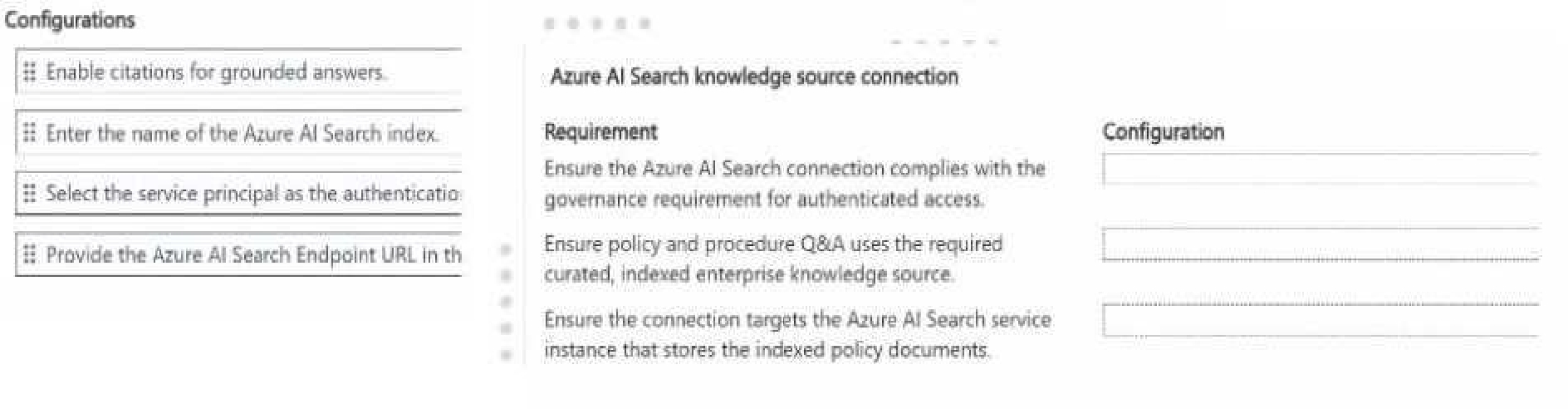
index → Enter the Azure AI Search index name; Correct Azure AI Search service instance → Provide
the Azure AI Search endpoint URL.
Comprehensive and Detailed Explanation From Microsoft AB-620 Study Guide: An Azure AI Search
connection needs three distinct pieces of configuration. The endpoint identifies the search-service
instance that hosts Fabrikam's indexed documents. The index name then selects the specific vector
index containing the curated policies and procedures. Authentication determines how Copilot Studio
is authorized to query that service. Because the scenario requires governed application access rather
than a maker's personal identity, the service-principal option is the appropriate selection from the
choices provided. Enabling citations is useful after retrieval is configured, but it does not establish the
service connection or select an index. Microsoft recommends creating Azure AI Search through the
supported data-source connection experience rather than manually assembling an unsupported
endpoint/key combination. Administrators should grant the service principal only the permissions
needed for query operations, protect its credentials, and maintain separate configuration per
environment. Testing should confirm that the intended index—not another index in the same
service—is queried, that unauthorized content is excluded, and that policy responses cite material
that actually supports the generated guidance. Study Guide alignment: Integrate and extend agents
in Copilot Studio > Connect to enterprise knowledge sources > Connect to Azure AI Search.
===============
AB-620: Designing and Building Integrated AI Agent Solutions in Copilot Studio Practice test unlocks all online simulator questions
Thank you for choosing the free version of the AB-620: Designing and Building Integrated AI Agent Solutions in Copilot Studio practice test! Further deepen your knowledge on Microsoft Simulator; by unlocking the full version of our AB-620: Designing and Building Integrated AI Agent Solutions in Copilot Studio Simulator you will be able to take tests with over 77 constantly updated questions and easily pass your exam. 98% of people pass the exam in the first attempt after preparing with our 77 questions.
BUY NOWWhat to expect from our AB-620: Designing and Building Integrated AI Agent Solutions in Copilot Studio practice tests and how to prepare for any exam?
The AB-620: Designing and Building Integrated AI Agent Solutions in Copilot Studio Simulator Practice Tests are part of the Microsoft Database and are the best way to prepare for any AB-620: Designing and Building Integrated AI Agent Solutions in Copilot Studio exam. The AB-620: Designing and Building Integrated AI Agent Solutions in Copilot Studio practice tests consist of 77 questions and are written by experts to help you and prepare you to pass the exam on the first attempt. The AB-620: Designing and Building Integrated AI Agent Solutions in Copilot Studio database includes questions from previous and other exams, which means you will be able to practice simulating past and future questions. Preparation with AB-620: Designing and Building Integrated AI Agent Solutions in Copilot Studio Simulator will also give you an idea of the time it will take to complete each section of the AB-620: Designing and Building Integrated AI Agent Solutions in Copilot Studio practice test . It is important to note that the AB-620: Designing and Building Integrated AI Agent Solutions in Copilot Studio Simulator does not replace the classic AB-620: Designing and Building Integrated AI Agent Solutions in Copilot Studio study guides; however, the Simulator provides valuable insights into what to expect and how much work needs to be done to prepare for the AB-620: Designing and Building Integrated AI Agent Solutions in Copilot Studio exam.
BUY NOWAB-620: Designing and Building Integrated AI Agent Solutions in Copilot Studio Practice test therefore represents an excellent tool to prepare for the actual exam together with our Microsoft practice test . Our AB-620: Designing and Building Integrated AI Agent Solutions in Copilot Studio Simulator will help you assess your level of preparation and understand your strengths and weaknesses. Below you can read all the quizzes you will find in our AB-620: Designing and Building Integrated AI Agent Solutions in Copilot Studio Simulator and how our unique AB-620: Designing and Building Integrated AI Agent Solutions in Copilot Studio Database made up of real questions:
Info quiz:
- Quiz name:AB-620: Designing and Building Integrated AI Agent Solutions in Copilot Studio
- Total number of questions:77
- Number of questions for the test:50
- Pass score:80%
You can prepare for the AB-620: Designing and Building Integrated AI Agent Solutions in Copilot Studio exams with our mobile app. It is very easy to use and even works offline in case of network failure, with all the functions you need to study and practice with our AB-620: Designing and Building Integrated AI Agent Solutions in Copilot Studio Simulator.
Use our Mobile App, available for both Android and iOS devices, with our AB-620: Designing and Building Integrated AI Agent Solutions in Copilot Studio Simulator . You can use it anywhere and always remember that our mobile app is free and available on all stores.
Our Mobile App contains all AB-620: Designing and Building Integrated AI Agent Solutions in Copilot Studio practice tests which consist of 77 questions and also provide study material to pass the final AB-620: Designing and Building Integrated AI Agent Solutions in Copilot Studio exam with guaranteed success. Our AB-620: Designing and Building Integrated AI Agent Solutions in Copilot Studio database contain hundreds of questions and Microsoft Tests related to AB-620: Designing and Building Integrated AI Agent Solutions in Copilot Studio Exam. This way you can practice anywhere you want, even offline without the internet.
BUY NOW