Quiz AI-103: Microsoft Developing AI Apps and Agents on Azure
Quiz
Overview
Contoso, Ltd is a multinational retail company that builds, deploys, and manages generative Al and
agent-based solutions by using Microsoft Foundry.
Identity Environment:
Contoso uses Microsoft Entra ID for identity management, authentication, and authorization
capabilities that enable agents to access organizational resources and services.
Contoso recently formed a new Al engineering team named Agent1Dev Team to optimize and
maintain existing Al solutions.
The team collaborates with solution architects, DevOps engineers, and security engineers to design,
implement, monitor, and secure Al applications.
Contoso also has a team named Agent1Test Team that is responsible for validating Al solutions
before the solution deployments.
Generative Environment:
Contoso has a Microsoft Foundry deployment that contains two projects named Project1 and
Project2.
Project1
Project1 contains a customer support agent named Agent1 that assists customers with product
inquiries and troubleshooting requests.
Agent1 has the following configurations:
Agent1 uses a base model deployment.
A safety evaluation pipeline is NOT enabled.
Tool invocation approval workflows are NOT enabled.
Conversation memory constraints are NOT configured.
Agent1 interacts with customers by using digital support channels and answers general questions
about Contoso products.
Project1 is deployed to an Azure region located in the European Union (EU).
Agent1Dev Team will use Project1 to optimize and maintain Agent1.
Project2
Project2 contains a deployed video generation model. The marketing department at Contoso has
access to Project2 and plans to use the model to develop a video creation solution.
Development of the solution is incomplete.
Data Environment:
Contoso stores product-related information in Azure resources that support Al applications.
The Azure environment contains an Azure Blob Storage account named storage1 that stores product
detail sheets for all the Contoso products.
The product sheets include specifications, feature descriptions, and product support information that
Agent1 can use to answer customer questions. The product sheets are stored in the PDF format.
Problem Statement:
Contoso identifies the following issues:
Agent1 has only general knowledge of the Contoso products.
A recent chat interaction with Agent1 was analyzed for sentiment. The results of the analysis have
NOT been processed yet.
Agent1 does NOT use the detailed product information in the product sheets stored in storage1 when
responding to customer questions.
The finance department at Contoso reports that vendor invoices must be reviewed manually to
ensure that the invoices match the terms defined in the vendor contracts. The invoices contain
tables, logos, and varied layouts that make the documents difficult to process consistently.
Requirement:
Planned Changes:
Contoso plans to implement the following changes:
Implement a solution for Project1 that analyzes the vendor invoices by evaluating both the visual
layout and the textual content of the invoices, so that the invoice details can be verified against the
vendor contract terms.
Update the base model deployment used by Agent1 and standardize the model version to ensure
continuity and consistent responses.
Enable Agent1 to retrieve and use the detailed product information from the product sheets stored
in storage1.
Implement an indexing solution for the product sheets that Agent1 can use to answer customer
questions.
Complete the development of the video creation solution.
Technical Requirements:
Contoso identifies the following technical requirements:
The model deployment used by Agent1 must support scalable, high-throughput generative Al
workloads and dynamically scale to handle variable customer support traffic, without requiring
reserved throughput capacity.
The product sheets must be processed by using an indexing pipeline that enables semantic and
vector search, so that Agent1 can retrieve the relevant product information.
Responses generated by using the product sheet information must be relevant, complete, and
accurate.
Agent1 must be able to use the product sheets to answer natural language questions about product
details.
The model version used by Agent1 must remain consistent to ensure stable responses.
The data processed by the model must remain within the EU.
Safety and Compliance Requirements:
Contoso identifies the following security and compliance requirements:
API keys must NOT be used to access Foundry-deployed models.
Access to the Azure resources must follow the principle of least privilege.
The developers at Contoso must authenticate to Microsoft Foundry resources by using Microsoft
Entra authentication.
Access to Project1 must be assigned to the members of Agent1Dev Team by using a security group
named SC_Agent1_Dev.
Access to Project1 must be assigned to the members of Agent1Test Team by using a security group
named SC_Agent1_Test.
Agent1 must never reveal customer information, even if a document that contains customer data is
added erroneously to the product sheet repository in storage1.
The product sheets might contain images that include embedded text. Agent1 must be protected
from malicious instructions potentially hidden within the images.
Business Information:
Contoso identifies the following business requirements:
Users that interact with Agent1 must have a personalized experience in future interactions, including
the ability for Agent1 to retain conversation context and recall relevant information from previous
interactions.
Agent1 must answer questions only about the products sold by Contoso.
solution must meet the business requirements.
What should you do?
Quiz
Overview
Contoso, Ltd is a multinational retail company that builds, deploys, and manages generative Al and
agent-based solutions by using Microsoft Foundry.
Identity Environment:
Contoso uses Microsoft Entra ID for identity management, authentication, and authorization
capabilities that enable agents to access organizational resources and services.
Contoso recently formed a new Al engineering team named Agent1Dev Team to optimize and
maintain existing Al solutions.
The team collaborates with solution architects, DevOps engineers, and security engineers to design,
implement, monitor, and secure Al applications.
Contoso also has a team named Agent1Test Team that is responsible for validating Al solutions
before the solution deployments.
Generative Environment:
Contoso has a Microsoft Foundry deployment that contains two projects named Project1 and
Project2.
Project1
Project1 contains a customer support agent named Agent1 that assists customers with product
inquiries and troubleshooting requests.
Agent1 has the following configurations:
Agent1 uses a base model deployment.
A safety evaluation pipeline is NOT enabled.
Tool invocation approval workflows are NOT enabled.
Conversation memory constraints are NOT configured.
Agent1 interacts with customers by using digital support channels and answers general questions
about Contoso products.
Project1 is deployed to an Azure region located in the European Union (EU).
Agent1Dev Team will use Project1 to optimize and maintain Agent1.
Project2
Project2 contains a deployed video generation model. The marketing department at Contoso has
access to Project2 and plans to use the model to develop a video creation solution.
Development of the solution is incomplete.
Data Environment:
Contoso stores product-related information in Azure resources that support Al applications.
The Azure environment contains an Azure Blob Storage account named storage1 that stores product
detail sheets for all the Contoso products.
The product sheets include specifications, feature descriptions, and product support information that
Agent1 can use to answer customer questions. The product sheets are stored in the PDF format.
Problem Statement:
Contoso identifies the following issues:
Agent1 has only general knowledge of the Contoso products.
A recent chat interaction with Agent1 was analyzed for sentiment. The results of the analysis have
NOT been processed yet.
Agent1 does NOT use the detailed product information in the product sheets stored in storage1 when
responding to customer questions.
The finance department at Contoso reports that vendor invoices must be reviewed manually to
ensure that the invoices match the terms defined in the vendor contracts. The invoices contain
tables, logos, and varied layouts that make the documents difficult to process consistently.
Requirement:
Planned Changes:
Contoso plans to implement the following changes:
Implement a solution for Project1 that analyzes the vendor invoices by evaluating both the visual
layout and the textual content of the invoices, so that the invoice details can be verified against the
vendor contract terms.
Update the base model deployment used by Agent1 and standardize the model version to ensure
continuity and consistent responses.
Enable Agent1 to retrieve and use the detailed product information from the product sheets stored
in storage1.
Implement an indexing solution for the product sheets that Agent1 can use to answer customer
questions.
Complete the development of the video creation solution.
Technical Requirements:
Contoso identifies the following technical requirements:
The model deployment used by Agent1 must support scalable, high-throughput generative Al
workloads and dynamically scale to handle variable customer support traffic, without requiring
reserved throughput capacity.
The product sheets must be processed by using an indexing pipeline that enables semantic and
vector search, so that Agent1 can retrieve the relevant product information.
Responses generated by using the product sheet information must be relevant, complete, and
accurate.
Agent1 must be able to use the product sheets to answer natural language questions about product
details.
The model version used by Agent1 must remain consistent to ensure stable responses.
The data processed by the model must remain within the EU.
Safety and Compliance Requirements:
Contoso identifies the following security and compliance requirements:
API keys must NOT be used to access Foundry-deployed models.
Access to the Azure resources must follow the principle of least privilege.
The developers at Contoso must authenticate to Microsoft Foundry resources by using Microsoft
Entra authentication.
Access to Project1 must be assigned to the members of Agent1Dev Team by using a security group
named SC_Agent1_Dev.
Access to Project1 must be assigned to the members of Agent1Test Team by using a security group
named SC_Agent1_Test.
Agent1 must never reveal customer information, even if a document that contains customer data is
added erroneously to the product sheet repository in storage1.
The product sheets might contain images that include embedded text. Agent1 must be protected
from malicious instructions potentially hidden within the images.
Business Information:
Contoso identifies the following business requirements:
Users that interact with Agent1 must have a personalized experience in future interactions, including
the ability for Agent1 to retain conversation context and recall relevant information from previous
interactions.
Agent1 must answer questions only about the products sold by Contoso.
solution must meet the business requirements.
What should you do?
Quiz
Overview
Contoso, Ltd is a multinational retail company that builds, deploys, and manages generative Al and
agent-based solutions by using Microsoft Foundry.
Identity Environment:
Contoso uses Microsoft Entra ID for identity management, authentication, and authorization
capabilities that enable agents to access organizational resources and services.
Contoso recently formed a new Al engineering team named Agent1Dev Team to optimize and
maintain existing Al solutions.
The team collaborates with solution architects, DevOps engineers, and security engineers to design,
implement, monitor, and secure Al applications.
Contoso also has a team named Agent1Test Team that is responsible for validating Al solutions
before the solution deployments.
Generative Environment:
Contoso has a Microsoft Foundry deployment that contains two projects named Project1 and
Project2.
Project1
Project1 contains a customer support agent named Agent1 that assists customers with product
inquiries and troubleshooting requests.
Agent1 has the following configurations:
Agent1 uses a base model deployment.
A safety evaluation pipeline is NOT enabled.
Tool invocation approval workflows are NOT enabled.
Conversation memory constraints are NOT configured.
Agent1 interacts with customers by using digital support channels and answers general questions
about Contoso products.
Project1 is deployed to an Azure region located in the European Union (EU).
Agent1Dev Team will use Project1 to optimize and maintain Agent1.
Project2
Project2 contains a deployed video generation model. The marketing department at Contoso has
access to Project2 and plans to use the model to develop a video creation solution.
Development of the solution is incomplete.
Data Environment:
Contoso stores product-related information in Azure resources that support Al applications.
The Azure environment contains an Azure Blob Storage account named storage1 that stores product
detail sheets for all the Contoso products.
The product sheets include specifications, feature descriptions, and product support information that
Agent1 can use to answer customer questions. The product sheets are stored in the PDF format.
Problem Statement:
Contoso identifies the following issues:
Agent1 has only general knowledge of the Contoso products.
A recent chat interaction with Agent1 was analyzed for sentiment. The results of the analysis have
NOT been processed yet.
Agent1 does NOT use the detailed product information in the product sheets stored in storage1 when
responding to customer questions.
The finance department at Contoso reports that vendor invoices must be reviewed manually to
ensure that the invoices match the terms defined in the vendor contracts. The invoices contain
tables, logos, and varied layouts that make the documents difficult to process consistently.
Requirement:
Planned Changes:
Contoso plans to implement the following changes:
Implement a solution for Project1 that analyzes the vendor invoices by evaluating both the visual
layout and the textual content of the invoices, so that the invoice details can be verified against the
vendor contract terms.
Update the base model deployment used by Agent1 and standardize the model version to ensure
continuity and consistent responses.
Enable Agent1 to retrieve and use the detailed product information from the product sheets stored
in storage1.
Implement an indexing solution for the product sheets that Agent1 can use to answer customer
questions.
Complete the development of the video creation solution.
Technical Requirements:
Contoso identifies the following technical requirements:
The model deployment used by Agent1 must support scalable, high-throughput generative Al
workloads and dynamically scale to handle variable customer support traffic, without requiring
reserved throughput capacity.
The product sheets must be processed by using an indexing pipeline that enables semantic and
vector search, so that Agent1 can retrieve the relevant product information.
Responses generated by using the product sheet information must be relevant, complete, and
accurate.
Agent1 must be able to use the product sheets to answer natural language questions about product
details.
The model version used by Agent1 must remain consistent to ensure stable responses.
The data processed by the model must remain within the EU.
Safety and Compliance Requirements:
Contoso identifies the following security and compliance requirements:
API keys must NOT be used to access Foundry-deployed models.
Access to the Azure resources must follow the principle of least privilege.
The developers at Contoso must authenticate to Microsoft Foundry resources by using Microsoft
Entra authentication.
Access to Project1 must be assigned to the members of Agent1Dev Team by using a security group
named SC_Agent1_Dev.
Access to Project1 must be assigned to the members of Agent1Test Team by using a security group
named SC_Agent1_Test.
Agent1 must never reveal customer information, even if a document that contains customer data is
added erroneously to the product sheet repository in storage1.
The product sheets might contain images that include embedded text. Agent1 must be protected
from malicious instructions potentially hidden within the images.
Business Information:
Contoso identifies the following business requirements:
Users that interact with Agent1 must have a personalized experience in future interactions, including
the ability for Agent1 to retain conversation context and recall relevant information from previous
interactions.
Agent1 must answer questions only about the products sold by Contoso.
and compliance requirements.
How should you complete the Python code? To answer, select the appropriate options in the answer
area.
NOTE: Each correct selection is worth one point.
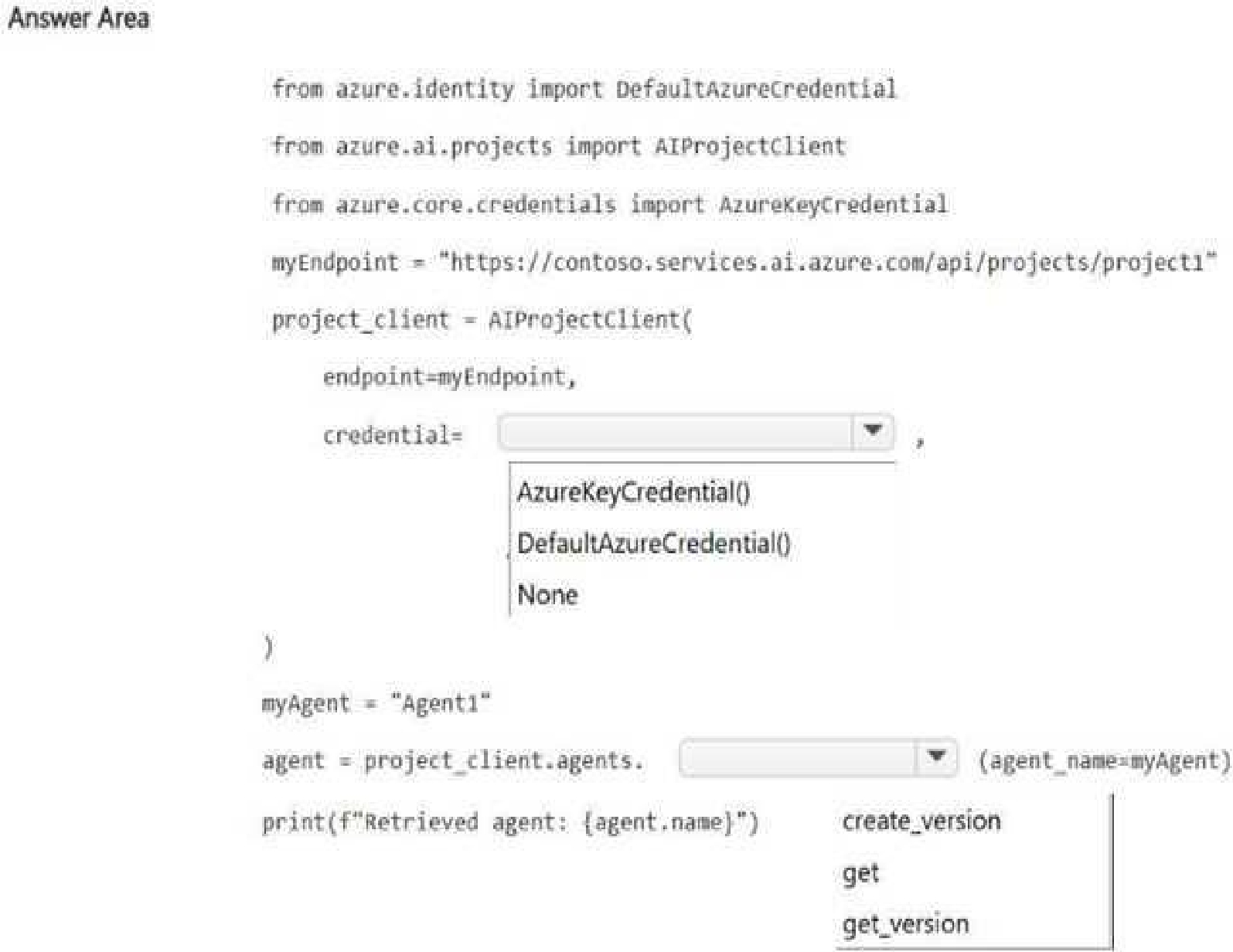
agent = project_client.agents.get(agent_name=myAgent)
The correct authentication option is DefaultAzureCredential() because the case study states that API
keys must not be used to access Foundry-deployed models and that Contoso developers must
authenticate to Microsoft Foundry resources by using Microsoft Entra authentication. It also states
that access to Project1 must be assigned to Agent1Dev Team by using the security group
SC_Agent1_Dev. Microsoft Foundry authentication guidance recommends Microsoft Entra ID for
production workloads because it supports least-privilege RBAC, per-principal auditing, and keyless
authentication. AzureKeyCredential() would violate the no-API-key requirement, and None would
not provide a valid credential.
The correct agent operation is get because the task is to access an existing agent named Agent1, not
create a new version or retrieve a specific published version. Microsoft Foundry SDK examples show
AIProjectClient created with DefaultAzureCredential() and then using project agent operations to
create, retrieve, or interact with agents by name. To meet the compliance requirement, the group
SC_Agent1_Dev must also be granted the appropriate project-scoped Foundry role, such as Foundry
User, for Project1. Reference topics: Microsoft Entra authentication, Foundry RBAC, AIProjectClient,
and project agent access.
Quiz
Overview
Contoso, Ltd is a multinational retail company that builds, deploys, and manages generative Al and
agent-based solutions by using Microsoft Foundry.
Identity Environment:
Contoso uses Microsoft Entra ID for identity management, authentication, and authorization
capabilities that enable agents to access organizational resources and services.
Contoso recently formed a new Al engineering team named Agent1Dev Team to optimize and
maintain existing Al solutions.
The team collaborates with solution architects, DevOps engineers, and security engineers to design,
implement, monitor, and secure Al applications.
Contoso also has a team named Agent1Test Team that is responsible for validating Al solutions
before the solution deployments.
Generative Environment:
Contoso has a Microsoft Foundry deployment that contains two projects named Project1 and
Project2.
Project1
Project1 contains a customer support agent named Agent1 that assists customers with product
inquiries and troubleshooting requests.
Agent1 has the following configurations:
Agent1 uses a base model deployment.
A safety evaluation pipeline is NOT enabled.
Tool invocation approval workflows are NOT enabled.
Conversation memory constraints are NOT configured.
Agent1 interacts with customers by using digital support channels and answers general questions
about Contoso products.
Project1 is deployed to an Azure region located in the European Union (EU).
Agent1Dev Team will use Project1 to optimize and maintain Agent1.
Project2
Project2 contains a deployed video generation model. The marketing department at Contoso has
access to Project2 and plans to use the model to develop a video creation solution.
Development of the solution is incomplete.
Data Environment:
Contoso stores product-related information in Azure resources that support Al applications.
The Azure environment contains an Azure Blob Storage account named storage1 that stores product
detail sheets for all the Contoso products.
The product sheets include specifications, feature descriptions, and product support information that
Agent1 can use to answer customer questions. The product sheets are stored in the PDF format.
Problem Statement:
Contoso identifies the following issues:
Agent1 has only general knowledge of the Contoso products.
A recent chat interaction with Agent1 was analyzed for sentiment. The results of the analysis have
NOT been processed yet.
Agent1 does NOT use the detailed product information in the product sheets stored in storage1 when
responding to customer questions.
The finance department at Contoso reports that vendor invoices must be reviewed manually to
ensure that the invoices match the terms defined in the vendor contracts. The invoices contain
tables, logos, and varied layouts that make the documents difficult to process consistently.
Requirement:
Planned Changes:
Contoso plans to implement the following changes:
Implement a solution for Project1 that analyzes the vendor invoices by evaluating both the visual
layout and the textual content of the invoices, so that the invoice details can be verified against the
vendor contract terms.
Update the base model deployment used by Agent1 and standardize the model version to ensure
continuity and consistent responses.
Enable Agent1 to retrieve and use the detailed product information from the product sheets stored
in storage1.
Implement an indexing solution for the product sheets that Agent1 can use to answer customer
questions.
Complete the development of the video creation solution.
Technical Requirements:
Contoso identifies the following technical requirements:
The model deployment used by Agent1 must support scalable, high-throughput generative Al
workloads and dynamically scale to handle variable customer support traffic, without requiring
reserved throughput capacity.
The product sheets must be processed by using an indexing pipeline that enables semantic and
vector search, so that Agent1 can retrieve the relevant product information.
Responses generated by using the product sheet information must be relevant, complete, and
accurate.
Agent1 must be able to use the product sheets to answer natural language questions about product
details.
The model version used by Agent1 must remain consistent to ensure stable responses.
The data processed by the model must remain within the EU.
Safety and Compliance Requirements:
Contoso identifies the following security and compliance requirements:
API keys must NOT be used to access Foundry-deployed models.
Access to the Azure resources must follow the principle of least privilege.
The developers at Contoso must authenticate to Microsoft Foundry resources by using Microsoft
Entra authentication.
Access to Project1 must be assigned to the members of Agent1Dev Team by using a security group
named SC_Agent1_Dev.
Access to Project1 must be assigned to the members of Agent1Test Team by using a security group
named SC_Agent1_Test.
Agent1 must never reveal customer information, even if a document that contains customer data is
added erroneously to the product sheet repository in storage1.
The product sheets might contain images that include embedded text. Agent1 must be protected
from malicious instructions potentially hidden within the images.
Business Information:
Contoso identifies the following business requirements:
Users that interact with Agent1 must have a personalized experience in future interactions, including
the ability for Agent1 to retain conversation context and recall relevant information from previous
interactions.
Agent1 must answer questions only about the products sold by Contoso.
department.
What should you include in the recommendation?
Quiz
Overview
Contoso, Ltd is a multinational retail company that builds, deploys, and manages generative Al and
agent-based solutions by using Microsoft Foundry.
Identity Environment:
Contoso uses Microsoft Entra ID for identity management, authentication, and authorization
capabilities that enable agents to access organizational resources and services.
Contoso recently formed a new Al engineering team named Agent1Dev Team to optimize and
maintain existing Al solutions.
The team collaborates with solution architects, DevOps engineers, and security engineers to design,
implement, monitor, and secure Al applications.
Contoso also has a team named Agent1Test Team that is responsible for validating Al solutions
before the solution deployments.
Generative Environment:
Contoso has a Microsoft Foundry deployment that contains two projects named Project1 and
Project2.
Project1
Project1 contains a customer support agent named Agent1 that assists customers with product
inquiries and troubleshooting requests.
Agent1 has the following configurations:
Agent1 uses a base model deployment.
A safety evaluation pipeline is NOT enabled.
Tool invocation approval workflows are NOT enabled.
Conversation memory constraints are NOT configured.
Agent1 interacts with customers by using digital support channels and answers general questions
about Contoso products.
Project1 is deployed to an Azure region located in the European Union (EU).
Agent1Dev Team will use Project1 to optimize and maintain Agent1.
Project2
Project2 contains a deployed video generation model. The marketing department at Contoso has
access to Project2 and plans to use the model to develop a video creation solution.
Development of the solution is incomplete.
Data Environment:
Contoso stores product-related information in Azure resources that support Al applications.
The Azure environment contains an Azure Blob Storage account named storage1 that stores product
detail sheets for all the Contoso products.
The product sheets include specifications, feature descriptions, and product support information that
Agent1 can use to answer customer questions. The product sheets are stored in the PDF format.
Problem Statement:
Contoso identifies the following issues:
Agent1 has only general knowledge of the Contoso products.
A recent chat interaction with Agent1 was analyzed for sentiment. The results of the analysis have
NOT been processed yet.
Agent1 does NOT use the detailed product information in the product sheets stored in storage1 when
responding to customer questions.
The finance department at Contoso reports that vendor invoices must be reviewed manually to
ensure that the invoices match the terms defined in the vendor contracts. The invoices contain
tables, logos, and varied layouts that make the documents difficult to process consistently.
Requirement:
Planned Changes:
Contoso plans to implement the following changes:
Implement a solution for Project1 that analyzes the vendor invoices by evaluating both the visual
layout and the textual content of the invoices, so that the invoice details can be verified against the
vendor contract terms.
Update the base model deployment used by Agent1 and standardize the model version to ensure
continuity and consistent responses.
Enable Agent1 to retrieve and use the detailed product information from the product sheets stored
in storage1.
Implement an indexing solution for the product sheets that Agent1 can use to answer customer
questions.
Complete the development of the video creation solution.
Technical Requirements:
Contoso identifies the following technical requirements:
The model deployment used by Agent1 must support scalable, high-throughput generative Al
workloads and dynamically scale to handle variable customer support traffic, without requiring
reserved throughput capacity.
The product sheets must be processed by using an indexing pipeline that enables semantic and
vector search, so that Agent1 can retrieve the relevant product information.
Responses generated by using the product sheet information must be relevant, complete, and
accurate.
Agent1 must be able to use the product sheets to answer natural language questions about product
details.
The model version used by Agent1 must remain consistent to ensure stable responses.
The data processed by the model must remain within the EU.
Safety and Compliance Requirements:
Contoso identifies the following security and compliance requirements:
API keys must NOT be used to access Foundry-deployed models.
Access to the Azure resources must follow the principle of least privilege.
The developers at Contoso must authenticate to Microsoft Foundry resources by using Microsoft
Entra authentication.
Access to Project1 must be assigned to the members of Agent1Dev Team by using a security group
named SC_Agent1_Dev.
Access to Project1 must be assigned to the members of Agent1Test Team by using a security group
named SC_Agent1_Test.
Agent1 must never reveal customer information, even if a document that contains customer data is
added erroneously to the product sheet repository in storage1.
The product sheets might contain images that include embedded text. Agent1 must be protected
from malicious instructions potentially hidden within the images.
Business Information:
Contoso identifies the following business requirements:
Users that interact with Agent1 must have a personalized experience in future interactions, including
the ability for Agent1 to retain conversation context and recall relevant information from previous
interactions.
Agent1 must answer questions only about the products sold by Contoso.
Agent1 to use the product information stored in
storage1.
What should you include in the recommendation?
Quiz
Overview
Contoso, Ltd is a multinational retail company that builds, deploys, and manages generative Al and
agent-based solutions by using Microsoft Foundry.
Identity Environment:
Contoso uses Microsoft Entra ID for identity management, authentication, and authorization
capabilities that enable agents to access organizational resources and services.
Contoso recently formed a new Al engineering team named Agent1Dev Team to optimize and
maintain existing Al solutions.
The team collaborates with solution architects, DevOps engineers, and security engineers to design,
implement, monitor, and secure Al applications.
Contoso also has a team named Agent1Test Team that is responsible for validating Al solutions
before the solution deployments.
Generative Environment:
Contoso has a Microsoft Foundry deployment that contains two projects named Project1 and
Project2.
Project1
Project1 contains a customer support agent named Agent1 that assists customers with product
inquiries and troubleshooting requests.
Agent1 has the following configurations:
Agent1 uses a base model deployment.
A safety evaluation pipeline is NOT enabled.
Tool invocation approval workflows are NOT enabled.
Conversation memory constraints are NOT configured.
Agent1 interacts with customers by using digital support channels and answers general questions
about Contoso products.
Project1 is deployed to an Azure region located in the European Union (EU).
Agent1Dev Team will use Project1 to optimize and maintain Agent1.
Project2
Project2 contains a deployed video generation model. The marketing department at Contoso has
access to Project2 and plans to use the model to develop a video creation solution.
Development of the solution is incomplete.
Data Environment:
Contoso stores product-related information in Azure resources that support Al applications.
The Azure environment contains an Azure Blob Storage account named storage1 that stores product
detail sheets for all the Contoso products.
The product sheets include specifications, feature descriptions, and product support information that
Agent1 can use to answer customer questions. The product sheets are stored in the PDF format.
Problem Statement:
Contoso identifies the following issues:
Agent1 has only general knowledge of the Contoso products.
A recent chat interaction with Agent1 was analyzed for sentiment. The results of the analysis have
NOT been processed yet.
Agent1 does NOT use the detailed product information in the product sheets stored in storage1 when
responding to customer questions.
The finance department at Contoso reports that vendor invoices must be reviewed manually to
ensure that the invoices match the terms defined in the vendor contracts. The invoices contain
tables, logos, and varied layouts that make the documents difficult to process consistently.
Requirement:
Planned Changes:
Contoso plans to implement the following changes:
Implement a solution for Project1 that analyzes the vendor invoices by evaluating both the visual
layout and the textual content of the invoices, so that the invoice details can be verified against the
vendor contract terms.
Update the base model deployment used by Agent1 and standardize the model version to ensure
continuity and consistent responses.
Enable Agent1 to retrieve and use the detailed product information from the product sheets stored
in storage1.
Implement an indexing solution for the product sheets that Agent1 can use to answer customer
questions.
Complete the development of the video creation solution.
Technical Requirements:
Contoso identifies the following technical requirements:
The model deployment used by Agent1 must support scalable, high-throughput generative Al
workloads and dynamically scale to handle variable customer support traffic, without requiring
reserved throughput capacity.
The product sheets must be processed by using an indexing pipeline that enables semantic and
vector search, so that Agent1 can retrieve the relevant product information.
Responses generated by using the product sheet information must be relevant, complete, and
accurate.
Agent1 must be able to use the product sheets to answer natural language questions about product
details.
The model version used by Agent1 must remain consistent to ensure stable responses.
The data processed by the model must remain within the EU.
Safety and Compliance Requirements:
Contoso identifies the following security and compliance requirements:
API keys must NOT be used to access Foundry-deployed models.
Access to the Azure resources must follow the principle of least privilege.
The developers at Contoso must authenticate to Microsoft Foundry resources by using Microsoft
Entra authentication.
Access to Project1 must be assigned to the members of Agent1Dev Team by using a security group
named SC_Agent1_Dev.
Access to Project1 must be assigned to the members of Agent1Test Team by using a security group
named SC_Agent1_Test.
Agent1 must never reveal customer information, even if a document that contains customer data is
added erroneously to the product sheet repository in storage1.
The product sheets might contain images that include embedded text. Agent1 must be protected
from malicious instructions potentially hidden within the images.
Business Information:
Contoso identifies the following business requirements:
Users that interact with Agent1 must have a personalized experience in future interactions, including
the ability for Agent1 to retain conversation context and recall relevant information from previous
interactions.
Agent1 must answer questions only about the products sold by Contoso.
storage1. The solution must
meet the technical requirement.
Which two built-in skills should you use? Each correct answer presents part of the solution.
NOTE: Each correct selection is worth one point.
Quiz
Overview
Contoso, Ltd is a multinational retail company that builds, deploys, and manages generative Al and
agent-based solutions by using Microsoft Foundry.
Identity Environment:
Contoso uses Microsoft Entra ID for identity management, authentication, and authorization
capabilities that enable agents to access organizational resources and services.
Contoso recently formed a new Al engineering team named Agent1Dev Team to optimize and
maintain existing Al solutions.
The team collaborates with solution architects, DevOps engineers, and security engineers to design,
implement, monitor, and secure Al applications.
Contoso also has a team named Agent1Test Team that is responsible for validating Al solutions
before the solution deployments.
Generative Environment:
Contoso has a Microsoft Foundry deployment that contains two projects named Project1 and
Project2.
Project1
Project1 contains a customer support agent named Agent1 that assists customers with product
inquiries and troubleshooting requests.
Agent1 has the following configurations:
Agent1 uses a base model deployment.
A safety evaluation pipeline is NOT enabled.
Tool invocation approval workflows are NOT enabled.
Conversation memory constraints are NOT configured.
Agent1 interacts with customers by using digital support channels and answers general questions
about Contoso products.
Project1 is deployed to an Azure region located in the European Union (EU).
Agent1Dev Team will use Project1 to optimize and maintain Agent1.
Project2
Project2 contains a deployed video generation model. The marketing department at Contoso has
access to Project2 and plans to use the model to develop a video creation solution.
Development of the solution is incomplete.
Data Environment:
Contoso stores product-related information in Azure resources that support Al applications.
The Azure environment contains an Azure Blob Storage account named storage1 that stores product
detail sheets for all the Contoso products.
The product sheets include specifications, feature descriptions, and product support information that
Agent1 can use to answer customer questions. The product sheets are stored in the PDF format.
Problem Statement:
Contoso identifies the following issues:
Agent1 has only general knowledge of the Contoso products.
A recent chat interaction with Agent1 was analyzed for sentiment. The results of the analysis have
NOT been processed yet.
Agent1 does NOT use the detailed product information in the product sheets stored in storage1 when
responding to customer questions.
The finance department at Contoso reports that vendor invoices must be reviewed manually to
ensure that the invoices match the terms defined in the vendor contracts. The invoices contain
tables, logos, and varied layouts that make the documents difficult to process consistently.
Requirement:
Planned Changes:
Contoso plans to implement the following changes:
Implement a solution for Project1 that analyzes the vendor invoices by evaluating both the visual
layout and the textual content of the invoices, so that the invoice details can be verified against the
vendor contract terms.
Update the base model deployment used by Agent1 and standardize the model version to ensure
continuity and consistent responses.
Enable Agent1 to retrieve and use the detailed product information from the product sheets stored
in storage1.
Implement an indexing solution for the product sheets that Agent1 can use to answer customer
questions.
Complete the development of the video creation solution.
Technical Requirements:
Contoso identifies the following technical requirements:
The model deployment used by Agent1 must support scalable, high-throughput generative Al
workloads and dynamically scale to handle variable customer support traffic, without requiring
reserved throughput capacity.
The product sheets must be processed by using an indexing pipeline that enables semantic and
vector search, so that Agent1 can retrieve the relevant product information.
Responses generated by using the product sheet information must be relevant, complete, and
accurate.
Agent1 must be able to use the product sheets to answer natural language questions about product
details.
The model version used by Agent1 must remain consistent to ensure stable responses.
The data processed by the model must remain within the EU.
Safety and Compliance Requirements:
Contoso identifies the following security and compliance requirements:
API keys must NOT be used to access Foundry-deployed models.
Access to the Azure resources must follow the principle of least privilege.
The developers at Contoso must authenticate to Microsoft Foundry resources by using Microsoft
Entra authentication.
Access to Project1 must be assigned to the members of Agent1Dev Team by using a security group
named SC_Agent1_Dev.
Access to Project1 must be assigned to the members of Agent1Test Team by using a security group
named SC_Agent1_Test.
Agent1 must never reveal customer information, even if a document that contains customer data is
added erroneously to the product sheet repository in storage1.
The product sheets might contain images that include embedded text. Agent1 must be protected
from malicious instructions potentially hidden within the images.
Business Information:
Contoso identifies the following business requirements:
Users that interact with Agent1 must have a personalized experience in future interactions, including
the ability for Agent1 to retain conversation context and recall relevant information from previous
interactions.
Agent1 must answer questions only about the products sold by Contoso.
What should you configure? To answer, select the appropriate options in the answer area.
NOTE: Each correct selection is worth one point.
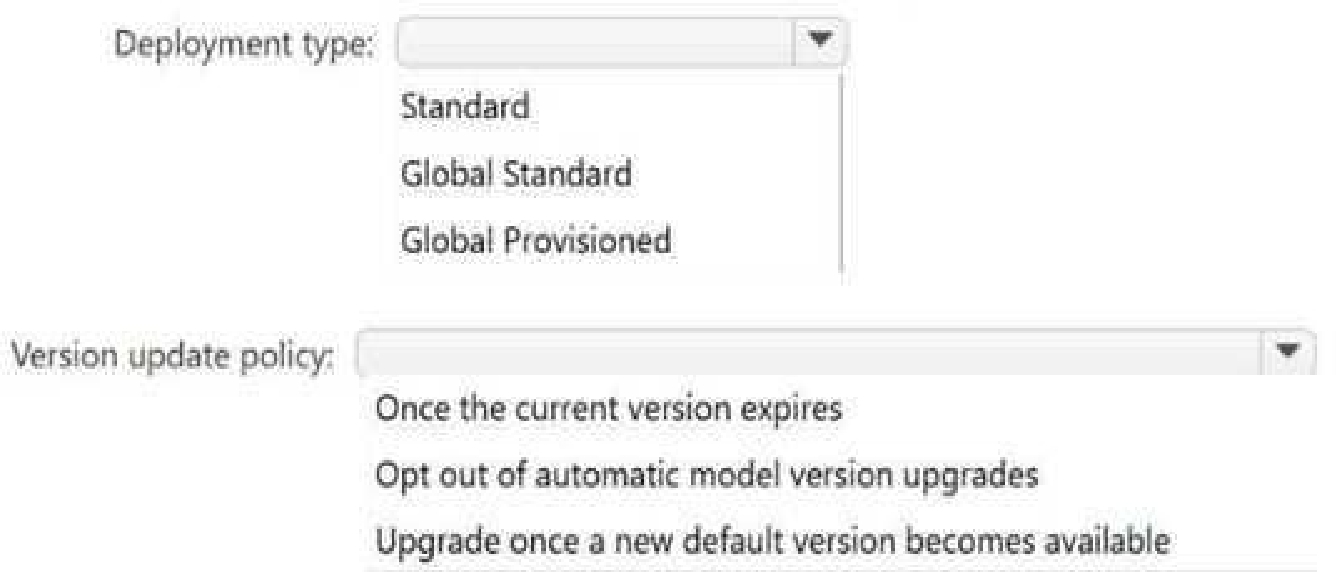
Explanation:
To configure a model deployment for Agent1, you need to select the option that matches the required deployment settings in Azure AI or the relevant model hosting environment. In this question, option A is the correct configuration because it aligns with the technical requirements for the agent’s model deployment.
Why A is correct:
- It satisfies the deployment requirement for Agent1.
- It matches the expected model deployment configuration.
- The other options do not meet the stated technical constraints.
If you want, I can also help explain how to identify the correct deployment option from the image or walk through the likely decision logic used in the exam question.
Quiz
Overview
Contoso, Ltd is a multinational retail company that builds, deploys, and manages generative Al and
agent-based solutions by using Microsoft Foundry.
Identity Environment:
Contoso uses Microsoft Entra ID for identity management, authentication, and authorization
capabilities that enable agents to access organizational resources and services.
Contoso recently formed a new Al engineering team named Agent1Dev Team to optimize and
maintain existing Al solutions.
The team collaborates with solution architects, DevOps engineers, and security engineers to design,
implement, monitor, and secure Al applications.
Contoso also has a team named Agent1Test Team that is responsible for validating Al solutions
before the solution deployments.
Generative Environment:
Contoso has a Microsoft Foundry deployment that contains two projects named Project1 and
Project2.
Project1
Project1 contains a customer support agent named Agent1 that assists customers with product
inquiries and troubleshooting requests.
Agent1 has the following configurations:
Agent1 uses a base model deployment.
A safety evaluation pipeline is NOT enabled.
Tool invocation approval workflows are NOT enabled.
Conversation memory constraints are NOT configured.
Agent1 interacts with customers by using digital support channels and answers general questions
about Contoso products.
Project1 is deployed to an Azure region located in the European Union (EU).
Agent1Dev Team will use Project1 to optimize and maintain Agent1.
Project2
Project2 contains a deployed video generation model. The marketing department at Contoso has
access to Project2 and plans to use the model to develop a video creation solution.
Development of the solution is incomplete.
Data Environment:
Contoso stores product-related information in Azure resources that support Al applications.
The Azure environment contains an Azure Blob Storage account named storage1 that stores product
detail sheets for all the Contoso products.
The product sheets include specifications, feature descriptions, and product support information that
Agent1 can use to answer customer questions. The product sheets are stored in the PDF format.
Problem Statement:
Contoso identifies the following issues:
Agent1 has only general knowledge of the Contoso products.
A recent chat interaction with Agent1 was analyzed for sentiment. The results of the analysis have
NOT been processed yet.
Agent1 does NOT use the detailed product information in the product sheets stored in storage1 when
responding to customer questions.
The finance department at Contoso reports that vendor invoices must be reviewed manually to
ensure that the invoices match the terms defined in the vendor contracts. The invoices contain
tables, logos, and varied layouts that make the documents difficult to process consistently.
Requirement:
Planned Changes:
Contoso plans to implement the following changes:
Implement a solution for Project1 that analyzes the vendor invoices by evaluating both the visual
layout and the textual content of the invoices, so that the invoice details can be verified against the
vendor contract terms.
Update the base model deployment used by Agent1 and standardize the model version to ensure
continuity and consistent responses.
Enable Agent1 to retrieve and use the detailed product information from the product sheets stored
in storage1.
Implement an indexing solution for the product sheets that Agent1 can use to answer customer
questions.
Complete the development of the video creation solution.
Technical Requirements:
Contoso identifies the following technical requirements:
The model deployment used by Agent1 must support scalable, high-throughput generative Al
workloads and dynamically scale to handle variable customer support traffic, without requiring
reserved throughput capacity.
The product sheets must be processed by using an indexing pipeline that enables semantic and
vector search, so that Agent1 can retrieve the relevant product information.
Responses generated by using the product sheet information must be relevant, complete, and
accurate.
Agent1 must be able to use the product sheets to answer natural language questions about product
details.
The model version used by Agent1 must remain consistent to ensure stable responses.
The data processed by the model must remain within the EU.
Safety and Compliance Requirements:
Contoso identifies the following security and compliance requirements:
API keys must NOT be used to access Foundry-deployed models.
Access to the Azure resources must follow the principle of least privilege.
The developers at Contoso must authenticate to Microsoft Foundry resources by using Microsoft
Entra authentication.
Access to Project1 must be assigned to the members of Agent1Dev Team by using a security group
named SC_Agent1_Dev.
Access to Project1 must be assigned to the members of Agent1Test Team by using a security group
named SC_Agent1_Test.
Agent1 must never reveal customer information, even if a document that contains customer data is
added erroneously to the product sheet repository in storage1.
The product sheets might contain images that include embedded text. Agent1 must be protected
from malicious instructions potentially hidden within the images.
Business Information:
Contoso identifies the following business requirements:
Users that interact with Agent1 must have a personalized experience in future interactions, including
the ability for Agent1 to retain conversation context and recall relevant information from previous
interactions.
Agent1 must answer questions only about the products sold by Contoso.
What should you use?
Quiz
You have an Ask a question node that stores user responses in a local variable named Var01.
You need to create the following Power Fx expressions:
An if/else condition expression that ensures that Var01 contains a value
A Send message expression that returns the stored user response in uppercase
How should you configure the expressions? To answer, select the appropriate options in the answer
area.
NOTE: Each correct selection is worth one point.
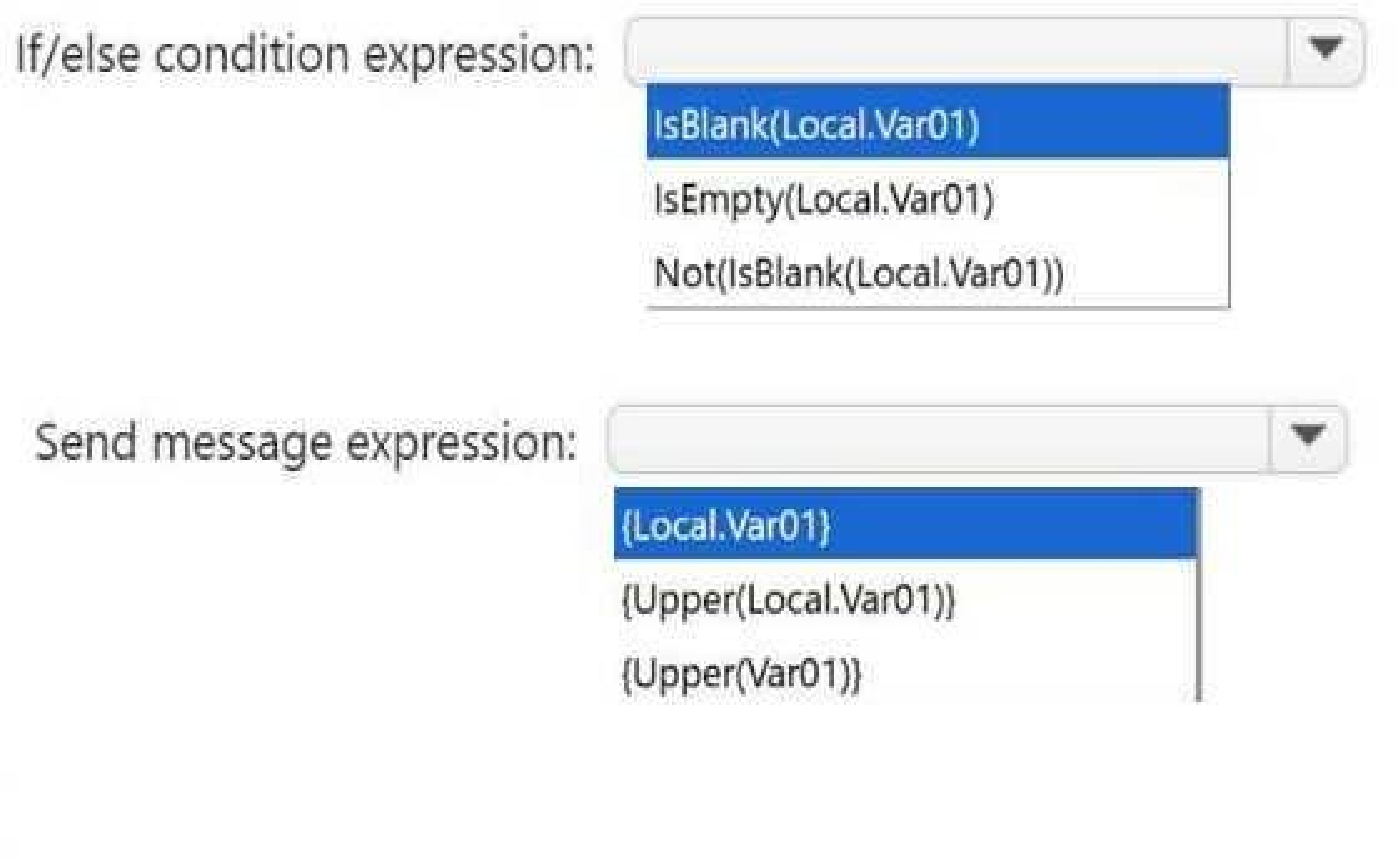
Send message expression: {Upper(Local.Var01)}
The correct if/else condition is Not(IsBlank(Local.Var01)) because the workflow must continue only
when the Ask a question node has captured a nonblank value. In Power Fx, IsBlank checks whether a
value is blank, while Not reverses that Boolean result; therefore, Not(IsBlank(Local.Var01)) evaluates
to true only when Var01 contains user input. IsEmpty(Local.Var01) is not the correct choice because
IsEmpty checks whether a table contains records, not whether a text variable has a value. The Power
Fx formula reference distinguishes these functions by defining IsBlank for blank values and IsEmpty
for empty tables.
The Send message expression must be {Upper(Local.Var01)}. Microsoft Foundry workflow guidance
uses the same pattern for an Ask a question node saved as Var01, followed by a Send message action
that outputs {Upper(Local.Var01)}. The Local. prefix is required because the response is stored in a
local workflow variable, and Upper() converts the stored text response to uppercase. Reference
topics: Microsoft Foundry workflows, Power Fx expressions, local variables, if/else branching, and
Send message actions.
Quiz
You need to connect to the index to meet the following requirements:
• Complex questions must retrieve information from multiple chunks.
• Multi-turn conversations must influence retrieval planning.
• Retrievals must run in parallel to reduce latency.
Which retrieval approach should you use?
AI-103: Microsoft Developing AI Apps and Agents on Azure Practice test unlocks all online simulator questions
Thank you for choosing the free version of the AI-103: Microsoft Developing AI Apps and Agents on Azure practice test! Further deepen your knowledge on Microsoft Simulator; by unlocking the full version of our AI-103: Microsoft Developing AI Apps and Agents on Azure Simulator you will be able to take tests with over 67 constantly updated questions and easily pass your exam. 98% of people pass the exam in the first attempt after preparing with our 67 questions.
BUY NOWWhat to expect from our AI-103: Microsoft Developing AI Apps and Agents on Azure practice tests and how to prepare for any exam?
The AI-103: Microsoft Developing AI Apps and Agents on Azure Simulator Practice Tests are part of the Microsoft Database and are the best way to prepare for any AI-103: Microsoft Developing AI Apps and Agents on Azure exam. The AI-103: Microsoft Developing AI Apps and Agents on Azure practice tests consist of 67 questions and are written by experts to help you and prepare you to pass the exam on the first attempt. The AI-103: Microsoft Developing AI Apps and Agents on Azure database includes questions from previous and other exams, which means you will be able to practice simulating past and future questions. Preparation with AI-103: Microsoft Developing AI Apps and Agents on Azure Simulator will also give you an idea of the time it will take to complete each section of the AI-103: Microsoft Developing AI Apps and Agents on Azure practice test . It is important to note that the AI-103: Microsoft Developing AI Apps and Agents on Azure Simulator does not replace the classic AI-103: Microsoft Developing AI Apps and Agents on Azure study guides; however, the Simulator provides valuable insights into what to expect and how much work needs to be done to prepare for the AI-103: Microsoft Developing AI Apps and Agents on Azure exam.
BUY NOWAI-103: Microsoft Developing AI Apps and Agents on Azure Practice test therefore represents an excellent tool to prepare for the actual exam together with our Microsoft practice test . Our AI-103: Microsoft Developing AI Apps and Agents on Azure Simulator will help you assess your level of preparation and understand your strengths and weaknesses. Below you can read all the quizzes you will find in our AI-103: Microsoft Developing AI Apps and Agents on Azure Simulator and how our unique AI-103: Microsoft Developing AI Apps and Agents on Azure Database made up of real questions:
Info quiz:
- Quiz name:AI-103: Microsoft Developing AI Apps and Agents on Azure
- Total number of questions:67
- Number of questions for the test:50
- Pass score:80%
You can prepare for the AI-103: Microsoft Developing AI Apps and Agents on Azure exams with our mobile app. It is very easy to use and even works offline in case of network failure, with all the functions you need to study and practice with our AI-103: Microsoft Developing AI Apps and Agents on Azure Simulator.
Use our Mobile App, available for both Android and iOS devices, with our AI-103: Microsoft Developing AI Apps and Agents on Azure Simulator . You can use it anywhere and always remember that our mobile app is free and available on all stores.
Our Mobile App contains all AI-103: Microsoft Developing AI Apps and Agents on Azure practice tests which consist of 67 questions and also provide study material to pass the final AI-103: Microsoft Developing AI Apps and Agents on Azure exam with guaranteed success. Our AI-103: Microsoft Developing AI Apps and Agents on Azure database contain hundreds of questions and Microsoft Tests related to AI-103: Microsoft Developing AI Apps and Agents on Azure Exam. This way you can practice anywhere you want, even offline without the internet.
BUY NOW