20:00

Quiz AI-200: Microsoft Developing AI Cloud Solutions on Azure

Free Test
/ 10

Quiz

1/10
You need to deploy Azure function resources and apps by using an automated, version-
controlled
CI/CD pipeline that supports declarative infrastructure deployment. What should you use?
OPTIONS :
Select the answer
1 correct answer
A.
Local Git deployment
B.
GitHub Actions
C.
Azure Functions Core Tools
D.
Azure CLI Answer : B EXPLANATION : Detailed GitHub Actions is the correct orchestration mechanism among the options because the case requires an automated, version-controlled pipeline and Bicep-based declarative deployment. Microsoft documents GitHub Actions as a supported way to deploy Bicep and automate Azure resource deployment. Local Git, Azure Functions Core Tools, and Azure CLI can participate in development or scripted deployment, but they do not by themselves satisfy the stated requirement for a repository-driven, repeatable CI/CD pipeline. Study Guide Alignment: Security and operations: Key Vault, App Configuration, managed identity, OpenTelemetry, Azure Monitor, and KQL-based troubleshooting. Official Microsoft Learn Reference: AI-200 Study Guide | Deploy Bicep with GitHub Actions | Automate Function app resource deployment

Quiz

2/10
You need to address the known issue resulting from vector similarity queries.
Which two actions should you perform? Each correct answer presents part of the solution.
Choose
two.
NOTE: Each correct selection is worth one point.
OPTIONS :
Select the answer
1 correct answer
A.
Add a composite index on the vector fields and metadata properties of the container.
B.
Reduce the numeric precision of the vector embeddings where supported.
C.
Set the account consistency level to Strong.
D.
Change the vector index type from flat to quantizedFlat or diskANN. Answer : B,D EXPLANATION : Detailed The objective is to reduce RU consumption from vector similarity queries. Microsoft guidance identifies vector numeric precision and vector-index selection as major cost and performance levers. Using a lower supported vector precision can reduce storage and processing cost, while quantizedFlat and DiskANN are designed to reduce latency and RU consumption compared with flat search for appropriate data sizes. Strong consistency would increase resource cost rather than solve vector-search efficiency. A regular composite index is not a substitute for the vector index. Option B should be read as reducing vector numeric precision, not changing a generic “indexing precision” setting. Study Guide Alignment: AI data-management workloads: Cosmos DB, PostgreSQL, caching, vector storage, vector retrieval, consistency, and connection optimization. Official Microsoft Learn Reference: AI-200 Study Guide | Vector search in Azure Cosmos DB | Optimize Cosmos DB vector search performance

Quiz

3/10
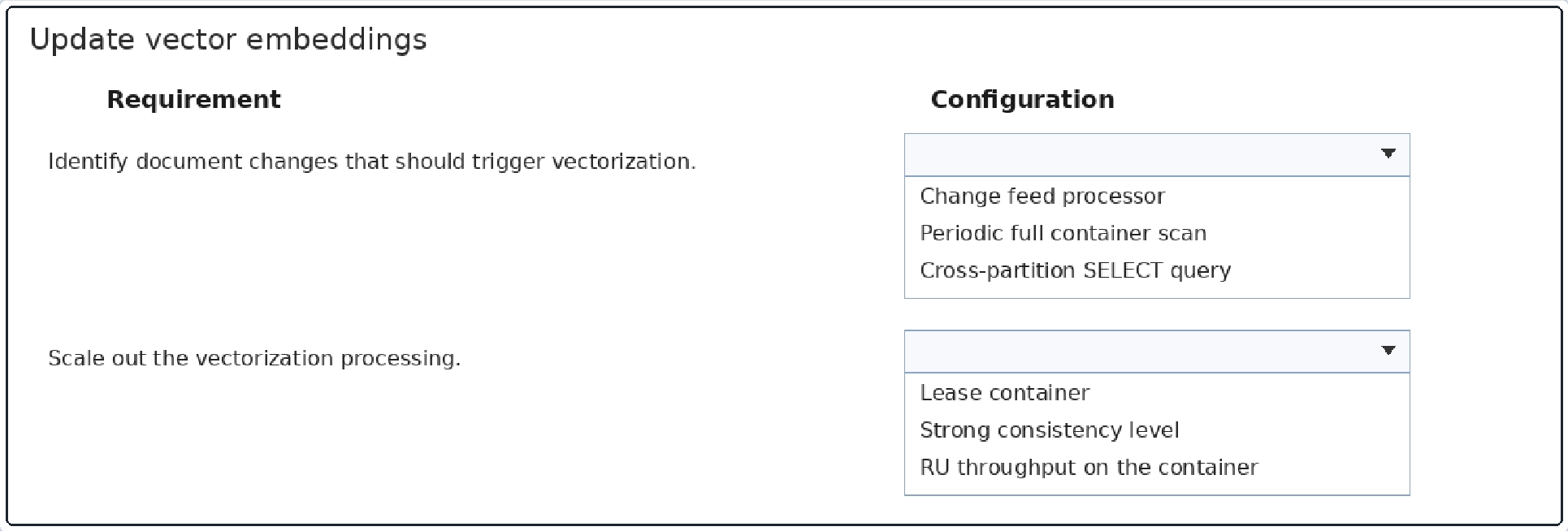
You need to configure vector embedding updates according to the business and technical
requirements.
Which information should you use? To answer, select the appropriate option in the answer
area.


NOTE: Each correct selection is worth one point.
Certification Exam AI-200: Microsoft Developing AI Cloud Solutions on Azure Microsoft Microsoft-AI-200 3-3098136971

OPTIONS :
Select the answer
1 correct answer
See the Explanation. Answer : A EXPLANATION : Certification Exam AI-200: Microsoft Developing AI Cloud Solutions on Azure Microsoft Microsoft-AI-200 4-1869420722
Identify document changes: Change feed processor. Scale out vectorization processing: Lease container. Detailed The change feed processor is designed to react to inserts and updates in a monitored Cosmos DB container, which directly matches the requirement to generate embeddings for new or changed documents. Its lease container stores processing state and coordinates work across multiple workers, allowing the processing workload to scale out without duplicating ownership of change- feed ranges. A periodic full scan would consume unnecessary RUs, and neither strong consistency nor container RU throughput is the coordination mechanism for distributed change-feed workers. Study Guide Alignment: AI data-management workloads: Cosmos DB, PostgreSQL, caching, vector storage, vector retrieval, consistency, and connection optimization. Official Microsoft Learn Reference: AI-200 Study Guide | Azure Cosmos DB change feed processor

Quiz

4/10
A company is building an AI-powered customer support application on Azure. The
application must call large language models, store conversation history, and use enterprise
data to answer questions. Which service should be used to host and access the generative
AI model?
OPTIONS :
Select the answer
1 correct answer
A.
Azure AI Search
B.
Azure OpenAI Service
C.
Azure Event Grid
D.
Azure Monitor Answer : B EXPLANATION : Azure OpenAI Service provides access to generative AI models that can be used for chat completion, summarization, content generation, and reasoning-based tasks. Azure AI Search can help retrieve enterprise data, but it does not host the generative model itself. For an AI- powered support application, Azure OpenAI is the correct service for interacting with large language models.

Quiz

5/10
A developer needs to build an AI application that retrieves relevant company documents
before sending a prompt to a language model. Which architecture pattern should be used?
OPTIONS :
Select the answer
1 correct answer
A.
Model fine-tuning only
B.
Batch processing
C.
Retrieval-Augmented Generation
D.
Static rule-based routing Answer : C EXPLANATION : Retrieval-Augmented Generation, or RAG, retrieves relevant information from external data sources and provides that information as grounding context to a generative AI model. This approach helps improve answer accuracy and reduce hallucinations. It is commonly implemented with Azure AI Search, embeddings, and Azure OpenAI.

Quiz

6/10
An application uses Azure AI Search with vector search. What is the main purpose of
storing vector embeddings in the search index?
OPTIONS :
Select the answer
1 correct answer
A.
To support semantic similarity search
B.
To encrypt documents automatically
C.
To replace authentication keys
D.
To monitor application latency Answer : A EXPLANATION : Vector embeddings represent text or other content as numeric vectors that capture semantic meaning. By storing embeddings in an Azure AI Search index, the application can find documents that are conceptually similar to the user query, even when exact keywords do not match. This is essential for RAG and intelligent search scenarios.

Quiz

7/10
A development team is creating a Python application that calls Azure OpenAI. The
application must authenticate without storing secrets in source code. Which approach
should be used?
OPTIONS :
Select the answer
1 correct answer
A.
Store the API key in the application repository
B.
Use a hardcoded connection string
C.
Disable authentication for the endpoint
D.
Use managed identity or Azure Key Vault Answer : D EXPLANATION : Managed identities and Azure Key Vault help avoid storing secrets directly in application code. Managed identity allows Azure resources to authenticate securely to other Azure services. Key Vault can store API keys, certificates, and secrets securely, reducing the risk of credential exposure.

Quiz

8/10
A company wants an AI solution that can extract fields from invoices, including vendor
name, invoice number, total amount, and due date. Which Azure service is most
appropriate?
OPTIONS :
Select the answer
1 correct answer
A.
Azure Cosmos DB
B.
Azure AI Language
C.
Azure AI Document Intelligence
D.
Azure Functions Answer : C EXPLANATION : Azure AI Document Intelligence is designed to extract structured data from documents such as invoices, receipts, forms, and contracts. It includes prebuilt models for common document types and supports custom models for specialized layouts. It is the best fit for invoice field extraction.

Quiz

9/10
A developer is designing an AI chat application. The application must remember previous
user messages in the same conversation. What should the developer implement?
OPTIONS :
Select the answer
1 correct answer
A.
A new model deployment for every message
B.
A separate Azure subscription for every chat
C.
A static system prompt only
D.
Conversation state management Answer : D EXPLANATION : Conversation state management stores or passes previous messages so the model can respond with awareness of the ongoing conversation. Without conversation history, each prompt is processed independently. Developers commonly store history in memory, a database, or a session store and include relevant context in each request. 540004-

Quiz

10/10
A company wants to classify customer feedback as positive, neutral, or negative. Which
Azure AI capability should be used?
OPTIONS :
Select the answer
1 correct answer
A.
Speech synthesis
B.
Sentiment analysis
C.
Vector indexing
D.
Object detection Answer : B EXPLANATION : Sentiment analysis is a natural language processing capability that determines whether text expresses positive, negative, neutral, or mixed sentiment. It is commonly used to analyze reviews, surveys, customer feedback, and support messages. Azure AI Language provides sentiment analysis capabilities.
Looking for more questions?Buy now

AI-200: Microsoft Developing AI Cloud Solutions on Azure Practice test unlocks all online simulator questions

Thank you for choosing the free version of the AI-200: Microsoft Developing AI Cloud Solutions on Azure practice test! Further deepen your knowledge on Microsoft Simulator; by unlocking the full version of our AI-200: Microsoft Developing AI Cloud Solutions on Azure Simulator you will be able to take tests with over 50 constantly updated questions and easily pass your exam. 98% of people pass the exam in the first attempt after preparing with our 50 questions.

BUY NOW

What to expect from our AI-200: Microsoft Developing AI Cloud Solutions on Azure practice tests and how to prepare for any exam?

The AI-200: Microsoft Developing AI Cloud Solutions on Azure Simulator Practice Tests are part of the Microsoft Database and are the best way to prepare for any AI-200: Microsoft Developing AI Cloud Solutions on Azure exam. The AI-200: Microsoft Developing AI Cloud Solutions on Azure practice tests consist of 50 questions and are written by experts to help you and prepare you to pass the exam on the first attempt. The AI-200: Microsoft Developing AI Cloud Solutions on Azure database includes questions from previous and other exams, which means you will be able to practice simulating past and future questions. Preparation with AI-200: Microsoft Developing AI Cloud Solutions on Azure Simulator will also give you an idea of the time it will take to complete each section of the AI-200: Microsoft Developing AI Cloud Solutions on Azure practice test . It is important to note that the AI-200: Microsoft Developing AI Cloud Solutions on Azure Simulator does not replace the classic AI-200: Microsoft Developing AI Cloud Solutions on Azure study guides; however, the Simulator provides valuable insights into what to expect and how much work needs to be done to prepare for the AI-200: Microsoft Developing AI Cloud Solutions on Azure exam.

BUY NOW

AI-200: Microsoft Developing AI Cloud Solutions on Azure Practice test therefore represents an excellent tool to prepare for the actual exam together with our Microsoft practice test . Our AI-200: Microsoft Developing AI Cloud Solutions on Azure Simulator will help you assess your level of preparation and understand your strengths and weaknesses. Below you can read all the quizzes you will find in our AI-200: Microsoft Developing AI Cloud Solutions on Azure Simulator and how our unique AI-200: Microsoft Developing AI Cloud Solutions on Azure Database made up of real questions:

Info quiz:

  • Quiz name:AI-200: Microsoft Developing AI Cloud Solutions on Azure
  • Total number of questions:50
  • Number of questions for the test:50
  • Pass score:80%

You can prepare for the AI-200: Microsoft Developing AI Cloud Solutions on Azure exams with our mobile app. It is very easy to use and even works offline in case of network failure, with all the functions you need to study and practice with our AI-200: Microsoft Developing AI Cloud Solutions on Azure Simulator.

Use our Mobile App, available for both Android and iOS devices, with our AI-200: Microsoft Developing AI Cloud Solutions on Azure Simulator . You can use it anywhere and always remember that our mobile app is free and available on all stores.

Our Mobile App contains all AI-200: Microsoft Developing AI Cloud Solutions on Azure practice tests which consist of 50 questions and also provide study material to pass the final AI-200: Microsoft Developing AI Cloud Solutions on Azure exam with guaranteed success. Our AI-200: Microsoft Developing AI Cloud Solutions on Azure database contain hundreds of questions and Microsoft Tests related to AI-200: Microsoft Developing AI Cloud Solutions on Azure Exam. This way you can practice anywhere you want, even offline without the internet.

BUY NOW
