Quiz AI-300: Microsoft Operationalizing Machine Learning and Generative AI Solutions
Quiz
Background
Fabrikam Inc. is a mid-sized healthcare analytics company that provides population health
dashboards and predictive insights to regional hospital systems across the United States. Fabrikam
Inc. customers rely on near real time analytics to monitor patient flow, staffing needs, and
readmission risks. They use multiple traditional forecasting machine learning models for predictions.
Fabrikam Inc. has an established Microsoft Azure footprint. The company uses Jupyter Notebooks
that run on a local server as the primary development environment. The data science team is
experiencing scalability, asset management and code management issues with the current
development platform. Fabrikam Inc. plans to migrate to a cloud-based development environment to
mitigate the issues.
Additionally, the company plans to implement a Retrieval-Augmented Generation (RAG)-based chat
application for client support.
Leadership requires the application to be developed and deployed with a low operational risk.
Current Environment
Fabrikam Inc. operates a single Azure subscription that has the following components:
Azure Data Lake Storage Gen2 that contains de-identified clinical and operational datasets
Azure AI Search indexing curated analytical documents and reference materials
A small set of Python-based training scripts maintained by data scientists Azure OpenAI Service with
deployed foundational models
A Microsoft Foundry resource for building a RAG-based solution
Evaluation data has manually defined expected responses.
The current challenges faced by the data science team include the following:
Model training jobs are run manually from notebooks.
Experiment tracking is inconsistent
Model versions are registered without standardized metadata.
Deployment is performed manually by data scientists, with limited rollback capability.
The team has no standardized evaluation process for generative AI outputs.
The environment currently allows public network access. Authentication relies on user accounts
rather than managed identities.
Compute targets are manually created and shared across experiments. This has led to resource
contention during peak usage.
Business Requirements
Fabrikam Inc. has the following business requirements for the modernization initiative:
Provide a conversational interface that answers analytics questions by using internal documents and
datasets.
Ensure that sensitive healthcare-related data is not exposed outside the Fabrikam Inc. Azure tenant.
Enable repeatable and auditable model training and deployment processes.
Support experimentation to compare prompt strategies and fine-tuned models.
Align the model with the ranked preferences and optimize behavior for the long term.
Minimize disruption to existing analytics workloads during rollout.
Technical Requirements
To support the business goals, Fabrikam Inc. identifies these technical requirements:
Use Azure Machine Learning workspaces to centrally manage data assets, models, and
environments.
Implement experiment tracking and model versioning for all training jobs.
Orchestrate training and evaluation by using pipelines rather than manually running notebooks.
Deploy traditional machine learning models with support for staged rollout and rollback.
Improve RAG-based solution output quality.
Use the existing evaluation datasets that are based on real data with input-output pairs.
Apply advanced fine-tuning techniques only when prompt engineering is insufficient
Issues and Constraints
Fabrikam Inc. must comply with internal security policies that require the company to restrict
network access and avoid long-lived secrets. The data science team has limited Azure DevOps
experience, so solutions must favor managed services and automation over custom infrastructure.
Cost predictability is important. Leadership prefers serverless or managed compute options where
possible but is willing to approve dedicated compute for stable production workloads.
Problem Statement
Fabrikam Inc. must design and implement an Azure-based AI operations solution that enables
reliable training, evaluation, deployment, and iteration of generative AI models. The solution must
support experimentation and gradual rollout while ensuring governance, security, and operational
stability. The data science and platform teams must collaborate to deliver this solution by using Azure
Machine Learning and Microsoft Foundry capabilities.
Which action should you perform first?
Quiz
Background
Fabrikam Inc. is a mid-sized healthcare analytics company that provides population health
dashboards and predictive insights to regional hospital systems across the United States. Fabrikam
Inc. customers rely on near real time analytics to monitor patient flow, staffing needs, and
readmission risks. They use multiple traditional forecasting machine learning models for predictions.
Fabrikam Inc. has an established Microsoft Azure footprint. The company uses Jupyter Notebooks
that run on a local server as the primary development environment. The data science team is
experiencing scalability, asset management and code management issues with the current
development platform. Fabrikam Inc. plans to migrate to a cloud-based development environment to
mitigate the issues.
Additionally, the company plans to implement a Retrieval-Augmented Generation (RAG)-based chat
application for client support.
Leadership requires the application to be developed and deployed with a low operational risk.
Current Environment
Fabrikam Inc. operates a single Azure subscription that has the following components:
Azure Data Lake Storage Gen2 that contains de-identified clinical and operational datasets
Azure AI Search indexing curated analytical documents and reference materials
A small set of Python-based training scripts maintained by data scientists Azure OpenAI Service with
deployed foundational models
A Microsoft Foundry resource for building a RAG-based solution
Evaluation data has manually defined expected responses.
The current challenges faced by the data science team include the following:
Model training jobs are run manually from notebooks.
Experiment tracking is inconsistent
Model versions are registered without standardized metadata.
Deployment is performed manually by data scientists, with limited rollback capability.
The team has no standardized evaluation process for generative AI outputs.
The environment currently allows public network access. Authentication relies on user accounts
rather than managed identities.
Compute targets are manually created and shared across experiments. This has led to resource
contention during peak usage.
Business Requirements
Fabrikam Inc. has the following business requirements for the modernization initiative:
Provide a conversational interface that answers analytics questions by using internal documents and
datasets.
Ensure that sensitive healthcare-related data is not exposed outside the Fabrikam Inc. Azure tenant.
Enable repeatable and auditable model training and deployment processes.
Support experimentation to compare prompt strategies and fine-tuned models.
Align the model with the ranked preferences and optimize behavior for the long term.
Minimize disruption to existing analytics workloads during rollout.
Technical Requirements
To support the business goals, Fabrikam Inc. identifies these technical requirements:
Use Azure Machine Learning workspaces to centrally manage data assets, models, and
environments.
Implement experiment tracking and model versioning for all training jobs.
Orchestrate training and evaluation by using pipelines rather than manually running notebooks.
Deploy traditional machine learning models with support for staged rollout and rollback.
Improve RAG-based solution output quality.
Use the existing evaluation datasets that are based on real data with input-output pairs.
Apply advanced fine-tuning techniques only when prompt engineering is insufficient
Issues and Constraints
Fabrikam Inc. must comply with internal security policies that require the company to restrict
network access and avoid long-lived secrets. The data science team has limited Azure DevOps
experience, so solutions must favor managed services and automation over custom infrastructure.
Cost predictability is important. Leadership prefers serverless or managed compute options where
possible but is willing to approve dedicated compute for stable production workloads.
Problem Statement
Fabrikam Inc. must design and implement an Azure-based AI operations solution that enables
reliable training, evaluation, deployment, and iteration of generative AI models. The solution must
support experimentation and gradual rollout while ensuring governance, security, and operational
stability. The data science and platform teams must collaborate to deliver this solution by using Azure
Machine Learning and Microsoft Foundry capabilities.
constraints, and technical requirements.
What should you implement?
Quiz
Background
Fabrikam Inc. is a mid-sized healthcare analytics company that provides population health
dashboards and predictive insights to regional hospital systems across the United States. Fabrikam
Inc. customers rely on near real time analytics to monitor patient flow, staffing needs, and
readmission risks. They use multiple traditional forecasting machine learning models for predictions.
Fabrikam Inc. has an established Microsoft Azure footprint. The company uses Jupyter Notebooks
that run on a local server as the primary development environment. The data science team is
experiencing scalability, asset management and code management issues with the current
development platform. Fabrikam Inc. plans to migrate to a cloud-based development environment to
mitigate the issues.
Additionally, the company plans to implement a Retrieval-Augmented Generation (RAG)-based chat
application for client support.
Leadership requires the application to be developed and deployed with a low operational risk.
Current Environment
Fabrikam Inc. operates a single Azure subscription that has the following components:
Azure Data Lake Storage Gen2 that contains de-identified clinical and operational datasets
Azure AI Search indexing curated analytical documents and reference materials
A small set of Python-based training scripts maintained by data scientists Azure OpenAI Service with
deployed foundational models
A Microsoft Foundry resource for building a RAG-based solution
Evaluation data has manually defined expected responses.
The current challenges faced by the data science team include the following:
Model training jobs are run manually from notebooks.
Experiment tracking is inconsistent
Model versions are registered without standardized metadata.
Deployment is performed manually by data scientists, with limited rollback capability.
The team has no standardized evaluation process for generative AI outputs.
The environment currently allows public network access. Authentication relies on user accounts
rather than managed identities.
Compute targets are manually created and shared across experiments. This has led to resource
contention during peak usage.
Business Requirements
Fabrikam Inc. has the following business requirements for the modernization initiative:
Provide a conversational interface that answers analytics questions by using internal documents and
datasets.
Ensure that sensitive healthcare-related data is not exposed outside the Fabrikam Inc. Azure tenant.
Enable repeatable and auditable model training and deployment processes.
Support experimentation to compare prompt strategies and fine-tuned models.
Align the model with the ranked preferences and optimize behavior for the long term.
Minimize disruption to existing analytics workloads during rollout.
Technical Requirements
To support the business goals, Fabrikam Inc. identifies these technical requirements:
Use Azure Machine Learning workspaces to centrally manage data assets, models, and
environments.
Implement experiment tracking and model versioning for all training jobs.
Orchestrate training and evaluation by using pipelines rather than manually running notebooks.
Deploy traditional machine learning models with support for staged rollout and rollback.
Improve RAG-based solution output quality.
Use the existing evaluation datasets that are based on real data with input-output pairs.
Apply advanced fine-tuning techniques only when prompt engineering is insufficient
Issues and Constraints
Fabrikam Inc. must comply with internal security policies that require the company to restrict
network access and avoid long-lived secrets. The data science team has limited Azure DevOps
experience, so solutions must favor managed services and automation over custom infrastructure.
Cost predictability is important. Leadership prefers serverless or managed compute options where
possible but is willing to approve dedicated compute for stable production workloads.
Problem Statement
Fabrikam Inc. must design and implement an Azure-based AI operations solution that enables
reliable training, evaluation, deployment, and iteration of generative AI models. The solution must
support experimentation and gradual rollout while ensuring governance, security, and operational
stability. The data science and platform teams must collaborate to deliver this solution by using Azure
Machine Learning and Microsoft Foundry capabilities.
What should you recommend?
Quiz
different downstream systems.
One system requests predictions synchronously during customer interactions.
Another system submits files containing millions of records for scheduled scoring.
You need to deploy the model by using managed inference options that match each usage pattern.
Which option should you use for each usage pattern? To answer, select the appropriate options in
the answer area. NOTE: Each correct selection is worth one point.
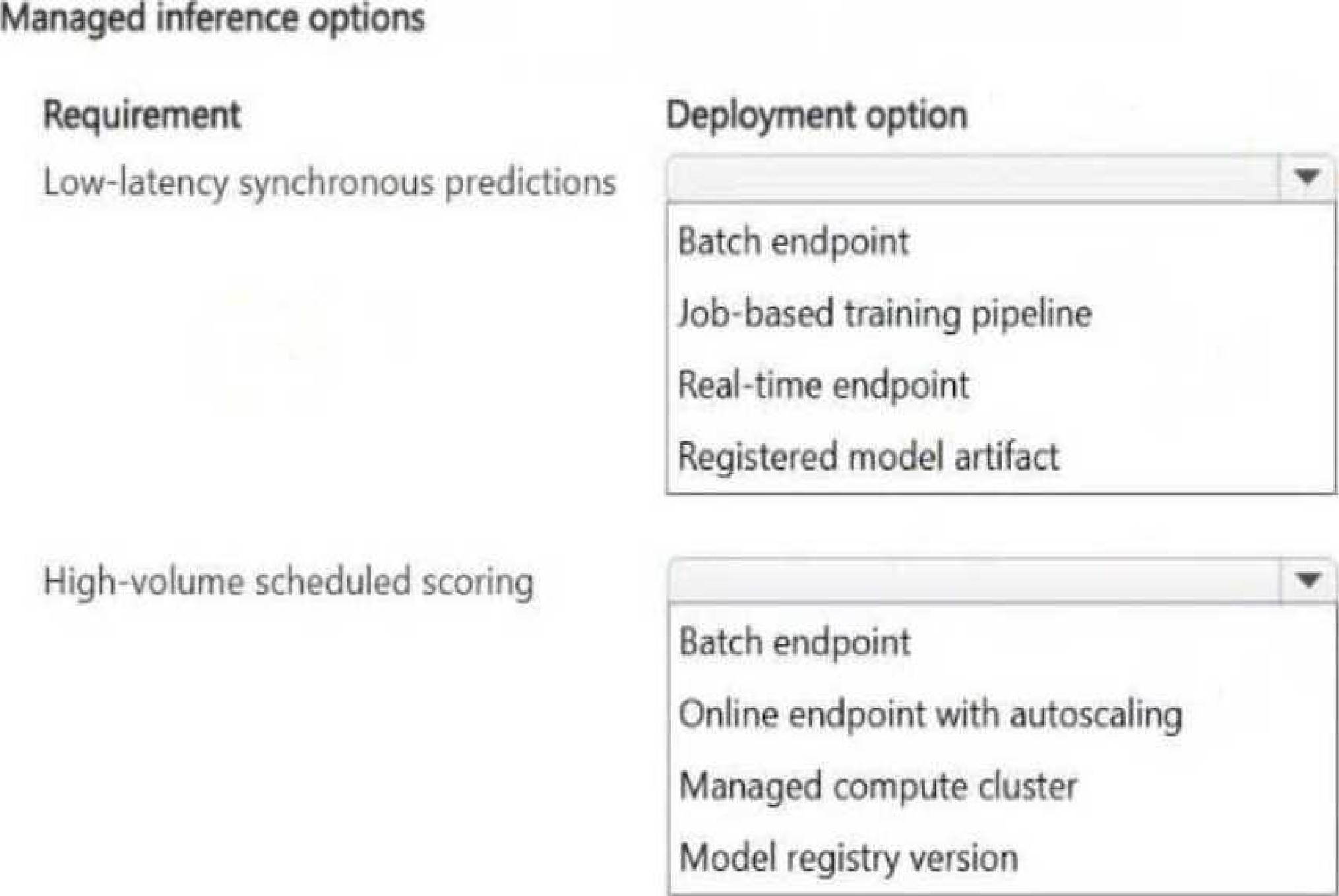
Explanation:
You need to match each workload with the most appropriate managed inference option:
1. Synchronous predictions during customer interactions
This requires low-latency, real-time responses because the system needs a prediction immediately while the customer is interacting.
The correct managed inference option for this is:
Managed online endpoint
2. Scheduled scoring of files containing millions of records
This is a batch workload because it processes large volumes of records asynchronously and does not require an immediate response.
The correct managed inference option for this is:
Batch endpoint
Why this is the right match:
- Managed online endpoints are designed for real-time inference with low latency.
- Batch endpoints are designed for large-scale, asynchronous inference over files or datasets.
So the correct selections are:
- Synchronous customer interactions: Managed online endpoint
- Millions of records submitted in files: Batch endpoint
If you want, I can also explain why the other options are not correct.
Quiz
You must deploy the model to use a low-priority VM with a pricing discount.
You need to deploy the model.
Which compute target should you use?
Quiz
endpoints.
The team needs to introduce a new version of a model to production without disrupting existing
users.
The team must validate the new version before full rollout.
You need to reduce risk during deployment.
What should you do?
Quiz
You plan to fine-tune the model.
You need to prepare a file that contains training data.
Which file format should you use?
Quiz
You plan to fine-tune the model.
You need to prepare a file that contains training data for multi-turn chat.
Which file encoding method should you use?
Quiz
You label examples of support tickets. You must improve classification accuracy by configuring and
fine-tuning the base model in Microsoft Foundry.
You need to configure and run fine-tuning.
What should you do first?
Quiz
variants in a development environment.
The team requires consistent inputs to evaluate prompt variants without relying on live user traffic.
You need to create a controlled evaluation of input data.
Which action should you perform first?
AI-300: Microsoft Operationalizing Machine Learning and Generative AI Solutions Practice test unlocks all online simulator questions
Thank you for choosing the free version of the AI-300: Microsoft Operationalizing Machine Learning and Generative AI Solutions practice test! Further deepen your knowledge on Microsoft Simulator; by unlocking the full version of our AI-300: Microsoft Operationalizing Machine Learning and Generative AI Solutions Simulator you will be able to take tests with over 60 constantly updated questions and easily pass your exam. 98% of people pass the exam in the first attempt after preparing with our 60 questions.
BUY NOWWhat to expect from our AI-300: Microsoft Operationalizing Machine Learning and Generative AI Solutions practice tests and how to prepare for any exam?
The AI-300: Microsoft Operationalizing Machine Learning and Generative AI Solutions Simulator Practice Tests are part of the Microsoft Database and are the best way to prepare for any AI-300: Microsoft Operationalizing Machine Learning and Generative AI Solutions exam. The AI-300: Microsoft Operationalizing Machine Learning and Generative AI Solutions practice tests consist of 60 questions and are written by experts to help you and prepare you to pass the exam on the first attempt. The AI-300: Microsoft Operationalizing Machine Learning and Generative AI Solutions database includes questions from previous and other exams, which means you will be able to practice simulating past and future questions. Preparation with AI-300: Microsoft Operationalizing Machine Learning and Generative AI Solutions Simulator will also give you an idea of the time it will take to complete each section of the AI-300: Microsoft Operationalizing Machine Learning and Generative AI Solutions practice test . It is important to note that the AI-300: Microsoft Operationalizing Machine Learning and Generative AI Solutions Simulator does not replace the classic AI-300: Microsoft Operationalizing Machine Learning and Generative AI Solutions study guides; however, the Simulator provides valuable insights into what to expect and how much work needs to be done to prepare for the AI-300: Microsoft Operationalizing Machine Learning and Generative AI Solutions exam.
BUY NOWAI-300: Microsoft Operationalizing Machine Learning and Generative AI Solutions Practice test therefore represents an excellent tool to prepare for the actual exam together with our Microsoft practice test . Our AI-300: Microsoft Operationalizing Machine Learning and Generative AI Solutions Simulator will help you assess your level of preparation and understand your strengths and weaknesses. Below you can read all the quizzes you will find in our AI-300: Microsoft Operationalizing Machine Learning and Generative AI Solutions Simulator and how our unique AI-300: Microsoft Operationalizing Machine Learning and Generative AI Solutions Database made up of real questions:
Info quiz:
- Quiz name:AI-300: Microsoft Operationalizing Machine Learning and Generative AI Solutions
- Total number of questions:60
- Number of questions for the test:50
- Pass score:80%
You can prepare for the AI-300: Microsoft Operationalizing Machine Learning and Generative AI Solutions exams with our mobile app. It is very easy to use and even works offline in case of network failure, with all the functions you need to study and practice with our AI-300: Microsoft Operationalizing Machine Learning and Generative AI Solutions Simulator.
Use our Mobile App, available for both Android and iOS devices, with our AI-300: Microsoft Operationalizing Machine Learning and Generative AI Solutions Simulator . You can use it anywhere and always remember that our mobile app is free and available on all stores.
Our Mobile App contains all AI-300: Microsoft Operationalizing Machine Learning and Generative AI Solutions practice tests which consist of 60 questions and also provide study material to pass the final AI-300: Microsoft Operationalizing Machine Learning and Generative AI Solutions exam with guaranteed success. Our AI-300: Microsoft Operationalizing Machine Learning and Generative AI Solutions database contain hundreds of questions and Microsoft Tests related to AI-300: Microsoft Operationalizing Machine Learning and Generative AI Solutions Exam. This way you can practice anywhere you want, even offline without the internet.
BUY NOW