Quiz AZ-305: Microsoft Designing Microsoft Azure Infrastructure Solutions
Quiz
Case Study
Overview
This is a case study. Case studies are not timed separately. You can use as much exam time as you
would like to complete each case. However, there may be additional case studies and sections on
this exam. You must manage your time to ensure that you are able to complete all questions included
on this exam in the time provided.
To answer the questions included in a case study, you will need to reference information that is
provided in the case study. Case studies might contain exhibits and other resources that provide
more information about the scenario that is described in the case study. Each question is
independent of the other questions in this case study.
At the end of this case study, a review screen will appear. This screen allows you to review your
answers and to make changes before you move to the next section of the exam. After you begin a
new section, you cannot return to this section.
To start the case study
To display the first question in this case study, click the Next button. Use the buttons in the left pane
to explore the content of the case study before you answer the questions. Clicking these buttons
displays information such as business requirements, existing environment, and problem statements.
If the case study has an All Information tab, note that the information displayed is identical to the
information displayed on the subsequent tabs. When you are ready to answer a question, click the
Question button to return to the question.
Overview. General Overview
Litware, Inc. is a medium-sized finance company.
Overview. Physical Locations
Litware has a main office in Boston.
Existing Environment. Identity Environment
The network contains an Active Directory forest named Litware.com that is linked to an Azure Active
Directory (Azure AD) tenant named Litware.com. All users have Azure Active Directory Premium P2
licenses.
Litware has a second Azure AD tenant named dev.Litware.com that is used as a development
environment.
The Litware.com tenant has a conditional acсess policy named capolicy1. Capolicy1 requires that
when users manage the Azure subscription for a production environment by using the Azure portal,
they must connect from a hybrid Azure AD-joined device.
Existing Environment. Azure Environment
Litware has 10 Azure subscriptions that are linked to the Litware.com tenant and five Azure
subscriptions that are linked to the dev.Litware.com tenant. All the subscriptions are in an Enterprise
Agreement (EA).
The Litware.com tenant contains a custom Azure role-based access control (Azure RBAC) role named
Role1 that grants the DataActions read permission to the blobs and files in Azure Storage.
Existing Environment. On-premises Environment
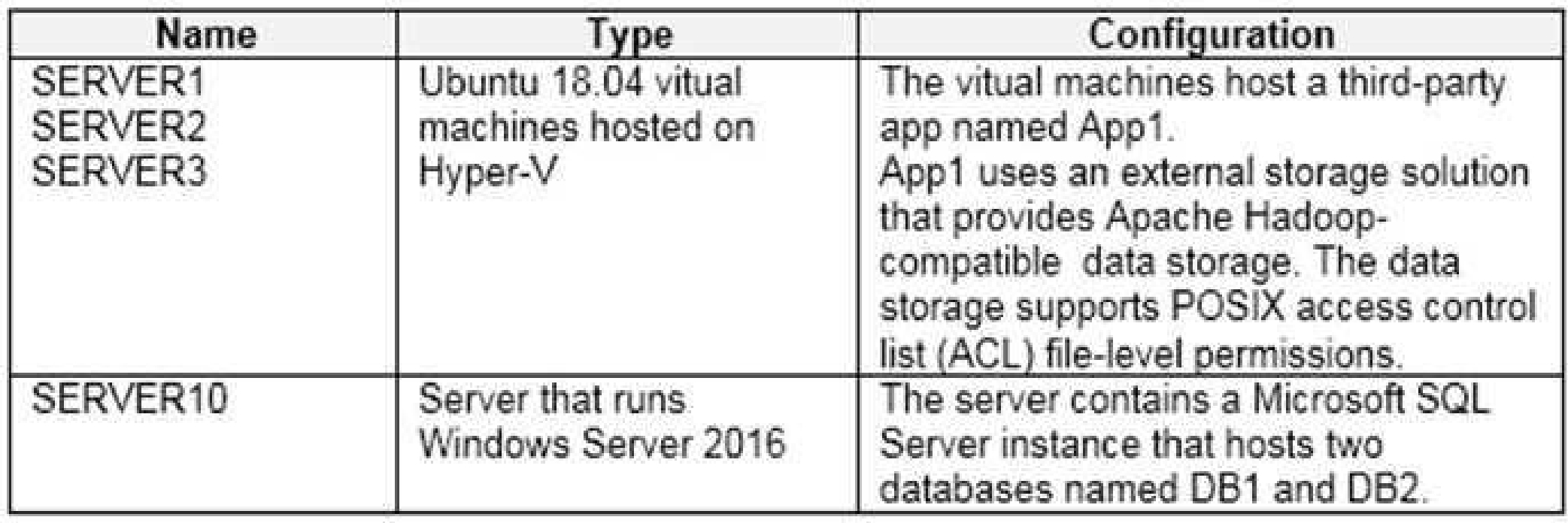
The on-premises network of Litware contains the resources shown in the following table.
Existing Environment. Network Environment
Litware has ExpressRoute connectivity to Azure.
Planned Changes and Requirements. Planned Changes
Litware plans to implement the following changes:
Migrate DB1 and DB2 to Azure.
Migrate App1 to Azure virtual machines.
Deploy the Azure virtual machines that will host App1 to Azure dedicated hosts.
Planned Changes and Requirements. Authentication and Authorization Requirements
Litware identifies the following authentication and authorization requirements:
Users that manage the production environment by using the Azure portal must connect from a
hybrid Azure AD-joined device and authenticate by using Azure Multi-Factor Authentication (MFA).
The Network Contributor built-in RBAC role must be used to grant permission to all the virtual
networks in all the Azure subscriptions.
To access the resources in Azure, App1 must use the managed identity of the virtual machines that
will host the app.
Role1 must be used to assign permissions to the storage accounts of all the Azure subscriptions.
RBAC roles must be applied at the highest level possible.
Planned Changes and Requirements. Resiliency Requirements
Litware identifies the following resiliency requirements:
Once migrated to Azure, DB1 and DB2 must meet the following requirements:
- Maintain availability if two availability zones in the local Azure region fail.
- Fail over automatically.
- Minimize I/O latency.
App1 must meet the following requirements:
- Be hosted in an Azure region that supports availability zones.
- Be hosted on Azure virtual machines that support automatic scaling.
- Maintain availability if two availability zones in the local Azure region fail.
Planned Changes and Requirements. Security and Compliance Requirements
Litware identifies the following security and compliance requirements:
Once App1 is migrated to Azure, you must ensure that new data can be written to the app, and the
modification of new and existing data is prevented for a period of three years.
On-premises users and services must be able to access the Azure Storage account that will host the
data in App1.
Access to the public endpoint of the Azure Storage account that will host the App1 data must be
prevented.
All Azure SQL databases in the production environment must have Transparent Data Encryption (TDE)
enabled.
App1 must not share physical hardware with other workloads.
Planned Changes and Requirements. Business Requirements
Litware identifies the following business requirements:
Minimize administrative effort.
Minimize costs.
You need to recommend a network connectivity solution for the Azure Storage account that will host
the App1 dat
a. The solution must meet the security and compliance requirements.
What should you include in the recommendation?
Quiz
Case Study
Overview
This is a case study. Case studies are not timed separately. You can use as much exam time as you
would like to complete each case. However, there may be additional case studies and sections on
this exam. You must manage your time to ensure that you are able to complete all questions included
on this exam in the time provided.
To answer the questions included in a case study, you will need to reference information that is
provided in the case study. Case studies might contain exhibits and other resources that provide
more information about the scenario that is described in the case study. Each question is
independent of the other questions in this case study.
At the end of this case study, a review screen will appear. This screen allows you to review your
answers and to make changes before you move to the next section of the exam. After you begin a
new section, you cannot return to this section.
To start the case study
To display the first question in this case study, click the Next button. Use the buttons in the left pane
to explore the content of the case study before you answer the questions. Clicking these buttons
displays information such as business requirements, existing environment, and problem statements.
If the case study has an All Information tab, note that the information displayed is identical to the
information displayed on the subsequent tabs. When you are ready to answer a question, click the
Question button to return to the question.
Overview. General Overview
Litware, Inc. is a medium-sized finance company.
Overview. Physical Locations
Litware has a main office in Boston.
Existing Environment. Identity Environment
The network contains an Active Directory forest named Litware.com that is linked to an Azure Active
Directory (Azure AD) tenant named Litware.com. All users have Azure Active Directory Premium P2
licenses.
Litware has a second Azure AD tenant named dev.Litware.com that is used as a development
environment.
The Litware.com tenant has a conditional acсess policy named capolicy1. Capolicy1 requires that
when users manage the Azure subscription for a production environment by using the Azure portal,
they must connect from a hybrid Azure AD-joined device.
Existing Environment. Azure Environment
Litware has 10 Azure subscriptions that are linked to the Litware.com tenant and five Azure
subscriptions that are linked to the dev.Litware.com tenant. All the subscriptions are in an Enterprise
Agreement (EA).
The Litware.com tenant contains a custom Azure role-based access control (Azure RBAC) role named
Role1 that grants the DataActions read permission to the blobs and files in Azure Storage.
Existing Environment. On-premises Environment
The on-premises network of Litware contains the resources shown in the following table.
Existing Environment. Network Environment
Litware has ExpressRoute connectivity to Azure.
Planned Changes and Requirements. Planned Changes
Litware plans to implement the following changes:
Migrate DB1 and DB2 to Azure.
Migrate App1 to Azure virtual machines.
Deploy the Azure virtual machines that will host App1 to Azure dedicated hosts.
Planned Changes and Requirements. Authentication and Authorization Requirements
Litware identifies the following authentication and authorization requirements:
Users that manage the production environment by using the Azure portal must connect from a
hybrid Azure AD-joined device and authenticate by using Azure Multi-Factor Authentication (MFA).
The Network Contributor built-in RBAC role must be used to grant permission to all the virtual
networks in all the Azure subscriptions.
To access the resources in Azure, App1 must use the managed identity of the virtual machines that
will host the app.
Role1 must be used to assign permissions to the storage accounts of all the Azure subscriptions.
RBAC roles must be applied at the highest level possible.
Planned Changes and Requirements. Resiliency Requirements
Litware identifies the following resiliency requirements:
Once migrated to Azure, DB1 and DB2 must meet the following requirements:
- Maintain availability if two availability zones in the local Azure region fail.
- Fail over automatically.
- Minimize I/O latency.
App1 must meet the following requirements:
- Be hosted in an Azure region that supports availability zones.
- Be hosted on Azure virtual machines that support automatic scaling.
- Maintain availability if two availability zones in the local Azure region fail.
Planned Changes and Requirements. Security and Compliance Requirements
Litware identifies the following security and compliance requirements:
Once App1 is migrated to Azure, you must ensure that new data can be written to the app, and the
modification of new and existing data is prevented for a period of three years.
On-premises users and services must be able to access the Azure Storage account that will host the
data in App1.
Access to the public endpoint of the Azure Storage account that will host the App1 data must be
prevented.
All Azure SQL databases in the production environment must have Transparent Data Encryption (TDE)
enabled.
App1 must not share physical hardware with other workloads.
Planned Changes and Requirements. Business Requirements
Litware identifies the following business requirements:
Minimize administrative effort.
Minimize costs.
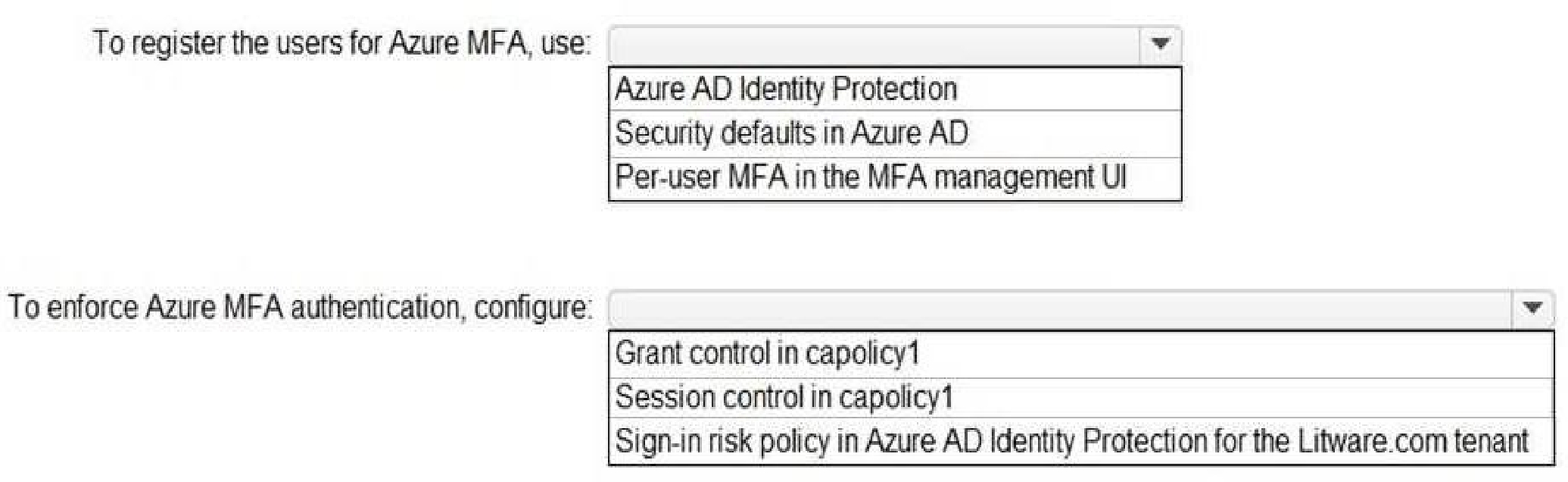
and must authenticate by using Azure MFA when they sign in to the Azure portal. The solution must
meet the authentication and authorization requirements.
What should you do? To answer, select the appropriate options in the answer area.
NOTE: Each correct selection is worth one point.
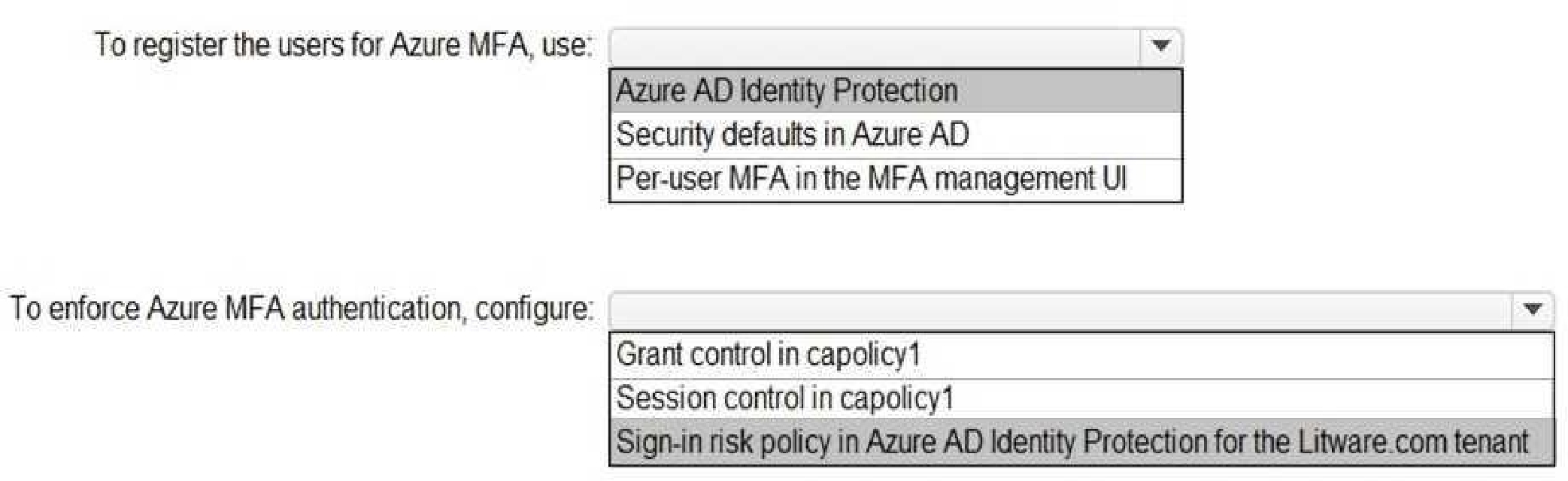
Box 1: Azure AD Identity Protection
Azure AD Identity Protection helps you manage the roll-out of Azure AD Multi-Factor Authentication
(MFA) registration by configuring a Conditional Access policy to require MFA registration no matter
what modern authentication app you are signing in to.
Scenario: Users that manage the production environment by using the Azure portal must connect
from a hybrid Azure AD-joined device and authenticate by using Azure Multi-Factor Authentication
(MFA).
Box 2: Sign-in risk policy...
Scenario: The Litware.com tenant has a conditional access policy named capolicy1. Capolicy1
requires that when users manage the Azure subscription for a production environment by using the
Azure portal, they must connect from a hybrid Azure AD-joined device.
Identity Protection policies we have two risk policies that we can enable in our directory.
Sign-in risk policy
User risk policy
Reference:
[https://docs.microsoft.com/en-us/azure/active-directory/identity-protection/howto-identity-](https://docs.microsoft.com/en-us/azure/active-directory/identity-protection/howto-identity-)
protection-configure-mfa-policy
[https://docs.microsoft.com/en-us/azure/active-directory/identity-protection/howto-identity-](https://docs.microsoft.com/en-us/azure/active-directory/identity-protection/howto-identity-)
protection-configure-risk-policies
Quiz
Case Study
Overview
This is a case study. Case studies are not timed separately. You can use as much exam time as you
would like to complete each case. However, there may be additional case studies and sections on
this exam. You must manage your time to ensure that you are able to complete all questions included
on this exam in the time provided.
To answer the questions included in a case study, you will need to reference information that is
provided in the case study. Case studies might contain exhibits and other resources that provide
more information about the scenario that is described in the case study. Each question is
independent of the other questions in this case study.
At the end of this case study, a review screen will appear. This screen allows you to review your
answers and to make changes before you move to the next section of the exam. After you begin a
new section, you cannot return to this section.
To start the case study
To display the first question in this case study, click the Next button. Use the buttons in the left pane
to explore the content of the case study before you answer the questions. Clicking these buttons
displays information such as business requirements, existing environment, and problem statements.
If the case study has an All Information tab, note that the information displayed is identical to the
information displayed on the subsequent tabs. When you are ready to answer a question, click the
Question button to return to the question.
Overview. General Overview
Litware, Inc. is a medium-sized finance company.
Overview. Physical Locations
Litware has a main office in Boston.
Existing Environment. Identity Environment
The network contains an Active Directory forest named Litware.com that is linked to an Azure Active
Directory (Azure AD) tenant named Litware.com. All users have Azure Active Directory Premium P2
licenses.
Litware has a second Azure AD tenant named dev.Litware.com that is used as a development
environment.
The Litware.com tenant has a conditional acсess policy named capolicy1. Capolicy1 requires that
when users manage the Azure subscription for a production environment by using the Azure portal,
they must connect from a hybrid Azure AD-joined device.
Existing Environment. Azure Environment
Litware has 10 Azure subscriptions that are linked to the Litware.com tenant and five Azure
subscriptions that are linked to the dev.Litware.com tenant. All the subscriptions are in an Enterprise
Agreement (EA).
The Litware.com tenant contains a custom Azure role-based access control (Azure RBAC) role named
Role1 that grants the DataActions read permission to the blobs and files in Azure Storage.
Existing Environment. On-premises Environment
The on-premises network of Litware contains the resources shown in the following table.
Existing Environment. Network Environment
Litware has ExpressRoute connectivity to Azure.
Planned Changes and Requirements. Planned Changes
Litware plans to implement the following changes:
Migrate DB1 and DB2 to Azure.
Migrate App1 to Azure virtual machines.
Deploy the Azure virtual machines that will host App1 to Azure dedicated hosts.
Planned Changes and Requirements. Authentication and Authorization Requirements
Litware identifies the following authentication and authorization requirements:
Users that manage the production environment by using the Azure portal must connect from a
hybrid Azure AD-joined device and authenticate by using Azure Multi-Factor Authentication (MFA).
The Network Contributor built-in RBAC role must be used to grant permission to all the virtual
networks in all the Azure subscriptions.
To access the resources in Azure, App1 must use the managed identity of the virtual machines that
will host the app.
Role1 must be used to assign permissions to the storage accounts of all the Azure subscriptions.
RBAC roles must be applied at the highest level possible.
Planned Changes and Requirements. Resiliency Requirements
Litware identifies the following resiliency requirements:
Once migrated to Azure, DB1 and DB2 must meet the following requirements:
- Maintain availability if two availability zones in the local Azure region fail.
- Fail over automatically.
- Minimize I/O latency.
App1 must meet the following requirements:
- Be hosted in an Azure region that supports availability zones.
- Be hosted on Azure virtual machines that support automatic scaling.
- Maintain availability if two availability zones in the local Azure region fail.
Planned Changes and Requirements. Security and Compliance Requirements
Litware identifies the following security and compliance requirements:
Once App1 is migrated to Azure, you must ensure that new data can be written to the app, and the
modification of new and existing data is prevented for a period of three years.
On-premises users and services must be able to access the Azure Storage account that will host the
data in App1.
Access to the public endpoint of the Azure Storage account that will host the App1 data must be
prevented.
All Azure SQL databases in the production environment must have Transparent Data Encryption (TDE)
enabled.
App1 must not share physical hardware with other workloads.
Planned Changes and Requirements. Business Requirements
Litware identifies the following business requirements:
Minimize administrative effort.
Minimize costs.
requirements.
Which type of endpoint should App1 use to obtain an access token?
Quiz
Case Study
Overview
This is a case study. Case studies are not timed separately. You can use as much exam time as you
would like to complete each case. However, there may be additional case studies and sections on
this exam. You must manage your time to ensure that you are able to complete all questions included
on this exam in the time provided.
To answer the questions included in a case study, you will need to reference information that is
provided in the case study. Case studies might contain exhibits and other resources that provide
more information about the scenario that is described in the case study. Each question is
independent of the other questions in this case study.
At the end of this case study, a review screen will appear. This screen allows you to review your
answers and to make changes before you move to the next section of the exam. After you begin a
new section, you cannot return to this section.
To start the case study
To display the first question in this case study, click the Next button. Use the buttons in the left pane
to explore the content of the case study before you answer the questions. Clicking these buttons
displays information such as business requirements, existing environment, and problem statements.
If the case study has an All Information tab, note that the information displayed is identical to the
information displayed on the subsequent tabs. When you are ready to answer a question, click the
Question button to return to the question.
Overview. General Overview
Litware, Inc. is a medium-sized finance company.
Overview. Physical Locations
Litware has a main office in Boston.
Existing Environment. Identity Environment
The network contains an Active Directory forest named Litware.com that is linked to an Azure Active
Directory (Azure AD) tenant named Litware.com. All users have Azure Active Directory Premium P2
licenses.
Litware has a second Azure AD tenant named dev.Litware.com that is used as a development
environment.
The Litware.com tenant has a conditional acсess policy named capolicy1. Capolicy1 requires that
when users manage the Azure subscription for a production environment by using the Azure portal,
they must connect from a hybrid Azure AD-joined device.
Existing Environment. Azure Environment
Litware has 10 Azure subscriptions that are linked to the Litware.com tenant and five Azure
subscriptions that are linked to the dev.Litware.com tenant. All the subscriptions are in an Enterprise
Agreement (EA).
The Litware.com tenant contains a custom Azure role-based access control (Azure RBAC) role named
Role1 that grants the DataActions read permission to the blobs and files in Azure Storage.
Existing Environment. On-premises Environment
The on-premises network of Litware contains the resources shown in the following table.
Existing Environment. Network Environment
Litware has ExpressRoute connectivity to Azure.
Planned Changes and Requirements. Planned Changes
Litware plans to implement the following changes:
Migrate DB1 and DB2 to Azure.
Migrate App1 to Azure virtual machines.
Deploy the Azure virtual machines that will host App1 to Azure dedicated hosts.
Planned Changes and Requirements. Authentication and Authorization Requirements
Litware identifies the following authentication and authorization requirements:
Users that manage the production environment by using the Azure portal must connect from a
hybrid Azure AD-joined device and authenticate by using Azure Multi-Factor Authentication (MFA).
The Network Contributor built-in RBAC role must be used to grant permission to all the virtual
networks in all the Azure subscriptions.
To access the resources in Azure, App1 must use the managed identity of the virtual machines that
will host the app.
Role1 must be used to assign permissions to the storage accounts of all the Azure subscriptions.
RBAC roles must be applied at the highest level possible.
Planned Changes and Requirements. Resiliency Requirements
Litware identifies the following resiliency requirements:
Once migrated to Azure, DB1 and DB2 must meet the following requirements:
- Maintain availability if two availability zones in the local Azure region fail.
- Fail over automatically.
- Minimize I/O latency.
App1 must meet the following requirements:
- Be hosted in an Azure region that supports availability zones.
- Be hosted on Azure virtual machines that support automatic scaling.
- Maintain availability if two availability zones in the local Azure region fail.
Planned Changes and Requirements. Security and Compliance Requirements
Litware identifies the following security and compliance requirements:
Once App1 is migrated to Azure, you must ensure that new data can be written to the app, and the
modification of new and existing data is prevented for a period of three years.
On-premises users and services must be able to access the Azure Storage account that will host the
data in App1.
Access to the public endpoint of the Azure Storage account that will host the App1 data must be
prevented.
All Azure SQL databases in the production environment must have Transparent Data Encryption (TDE)
enabled.
App1 must not share physical hardware with other workloads.
Planned Changes and Requirements. Business Requirements
Litware identifies the following business requirements:
Minimize administrative effort.
Minimize costs.
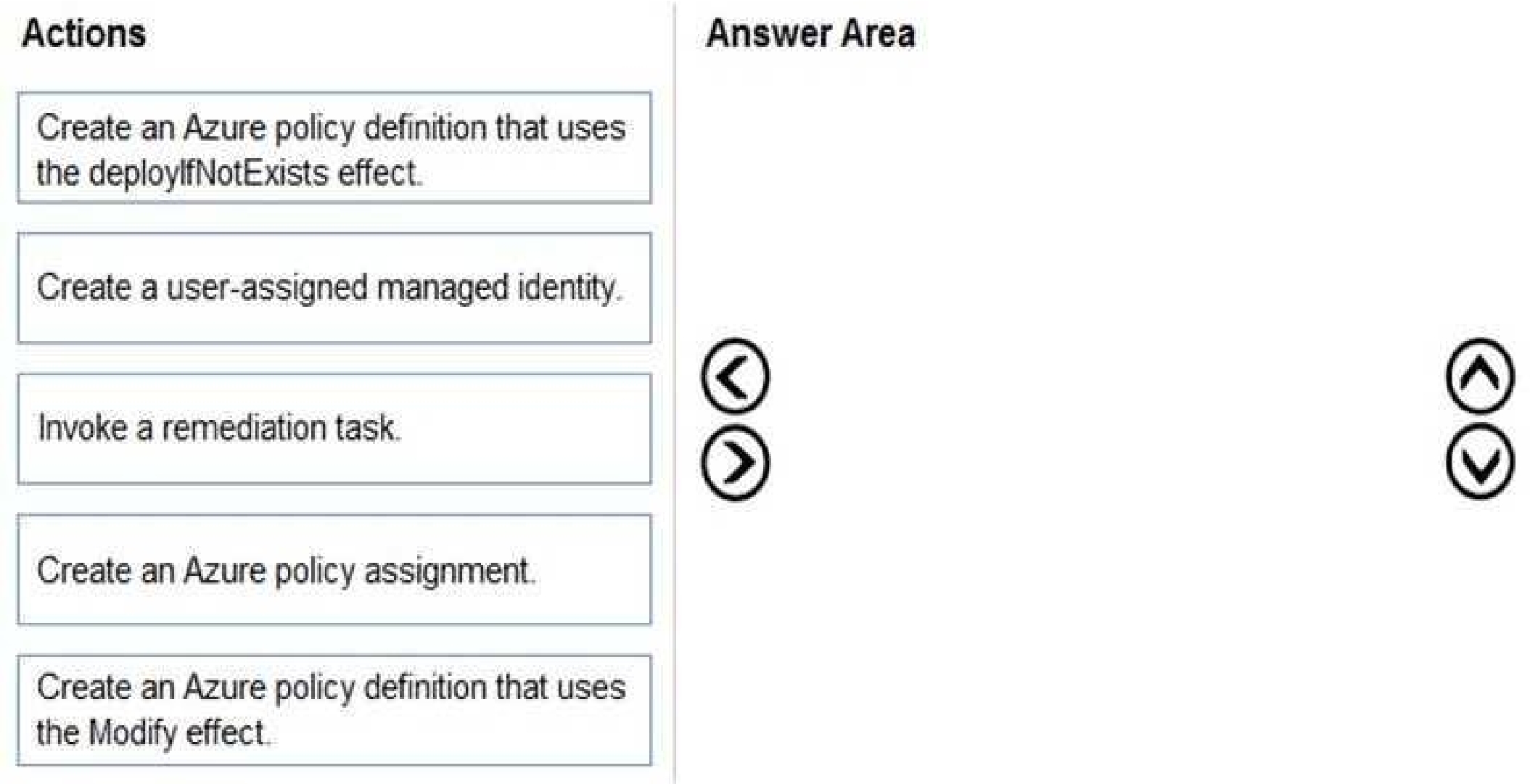
You need to configure an Azure policy to ensure that the Azure SQL databases have TDE enabled. The
solution must meet the security and compliance requirements.
Which three actions should you perform in sequence? To answer, move the appropriate actions from
the list of actions to the answer area and arrange them in the correct order.
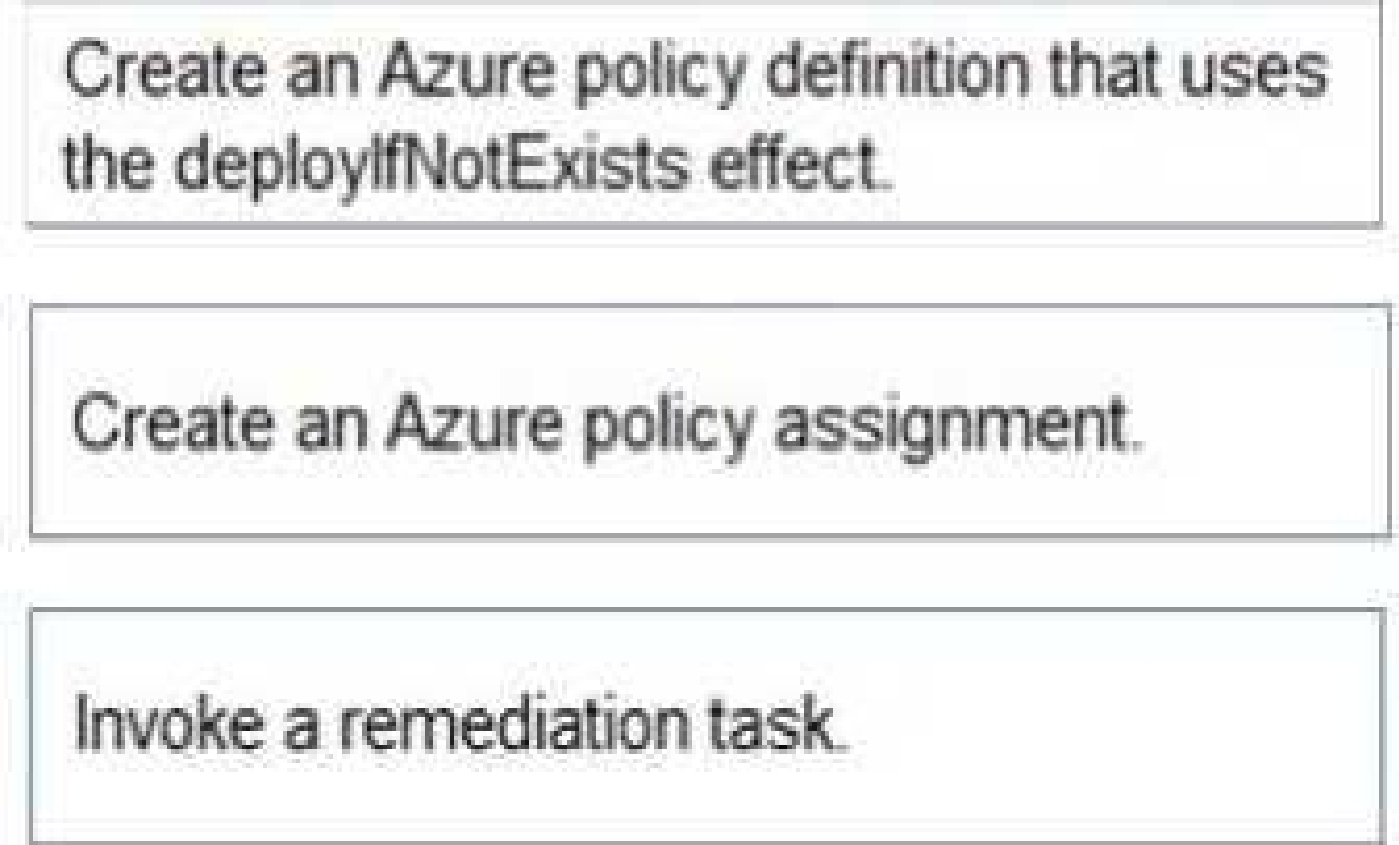
Scenario: All Azure SQL databases in the production environment must have Transparent Data
Encryption (TDE) enabled.
Step 1: Create an Azure policy definition that uses the deployIfNotExists identity.
The first step is to define the roles that deployIfNotExists and modify needs in the policy definition to
successfully deploy the content of your included template.
Step 2: Create an Azure policy assignment
When creating an assignment using the portal, Azure Policy both generates the managed identity
and grants it the roles defined in roleDefinitionIds.
Step 3: Invoke a remediation task
Resources that are non-compliant to a deployIfNotExists or modify policy can be put into a compliant
state through Remediation. Remediation is accomplished by instructing Azure Policy to run the
deployIfNotExists effect or the modify operations of the assigned policy on your existing resources
and subscriptions, whether that assignment is to a management group, a subscription, a resource
group, or an individual resource.
During evaluation, the policy assignment with deployIfNotExists or modify effects determines if
there are non-compliant resources or subscriptions. When non-compliant resources or subscriptions
are found, the details are provided on the Remediation page.
Reference:
[https://docs.microsoft.com/en-us/azure/governance/policy/how-to/remediate-resources](https://docs.microsoft.com/en-us/azure/governance/policy/how-to/remediate-resources)
Quiz
Case Study
Overview
This is a case study. Case studies are not timed separately. You can use as much exam time as you
would like to complete each case. However, there may be additional case studies and sections on
this exam. You must manage your time to ensure that you are able to complete all questions included
on this exam in the time provided.
To answer the questions included in a case study, you will need to reference information that is
provided in the case study. Case studies might contain exhibits and other resources that provide
more information about the scenario that is described in the case study. Each question is
independent of the other questions in this case study.
At the end of this case study, a review screen will appear. This screen allows you to review your
answers and to make changes before you move to the next section of the exam. After you begin a
new section, you cannot return to this section.
To start the case study
To display the first question in this case study, click the Next button. Use the buttons in the left pane
to explore the content of the case study before you answer the questions. Clicking these buttons
displays information such as business requirements, existing environment, and problem statements.
If the case study has an All Information tab, note that the information displayed is identical to the
information displayed on the subsequent tabs. When you are ready to answer a question, click the
Question button to return to the question.
Overview. General Overview
Litware, Inc. is a medium-sized finance company.
Overview. Physical Locations
Litware has a main office in Boston.
Existing Environment. Identity Environment
The network contains an Active Directory forest named Litware.com that is linked to an Azure Active
Directory (Azure AD) tenant named Litware.com. All users have Azure Active Directory Premium P2
licenses.
Litware has a second Azure AD tenant named dev.Litware.com that is used as a development
environment.
The Litware.com tenant has a conditional acсess policy named capolicy1. Capolicy1 requires that
when users manage the Azure subscription for a production environment by using the Azure portal,
they must connect from a hybrid Azure AD-joined device.
Existing Environment. Azure Environment
Litware has 10 Azure subscriptions that are linked to the Litware.com tenant and five Azure
subscriptions that are linked to the dev.Litware.com tenant. All the subscriptions are in an Enterprise
Agreement (EA).
The Litware.com tenant contains a custom Azure role-based access control (Azure RBAC) role named
Role1 that grants the DataActions read permission to the blobs and files in Azure Storage.
Existing Environment. On-premises Environment
The on-premises network of Litware contains the resources shown in the following table.
Existing Environment. Network Environment
Litware has ExpressRoute connectivity to Azure.
Planned Changes and Requirements. Planned Changes
Litware plans to implement the following changes:
Migrate DB1 and DB2 to Azure.
Migrate App1 to Azure virtual machines.
Deploy the Azure virtual machines that will host App1 to Azure dedicated hosts.
Planned Changes and Requirements. Authentication and Authorization Requirements
Litware identifies the following authentication and authorization requirements:
Users that manage the production environment by using the Azure portal must connect from a
hybrid Azure AD-joined device and authenticate by using Azure Multi-Factor Authentication (MFA).
The Network Contributor built-in RBAC role must be used to grant permission to all the virtual
networks in all the Azure subscriptions.
To access the resources in Azure, App1 must use the managed identity of the virtual machines that
will host the app.
Role1 must be used to assign permissions to the storage accounts of all the Azure subscriptions.
RBAC roles must be applied at the highest level possible.
Planned Changes and Requirements. Resiliency Requirements
Litware identifies the following resiliency requirements:
Once migrated to Azure, DB1 and DB2 must meet the following requirements:
- Maintain availability if two availability zones in the local Azure region fail.
- Fail over automatically.
- Minimize I/O latency.
App1 must meet the following requirements:
- Be hosted in an Azure region that supports availability zones.
- Be hosted on Azure virtual machines that support automatic scaling.
- Maintain availability if two availability zones in the local Azure region fail.
Planned Changes and Requirements. Security and Compliance Requirements
Litware identifies the following security and compliance requirements:
Once App1 is migrated to Azure, you must ensure that new data can be written to the app, and the
modification of new and existing data is prevented for a period of three years.
On-premises users and services must be able to access the Azure Storage account that will host the
data in App1.
Access to the public endpoint of the Azure Storage account that will host the App1 data must be
prevented.
All Azure SQL databases in the production environment must have Transparent Data Encryption (TDE)
enabled.
App1 must not share physical hardware with other workloads.
Planned Changes and Requirements. Business Requirements
Litware identifies the following business requirements:
Minimize administrative effort.
Minimize costs.
You need to recommend a high-availability solution for App1. The solution must meet the resiliency
requirements.
What should you include in the recommendation? To answer, select the appropriate options in the
answer area.
NOTE: Each correct selection is worth one point.
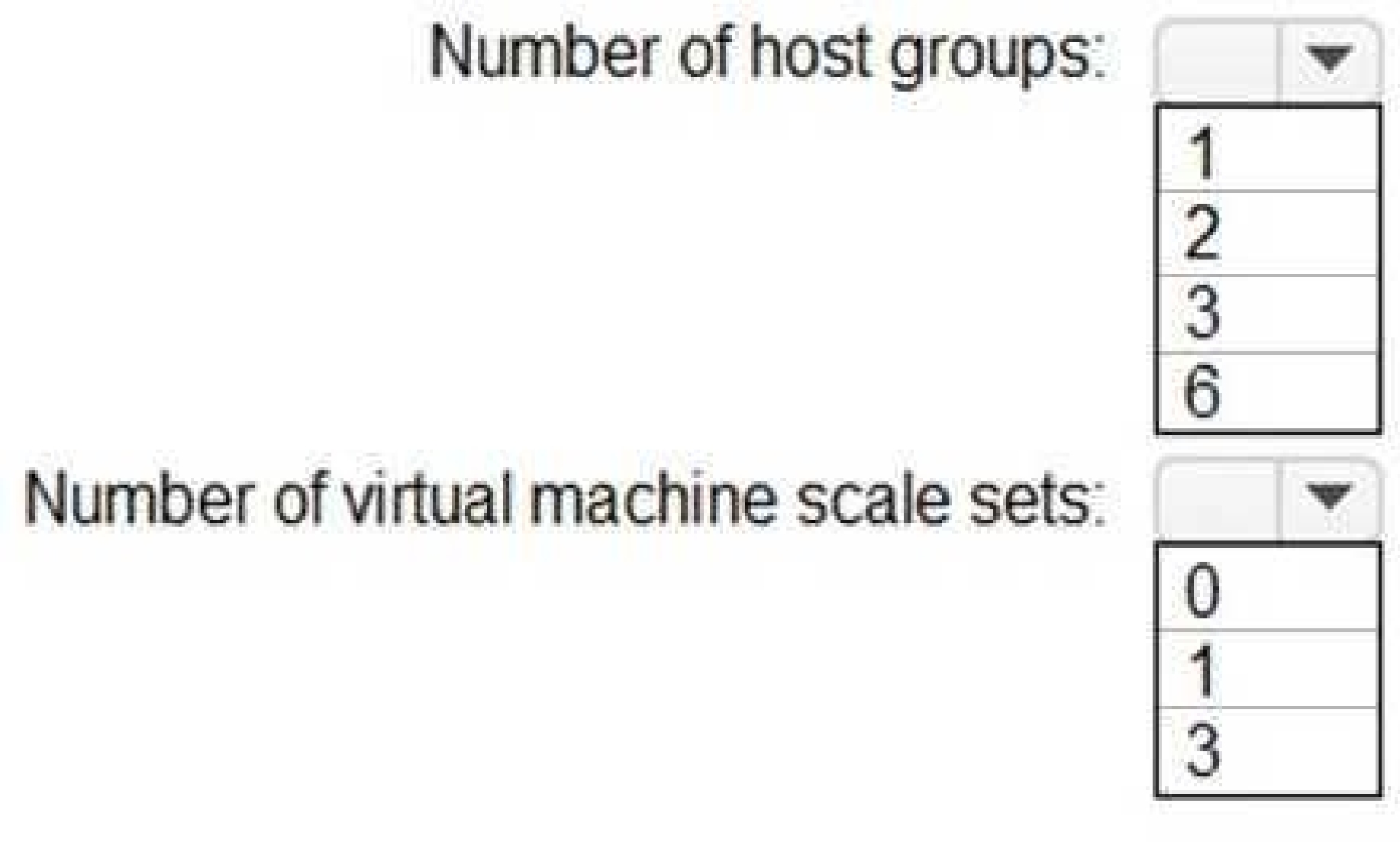
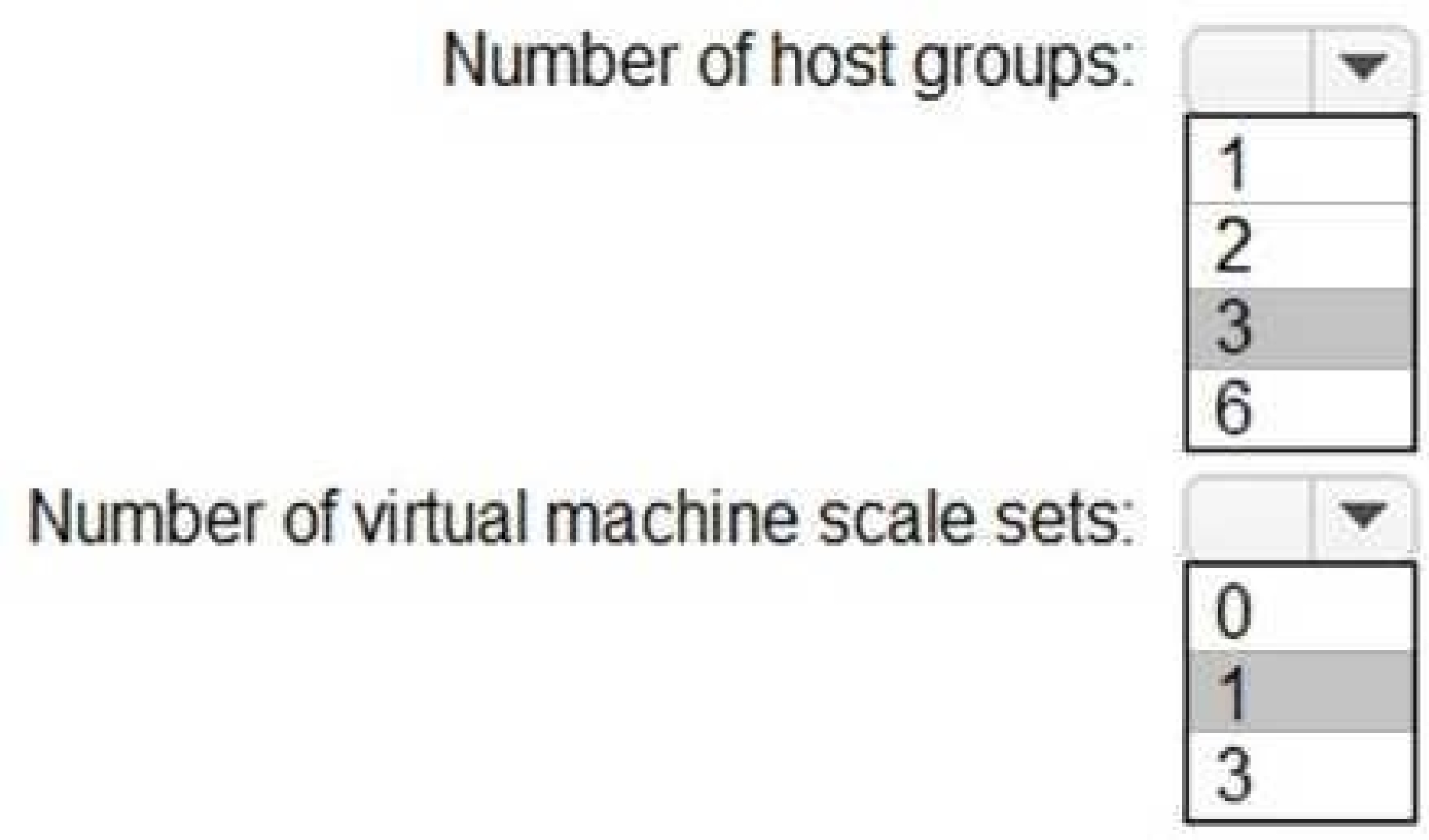
Box 1: 3
Scenario: App1 must meet the following requirements:
Be hosted in an Azure region that supports availability zones.
Maintain availability if two availability zones in the local Azure region fail.
A host group is a resource that represents a collection of dedicated hosts. You create a host group in a
region and an availability zone, and add hosts to it.
Use Availability Zones for fault isolation
Availability zones are unique physical locations within an Azure region. Each zone is made up of one
or more datacenters equipped with independent power, cooling, and networking. A host group is
created in a single availability zone. Once created, all hosts will be placed within that zone. To
achieve high availability across zones, you need to create multiple host groups (one per zone) and
spread your hosts accordingly.
Box 2: 1
Scenario: App1 must meet the following requirements:
Be hosted on Azure virtual machines that support automatic scaling.
An Azure virtual machine scale set can automatically increase or decrease the number of VM
instances that run your application. This automated and elastic behavior reduces the management
overhead to monitor and optimize the performance of your application.
Reference:
[https://docs.microsoft.com/en-us/azure/virtual-machines/dedicated-hosts](https://docs.microsoft.com/en-us/azure/virtual-machines/dedicated-hosts)
[https://docs.microsoft.com/en-us/azure/virtual-machine-scale-sets/virtual-machine-scale-sets-](https://docs.microsoft.com/en-us/azure/virtual-machine-scale-sets/virtual-machine-scale-sets-)
autoscale-overview
Quiz
Case Study
Overview
This is a case study. Case studies are not timed separately. You can use as much exam time as you
would like to complete each case. However, there may be additional case studies and sections on
this exam. You must manage your time to ensure that you are able to complete all questions included
on this exam in the time provided.
To answer the questions included in a case study, you will need to reference information that is
provided in the case study. Case studies might contain exhibits and other resources that provide
more information about the scenario that is described in the case study. Each question is
independent of the other questions in this case study.
At the end of this case study, a review screen will appear. This screen allows you to review your
answers and to make changes before you move to the next section of the exam. After you begin a
new section, you cannot return to this section.
To start the case study
To display the first question in this case study, click the Next button. Use the buttons in the left pane
to explore the content of the case study before you answer the questions. Clicking these buttons
displays information such as business requirements, existing environment, and problem statements.
If the case study has an All Information tab, note that the information displayed is identical to the
information displayed on the subsequent tabs. When you are ready to answer a question, click the
Question button to return to the question.
Overview. General Overview
Litware, Inc. is a medium-sized finance company.
Overview. Physical Locations
Litware has a main office in Boston.
Existing Environment. Identity Environment
The network contains an Active Directory forest named Litware.com that is linked to an Azure Active
Directory (Azure AD) tenant named Litware.com. All users have Azure Active Directory Premium P2
licenses.
Litware has a second Azure AD tenant named dev.Litware.com that is used as a development
environment.
The Litware.com tenant has a conditional acсess policy named capolicy1. Capolicy1 requires that
when users manage the Azure subscription for a production environment by using the Azure portal,
they must connect from a hybrid Azure AD-joined device.
Existing Environment. Azure Environment
Litware has 10 Azure subscriptions that are linked to the Litware.com tenant and five Azure
subscriptions that are linked to the dev.Litware.com tenant. All the subscriptions are in an Enterprise
Agreement (EA).
The Litware.com tenant contains a custom Azure role-based access control (Azure RBAC) role named
Role1 that grants the DataActions read permission to the blobs and files in Azure Storage.
Existing Environment. On-premises Environment
The on-premises network of Litware contains the resources shown in the following table.
Existing Environment. Network Environment
Litware has ExpressRoute connectivity to Azure.
Planned Changes and Requirements. Planned Changes
Litware plans to implement the following changes:
Migrate DB1 and DB2 to Azure.
Migrate App1 to Azure virtual machines.
Deploy the Azure virtual machines that will host App1 to Azure dedicated hosts.
Planned Changes and Requirements. Authentication and Authorization Requirements
Litware identifies the following authentication and authorization requirements:
Users that manage the production environment by using the Azure portal must connect from a
hybrid Azure AD-joined device and authenticate by using Azure Multi-Factor Authentication (MFA).
The Network Contributor built-in RBAC role must be used to grant permission to all the virtual
networks in all the Azure subscriptions.
To access the resources in Azure, App1 must use the managed identity of the virtual machines that
will host the app.
Role1 must be used to assign permissions to the storage accounts of all the Azure subscriptions.
RBAC roles must be applied at the highest level possible.
Planned Changes and Requirements. Resiliency Requirements
Litware identifies the following resiliency requirements:
Once migrated to Azure, DB1 and DB2 must meet the following requirements:
- Maintain availability if two availability zones in the local Azure region fail.
- Fail over automatically.
- Minimize I/O latency.
App1 must meet the following requirements:
- Be hosted in an Azure region that supports availability zones.
- Be hosted on Azure virtual machines that support automatic scaling.
- Maintain availability if two availability zones in the local Azure region fail.
Planned Changes and Requirements. Security and Compliance Requirements
Litware identifies the following security and compliance requirements:
Once App1 is migrated to Azure, you must ensure that new data can be written to the app, and the
modification of new and existing data is prevented for a period of three years.
On-premises users and services must be able to access the Azure Storage account that will host the
data in App1.
Access to the public endpoint of the Azure Storage account that will host the App1 data must be
prevented.
All Azure SQL databases in the production environment must have Transparent Data Encryption (TDE)
enabled.
App1 must not share physical hardware with other workloads.
Planned Changes and Requirements. Business Requirements
Litware identifies the following business requirements:
Minimize administrative effort.
Minimize costs.
You need to estimate the compute costs for App1 in Azure. The solution must meet the security and
compliance requirements.
What should you use to estimate the costs, and what should you implement to minimize the costs?
To answer, select the appropriate options in the answer area.
NOTE: Each correct selection is worth one point.
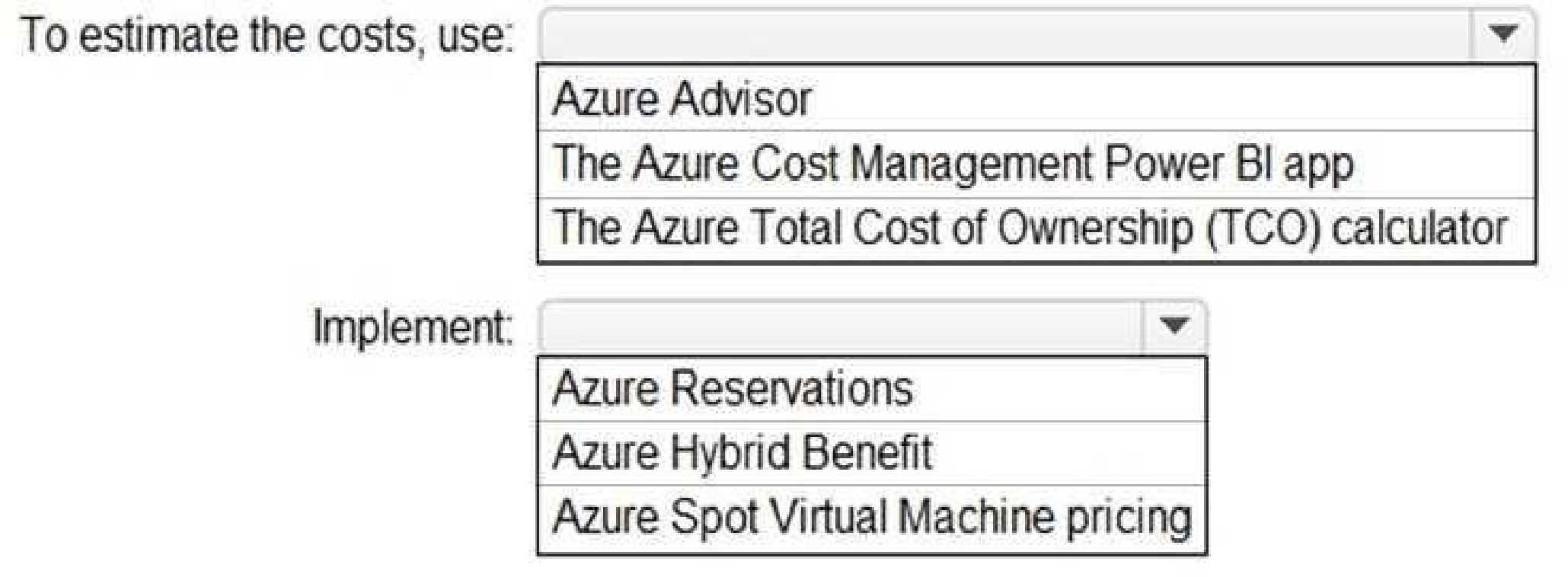
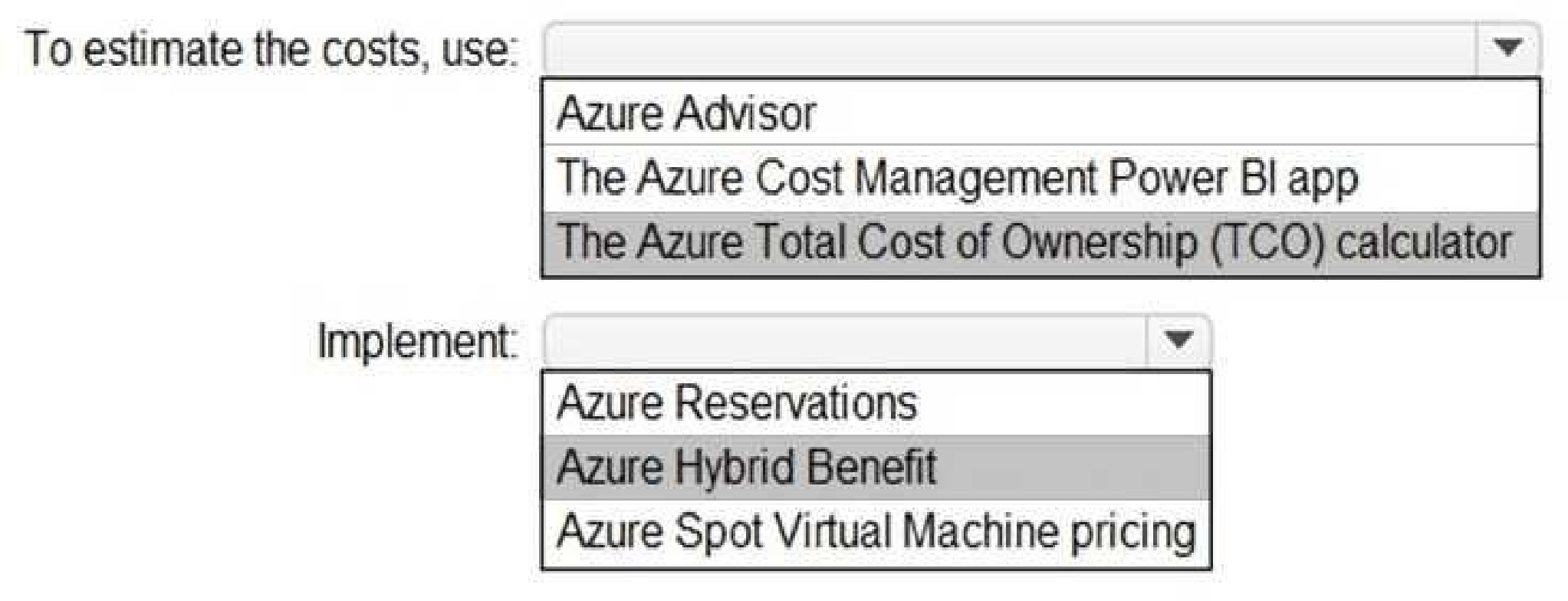
Box 1: The Azure Total Cost of Ownership (TCO) Calculator
The Total Cost of Ownership (TCO) Calculator estimates the cost savings you can realize by migrating
your workloads to Azure.
Note: The TCO Calculator recommends a set of equivalent services in Azure that will support your
applications. Our analysis will show each cost area with an estimate of your on-premises spend
versus your spend in Azure. There are several cost categories that either decrease or go away
completely when you move workloads to the cloud.
Box 2: Azure Hybrid Benefit
Azure Hybrid Benefit is a licensing benefit that helps you to significantly reduce the costs of running
your workloads in the cloud. It works by letting you use your on-premises Software Assurance-
enabled Windows Server and SQL Server licenses on Azure. And now, this benefit applies to RedHat
and SUSE Linux subscriptions, too.
Scenario:
Litware identifies the following security and compliance requirements:
Once App1 is migrated to Azure, you must ensure that new data can be written to the app, and the
modification of new and existing data is prevented for a period of three years.
On-premises users and services must be able to access the Azure Storage account that will host the
data in App1.
Access to the public endpoint of the Azure Storage account that will host the App1 data must be
prevented.
All Azure SQL databases in the production environment must have Transparent Data Encryption (TDE)
enabled.
App1 must not share physical hardware with other workloads.
Reference:
[https://azure.microsoft.com/en-us/pricing/tco/](https://azure.microsoft.com/en-us/pricing/tco/)
[https://azure.microsoft.com/en-us/pricing/hybrid-benefit/](https://azure.microsoft.com/en-us/pricing/hybrid-benefit/)
Quiz
Case Study
Overview
This is a case study. Case studies are not timed separately. You can use as much exam time as you
would like to complete each case. However, there may be additional case studies and sections on
this exam. You must manage your time to ensure that you are able to complete all questions included
on this exam in the time provided.
To answer the questions included in a case study, you will need to reference information that is
provided in the case study. Case studies might contain exhibits and other resources that provide
more information about the scenario that is described in the case study. Each question is
independent of the other questions in this case study.
At the end of this case study, a review screen will appear. This screen allows you to review your
answers and to make changes before you move to the next section of the exam. After you begin a
new section, you cannot return to this section.
To start the case study
To display the first question in this case study, click the Next button. Use the buttons in the left pane
to explore the content of the case study before you answer the questions. Clicking these buttons
displays information such as business requirements, existing environment, and problem statements.
If the case study has an All Information tab, note that the information displayed is identical to the
information displayed on the subsequent tabs. When you are ready to answer a question, click the
Question button to return to the question.
Overview. General Overview
Litware, Inc. is a medium-sized finance company.
Overview. Physical Locations
Litware has a main office in Boston.
Existing Environment. Identity Environment
The network contains an Active Directory forest named Litware.com that is linked to an Azure Active
Directory (Azure AD) tenant named Litware.com. All users have Azure Active Directory Premium P2
licenses.
Litware has a second Azure AD tenant named dev.Litware.com that is used as a development
environment.
The Litware.com tenant has a conditional acсess policy named capolicy1. Capolicy1 requires that
when users manage the Azure subscription for a production environment by using the Azure portal,
they must connect from a hybrid Azure AD-joined device.
Existing Environment. Azure Environment
Litware has 10 Azure subscriptions that are linked to the Litware.com tenant and five Azure
subscriptions that are linked to the dev.Litware.com tenant. All the subscriptions are in an Enterprise
Agreement (EA).
The Litware.com tenant contains a custom Azure role-based access control (Azure RBAC) role named
Role1 that grants the DataActions read permission to the blobs and files in Azure Storage.
Existing Environment. On-premises Environment
The on-premises network of Litware contains the resources shown in the following table.
Existing Environment. Network Environment
Litware has ExpressRoute connectivity to Azure.
Planned Changes and Requirements. Planned Changes
Litware plans to implement the following changes:
Migrate DB1 and DB2 to Azure.
Migrate App1 to Azure virtual machines.
Deploy the Azure virtual machines that will host App1 to Azure dedicated hosts.
Planned Changes and Requirements. Authentication and Authorization Requirements
Litware identifies the following authentication and authorization requirements:
Users that manage the production environment by using the Azure portal must connect from a
hybrid Azure AD-joined device and authenticate by using Azure Multi-Factor Authentication (MFA).
The Network Contributor built-in RBAC role must be used to grant permission to all the virtual
networks in all the Azure subscriptions.
To access the resources in Azure, App1 must use the managed identity of the virtual machines that
will host the app.
Role1 must be used to assign permissions to the storage accounts of all the Azure subscriptions.
RBAC roles must be applied at the highest level possible.
Planned Changes and Requirements. Resiliency Requirements
Litware identifies the following resiliency requirements:
Once migrated to Azure, DB1 and DB2 must meet the following requirements:
- Maintain availability if two availability zones in the local Azure region fail.
- Fail over automatically.
- Minimize I/O latency.
App1 must meet the following requirements:
- Be hosted in an Azure region that supports availability zones.
- Be hosted on Azure virtual machines that support automatic scaling.
- Maintain availability if two availability zones in the local Azure region fail.
Planned Changes and Requirements. Security and Compliance Requirements
Litware identifies the following security and compliance requirements:
Once App1 is migrated to Azure, you must ensure that new data can be written to the app, and the
modification of new and existing data is prevented for a period of three years.
On-premises users and services must be able to access the Azure Storage account that will host the
data in App1.
Access to the public endpoint of the Azure Storage account that will host the App1 data must be
prevented.
All Azure SQL databases in the production environment must have Transparent Data Encryption (TDE)
enabled.
App1 must not share physical hardware with other workloads.
Planned Changes and Requirements. Business Requirements
Litware identifies the following business requirements:
Minimize administrative effort.
Minimize costs.
You need to recommend a storage solution for App1 that meets the security and compliance
requirements.
Which type of storage should you recommend, and how should you recommend configuring the
storage? To answer, select the appropriate options in the answer area.
NOTE: Each correct selection is worth one point.
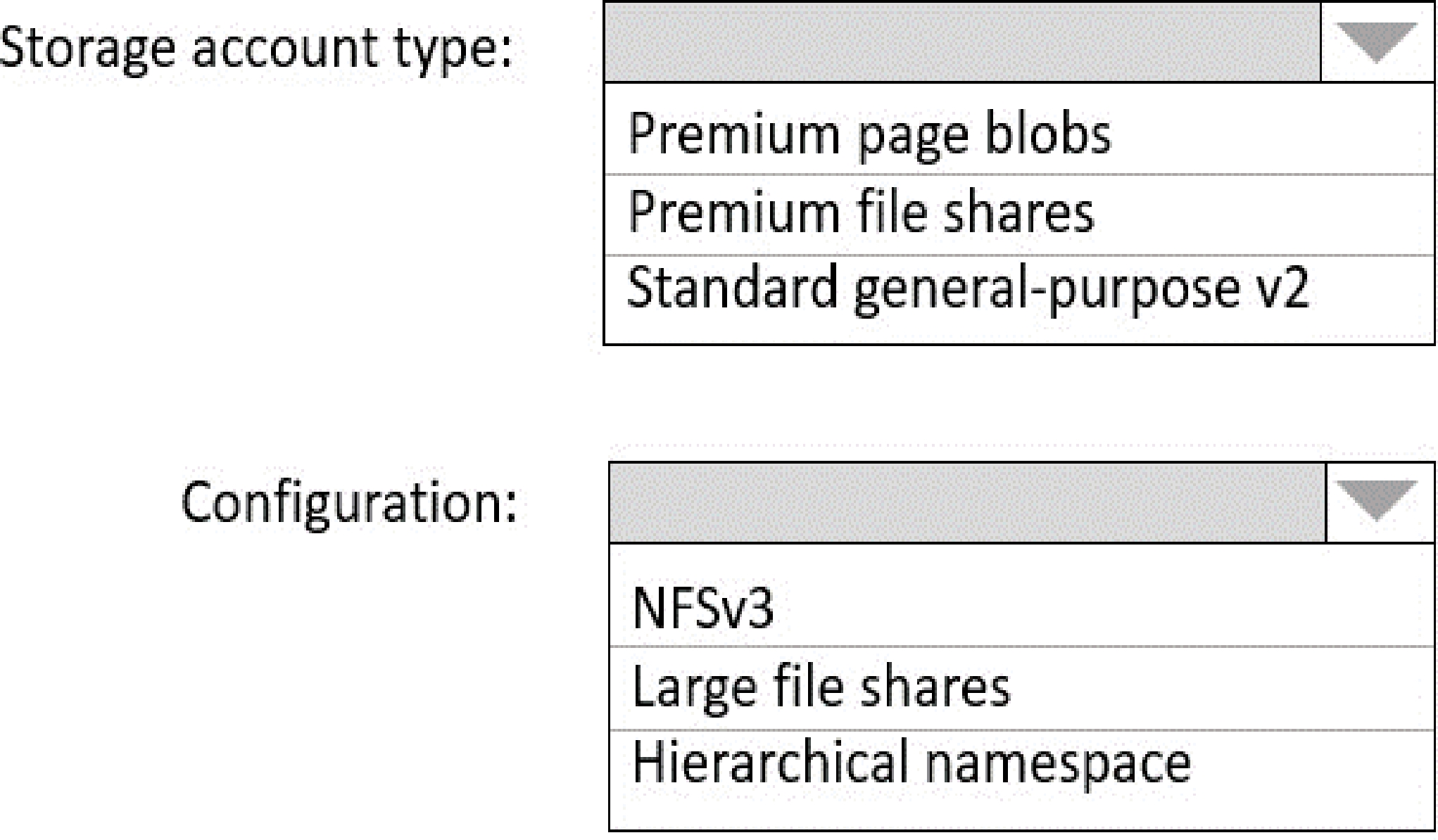
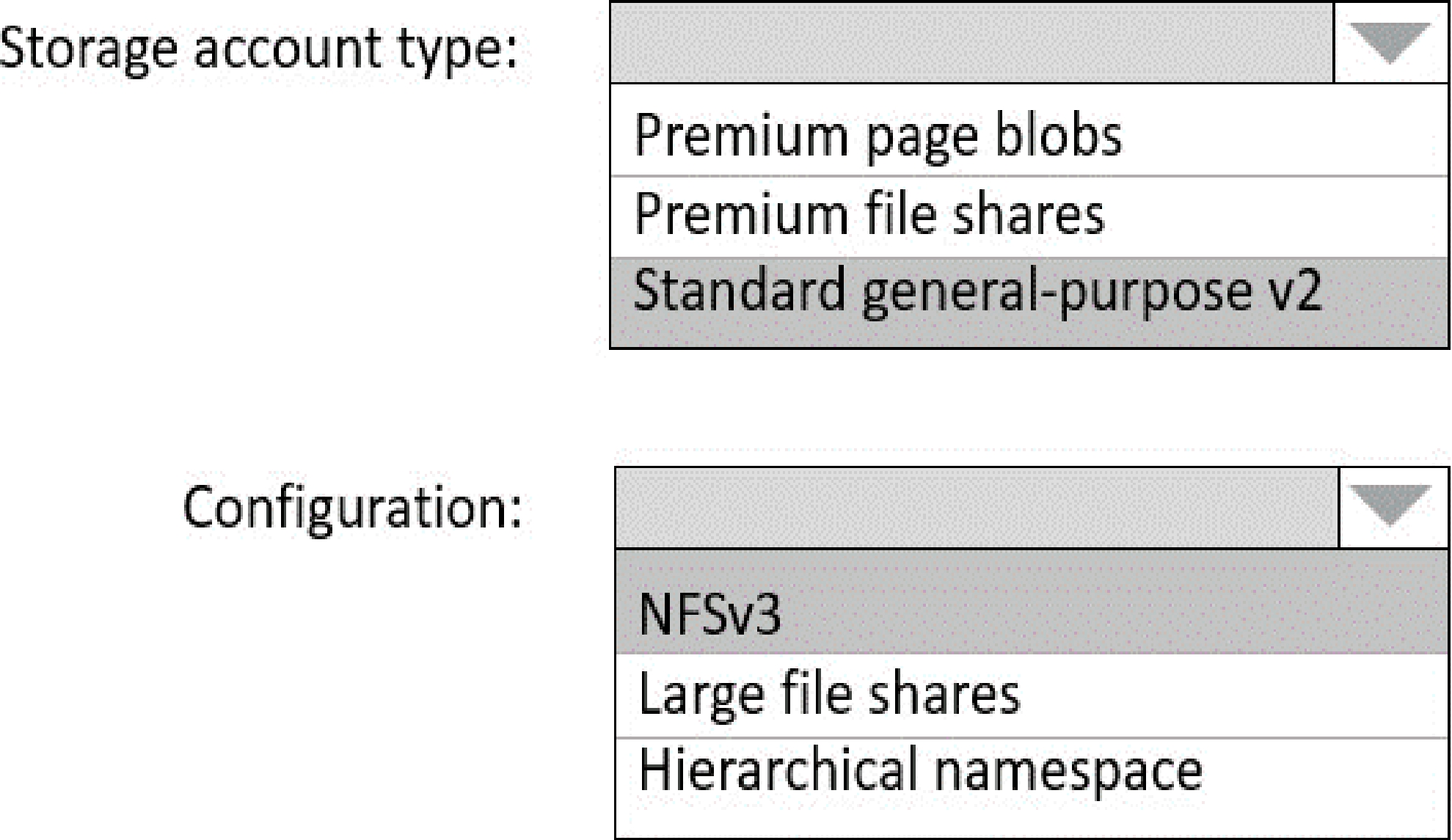
Box 1: Standard general-purpose v2
Standard general-purpose v2 supports Blob Storage.
Azure Storage provides data protection for Blob Storage and Azure Data Lake Storage Gen2.
Scenario:
Litware identifies the following security and compliance requirements:
Once App1 is migrated to Azure, you must ensure that new data can be written to the app, and the
modification of new and existing data is prevented for a period of three years.
On-premises users and services must be able to access the Azure Storage account that will host the
data in App1.
Access to the public endpoint of the Azure Storage account that will host the App1 data must be
prevented.
All Azure SQL databases in the production environment must have Transparent Data Encryption (TDE)
enabled.
App1 must NOT share physical hardware with other workloads.
Box 2: NFSv3
Scenario: Plan: Migrate App1 to Azure virtual machines.
Blob storage now supports the Network File System (NFS) 3.0 protocol. This support provides Linux
file system compatibility at object storage scale and prices and enables Linux clients to mount a
container in Blob storage from an Azure Virtual Machine (VM) or a computer on-premises.
Reference:
[https://docs.microsoft.com/en-us/azure/storage/blobs/data-protection-overview](https://docs.microsoft.com/en-us/azure/storage/blobs/data-protection-overview)
Quiz
Case Study
Overview
This is a case study. Case studies are not timed separately. You can use as much exam time as you
would like to complete each case. However, there may be additional case studies and sections on
this exam. You must manage your time to ensure that you are able to complete all questions included
on this exam in the time provided.
To answer the questions included in a case study, you will need to reference information that is
provided in the case study. Case studies might contain exhibits and other resources that provide
more information about the scenario that is described in the case study. Each question is
independent of the other questions in this case study.
At the end of this case study, a review screen will appear. This screen allows you to review your
answers and to make changes before you move to the next section of the exam. After you begin a
new section, you cannot return to this section.
To start the case study
To display the first question in this case study, click the Next button. Use the buttons in the left pane
to explore the content of the case study before you answer the questions. Clicking these buttons
displays information such as business requirements, existing environment, and problem statements.
If the case study has an All Information tab, note that the information displayed is identical to the
information displayed on the subsequent tabs. When you are ready to answer a question, click the
Question button to return to the question.
Overview. General Overview
Litware, Inc. is a medium-sized finance company.
Overview. Physical Locations
Litware has a main office in Boston.
Existing Environment. Identity Environment
The network contains an Active Directory forest named Litware.com that is linked to an Azure Active
Directory (Azure AD) tenant named Litware.com. All users have Azure Active Directory Premium P2
licenses.
Litware has a second Azure AD tenant named dev.Litware.com that is used as a development
environment.
The Litware.com tenant has a conditional acсess policy named capolicy1. Capolicy1 requires that
when users manage the Azure subscription for a production environment by using the Azure portal,
they must connect from a hybrid Azure AD-joined device.
Existing Environment. Azure Environment
Litware has 10 Azure subscriptions that are linked to the Litware.com tenant and five Azure
subscriptions that are linked to the dev.Litware.com tenant. All the subscriptions are in an Enterprise
Agreement (EA).
The Litware.com tenant contains a custom Azure role-based access control (Azure RBAC) role named
Role1 that grants the DataActions read permission to the blobs and files in Azure Storage.
Existing Environment. On-premises Environment
The on-premises network of Litware contains the resources shown in the following table.
Existing Environment. Network Environment
Litware has ExpressRoute connectivity to Azure.
Planned Changes and Requirements. Planned Changes
Litware plans to implement the following changes:
Migrate DB1 and DB2 to Azure.
Migrate App1 to Azure virtual machines.
Deploy the Azure virtual machines that will host App1 to Azure dedicated hosts.
Planned Changes and Requirements. Authentication and Authorization Requirements
Litware identifies the following authentication and authorization requirements:
Users that manage the production environment by using the Azure portal must connect from a
hybrid Azure AD-joined device and authenticate by using Azure Multi-Factor Authentication (MFA).
The Network Contributor built-in RBAC role must be used to grant permission to all the virtual
networks in all the Azure subscriptions.
To access the resources in Azure, App1 must use the managed identity of the virtual machines that
will host the app.
Role1 must be used to assign permissions to the storage accounts of all the Azure subscriptions.
RBAC roles must be applied at the highest level possible.
Planned Changes and Requirements. Resiliency Requirements
Litware identifies the following resiliency requirements:
Once migrated to Azure, DB1 and DB2 must meet the following requirements:
- Maintain availability if two availability zones in the local Azure region fail.
- Fail over automatically.
- Minimize I/O latency.
App1 must meet the following requirements:
- Be hosted in an Azure region that supports availability zones.
- Be hosted on Azure virtual machines that support automatic scaling.
- Maintain availability if two availability zones in the local Azure region fail.
Planned Changes and Requirements. Security and Compliance Requirements
Litware identifies the following security and compliance requirements:
Once App1 is migrated to Azure, you must ensure that new data can be written to the app, and the
modification of new and existing data is prevented for a period of three years.
On-premises users and services must be able to access the Azure Storage account that will host the
data in App1.
Access to the public endpoint of the Azure Storage account that will host the App1 data must be
prevented.
All Azure SQL databases in the production environment must have Transparent Data Encryption (TDE)
enabled.
App1 must not share physical hardware with other workloads.
Planned Changes and Requirements. Business Requirements
Litware identifies the following business requirements:
Minimize administrative effort.
Minimize costs.
compliance requirement
What should you do?
Quiz
Case Study
Overview
This is a case study. Case studies are not timed separately. You can use as much exam time as you
would like to complete each case. However, there may be additional case studies and sections on
this exam. You must manage your time to ensure that you are able to complete all questions included
on this exam in the time provided.
To answer the questions included in a case study, you will need to reference information that is
provided in the case study. Case studies might contain exhibits and other resources that provide
more information about the scenario that is described in the case study. Each question is
independent of the other questions in this case study.
At the end of this case study, a review screen will appear. This screen allows you to review your
answers and to make changes before you move to the next section of the exam. After you begin a
new section, you cannot return to this section.
To start the case study
To display the first question in this case study, click the Next button. Use the buttons in the left pane
to explore the content of the case study before you answer the questions. Clicking these buttons
displays information such as business requirements, existing environment, and problem statements.
If the case study has an All Information tab, note that the information displayed is identical to the
information displayed on the subsequent tabs. When you are ready to answer a question, click the
Question button to return to the question.
Overview. General Overview
Litware, Inc. is a medium-sized finance company.
Overview. Physical Locations
Litware has a main office in Boston.
Existing Environment. Identity Environment
The network contains an Active Directory forest named Litware.com that is linked to an Azure Active
Directory (Azure AD) tenant named Litware.com. All users have Azure Active Directory Premium P2
licenses.
Litware has a second Azure AD tenant named dev.Litware.com that is used as a development
environment.
The Litware.com tenant has a conditional acсess policy named capolicy1. Capolicy1 requires that
when users manage the Azure subscription for a production environment by using the Azure portal,
they must connect from a hybrid Azure AD-joined device.
Existing Environment. Azure Environment
Litware has 10 Azure subscriptions that are linked to the Litware.com tenant and five Azure
subscriptions that are linked to the dev.Litware.com tenant. All the subscriptions are in an Enterprise
Agreement (EA).
The Litware.com tenant contains a custom Azure role-based access control (Azure RBAC) role named
Role1 that grants the DataActions read permission to the blobs and files in Azure Storage.
Existing Environment. On-premises Environment
The on-premises network of Litware contains the resources shown in the following table.
Existing Environment. Network Environment
Litware has ExpressRoute connectivity to Azure.
Planned Changes and Requirements. Planned Changes
Litware plans to implement the following changes:
Migrate DB1 and DB2 to Azure.
Migrate App1 to Azure virtual machines.
Deploy the Azure virtual machines that will host App1 to Azure dedicated hosts.
Planned Changes and Requirements. Authentication and Authorization Requirements
Litware identifies the following authentication and authorization requirements:
Users that manage the production environment by using the Azure portal must connect from a
hybrid Azure AD-joined device and authenticate by using Azure Multi-Factor Authentication (MFA).
The Network Contributor built-in RBAC role must be used to grant permission to all the virtual
networks in all the Azure subscriptions.
To access the resources in Azure, App1 must use the managed identity of the virtual machines that
will host the app.
Role1 must be used to assign permissions to the storage accounts of all the Azure subscriptions.
RBAC roles must be applied at the highest level possible.
Planned Changes and Requirements. Resiliency Requirements
Litware identifies the following resiliency requirements:
Once migrated to Azure, DB1 and DB2 must meet the following requirements:
- Maintain availability if two availability zones in the local Azure region fail.
- Fail over automatically.
- Minimize I/O latency.
App1 must meet the following requirements:
- Be hosted in an Azure region that supports availability zones.
- Be hosted on Azure virtual machines that support automatic scaling.
- Maintain availability if two availability zones in the local Azure region fail.
Planned Changes and Requirements. Security and Compliance Requirements
Litware identifies the following security and compliance requirements:
Once App1 is migrated to Azure, you must ensure that new data can be written to the app, and the
modification of new and existing data is prevented for a period of three years.
On-premises users and services must be able to access the Azure Storage account that will host the
data in App1.
Access to the public endpoint of the Azure Storage account that will host the App1 data must be
prevented.
All Azure SQL databases in the production environment must have Transparent Data Encryption (TDE)
enabled.
App1 must not share physical hardware with other workloads.
Planned Changes and Requirements. Business Requirements
Litware identifies the following business requirements:
Minimize administrative effort.
Minimize costs.
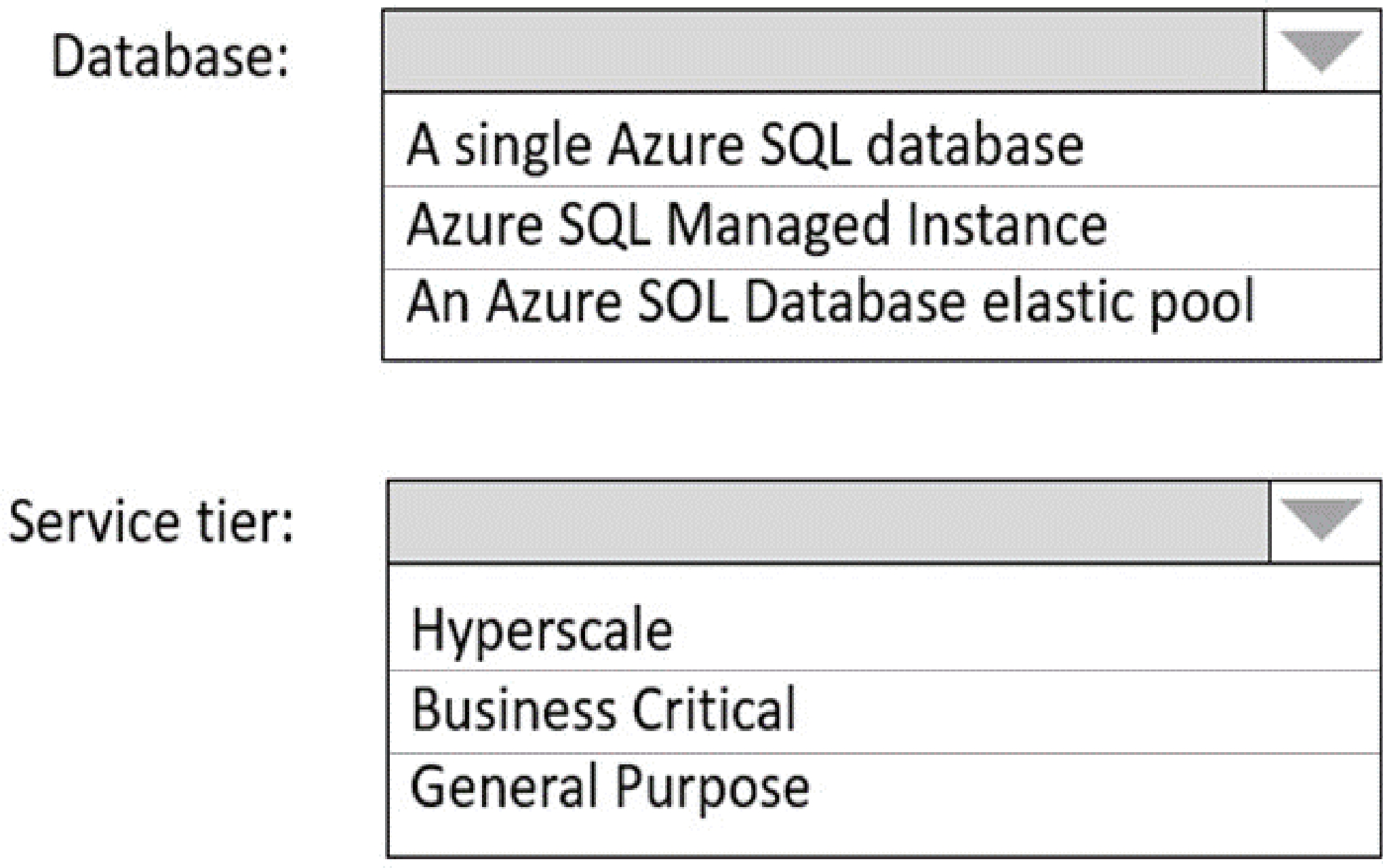
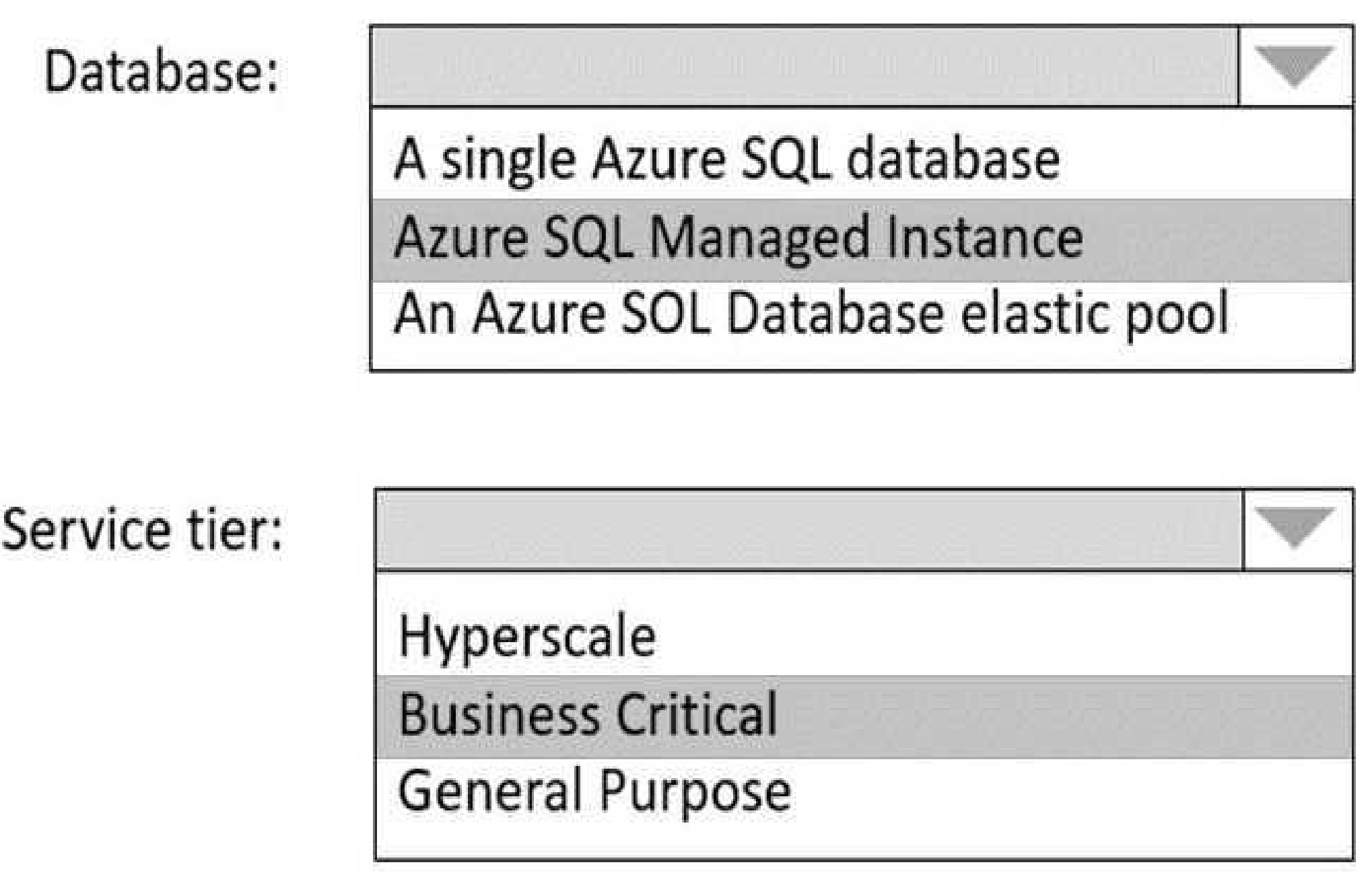
Box 1: SQL Managed Instance
Scenario: Once migrated to Azure, DB1 and DB2 must meet the following requirements:
Maintain availability if two availability zones in the local Azure region fail.
Fail over automatically.
Minimize I/O latency.
The auto-failover groups feature allows you to manage the replication and failover of a group of
databases on a server or all databases in a managed instance to another region. It is a declarative
abstraction on top of the existing active geo-replication feature, designed to simplify deployment
and management of geo-replicated databases at scale. You can initiate a geo-failover manually or
you can delegate it to the Azure service based on a user-defined policy. The latter option allows you
to automatically recover multiple related databases in a secondary region after a catastrophic failure
or other unplanned event that results in full or partial loss of the SQL Database or SQL Managed
Instance availability in the primary region.
Box 2: Business critical
SQL Managed Instance is available in two service tiers:
General purpose: Designed for applications with typical performance and I/O latency requirements.
Business critical: Designed for applications with low I/O latency requirements and minimal impact of
underlying maintenance operations on the workload.
Reference:
[https://docs.microsoft.com/en-us/azure/azure-sql/database/auto-failover-group-overview](https://docs.microsoft.com/en-us/azure/azure-sql/database/auto-failover-group-overview)
[https://docs.microsoft.com/en-us/azure/azure-sql/managed-instance/sql-managed-instance-paas-](https://docs.microsoft.com/en-us/azure/azure-sql/managed-instance/sql-managed-instance-paas-)
overview
Quiz
Case Study
Overview
This is a case study. Case studies are not timed separately. You can use as much exam time as you
would like to complete each case. However, there may be additional case studies and sections on
this exam. You must manage your time to ensure that you are able to complete all questions included
on this exam in the time provided.
To answer the questions included in a case study, you will need to reference information that is
provided in the case study. Case studies might contain exhibits and other resources that provide
more information about the scenario that is described in the case study. Each question is
independent of the other questions in this case study.
At the end of this case study, a review screen will appear. This screen allows you to review your
answers and to make changes before you move to the next section of the exam. After you begin a
new section, you cannot return to this section.
To start the case study
To display the first question in this case study, click the Next button. Use the buttons in the left pane
to explore the content of the case study before you answer the questions. Clicking these buttons
displays information such as business requirements, existing environment, and problem statements.
If the case study has an All Information tab, note that the information displayed is identical to the
information displayed on the subsequent tabs. When you are ready to answer a question, click the
Question button to return to the question.
Overview. General Overview
Litware, Inc. is a medium-sized finance company.
Overview. Physical Locations
Litware has a main office in Boston.
Existing Environment. Identity Environment
The network contains an Active Directory forest named Litware.com that is linked to an Azure Active
Directory (Azure AD) tenant named Litware.com. All users have Azure Active Directory Premium P2
licenses.
Litware has a second Azure AD tenant named dev.Litware.com that is used as a development
environment.
The Litware.com tenant has a conditional acсess policy named capolicy1. Capolicy1 requires that
when users manage the Azure subscription for a production environment by using the Azure portal,
they must connect from a hybrid Azure AD-joined device.
Existing Environment. Azure Environment
Litware has 10 Azure subscriptions that are linked to the Litware.com tenant and five Azure
subscriptions that are linked to the dev.Litware.com tenant. All the subscriptions are in an Enterprise
Agreement (EA).
The Litware.com tenant contains a custom Azure role-based access control (Azure RBAC) role named
Role1 that grants the DataActions read permission to the blobs and files in Azure Storage.
Existing Environment. On-premises Environment
The on-premises network of Litware contains the resources shown in the following table.
Existing Environment. Network Environment
Litware has ExpressRoute connectivity to Azure.
Planned Changes and Requirements. Planned Changes
Litware plans to implement the following changes:
Migrate DB1 and DB2 to Azure.
Migrate App1 to Azure virtual machines.
Deploy the Azure virtual machines that will host App1 to Azure dedicated hosts.
Planned Changes and Requirements. Authentication and Authorization Requirements
Litware identifies the following authentication and authorization requirements:
Users that manage the production environment by using the Azure portal must connect from a
hybrid Azure AD-joined device and authenticate by using Azure Multi-Factor Authentication (MFA).
The Network Contributor built-in RBAC role must be used to grant permission to all the virtual
networks in all the Azure subscriptions.
To access the resources in Azure, App1 must use the managed identity of the virtual machines that
will host the app.
Role1 must be used to assign permissions to the storage accounts of all the Azure subscriptions.
RBAC roles must be applied at the highest level possible.
Planned Changes and Requirements. Resiliency Requirements
Litware identifies the following resiliency requirements:
Once migrated to Azure, DB1 and DB2 must meet the following requirements:
- Maintain availability if two availability zones in the local Azure region fail.
- Fail over automatically.
- Minimize I/O latency.
App1 must meet the following requirements:
- Be hosted in an Azure region that supports availability zones.
- Be hosted on Azure virtual machines that support automatic scaling.
- Maintain availability if two availability zones in the local Azure region fail.
Planned Changes and Requirements. Security and Compliance Requirements
Litware identifies the following security and compliance requirements:
Once App1 is migrated to Azure, you must ensure that new data can be written to the app, and the
modification of new and existing data is prevented for a period of three years.
On-premises users and services must be able to access the Azure Storage account that will host the
data in App1.
Access to the public endpoint of the Azure Storage account that will host the App1 data must be
prevented.
All Azure SQL databases in the production environment must have Transparent Data Encryption (TDE)
enabled.
App1 must not share physical hardware with other workloads.
Planned Changes and Requirements. Business Requirements
Litware identifies the following business requirements:
Minimize administrative effort.
Minimize costs.
solution must meet the authentication and authorization requirements.
What is the minimum number of assignments that you must use?
AZ-305: Microsoft Designing Microsoft Azure Infrastructure Solutions Practice test unlocks all online simulator questions
Thank you for choosing the free version of the AZ-305: Microsoft Designing Microsoft Azure Infrastructure Solutions practice test! Further deepen your knowledge on Microsoft Simulator; by unlocking the full version of our AZ-305: Microsoft Designing Microsoft Azure Infrastructure Solutions Simulator you will be able to take tests with over 340 constantly updated questions and easily pass your exam. 98% of people pass the exam in the first attempt after preparing with our 340 questions.
BUY NOWWhat to expect from our AZ-305: Microsoft Designing Microsoft Azure Infrastructure Solutions practice tests and how to prepare for any exam?
The AZ-305: Microsoft Designing Microsoft Azure Infrastructure Solutions Simulator Practice Tests are part of the Microsoft Database and are the best way to prepare for any AZ-305: Microsoft Designing Microsoft Azure Infrastructure Solutions exam. The AZ-305: Microsoft Designing Microsoft Azure Infrastructure Solutions practice tests consist of 340 questions and are written by experts to help you and prepare you to pass the exam on the first attempt. The AZ-305: Microsoft Designing Microsoft Azure Infrastructure Solutions database includes questions from previous and other exams, which means you will be able to practice simulating past and future questions. Preparation with AZ-305: Microsoft Designing Microsoft Azure Infrastructure Solutions Simulator will also give you an idea of the time it will take to complete each section of the AZ-305: Microsoft Designing Microsoft Azure Infrastructure Solutions practice test . It is important to note that the AZ-305: Microsoft Designing Microsoft Azure Infrastructure Solutions Simulator does not replace the classic AZ-305: Microsoft Designing Microsoft Azure Infrastructure Solutions study guides; however, the Simulator provides valuable insights into what to expect and how much work needs to be done to prepare for the AZ-305: Microsoft Designing Microsoft Azure Infrastructure Solutions exam.
BUY NOWAZ-305: Microsoft Designing Microsoft Azure Infrastructure Solutions Practice test therefore represents an excellent tool to prepare for the actual exam together with our Microsoft practice test . Our AZ-305: Microsoft Designing Microsoft Azure Infrastructure Solutions Simulator will help you assess your level of preparation and understand your strengths and weaknesses. Below you can read all the quizzes you will find in our AZ-305: Microsoft Designing Microsoft Azure Infrastructure Solutions Simulator and how our unique AZ-305: Microsoft Designing Microsoft Azure Infrastructure Solutions Database made up of real questions:
Info quiz:
- Quiz name:AZ-305: Microsoft Designing Microsoft Azure Infrastructure Solutions
- Total number of questions:340
- Number of questions for the test:50
- Pass score:80%
You can prepare for the AZ-305: Microsoft Designing Microsoft Azure Infrastructure Solutions exams with our mobile app. It is very easy to use and even works offline in case of network failure, with all the functions you need to study and practice with our AZ-305: Microsoft Designing Microsoft Azure Infrastructure Solutions Simulator.
Use our Mobile App, available for both Android and iOS devices, with our AZ-305: Microsoft Designing Microsoft Azure Infrastructure Solutions Simulator . You can use it anywhere and always remember that our mobile app is free and available on all stores.
Our Mobile App contains all AZ-305: Microsoft Designing Microsoft Azure Infrastructure Solutions practice tests which consist of 340 questions and also provide study material to pass the final AZ-305: Microsoft Designing Microsoft Azure Infrastructure Solutions exam with guaranteed success. Our AZ-305: Microsoft Designing Microsoft Azure Infrastructure Solutions database contain hundreds of questions and Microsoft Tests related to AZ-305: Microsoft Designing Microsoft Azure Infrastructure Solutions Exam. This way you can practice anywhere you want, even offline without the internet.
BUY NOW