Quiz AZ-700: Designing and Implementing Microsoft Azure Networking Solutions
Quiz
Overview
Litware. Inc. is a financial company that has a main datacenter in Boston and 20 branch offices across
the United States. Users have Android, iOS, and Windows 10 devices.
Existing Environment:
Hybrid Environment
The on-prernises network contains an Active Directory forest named litwareinc.com that syncs to an
Azure Active Directory (Azure AD) tenant named litwareinc.com by usinq Azure AD Connect.
All the offices connect to a virtual network named Vnetl by using a Site-to-Site VPN connection.
Azure Environment
Litware has an Azure subscription named Sub1 that is linked to the litwareinc.com Azure AD tenant.
Sub1 contains resources in the East US Azure region as shown in the following table.
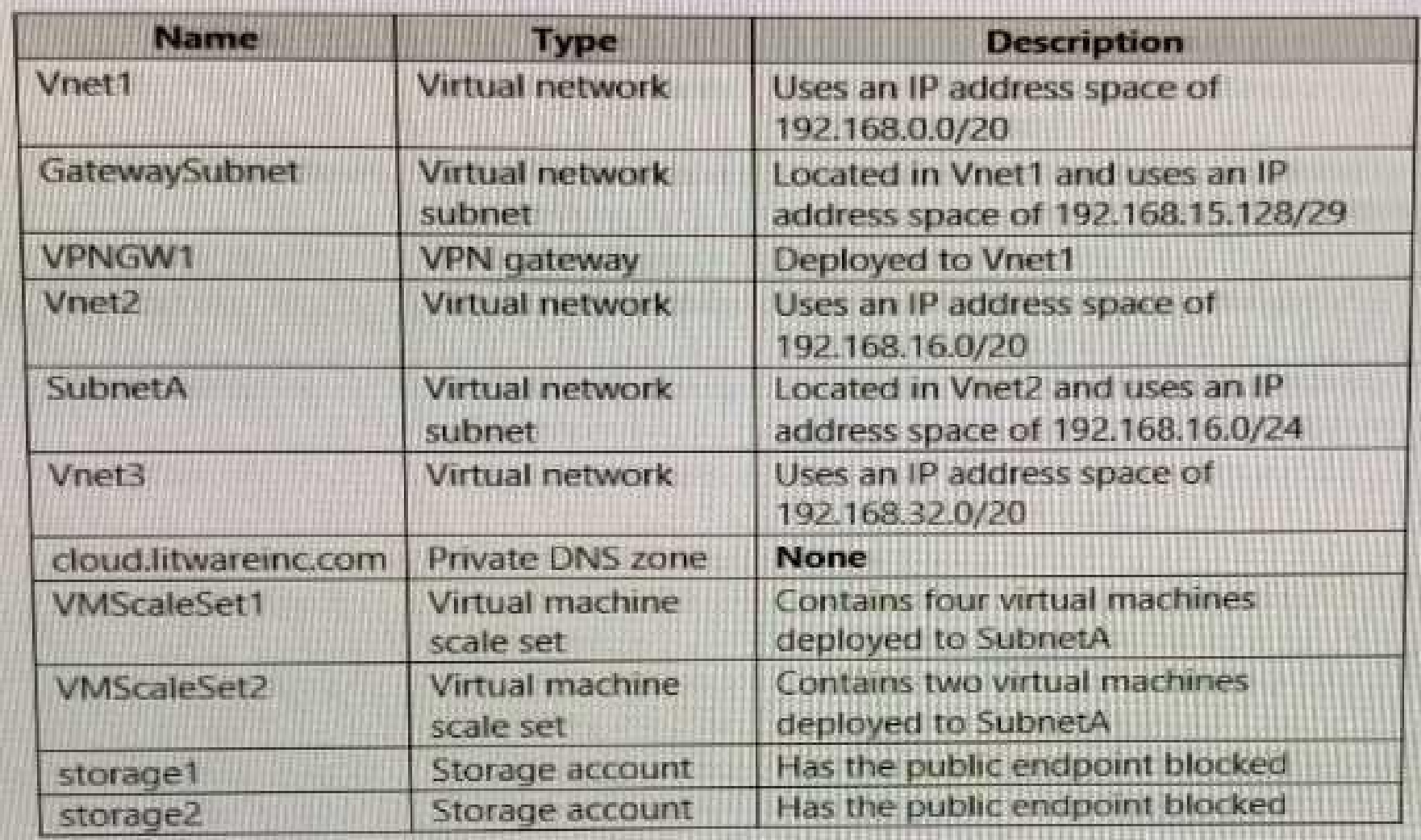
There is bidirectional peering between Vnet1 and Vnet2. There is bidirectional peering between
Vnet1 and Vnet3. Currently, Vnet2 and Vnet3 cannot communicate directly.
Requirements:
Business Requirements
Litware wants to minimize costs whenever possible, as long as all other requirements are met.
Virtual Networking Requirements
Litware identifies the following virtual networking requirements:
* Direct the default route of 0.0.0.0/0 on Vnet2 and Vnet3 to the Boston datacenter over an
ExpressRoute circuit.
* Ensure that the records in the cloud.litwareinc.com zone can be resolved from the on-premises
locations.
* Automatically register the DNS names of Azure virtual machines to the cloud.litwareinc.com zone.
* Minimize the size of the subnets allocated to platform-managed services.
* Allow traffic from VMScaleSet1 to VMScaleSet2 on the TCP port 443 only.
Hybrid Networking Requirements
Litware identifies the following hybrid networking requirements:
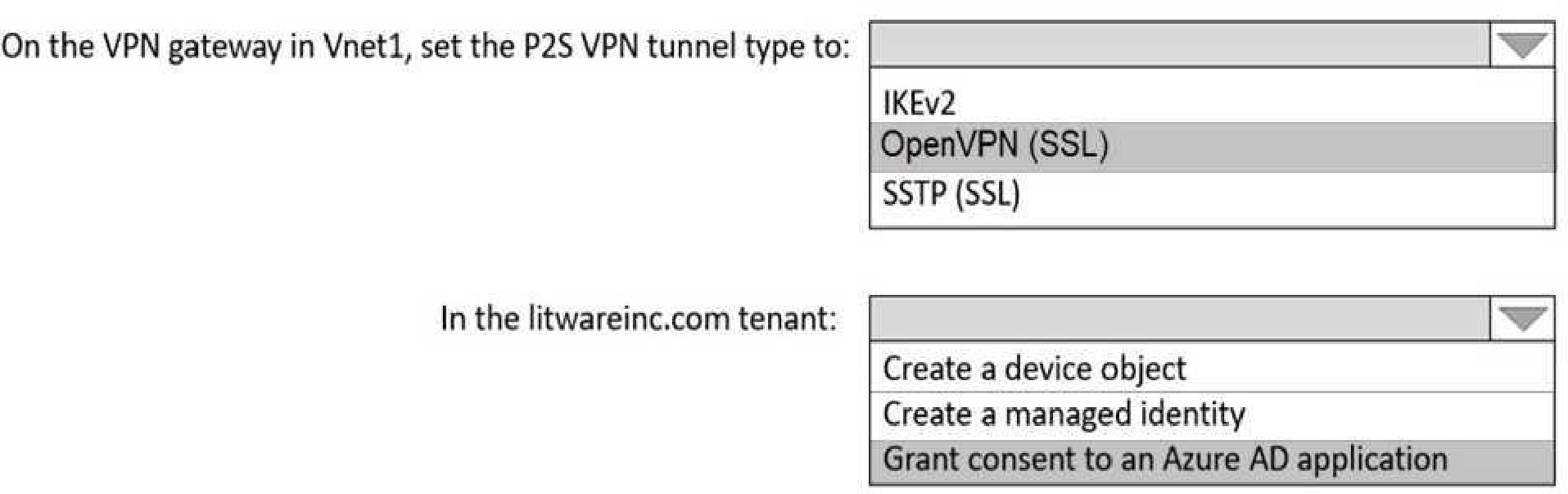
* Users must be able to connect to Vnet1 by using a Point-to-Site (P2S) VPN when working remotely.
Connections must be authenticated by Azure AD.
* Latency of the traffic between the Boston datacenter and all the virtual networks must be
minimized.
* The Boston datacenter must connect to the Azure virtual networks by using an ExpressRoute
FastPath connection.
* Traffic between Vnet2 and Vnet3 must be routed through Vnet1.
PaaS Networking Requirements
Litware identifies the following networking requirements for platform as a service (PaaS):
* The storage1 account must be accessible from all on-premises locations without exposing the
public endpoint of storage1.
* The storage2 account must be accessible from Vnet2 and Vnet3 without exposing the public
endpoint of storage2.
and the business requirements.
Which two actions should you include in the solution? Each correct answer presents part of the
solution.
NOTE: Each correct selection is worth one point.
Quiz
Overview
Litware. Inc. is a financial company that has a main datacenter in Boston and 20 branch offices across
the United States. Users have Android, iOS, and Windows 10 devices.
Existing Environment:
Hybrid Environment
The on-prernises network contains an Active Directory forest named litwareinc.com that syncs to an
Azure Active Directory (Azure AD) tenant named litwareinc.com by usinq Azure AD Connect.
All the offices connect to a virtual network named Vnetl by using a Site-to-Site VPN connection.
Azure Environment
Litware has an Azure subscription named Sub1 that is linked to the litwareinc.com Azure AD tenant.
Sub1 contains resources in the East US Azure region as shown in the following table.
There is bidirectional peering between Vnet1 and Vnet2. There is bidirectional peering between
Vnet1 and Vnet3. Currently, Vnet2 and Vnet3 cannot communicate directly.
Requirements:
Business Requirements
Litware wants to minimize costs whenever possible, as long as all other requirements are met.
Virtual Networking Requirements
Litware identifies the following virtual networking requirements:
* Direct the default route of 0.0.0.0/0 on Vnet2 and Vnet3 to the Boston datacenter over an
ExpressRoute circuit.
* Ensure that the records in the cloud.litwareinc.com zone can be resolved from the on-premises
locations.
* Automatically register the DNS names of Azure virtual machines to the cloud.litwareinc.com zone.
* Minimize the size of the subnets allocated to platform-managed services.
* Allow traffic from VMScaleSet1 to VMScaleSet2 on the TCP port 443 only.
Hybrid Networking Requirements
Litware identifies the following hybrid networking requirements:
* Users must be able to connect to Vnet1 by using a Point-to-Site (P2S) VPN when working remotely.
Connections must be authenticated by Azure AD.
* Latency of the traffic between the Boston datacenter and all the virtual networks must be
minimized.
* The Boston datacenter must connect to the Azure virtual networks by using an ExpressRoute
FastPath connection.
* Traffic between Vnet2 and Vnet3 must be routed through Vnet1.
PaaS Networking Requirements
Litware identifies the following networking requirements for platform as a service (PaaS):
* The storage1 account must be accessible from all on-premises locations without exposing the
public endpoint of storage1.
* The storage2 account must be accessible from Vnet2 and Vnet3 without exposing the public
endpoint of storage2.
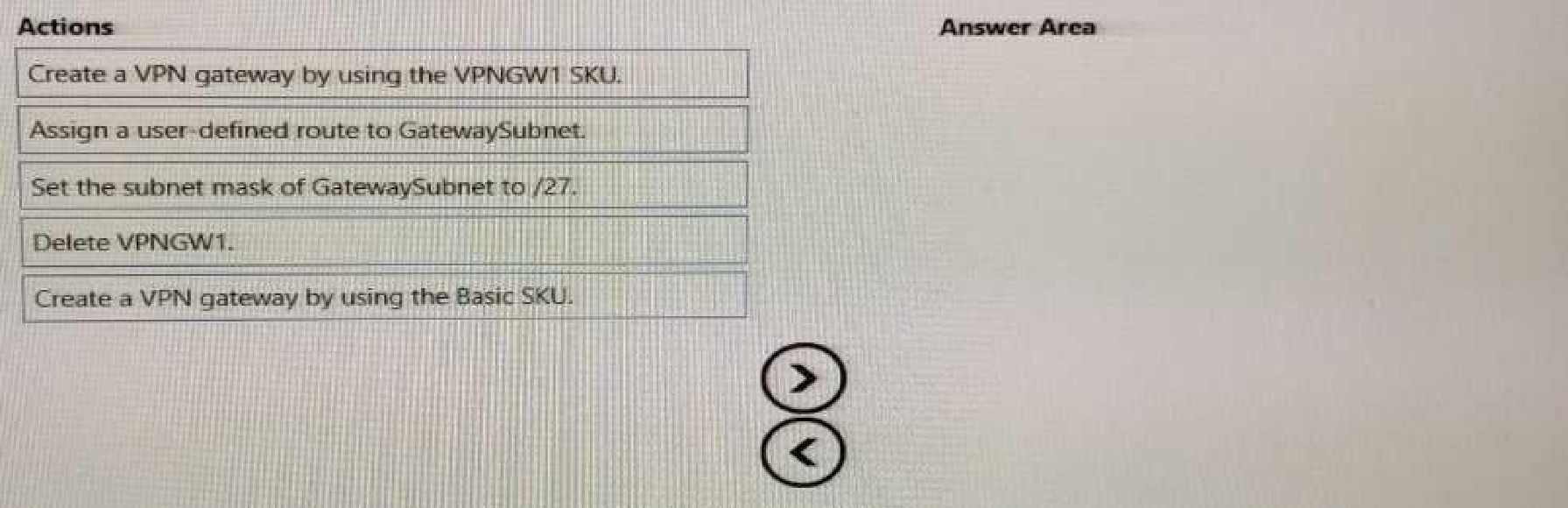
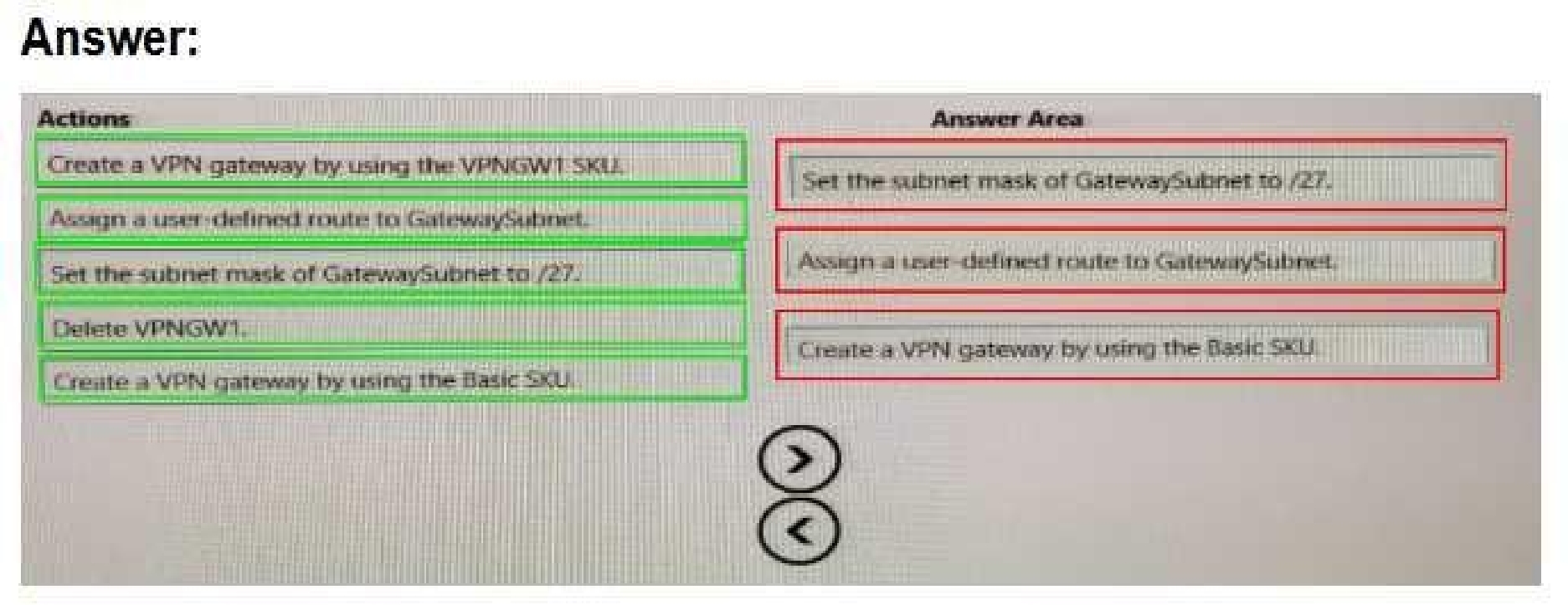
You need to prepare Vnet1 for the deployment of an ExpressRoute gateway. The solution must meet
the hybrid connectivity requirements and the business requirements.
Which three actions should you perform in sequence for Vnet1? To answer, move the appropriate
actions from the list of actions to the answer area and arrange them in the correct order.
Quiz
Overview
Litware. Inc. is a financial company that has a main datacenter in Boston and 20 branch offices across
the United States. Users have Android, iOS, and Windows 10 devices.
Existing Environment:
Hybrid Environment
The on-prernises network contains an Active Directory forest named litwareinc.com that syncs to an
Azure Active Directory (Azure AD) tenant named litwareinc.com by usinq Azure AD Connect.
All the offices connect to a virtual network named Vnetl by using a Site-to-Site VPN connection.
Azure Environment
Litware has an Azure subscription named Sub1 that is linked to the litwareinc.com Azure AD tenant.
Sub1 contains resources in the East US Azure region as shown in the following table.
There is bidirectional peering between Vnet1 and Vnet2. There is bidirectional peering between
Vnet1 and Vnet3. Currently, Vnet2 and Vnet3 cannot communicate directly.
Requirements:
Business Requirements
Litware wants to minimize costs whenever possible, as long as all other requirements are met.
Virtual Networking Requirements
Litware identifies the following virtual networking requirements:
* Direct the default route of 0.0.0.0/0 on Vnet2 and Vnet3 to the Boston datacenter over an
ExpressRoute circuit.
* Ensure that the records in the cloud.litwareinc.com zone can be resolved from the on-premises
locations.
* Automatically register the DNS names of Azure virtual machines to the cloud.litwareinc.com zone.
* Minimize the size of the subnets allocated to platform-managed services.
* Allow traffic from VMScaleSet1 to VMScaleSet2 on the TCP port 443 only.
Hybrid Networking Requirements
Litware identifies the following hybrid networking requirements:
* Users must be able to connect to Vnet1 by using a Point-to-Site (P2S) VPN when working remotely.
Connections must be authenticated by Azure AD.
* Latency of the traffic between the Boston datacenter and all the virtual networks must be
minimized.
* The Boston datacenter must connect to the Azure virtual networks by using an ExpressRoute
FastPath connection.
* Traffic between Vnet2 and Vnet3 must be routed through Vnet1.
PaaS Networking Requirements
Litware identifies the following networking requirements for platform as a service (PaaS):
* The storage1 account must be accessible from all on-premises locations without exposing the
public endpoint of storage1.
* The storage2 account must be accessible from Vnet2 and Vnet3 without exposing the public
endpoint of storage2.
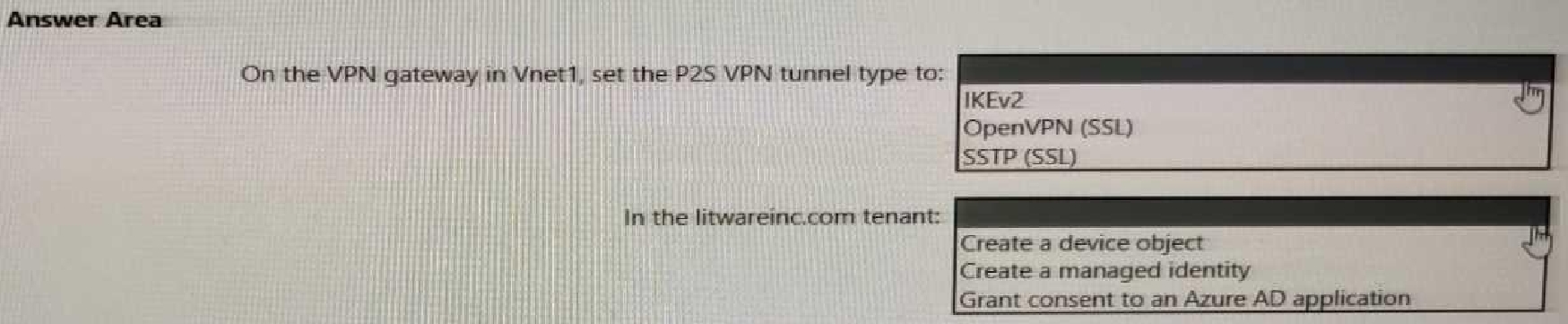
hybrid networking requirements.
What should you do? To answer, select the appropriate options in the answer area.
NOTE: Each correct selection is worth one point.
Quiz
Overview
Litware. Inc. is a financial company that has a main datacenter in Boston and 20 branch offices across
the United States. Users have Android, iOS, and Windows 10 devices.
Existing Environment:
Hybrid Environment
The on-prernises network contains an Active Directory forest named litwareinc.com that syncs to an
Azure Active Directory (Azure AD) tenant named litwareinc.com by usinq Azure AD Connect.
All the offices connect to a virtual network named Vnetl by using a Site-to-Site VPN connection.
Azure Environment
Litware has an Azure subscription named Sub1 that is linked to the litwareinc.com Azure AD tenant.
Sub1 contains resources in the East US Azure region as shown in the following table.
There is bidirectional peering between Vnet1 and Vnet2. There is bidirectional peering between
Vnet1 and Vnet3. Currently, Vnet2 and Vnet3 cannot communicate directly.
Requirements:
Business Requirements
Litware wants to minimize costs whenever possible, as long as all other requirements are met.
Virtual Networking Requirements
Litware identifies the following virtual networking requirements:
* Direct the default route of 0.0.0.0/0 on Vnet2 and Vnet3 to the Boston datacenter over an
ExpressRoute circuit.
* Ensure that the records in the cloud.litwareinc.com zone can be resolved from the on-premises
locations.
* Automatically register the DNS names of Azure virtual machines to the cloud.litwareinc.com zone.
* Minimize the size of the subnets allocated to platform-managed services.
* Allow traffic from VMScaleSet1 to VMScaleSet2 on the TCP port 443 only.
Hybrid Networking Requirements
Litware identifies the following hybrid networking requirements:
* Users must be able to connect to Vnet1 by using a Point-to-Site (P2S) VPN when working remotely.
Connections must be authenticated by Azure AD.
* Latency of the traffic between the Boston datacenter and all the virtual networks must be
minimized.
* The Boston datacenter must connect to the Azure virtual networks by using an ExpressRoute
FastPath connection.
* Traffic between Vnet2 and Vnet3 must be routed through Vnet1.
PaaS Networking Requirements
Litware identifies the following networking requirements for platform as a service (PaaS):
* The storage1 account must be accessible from all on-premises locations without exposing the
public endpoint of storage1.
* The storage2 account must be accessible from Vnet2 and Vnet3 without exposing the public
endpoint of storage2.
requirements and the business requirements.
What should you include in the solution?
Quiz
Overview
Litware. Inc. is a financial company that has a main datacenter in Boston and 20 branch offices across
the United States. Users have Android, iOS, and Windows 10 devices.
Existing Environment:
Hybrid Environment
The on-prernises network contains an Active Directory forest named litwareinc.com that syncs to an
Azure Active Directory (Azure AD) tenant named litwareinc.com by usinq Azure AD Connect.
All the offices connect to a virtual network named Vnetl by using a Site-to-Site VPN connection.
Azure Environment
Litware has an Azure subscription named Sub1 that is linked to the litwareinc.com Azure AD tenant.
Sub1 contains resources in the East US Azure region as shown in the following table.
There is bidirectional peering between Vnet1 and Vnet2. There is bidirectional peering between
Vnet1 and Vnet3. Currently, Vnet2 and Vnet3 cannot communicate directly.
Requirements:
Business Requirements
Litware wants to minimize costs whenever possible, as long as all other requirements are met.
Virtual Networking Requirements
Litware identifies the following virtual networking requirements:
* Direct the default route of 0.0.0.0/0 on Vnet2 and Vnet3 to the Boston datacenter over an
ExpressRoute circuit.
* Ensure that the records in the cloud.litwareinc.com zone can be resolved from the on-premises
locations.
* Automatically register the DNS names of Azure virtual machines to the cloud.litwareinc.com zone.
* Minimize the size of the subnets allocated to platform-managed services.
* Allow traffic from VMScaleSet1 to VMScaleSet2 on the TCP port 443 only.
Hybrid Networking Requirements
Litware identifies the following hybrid networking requirements:
* Users must be able to connect to Vnet1 by using a Point-to-Site (P2S) VPN when working remotely.
Connections must be authenticated by Azure AD.
* Latency of the traffic between the Boston datacenter and all the virtual networks must be
minimized.
* The Boston datacenter must connect to the Azure virtual networks by using an ExpressRoute
FastPath connection.
* Traffic between Vnet2 and Vnet3 must be routed through Vnet1.
PaaS Networking Requirements
Litware identifies the following networking requirements for platform as a service (PaaS):
* The storage1 account must be accessible from all on-premises locations without exposing the
public endpoint of storage1.
* The storage2 account must be accessible from Vnet2 and Vnet3 without exposing the public
endpoint of storage2.
datacenter. The solution must meet the hybrid networking requirements and business requirements.
What should you recommend? To answer, select the appropriate options in the answer area.
NOTE: Each correct selection is worth one point.
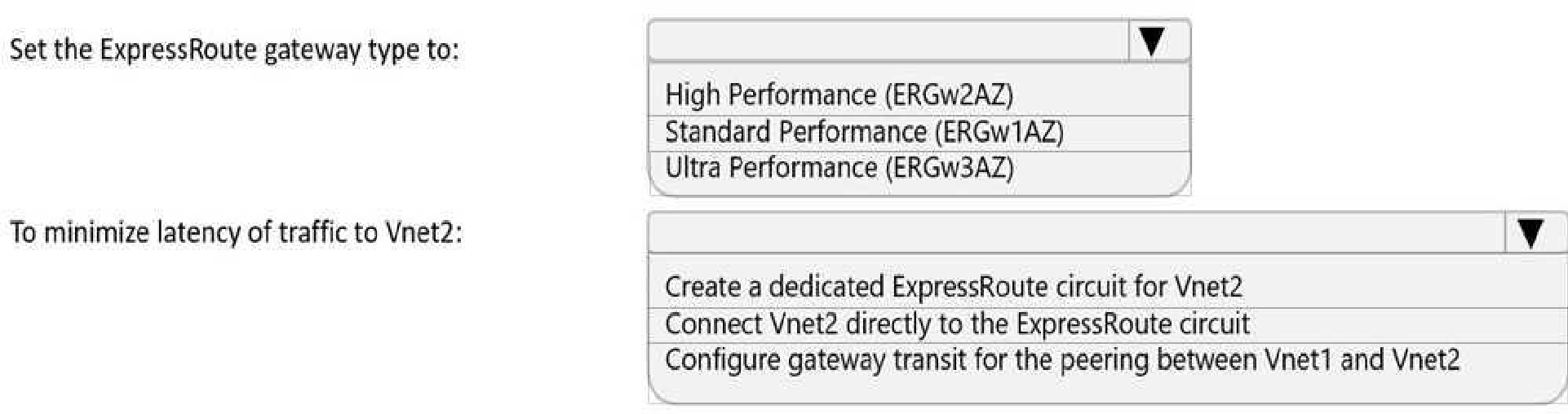
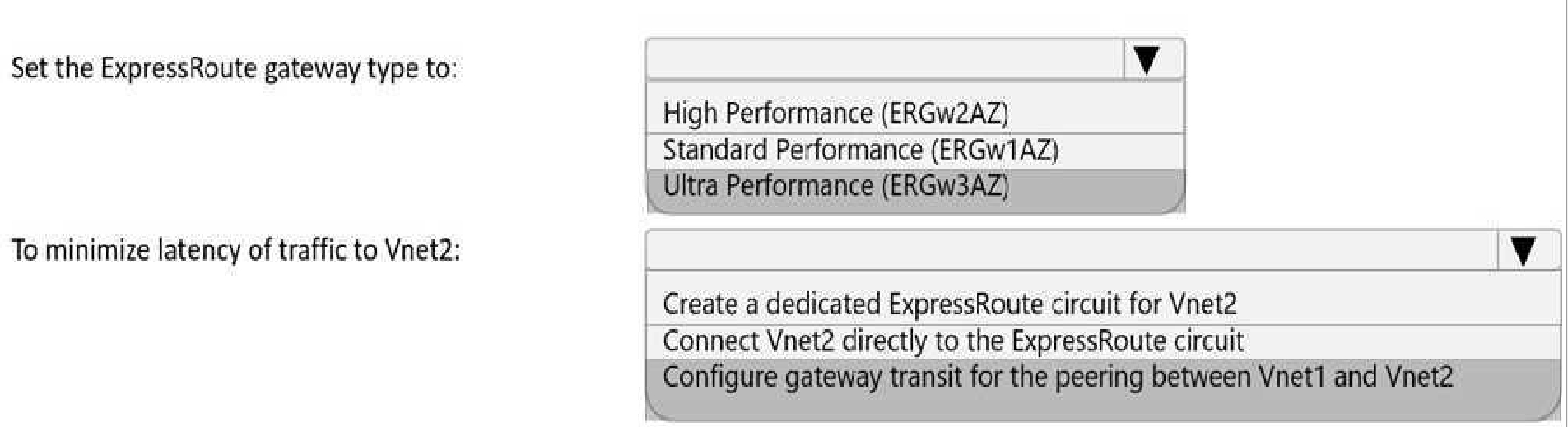
For the first question, only ExpressRoute GW SKU Ultra Performance support FastPath feature.
For the second question, vnet1 will connect to ExpressRoute gw, once Vnet1 peers with Vnet2, the
traffic from on-premise network will bypass GW and Vnet1, directly goes to Vnet2, while this feature
is under public preview.
====Reference
ExpressRoute virtual network gateway is designed to exchange network routes and route network
traffic. FastPath is designed to improve the data path performance between your on-premises
network and your virtual network. When enabled, FastPath sends network traffic directly to virtual
machines in the virtual network, bypassing the gateway.
To configure FastPath, the virtual network gateway must be either:
Ultra Performance
ErGw3AZ
VNet Peering - FastPath will send traffic directly to any VM deployed in a virtual network peered to
the one connected to ExpressRoute, bypassing the ExpressRoute virtual network gateway.
[https://docs.microsoft.com/en-us/azure/expressroute/about-fastpath](https://docs.microsoft.com/en-us/azure/expressroute/about-fastpath)
Gateway SKU
[https://docs.microsoft.com/en-us/azure/expressroute/expressroute-about-virtual-network-gateways](https://docs.microsoft.com/en-us/azure/expressroute/expressroute-about-virtual-network-gateways)
Quiz
Overview
Litware. Inc. is a financial company that has a main datacenter in Boston and 20 branch offices across
the United States. Users have Android, iOS, and Windows 10 devices.
Existing Environment:
Hybrid Environment
The on-prernises network contains an Active Directory forest named litwareinc.com that syncs to an
Azure Active Directory (Azure AD) tenant named litwareinc.com by usinq Azure AD Connect.
All the offices connect to a virtual network named Vnetl by using a Site-to-Site VPN connection.
Azure Environment
Litware has an Azure subscription named Sub1 that is linked to the litwareinc.com Azure AD tenant.
Sub1 contains resources in the East US Azure region as shown in the following table.
There is bidirectional peering between Vnet1 and Vnet2. There is bidirectional peering between
Vnet1 and Vnet3. Currently, Vnet2 and Vnet3 cannot communicate directly.
Requirements:
Business Requirements
Litware wants to minimize costs whenever possible, as long as all other requirements are met.
Virtual Networking Requirements
Litware identifies the following virtual networking requirements:
* Direct the default route of 0.0.0.0/0 on Vnet2 and Vnet3 to the Boston datacenter over an
ExpressRoute circuit.
* Ensure that the records in the cloud.litwareinc.com zone can be resolved from the on-premises
locations.
* Automatically register the DNS names of Azure virtual machines to the cloud.litwareinc.com zone.
* Minimize the size of the subnets allocated to platform-managed services.
* Allow traffic from VMScaleSet1 to VMScaleSet2 on the TCP port 443 only.
Hybrid Networking Requirements
Litware identifies the following hybrid networking requirements:
* Users must be able to connect to Vnet1 by using a Point-to-Site (P2S) VPN when working remotely.
Connections must be authenticated by Azure AD.
* Latency of the traffic between the Boston datacenter and all the virtual networks must be
minimized.
* The Boston datacenter must connect to the Azure virtual networks by using an ExpressRoute
FastPath connection.
* Traffic between Vnet2 and Vnet3 must be routed through Vnet1.
PaaS Networking Requirements
Litware identifies the following networking requirements for platform as a service (PaaS):
* The storage1 account must be accessible from all on-premises locations without exposing the
public endpoint of storage1.
* The storage2 account must be accessible from Vnet2 and Vnet3 without exposing the public
endpoint of storage2.
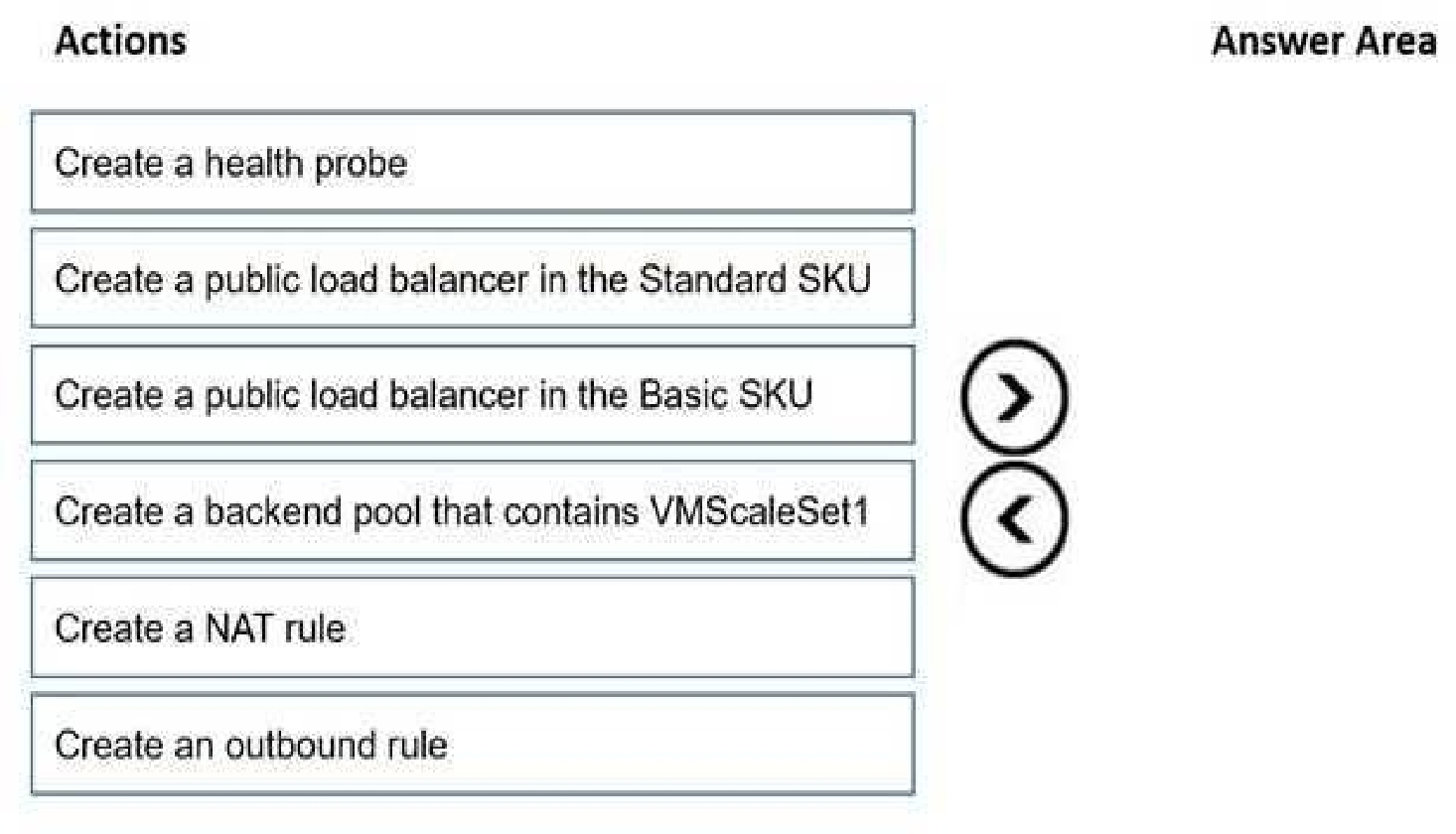
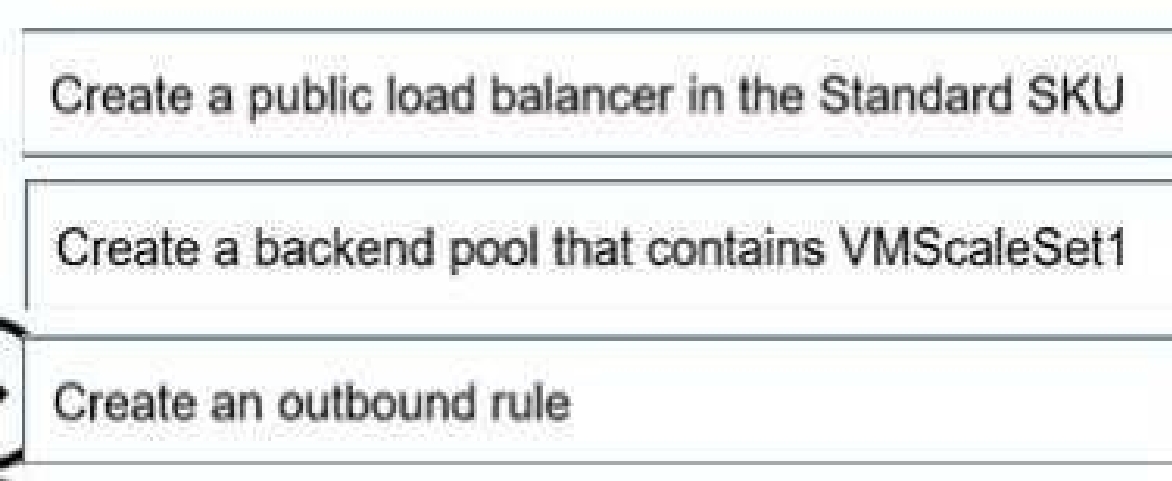
You need to implement outbound connectivity for VMScaleSet1. The solution must meet the virtual
networking requirements and the business requirements.
Which three actions should you perform in sequence? To answer, move the appropriate actions from
the list of actions to the answer area and arrange them in the correct order.
Reference:
[https://docs.microsoft.com/en-us/azure/load-balancer/skus](https://docs.microsoft.com/en-us/azure/load-balancer/skus)
[https://docs.microsoft.com/en-us/azure/load-balancer/load-balancer-outbound-](https://docs.microsoft.com/en-us/azure/load-balancer/load-balancer-outbound-)
connections#outboundrules
Quiz
Overview
Litware. Inc. is a financial company that has a main datacenter in Boston and 20 branch offices across
the United States. Users have Android, iOS, and Windows 10 devices.
Existing Environment:
Hybrid Environment
The on-prernises network contains an Active Directory forest named litwareinc.com that syncs to an
Azure Active Directory (Azure AD) tenant named litwareinc.com by usinq Azure AD Connect.
All the offices connect to a virtual network named Vnetl by using a Site-to-Site VPN connection.
Azure Environment
Litware has an Azure subscription named Sub1 that is linked to the litwareinc.com Azure AD tenant.
Sub1 contains resources in the East US Azure region as shown in the following table.
There is bidirectional peering between Vnet1 and Vnet2. There is bidirectional peering between
Vnet1 and Vnet3. Currently, Vnet2 and Vnet3 cannot communicate directly.
Requirements:
Business Requirements
Litware wants to minimize costs whenever possible, as long as all other requirements are met.
Virtual Networking Requirements
Litware identifies the following virtual networking requirements:
* Direct the default route of 0.0.0.0/0 on Vnet2 and Vnet3 to the Boston datacenter over an
ExpressRoute circuit.
* Ensure that the records in the cloud.litwareinc.com zone can be resolved from the on-premises
locations.
* Automatically register the DNS names of Azure virtual machines to the cloud.litwareinc.com zone.
* Minimize the size of the subnets allocated to platform-managed services.
* Allow traffic from VMScaleSet1 to VMScaleSet2 on the TCP port 443 only.
Hybrid Networking Requirements
Litware identifies the following hybrid networking requirements:
* Users must be able to connect to Vnet1 by using a Point-to-Site (P2S) VPN when working remotely.
Connections must be authenticated by Azure AD.
* Latency of the traffic between the Boston datacenter and all the virtual networks must be
minimized.
* The Boston datacenter must connect to the Azure virtual networks by using an ExpressRoute
FastPath connection.
* Traffic between Vnet2 and Vnet3 must be routed through Vnet1.
PaaS Networking Requirements
Litware identifies the following networking requirements for platform as a service (PaaS):
* The storage1 account must be accessible from all on-premises locations without exposing the
public endpoint of storage1.
* The storage2 account must be accessible from Vnet2 and Vnet3 without exposing the public
endpoint of storage2.
networking requirements.
What should you use to configure the default route?
Quiz
Overview
Litware. Inc. is a financial company that has a main datacenter in Boston and 20 branch offices across
the United States. Users have Android, iOS, and Windows 10 devices.
Existing Environment:
Hybrid Environment
The on-prernises network contains an Active Directory forest named litwareinc.com that syncs to an
Azure Active Directory (Azure AD) tenant named litwareinc.com by usinq Azure AD Connect.
All the offices connect to a virtual network named Vnetl by using a Site-to-Site VPN connection.
Azure Environment
Litware has an Azure subscription named Sub1 that is linked to the litwareinc.com Azure AD tenant.
Sub1 contains resources in the East US Azure region as shown in the following table.
There is bidirectional peering between Vnet1 and Vnet2. There is bidirectional peering between
Vnet1 and Vnet3. Currently, Vnet2 and Vnet3 cannot communicate directly.
Requirements:
Business Requirements
Litware wants to minimize costs whenever possible, as long as all other requirements are met.
Virtual Networking Requirements
Litware identifies the following virtual networking requirements:
* Direct the default route of 0.0.0.0/0 on Vnet2 and Vnet3 to the Boston datacenter over an
ExpressRoute circuit.
* Ensure that the records in the cloud.litwareinc.com zone can be resolved from the on-premises
locations.
* Automatically register the DNS names of Azure virtual machines to the cloud.litwareinc.com zone.
* Minimize the size of the subnets allocated to platform-managed services.
* Allow traffic from VMScaleSet1 to VMScaleSet2 on the TCP port 443 only.
Hybrid Networking Requirements
Litware identifies the following hybrid networking requirements:
* Users must be able to connect to Vnet1 by using a Point-to-Site (P2S) VPN when working remotely.
Connections must be authenticated by Azure AD.
* Latency of the traffic between the Boston datacenter and all the virtual networks must be
minimized.
* The Boston datacenter must connect to the Azure virtual networks by using an ExpressRoute
FastPath connection.
* Traffic between Vnet2 and Vnet3 must be routed through Vnet1.
PaaS Networking Requirements
Litware identifies the following networking requirements for platform as a service (PaaS):
* The storage1 account must be accessible from all on-premises locations without exposing the
public endpoint of storage1.
* The storage2 account must be accessible from Vnet2 and Vnet3 without exposing the public
endpoint of storage2.
networking requirements.
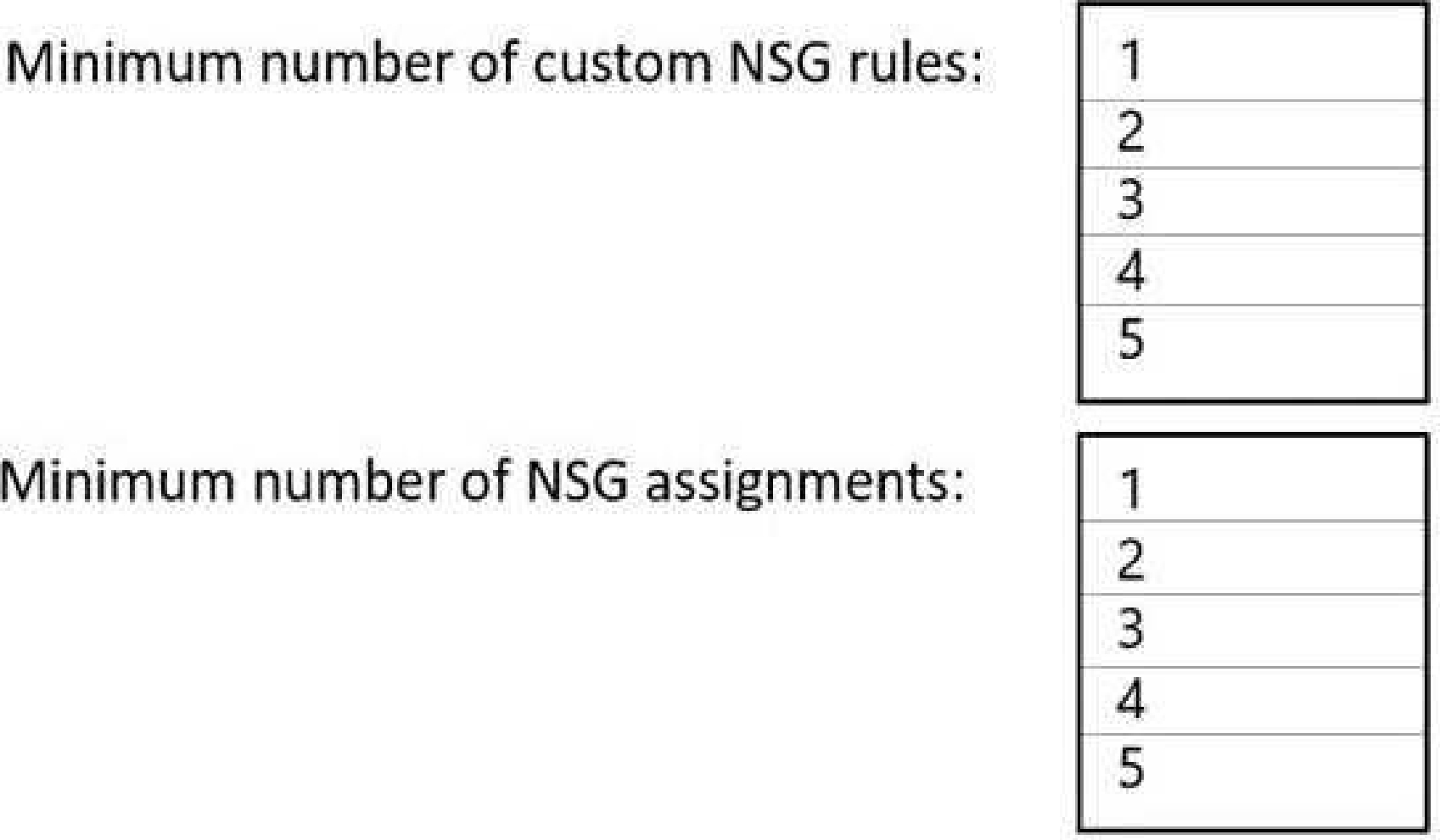
What is the minimum number of custom NSG rules and NSG assignments required? To answer, select
the appropriate options in the answer area.
NOTE: Each correct selection is worth one point.
Ite rule for the
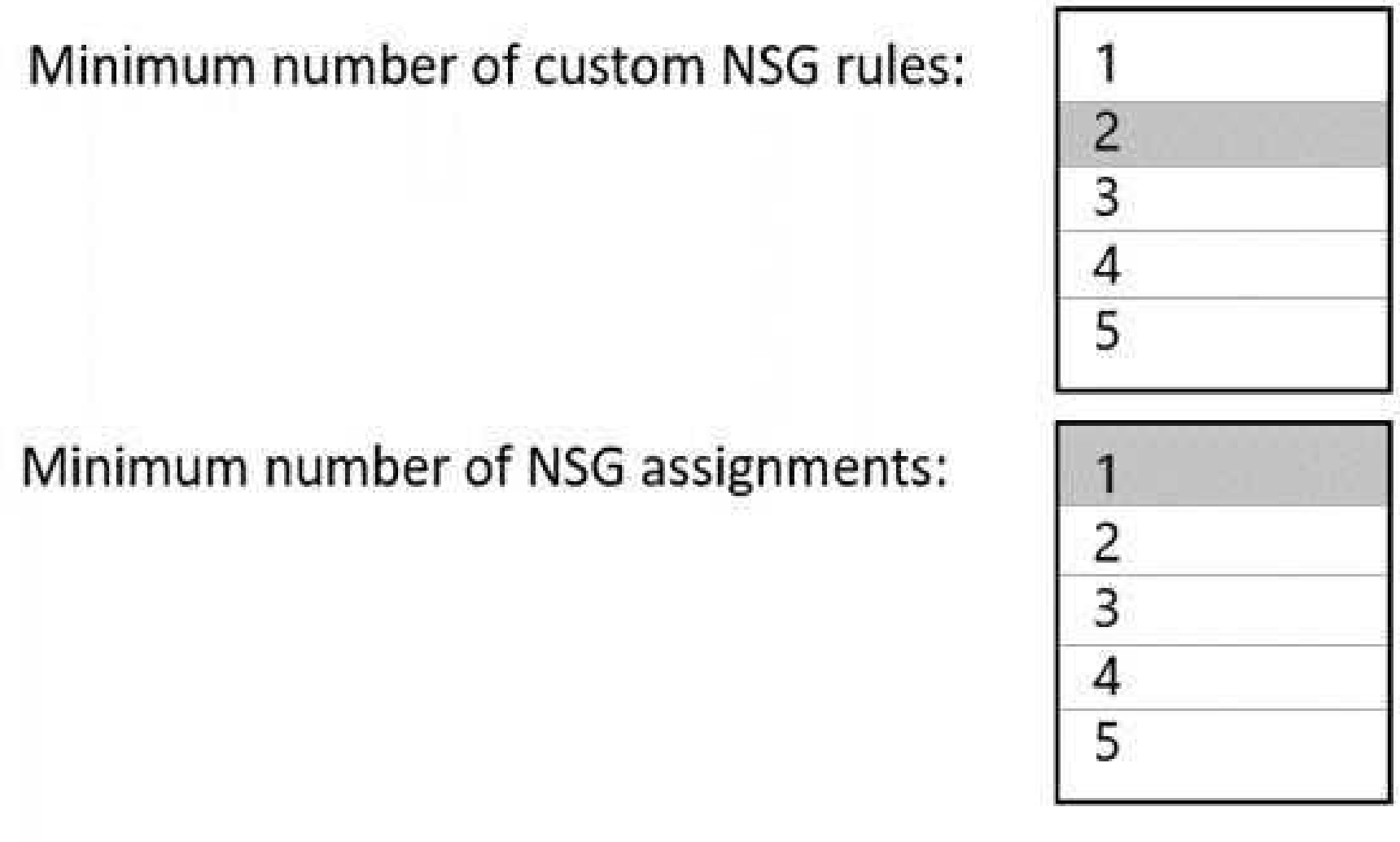
Box 2: One NSG
The minimum requirement is one NSG. You could attach the NSG to VMScaleSet1 and restrict
outbound traffic, or you could attach the NSG to VMScaleSet2 and restrict inbound traffic. Either way
you would need two custom NSG rules.
Box 1: Two custom rules
With the NSG attached to VMScaleSet2, you would need to create a custom rule blocking all traffic
from VMScaleSet1. Then you would need to create another custom rule with a higher priority than
the first rule that allows traffic on port 443.
The default rules in the NSG will allow all other traffic to VMScaleSet2.
Quiz
Overview
Litware. Inc. is a financial company that has a main datacenter in Boston and 20 branch offices across
the United States. Users have Android, iOS, and Windows 10 devices.
Existing Environment:
Hybrid Environment
The on-prernises network contains an Active Directory forest named litwareinc.com that syncs to an
Azure Active Directory (Azure AD) tenant named litwareinc.com by usinq Azure AD Connect.
All the offices connect to a virtual network named Vnetl by using a Site-to-Site VPN connection.
Azure Environment
Litware has an Azure subscription named Sub1 that is linked to the litwareinc.com Azure AD tenant.
Sub1 contains resources in the East US Azure region as shown in the following table.
There is bidirectional peering between Vnet1 and Vnet2. There is bidirectional peering between
Vnet1 and Vnet3. Currently, Vnet2 and Vnet3 cannot communicate directly.
Requirements:
Business Requirements
Litware wants to minimize costs whenever possible, as long as all other requirements are met.
Virtual Networking Requirements
Litware identifies the following virtual networking requirements:
* Direct the default route of 0.0.0.0/0 on Vnet2 and Vnet3 to the Boston datacenter over an
ExpressRoute circuit.
* Ensure that the records in the cloud.litwareinc.com zone can be resolved from the on-premises
locations.
* Automatically register the DNS names of Azure virtual machines to the cloud.litwareinc.com zone.
* Minimize the size of the subnets allocated to platform-managed services.
* Allow traffic from VMScaleSet1 to VMScaleSet2 on the TCP port 443 only.
Hybrid Networking Requirements
Litware identifies the following hybrid networking requirements:
* Users must be able to connect to Vnet1 by using a Point-to-Site (P2S) VPN when working remotely.
Connections must be authenticated by Azure AD.
* Latency of the traffic between the Boston datacenter and all the virtual networks must be
minimized.
* The Boston datacenter must connect to the Azure virtual networks by using an ExpressRoute
FastPath connection.
* Traffic between Vnet2 and Vnet3 must be routed through Vnet1.
PaaS Networking Requirements
Litware identifies the following networking requirements for platform as a service (PaaS):
* The storage1 account must be accessible from all on-premises locations without exposing the
public endpoint of storage1.
* The storage2 account must be accessible from Vnet2 and Vnet3 without exposing the public
endpoint of storage2.
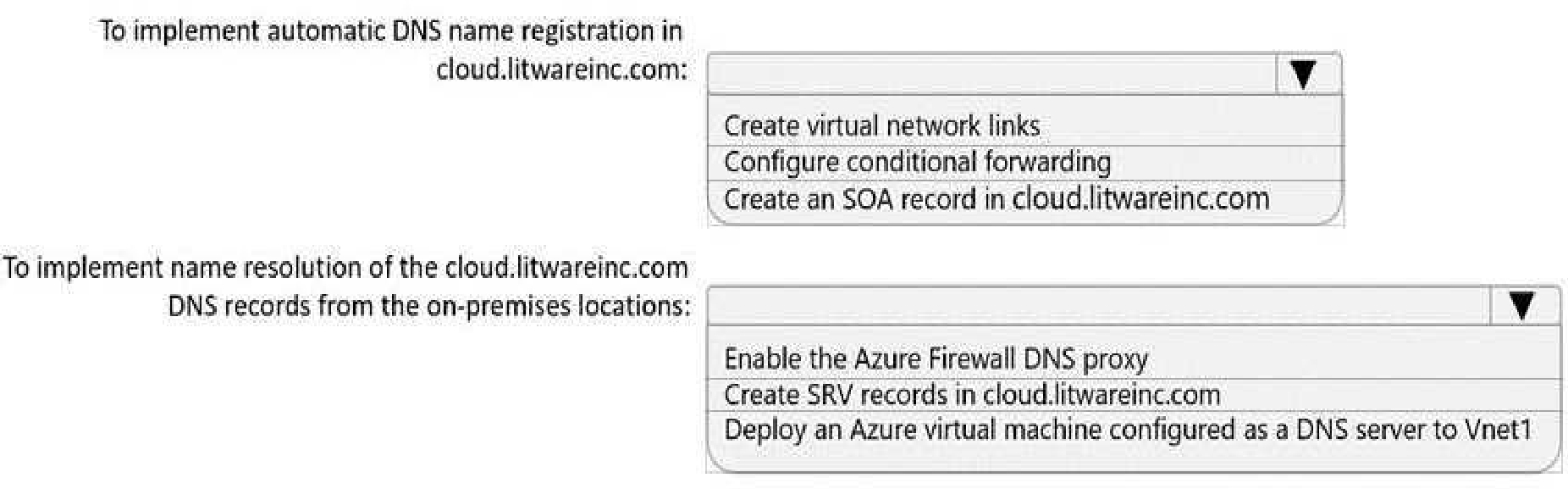
networking requirements.
What should you do? To answer, select the appropriate options in the answer area.
NOTE: Each correct selection is worth one point.
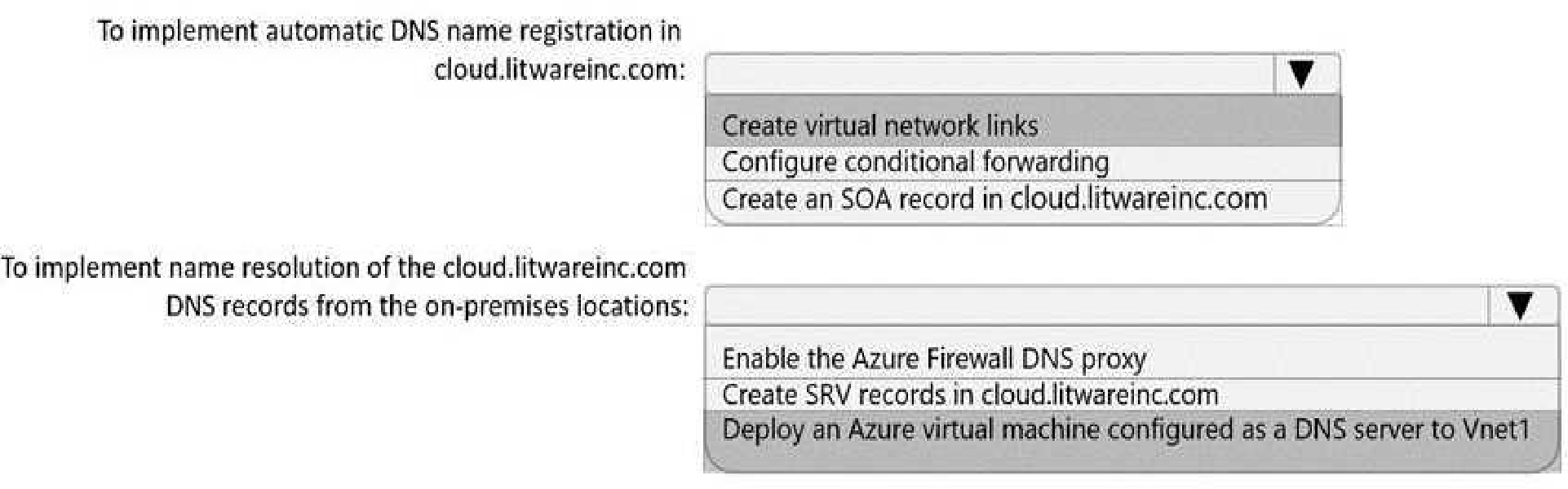
Reference:
[https://docs.microsoft.com/en-us/azure/dns/private-dns-autoregistration](https://docs.microsoft.com/en-us/azure/dns/private-dns-autoregistration)
[https://docs.microsoft.com/en-us/azure/virtual-network/virtual-networks-name-resolution-for-vms-](https://docs.microsoft.com/en-us/azure/virtual-network/virtual-networks-name-resolution-for-vms-)
and-role-instances
Quiz
Overview
Litware. Inc. is a financial company that has a main datacenter in Boston and 20 branch offices across
the United States. Users have Android, iOS, and Windows 10 devices.
Existing Environment:
Hybrid Environment
The on-prernises network contains an Active Directory forest named litwareinc.com that syncs to an
Azure Active Directory (Azure AD) tenant named litwareinc.com by usinq Azure AD Connect.
All the offices connect to a virtual network named Vnetl by using a Site-to-Site VPN connection.
Azure Environment
Litware has an Azure subscription named Sub1 that is linked to the litwareinc.com Azure AD tenant.
Sub1 contains resources in the East US Azure region as shown in the following table.
There is bidirectional peering between Vnet1 and Vnet2. There is bidirectional peering between
Vnet1 and Vnet3. Currently, Vnet2 and Vnet3 cannot communicate directly.
Requirements:
Business Requirements
Litware wants to minimize costs whenever possible, as long as all other requirements are met.
Virtual Networking Requirements
Litware identifies the following virtual networking requirements:
* Direct the default route of 0.0.0.0/0 on Vnet2 and Vnet3 to the Boston datacenter over an
ExpressRoute circuit.
* Ensure that the records in the cloud.litwareinc.com zone can be resolved from the on-premises
locations.
* Automatically register the DNS names of Azure virtual machines to the cloud.litwareinc.com zone.
* Minimize the size of the subnets allocated to platform-managed services.
* Allow traffic from VMScaleSet1 to VMScaleSet2 on the TCP port 443 only.
Hybrid Networking Requirements
Litware identifies the following hybrid networking requirements:
* Users must be able to connect to Vnet1 by using a Point-to-Site (P2S) VPN when working remotely.
Connections must be authenticated by Azure AD.
* Latency of the traffic between the Boston datacenter and all the virtual networks must be
minimized.
* The Boston datacenter must connect to the Azure virtual networks by using an ExpressRoute
FastPath connection.
* Traffic between Vnet2 and Vnet3 must be routed through Vnet1.
PaaS Networking Requirements
Litware identifies the following networking requirements for platform as a service (PaaS):
* The storage1 account must be accessible from all on-premises locations without exposing the
public endpoint of storage1.
* The storage2 account must be accessible from Vnet2 and Vnet3 without exposing the public
endpoint of storage2.
networking requirements.
What should you use to configure the default route?
AZ-700: Designing and Implementing Microsoft Azure Networking Solutions Practice test unlocks all online simulator questions
Thank you for choosing the free version of the AZ-700: Designing and Implementing Microsoft Azure Networking Solutions practice test! Further deepen your knowledge on Microsoft Simulator; by unlocking the full version of our AZ-700: Designing and Implementing Microsoft Azure Networking Solutions Simulator you will be able to take tests with over 317 constantly updated questions and easily pass your exam. 98% of people pass the exam in the first attempt after preparing with our 317 questions.
BUY NOWWhat to expect from our AZ-700: Designing and Implementing Microsoft Azure Networking Solutions practice tests and how to prepare for any exam?
The AZ-700: Designing and Implementing Microsoft Azure Networking Solutions Simulator Practice Tests are part of the Microsoft Database and are the best way to prepare for any AZ-700: Designing and Implementing Microsoft Azure Networking Solutions exam. The AZ-700: Designing and Implementing Microsoft Azure Networking Solutions practice tests consist of 317 questions and are written by experts to help you and prepare you to pass the exam on the first attempt. The AZ-700: Designing and Implementing Microsoft Azure Networking Solutions database includes questions from previous and other exams, which means you will be able to practice simulating past and future questions. Preparation with AZ-700: Designing and Implementing Microsoft Azure Networking Solutions Simulator will also give you an idea of the time it will take to complete each section of the AZ-700: Designing and Implementing Microsoft Azure Networking Solutions practice test . It is important to note that the AZ-700: Designing and Implementing Microsoft Azure Networking Solutions Simulator does not replace the classic AZ-700: Designing and Implementing Microsoft Azure Networking Solutions study guides; however, the Simulator provides valuable insights into what to expect and how much work needs to be done to prepare for the AZ-700: Designing and Implementing Microsoft Azure Networking Solutions exam.
BUY NOWAZ-700: Designing and Implementing Microsoft Azure Networking Solutions Practice test therefore represents an excellent tool to prepare for the actual exam together with our Microsoft practice test . Our AZ-700: Designing and Implementing Microsoft Azure Networking Solutions Simulator will help you assess your level of preparation and understand your strengths and weaknesses. Below you can read all the quizzes you will find in our AZ-700: Designing and Implementing Microsoft Azure Networking Solutions Simulator and how our unique AZ-700: Designing and Implementing Microsoft Azure Networking Solutions Database made up of real questions:
Info quiz:
- Quiz name:AZ-700: Designing and Implementing Microsoft Azure Networking Solutions
- Total number of questions:317
- Number of questions for the test:50
- Pass score:80%
You can prepare for the AZ-700: Designing and Implementing Microsoft Azure Networking Solutions exams with our mobile app. It is very easy to use and even works offline in case of network failure, with all the functions you need to study and practice with our AZ-700: Designing and Implementing Microsoft Azure Networking Solutions Simulator.
Use our Mobile App, available for both Android and iOS devices, with our AZ-700: Designing and Implementing Microsoft Azure Networking Solutions Simulator . You can use it anywhere and always remember that our mobile app is free and available on all stores.
Our Mobile App contains all AZ-700: Designing and Implementing Microsoft Azure Networking Solutions practice tests which consist of 317 questions and also provide study material to pass the final AZ-700: Designing and Implementing Microsoft Azure Networking Solutions exam with guaranteed success. Our AZ-700: Designing and Implementing Microsoft Azure Networking Solutions database contain hundreds of questions and Microsoft Tests related to AZ-700: Designing and Implementing Microsoft Azure Networking Solutions Exam. This way you can practice anywhere you want, even offline without the internet.
BUY NOW