Quiz DP-203: Microsoft Certified: Azure Databricks Data Engineer Associate
Quiz
Transactional Date
Contoso has three years of customer, transactional, operation, sourcing, and supplier data comprised
of 10 billion records stored across multiple on-premises Microsoft SQL Server servers. The SQL server
instances contain data from various operational systems. The data is loaded into the instances by
using SQL server integration Services (SSIS) packages.
You estimate that combining all product sales transactions into a company-wide sales transactions
dataset will result in a single table that contains 5 billion rows, with one row per transaction.
Most queries targeting the sales transactions data will be used to identify which products were sold
in retail stores and which products were sold online during different time period. Sales transaction
data that is older than three years will be removed monthly.
You plan to create a retail store table that will contain the address of each retail store. The table will
be approximately 2 MB. Queries for retail store sales will include the retail store addresses.
You plan to create a promotional table that will contain a promotion ID. The promotion ID will be
associated to a specific product. The product will be identified by a product ID. The table will be
approximately 5 GB.
Streaming Twitter Data
The ecommerce department at Contoso develops and Azure logic app that captures trending Twitter
feeds referencing the company’s products and pushes the products to Azure Event Hubs.
Planned Changes
Contoso plans to implement the following changes:
* Load the sales transaction dataset to Azure Synapse Analytics.
* Integrate on-premises data stores with Azure Synapse Analytics by using SSIS packages.
* Use Azure Synapse Analytics to analyze Twitter feeds to assess customer sentiments about
products.
Sales Transaction Dataset Requirements
Contoso identifies the following requirements for the sales transaction dataset:
• Partition data that contains sales transaction records. Partitions must be designed to provide
efficient loads by month. Boundary values must belong: to the partition on the right.
• Ensure that queries joining and filtering sales transaction records based on product ID complete as
quickly as possible.
• Implement a surrogate key to account for changes to the retail store addresses.
• Ensure that data storage costs and performance are predictable.
• Minimize how long it takes to remove old records.
Customer Sentiment Analytics Requirement
Contoso identifies the following requirements for customer sentiment analytics:
• Allow Contoso users to use PolyBase in an A/ure Synapse Analytics dedicated SQL pool to query
the content of the data records that host the Twitter feeds. Data must be protected by using row-
level security (RLS). The users must be authenticated by using their own A/ureAD credentials.
• Maximize the throughput of ingesting Twitter feeds from Event Hubs to Azure Storage without
purchasing additional throughput or capacity units.
• Store Twitter feeds in Azure Storage by using Event Hubs Capture. The feeds will be converted into
Parquet files.
• Ensure that the data store supports Azure AD-based access control down to the object level.
• Minimize administrative effort to maintain the Twitter feed data records.
• Purge Twitter feed data records;itftaitJ are older than two years.
Data Integration Requirements
Contoso identifies the following requirements for data integration:
Use an Azure service that leverages the existing SSIS packages to ingest on-premises data into
datasets stored in a dedicated SQL pool of Azure Synaps Analytics and transform the data.
Identify a process to ensure that changes to the ingestion and transformation activities can be
version controlled and developed independently by multiple data engineers.
meet the data integration requirements.
Which type of integration runtime should you use?
Quiz
Transactional Date
Contoso has three years of customer, transactional, operation, sourcing, and supplier data comprised
of 10 billion records stored across multiple on-premises Microsoft SQL Server servers. The SQL server
instances contain data from various operational systems. The data is loaded into the instances by
using SQL server integration Services (SSIS) packages.
You estimate that combining all product sales transactions into a company-wide sales transactions
dataset will result in a single table that contains 5 billion rows, with one row per transaction.
Most queries targeting the sales transactions data will be used to identify which products were sold
in retail stores and which products were sold online during different time period. Sales transaction
data that is older than three years will be removed monthly.
You plan to create a retail store table that will contain the address of each retail store. The table will
be approximately 2 MB. Queries for retail store sales will include the retail store addresses.
You plan to create a promotional table that will contain a promotion ID. The promotion ID will be
associated to a specific product. The product will be identified by a product ID. The table will be
approximately 5 GB.
Streaming Twitter Data
The ecommerce department at Contoso develops and Azure logic app that captures trending Twitter
feeds referencing the company’s products and pushes the products to Azure Event Hubs.
Planned Changes
Contoso plans to implement the following changes:
* Load the sales transaction dataset to Azure Synapse Analytics.
* Integrate on-premises data stores with Azure Synapse Analytics by using SSIS packages.
* Use Azure Synapse Analytics to analyze Twitter feeds to assess customer sentiments about
products.
Sales Transaction Dataset Requirements
Contoso identifies the following requirements for the sales transaction dataset:
• Partition data that contains sales transaction records. Partitions must be designed to provide
efficient loads by month. Boundary values must belong: to the partition on the right.
• Ensure that queries joining and filtering sales transaction records based on product ID complete as
quickly as possible.
• Implement a surrogate key to account for changes to the retail store addresses.
• Ensure that data storage costs and performance are predictable.
• Minimize how long it takes to remove old records.
Customer Sentiment Analytics Requirement
Contoso identifies the following requirements for customer sentiment analytics:
• Allow Contoso users to use PolyBase in an A/ure Synapse Analytics dedicated SQL pool to query
the content of the data records that host the Twitter feeds. Data must be protected by using row-
level security (RLS). The users must be authenticated by using their own A/ureAD credentials.
• Maximize the throughput of ingesting Twitter feeds from Event Hubs to Azure Storage without
purchasing additional throughput or capacity units.
• Store Twitter feeds in Azure Storage by using Event Hubs Capture. The feeds will be converted into
Parquet files.
• Ensure that the data store supports Azure AD-based access control down to the object level.
• Minimize administrative effort to maintain the Twitter feed data records.
• Purge Twitter feed data records;itftaitJ are older than two years.
Data Integration Requirements
Contoso identifies the following requirements for data integration:
Use an Azure service that leverages the existing SSIS packages to ingest on-premises data into
datasets stored in a dedicated SQL pool of Azure Synaps Analytics and transform the data.
Identify a process to ensure that changes to the ingestion and transformation activities can be
version controlled and developed independently by multiple data engineers.
You need to ensure that the Twitter feed data can be analyzed in the dedicated SQL pool. The
solution must meet the customer sentiment analytics requirements.
Which three Transaction-SQL DDL commands should you run in sequence? To answer, move the
appropriate commands from the list of commands to the answer area and arrange them in the
correct order.
NOTE: More than one order of answer choices is correct. You will receive credit for any of the correct
orders you select.
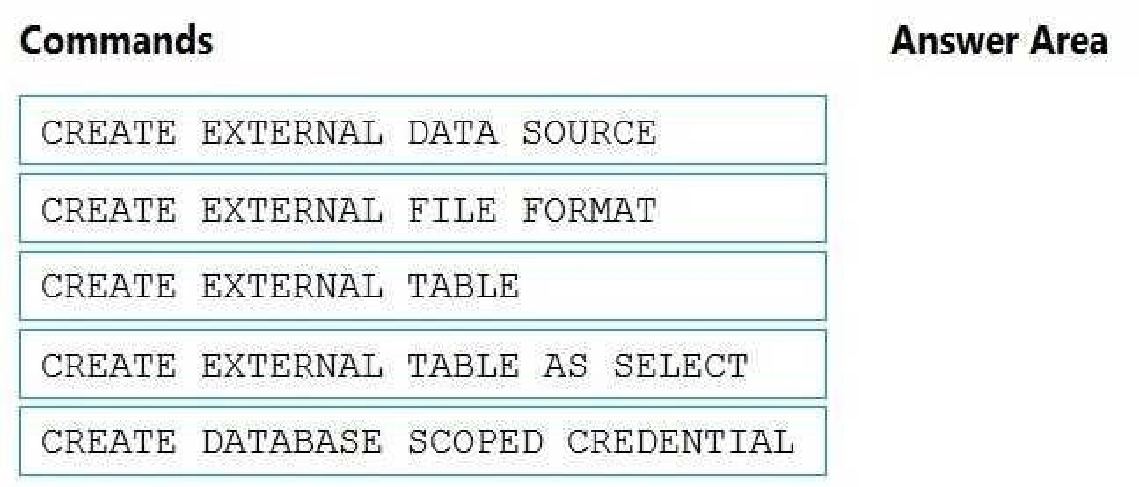
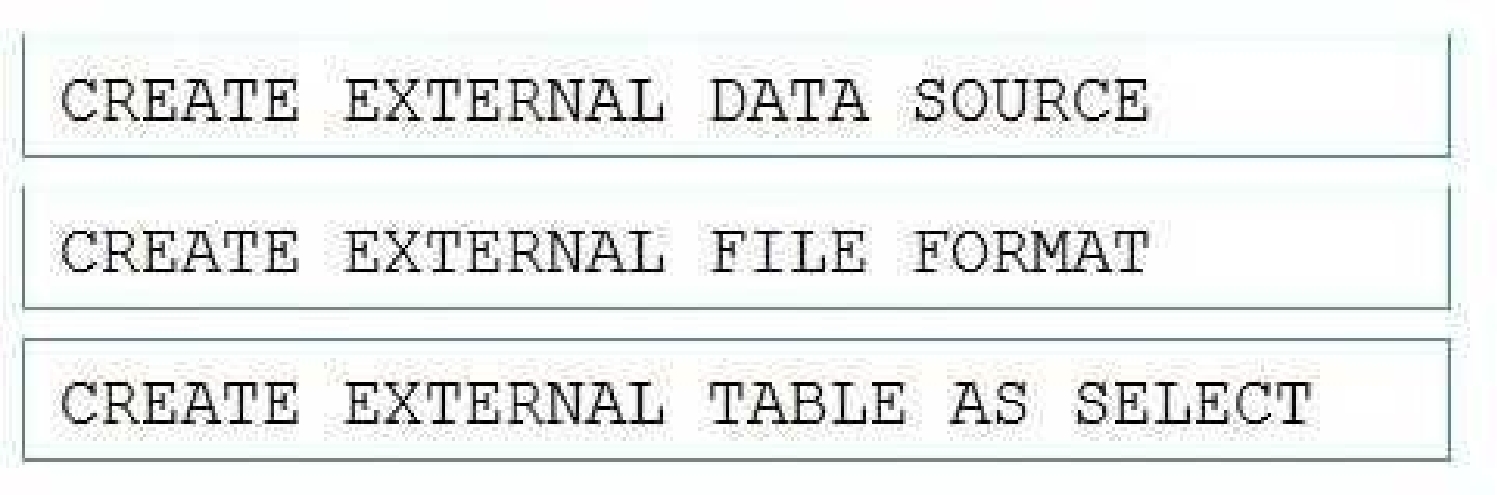
Scenario: Allow Contoso users to use PolyBase in an Azure Synapse Analytics dedicated SQL pool to
query the content of the data records that host the Twitter feeds. Data must be protected by using
row-level security (RLS). The users must be authenticated by using their own Azure AD credentials.
Box 1: CREATE EXTERNAL DATA SOURCE
External data sources are used to connect to storage accounts.
Box 2: CREATE EXTERNAL FILE FORMAT
CREATE EXTERNAL FILE FORMAT creates an external file format object that defines external data
stored in Azure Blob Storage or Azure Data Lake Storage. Creating an external file format is a
prerequisite for creating an external table.
Box 3: CREATE EXTERNAL TABLE AS SELECT
When used in conjunction with the CREATE TABLE AS SELECT statement, selecting from an external
table imports data into a table within the SQL pool. In addition to the COPY statement, external
tables are useful for loading data.
Reference:
[https://docs.microsoft.com/en-us/azure/synapse-analytics/sql/develop-tables-external-tables](https://docs.microsoft.com/en-us/azure/synapse-analytics/sql/develop-tables-external-tables)
Quiz
Transactional Date
Contoso has three years of customer, transactional, operation, sourcing, and supplier data comprised
of 10 billion records stored across multiple on-premises Microsoft SQL Server servers. The SQL server
instances contain data from various operational systems. The data is loaded into the instances by
using SQL server integration Services (SSIS) packages.
You estimate that combining all product sales transactions into a company-wide sales transactions
dataset will result in a single table that contains 5 billion rows, with one row per transaction.
Most queries targeting the sales transactions data will be used to identify which products were sold
in retail stores and which products were sold online during different time period. Sales transaction
data that is older than three years will be removed monthly.
You plan to create a retail store table that will contain the address of each retail store. The table will
be approximately 2 MB. Queries for retail store sales will include the retail store addresses.
You plan to create a promotional table that will contain a promotion ID. The promotion ID will be
associated to a specific product. The product will be identified by a product ID. The table will be
approximately 5 GB.
Streaming Twitter Data
The ecommerce department at Contoso develops and Azure logic app that captures trending Twitter
feeds referencing the company’s products and pushes the products to Azure Event Hubs.
Planned Changes
Contoso plans to implement the following changes:
* Load the sales transaction dataset to Azure Synapse Analytics.
* Integrate on-premises data stores with Azure Synapse Analytics by using SSIS packages.
* Use Azure Synapse Analytics to analyze Twitter feeds to assess customer sentiments about
products.
Sales Transaction Dataset Requirements
Contoso identifies the following requirements for the sales transaction dataset:
• Partition data that contains sales transaction records. Partitions must be designed to provide
efficient loads by month. Boundary values must belong: to the partition on the right.
• Ensure that queries joining and filtering sales transaction records based on product ID complete as
quickly as possible.
• Implement a surrogate key to account for changes to the retail store addresses.
• Ensure that data storage costs and performance are predictable.
• Minimize how long it takes to remove old records.
Customer Sentiment Analytics Requirement
Contoso identifies the following requirements for customer sentiment analytics:
• Allow Contoso users to use PolyBase in an A/ure Synapse Analytics dedicated SQL pool to query
the content of the data records that host the Twitter feeds. Data must be protected by using row-
level security (RLS). The users must be authenticated by using their own A/ureAD credentials.
• Maximize the throughput of ingesting Twitter feeds from Event Hubs to Azure Storage without
purchasing additional throughput or capacity units.
• Store Twitter feeds in Azure Storage by using Event Hubs Capture. The feeds will be converted into
Parquet files.
• Ensure that the data store supports Azure AD-based access control down to the object level.
• Minimize administrative effort to maintain the Twitter feed data records.
• Purge Twitter feed data records;itftaitJ are older than two years.
Data Integration Requirements
Contoso identifies the following requirements for data integration:
Use an Azure service that leverages the existing SSIS packages to ingest on-premises data into
datasets stored in a dedicated SQL pool of Azure Synaps Analytics and transform the data.
Identify a process to ensure that changes to the ingestion and transformation activities can be
version controlled and developed independently by multiple data engineers.
meet the sales transaction dataset requirements.
What should you include in the solution? To answer, select the appropriate options in the answer
area.
NOTE: Each correct selection is worth one point.
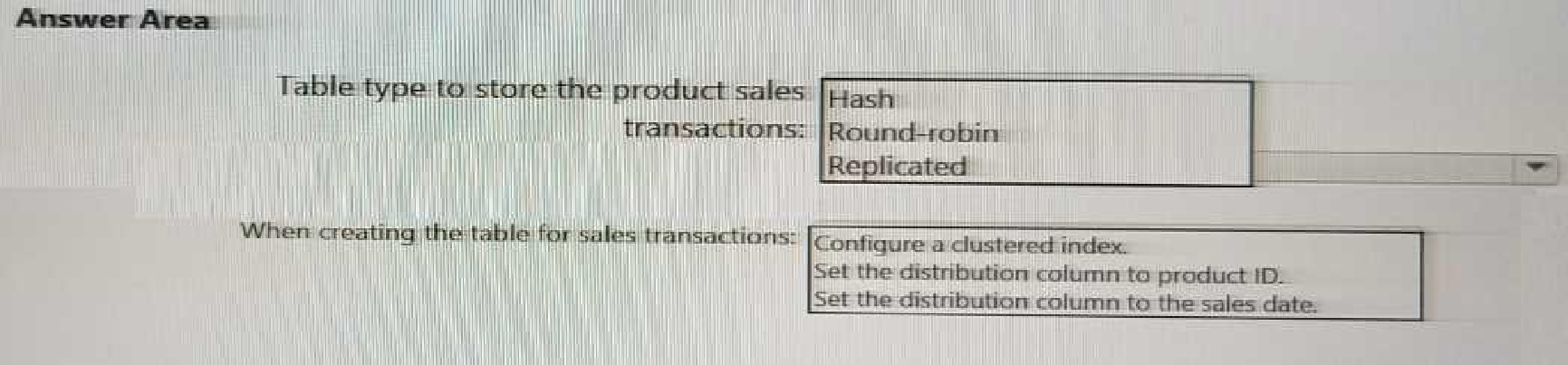
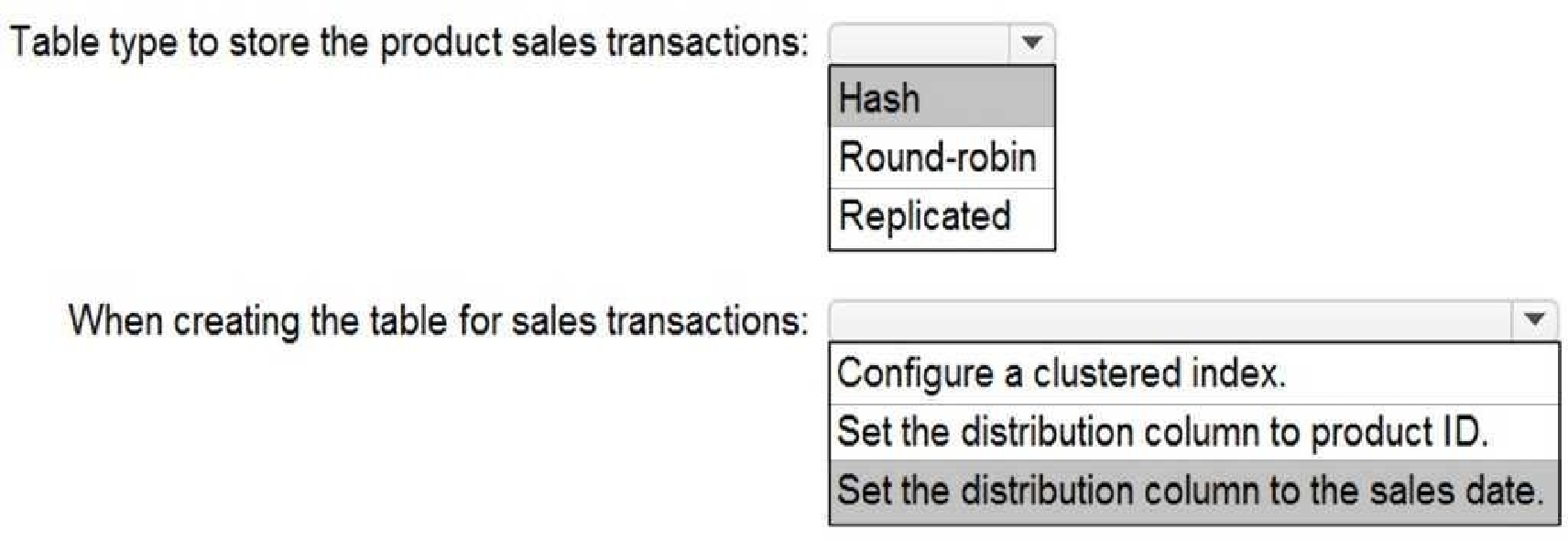
Box 1: Hash
Scenario:
Ensure that queries joining and filtering sales transaction records based on product ID complete as
quickly as possible.
A hash distributed table can deliver the highest query performance for joins and aggregations on
large tables.
Box 2: Set the distribution column to the sales date.
Scenario: Partition data that contains sales transaction records. Partitions must be designed to
provide efficient loads by month. Boundary values must belong to the partition on the right.
Reference:
[https://rajanieshkaushikk.com/2020/09/09/how-to-choose-right-data-distribution-strategy-for-](https://rajanieshkaushikk.com/2020/09/09/how-to-choose-right-data-distribution-strategy-for-)
azure-synapse/
Quiz
Transactional Date
Contoso has three years of customer, transactional, operation, sourcing, and supplier data comprised
of 10 billion records stored across multiple on-premises Microsoft SQL Server servers. The SQL server
instances contain data from various operational systems. The data is loaded into the instances by
using SQL server integration Services (SSIS) packages.
You estimate that combining all product sales transactions into a company-wide sales transactions
dataset will result in a single table that contains 5 billion rows, with one row per transaction.
Most queries targeting the sales transactions data will be used to identify which products were sold
in retail stores and which products were sold online during different time period. Sales transaction
data that is older than three years will be removed monthly.
You plan to create a retail store table that will contain the address of each retail store. The table will
be approximately 2 MB. Queries for retail store sales will include the retail store addresses.
You plan to create a promotional table that will contain a promotion ID. The promotion ID will be
associated to a specific product. The product will be identified by a product ID. The table will be
approximately 5 GB.
Streaming Twitter Data
The ecommerce department at Contoso develops and Azure logic app that captures trending Twitter
feeds referencing the company’s products and pushes the products to Azure Event Hubs.
Planned Changes
Contoso plans to implement the following changes:
* Load the sales transaction dataset to Azure Synapse Analytics.
* Integrate on-premises data stores with Azure Synapse Analytics by using SSIS packages.
* Use Azure Synapse Analytics to analyze Twitter feeds to assess customer sentiments about
products.
Sales Transaction Dataset Requirements
Contoso identifies the following requirements for the sales transaction dataset:
• Partition data that contains sales transaction records. Partitions must be designed to provide
efficient loads by month. Boundary values must belong: to the partition on the right.
• Ensure that queries joining and filtering sales transaction records based on product ID complete as
quickly as possible.
• Implement a surrogate key to account for changes to the retail store addresses.
• Ensure that data storage costs and performance are predictable.
• Minimize how long it takes to remove old records.
Customer Sentiment Analytics Requirement
Contoso identifies the following requirements for customer sentiment analytics:
• Allow Contoso users to use PolyBase in an A/ure Synapse Analytics dedicated SQL pool to query
the content of the data records that host the Twitter feeds. Data must be protected by using row-
level security (RLS). The users must be authenticated by using their own A/ureAD credentials.
• Maximize the throughput of ingesting Twitter feeds from Event Hubs to Azure Storage without
purchasing additional throughput or capacity units.
• Store Twitter feeds in Azure Storage by using Event Hubs Capture. The feeds will be converted into
Parquet files.
• Ensure that the data store supports Azure AD-based access control down to the object level.
• Minimize administrative effort to maintain the Twitter feed data records.
• Purge Twitter feed data records;itftaitJ are older than two years.
Data Integration Requirements
Contoso identifies the following requirements for data integration:
Use an Azure service that leverages the existing SSIS packages to ingest on-premises data into
datasets stored in a dedicated SQL pool of Azure Synaps Analytics and transform the data.
Identify a process to ensure that changes to the ingestion and transformation activities can be
version controlled and developed independently by multiple data engineers.
transaction dataset requirements.
What should you include in the solution? To answer, select the appropriate options in the answer
area.
NOTE: Each correct selection is worth one point.
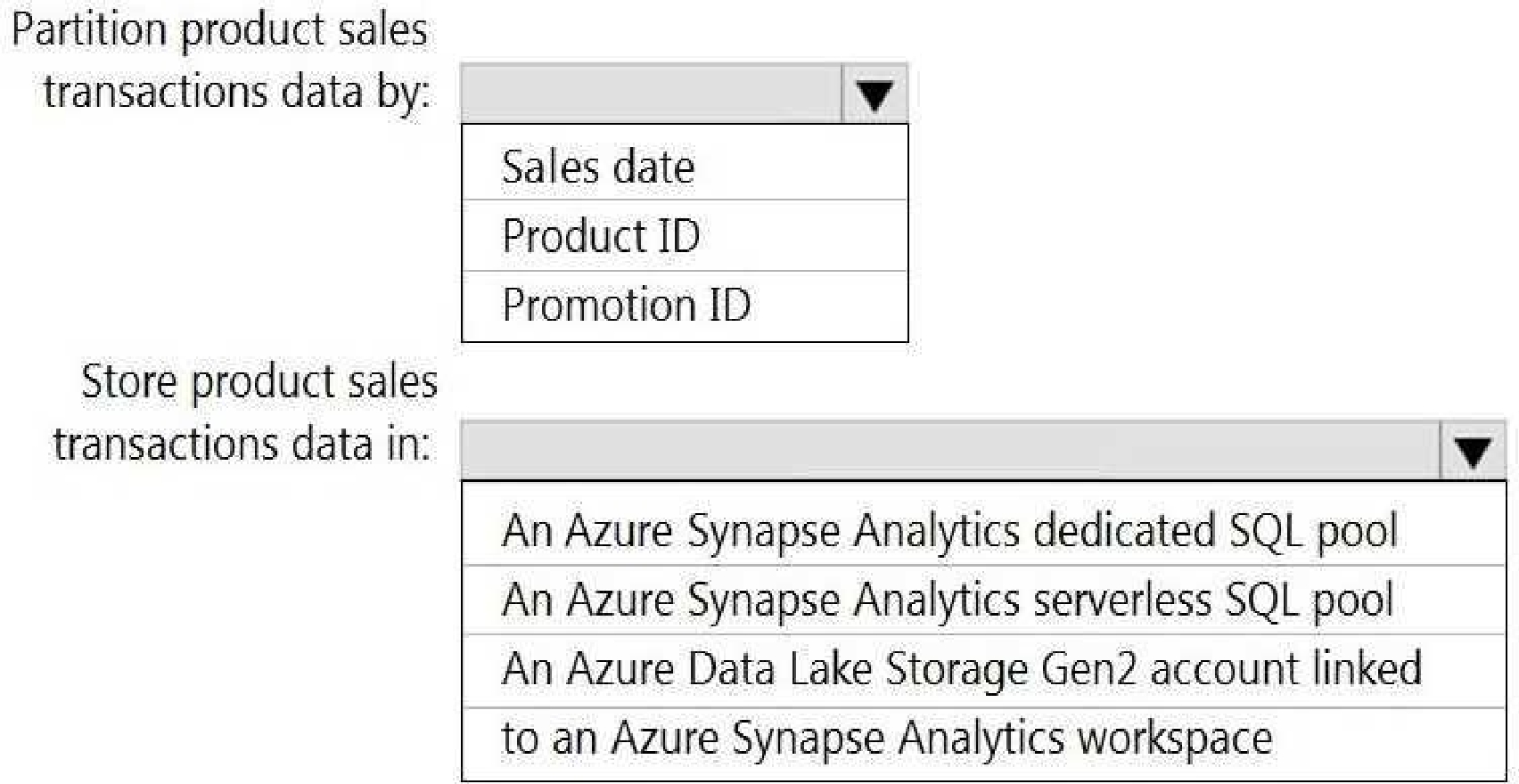
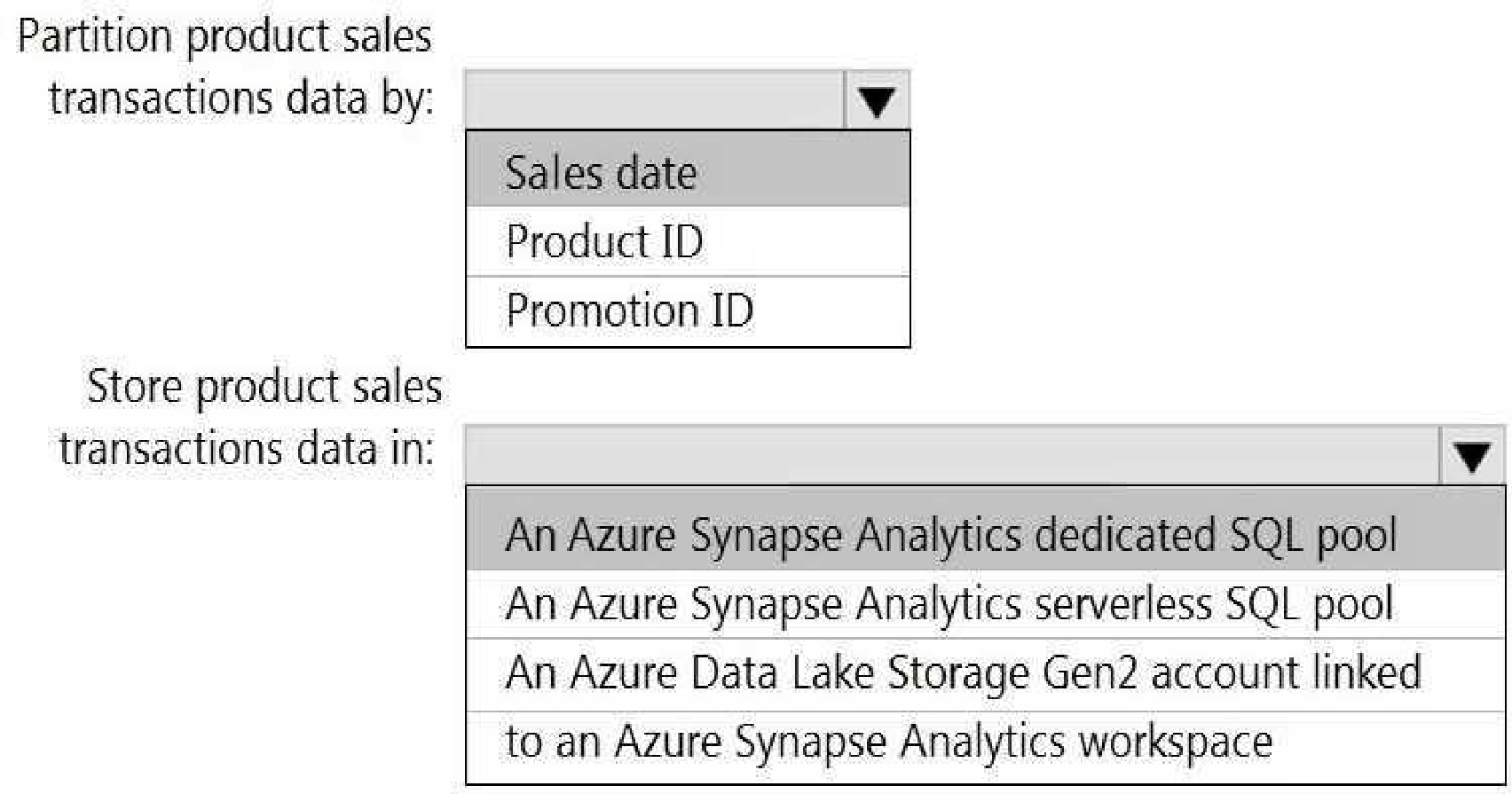
Box 1: Sales date
Scenario: Contoso requirements for data integration include:
Partition data that contains sales transaction records. Partitions must be designed to provide efficient
loads by month. Boundary values must belong to the partition on the right.
Box 2: An Azure Synapse Analytics Dedicated SQL pool
Scenario: Contoso requirements for data integration include:
Ensure that data storage costs and performance are predictable.
The size of a dedicated SQL pool (formerly SQL DW) is determined by Data Warehousing Units
(DWU).
Dedicated SQL pool (formerly SQL DW) stores data in relational tables with columnar storage. This
format significantly reduces the data storage costs, and improves query performance.
Synapse analytics dedicated sql pool
Reference:
[https://docs.microsoft.com/en-us/azure/synapse-analytics/sql-data-warehouse/sql-data-warehouse-](https://docs.microsoft.com/en-us/azure/synapse-analytics/sql-data-warehouse/sql-data-warehouse-)
overview-what-is
Quiz
Transactional Date
Contoso has three years of customer, transactional, operation, sourcing, and supplier data comprised
of 10 billion records stored across multiple on-premises Microsoft SQL Server servers. The SQL server
instances contain data from various operational systems. The data is loaded into the instances by
using SQL server integration Services (SSIS) packages.
You estimate that combining all product sales transactions into a company-wide sales transactions
dataset will result in a single table that contains 5 billion rows, with one row per transaction.
Most queries targeting the sales transactions data will be used to identify which products were sold
in retail stores and which products were sold online during different time period. Sales transaction
data that is older than three years will be removed monthly.
You plan to create a retail store table that will contain the address of each retail store. The table will
be approximately 2 MB. Queries for retail store sales will include the retail store addresses.
You plan to create a promotional table that will contain a promotion ID. The promotion ID will be
associated to a specific product. The product will be identified by a product ID. The table will be
approximately 5 GB.
Streaming Twitter Data
The ecommerce department at Contoso develops and Azure logic app that captures trending Twitter
feeds referencing the company’s products and pushes the products to Azure Event Hubs.
Planned Changes
Contoso plans to implement the following changes:
* Load the sales transaction dataset to Azure Synapse Analytics.
* Integrate on-premises data stores with Azure Synapse Analytics by using SSIS packages.
* Use Azure Synapse Analytics to analyze Twitter feeds to assess customer sentiments about
products.
Sales Transaction Dataset Requirements
Contoso identifies the following requirements for the sales transaction dataset:
• Partition data that contains sales transaction records. Partitions must be designed to provide
efficient loads by month. Boundary values must belong: to the partition on the right.
• Ensure that queries joining and filtering sales transaction records based on product ID complete as
quickly as possible.
• Implement a surrogate key to account for changes to the retail store addresses.
• Ensure that data storage costs and performance are predictable.
• Minimize how long it takes to remove old records.
Customer Sentiment Analytics Requirement
Contoso identifies the following requirements for customer sentiment analytics:
• Allow Contoso users to use PolyBase in an A/ure Synapse Analytics dedicated SQL pool to query
the content of the data records that host the Twitter feeds. Data must be protected by using row-
level security (RLS). The users must be authenticated by using their own A/ureAD credentials.
• Maximize the throughput of ingesting Twitter feeds from Event Hubs to Azure Storage without
purchasing additional throughput or capacity units.
• Store Twitter feeds in Azure Storage by using Event Hubs Capture. The feeds will be converted into
Parquet files.
• Ensure that the data store supports Azure AD-based access control down to the object level.
• Minimize administrative effort to maintain the Twitter feed data records.
• Purge Twitter feed data records;itftaitJ are older than two years.
Data Integration Requirements
Contoso identifies the following requirements for data integration:
Use an Azure service that leverages the existing SSIS packages to ingest on-premises data into
datasets stored in a dedicated SQL pool of Azure Synaps Analytics and transform the data.
Identify a process to ensure that changes to the ingestion and transformation activities can be
version controlled and developed independently by multiple data engineers.
dat
a. The solution must meet the sales transaction dataset requirements.
What solution must meet the sales transaction dataset requirements.
What should you do? To answer, select the appropriate options in the answer area.
NOTE: Each correct selection is worth one point.
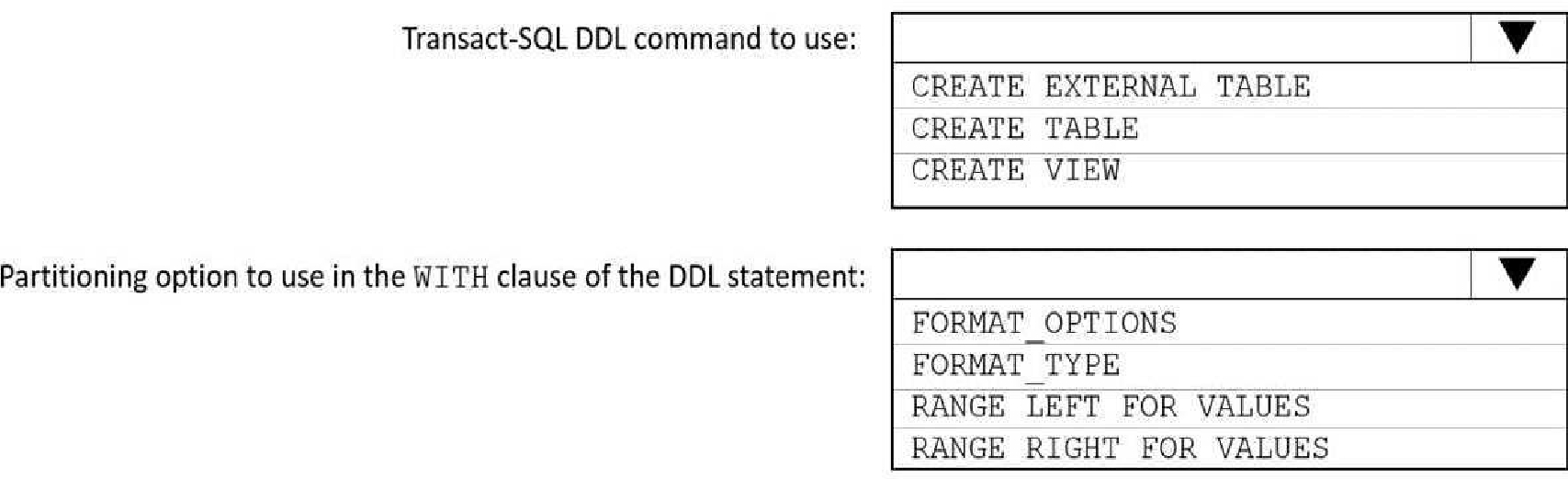
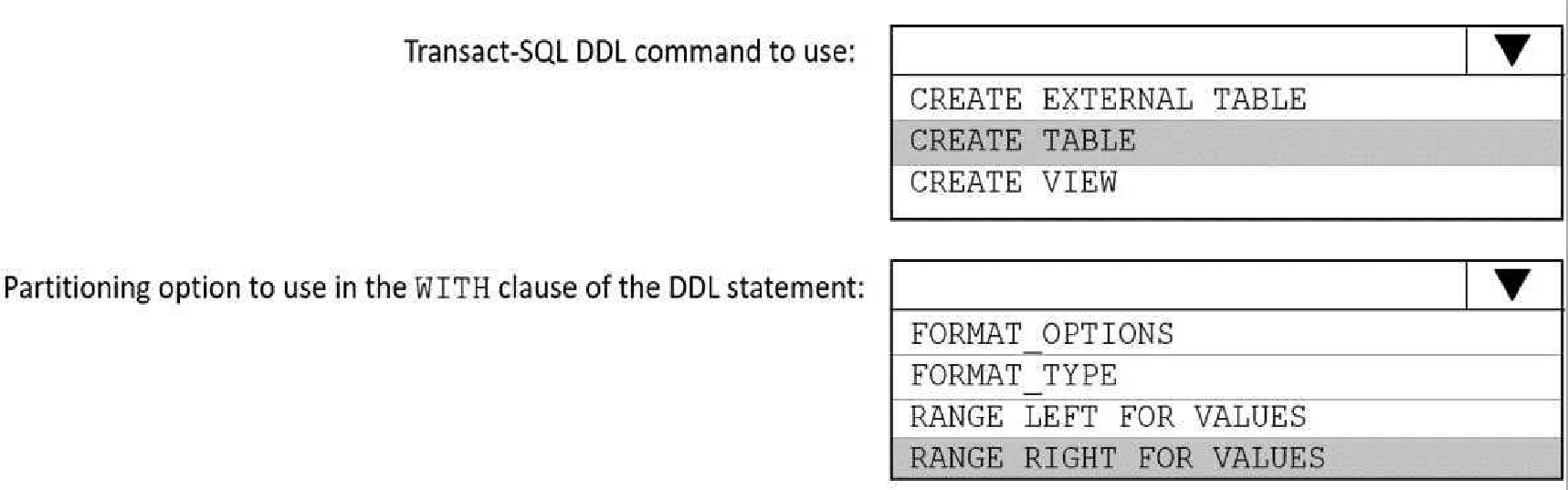
Box 1: Create table
Scenario: Load the sales transaction dataset to Azure Synapse Analytics
Box 2: RANGE RIGHT FOR VALUES
Scenario: Partition data that contains sales transaction records. Partitions must be designed to
provide efficient loads by month. Boundary values must belong to the partition on the right.
RANGE RIGHT: Specifies the boundary value belongs to the partition on the right (higher values).
FOR VALUES ( boundary_value [,...n] ): Specifies the boundary values for the partition.
Scenario: Load the sales transaction dataset to Azure Synapse Analytics.
Contoso identifies the following requirements for the sales transaction dataset:
Partition data that contains sales transaction records. Partitions must be designed to provide efficient
loads by month. Boundary values must belong to the partition on the right.
Ensure that queries joining and filtering sales transaction records based on product ID complete as
quickly as possible.
Implement a surrogate key to account for changes to the retail store addresses.
Ensure that data storage costs and performance are predictable.
Minimize how long it takes to remove old records.
Reference:
[https://docs.microsoft.com/en-us/sql/t-sql/statements/create-table-azure-sql-data-warehouse](https://docs.microsoft.com/en-us/sql/t-sql/statements/create-table-azure-sql-data-warehouse)
Quiz
Transactional Date
Contoso has three years of customer, transactional, operation, sourcing, and supplier data comprised
of 10 billion records stored across multiple on-premises Microsoft SQL Server servers. The SQL server
instances contain data from various operational systems. The data is loaded into the instances by
using SQL server integration Services (SSIS) packages.
You estimate that combining all product sales transactions into a company-wide sales transactions
dataset will result in a single table that contains 5 billion rows, with one row per transaction.
Most queries targeting the sales transactions data will be used to identify which products were sold
in retail stores and which products were sold online during different time period. Sales transaction
data that is older than three years will be removed monthly.
You plan to create a retail store table that will contain the address of each retail store. The table will
be approximately 2 MB. Queries for retail store sales will include the retail store addresses.
You plan to create a promotional table that will contain a promotion ID. The promotion ID will be
associated to a specific product. The product will be identified by a product ID. The table will be
approximately 5 GB.
Streaming Twitter Data
The ecommerce department at Contoso develops and Azure logic app that captures trending Twitter
feeds referencing the company’s products and pushes the products to Azure Event Hubs.
Planned Changes
Contoso plans to implement the following changes:
* Load the sales transaction dataset to Azure Synapse Analytics.
* Integrate on-premises data stores with Azure Synapse Analytics by using SSIS packages.
* Use Azure Synapse Analytics to analyze Twitter feeds to assess customer sentiments about
products.
Sales Transaction Dataset Requirements
Contoso identifies the following requirements for the sales transaction dataset:
• Partition data that contains sales transaction records. Partitions must be designed to provide
efficient loads by month. Boundary values must belong: to the partition on the right.
• Ensure that queries joining and filtering sales transaction records based on product ID complete as
quickly as possible.
• Implement a surrogate key to account for changes to the retail store addresses.
• Ensure that data storage costs and performance are predictable.
• Minimize how long it takes to remove old records.
Customer Sentiment Analytics Requirement
Contoso identifies the following requirements for customer sentiment analytics:
• Allow Contoso users to use PolyBase in an A/ure Synapse Analytics dedicated SQL pool to query
the content of the data records that host the Twitter feeds. Data must be protected by using row-
level security (RLS). The users must be authenticated by using their own A/ureAD credentials.
• Maximize the throughput of ingesting Twitter feeds from Event Hubs to Azure Storage without
purchasing additional throughput or capacity units.
• Store Twitter feeds in Azure Storage by using Event Hubs Capture. The feeds will be converted into
Parquet files.
• Ensure that the data store supports Azure AD-based access control down to the object level.
• Minimize administrative effort to maintain the Twitter feed data records.
• Purge Twitter feed data records;itftaitJ are older than two years.
Data Integration Requirements
Contoso identifies the following requirements for data integration:
Use an Azure service that leverages the existing SSIS packages to ingest on-premises data into
datasets stored in a dedicated SQL pool of Azure Synaps Analytics and transform the data.
Identify a process to ensure that changes to the ingestion and transformation activities can be
version controlled and developed independently by multiple data engineers.
transaction
dataset requirements.
What should you create?
Quiz
Transactional Date
Contoso has three years of customer, transactional, operation, sourcing, and supplier data comprised
of 10 billion records stored across multiple on-premises Microsoft SQL Server servers. The SQL server
instances contain data from various operational systems. The data is loaded into the instances by
using SQL server integration Services (SSIS) packages.
You estimate that combining all product sales transactions into a company-wide sales transactions
dataset will result in a single table that contains 5 billion rows, with one row per transaction.
Most queries targeting the sales transactions data will be used to identify which products were sold
in retail stores and which products were sold online during different time period. Sales transaction
data that is older than three years will be removed monthly.
You plan to create a retail store table that will contain the address of each retail store. The table will
be approximately 2 MB. Queries for retail store sales will include the retail store addresses.
You plan to create a promotional table that will contain a promotion ID. The promotion ID will be
associated to a specific product. The product will be identified by a product ID. The table will be
approximately 5 GB.
Streaming Twitter Data
The ecommerce department at Contoso develops and Azure logic app that captures trending Twitter
feeds referencing the company’s products and pushes the products to Azure Event Hubs.
Planned Changes
Contoso plans to implement the following changes:
* Load the sales transaction dataset to Azure Synapse Analytics.
* Integrate on-premises data stores with Azure Synapse Analytics by using SSIS packages.
* Use Azure Synapse Analytics to analyze Twitter feeds to assess customer sentiments about
products.
Sales Transaction Dataset Requirements
Contoso identifies the following requirements for the sales transaction dataset:
• Partition data that contains sales transaction records. Partitions must be designed to provide
efficient loads by month. Boundary values must belong: to the partition on the right.
• Ensure that queries joining and filtering sales transaction records based on product ID complete as
quickly as possible.
• Implement a surrogate key to account for changes to the retail store addresses.
• Ensure that data storage costs and performance are predictable.
• Minimize how long it takes to remove old records.
Customer Sentiment Analytics Requirement
Contoso identifies the following requirements for customer sentiment analytics:
• Allow Contoso users to use PolyBase in an A/ure Synapse Analytics dedicated SQL pool to query
the content of the data records that host the Twitter feeds. Data must be protected by using row-
level security (RLS). The users must be authenticated by using their own A/ureAD credentials.
• Maximize the throughput of ingesting Twitter feeds from Event Hubs to Azure Storage without
purchasing additional throughput or capacity units.
• Store Twitter feeds in Azure Storage by using Event Hubs Capture. The feeds will be converted into
Parquet files.
• Ensure that the data store supports Azure AD-based access control down to the object level.
• Minimize administrative effort to maintain the Twitter feed data records.
• Purge Twitter feed data records;itftaitJ are older than two years.
Data Integration Requirements
Contoso identifies the following requirements for data integration:
Use an Azure service that leverages the existing SSIS packages to ingest on-premises data into
datasets stored in a dedicated SQL pool of Azure Synaps Analytics and transform the data.
Identify a process to ensure that changes to the ingestion and transformation activities can be
version controlled and developed independently by multiple data engineers.
a. The solution must meet the sales transaction dataset requirements.
What should you include in the solution? To answer, select the appropriate options in the answer
area.
NOTE: Each correct selection is worth one point.
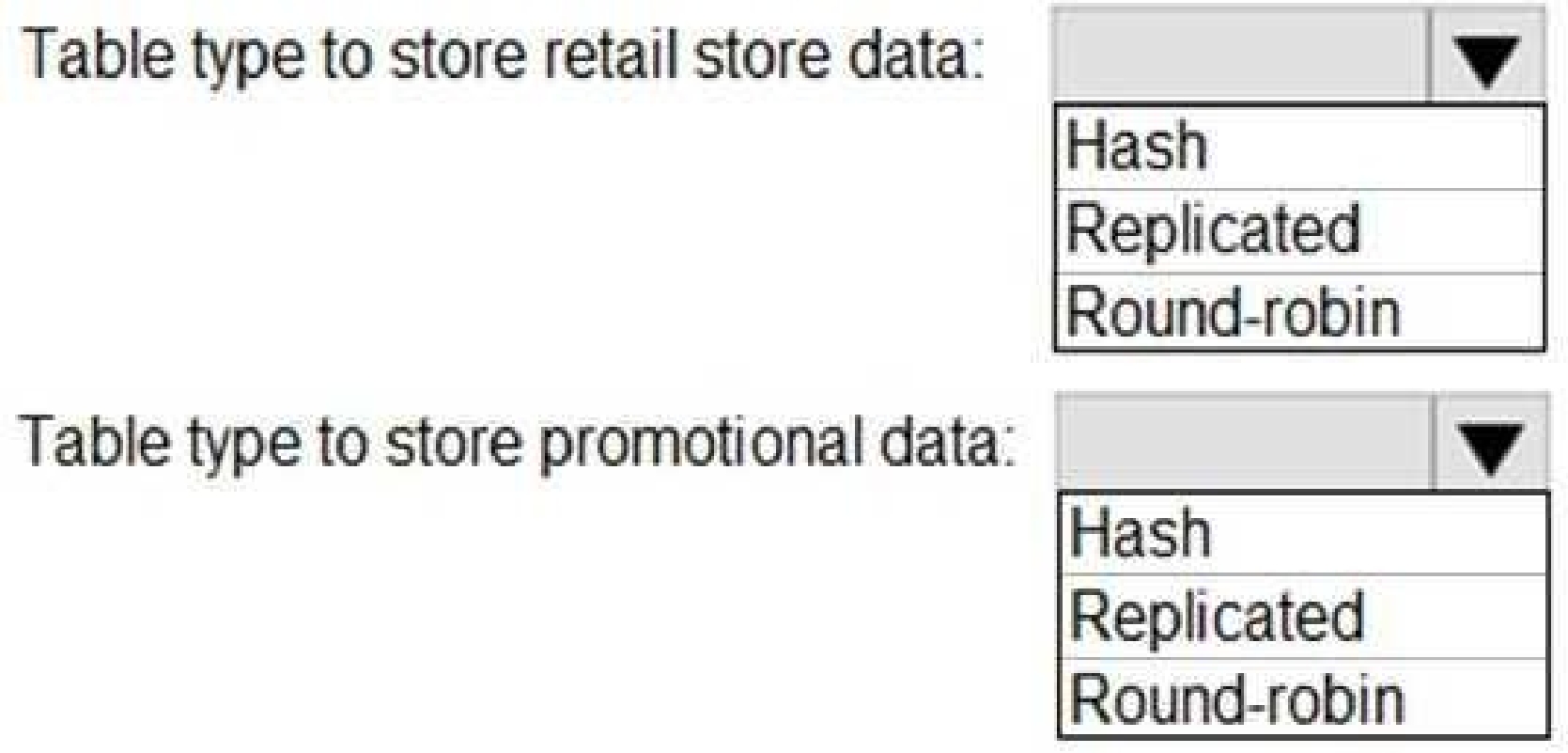
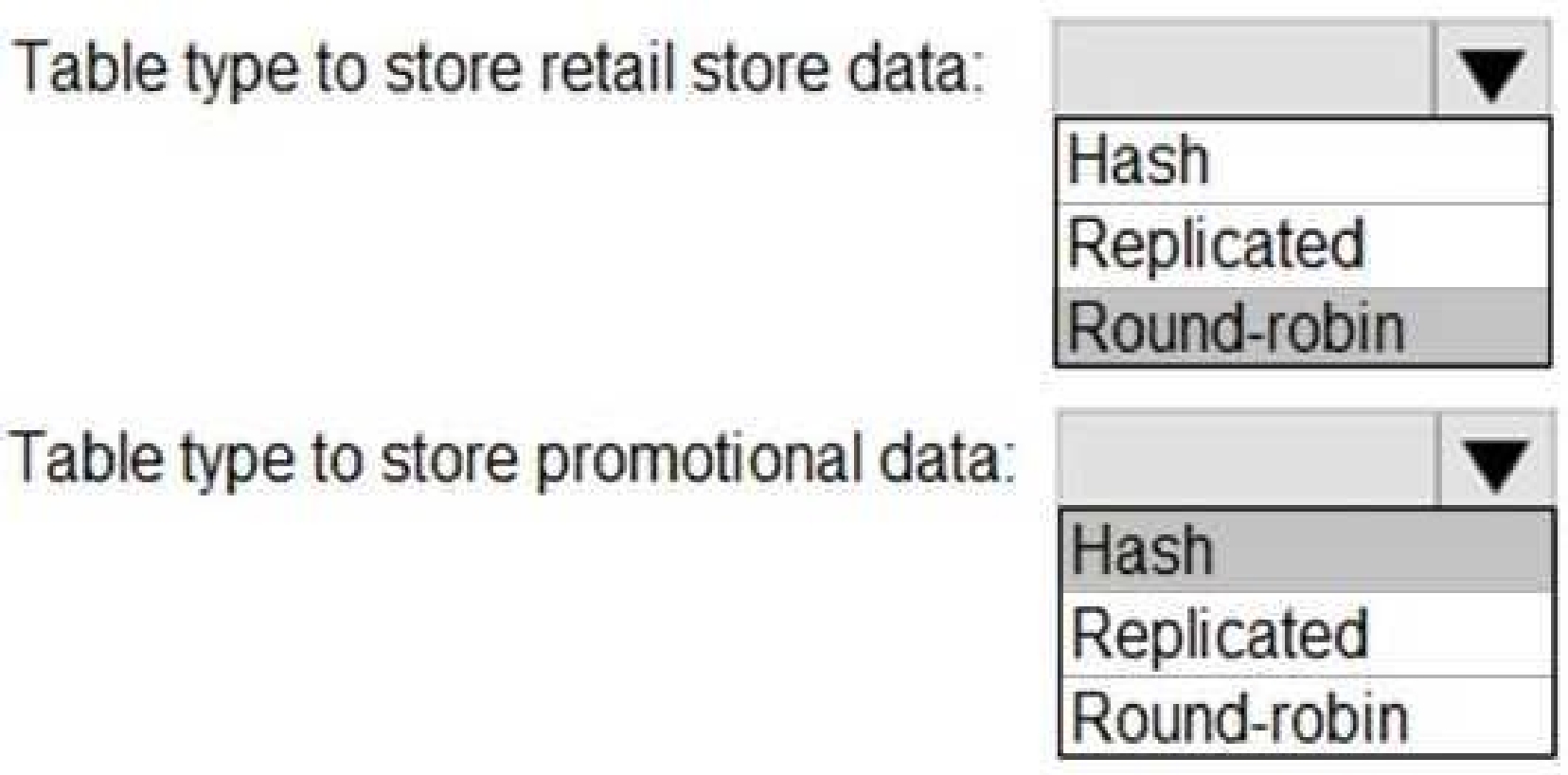
Box 1: Round-robin
Round-robin tables are useful for improving loading speed.
Scenario: Partition data that contains sales transaction records. Partitions must be designed to
provide efficient loads by month.
Box 2: Hash
Hash-distributed tables improve query performance on large fact tables.
Reference:
[https://docs.microsoft.com/en-us/azure/synapse-analytics/sql-data-warehouse/sql-data-warehouse-](https://docs.microsoft.com/en-us/azure/synapse-analytics/sql-data-warehouse/sql-data-warehouse-)
tables-distribute
Quiz
Transactional Date
Contoso has three years of customer, transactional, operation, sourcing, and supplier data comprised
of 10 billion records stored across multiple on-premises Microsoft SQL Server servers. The SQL server
instances contain data from various operational systems. The data is loaded into the instances by
using SQL server integration Services (SSIS) packages.
You estimate that combining all product sales transactions into a company-wide sales transactions
dataset will result in a single table that contains 5 billion rows, with one row per transaction.
Most queries targeting the sales transactions data will be used to identify which products were sold
in retail stores and which products were sold online during different time period. Sales transaction
data that is older than three years will be removed monthly.
You plan to create a retail store table that will contain the address of each retail store. The table will
be approximately 2 MB. Queries for retail store sales will include the retail store addresses.
You plan to create a promotional table that will contain a promotion ID. The promotion ID will be
associated to a specific product. The product will be identified by a product ID. The table will be
approximately 5 GB.
Streaming Twitter Data
The ecommerce department at Contoso develops and Azure logic app that captures trending Twitter
feeds referencing the company’s products and pushes the products to Azure Event Hubs.
Planned Changes
Contoso plans to implement the following changes:
* Load the sales transaction dataset to Azure Synapse Analytics.
* Integrate on-premises data stores with Azure Synapse Analytics by using SSIS packages.
* Use Azure Synapse Analytics to analyze Twitter feeds to assess customer sentiments about
products.
Sales Transaction Dataset Requirements
Contoso identifies the following requirements for the sales transaction dataset:
• Partition data that contains sales transaction records. Partitions must be designed to provide
efficient loads by month. Boundary values must belong: to the partition on the right.
• Ensure that queries joining and filtering sales transaction records based on product ID complete as
quickly as possible.
• Implement a surrogate key to account for changes to the retail store addresses.
• Ensure that data storage costs and performance are predictable.
• Minimize how long it takes to remove old records.
Customer Sentiment Analytics Requirement
Contoso identifies the following requirements for customer sentiment analytics:
• Allow Contoso users to use PolyBase in an A/ure Synapse Analytics dedicated SQL pool to query
the content of the data records that host the Twitter feeds. Data must be protected by using row-
level security (RLS). The users must be authenticated by using their own A/ureAD credentials.
• Maximize the throughput of ingesting Twitter feeds from Event Hubs to Azure Storage without
purchasing additional throughput or capacity units.
• Store Twitter feeds in Azure Storage by using Event Hubs Capture. The feeds will be converted into
Parquet files.
• Ensure that the data store supports Azure AD-based access control down to the object level.
• Minimize administrative effort to maintain the Twitter feed data records.
• Purge Twitter feed data records;itftaitJ are older than two years.
Data Integration Requirements
Contoso identifies the following requirements for data integration:
Use an Azure service that leverages the existing SSIS packages to ingest on-premises data into
datasets stored in a dedicated SQL pool of Azure Synaps Analytics and transform the data.
Identify a process to ensure that changes to the ingestion and transformation activities can be
version controlled and developed independently by multiple data engineers.
meet the customer sentiment analytics requirements.
Which Azure Storage functionality should you include in the solution?
Quiz
Transactional Date
Contoso has three years of customer, transactional, operation, sourcing, and supplier data comprised
of 10 billion records stored across multiple on-premises Microsoft SQL Server servers. The SQL server
instances contain data from various operational systems. The data is loaded into the instances by
using SQL server integration Services (SSIS) packages.
You estimate that combining all product sales transactions into a company-wide sales transactions
dataset will result in a single table that contains 5 billion rows, with one row per transaction.
Most queries targeting the sales transactions data will be used to identify which products were sold
in retail stores and which products were sold online during different time period. Sales transaction
data that is older than three years will be removed monthly.
You plan to create a retail store table that will contain the address of each retail store. The table will
be approximately 2 MB. Queries for retail store sales will include the retail store addresses.
You plan to create a promotional table that will contain a promotion ID. The promotion ID will be
associated to a specific product. The product will be identified by a product ID. The table will be
approximately 5 GB.
Streaming Twitter Data
The ecommerce department at Contoso develops and Azure logic app that captures trending Twitter
feeds referencing the company’s products and pushes the products to Azure Event Hubs.
Planned Changes
Contoso plans to implement the following changes:
* Load the sales transaction dataset to Azure Synapse Analytics.
* Integrate on-premises data stores with Azure Synapse Analytics by using SSIS packages.
* Use Azure Synapse Analytics to analyze Twitter feeds to assess customer sentiments about
products.
Sales Transaction Dataset Requirements
Contoso identifies the following requirements for the sales transaction dataset:
• Partition data that contains sales transaction records. Partitions must be designed to provide
efficient loads by month. Boundary values must belong: to the partition on the right.
• Ensure that queries joining and filtering sales transaction records based on product ID complete as
quickly as possible.
• Implement a surrogate key to account for changes to the retail store addresses.
• Ensure that data storage costs and performance are predictable.
• Minimize how long it takes to remove old records.
Customer Sentiment Analytics Requirement
Contoso identifies the following requirements for customer sentiment analytics:
• Allow Contoso users to use PolyBase in an A/ure Synapse Analytics dedicated SQL pool to query
the content of the data records that host the Twitter feeds. Data must be protected by using row-
level security (RLS). The users must be authenticated by using their own A/ureAD credentials.
• Maximize the throughput of ingesting Twitter feeds from Event Hubs to Azure Storage without
purchasing additional throughput or capacity units.
• Store Twitter feeds in Azure Storage by using Event Hubs Capture. The feeds will be converted into
Parquet files.
• Ensure that the data store supports Azure AD-based access control down to the object level.
• Minimize administrative effort to maintain the Twitter feed data records.
• Purge Twitter feed data records;itftaitJ are older than two years.
Data Integration Requirements
Contoso identifies the following requirements for data integration:
Use an Azure service that leverages the existing SSIS packages to ingest on-premises data into
datasets stored in a dedicated SQL pool of Azure Synaps Analytics and transform the data.
Identify a process to ensure that changes to the ingestion and transformation activities can be
version controlled and developed independently by multiple data engineers.
meet the customer sentiment analytics requirements.
What should you include in the solution? To answer, select the appropriate options in the answer
area
NOTE: Each correct selection b worth one point.
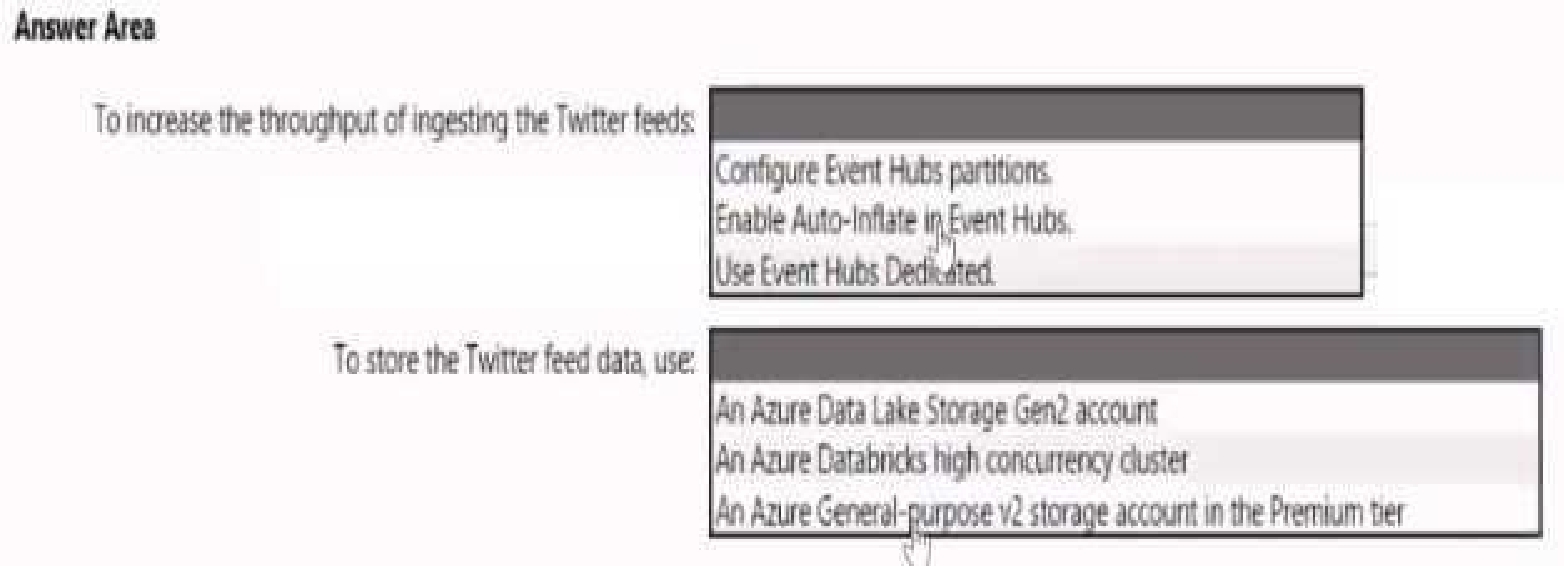
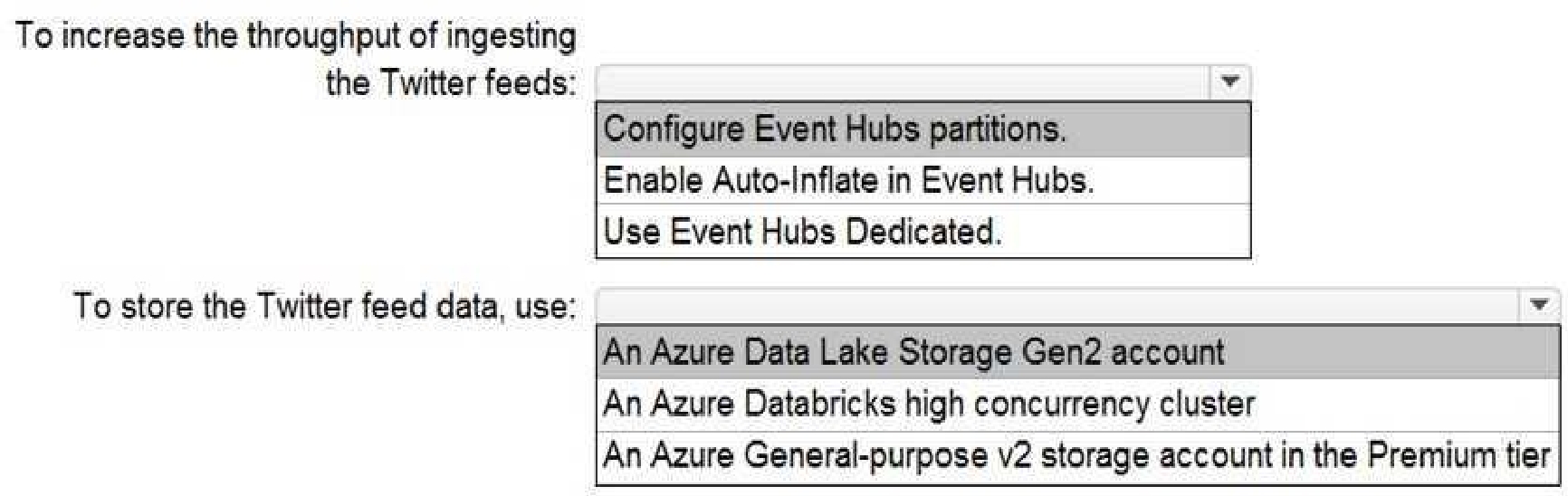
Box 1: Configure Evegent Hubs partitions
Scenario: Maximize the throughput of ingesting Twitter feeds from Event Hubs to Azure Storage
without purchasing additional throughput or capacity units.
Event Hubs is designed to help with processing of large volumes of events. Event Hubs throughput is
scaled by using partitions and throughput-unit allocations.
Event Hubs traffic is controlled by TUs (standard tier). Auto-inflate enables you to start small with
the minimum required TUs you choose. The feature then scales automatically to the maximum limit
of TUs you need, depending on the increase in your traffic.
Box 2: An Azure Data Lake Storage Gen2 account
Scenario: Ensure that the data store supports Azure AD-based access control down to the object
level.
Azure Data Lake Storage Gen2 implements an access control model that supports both Azure role-
based access control (Azure RBAC) and POSIX-like access control lists (ACLs).
Reference:
[https://docs.microsoft.com/en-us/azure/event-hubs/event-hubs-features](https://docs.microsoft.com/en-us/azure/event-hubs/event-hubs-features)
[https://docs.microsoft.com/en-us/azure/storage/blobs/data-lake-storage-access-control](https://docs.microsoft.com/en-us/azure/storage/blobs/data-lake-storage-access-control)
Quiz
Transactional Date
Contoso has three years of customer, transactional, operation, sourcing, and supplier data comprised
of 10 billion records stored across multiple on-premises Microsoft SQL Server servers. The SQL server
instances contain data from various operational systems. The data is loaded into the instances by
using SQL server integration Services (SSIS) packages.
You estimate that combining all product sales transactions into a company-wide sales transactions
dataset will result in a single table that contains 5 billion rows, with one row per transaction.
Most queries targeting the sales transactions data will be used to identify which products were sold
in retail stores and which products were sold online during different time period. Sales transaction
data that is older than three years will be removed monthly.
You plan to create a retail store table that will contain the address of each retail store. The table will
be approximately 2 MB. Queries for retail store sales will include the retail store addresses.
You plan to create a promotional table that will contain a promotion ID. The promotion ID will be
associated to a specific product. The product will be identified by a product ID. The table will be
approximately 5 GB.
Streaming Twitter Data
The ecommerce department at Contoso develops and Azure logic app that captures trending Twitter
feeds referencing the company’s products and pushes the products to Azure Event Hubs.
Planned Changes
Contoso plans to implement the following changes:
* Load the sales transaction dataset to Azure Synapse Analytics.
* Integrate on-premises data stores with Azure Synapse Analytics by using SSIS packages.
* Use Azure Synapse Analytics to analyze Twitter feeds to assess customer sentiments about
products.
Sales Transaction Dataset Requirements
Contoso identifies the following requirements for the sales transaction dataset:
• Partition data that contains sales transaction records. Partitions must be designed to provide
efficient loads by month. Boundary values must belong: to the partition on the right.
• Ensure that queries joining and filtering sales transaction records based on product ID complete as
quickly as possible.
• Implement a surrogate key to account for changes to the retail store addresses.
• Ensure that data storage costs and performance are predictable.
• Minimize how long it takes to remove old records.
Customer Sentiment Analytics Requirement
Contoso identifies the following requirements for customer sentiment analytics:
• Allow Contoso users to use PolyBase in an A/ure Synapse Analytics dedicated SQL pool to query
the content of the data records that host the Twitter feeds. Data must be protected by using row-
level security (RLS). The users must be authenticated by using their own A/ureAD credentials.
• Maximize the throughput of ingesting Twitter feeds from Event Hubs to Azure Storage without
purchasing additional throughput or capacity units.
• Store Twitter feeds in Azure Storage by using Event Hubs Capture. The feeds will be converted into
Parquet files.
• Ensure that the data store supports Azure AD-based access control down to the object level.
• Minimize administrative effort to maintain the Twitter feed data records.
• Purge Twitter feed data records;itftaitJ are older than two years.
Data Integration Requirements
Contoso identifies the following requirements for data integration:
Use an Azure service that leverages the existing SSIS packages to ingest on-premises data into
datasets stored in a dedicated SQL pool of Azure Synaps Analytics and transform the data.
Identify a process to ensure that changes to the ingestion and transformation activities can be
version controlled and developed independently by multiple data engineers.
You need to implement versioned changes to the integration pipelines. The solution must meet the
data integration requirements.
In which order should you perform the actions? To answer, move all actions from the list of actions to
the answer area and arrange them in the correct order.
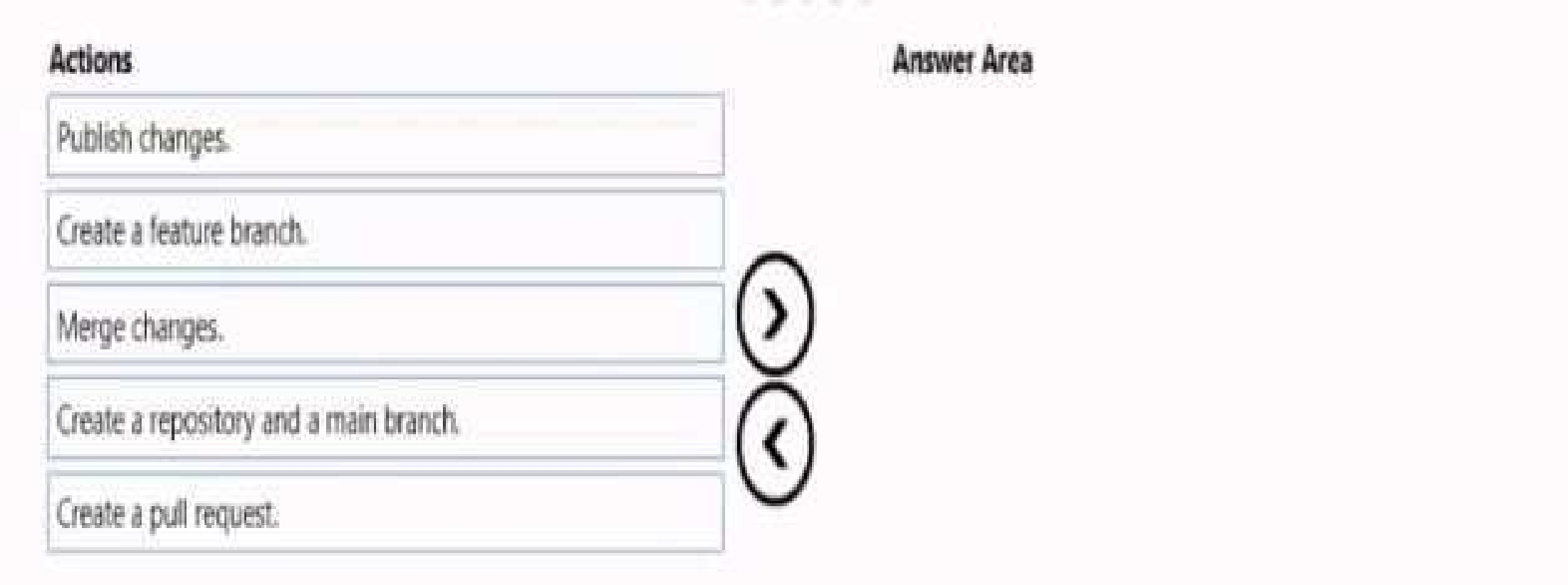
1. Create a new version of the integration pipeline
2. Modify the new version
3. Test the new version
4. Publish the new version
Explanation:
When you need to implement versioned changes, you should not edit the currently active pipeline directly. Instead, you create a new version first so the existing integration flow remains stable. After that, you make the required changes in the new version, validate them through testing, and then publish the version once it is confirmed to meet the data integration requirements.
This approach helps ensure:
- Existing integrations are not disrupted
- Changes are isolated in a separate version
- Only tested updates are promoted to production use
Since the correct answer is A, the intended sequence is the one shown above.
DP-203: Microsoft Certified: Azure Databricks Data Engineer Associate Practice test unlocks all online simulator questions
Thank you for choosing the free version of the DP-203: Microsoft Certified: Azure Databricks Data Engineer Associate practice test! Further deepen your knowledge on Microsoft Simulator; by unlocking the full version of our DP-203: Microsoft Certified: Azure Databricks Data Engineer Associate Simulator you will be able to take tests with over 354 constantly updated questions and easily pass your exam. 98% of people pass the exam in the first attempt after preparing with our 354 questions.
BUY NOWWhat to expect from our DP-203: Microsoft Certified: Azure Databricks Data Engineer Associate practice tests and how to prepare for any exam?
The DP-203: Microsoft Certified: Azure Databricks Data Engineer Associate Simulator Practice Tests are part of the Microsoft Database and are the best way to prepare for any DP-203: Microsoft Certified: Azure Databricks Data Engineer Associate exam. The DP-203: Microsoft Certified: Azure Databricks Data Engineer Associate practice tests consist of 354 questions and are written by experts to help you and prepare you to pass the exam on the first attempt. The DP-203: Microsoft Certified: Azure Databricks Data Engineer Associate database includes questions from previous and other exams, which means you will be able to practice simulating past and future questions. Preparation with DP-203: Microsoft Certified: Azure Databricks Data Engineer Associate Simulator will also give you an idea of the time it will take to complete each section of the DP-203: Microsoft Certified: Azure Databricks Data Engineer Associate practice test . It is important to note that the DP-203: Microsoft Certified: Azure Databricks Data Engineer Associate Simulator does not replace the classic DP-203: Microsoft Certified: Azure Databricks Data Engineer Associate study guides; however, the Simulator provides valuable insights into what to expect and how much work needs to be done to prepare for the DP-203: Microsoft Certified: Azure Databricks Data Engineer Associate exam.
BUY NOWDP-203: Microsoft Certified: Azure Databricks Data Engineer Associate Practice test therefore represents an excellent tool to prepare for the actual exam together with our Microsoft practice test . Our DP-203: Microsoft Certified: Azure Databricks Data Engineer Associate Simulator will help you assess your level of preparation and understand your strengths and weaknesses. Below you can read all the quizzes you will find in our DP-203: Microsoft Certified: Azure Databricks Data Engineer Associate Simulator and how our unique DP-203: Microsoft Certified: Azure Databricks Data Engineer Associate Database made up of real questions:
Info quiz:
- Quiz name:DP-203: Microsoft Certified: Azure Databricks Data Engineer Associate
- Total number of questions:354
- Number of questions for the test:50
- Pass score:80%
You can prepare for the DP-203: Microsoft Certified: Azure Databricks Data Engineer Associate exams with our mobile app. It is very easy to use and even works offline in case of network failure, with all the functions you need to study and practice with our DP-203: Microsoft Certified: Azure Databricks Data Engineer Associate Simulator.
Use our Mobile App, available for both Android and iOS devices, with our DP-203: Microsoft Certified: Azure Databricks Data Engineer Associate Simulator . You can use it anywhere and always remember that our mobile app is free and available on all stores.
Our Mobile App contains all DP-203: Microsoft Certified: Azure Databricks Data Engineer Associate practice tests which consist of 354 questions and also provide study material to pass the final DP-203: Microsoft Certified: Azure Databricks Data Engineer Associate exam with guaranteed success. Our DP-203: Microsoft Certified: Azure Databricks Data Engineer Associate database contain hundreds of questions and Microsoft Tests related to DP-203: Microsoft Certified: Azure Databricks Data Engineer Associate Exam. This way you can practice anywhere you want, even offline without the internet.
BUY NOW