Quiz MB-310: Microsoft Dynamics 365 Finance
Quiz
Case study
Overview
This is a case study. Case studies are not timed separately. You can use as much exam time as you
would like to complete each case. However, there may be additional case studies and sections on
this exam. You must manage your time to ensure that you are able to complete all questions included
on this exam in the time provided.
To answer the questions included in a case study, you will need to reference information that is
provided in the case study. Case studies might contain exhibits and other resources that provide
more information about the scenario that is described in the case study. Each question is
independent of the other questions in this case study.
At the end of this case study, a review screen will appear. This screen allows you to review your
answers and to make changes before you move to the next section of the exam. After you begin a
new section, you cannot return to this section.
To start the case study
To display the first question in this case study, click the Next button. Use the buttons in the left pane
to explore the content of the case study before you answer the questions. Clicking these buttons
displays information such as business requirements, existing environment, and problem statements.
If the case study has an All Information tab, note that the information displayed is identical to the
information displayed on the subsequent tabs. When you are ready to answer a question, click the
Question button to return to the question.
Background
Fourth Coffee is a coffee and supplies manufacturer based in Seattle. The company recently
purchased CompanyA, based in the United States, and CompanyB, based in Canada, in order to
increase production of their award-winning espresso machine and distribution of their dark roast
coffee beans, respectively.
Fourth Coffee has set up CompanyA and CompanyB in their Dynamics 365 Finance environment to
gain better visibility into the companies' profitability. CompanyA and CompanyB will continue to
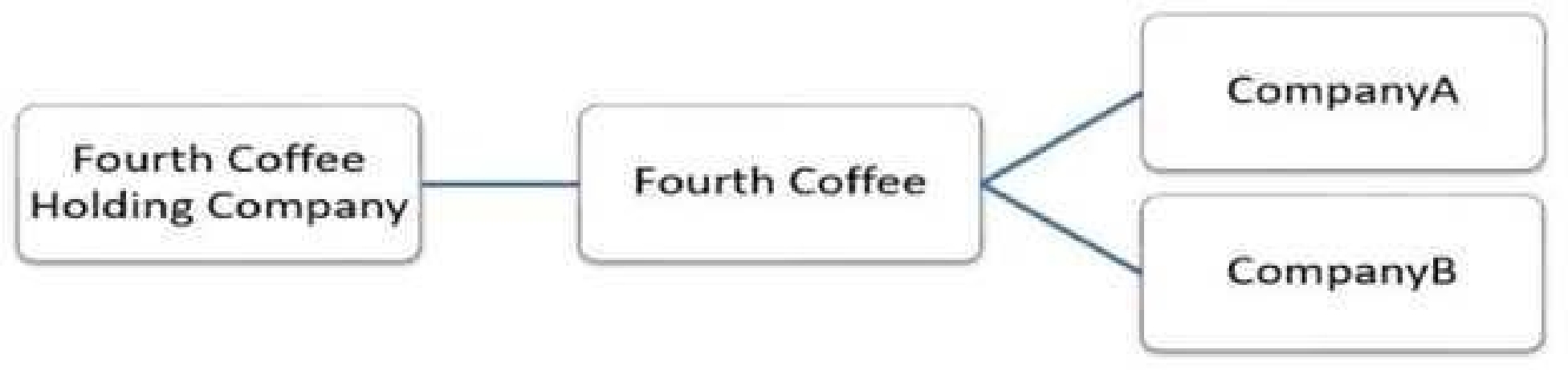
operate as subsidiaries of Fourth Coffee, but all operational companies will be consolidated under
Fourth Coffee Holding Company in US dollars (USD) for reporting purposes.
The current organizational chart is shown below:
Current environment
Systemwide setup
Dynamics 365 Finance in Microsoft Azure is used to manage the supply chain, retail, and financials.
All companies share a Chart of Accounts.
Two dimensions are used: Department and Division.
Budgeting is controlled at the department level.
Customers and vendors are defined as two groups: Domestic and International.
Mandatory credit check is set to No.
Consolidate online is used for the consolidation of all companies.
International main accounts are subject to foreign currency revaluation.
The purchasing budget is used to enforce purchasing limits.
General ledger accounts

Fourth Coffee
The base currency is USD.
Three item groups are used: coffee, supplies, and nonstock.
The standard sales tax method is used.
Acquiring fixed assets requires a purchase order.
All customer payment journals require a deposit slip.
CustomerX is a taxable company.
CustomerY is a tax-exempt company.
CustomerZ is a taxable company.
VendorA is a Colombian supplier of coffee beans and belongs to the international vendor group.
VendorB is a Peruvian supplier of coffee machine filters and belongs to the international vendor
group.
VendorC is a Texas supplier of espresso valves and belongs to the domestic vendor group.
CompanyA
The base currency is USD.
It consists of a marketing department and a digital division.
A 4-5-4 calendar structure is used.
The standard sales tax method is used.
CompanyB
The base currency is CAD.
The conditional sales tax method is used.
Requirements
Reporting
A consolidated Fourth Coffee financial report is required in USD currency.
Fourth Coffee and its subsidiaries need to be able to report sales by item type.
Year-end adjustments need to be reported separately in a different period to view financial reporting
inclusive and exclusive of year-end adjustments.
Issues
User1 observes that a General journal was used in error to post to the Domestic Accounts Receivable
trade account.
User2 has to repeatedly reclassify vendor invoice journals in Fourth Coffee Company that are posted
to the marketing department and digital division.
When User3 posts an Accounts receivable payment journal, a deposit slip is not generated.
User4 observes an increase in procurement department expenses for supplies.
User5 observes that sales tax is not calculating on a sales order for CustomerZ.
User6 observes that sales tax is calculating for CustomerY.
User7 observes that the sales tax payment report is excluding posted invoice transactions.
User8 in CompanyA attempts to set up the sales tax receivable account on the sales tax posting form.
User9 in CompanyA needs to purchase three tablets by using a purchase order and record the
devices as fixed assets.
CustomerX requires a credit check when making a purchase and is currently at their credit limit.
Which three actions should you perform? Each correct answer presents part of the solution.
NOTE: Each correct selection is worth one point.
Quiz
Case study
Overview
This is a case study. Case studies are not timed separately. You can use as much exam time as you
would like to complete each case. However, there may be additional case studies and sections on
this exam. You must manage your time to ensure that you are able to complete all questions included
on this exam in the time provided.
To answer the questions included in a case study, you will need to reference information that is
provided in the case study. Case studies might contain exhibits and other resources that provide
more information about the scenario that is described in the case study. Each question is
independent of the other questions in this case study.
At the end of this case study, a review screen will appear. This screen allows you to review your
answers and to make changes before you move to the next section of the exam. After you begin a
new section, you cannot return to this section.
To start the case study
To display the first question in this case study, click the Next button. Use the buttons in the left pane
to explore the content of the case study before you answer the questions. Clicking these buttons
displays information such as business requirements, existing environment, and problem statements.
If the case study has an All Information tab, note that the information displayed is identical to the
information displayed on the subsequent tabs. When you are ready to answer a question, click the
Question button to return to the question.
Background
Fourth Coffee is a coffee and supplies manufacturer based in Seattle. The company recently
purchased CompanyA, based in the United States, and CompanyB, based in Canada, in order to
increase production of their award-winning espresso machine and distribution of their dark roast
coffee beans, respectively.
Fourth Coffee has set up CompanyA and CompanyB in their Dynamics 365 Finance environment to
gain better visibility into the companies' profitability. CompanyA and CompanyB will continue to
operate as subsidiaries of Fourth Coffee, but all operational companies will be consolidated under
Fourth Coffee Holding Company in US dollars (USD) for reporting purposes.
The current organizational chart is shown below:
Current environment
Systemwide setup
Dynamics 365 Finance in Microsoft Azure is used to manage the supply chain, retail, and financials.
All companies share a Chart of Accounts.
Two dimensions are used: Department and Division.
Budgeting is controlled at the department level.
Customers and vendors are defined as two groups: Domestic and International.
Mandatory credit check is set to No.
Consolidate online is used for the consolidation of all companies.
International main accounts are subject to foreign currency revaluation.
The purchasing budget is used to enforce purchasing limits.
General ledger accounts
Fourth Coffee
The base currency is USD.
Three item groups are used: coffee, supplies, and nonstock.
The standard sales tax method is used.
Acquiring fixed assets requires a purchase order.
All customer payment journals require a deposit slip.
CustomerX is a taxable company.
CustomerY is a tax-exempt company.
CustomerZ is a taxable company.
VendorA is a Colombian supplier of coffee beans and belongs to the international vendor group.
VendorB is a Peruvian supplier of coffee machine filters and belongs to the international vendor
group.
VendorC is a Texas supplier of espresso valves and belongs to the domestic vendor group.
CompanyA
The base currency is USD.
It consists of a marketing department and a digital division.
A 4-5-4 calendar structure is used.
The standard sales tax method is used.
CompanyB
The base currency is CAD.
The conditional sales tax method is used.
Requirements
Reporting
A consolidated Fourth Coffee financial report is required in USD currency.
Fourth Coffee and its subsidiaries need to be able to report sales by item type.
Year-end adjustments need to be reported separately in a different period to view financial reporting
inclusive and exclusive of year-end adjustments.
Issues
User1 observes that a General journal was used in error to post to the Domestic Accounts Receivable
trade account.
User2 has to repeatedly reclassify vendor invoice journals in Fourth Coffee Company that are posted
to the marketing department and digital division.
When User3 posts an Accounts receivable payment journal, a deposit slip is not generated.
User4 observes an increase in procurement department expenses for supplies.
User5 observes that sales tax is not calculating on a sales order for CustomerZ.
User6 observes that sales tax is calculating for CustomerY.
User7 observes that the sales tax payment report is excluding posted invoice transactions.
User8 in CompanyA attempts to set up the sales tax receivable account on the sales tax posting form.
User9 in CompanyA needs to purchase three tablets by using a purchase order and record the
devices as fixed assets.
CustomerX requires a credit check when making a purchase and is currently at their credit limit.
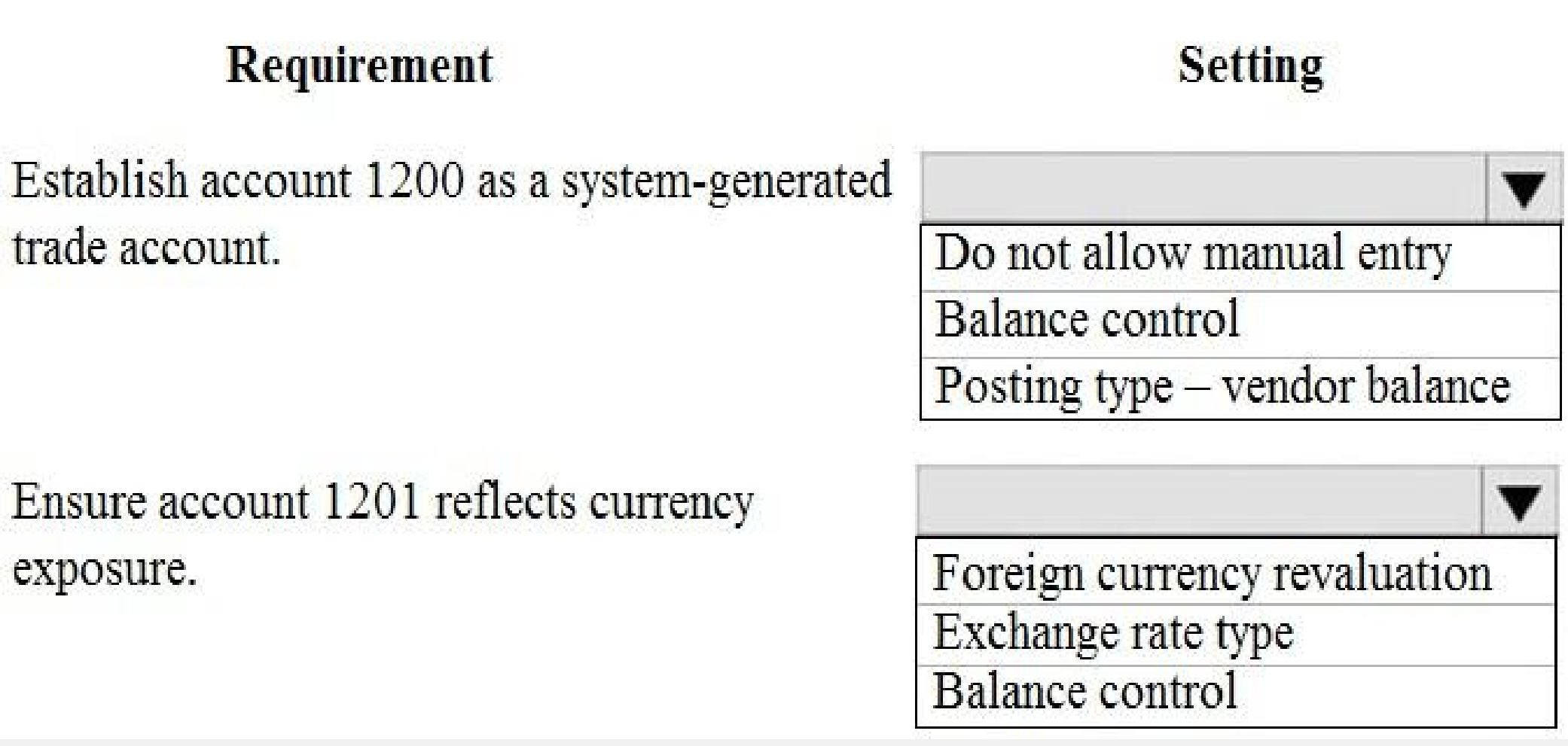
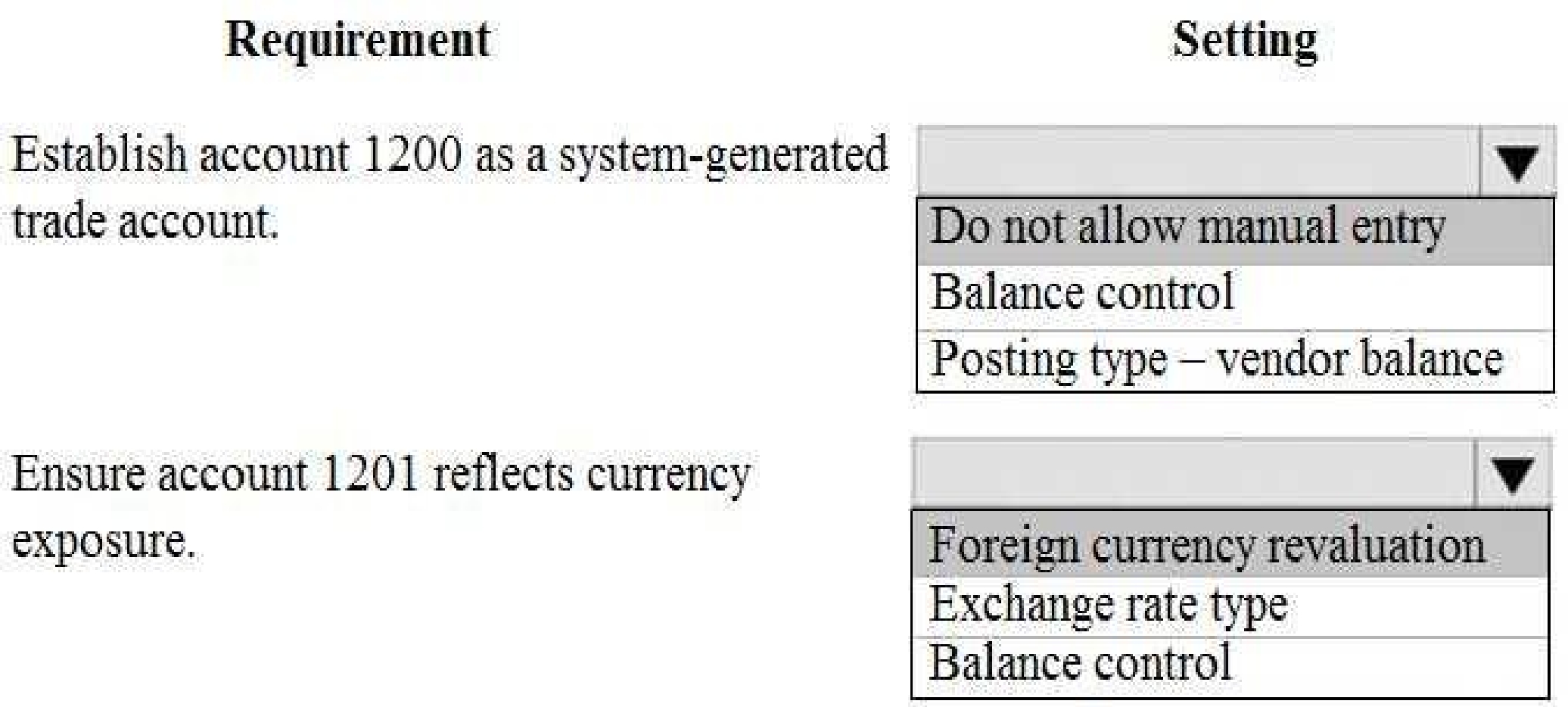
Which settings should you use? To answer, select the appropriate options in the answer area.
NOTE: Each correct selection is worth one point.
Quiz
Case study
Overview
This is a case study. Case studies are not timed separately. You can use as much exam time as you
would like to complete each case. However, there may be additional case studies and sections on
this exam. You must manage your time to ensure that you are able to complete all questions included
on this exam in the time provided.
To answer the questions included in a case study, you will need to reference information that is
provided in the case study. Case studies might contain exhibits and other resources that provide
more information about the scenario that is described in the case study. Each question is
independent of the other questions in this case study.
At the end of this case study, a review screen will appear. This screen allows you to review your
answers and to make changes before you move to the next section of the exam. After you begin a
new section, you cannot return to this section.
To start the case study
To display the first question in this case study, click the Next button. Use the buttons in the left pane
to explore the content of the case study before you answer the questions. Clicking these buttons
displays information such as business requirements, existing environment, and problem statements.
If the case study has an All Information tab, note that the information displayed is identical to the
information displayed on the subsequent tabs. When you are ready to answer a question, click the
Question button to return to the question.
Background
Fourth Coffee is a coffee and supplies manufacturer based in Seattle. The company recently
purchased CompanyA, based in the United States, and CompanyB, based in Canada, in order to
increase production of their award-winning espresso machine and distribution of their dark roast
coffee beans, respectively.
Fourth Coffee has set up CompanyA and CompanyB in their Dynamics 365 Finance environment to
gain better visibility into the companies' profitability. CompanyA and CompanyB will continue to
operate as subsidiaries of Fourth Coffee, but all operational companies will be consolidated under
Fourth Coffee Holding Company in US dollars (USD) for reporting purposes.
The current organizational chart is shown below:
Current environment
Systemwide setup
Dynamics 365 Finance in Microsoft Azure is used to manage the supply chain, retail, and financials.
All companies share a Chart of Accounts.
Two dimensions are used: Department and Division.
Budgeting is controlled at the department level.
Customers and vendors are defined as two groups: Domestic and International.
Mandatory credit check is set to No.
Consolidate online is used for the consolidation of all companies.
International main accounts are subject to foreign currency revaluation.
The purchasing budget is used to enforce purchasing limits.
General ledger accounts
Fourth Coffee
The base currency is USD.
Three item groups are used: coffee, supplies, and nonstock.
The standard sales tax method is used.
Acquiring fixed assets requires a purchase order.
All customer payment journals require a deposit slip.
CustomerX is a taxable company.
CustomerY is a tax-exempt company.
CustomerZ is a taxable company.
VendorA is a Colombian supplier of coffee beans and belongs to the international vendor group.
VendorB is a Peruvian supplier of coffee machine filters and belongs to the international vendor
group.
VendorC is a Texas supplier of espresso valves and belongs to the domestic vendor group.
CompanyA
The base currency is USD.
It consists of a marketing department and a digital division.
A 4-5-4 calendar structure is used.
The standard sales tax method is used.
CompanyB
The base currency is CAD.
The conditional sales tax method is used.
Requirements
Reporting
A consolidated Fourth Coffee financial report is required in USD currency.
Fourth Coffee and its subsidiaries need to be able to report sales by item type.
Year-end adjustments need to be reported separately in a different period to view financial reporting
inclusive and exclusive of year-end adjustments.
Issues
User1 observes that a General journal was used in error to post to the Domestic Accounts Receivable
trade account.
User2 has to repeatedly reclassify vendor invoice journals in Fourth Coffee Company that are posted
to the marketing department and digital division.
When User3 posts an Accounts receivable payment journal, a deposit slip is not generated.
User4 observes an increase in procurement department expenses for supplies.
User5 observes that sales tax is not calculating on a sales order for CustomerZ.
User6 observes that sales tax is calculating for CustomerY.
User7 observes that the sales tax payment report is excluding posted invoice transactions.
User8 in CompanyA attempts to set up the sales tax receivable account on the sales tax posting form.
User9 in CompanyA needs to purchase three tablets by using a purchase order and record the
devices as fixed assets.
CustomerX requires a credit check when making a purchase and is currently at their credit limit.
Why are some transactions being excluded?
Quiz
Case study
Overview
This is a case study. Case studies are not timed separately. You can use as much exam time as you
would like to complete each case. However, there may be additional case studies and sections on
this exam. You must manage your time to ensure that you are able to complete all questions included
on this exam in the time provided.
To answer the questions included in a case study, you will need to reference information that is
provided in the case study. Case studies might contain exhibits and other resources that provide
more information about the scenario that is described in the case study. Each question is
independent of the other questions in this case study.
At the end of this case study, a review screen will appear. This screen allows you to review your
answers and to make changes before you move to the next section of the exam. After you begin a
new section, you cannot return to this section.
To start the case study
To display the first question in this case study, click the Next button. Use the buttons in the left pane
to explore the content of the case study before you answer the questions. Clicking these buttons
displays information such as business requirements, existing environment, and problem statements.
If the case study has an All Information tab, note that the information displayed is identical to the
information displayed on the subsequent tabs. When you are ready to answer a question, click the
Question button to return to the question.
Background
Fourth Coffee is a coffee and supplies manufacturer based in Seattle. The company recently
purchased CompanyA, based in the United States, and CompanyB, based in Canada, in order to
increase production of their award-winning espresso machine and distribution of their dark roast
coffee beans, respectively.
Fourth Coffee has set up CompanyA and CompanyB in their Dynamics 365 Finance environment to
gain better visibility into the companies' profitability. CompanyA and CompanyB will continue to
operate as subsidiaries of Fourth Coffee, but all operational companies will be consolidated under
Fourth Coffee Holding Company in US dollars (USD) for reporting purposes.
The current organizational chart is shown below:
Current environment
Systemwide setup
Dynamics 365 Finance in Microsoft Azure is used to manage the supply chain, retail, and financials.
All companies share a Chart of Accounts.
Two dimensions are used: Department and Division.
Budgeting is controlled at the department level.
Customers and vendors are defined as two groups: Domestic and International.
Mandatory credit check is set to No.
Consolidate online is used for the consolidation of all companies.
International main accounts are subject to foreign currency revaluation.
The purchasing budget is used to enforce purchasing limits.
General ledger accounts
Fourth Coffee
The base currency is USD.
Three item groups are used: coffee, supplies, and nonstock.
The standard sales tax method is used.
Acquiring fixed assets requires a purchase order.
All customer payment journals require a deposit slip.
CustomerX is a taxable company.
CustomerY is a tax-exempt company.
CustomerZ is a taxable company.
VendorA is a Colombian supplier of coffee beans and belongs to the international vendor group.
VendorB is a Peruvian supplier of coffee machine filters and belongs to the international vendor
group.
VendorC is a Texas supplier of espresso valves and belongs to the domestic vendor group.
CompanyA
The base currency is USD.
It consists of a marketing department and a digital division.
A 4-5-4 calendar structure is used.
The standard sales tax method is used.
CompanyB
The base currency is CAD.
The conditional sales tax method is used.
Requirements
Reporting
A consolidated Fourth Coffee financial report is required in USD currency.
Fourth Coffee and its subsidiaries need to be able to report sales by item type.
Year-end adjustments need to be reported separately in a different period to view financial reporting
inclusive and exclusive of year-end adjustments.
Issues
User1 observes that a General journal was used in error to post to the Domestic Accounts Receivable
trade account.
User2 has to repeatedly reclassify vendor invoice journals in Fourth Coffee Company that are posted
to the marketing department and digital division.
When User3 posts an Accounts receivable payment journal, a deposit slip is not generated.
User4 observes an increase in procurement department expenses for supplies.
User5 observes that sales tax is not calculating on a sales order for CustomerZ.
User6 observes that sales tax is calculating for CustomerY.
User7 observes that the sales tax payment report is excluding posted invoice transactions.
User8 in CompanyA attempts to set up the sales tax receivable account on the sales tax posting form.
User9 in CompanyA needs to purchase three tablets by using a purchase order and record the
devices as fixed assets.
CustomerX requires a credit check when making a purchase and is currently at their credit limit.
What are two possible reasons? Each answer is a complete solution.
NOTE: Each correct selection is worth one point.
Quiz
Case study
Overview
This is a case study. Case studies are not timed separately. You can use as much exam time as you
would like to complete each case. However, there may be additional case studies and sections on
this exam. You must manage your time to ensure that you are able to complete all questions included
on this exam in the time provided.
To answer the questions included in a case study, you will need to reference information that is
provided in the case study. Case studies might contain exhibits and other resources that provide
more information about the scenario that is described in the case study. Each question is
independent of the other questions in this case study.
At the end of this case study, a review screen will appear. This screen allows you to review your
answers and to make changes before you move to the next section of the exam. After you begin a
new section, you cannot return to this section.
To start the case study
To display the first question in this case study, click the Next button. Use the buttons in the left pane
to explore the content of the case study before you answer the questions. Clicking these buttons
displays information such as business requirements, existing environment, and problem statements.
If the case study has an All Information tab, note that the information displayed is identical to the
information displayed on the subsequent tabs. When you are ready to answer a question, click the
Question button to return to the question.
Background
Fourth Coffee is a coffee and supplies manufacturer based in Seattle. The company recently
purchased CompanyA, based in the United States, and CompanyB, based in Canada, in order to
increase production of their award-winning espresso machine and distribution of their dark roast
coffee beans, respectively.
Fourth Coffee has set up CompanyA and CompanyB in their Dynamics 365 Finance environment to
gain better visibility into the companies' profitability. CompanyA and CompanyB will continue to
operate as subsidiaries of Fourth Coffee, but all operational companies will be consolidated under
Fourth Coffee Holding Company in US dollars (USD) for reporting purposes.
The current organizational chart is shown below:
Current environment
Systemwide setup
Dynamics 365 Finance in Microsoft Azure is used to manage the supply chain, retail, and financials.
All companies share a Chart of Accounts.
Two dimensions are used: Department and Division.
Budgeting is controlled at the department level.
Customers and vendors are defined as two groups: Domestic and International.
Mandatory credit check is set to No.
Consolidate online is used for the consolidation of all companies.
International main accounts are subject to foreign currency revaluation.
The purchasing budget is used to enforce purchasing limits.
General ledger accounts
Fourth Coffee
The base currency is USD.
Three item groups are used: coffee, supplies, and nonstock.
The standard sales tax method is used.
Acquiring fixed assets requires a purchase order.
All customer payment journals require a deposit slip.
CustomerX is a taxable company.
CustomerY is a tax-exempt company.
CustomerZ is a taxable company.
VendorA is a Colombian supplier of coffee beans and belongs to the international vendor group.
VendorB is a Peruvian supplier of coffee machine filters and belongs to the international vendor
group.
VendorC is a Texas supplier of espresso valves and belongs to the domestic vendor group.
CompanyA
The base currency is USD.
It consists of a marketing department and a digital division.
A 4-5-4 calendar structure is used.
The standard sales tax method is used.
CompanyB
The base currency is CAD.
The conditional sales tax method is used.
Requirements
Reporting
A consolidated Fourth Coffee financial report is required in USD currency.
Fourth Coffee and its subsidiaries need to be able to report sales by item type.
Year-end adjustments need to be reported separately in a different period to view financial reporting
inclusive and exclusive of year-end adjustments.
Issues
User1 observes that a General journal was used in error to post to the Domestic Accounts Receivable
trade account.
User2 has to repeatedly reclassify vendor invoice journals in Fourth Coffee Company that are posted
to the marketing department and digital division.
When User3 posts an Accounts receivable payment journal, a deposit slip is not generated.
User4 observes an increase in procurement department expenses for supplies.
User5 observes that sales tax is not calculating on a sales order for CustomerZ.
User6 observes that sales tax is calculating for CustomerY.
User7 observes that the sales tax payment report is excluding posted invoice transactions.
User8 in CompanyA attempts to set up the sales tax receivable account on the sales tax posting form.
User9 in CompanyA needs to purchase three tablets by using a purchase order and record the
devices as fixed assets.
CustomerX requires a credit check when making a purchase and is currently at their credit limit.
What should you select?
Quiz
Case study
Overview
This is a case study. Case studies are not timed separately. You can use as much exam time as you
would like to complete each case. However, there may be additional case studies and sections on
this exam. You must manage your time to ensure that you are able to complete all questions included
on this exam in the time provided.
To answer the questions included in a case study, you will need to reference information that is
provided in the case study. Case studies might contain exhibits and other resources that provide
more information about the scenario that is described in the case study. Each question is
independent of the other questions in this case study.
At the end of this case study, a review screen will appear. This screen allows you to review your
answers and to make changes before you move to the next section of the exam. After you begin a
new section, you cannot return to this section.
To start the case study
To display the first question in this case study, click the Next button. Use the buttons in the left pane
to explore the content of the case study before you answer the questions. Clicking these buttons
displays information such as business requirements, existing environment, and problem statements.
If the case study has an All Information tab, note that the information displayed is identical to the
information displayed on the subsequent tabs. When you are ready to answer a question, click the
Question button to return to the question.
Background
Fourth Coffee is a coffee and supplies manufacturer based in Seattle. The company recently
purchased CompanyA, based in the United States, and CompanyB, based in Canada, in order to
increase production of their award-winning espresso machine and distribution of their dark roast
coffee beans, respectively.
Fourth Coffee has set up CompanyA and CompanyB in their Dynamics 365 Finance environment to
gain better visibility into the companies' profitability. CompanyA and CompanyB will continue to
operate as subsidiaries of Fourth Coffee, but all operational companies will be consolidated under
Fourth Coffee Holding Company in US dollars (USD) for reporting purposes.
The current organizational chart is shown below:
Current environment
Systemwide setup
Dynamics 365 Finance in Microsoft Azure is used to manage the supply chain, retail, and financials.
All companies share a Chart of Accounts.
Two dimensions are used: Department and Division.
Budgeting is controlled at the department level.
Customers and vendors are defined as two groups: Domestic and International.
Mandatory credit check is set to No.
Consolidate online is used for the consolidation of all companies.
International main accounts are subject to foreign currency revaluation.
The purchasing budget is used to enforce purchasing limits.
General ledger accounts
Fourth Coffee
The base currency is USD.
Three item groups are used: coffee, supplies, and nonstock.
The standard sales tax method is used.
Acquiring fixed assets requires a purchase order.
All customer payment journals require a deposit slip.
CustomerX is a taxable company.
CustomerY is a tax-exempt company.
CustomerZ is a taxable company.
VendorA is a Colombian supplier of coffee beans and belongs to the international vendor group.
VendorB is a Peruvian supplier of coffee machine filters and belongs to the international vendor
group.
VendorC is a Texas supplier of espresso valves and belongs to the domestic vendor group.
CompanyA
The base currency is USD.
It consists of a marketing department and a digital division.
A 4-5-4 calendar structure is used.
The standard sales tax method is used.
CompanyB
The base currency is CAD.
The conditional sales tax method is used.
Requirements
Reporting
A consolidated Fourth Coffee financial report is required in USD currency.
Fourth Coffee and its subsidiaries need to be able to report sales by item type.
Year-end adjustments need to be reported separately in a different period to view financial reporting
inclusive and exclusive of year-end adjustments.
Issues
User1 observes that a General journal was used in error to post to the Domestic Accounts Receivable
trade account.
User2 has to repeatedly reclassify vendor invoice journals in Fourth Coffee Company that are posted
to the marketing department and digital division.
When User3 posts an Accounts receivable payment journal, a deposit slip is not generated.
User4 observes an increase in procurement department expenses for supplies.
User5 observes that sales tax is not calculating on a sales order for CustomerZ.
User6 observes that sales tax is calculating for CustomerY.
User7 observes that the sales tax payment report is excluding posted invoice transactions.
User8 in CompanyA attempts to set up the sales tax receivable account on the sales tax posting form.
User9 in CompanyA needs to purchase three tablets by using a purchase order and record the
devices as fixed assets.
CustomerX requires a credit check when making a purchase and is currently at their credit limit.
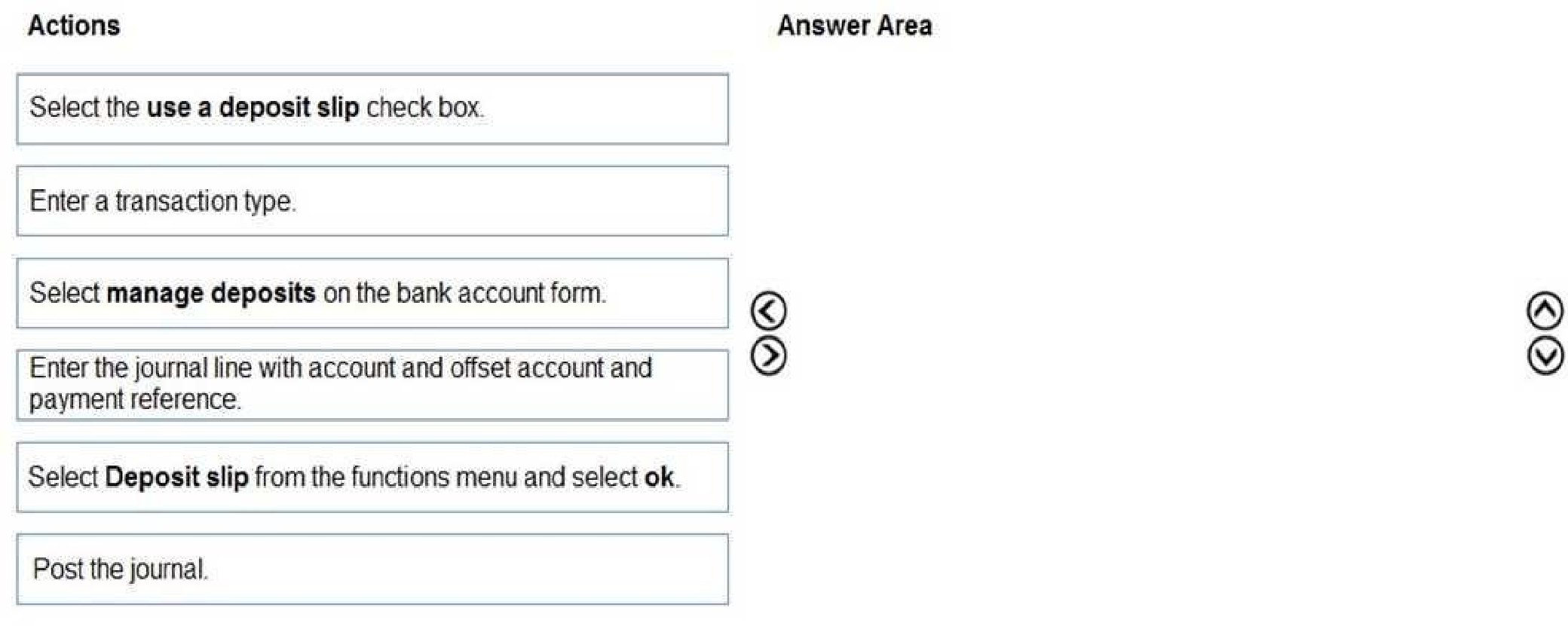
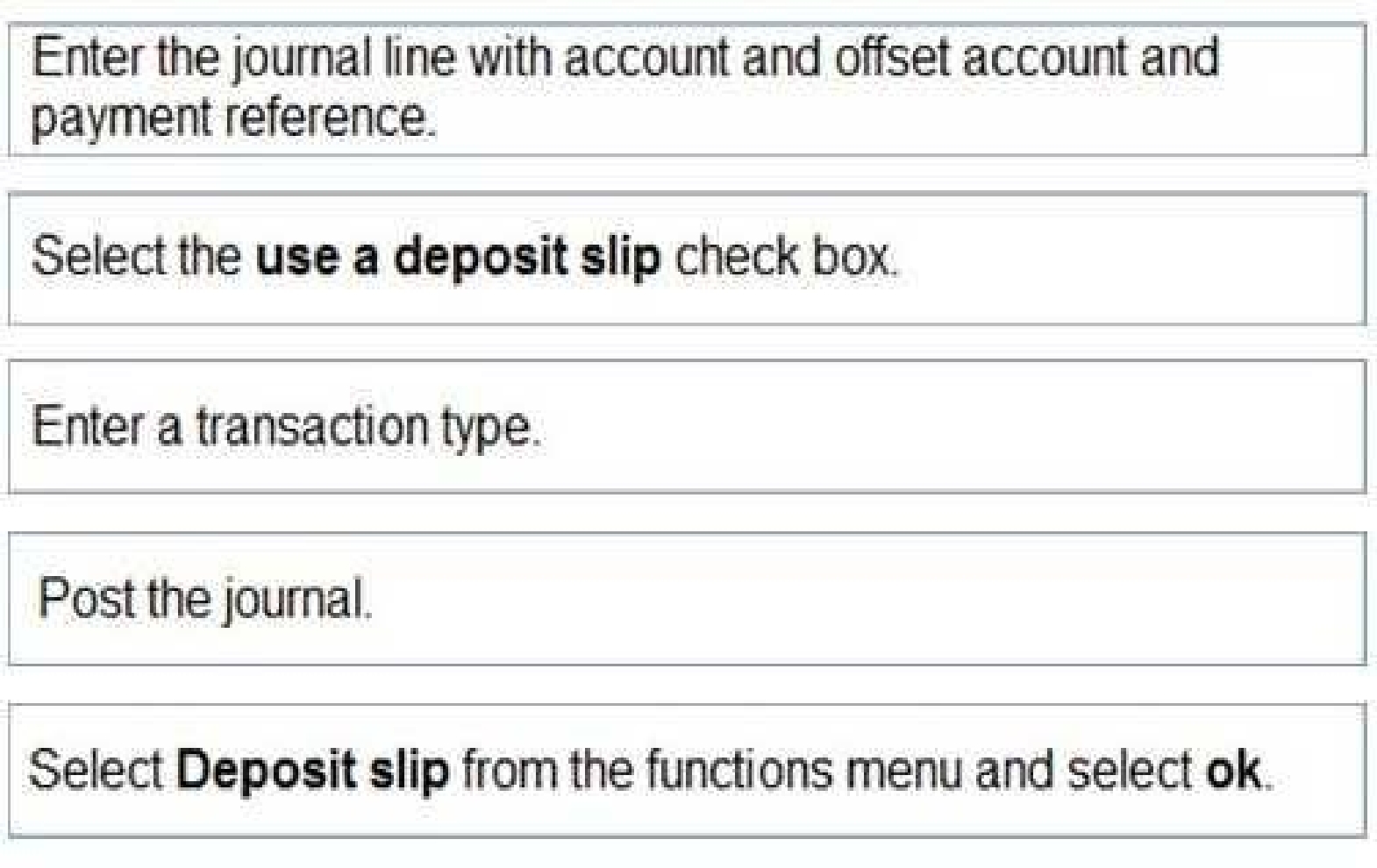
You need to assist User3 with generating a deposit slip to meet Fourth Coffee's requirement.
Which five actions should you perform in sequence? To answer, move the appropriate actions from
the list of actions to the answer area and arrange them in the correct order.
NOTE: More than one order of answer choices is correct. You will receive credit for any of the correct
orders you select.
Quiz
Case study
Overview
This is a case study. Case studies are not timed separately. You can use as much exam time as you
would like to complete each case. However, there may be additional case studies and sections on
this exam. You must manage your time to ensure that you are able to complete all questions included
on this exam in the time provided.
To answer the questions included in a case study, you will need to reference information that is
provided in the case study. Case studies might contain exhibits and other resources that provide
more information about the scenario that is described in the case study. Each question is
independent of the other questions in this case study.
At the end of this case study, a review screen will appear. This screen allows you to review your
answers and to make changes before you move to the next section of the exam. After you begin a
new section, you cannot return to this section.
To start the case study
To display the first question in this case study, click the Next button. Use the buttons in the left pane
to explore the content of the case study before you answer the questions. Clicking these buttons
displays information such as business requirements, existing environment, and problem statements.
If the case study has an All Information tab, note that the information displayed is identical to the
information displayed on the subsequent tabs. When you are ready to answer a question, click the
Question button to return to the question.
Background
Fourth Coffee is a coffee and supplies manufacturer based in Seattle. The company recently
purchased CompanyA, based in the United States, and CompanyB, based in Canada, in order to
increase production of their award-winning espresso machine and distribution of their dark roast
coffee beans, respectively.
Fourth Coffee has set up CompanyA and CompanyB in their Dynamics 365 Finance environment to
gain better visibility into the companies' profitability. CompanyA and CompanyB will continue to
operate as subsidiaries of Fourth Coffee, but all operational companies will be consolidated under
Fourth Coffee Holding Company in US dollars (USD) for reporting purposes.
The current organizational chart is shown below:
Current environment
Systemwide setup
Dynamics 365 Finance in Microsoft Azure is used to manage the supply chain, retail, and financials.
All companies share a Chart of Accounts.
Two dimensions are used: Department and Division.
Budgeting is controlled at the department level.
Customers and vendors are defined as two groups: Domestic and International.
Mandatory credit check is set to No.
Consolidate online is used for the consolidation of all companies.
International main accounts are subject to foreign currency revaluation.
The purchasing budget is used to enforce purchasing limits.
General ledger accounts
Fourth Coffee
The base currency is USD.
Three item groups are used: coffee, supplies, and nonstock.
The standard sales tax method is used.
Acquiring fixed assets requires a purchase order.
All customer payment journals require a deposit slip.
CustomerX is a taxable company.
CustomerY is a tax-exempt company.
CustomerZ is a taxable company.
VendorA is a Colombian supplier of coffee beans and belongs to the international vendor group.
VendorB is a Peruvian supplier of coffee machine filters and belongs to the international vendor
group.
VendorC is a Texas supplier of espresso valves and belongs to the domestic vendor group.
CompanyA
The base currency is USD.
It consists of a marketing department and a digital division.
A 4-5-4 calendar structure is used.
The standard sales tax method is used.
CompanyB
The base currency is CAD.
The conditional sales tax method is used.
Requirements
Reporting
A consolidated Fourth Coffee financial report is required in USD currency.
Fourth Coffee and its subsidiaries need to be able to report sales by item type.
Year-end adjustments need to be reported separately in a different period to view financial reporting
inclusive and exclusive of year-end adjustments.
Issues
User1 observes that a General journal was used in error to post to the Domestic Accounts Receivable
trade account.
User2 has to repeatedly reclassify vendor invoice journals in Fourth Coffee Company that are posted
to the marketing department and digital division.
When User3 posts an Accounts receivable payment journal, a deposit slip is not generated.
User4 observes an increase in procurement department expenses for supplies.
User5 observes that sales tax is not calculating on a sales order for CustomerZ.
User6 observes that sales tax is calculating for CustomerY.
User7 observes that the sales tax payment report is excluding posted invoice transactions.
User8 in CompanyA attempts to set up the sales tax receivable account on the sales tax posting form.
User9 in CompanyA needs to purchase three tablets by using a purchase order and record the
devices as fixed assets.
CustomerX requires a credit check when making a purchase and is currently at their credit limit.
D18912E1457D5D1DDCBD40AB3BF70D5D
Which three places show the results of financial consolidation? Each correct answer presents a
complete
solution.
NOTE: Each correct selection is worth one point.
Quiz
Case study
Overview
This is a case study. Case studies are not timed separately. You can use as much exam time as you
would like to complete each case. However, there may be additional case studies and sections on
this exam. You must manage your time to ensure that you are able to complete all questions included
on this exam in the time provided.
To answer the questions included in a case study, you will need to reference information that is
provided in the case study. Case studies might contain exhibits and other resources that provide
more information about the scenario that is described in the case study. Each question is
independent of the other questions in this case study.
At the end of this case study, a review screen will appear. This screen allows you to review your
answers and to make changes before you move to the next section of the exam. After you begin a
new section, you cannot return to this section.
To start the case study
To display the first question in this case study, click the Next button. Use the buttons in the left pane
to explore the content of the case study before you answer the questions. Clicking these buttons
displays information such as business requirements, existing environment, and problem statements.
If the case study has an All Information tab, note that the information displayed is identical to the
information displayed on the subsequent tabs. When you are ready to answer a question, click the
Question button to return to the question.
Background
Fourth Coffee is a coffee and supplies manufacturer based in Seattle. The company recently
purchased CompanyA, based in the United States, and CompanyB, based in Canada, in order to
increase production of their award-winning espresso machine and distribution of their dark roast
coffee beans, respectively.
Fourth Coffee has set up CompanyA and CompanyB in their Dynamics 365 Finance environment to
gain better visibility into the companies' profitability. CompanyA and CompanyB will continue to
operate as subsidiaries of Fourth Coffee, but all operational companies will be consolidated under
Fourth Coffee Holding Company in US dollars (USD) for reporting purposes.
The current organizational chart is shown below:
Current environment
Systemwide setup
Dynamics 365 Finance in Microsoft Azure is used to manage the supply chain, retail, and financials.
All companies share a Chart of Accounts.
Two dimensions are used: Department and Division.
Budgeting is controlled at the department level.
Customers and vendors are defined as two groups: Domestic and International.
Mandatory credit check is set to No.
Consolidate online is used for the consolidation of all companies.
International main accounts are subject to foreign currency revaluation.
The purchasing budget is used to enforce purchasing limits.
General ledger accounts
Fourth Coffee
The base currency is USD.
Three item groups are used: coffee, supplies, and nonstock.
The standard sales tax method is used.
Acquiring fixed assets requires a purchase order.
All customer payment journals require a deposit slip.
CustomerX is a taxable company.
CustomerY is a tax-exempt company.
CustomerZ is a taxable company.
VendorA is a Colombian supplier of coffee beans and belongs to the international vendor group.
VendorB is a Peruvian supplier of coffee machine filters and belongs to the international vendor
group.
VendorC is a Texas supplier of espresso valves and belongs to the domestic vendor group.
CompanyA
The base currency is USD.
It consists of a marketing department and a digital division.
A 4-5-4 calendar structure is used.
The standard sales tax method is used.
CompanyB
The base currency is CAD.
The conditional sales tax method is used.
Requirements
Reporting
A consolidated Fourth Coffee financial report is required in USD currency.
Fourth Coffee and its subsidiaries need to be able to report sales by item type.
Year-end adjustments need to be reported separately in a different period to view financial reporting
inclusive and exclusive of year-end adjustments.
Issues
User1 observes that a General journal was used in error to post to the Domestic Accounts Receivable
trade account.
User2 has to repeatedly reclassify vendor invoice journals in Fourth Coffee Company that are posted
to the marketing department and digital division.
When User3 posts an Accounts receivable payment journal, a deposit slip is not generated.
User4 observes an increase in procurement department expenses for supplies.
User5 observes that sales tax is not calculating on a sales order for CustomerZ.
User6 observes that sales tax is calculating for CustomerY.
User7 observes that the sales tax payment report is excluding posted invoice transactions.
User8 in CompanyA attempts to set up the sales tax receivable account on the sales tax posting form.
User9 in CompanyA needs to purchase three tablets by using a purchase order and record the
devices as fixed assets.
CustomerX requires a credit check when making a purchase and is currently at their credit limit.
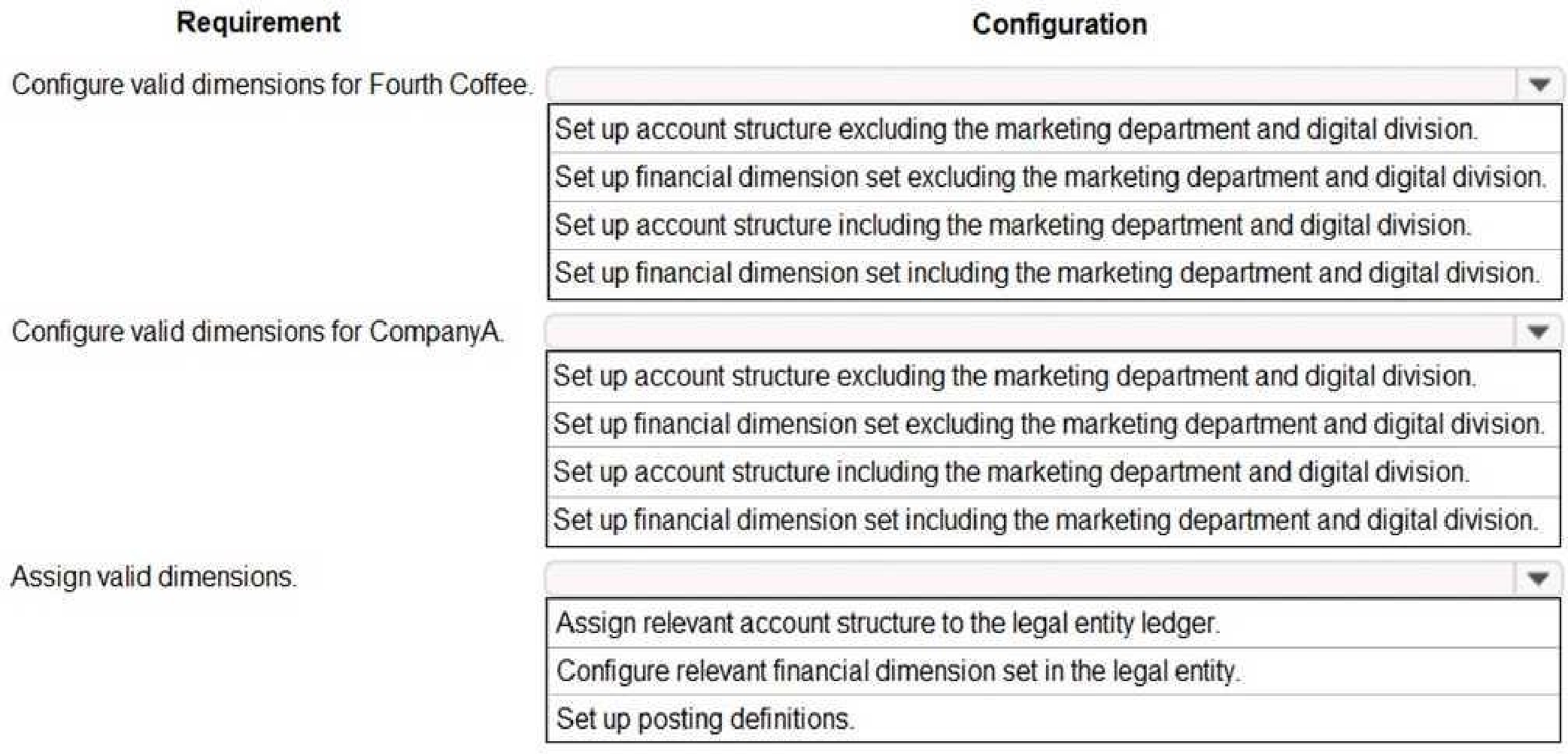
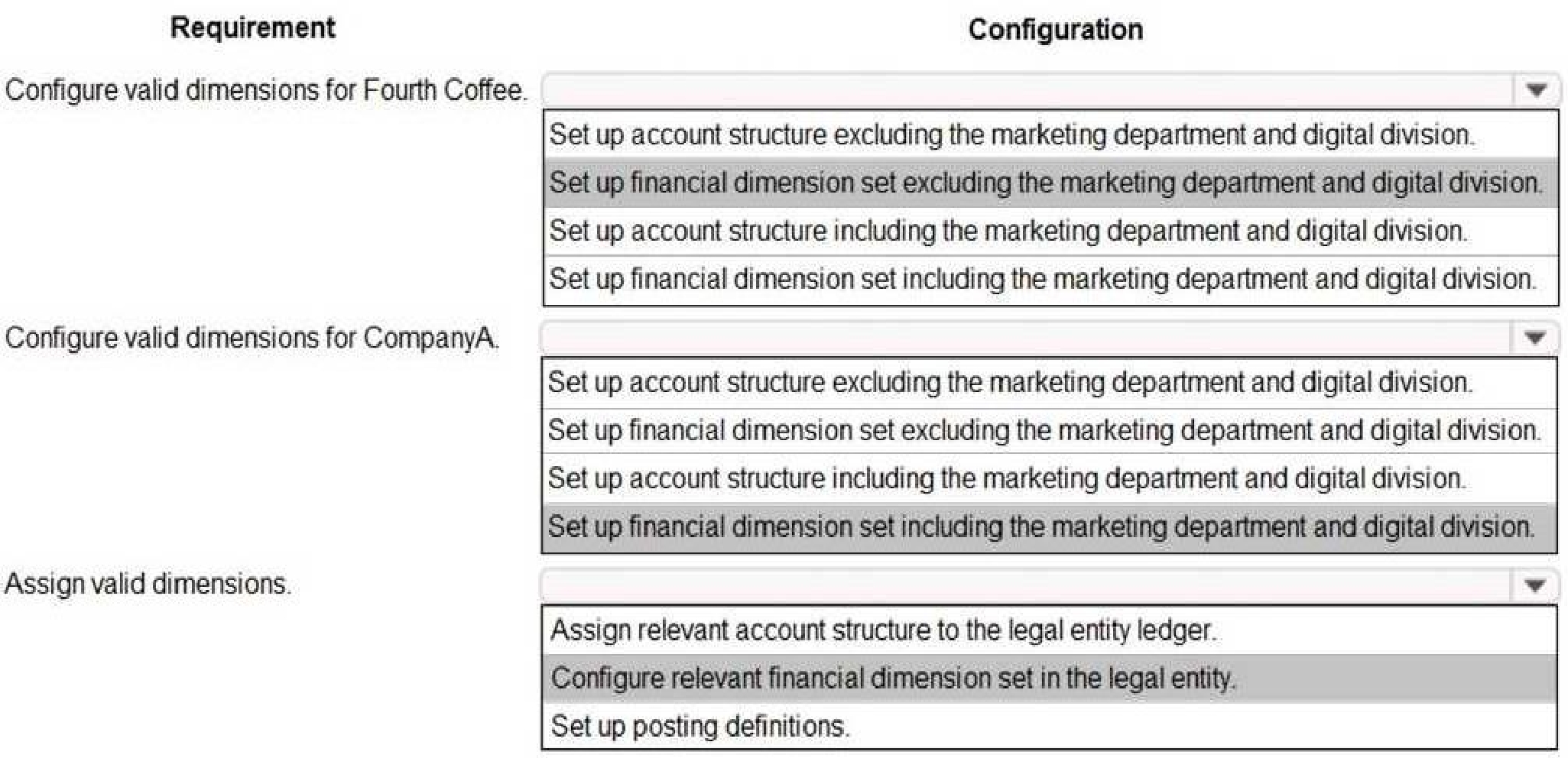
How should you configure the system? To answer, select the appropriate options in the answer area.
NOTE: Each correct selection is worth one point.
Quiz
Case study
Overview
This is a case study. Case studies are not timed separately. You can use as much exam time as you
would like to complete each case. However, there may be additional case studies and sections on
this exam. You must manage your time to ensure that you are able to complete all questions included
on this exam in the time provided.
To answer the questions included in a case study, you will need to reference information that is
provided in the case study. Case studies might contain exhibits and other resources that provide
more information about the scenario that is described in the case study. Each question is
independent of the other questions in this case study.
At the end of this case study, a review screen will appear. This screen allows you to review your
answers and to make changes before you move to the next section of the exam. After you begin a
new section, you cannot return to this section.
To start the case study
To display the first question in this case study, click the Next button. Use the buttons in the left pane
to explore the content of the case study before you answer the questions. Clicking these buttons
displays information such as business requirements, existing environment, and problem statements.
If the case study has an All Information tab, note that the information displayed is identical to the
information displayed on the subsequent tabs. When you are ready to answer a question, click the
Question button to return to the question.
Background
Fourth Coffee is a coffee and supplies manufacturer based in Seattle. The company recently
purchased CompanyA, based in the United States, and CompanyB, based in Canada, in order to
increase production of their award-winning espresso machine and distribution of their dark roast
coffee beans, respectively.
Fourth Coffee has set up CompanyA and CompanyB in their Dynamics 365 Finance environment to
gain better visibility into the companies' profitability. CompanyA and CompanyB will continue to
operate as subsidiaries of Fourth Coffee, but all operational companies will be consolidated under
Fourth Coffee Holding Company in US dollars (USD) for reporting purposes.
The current organizational chart is shown below:
Current environment
Systemwide setup
Dynamics 365 Finance in Microsoft Azure is used to manage the supply chain, retail, and financials.
All companies share a Chart of Accounts.
Two dimensions are used: Department and Division.
Budgeting is controlled at the department level.
Customers and vendors are defined as two groups: Domestic and International.
Mandatory credit check is set to No.
Consolidate online is used for the consolidation of all companies.
International main accounts are subject to foreign currency revaluation.
The purchasing budget is used to enforce purchasing limits.
General ledger accounts
Fourth Coffee
The base currency is USD.
Three item groups are used: coffee, supplies, and nonstock.
The standard sales tax method is used.
Acquiring fixed assets requires a purchase order.
All customer payment journals require a deposit slip.
CustomerX is a taxable company.
CustomerY is a tax-exempt company.
CustomerZ is a taxable company.
VendorA is a Colombian supplier of coffee beans and belongs to the international vendor group.
VendorB is a Peruvian supplier of coffee machine filters and belongs to the international vendor
group.
VendorC is a Texas supplier of espresso valves and belongs to the domestic vendor group.
CompanyA
The base currency is USD.
It consists of a marketing department and a digital division.
A 4-5-4 calendar structure is used.
The standard sales tax method is used.
CompanyB
The base currency is CAD.
The conditional sales tax method is used.
Requirements
Reporting
A consolidated Fourth Coffee financial report is required in USD currency.
Fourth Coffee and its subsidiaries need to be able to report sales by item type.
Year-end adjustments need to be reported separately in a different period to view financial reporting
inclusive and exclusive of year-end adjustments.
Issues
User1 observes that a General journal was used in error to post to the Domestic Accounts Receivable
trade account.
User2 has to repeatedly reclassify vendor invoice journals in Fourth Coffee Company that are posted
to the marketing department and digital division.
When User3 posts an Accounts receivable payment journal, a deposit slip is not generated.
User4 observes an increase in procurement department expenses for supplies.
User5 observes that sales tax is not calculating on a sales order for CustomerZ.
User6 observes that sales tax is calculating for CustomerY.
User7 observes that the sales tax payment report is excluding posted invoice transactions.
User8 in CompanyA attempts to set up the sales tax receivable account on the sales tax posting form.
User9 in CompanyA needs to purchase three tablets by using a purchase order and record the
devices as fixed assets.
CustomerX requires a credit check when making a purchase and is currently at their credit limit.
What should you select?
Quiz
Case study
Overview
This is a case study. Case studies are not timed separately. You can use as much exam time as you
would like to complete each case. However, there may be additional case studies and sections on
this exam. You must manage your time to ensure that you are able to complete all questions included
on this exam in the time provided.
To answer the questions included in a case study, you will need to reference information that is
provided in the case study. Case studies might contain exhibits and other resources that provide
more information about the scenario that is described in the case study. Each question is
independent of the other questions in this case study.
At the end of this case study, a review screen will appear. This screen allows you to review your
answers and to make changes before you move to the next section of the exam. After you begin a
new section, you cannot return to this section.
To start the case study
To display the first question in this case study, click the Next button. Use the buttons in the left pane
to explore the content of the case study before you answer the questions. Clicking these buttons
displays information such as business requirements, existing environment, and problem statements.
If the case study has an All Information tab, note that the information displayed is identical to the
information displayed on the subsequent tabs. When you are ready to answer a question, click the
Question button to return to the question.
Background
Fourth Coffee is a coffee and supplies manufacturer based in Seattle. The company recently
purchased CompanyA, based in the United States, and CompanyB, based in Canada, in order to
increase production of their award-winning espresso machine and distribution of their dark roast
coffee beans, respectively.
Fourth Coffee has set up CompanyA and CompanyB in their Dynamics 365 Finance environment to
gain better visibility into the companies' profitability. CompanyA and CompanyB will continue to
operate as subsidiaries of Fourth Coffee, but all operational companies will be consolidated under
Fourth Coffee Holding Company in US dollars (USD) for reporting purposes.
The current organizational chart is shown below:
Current environment
Systemwide setup
Dynamics 365 Finance in Microsoft Azure is used to manage the supply chain, retail, and financials.
All companies share a Chart of Accounts.
Two dimensions are used: Department and Division.
Budgeting is controlled at the department level.
Customers and vendors are defined as two groups: Domestic and International.
Mandatory credit check is set to No.
Consolidate online is used for the consolidation of all companies.
International main accounts are subject to foreign currency revaluation.
The purchasing budget is used to enforce purchasing limits.
General ledger accounts
Fourth Coffee
The base currency is USD.
Three item groups are used: coffee, supplies, and nonstock.
The standard sales tax method is used.
Acquiring fixed assets requires a purchase order.
All customer payment journals require a deposit slip.
CustomerX is a taxable company.
CustomerY is a tax-exempt company.
CustomerZ is a taxable company.
VendorA is a Colombian supplier of coffee beans and belongs to the international vendor group.
VendorB is a Peruvian supplier of coffee machine filters and belongs to the international vendor
group.
VendorC is a Texas supplier of espresso valves and belongs to the domestic vendor group.
CompanyA
The base currency is USD.
It consists of a marketing department and a digital division.
A 4-5-4 calendar structure is used.
The standard sales tax method is used.
CompanyB
The base currency is CAD.
The conditional sales tax method is used.
Requirements
Reporting
A consolidated Fourth Coffee financial report is required in USD currency.
Fourth Coffee and its subsidiaries need to be able to report sales by item type.
Year-end adjustments need to be reported separately in a different period to view financial reporting
inclusive and exclusive of year-end adjustments.
Issues
User1 observes that a General journal was used in error to post to the Domestic Accounts Receivable
trade account.
User2 has to repeatedly reclassify vendor invoice journals in Fourth Coffee Company that are posted
to the marketing department and digital division.
When User3 posts an Accounts receivable payment journal, a deposit slip is not generated.
User4 observes an increase in procurement department expenses for supplies.
User5 observes that sales tax is not calculating on a sales order for CustomerZ.
User6 observes that sales tax is calculating for CustomerY.
User7 observes that the sales tax payment report is excluding posted invoice transactions.
User8 in CompanyA attempts to set up the sales tax receivable account on the sales tax posting form.
User9 in CompanyA needs to purchase three tablets by using a purchase order and record the
devices as fixed assets.
CustomerX requires a credit check when making a purchase and is currently at their credit limit.
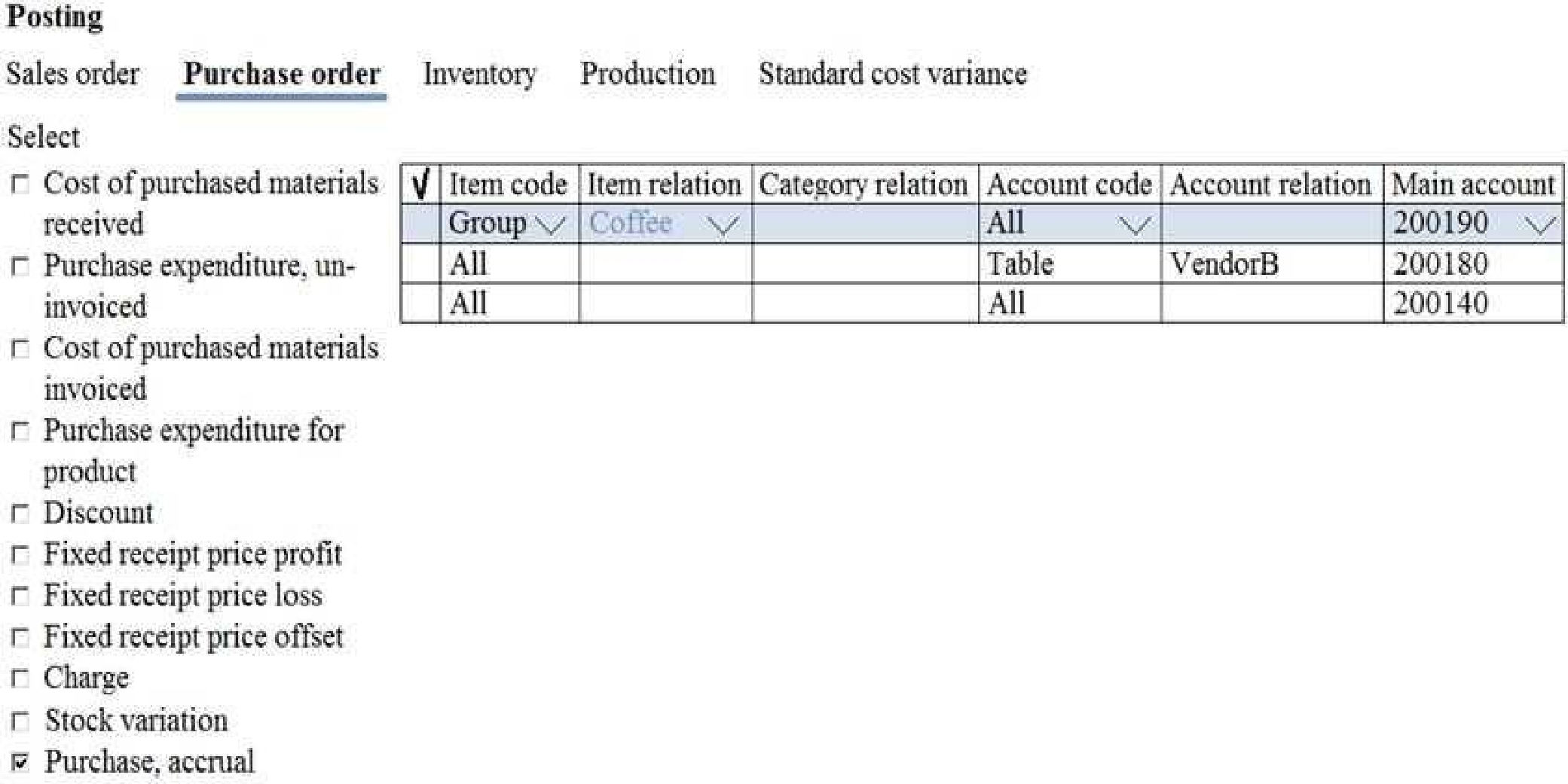
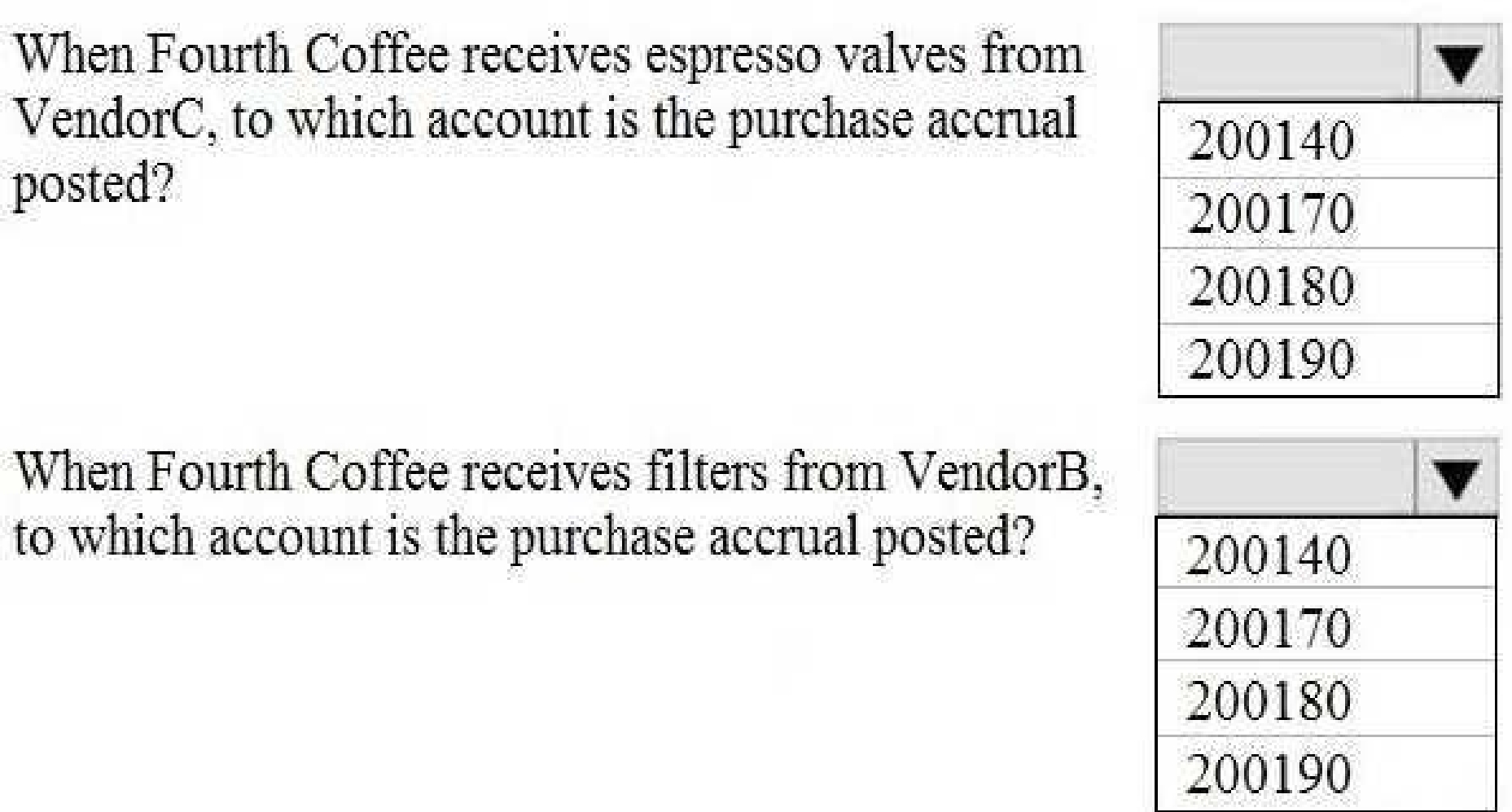
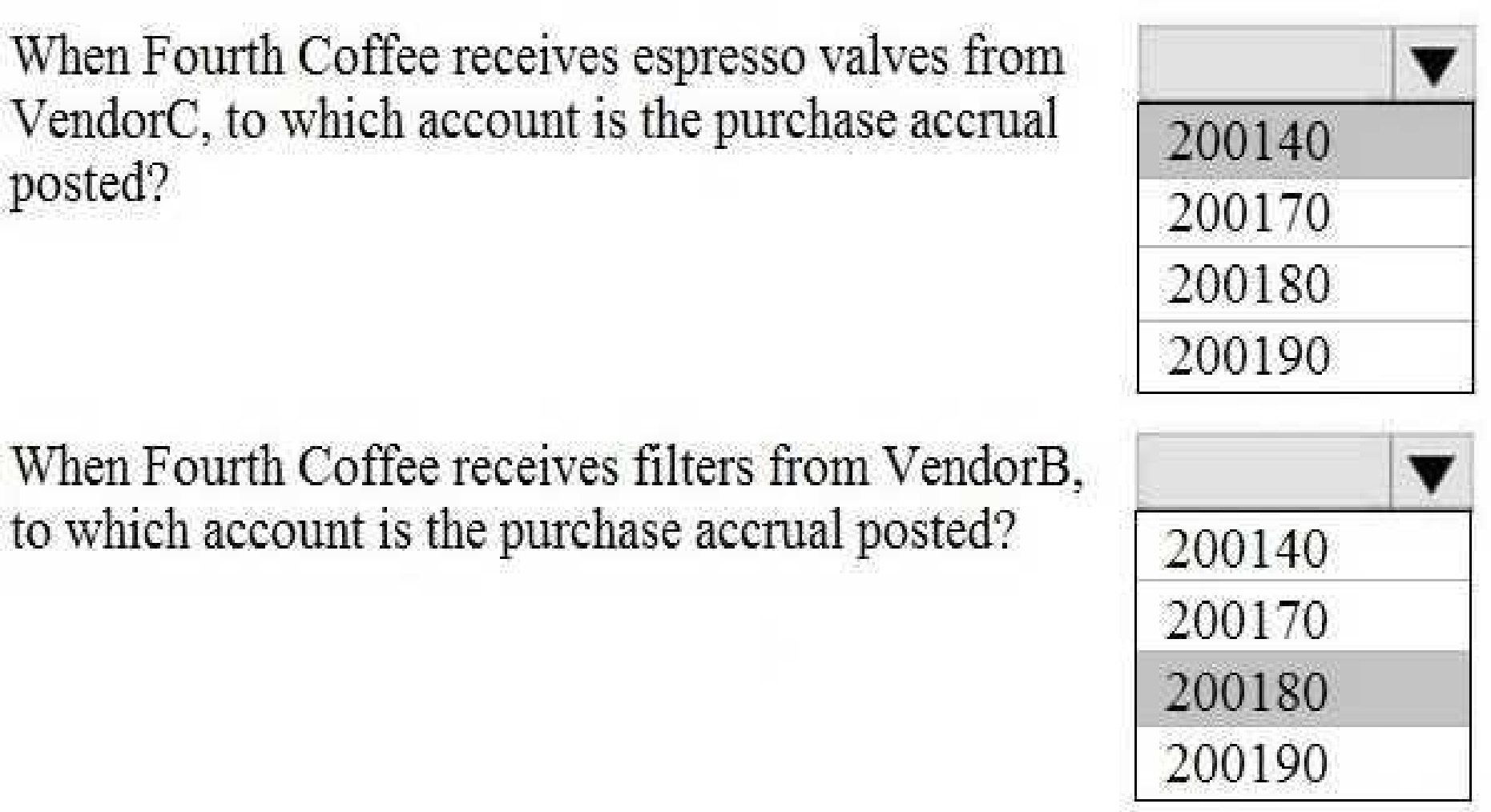
Use the drop-down menus to select the answer choice that answers each question based on the
information presented in the graphic.
NOTE: Each correct selection is worth one point.
MB-310: Microsoft Dynamics 365 Finance Practice test unlocks all online simulator questions
Thank you for choosing the free version of the MB-310: Microsoft Dynamics 365 Finance practice test! Further deepen your knowledge on Microsoft Simulator; by unlocking the full version of our MB-310: Microsoft Dynamics 365 Finance Simulator you will be able to take tests with over 345 constantly updated questions and easily pass your exam. 98% of people pass the exam in the first attempt after preparing with our 345 questions.
BUY NOWWhat to expect from our MB-310: Microsoft Dynamics 365 Finance practice tests and how to prepare for any exam?
The MB-310: Microsoft Dynamics 365 Finance Simulator Practice Tests are part of the Microsoft Database and are the best way to prepare for any MB-310: Microsoft Dynamics 365 Finance exam. The MB-310: Microsoft Dynamics 365 Finance practice tests consist of 345 questions and are written by experts to help you and prepare you to pass the exam on the first attempt. The MB-310: Microsoft Dynamics 365 Finance database includes questions from previous and other exams, which means you will be able to practice simulating past and future questions. Preparation with MB-310: Microsoft Dynamics 365 Finance Simulator will also give you an idea of the time it will take to complete each section of the MB-310: Microsoft Dynamics 365 Finance practice test . It is important to note that the MB-310: Microsoft Dynamics 365 Finance Simulator does not replace the classic MB-310: Microsoft Dynamics 365 Finance study guides; however, the Simulator provides valuable insights into what to expect and how much work needs to be done to prepare for the MB-310: Microsoft Dynamics 365 Finance exam.
BUY NOWMB-310: Microsoft Dynamics 365 Finance Practice test therefore represents an excellent tool to prepare for the actual exam together with our Microsoft practice test . Our MB-310: Microsoft Dynamics 365 Finance Simulator will help you assess your level of preparation and understand your strengths and weaknesses. Below you can read all the quizzes you will find in our MB-310: Microsoft Dynamics 365 Finance Simulator and how our unique MB-310: Microsoft Dynamics 365 Finance Database made up of real questions:
Info quiz:
- Quiz name:MB-310: Microsoft Dynamics 365 Finance
- Total number of questions:345
- Number of questions for the test:50
- Pass score:80%
You can prepare for the MB-310: Microsoft Dynamics 365 Finance exams with our mobile app. It is very easy to use and even works offline in case of network failure, with all the functions you need to study and practice with our MB-310: Microsoft Dynamics 365 Finance Simulator.
Use our Mobile App, available for both Android and iOS devices, with our MB-310: Microsoft Dynamics 365 Finance Simulator . You can use it anywhere and always remember that our mobile app is free and available on all stores.
Our Mobile App contains all MB-310: Microsoft Dynamics 365 Finance practice tests which consist of 345 questions and also provide study material to pass the final MB-310: Microsoft Dynamics 365 Finance exam with guaranteed success. Our MB-310: Microsoft Dynamics 365 Finance database contain hundreds of questions and Microsoft Tests related to MB-310: Microsoft Dynamics 365 Finance Exam. This way you can practice anywhere you want, even offline without the internet.
BUY NOW