Quiz MB-700: Microsoft Dynamics 365: Finance and Operations Apps Solution Architect
Quiz
Overview
This is a case study. Case studies are not timed separately. You can use as much exam time as you
would like to complete each case. However, there may be additional case studies and sections on
this exam. You must manage your time to ensure that you are able to complete all questions included
on this exam in the time provided.
To answer the questions included in a case study, you will need to reference information that is
provided in the case study. Case studies might contain exhibits and other resources that provide
more information about the scenario that is described in the case study. Each question is
independent of the other questions in this case study.
At the end of this case study, a review screen will appear. This screen allows you to review your
answers and to make changes before you move to the next section of the exam. After you begin a
new section, you cannot return to this section.
To start the case study
To display the first question in this case study, click the Next button. Use the buttons in the left pane
to explore the content of the case study before you answer the questions. Clicking these buttons
displays information such as business requirements, existing environment, and problem statements.
If the case study has an All Information tab, note that the information displayed is identical to the
information displayed on the subsequent tabs. When you are ready to answer a question, click the
Question button to return to the question.
Background
City Power and Light is a publicly traded electric utility company. The company has a corporate office,
four regional field offices, two subsidiary companies that produce solar energy, and one wind power
subsidiary. City Power and Light has 50 percent ownership in the solar energy company. The
company fully owns the wind power company but operates it separately from other businesses.
City Power and Light currently operates with varying integrated legacy systems and has difficulty
assembling company financials. Migrating these systems and workloads to a common platform
would improve visibility into the business and inform decision making. The company plans to
implement Dynamics 365.
Legacy systems
• The legacy system does not have audit capability of configurable workflow based on business logic
• The legacy paper-based purchasing system does not allow parent-child relationships for vendors.
Two signatures are required for purchase requisitions.
• Purchase orders are entered into the system manually based on signed purchase requisitions
printed to PDF and then emailed to the vendor.
• The legacy procurement system does not have a parent-child relationship for master data
management.
Financials
• All financial consolidate up to City Power and Light Holding, LLC.
• The finance department employees are currently able to create as well as pay invoices.
Customers
Sales orders from the website are uploaded into the system manually once a day .
International and domestic customers currently post to the same receivable account. At the end of
the month, these have to be separated into domestic and international receivable accounts.
Other information
• There are multiple active acquisitions expected during the implementation timeline.
• The item master data for solar panel configurations has multiple variables and variants. As a
complex.
General
• Flexible implementation approach to support frequently changing business needs and
requirements.
• A phased roll-out is needed due to the complexity of the business.
• Any offsite Travel meals submitted on an expense report without corresponding flight and hotel
expenses need to be reviewed.
• Ten percent of vendor invoices should be reviewed to ensure they meet company policy.
• Testing of business processes needs to be automated.
• Customer surveys must be sent out after email customer service interactions. Surveys must
contain a rating system and a way for customers to add comments.
• Employees require one central tool for internal communication, phone calls, and file sharing.
• Sales representatives need an enterprise quoting tool for solar panel customers.
Technical
• A cloud-based financial and operational system, accessible on mobile devices.
• The ability to keep a legacy meter reading application with the ability to use the data in aggregated
operating reports.
• Business processes should be tested with different variables for the same process as part of the
testing plan.
Functional
• Establish and document business processes to assist with on-boarding new employees more
efficiently.
• Parent-child relationships need to be established for vendors with regional offices. Purchasing
locations vary from invoicing locations.
• The ability to create automated wire payments.
Requisitions
• All purchase requisitions over $50 need to be approved by a manager.
• All purchase requisitions over $1,000 require senior manager approval.
• Multiple purchase requisitions to the same vendor should be combined.
Sales
The item master data for solar panel configurations have multiple variables and variants. This leads
to complex quoting and sales orders.
Sales representatives must be able to create automated wire payments.
Issues
• A limited number of users are available for testing.
• User1 reports that the date fields are not saving during formula entry with saved variables
functionality in the RSAT tool.
• The purchasing department is seeing duplicate vendor records during data conversion.
• Audit notes from the prior year indicate improvement is needed in roles and responsibilities
related to financial management and security roles.
• User2 reports that parts ordered on P0123 were never received and the vendor has said they
never received the PO.
• User3 provides feedback that important steps during journal entry are being forgotten and new
users need hands-on guidance.
• Service technicians report that they do not always have the appropriate tools or parts with them
requiring multiple service calls.
recommend?
Quiz
Overview
This is a case study. Case studies are not timed separately. You can use as much exam time as you
would like to complete each case. However, there may be additional case studies and sections on
this exam. You must manage your time to ensure that you are able to complete all questions included
on this exam in the time provided.
To answer the questions included in a case study, you will need to reference information that is
provided in the case study. Case studies might contain exhibits and other resources that provide
more information about the scenario that is described in the case study. Each question is
independent of the other questions in this case study.
At the end of this case study, a review screen will appear. This screen allows you to review your
answers and to make changes before you move to the next section of the exam. After you begin a
new section, you cannot return to this section.
To start the case study
To display the first question in this case study, click the Next button. Use the buttons in the left pane
to explore the content of the case study before you answer the questions. Clicking these buttons
displays information such as business requirements, existing environment, and problem statements.
If the case study has an All Information tab, note that the information displayed is identical to the
information displayed on the subsequent tabs. When you are ready to answer a question, click the
Question button to return to the question.
Background
City Power and Light is a publicly traded electric utility company. The company has a corporate office,
four regional field offices, two subsidiary companies that produce solar energy, and one wind power
subsidiary. City Power and Light has 50 percent ownership in the solar energy company. The
company fully owns the wind power company but operates it separately from other businesses.
City Power and Light currently operates with varying integrated legacy systems and has difficulty
assembling company financials. Migrating these systems and workloads to a common platform
would improve visibility into the business and inform decision making. The company plans to
implement Dynamics 365.
Legacy systems
• The legacy system does not have audit capability of configurable workflow based on business logic
• The legacy paper-based purchasing system does not allow parent-child relationships for vendors.
Two signatures are required for purchase requisitions.
• Purchase orders are entered into the system manually based on signed purchase requisitions
printed to PDF and then emailed to the vendor.
• The legacy procurement system does not have a parent-child relationship for master data
management.
Financials
• All financial consolidate up to City Power and Light Holding, LLC.
• The finance department employees are currently able to create as well as pay invoices.
Customers
Sales orders from the website are uploaded into the system manually once a day .
International and domestic customers currently post to the same receivable account. At the end of
the month, these have to be separated into domestic and international receivable accounts.
Other information
• There are multiple active acquisitions expected during the implementation timeline.
• The item master data for solar panel configurations has multiple variables and variants. As a
complex.
General
• Flexible implementation approach to support frequently changing business needs and
requirements.
• A phased roll-out is needed due to the complexity of the business.
• Any offsite Travel meals submitted on an expense report without corresponding flight and hotel
expenses need to be reviewed.
• Ten percent of vendor invoices should be reviewed to ensure they meet company policy.
• Testing of business processes needs to be automated.
• Customer surveys must be sent out after email customer service interactions. Surveys must
contain a rating system and a way for customers to add comments.
• Employees require one central tool for internal communication, phone calls, and file sharing.
• Sales representatives need an enterprise quoting tool for solar panel customers.
Technical
• A cloud-based financial and operational system, accessible on mobile devices.
• The ability to keep a legacy meter reading application with the ability to use the data in aggregated
operating reports.
• Business processes should be tested with different variables for the same process as part of the
testing plan.
Functional
• Establish and document business processes to assist with on-boarding new employees more
efficiently.
• Parent-child relationships need to be established for vendors with regional offices. Purchasing
locations vary from invoicing locations.
• The ability to create automated wire payments.
Requisitions
• All purchase requisitions over $50 need to be approved by a manager.
• All purchase requisitions over $1,000 require senior manager approval.
• Multiple purchase requisitions to the same vendor should be combined.
Sales
The item master data for solar panel configurations have multiple variables and variants. This leads
to complex quoting and sales orders.
Sales representatives must be able to create automated wire payments.
Issues
• A limited number of users are available for testing.
• User1 reports that the date fields are not saving during formula entry with saved variables
functionality in the RSAT tool.
• The purchasing department is seeing duplicate vendor records during data conversion.
• Audit notes from the prior year indicate improvement is needed in roles and responsibilities
related to financial management and security roles.
• User2 reports that parts ordered on P0123 were never received and the vendor has said they
never received the PO.
• User3 provides feedback that important steps during journal entry are being forgotten and new
users need hands-on guidance.
• Service technicians report that they do not always have the appropriate tools or parts with them
requiring multiple service calls.
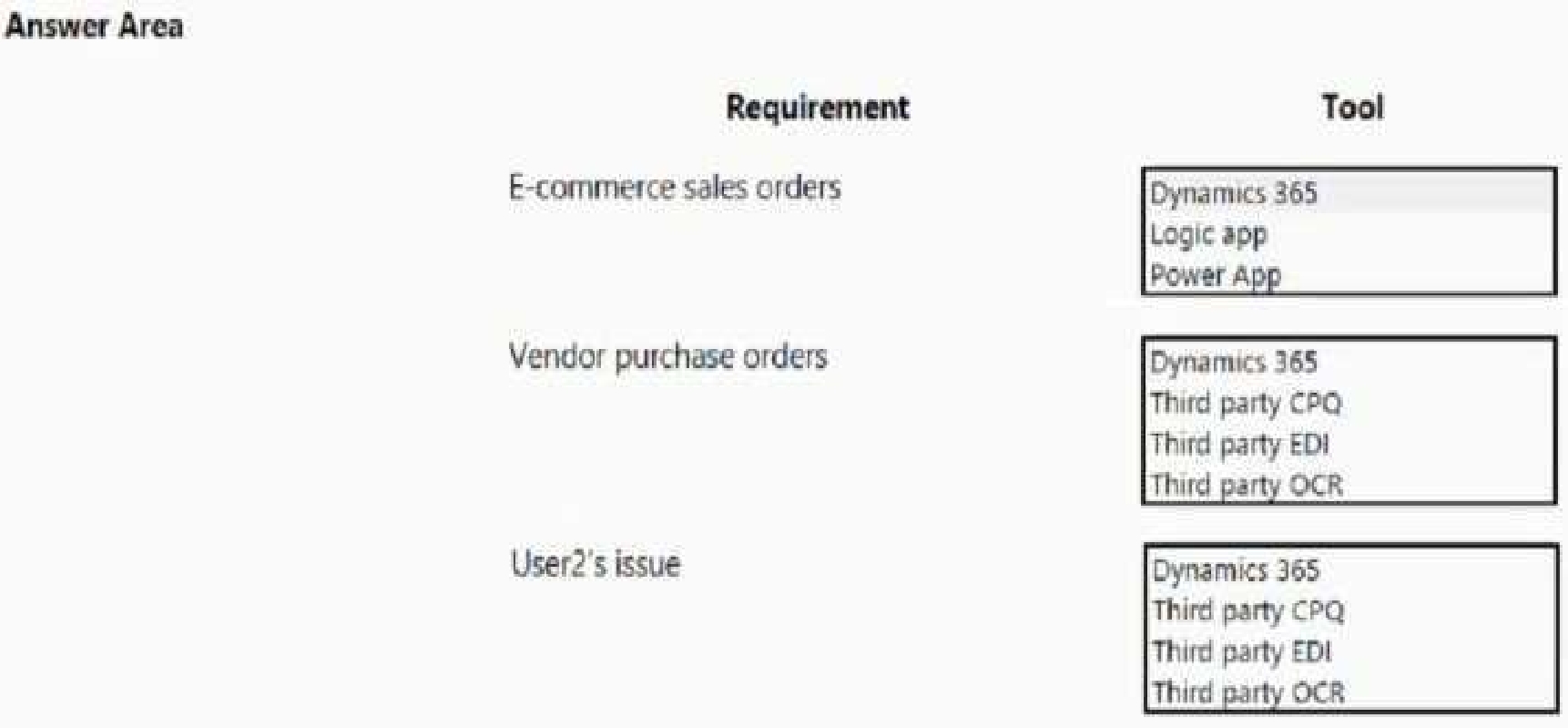
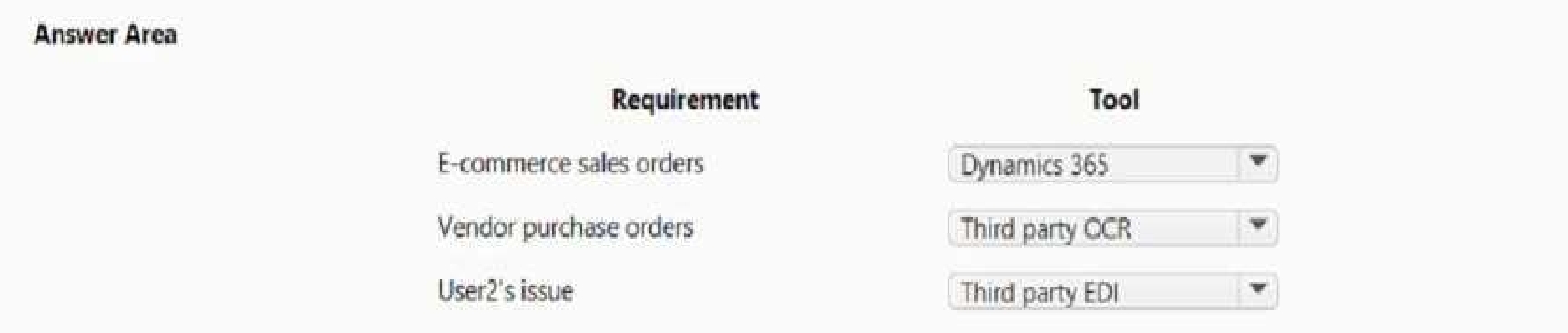
Which tool should you recommend for each requirement? To answer, select the appropriate options
in the answer area.
NOTE: Each correct selection is worth one point.

Quiz
Overview
This is a case study. Case studies are not timed separately. You can use as much exam time as you
would like to complete each case. However, there may be additional case studies and sections on
this exam. You must manage your time to ensure that you are able to complete all questions included
on this exam in the time provided.
To answer the questions included in a case study, you will need to reference information that is
provided in the case study. Case studies might contain exhibits and other resources that provide
more information about the scenario that is described in the case study. Each question is
independent of the other questions in this case study.
At the end of this case study, a review screen will appear. This screen allows you to review your
answers and to make changes before you move to the next section of the exam. After you begin a
new section, you cannot return to this section.
To start the case study
To display the first question in this case study, click the Next button. Use the buttons in the left pane
to explore the content of the case study before you answer the questions. Clicking these buttons
displays information such as business requirements, existing environment, and problem statements.
If the case study has an All Information tab, note that the information displayed is identical to the
information displayed on the subsequent tabs. When you are ready to answer a question, click the
Question button to return to the question.
Background
City Power and Light is a publicly traded electric utility company. The company has a corporate office,
four regional field offices, two subsidiary companies that produce solar energy, and one wind power
subsidiary. City Power and Light has 50 percent ownership in the solar energy company. The
company fully owns the wind power company but operates it separately from other businesses.
City Power and Light currently operates with varying integrated legacy systems and has difficulty
assembling company financials. Migrating these systems and workloads to a common platform
would improve visibility into the business and inform decision making. The company plans to
implement Dynamics 365.
Legacy systems
• The legacy system does not have audit capability of configurable workflow based on business logic
• The legacy paper-based purchasing system does not allow parent-child relationships for vendors.
Two signatures are required for purchase requisitions.
• Purchase orders are entered into the system manually based on signed purchase requisitions
printed to PDF and then emailed to the vendor.
• The legacy procurement system does not have a parent-child relationship for master data
management.
Financials
• All financial consolidate up to City Power and Light Holding, LLC.
• The finance department employees are currently able to create as well as pay invoices.
Customers
Sales orders from the website are uploaded into the system manually once a day .
International and domestic customers currently post to the same receivable account. At the end of
the month, these have to be separated into domestic and international receivable accounts.
Other information
• There are multiple active acquisitions expected during the implementation timeline.
• The item master data for solar panel configurations has multiple variables and variants. As a
complex.
General
• Flexible implementation approach to support frequently changing business needs and
requirements.
• A phased roll-out is needed due to the complexity of the business.
• Any offsite Travel meals submitted on an expense report without corresponding flight and hotel
expenses need to be reviewed.
• Ten percent of vendor invoices should be reviewed to ensure they meet company policy.
• Testing of business processes needs to be automated.
• Customer surveys must be sent out after email customer service interactions. Surveys must
contain a rating system and a way for customers to add comments.
• Employees require one central tool for internal communication, phone calls, and file sharing.
• Sales representatives need an enterprise quoting tool for solar panel customers.
Technical
• A cloud-based financial and operational system, accessible on mobile devices.
• The ability to keep a legacy meter reading application with the ability to use the data in aggregated
operating reports.
• Business processes should be tested with different variables for the same process as part of the
testing plan.
Functional
• Establish and document business processes to assist with on-boarding new employees more
efficiently.
• Parent-child relationships need to be established for vendors with regional offices. Purchasing
locations vary from invoicing locations.
• The ability to create automated wire payments.
Requisitions
• All purchase requisitions over $50 need to be approved by a manager.
• All purchase requisitions over $1,000 require senior manager approval.
• Multiple purchase requisitions to the same vendor should be combined.
Sales
The item master data for solar panel configurations have multiple variables and variants. This leads
to complex quoting and sales orders.
Sales representatives must be able to create automated wire payments.
Issues
• A limited number of users are available for testing.
• User1 reports that the date fields are not saving during formula entry with saved variables
functionality in the RSAT tool.
• The purchasing department is seeing duplicate vendor records during data conversion.
• Audit notes from the prior year indicate improvement is needed in roles and responsibilities
related to financial management and security roles.
• User2 reports that parts ordered on P0123 were never received and the vendor has said they
never received the PO.
• User3 provides feedback that important steps during journal entry are being forgotten and new
users need hands-on guidance.
• Service technicians report that they do not always have the appropriate tools or parts with them
requiring multiple service calls.
You need to determine which system functionality meets the business requirement.
What should you recommend? To answer, drag the appropriate functionalities to the correct
requirements. Each functionality may be used once, more than once, or not at all. You may need to
drag the split bar between panes or scroll to view content
NOTE: Each correct selection is worth one point.

Quiz
Overview
This is a case study. Case studies are not timed separately. You can use as much exam time as you
would like to complete each case. However, there may be additional case studies and sections on
this exam. You must manage your time to ensure that you are able to complete all questions included
on this exam in the time provided.
To answer the questions included in a case study, you will need to reference information that is
provided in the case study. Case studies might contain exhibits and other resources that provide
more information about the scenario that is described in the case study. Each question is
independent of the other questions in this case study.
At the end of this case study, a review screen will appear. This screen allows you to review your
answers and to make changes before you move to the next section of the exam. After you begin a
new section, you cannot return to this section.
To start the case study
To display the first question in this case study, click the Next button. Use the buttons in the left pane
to explore the content of the case study before you answer the questions. Clicking these buttons
displays information such as business requirements, existing environment, and problem statements.
If the case study has an All Information tab, note that the information displayed is identical to the
information displayed on the subsequent tabs. When you are ready to answer a question, click the
Question button to return to the question.
Background
City Power and Light is a publicly traded electric utility company. The company has a corporate office,
four regional field offices, two subsidiary companies that produce solar energy, and one wind power
subsidiary. City Power and Light has 50 percent ownership in the solar energy company. The
company fully owns the wind power company but operates it separately from other businesses.
City Power and Light currently operates with varying integrated legacy systems and has difficulty
assembling company financials. Migrating these systems and workloads to a common platform
would improve visibility into the business and inform decision making. The company plans to
implement Dynamics 365.
Legacy systems
• The legacy system does not have audit capability of configurable workflow based on business logic
• The legacy paper-based purchasing system does not allow parent-child relationships for vendors.
Two signatures are required for purchase requisitions.
• Purchase orders are entered into the system manually based on signed purchase requisitions
printed to PDF and then emailed to the vendor.
• The legacy procurement system does not have a parent-child relationship for master data
management.
Financials
• All financial consolidate up to City Power and Light Holding, LLC.
• The finance department employees are currently able to create as well as pay invoices.
Customers
Sales orders from the website are uploaded into the system manually once a day .
International and domestic customers currently post to the same receivable account. At the end of
the month, these have to be separated into domestic and international receivable accounts.
Other information
• There are multiple active acquisitions expected during the implementation timeline.
• The item master data for solar panel configurations has multiple variables and variants. As a
complex.
General
• Flexible implementation approach to support frequently changing business needs and
requirements.
• A phased roll-out is needed due to the complexity of the business.
• Any offsite Travel meals submitted on an expense report without corresponding flight and hotel
expenses need to be reviewed.
• Ten percent of vendor invoices should be reviewed to ensure they meet company policy.
• Testing of business processes needs to be automated.
• Customer surveys must be sent out after email customer service interactions. Surveys must
contain a rating system and a way for customers to add comments.
• Employees require one central tool for internal communication, phone calls, and file sharing.
• Sales representatives need an enterprise quoting tool for solar panel customers.
Technical
• A cloud-based financial and operational system, accessible on mobile devices.
• The ability to keep a legacy meter reading application with the ability to use the data in aggregated
operating reports.
• Business processes should be tested with different variables for the same process as part of the
testing plan.
Functional
• Establish and document business processes to assist with on-boarding new employees more
efficiently.
• Parent-child relationships need to be established for vendors with regional offices. Purchasing
locations vary from invoicing locations.
• The ability to create automated wire payments.
Requisitions
• All purchase requisitions over $50 need to be approved by a manager.
• All purchase requisitions over $1,000 require senior manager approval.
• Multiple purchase requisitions to the same vendor should be combined.
Sales
The item master data for solar panel configurations have multiple variables and variants. This leads
to complex quoting and sales orders.
Sales representatives must be able to create automated wire payments.
Issues
• A limited number of users are available for testing.
• User1 reports that the date fields are not saving during formula entry with saved variables
functionality in the RSAT tool.
• The purchasing department is seeing duplicate vendor records during data conversion.
• Audit notes from the prior year indicate improvement is needed in roles and responsibilities
related to financial management and security roles.
• User2 reports that parts ordered on P0123 were never received and the vendor has said they
never received the PO.
• User3 provides feedback that important steps during journal entry are being forgotten and new
users need hands-on guidance.
• Service technicians report that they do not always have the appropriate tools or parts with them
requiring multiple service calls.
Which three system capabilities should you recommend? Each correct answer presents part of the
solution.
NOTE: Each correct selection is worth one point.
Quiz
Overview
This is a case study. Case studies are not timed separately. You can use as much exam time as you
would like to complete each case. However, there may be additional case studies and sections on
this exam. You must manage your time to ensure that you are able to complete all questions included
on this exam in the time provided.
To answer the questions included in a case study, you will need to reference information that is
provided in the case study. Case studies might contain exhibits and other resources that provide
more information about the scenario that is described in the case study. Each question is
independent of the other questions in this case study.
At the end of this case study, a review screen will appear. This screen allows you to review your
answers and to make changes before you move to the next section of the exam. After you begin a
new section, you cannot return to this section.
To start the case study
To display the first question in this case study, click the Next button. Use the buttons in the left pane
to explore the content of the case study before you answer the questions. Clicking these buttons
displays information such as business requirements, existing environment, and problem statements.
If the case study has an All Information tab, note that the information displayed is identical to the
information displayed on the subsequent tabs. When you are ready to answer a question, click the
Question button to return to the question.
Background
City Power and Light is a publicly traded electric utility company. The company has a corporate office,
four regional field offices, two subsidiary companies that produce solar energy, and one wind power
subsidiary. City Power and Light has 50 percent ownership in the solar energy company. The
company fully owns the wind power company but operates it separately from other businesses.
City Power and Light currently operates with varying integrated legacy systems and has difficulty
assembling company financials. Migrating these systems and workloads to a common platform
would improve visibility into the business and inform decision making. The company plans to
implement Dynamics 365.
Legacy systems
• The legacy system does not have audit capability of configurable workflow based on business logic
• The legacy paper-based purchasing system does not allow parent-child relationships for vendors.
Two signatures are required for purchase requisitions.
• Purchase orders are entered into the system manually based on signed purchase requisitions
printed to PDF and then emailed to the vendor.
• The legacy procurement system does not have a parent-child relationship for master data
management.
Financials
• All financial consolidate up to City Power and Light Holding, LLC.
• The finance department employees are currently able to create as well as pay invoices.
Customers
Sales orders from the website are uploaded into the system manually once a day .
International and domestic customers currently post to the same receivable account. At the end of
the month, these have to be separated into domestic and international receivable accounts.
Other information
• There are multiple active acquisitions expected during the implementation timeline.
• The item master data for solar panel configurations has multiple variables and variants. As a
complex.
General
• Flexible implementation approach to support frequently changing business needs and
requirements.
• A phased roll-out is needed due to the complexity of the business.
• Any offsite Travel meals submitted on an expense report without corresponding flight and hotel
expenses need to be reviewed.
• Ten percent of vendor invoices should be reviewed to ensure they meet company policy.
• Testing of business processes needs to be automated.
• Customer surveys must be sent out after email customer service interactions. Surveys must
contain a rating system and a way for customers to add comments.
• Employees require one central tool for internal communication, phone calls, and file sharing.
• Sales representatives need an enterprise quoting tool for solar panel customers.
Technical
• A cloud-based financial and operational system, accessible on mobile devices.
• The ability to keep a legacy meter reading application with the ability to use the data in aggregated
operating reports.
• Business processes should be tested with different variables for the same process as part of the
testing plan.
Functional
• Establish and document business processes to assist with on-boarding new employees more
efficiently.
• Parent-child relationships need to be established for vendors with regional offices. Purchasing
locations vary from invoicing locations.
• The ability to create automated wire payments.
Requisitions
• All purchase requisitions over $50 need to be approved by a manager.
• All purchase requisitions over $1,000 require senior manager approval.
• Multiple purchase requisitions to the same vendor should be combined.
Sales
The item master data for solar panel configurations have multiple variables and variants. This leads
to complex quoting and sales orders.
Sales representatives must be able to create automated wire payments.
Issues
• A limited number of users are available for testing.
• User1 reports that the date fields are not saving during formula entry with saved variables
functionality in the RSAT tool.
• The purchasing department is seeing duplicate vendor records during data conversion.
• Audit notes from the prior year indicate improvement is needed in roles and responsibilities
related to financial management and security roles.
• User2 reports that parts ordered on P0123 were never received and the vendor has said they
never received the PO.
• User3 provides feedback that important steps during journal entry are being forgotten and new
users need hands-on guidance.
• Service technicians report that they do not always have the appropriate tools or parts with them
requiring multiple service calls.
concerns found in the prior year's audit. What should you do?
Quiz
Overview
This is a case study. Case studies are not timed separately. You can use as much exam time as you
would like to complete each case. However, there may be additional case studies and sections on
this exam. You must manage your time to ensure that you are able to complete all questions included
on this exam in the time provided.
To answer the questions included in a case study, you will need to reference information that is
provided in the case study. Case studies might contain exhibits and other resources that provide
more information about the scenario that is described in the case study. Each question is
independent of the other questions in this case study.
At the end of this case study, a review screen will appear. This screen allows you to review your
answers and to make changes before you move to the next section of the exam. After you begin a
new section, you cannot return to this section.
To start the case study
To display the first question in this case study, click the Next button. Use the buttons in the left pane
to explore the content of the case study before you answer the questions. Clicking these buttons
displays information such as business requirements, existing environment, and problem statements.
If the case study has an All Information tab, note that the information displayed is identical to the
information displayed on the subsequent tabs. When you are ready to answer a question, click the
Question button to return to the question.
Background
City Power and Light is a publicly traded electric utility company. The company has a corporate office,
four regional field offices, two subsidiary companies that produce solar energy, and one wind power
subsidiary. City Power and Light has 50 percent ownership in the solar energy company. The
company fully owns the wind power company but operates it separately from other businesses.
City Power and Light currently operates with varying integrated legacy systems and has difficulty
assembling company financials. Migrating these systems and workloads to a common platform
would improve visibility into the business and inform decision making. The company plans to
implement Dynamics 365.
Legacy systems
• The legacy system does not have audit capability of configurable workflow based on business logic
• The legacy paper-based purchasing system does not allow parent-child relationships for vendors.
Two signatures are required for purchase requisitions.
• Purchase orders are entered into the system manually based on signed purchase requisitions
printed to PDF and then emailed to the vendor.
• The legacy procurement system does not have a parent-child relationship for master data
management.
Financials
• All financial consolidate up to City Power and Light Holding, LLC.
• The finance department employees are currently able to create as well as pay invoices.
Customers
Sales orders from the website are uploaded into the system manually once a day .
International and domestic customers currently post to the same receivable account. At the end of
the month, these have to be separated into domestic and international receivable accounts.
Other information
• There are multiple active acquisitions expected during the implementation timeline.
• The item master data for solar panel configurations has multiple variables and variants. As a
complex.
General
• Flexible implementation approach to support frequently changing business needs and
requirements.
• A phased roll-out is needed due to the complexity of the business.
• Any offsite Travel meals submitted on an expense report without corresponding flight and hotel
expenses need to be reviewed.
• Ten percent of vendor invoices should be reviewed to ensure they meet company policy.
• Testing of business processes needs to be automated.
• Customer surveys must be sent out after email customer service interactions. Surveys must
contain a rating system and a way for customers to add comments.
• Employees require one central tool for internal communication, phone calls, and file sharing.
• Sales representatives need an enterprise quoting tool for solar panel customers.
Technical
• A cloud-based financial and operational system, accessible on mobile devices.
• The ability to keep a legacy meter reading application with the ability to use the data in aggregated
operating reports.
• Business processes should be tested with different variables for the same process as part of the
testing plan.
Functional
• Establish and document business processes to assist with on-boarding new employees more
efficiently.
• Parent-child relationships need to be established for vendors with regional offices. Purchasing
locations vary from invoicing locations.
• The ability to create automated wire payments.
Requisitions
• All purchase requisitions over $50 need to be approved by a manager.
• All purchase requisitions over $1,000 require senior manager approval.
• Multiple purchase requisitions to the same vendor should be combined.
Sales
The item master data for solar panel configurations have multiple variables and variants. This leads
to complex quoting and sales orders.
Sales representatives must be able to create automated wire payments.
Issues
• A limited number of users are available for testing.
• User1 reports that the date fields are not saving during formula entry with saved variables
functionality in the RSAT tool.
• The purchasing department is seeing duplicate vendor records during data conversion.
• Audit notes from the prior year indicate improvement is needed in roles and responsibilities
related to financial management and security roles.
• User2 reports that parts ordered on P0123 were never received and the vendor has said they
never received the PO.
• User3 provides feedback that important steps during journal entry are being forgotten and new
users need hands-on guidance.
• Service technicians report that they do not always have the appropriate tools or parts with them
requiring multiple service calls.
and new user training. What should you recommend?
Quiz
Overview
This is a case study. Case studies are not timed separately. You can use as much exam time as you
would like to complete each case. However, there may be additional case studies and sections on
this exam. You must manage your time to ensure that you are able to complete all questions included
on this exam in the time provided.
To answer the questions included in a case study, you will need to reference information that is
provided in the case study. Case studies might contain exhibits and other resources that provide
more information about the scenario that is described in the case study. Each question is
independent of the other questions in this case study.
At the end of this case study, a review screen will appear. This screen allows you to review your
answers and to make changes before you move to the next section of the exam. After you begin a
new section, you cannot return to this section.
To start the case study
To display the first question in this case study, click the Next button. Use the buttons in the left pane
to explore the content of the case study before you answer the questions. Clicking these buttons
displays information such as business requirements, existing environment, and problem statements.
If the case study has an All Information tab, note that the information displayed is identical to the
information displayed on the subsequent tabs. When you are ready to answer a question, click the
Question button to return to the question.
Background
City Power and Light is a publicly traded electric utility company. The company has a corporate office,
four regional field offices, two subsidiary companies that produce solar energy, and one wind power
subsidiary. City Power and Light has 50 percent ownership in the solar energy company. The
company fully owns the wind power company but operates it separately from other businesses.
City Power and Light currently operates with varying integrated legacy systems and has difficulty
assembling company financials. Migrating these systems and workloads to a common platform
would improve visibility into the business and inform decision making. The company plans to
implement Dynamics 365.
Legacy systems
• The legacy system does not have audit capability of configurable workflow based on business logic
• The legacy paper-based purchasing system does not allow parent-child relationships for vendors.
Two signatures are required for purchase requisitions.
• Purchase orders are entered into the system manually based on signed purchase requisitions
printed to PDF and then emailed to the vendor.
• The legacy procurement system does not have a parent-child relationship for master data
management.
Financials
• All financial consolidate up to City Power and Light Holding, LLC.
• The finance department employees are currently able to create as well as pay invoices.
Customers
Sales orders from the website are uploaded into the system manually once a day .
International and domestic customers currently post to the same receivable account. At the end of
the month, these have to be separated into domestic and international receivable accounts.
Other information
• There are multiple active acquisitions expected during the implementation timeline.
• The item master data for solar panel configurations has multiple variables and variants. As a
complex.
General
• Flexible implementation approach to support frequently changing business needs and
requirements.
• A phased roll-out is needed due to the complexity of the business.
• Any offsite Travel meals submitted on an expense report without corresponding flight and hotel
expenses need to be reviewed.
• Ten percent of vendor invoices should be reviewed to ensure they meet company policy.
• Testing of business processes needs to be automated.
• Customer surveys must be sent out after email customer service interactions. Surveys must
contain a rating system and a way for customers to add comments.
• Employees require one central tool for internal communication, phone calls, and file sharing.
• Sales representatives need an enterprise quoting tool for solar panel customers.
Technical
• A cloud-based financial and operational system, accessible on mobile devices.
• The ability to keep a legacy meter reading application with the ability to use the data in aggregated
operating reports.
• Business processes should be tested with different variables for the same process as part of the
testing plan.
Functional
• Establish and document business processes to assist with on-boarding new employees more
efficiently.
• Parent-child relationships need to be established for vendors with regional offices. Purchasing
locations vary from invoicing locations.
• The ability to create automated wire payments.
Requisitions
• All purchase requisitions over $50 need to be approved by a manager.
• All purchase requisitions over $1,000 require senior manager approval.
• Multiple purchase requisitions to the same vendor should be combined.
Sales
The item master data for solar panel configurations have multiple variables and variants. This leads
to complex quoting and sales orders.
Sales representatives must be able to create automated wire payments.
Issues
• A limited number of users are available for testing.
• User1 reports that the date fields are not saving during formula entry with saved variables
functionality in the RSAT tool.
• The purchasing department is seeing duplicate vendor records during data conversion.
• Audit notes from the prior year indicate improvement is needed in roles and responsibilities
related to financial management and security roles.
• User2 reports that parts ordered on P0123 were never received and the vendor has said they
never received the PO.
• User3 provides feedback that important steps during journal entry are being forgotten and new
users need hands-on guidance.
• Service technicians report that they do not always have the appropriate tools or parts with them
requiring multiple service calls.
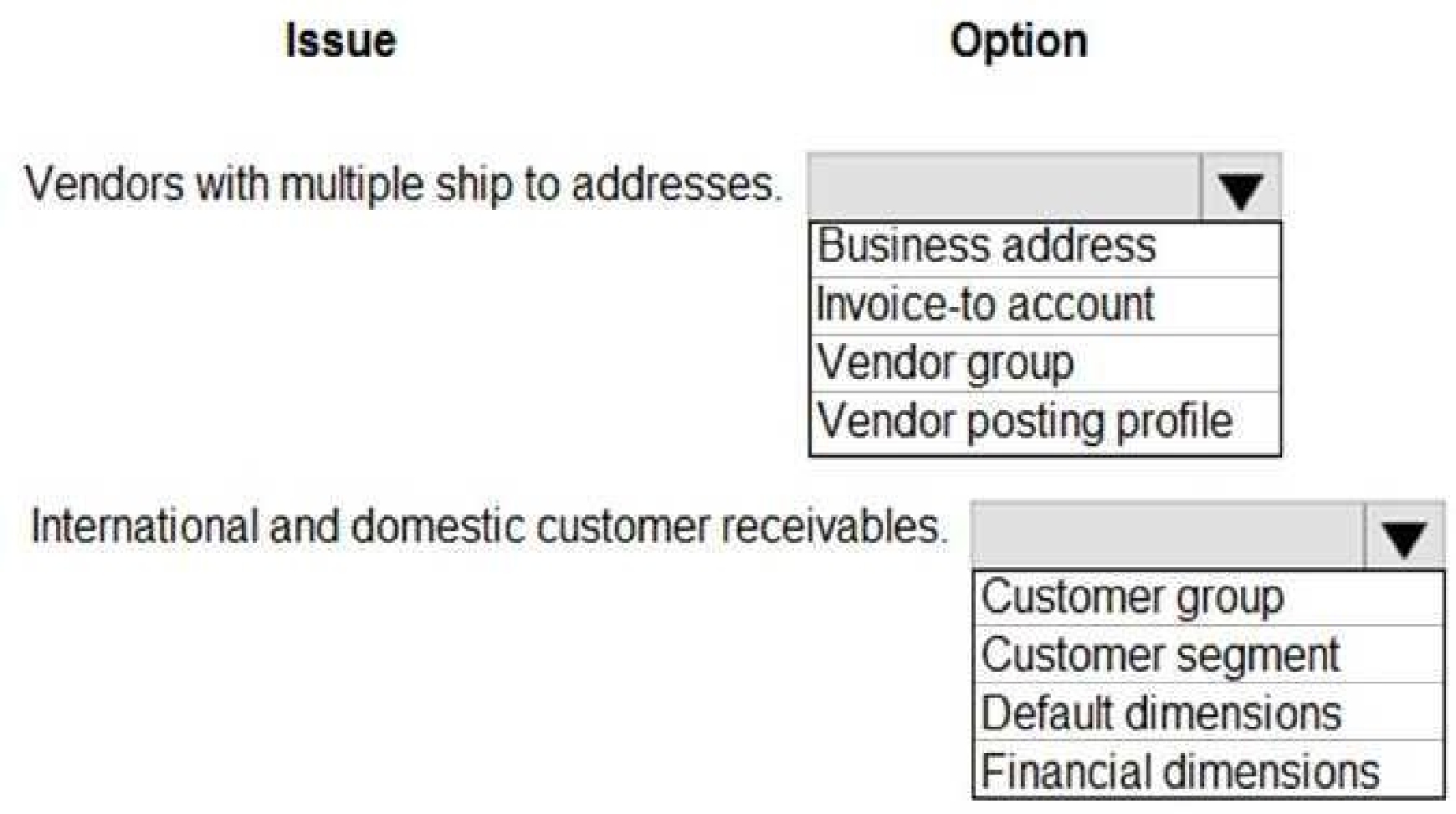
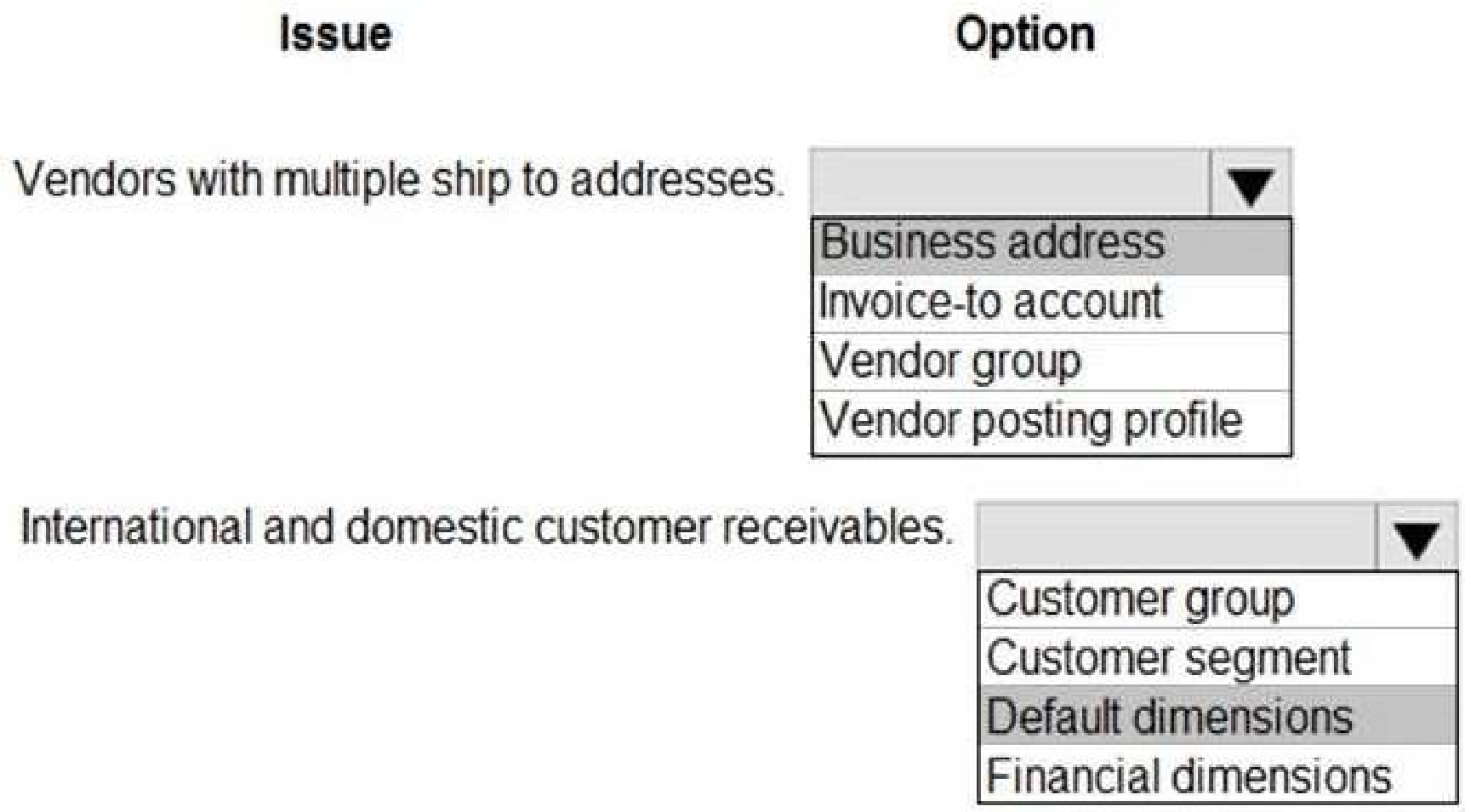
What should you recommend? To answer, select the appropriate options in the answer area.
NOTE: Each correct selection is worth one point.
Quiz
Overview
This is a case study. Case studies are not timed separately. You can use as much exam time as you
would like to complete each case. However, there may be additional case studies and sections on
this exam. You must manage your time to ensure that you are able to complete all questions included
on this exam in the time provided.
To answer the questions included in a case study, you will need to reference information that is
provided in the case study. Case studies might contain exhibits and other resources that provide
more information about the scenario that is described in the case study. Each question is
independent of the other questions in this case study.
At the end of this case study, a review screen will appear. This screen allows you to review your
answers and to make changes before you move to the next section of the exam. After you begin a
new section, you cannot return to this section.
To start the case study
To display the first question in this case study, click the Next button. Use the buttons in the left pane
to explore the content of the case study before you answer the questions. Clicking these buttons
displays information such as business requirements, existing environment, and problem statements.
If the case study has an All Information tab, note that the information displayed is identical to the
information displayed on the subsequent tabs. When you are ready to answer a question, click the
Question button to return to the question.
Background
City Power and Light is a publicly traded electric utility company. The company has a corporate office,
four regional field offices, two subsidiary companies that produce solar energy, and one wind power
subsidiary. City Power and Light has 50 percent ownership in the solar energy company. The
company fully owns the wind power company but operates it separately from other businesses.
City Power and Light currently operates with varying integrated legacy systems and has difficulty
assembling company financials. Migrating these systems and workloads to a common platform
would improve visibility into the business and inform decision making. The company plans to
implement Dynamics 365.
Legacy systems
• The legacy system does not have audit capability of configurable workflow based on business logic
• The legacy paper-based purchasing system does not allow parent-child relationships for vendors.
Two signatures are required for purchase requisitions.
• Purchase orders are entered into the system manually based on signed purchase requisitions
printed to PDF and then emailed to the vendor.
• The legacy procurement system does not have a parent-child relationship for master data
management.
Financials
• All financial consolidate up to City Power and Light Holding, LLC.
• The finance department employees are currently able to create as well as pay invoices.
Customers
Sales orders from the website are uploaded into the system manually once a day .
International and domestic customers currently post to the same receivable account. At the end of
the month, these have to be separated into domestic and international receivable accounts.
Other information
• There are multiple active acquisitions expected during the implementation timeline.
• The item master data for solar panel configurations has multiple variables and variants. As a
complex.
General
• Flexible implementation approach to support frequently changing business needs and
requirements.
• A phased roll-out is needed due to the complexity of the business.
• Any offsite Travel meals submitted on an expense report without corresponding flight and hotel
expenses need to be reviewed.
• Ten percent of vendor invoices should be reviewed to ensure they meet company policy.
• Testing of business processes needs to be automated.
• Customer surveys must be sent out after email customer service interactions. Surveys must
contain a rating system and a way for customers to add comments.
• Employees require one central tool for internal communication, phone calls, and file sharing.
• Sales representatives need an enterprise quoting tool for solar panel customers.
Technical
• A cloud-based financial and operational system, accessible on mobile devices.
• The ability to keep a legacy meter reading application with the ability to use the data in aggregated
operating reports.
• Business processes should be tested with different variables for the same process as part of the
testing plan.
Functional
• Establish and document business processes to assist with on-boarding new employees more
efficiently.
• Parent-child relationships need to be established for vendors with regional offices. Purchasing
locations vary from invoicing locations.
• The ability to create automated wire payments.
Requisitions
• All purchase requisitions over $50 need to be approved by a manager.
• All purchase requisitions over $1,000 require senior manager approval.
• Multiple purchase requisitions to the same vendor should be combined.
Sales
The item master data for solar panel configurations have multiple variables and variants. This leads
to complex quoting and sales orders.
Sales representatives must be able to create automated wire payments.
Issues
• A limited number of users are available for testing.
• User1 reports that the date fields are not saving during formula entry with saved variables
functionality in the RSAT tool.
• The purchasing department is seeing duplicate vendor records during data conversion.
• Audit notes from the prior year indicate improvement is needed in roles and responsibilities
related to financial management and security roles.
• User2 reports that parts ordered on P0123 were never received and the vendor has said they
never received the PO.
• User3 provides feedback that important steps during journal entry are being forgotten and new
users need hands-on guidance.
• Service technicians report that they do not always have the appropriate tools or parts with them
requiring multiple service calls.
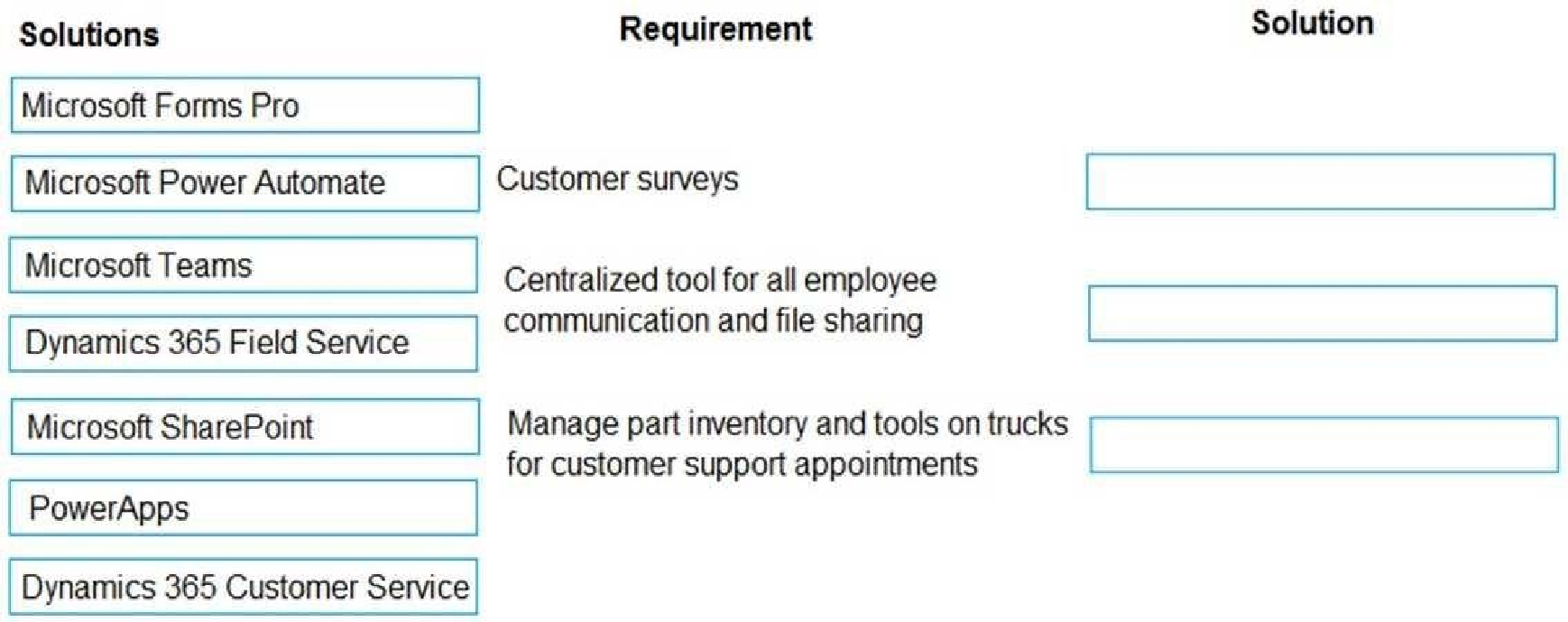
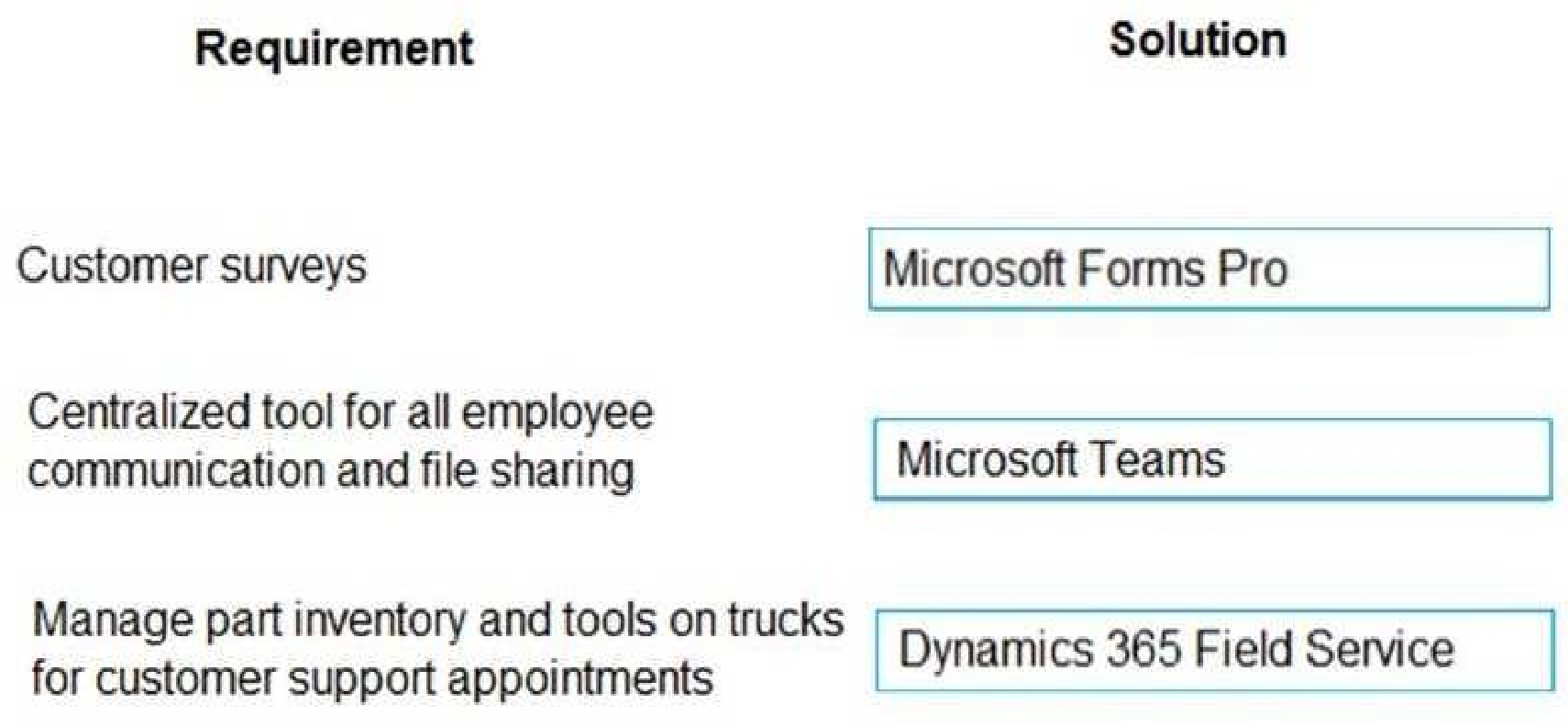
You need to recommend Microsoft solutions for City Power and Light’s business requirements.
What should you recommend? To answer, drag the appropriate solutions to the correct
requirements. Each solution may be used once, more than once, or not at all. You may need to drag
the split bar between panes or scroll to view content.
NOTE: Each correct selection is worth one point.
Quiz
Overview
This is a case study. Case studies are not timed separately. You can use as much exam time as you
would like to complete each case. However, there may be additional case studies and sections on
this exam. You must manage your time to ensure that you are able to complete all questions included
on this exam in the time provided.
To answer the questions included in a case study, you will need to reference information that is
provided in the case study. Case studies might contain exhibits and other resources that provide
more information about the scenario that is described in the case study. Each question is
independent of the other questions in this case study.
At the end of this case study, a review screen will appear. This screen allows you to review your
answers and to make changes before you move to the next section of the exam. After you begin a
new section, you cannot return to this section.
To start the case study
To display the first question in this case study, click the Next button. Use the buttons in the left pane
to explore the content of the case study before you answer the questions. Clicking these buttons
displays information such as business requirements, existing environment, and problem statements.
If the case study has an All Information tab, note that the information displayed is identical to the
information displayed on the subsequent tabs. When you are ready to answer a question, click the
Question button to return to the question.
Background
City Power and Light is a publicly traded electric utility company. The company has a corporate office,
four regional field offices, two subsidiary companies that produce solar energy, and one wind power
subsidiary. City Power and Light has 50 percent ownership in the solar energy company. The
company fully owns the wind power company but operates it separately from other businesses.
City Power and Light currently operates with varying integrated legacy systems and has difficulty
assembling company financials. Migrating these systems and workloads to a common platform
would improve visibility into the business and inform decision making. The company plans to
implement Dynamics 365.
Legacy systems
• The legacy system does not have audit capability of configurable workflow based on business logic
• The legacy paper-based purchasing system does not allow parent-child relationships for vendors.
Two signatures are required for purchase requisitions.
• Purchase orders are entered into the system manually based on signed purchase requisitions
printed to PDF and then emailed to the vendor.
• The legacy procurement system does not have a parent-child relationship for master data
management.
Financials
• All financial consolidate up to City Power and Light Holding, LLC.
• The finance department employees are currently able to create as well as pay invoices.
Customers
Sales orders from the website are uploaded into the system manually once a day .
International and domestic customers currently post to the same receivable account. At the end of
the month, these have to be separated into domestic and international receivable accounts.
Other information
• There are multiple active acquisitions expected during the implementation timeline.
• The item master data for solar panel configurations has multiple variables and variants. As a
complex.
General
• Flexible implementation approach to support frequently changing business needs and
requirements.
• A phased roll-out is needed due to the complexity of the business.
• Any offsite Travel meals submitted on an expense report without corresponding flight and hotel
expenses need to be reviewed.
• Ten percent of vendor invoices should be reviewed to ensure they meet company policy.
• Testing of business processes needs to be automated.
• Customer surveys must be sent out after email customer service interactions. Surveys must
contain a rating system and a way for customers to add comments.
• Employees require one central tool for internal communication, phone calls, and file sharing.
• Sales representatives need an enterprise quoting tool for solar panel customers.
Technical
• A cloud-based financial and operational system, accessible on mobile devices.
• The ability to keep a legacy meter reading application with the ability to use the data in aggregated
operating reports.
• Business processes should be tested with different variables for the same process as part of the
testing plan.
Functional
• Establish and document business processes to assist with on-boarding new employees more
efficiently.
• Parent-child relationships need to be established for vendors with regional offices. Purchasing
locations vary from invoicing locations.
• The ability to create automated wire payments.
Requisitions
• All purchase requisitions over $50 need to be approved by a manager.
• All purchase requisitions over $1,000 require senior manager approval.
• Multiple purchase requisitions to the same vendor should be combined.
Sales
The item master data for solar panel configurations have multiple variables and variants. This leads
to complex quoting and sales orders.
Sales representatives must be able to create automated wire payments.
Issues
• A limited number of users are available for testing.
• User1 reports that the date fields are not saving during formula entry with saved variables
functionality in the RSAT tool.
• The purchasing department is seeing duplicate vendor records during data conversion.
• Audit notes from the prior year indicate improvement is needed in roles and responsibilities
related to financial management and security roles.
• User2 reports that parts ordered on P0123 were never received and the vendor has said they
never received the PO.
• User3 provides feedback that important steps during journal entry are being forgotten and new
users need hands-on guidance.
• Service technicians report that they do not always have the appropriate tools or parts with them
requiring multiple service calls.
systems.
Which functionality should you recommend?
Quiz
Overview
This is a case study. Case studies are not timed separately. You can use as much exam time as you
would like to complete each case. However, there may be additional case studies and sections on
this exam. You must manage your time to ensure that you are able to complete all questions included
on this exam in the time provided.
To answer the questions included in a case study, you will need to reference information that is
provided in the case study. Case studies might contain exhibits and other resources that provide
more information about the scenario that is described in the case study. Each question is
independent of the other questions in this case study.
At the end of this case study, a review screen will appear. This screen allows you to review your
answers and to make changes before you move to the next section of the exam. After you begin a
new section, you cannot return to this section.
To start the case study
To display the first question in this case study, click the Next button. Use the buttons in the left pane
to explore the content of the case study before you answer the questions. Clicking these buttons
displays information such as business requirements, existing environment, and problem statements.
If the case study has an All Information tab, note that the information displayed is identical to the
information displayed on the subsequent tabs. When you are ready to answer a question, click the
Question button to return to the question.
Background
City Power and Light is a publicly traded electric utility company. The company has a corporate office,
four regional field offices, two subsidiary companies that produce solar energy, and one wind power
subsidiary. City Power and Light has 50 percent ownership in the solar energy company. The
company fully owns the wind power company but operates it separately from other businesses.
City Power and Light currently operates with varying integrated legacy systems and has difficulty
assembling company financials. Migrating these systems and workloads to a common platform
would improve visibility into the business and inform decision making. The company plans to
implement Dynamics 365.
Legacy systems
• The legacy system does not have audit capability of configurable workflow based on business logic
• The legacy paper-based purchasing system does not allow parent-child relationships for vendors.
Two signatures are required for purchase requisitions.
• Purchase orders are entered into the system manually based on signed purchase requisitions
printed to PDF and then emailed to the vendor.
• The legacy procurement system does not have a parent-child relationship for master data
management.
Financials
• All financial consolidate up to City Power and Light Holding, LLC.
• The finance department employees are currently able to create as well as pay invoices.
Customers
Sales orders from the website are uploaded into the system manually once a day .
International and domestic customers currently post to the same receivable account. At the end of
the month, these have to be separated into domestic and international receivable accounts.
Other information
• There are multiple active acquisitions expected during the implementation timeline.
• The item master data for solar panel configurations has multiple variables and variants. As a
complex.
General
• Flexible implementation approach to support frequently changing business needs and
requirements.
• A phased roll-out is needed due to the complexity of the business.
• Any offsite Travel meals submitted on an expense report without corresponding flight and hotel
expenses need to be reviewed.
• Ten percent of vendor invoices should be reviewed to ensure they meet company policy.
• Testing of business processes needs to be automated.
• Customer surveys must be sent out after email customer service interactions. Surveys must
contain a rating system and a way for customers to add comments.
• Employees require one central tool for internal communication, phone calls, and file sharing.
• Sales representatives need an enterprise quoting tool for solar panel customers.
Technical
• A cloud-based financial and operational system, accessible on mobile devices.
• The ability to keep a legacy meter reading application with the ability to use the data in aggregated
operating reports.
• Business processes should be tested with different variables for the same process as part of the
testing plan.
Functional
• Establish and document business processes to assist with on-boarding new employees more
efficiently.
• Parent-child relationships need to be established for vendors with regional offices. Purchasing
locations vary from invoicing locations.
• The ability to create automated wire payments.
Requisitions
• All purchase requisitions over $50 need to be approved by a manager.
• All purchase requisitions over $1,000 require senior manager approval.
• Multiple purchase requisitions to the same vendor should be combined.
Sales
The item master data for solar panel configurations have multiple variables and variants. This leads
to complex quoting and sales orders.
Sales representatives must be able to create automated wire payments.
Issues
• A limited number of users are available for testing.
• User1 reports that the date fields are not saving during formula entry with saved variables
functionality in the RSAT tool.
• The purchasing department is seeing duplicate vendor records during data conversion.
• Audit notes from the prior year indicate improvement is needed in roles and responsibilities
related to financial management and security roles.
• User2 reports that parts ordered on P0123 were never received and the vendor has said they
never received the PO.
• User3 provides feedback that important steps during journal entry are being forgotten and new
users need hands-on guidance.
• Service technicians report that they do not always have the appropriate tools or parts with them
requiring multiple service calls.
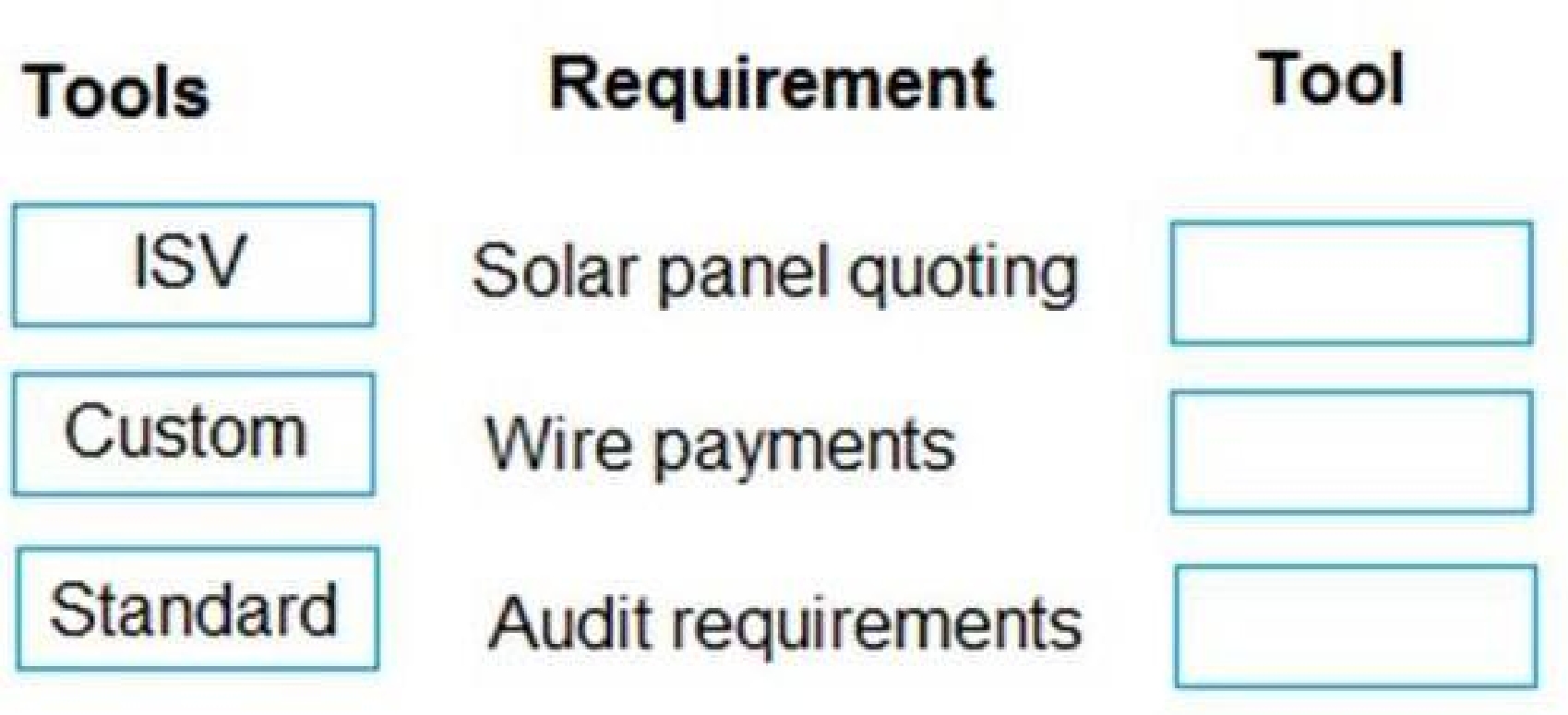
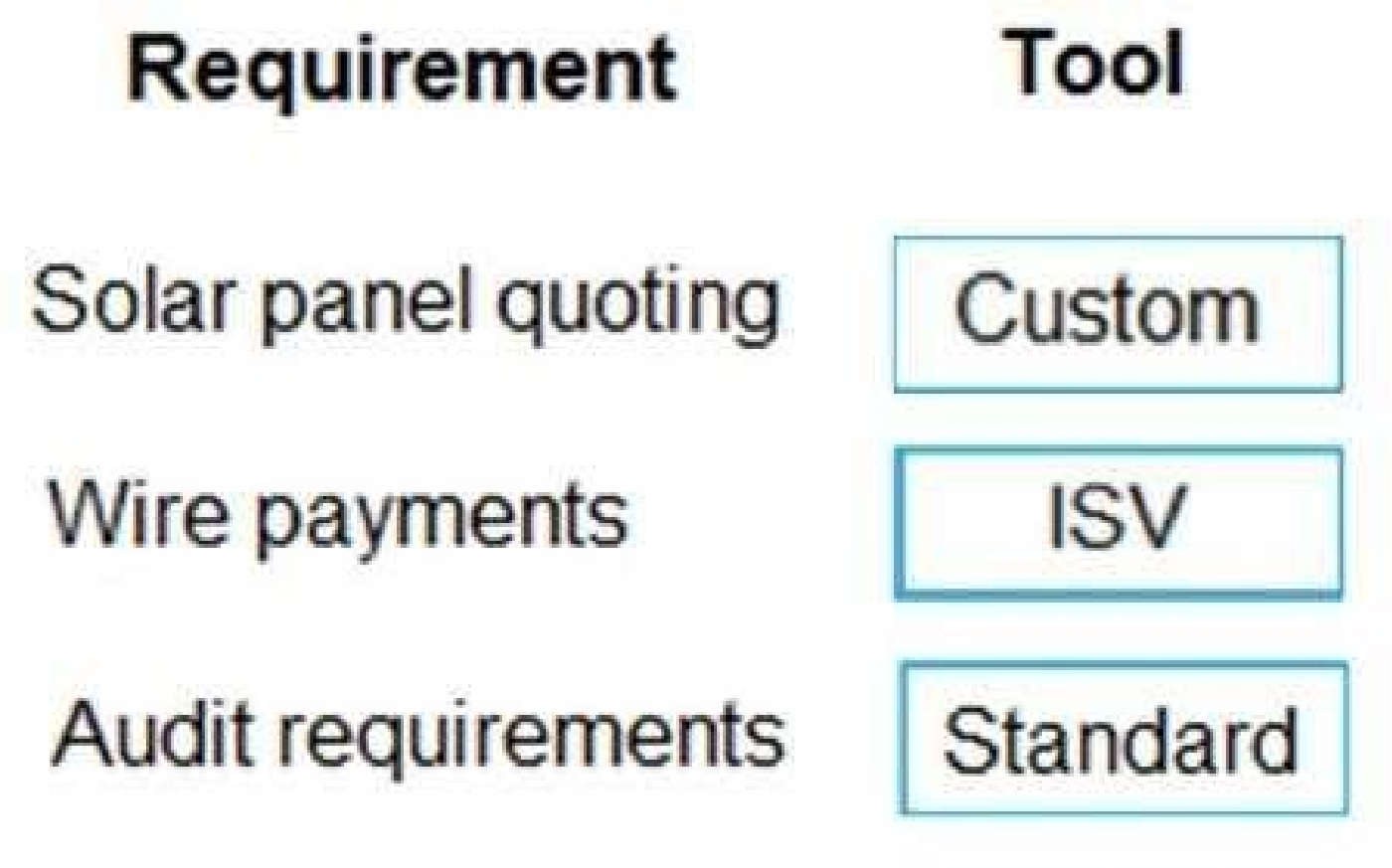
You need to recommend solutions for City Power and Light’s new system.
What should you recommend? To answer, drag the appropriate tools to the correct requirements.
Each tool may be used once, more than once, or not at all. You may need to drag the split bar
between panes or scroll to view content.
NOTE: Each correct selection is worth one point.
MB-700: Microsoft Dynamics 365: Finance and Operations Apps Solution Architect Practice test unlocks all online simulator questions
Thank you for choosing the free version of the MB-700: Microsoft Dynamics 365: Finance and Operations Apps Solution Architect practice test! Further deepen your knowledge on Microsoft Simulator; by unlocking the full version of our MB-700: Microsoft Dynamics 365: Finance and Operations Apps Solution Architect Simulator you will be able to take tests with over 322 constantly updated questions and easily pass your exam. 98% of people pass the exam in the first attempt after preparing with our 322 questions.
BUY NOWWhat to expect from our MB-700: Microsoft Dynamics 365: Finance and Operations Apps Solution Architect practice tests and how to prepare for any exam?
The MB-700: Microsoft Dynamics 365: Finance and Operations Apps Solution Architect Simulator Practice Tests are part of the Microsoft Database and are the best way to prepare for any MB-700: Microsoft Dynamics 365: Finance and Operations Apps Solution Architect exam. The MB-700: Microsoft Dynamics 365: Finance and Operations Apps Solution Architect practice tests consist of 322 questions and are written by experts to help you and prepare you to pass the exam on the first attempt. The MB-700: Microsoft Dynamics 365: Finance and Operations Apps Solution Architect database includes questions from previous and other exams, which means you will be able to practice simulating past and future questions. Preparation with MB-700: Microsoft Dynamics 365: Finance and Operations Apps Solution Architect Simulator will also give you an idea of the time it will take to complete each section of the MB-700: Microsoft Dynamics 365: Finance and Operations Apps Solution Architect practice test . It is important to note that the MB-700: Microsoft Dynamics 365: Finance and Operations Apps Solution Architect Simulator does not replace the classic MB-700: Microsoft Dynamics 365: Finance and Operations Apps Solution Architect study guides; however, the Simulator provides valuable insights into what to expect and how much work needs to be done to prepare for the MB-700: Microsoft Dynamics 365: Finance and Operations Apps Solution Architect exam.
BUY NOWMB-700: Microsoft Dynamics 365: Finance and Operations Apps Solution Architect Practice test therefore represents an excellent tool to prepare for the actual exam together with our Microsoft practice test . Our MB-700: Microsoft Dynamics 365: Finance and Operations Apps Solution Architect Simulator will help you assess your level of preparation and understand your strengths and weaknesses. Below you can read all the quizzes you will find in our MB-700: Microsoft Dynamics 365: Finance and Operations Apps Solution Architect Simulator and how our unique MB-700: Microsoft Dynamics 365: Finance and Operations Apps Solution Architect Database made up of real questions:
Info quiz:
- Quiz name:MB-700: Microsoft Dynamics 365: Finance and Operations Apps Solution Architect
- Total number of questions:322
- Number of questions for the test:50
- Pass score:80%
You can prepare for the MB-700: Microsoft Dynamics 365: Finance and Operations Apps Solution Architect exams with our mobile app. It is very easy to use and even works offline in case of network failure, with all the functions you need to study and practice with our MB-700: Microsoft Dynamics 365: Finance and Operations Apps Solution Architect Simulator.
Use our Mobile App, available for both Android and iOS devices, with our MB-700: Microsoft Dynamics 365: Finance and Operations Apps Solution Architect Simulator . You can use it anywhere and always remember that our mobile app is free and available on all stores.
Our Mobile App contains all MB-700: Microsoft Dynamics 365: Finance and Operations Apps Solution Architect practice tests which consist of 322 questions and also provide study material to pass the final MB-700: Microsoft Dynamics 365: Finance and Operations Apps Solution Architect exam with guaranteed success. Our MB-700: Microsoft Dynamics 365: Finance and Operations Apps Solution Architect database contain hundreds of questions and Microsoft Tests related to MB-700: Microsoft Dynamics 365: Finance and Operations Apps Solution Architect Exam. This way you can practice anywhere you want, even offline without the internet.
BUY NOW