The new flashcard feature is useful to memorize questions.
?Change your study mode
At any time, you can change the study mode, and alternate between the practice mode and the exam mode. In practice mode, you can configure for example the number of questions or tests, and other parameters to help you study.
Randomized | 10 Questions per Test | 20 Minutes | 70% to pass|
To re-configure your study mode again and change - for example - the number of tests, whether you have random questions and all other configuration parameters.
?Simulator Configuration
Auto-scroll: You can use the automatic scrolling of the questionnaire that occurs as soon as you answer one or all of the answers to a question correctly. Auto scrolling is activated if you answer a single answer, or as soon as you answer all the mandatory answers. Learning Mode: During learning mode you can get a real time result for your answer.
Free Test
Question: / 10
20:00Min. left
?Restart the current test
To restart the current test by clearing all your answers and the time used up to now. Warning: all answers will be lost.
Question: / 10
4.8(31 Votes)
Quiz
Question 1/101/10
For security reasons, you must track the access of files of a specific folder. In this scenario, what should you do to accomplish this task from the storage side?
Select the answer:Select the answer
1 correct answer
A.
Implement a Vscan solution.
B.
Use a cron job to save the audit log.
C.
Use role-based access control to track access.
D.
Implement an FPolicy solution.
The correct answer is D. Implement an FPolicy solution. FPolicy is a storage-side feature that can monitor file operations, such as opening, reading, writing, renaming, or deleting files. You can configure its policy scope to target a specific folder and track the relevant access events. Depending on the configuration, FPolicy can send event details to an external server or use supported native monitoring capabilities. Why the other options are incorrect: A. Implement a Vscan solution. Vscan is primarily used to scan files for viruses or malware. It is not the appropriate feature for tracking who accesses files in a particular folder. B. Use a cron job to save the audit log. A scheduled job might copy or preserve logs, but it does not itself monitor access to a specific folder. It is not a substitute for configuring file-access monitoring. C. Use role-based access control to track access. Role-based access control determines which users or administrators are allowed to perform actions. It manages permissions; it does not provide the required file-access tracking. Therefore, FPolicy is the appropriate storage-side solution for monitoring access to files in a specific folder.
Right Answer: D
Quiz
Question 2/102/10
You need to provide a customer an action plan to update an ONTAP system after a security bulletin has been issued. In this scenario, how do you accomplish this task?
Select the answer:Select the answer
1 correct answer
A.
Use the Interoperability Matrix Tool.
B.
Review the ONTAP 9 product page.
C.
Download the target version and do a pre-check.
D.
Use Upgrade Advisor on Active IQ.
The correct answer is C. Download the target ONTAP version and perform a pre-check. After a security bulletin identifies a version that contains the fix, the customer needs to plan an update to that target version. The pre-check evaluates the system’s readiness for the upgrade and can flag issues that should be addressed before the update, such as compatibility or configuration problems. This helps turn the security recommendation into a practical action plan. Why the other options are not the best answer: A. The Interoperability Matrix Tool is used to verify supported hardware and software combinations. It is useful during upgrade planning, but it does not perform the upgrade-readiness pre-check described here. B. The ONTAP 9 product page provides product information and resources, but reviewing it alone does not establish the system’s readiness to move to the target version. D. Upgrade Advisor in Active IQ can provide upgrade recommendations and planning guidance. However, for this scenario, the specified action is to obtain the target version and run a pre-check on the system.
Right Answer: C
Quiz
Question 3/103/10
What is the minimum number of compute nodes required to run the NetApp Deployment Engine for NetApp HCI?
Select the answer:Select the answer
1 correct answer
A.
2
B.
1
C.
3
D.
4
The correct answer is A. 2. NetApp Deployment Engine (NDE) requires at least two compute nodes for a NetApp HCI deployment. The nodes are configured together as part of the compute environment, providing the minimum cluster configuration expected by the deployment workflow. One compute node is not enough to meet that minimum. The requirement concerns compute nodes specifically; storage-node requirements are separate. Therefore, the minimum number of compute nodes is two.
Right Answer: A
Quiz
Question 4/104/10
Which NetApp technology enables you to perform block-based replication from NetApp Element software to Cloud Volumes ONTAP?
Select the answer:Select the answer
1 correct answer
A.
SyncMirror
B.
SnapMirror
C.
Cloud Sync
D.
MetroCluster
The correct answer is B. SnapMirror. SnapMirror enables replication from NetApp Element software to ONTAP systems, including Cloud Volumes ONTAP. It transfers volume data at the block level and can help protect workloads by keeping a replica in the cloud for recovery or other data-management purposes. The other options serve different purposes: A. SyncMirror mirrors data between disks or aggregates within an ONTAP system; it is not the technology used for Element-to-Cloud Volumes ONTAP replication. C. Cloud Sync is used to move or synchronize file and object data between supported storage locations, rather than to perform this block-based replication. D. MetroCluster provides site-level disaster recovery for ONTAP systems by maintaining a synchronized replica at a separate site. It is not the Element-to-Cloud Volumes ONTAP replication method.
Right Answer: B
Quiz
Question 5/105/10
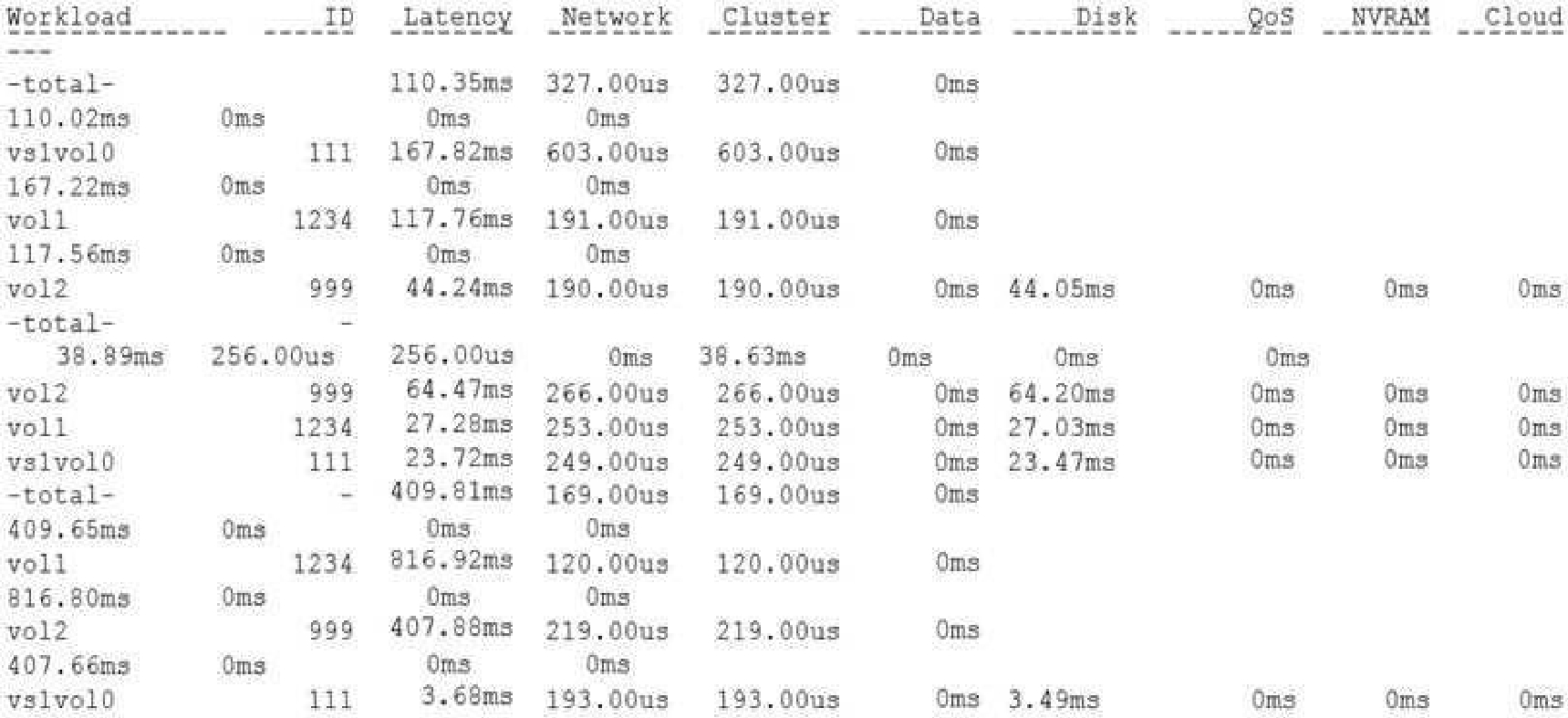
Referring to the exhibit, which two components should be examined? (Choose two.)
Select multiple answer: (Choose 2)Select the answer
2 correct answers
A.
cluster switches
B.
SAS adapter
C.
network interface card
D.
disk
The two components to examine are B. SAS adapter and D. disk. The exhibit indicates a problem in the storage path. The SAS adapter connects the storage system to its disks, so an adapter fault can interrupt disk access. A disk fault can also cause a storage problem and should be checked. Cluster switches and network interface cards handle network and cluster communication; they are not the components implicated by the storage-related indicators in the exhibit.
Right Answer: B, D
Quiz
Question 6/106/10
What are two reasons to use VLANs in a NetApp storage solution? (Choose two.)
Select multiple answer: (Choose 2)Select the answer
2 correct answers
A.
to isolate UDP traffic from TCP traffic
B.
to isolate management traffic from other IP traffic
C.
to isolate iSCSI traffic from NAS traffic
D.
to isolate FC traffic from other IP traffic
The intended answers are A and C. A. To isolate UDP traffic from TCP traffic VLANs place devices or interfaces into separate Layer 2 networks. If UDP-based and TCP-based services are assigned to different VLANs, their traffic can follow separate network paths and be managed independently. A VLAN does not identify or filter UDP and TCP by itself; the endpoints and network configuration must place the traffic on the appropriate VLANs. C. To isolate iSCSI traffic from NAS traffic iSCSI and NAS traffic can share Ethernet infrastructure, but they often have different performance, security, and operational requirements. Separate VLANs help keep the traffic logically separated and make it easier to apply distinct network policies. D is not a suitable choice because Fibre Channel uses a separate storage fabric rather than IP over Ethernet, so an Ethernet VLAN does not isolate FC traffic. One nuance: VLANs can also be used to separate management traffic in general networking, so B is technically plausible in many designs. The answer A, C reflects the intended choices for this NetApp question, not a claim that management traffic can never be placed on its own VLAN.
Right Answer: A, C
Quiz
Question 7/107/10
Which CIFS server configuration determines the domain controllers that a CIFS server uses?
Select the answer:Select the answer
1 correct answer
A.
site membership
B.
enabled SMB versions
C.
trusted domains
D.
discovery mode
The correct answer is A. site membership. A CIFS server’s site membership associates it with an Active Directory site. When the server locates domain controllers, it uses that site information to prefer domain controllers in the same site. Active Directory sites represent network locations and are associated with IP subnets, so this can help the CIFS server choose domain controllers that are nearby on the network. The other options affect different aspects of CIFS operation: B. Enabled SMB versions determine which SMB protocol versions the server supports, not which domain controllers it contacts. C. Trusted domains specify which other domains have trust relationships with the domain. They do not identify the domain controllers the CIFS server should use. D. Discovery mode concerns how the server discovers information or services; it does not define the server’s Active Directory site affiliation. Therefore, site membership determines which domain controllers the CIFS server is guided to use.
Right Answer: A
Quiz
Question 8/108/10
Which three techniques are used in ONTAP to improve storage efficiencies? (Choose three.)
Select multiple answer: (Choose 3)Select the answer
3 correct answers
A.
compression
B.
encryption
C.
compaction
D.
ADP
E.
thin provisioning
The correct answers are A, C, and E: compression, compaction, and thin provisioning. A. Compression reduces the physical space data occupies by encoding it more efficiently. ONTAP can apply compression to help store more data on the same amount of physical capacity. C. Compaction packs smaller data blocks together so they use storage blocks more efficiently. This reduces wasted space, especially when data does not fill a full block. E. Thin provisioning lets a volume or LUN present more logical capacity than is initially reserved on the physical storage. Physical space is consumed as data is written, helping avoid reserving unused capacity in advance. B. Encryption protects data from unauthorized access; it is a security feature rather than a storage-efficiency technique. D. ADP, or Advanced Drive Partitioning, partitions drives for use by ONTAP. It can help manage storage resources, but it is not one of the three efficiency techniques listed in this question.
Right Answer: A, C, E
Quiz
Question 9/109/10
You are working on a fabric MetroCluster. After a site failure, the plex starts to resync automatically to the aggregate mirror of Aggr1. The plex now shows a status of resyncing. During this process, you experience a slow resync of the SyncMirror plex. In this scenario, how do you solve the problem?
Select the answer:Select the answer
1 correct answer
A.
Add more disks to the aggregate to add more I/O capacity.
B.
Destroy and re-create plex, then run a baseline sync.
C.
Tune the resync speed by adding a QoS policy and limit the concurrent I/O to the aggregate.
D.
Tune the resync speed using the storage raid-options command.
The correct answer is C. Tune the resync speed by applying a QoS policy to limit competing I/O to the aggregate. During a SyncMirror resync, the system must copy changed data to the mirror plex while also handling normal workload I/O. If that workload is consuming much of the available I/O capacity, resync can progress slowly. A QoS policy can cap the competing workload, leaving more resources available for the resync and helping it complete sooner. Why the other options are less suitable: A. Adding disks increases aggregate capacity or may change its I/O capabilities, but it does not directly address contention from existing workload I/O. B. Destroying and recreating the plex would be disruptive and could require a full baseline synchronization. It is not an appropriate first response to a slow resync. D. The RAID options command configures RAID-related behavior; it is not the method described for addressing resync slowdown caused by competing workload I/O.
Right Answer: C
Quiz
Question 10/1010/10
When you replace a motherboard, which step will completely test the newly installed component?
Select the answer:Select the answer
1 correct answer
A.
From ONTAP, execute sldiag.
B.
From the LOADER prompt, type boot_ontap maint, then execute sldiag.
C.
From the LOADER prompt, type boot_diags, then execute sldiag.
D.
From the LOADER prompt, execute sldiag.
The correct answer is B. From the LOADER prompt, type `boot_ontap maint`, then execute `sldiag`. After a motherboard replacement, the system should be booted into ONTAP maintenance mode so the service-level diagnostics can test the newly installed hardware. At the LOADER prompt, `boot_ontap maint` starts that maintenance environment. Once it is running, you can execute `sldiag` to run the hardware diagnostics. Why the other options are incorrect: A. Running `sldiag` from ONTAP does not use the required maintenance-mode procedure for this test. C. `boot_diags` starts a diagnostics environment rather than booting ONTAP maintenance mode. The specified procedure is to use `boot_ontap maint` and then run `sldiag`. D. `sldiag` is not executed directly at the LOADER prompt. First boot into maintenance mode, then run the diagnostic command.
NS0-194: NetApp Certified Support Engineer (NCSE) Practice test unlocks all online simulator questions
Thank you for choosing the free version of the NS0-194: NetApp Certified Support Engineer (NCSE) practice test! Further deepen your knowledge on Netapp Simulator; by unlocking the full version of our NS0-194: NetApp Certified Support Engineer (NCSE) Simulator you will be able to take tests with over 60 constantly updated questions and easily pass your exam. 98% of people pass the exam in the first attempt after preparing with our 60 questions.
What to expect from our NS0-194: NetApp Certified Support Engineer (NCSE) practice tests and how to prepare for any exam?
The NS0-194: NetApp Certified Support Engineer (NCSE) Simulator Practice Tests are part of the Netapp Database and are the best way to prepare for any NS0-194: NetApp Certified Support Engineer (NCSE) exam. The NS0-194: NetApp Certified Support Engineer (NCSE) practice tests consist of 60 questions and are written by experts to help you and prepare you to pass the exam on the first attempt. The NS0-194: NetApp Certified Support Engineer (NCSE) database includes questions from previous and other exams, which means you will be able to practice simulating past and future questions. Preparation with NS0-194: NetApp Certified Support Engineer (NCSE) Simulator will also give you an idea of the time it will take to complete each section of the NS0-194: NetApp Certified Support Engineer (NCSE) practice test . It is important to note that the NS0-194: NetApp Certified Support Engineer (NCSE) Simulator does not replace the classic NS0-194: NetApp Certified Support Engineer (NCSE) study guides; however, the Simulator provides valuable insights into what to expect and how much work needs to be done to prepare for the NS0-194: NetApp Certified Support Engineer (NCSE) exam.
NS0-194: NetApp Certified Support Engineer (NCSE) Practice test therefore represents an excellent tool to prepare for the actual exam together with our Netapp practice test . Our NS0-194: NetApp Certified Support Engineer (NCSE) Simulator will help you assess your level of preparation and understand your strengths and weaknesses. Below you can read all the quizzes you will find in our NS0-194: NetApp Certified Support Engineer (NCSE) Simulator and how our unique NS0-194: NetApp Certified Support Engineer (NCSE) Database made up of real questions:
Info quiz:
Quiz name:NS0-194: NetApp Certified Support Engineer (NCSE)
Total number of questions:60
Number of questions for the test:50
Pass score:80%
You can prepare for the NS0-194: NetApp Certified Support Engineer (NCSE) exams with our mobile app. It is very easy to use and even works offline in case of network failure, with all the functions you need to study and practice with our NS0-194: NetApp Certified Support Engineer (NCSE) Simulator.
Use our Mobile App, available for both Android and iOS devices, with our NS0-194: NetApp Certified Support Engineer (NCSE) Simulator . You can use it anywhere and always remember that our mobile app is free and available on all stores.
Our Mobile App contains all NS0-194: NetApp Certified Support Engineer (NCSE) practice tests which consist of 60 questions and also provide study material to pass the final NS0-194: NetApp Certified Support Engineer (NCSE) exam with guaranteed success.
Our NS0-194: NetApp Certified Support Engineer (NCSE) database contain hundreds of questions and Netapp Tests related to NS0-194: NetApp Certified Support Engineer (NCSE) Exam. This way you can practice anywhere you want, even offline without the internet.