Quiz InsNV_Health02: Nevada Insurance Licensing NV Accident and Health
Quiz

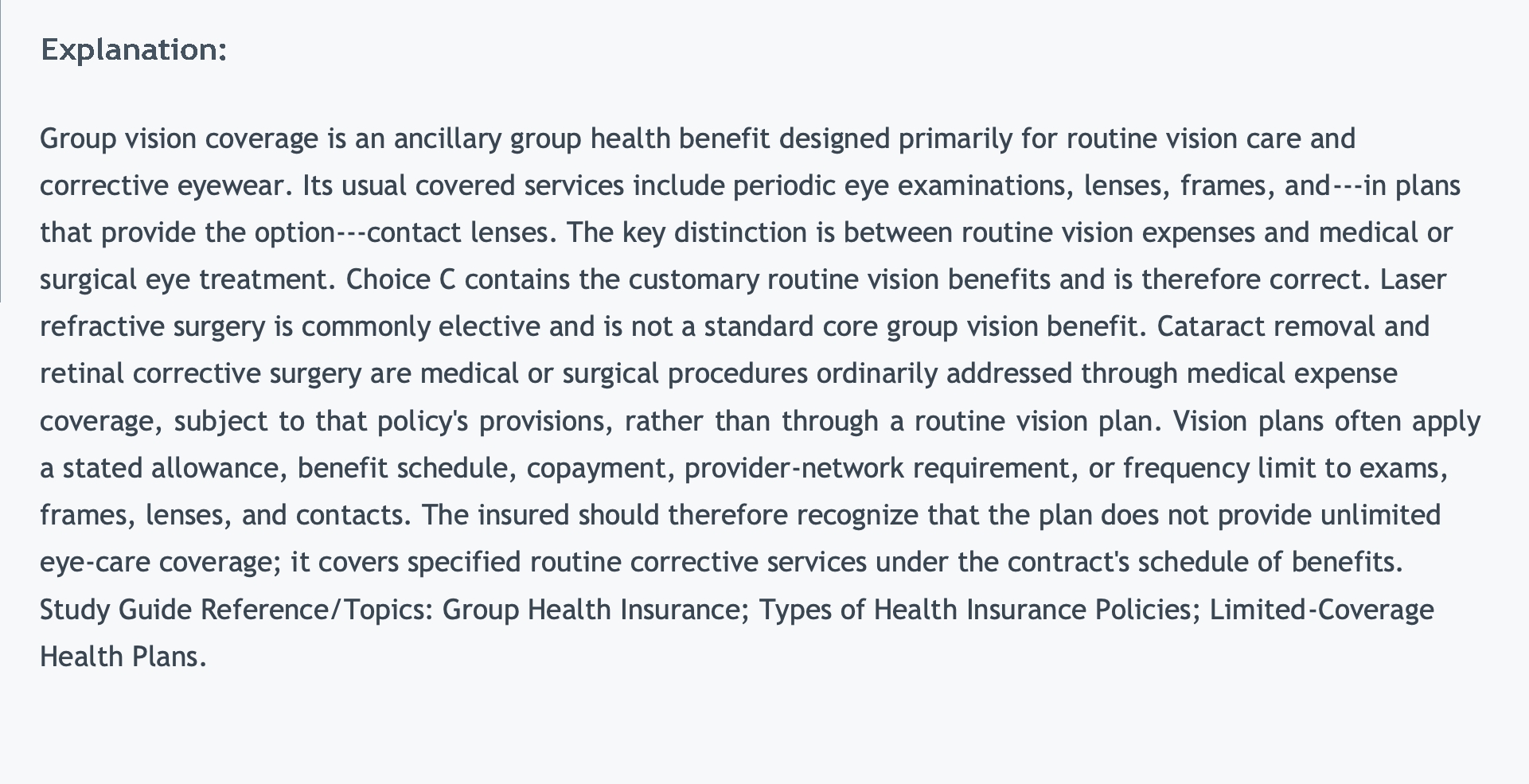
Nevada Insurance Licensing InsNV_Health02 COMPLETE STUDY GUIDE Page 8 of 149 Group vision coverage is an ancillary group health benefit designed primarily for routine vision care and corrective eyewear. Its usual covered services include periodic eye examinations, lenses, frames, and---in plans that provide the option---contact lenses. The key distinction is between routine vision expenses and medical or surgical eye treatment. Choice C contains the customary routine vision benefits and is therefore correct. Laser refractive surgery is commonly elective and is not a standard core group vision benefit. Cataract removal and retinal corrective surgery are medical or surgical procedures ordinarily addressed through medical expense coverage, subject to that policy's provisions, rather than through a routine vision plan. Vision plans often apply a stated allowance, benefit schedule, copayment, provider-network requirement, or frequency limit to exams, frames, lenses, and contacts. The insured should therefore recognize that the plan does not provide unlimited eye-care coverage; it covers specified routine corrective services under the contract's schedule of benefits. Study Guide Reference/Topics: Group Health Insurance; Types of Health Insurance Policies; Limited-Coverage Health Plans.
Quiz
Insurability rider?

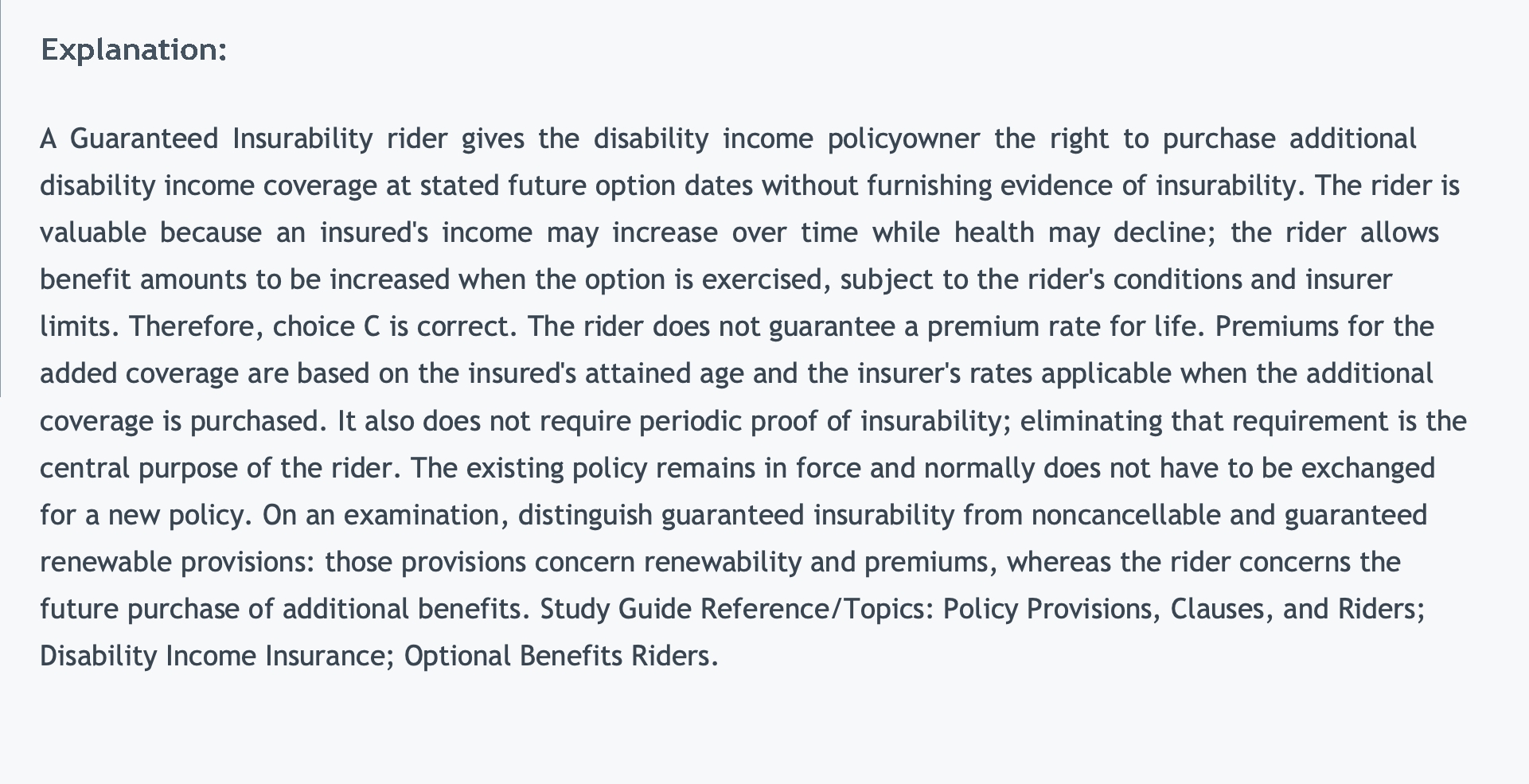
Nevada Insurance Licensing InsNV_Health02 COMPLETE STUDY GUIDE Page 9 of 149 A Guaranteed Insurability rider gives the disability income policyowner the right to purchase additional disability income coverage at stated future option dates without furnishing evidence of insurability. The rider is valuable because an insured's income may increase over time while health may decline; the rider allows benefit amounts to be increased when the option is exercised, subject to the rider's conditions and insurer limits. Therefore, choice C is correct. The rider does not guarantee a premium rate for life. Premiums for the added coverage are based on the insured's attained age and the insurer's rates applicable when the additional coverage is purchased. It also does not require periodic proof of insurability; eliminating that requirement is the central purpose of the rider. The existing policy remains in force and normally does not have to be exchanged for a new policy. On an examination, distinguish guaranteed insurability from noncancellable and guaranteed renewable provisions: those provisions concern renewability and premiums, whereas the rider concerns the future purchase of additional benefits. Study Guide Reference/Topics: Policy Provisions, Clauses, and Riders; Disability Income Insurance; Optional Benefits Riders.
Quiz
of being disabled should purchase which of the following riders?

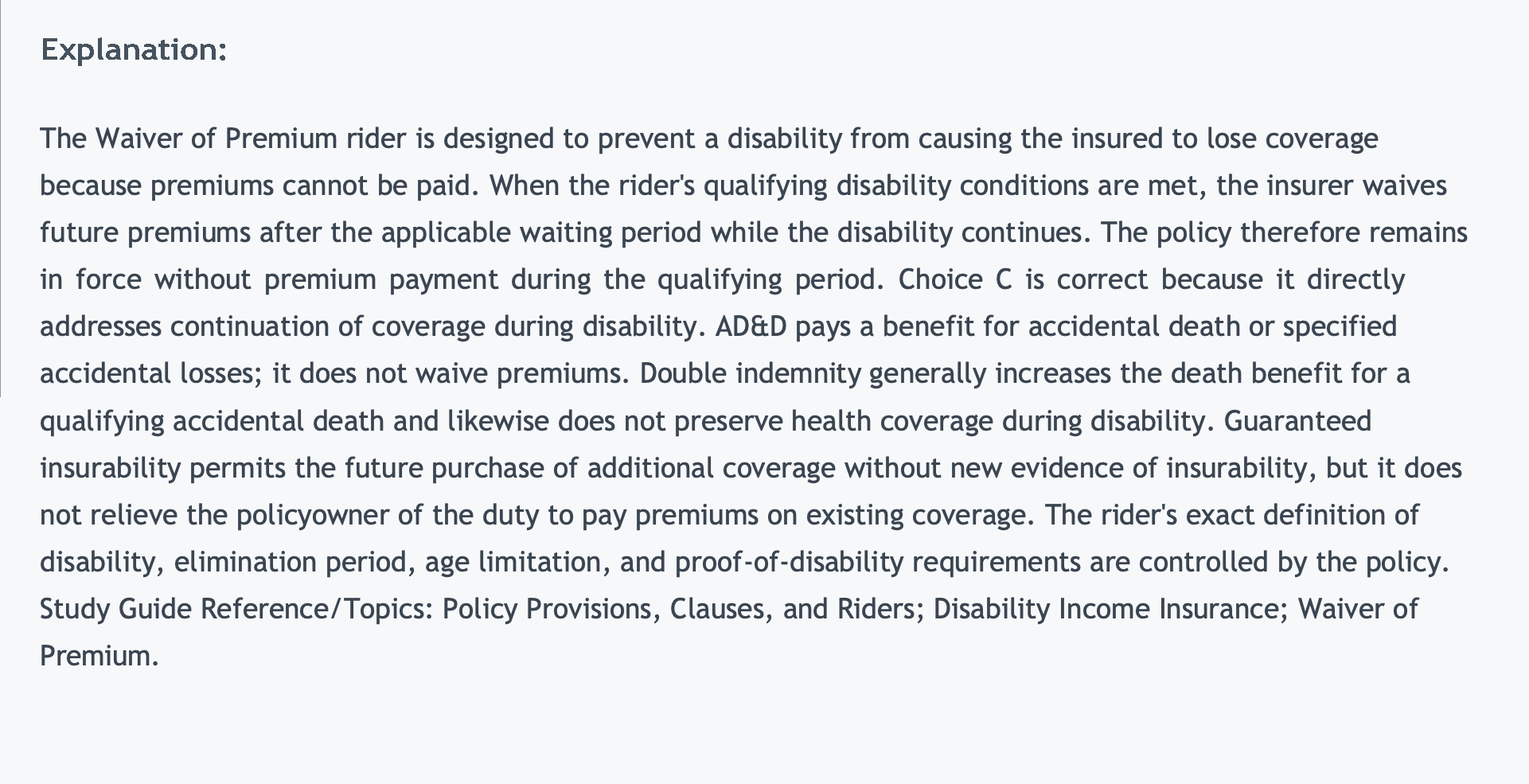
Nevada Insurance Licensing InsNV_Health02 COMPLETE STUDY GUIDE Page 10 of 149 The Waiver of Premium rider is designed to prevent a disability from causing the insured to lose coverage because premiums cannot be paid. When the rider's qualifying disability conditions are met, the insurer waives future premiums after the applicable waiting period while the disability continues. The policy therefore remains in force without premium payment during the qualifying period. Choice C is correct because it directly addresses continuation of coverage during disability. AD&D pays a benefit for accidental death or specified accidental losses; it does not waive premiums. Double indemnity generally increases the death benefit for a qualifying accidental death and likewise does not preserve health coverage during disability. Guaranteed insurability permits the future purchase of additional coverage without new evidence of insurability, but it does not relieve the policyowner of the duty to pay premiums on existing coverage. The rider's exact definition of disability, elimination period, age limitation, and proof-of-disability requirements are controlled by the policy. Study Guide Reference/Topics: Policy Provisions, Clauses, and Riders; Disability Income Insurance; Waiver of Premium.
Quiz

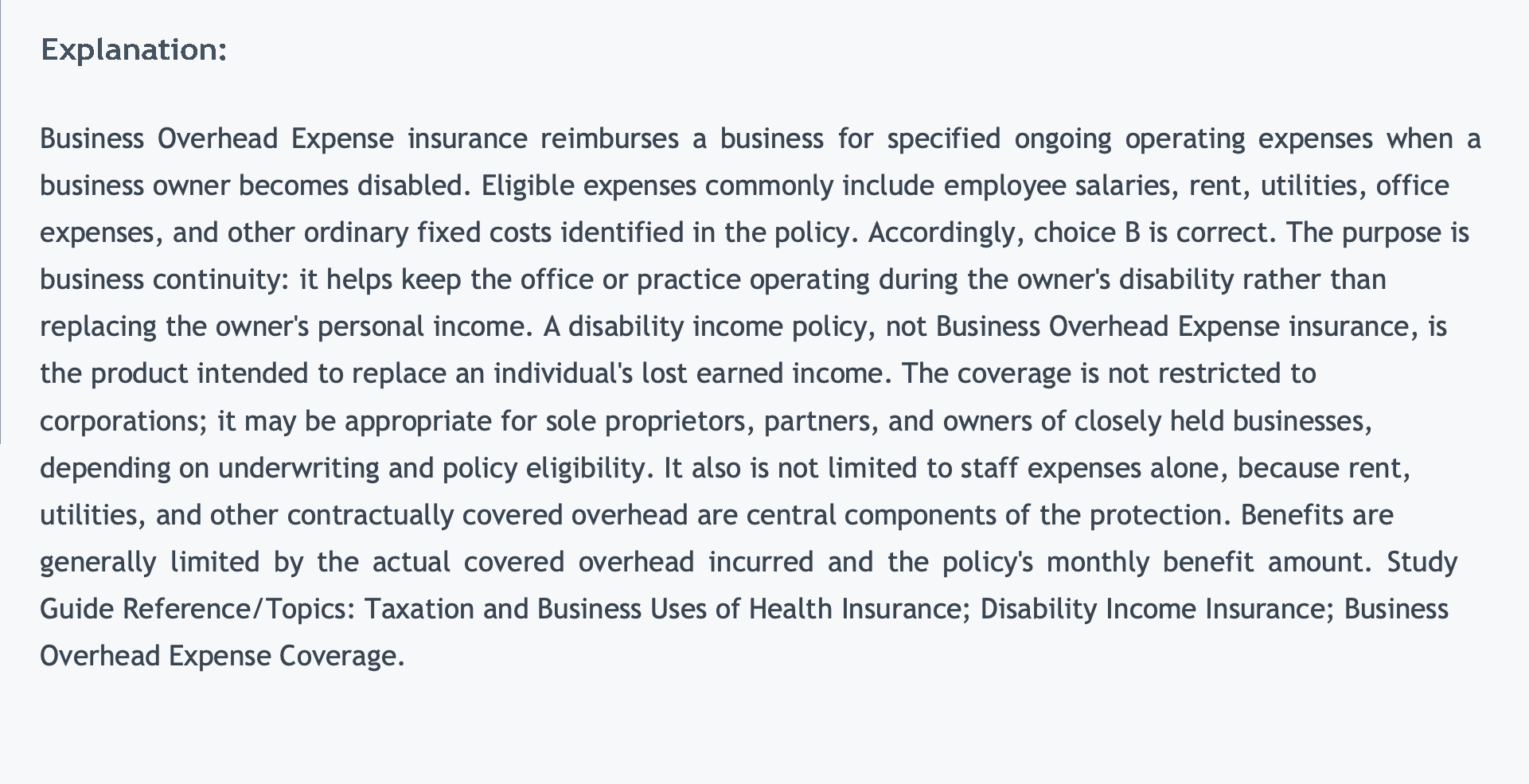
Nevada Insurance Licensing InsNV_Health02 COMPLETE STUDY GUIDE Page 11 of 149 Business Overhead Expense insurance reimburses a business for specified ongoing operating expenses when a business owner becomes disabled. Eligible expenses commonly include employee salaries, rent, utilities, office expenses, and other ordinary fixed costs identified in the policy. Accordingly, choice B is correct. The purpose is business continuity: it helps keep the office or practice operating during the owner's disability rather than replacing the owner's personal income. A disability income policy, not Business Overhead Expense insurance, is the product intended to replace an individual's lost earned income. The coverage is not restricted to corporations; it may be appropriate for sole proprietors, partners, and owners of closely held businesses, depending on underwriting and policy eligibility. It also is not limited to staff expenses alone, because rent, utilities, and other contractually covered overhead are central components of the protection. Benefits are generally limited by the actual covered overhead incurred and the policy's monthly benefit amount. Study Guide Reference/Topics: Taxation and Business Uses of Health Insurance; Disability Income Insurance; Business Overhead Expense Coverage.
Quiz

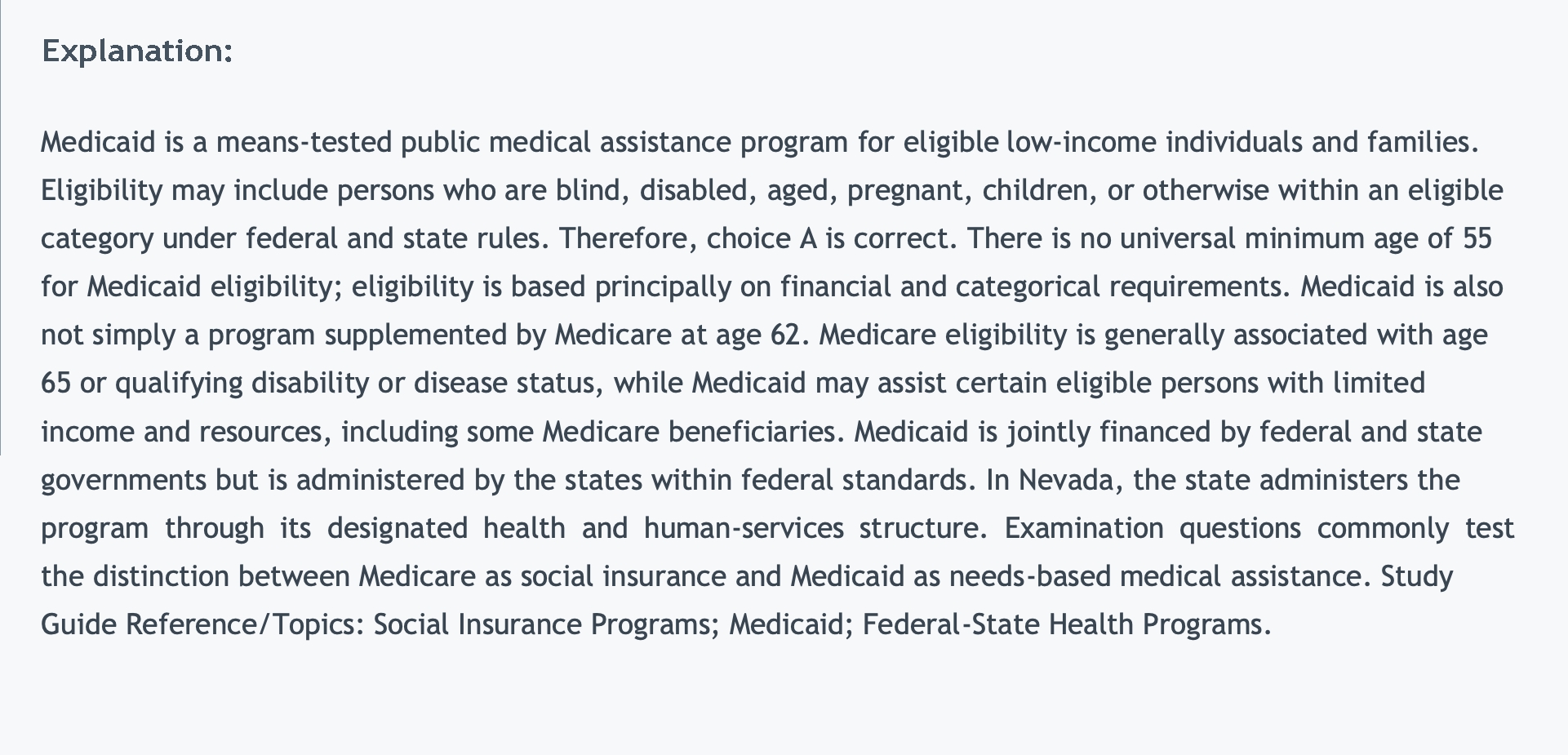
Nevada Insurance Licensing InsNV_Health02 COMPLETE STUDY GUIDE Page 12 of 149 Medicaid is a means-tested public medical assistance program for eligible low-income individuals and families. Eligibility may include persons who are blind, disabled, aged, pregnant, children, or otherwise within an eligible category under federal and state rules. Therefore, choice A is correct. There is no universal minimum age of 55 for Medicaid eligibility; eligibility is based principally on financial and categorical requirements. Medicaid is also not simply a program supplemented by Medicare at age 62. Medicare eligibility is generally associated with age 65 or qualifying disability or disease status, while Medicaid may assist certain eligible persons with limited income and resources, including some Medicare beneficiaries. Medicaid is jointly financed by federal and state governments but is administered by the states within federal standards. In Nevada, the state administers the program through its designated health and human-services structure. Examination questions commonly test the distinction between Medicare as social insurance and Medicaid as needs-based medical assistance. Study Guide Reference/Topics: Social Insurance Programs; Medicaid; Federal-State Health Programs.
Quiz
which of the following actions if an insured has understated the insured's age on the policy application?

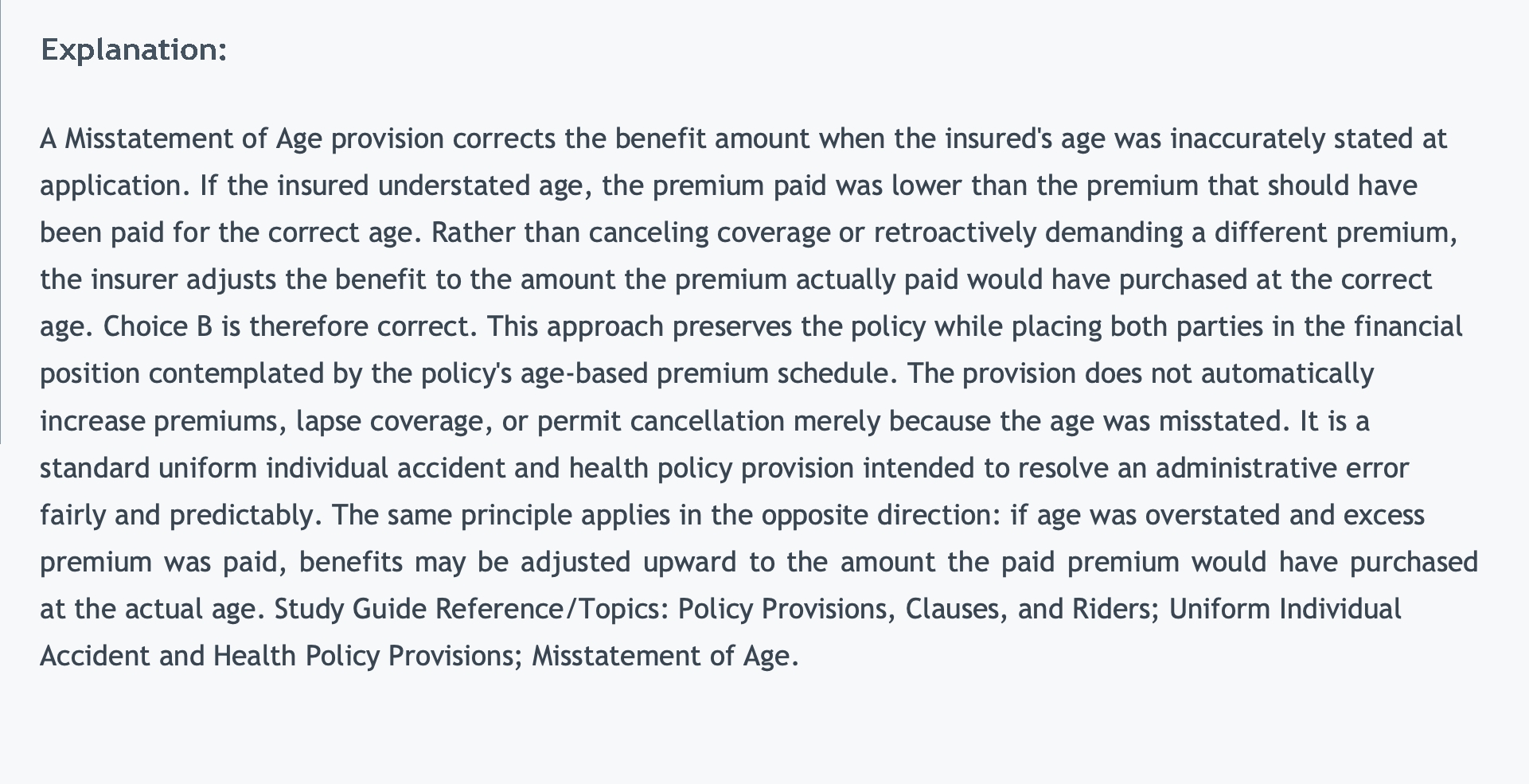
Nevada Insurance Licensing InsNV_Health02 COMPLETE STUDY GUIDE Page 13 of 149 A Misstatement of Age provision corrects the benefit amount when the insured's age was inaccurately stated at application. If the insured understated age, the premium paid was lower than the premium that should have been paid for the correct age. Rather than canceling coverage or retroactively demanding a different premium, the insurer adjusts the benefit to the amount the premium actually paid would have purchased at the correct age. Choice B is therefore correct. This approach preserves the policy while placing both parties in the financial position contemplated by the policy's age-based premium schedule. The provision does not automatically increase premiums, lapse coverage, or permit cancellation merely because the age was misstated. It is a standard uniform individual accident and health policy provision intended to resolve an administrative error fairly and predictably. The same principle applies in the opposite direction: if age was overstated and excess premium was paid, benefits may be adjusted upward to the amount the paid premium would have purchased at the actual age. Study Guide Reference/Topics: Policy Provisions, Clauses, and Riders; Uniform Individual Accident and Health Policy Provisions; Misstatement of Age.
Quiz
disability claim on July 31, the insurance company will MOST likely:

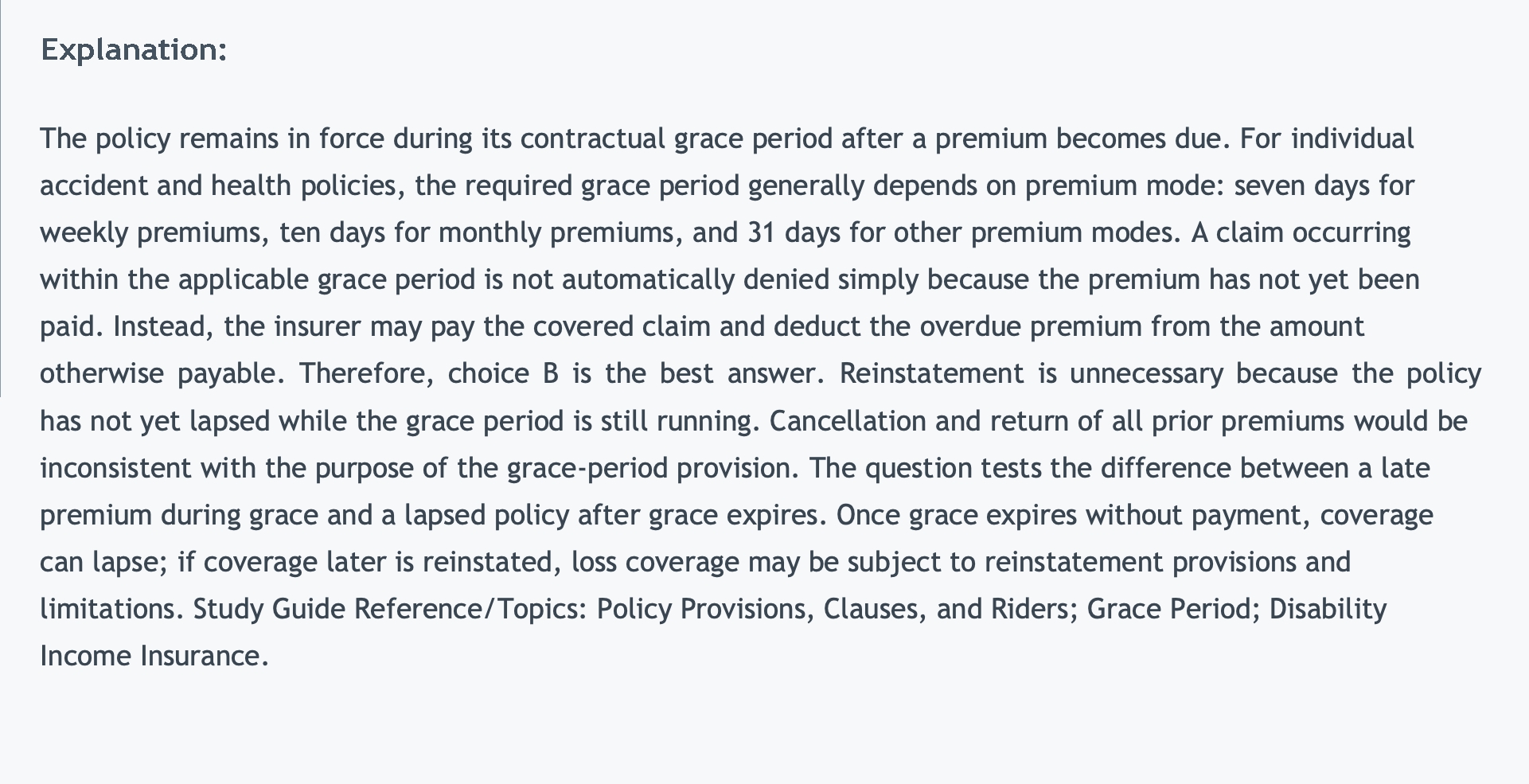
Nevada Insurance Licensing InsNV_Health02 COMPLETE STUDY GUIDE Page 14 of 149 The policy remains in force during its contractual grace period after a premium becomes due. For individual accident and health policies, the required grace period generally depends on premium mode: seven days for weekly premiums, ten days for monthly premiums, and 31 days for other premium modes. A claim occurring within the applicable grace period is not automatically denied simply because the premium has not yet been paid. Instead, the insurer may pay the covered claim and deduct the overdue premium from the amount otherwise payable. Therefore, choice B is the best answer. Reinstatement is unnecessary because the policy has not yet lapsed while the grace period is still running. Cancellation and return of all prior premiums would be inconsistent with the purpose of the grace-period provision. The question tests the difference between a late premium during grace and a lapsed policy after grace expires. Once grace expires without payment, coverage can lapse; if coverage later is reinstated, loss coverage may be subject to reinstatement provisions and limitations. Study Guide Reference/Topics: Policy Provisions, Clauses, and Riders; Grace Period; Disability Income Insurance.
Quiz

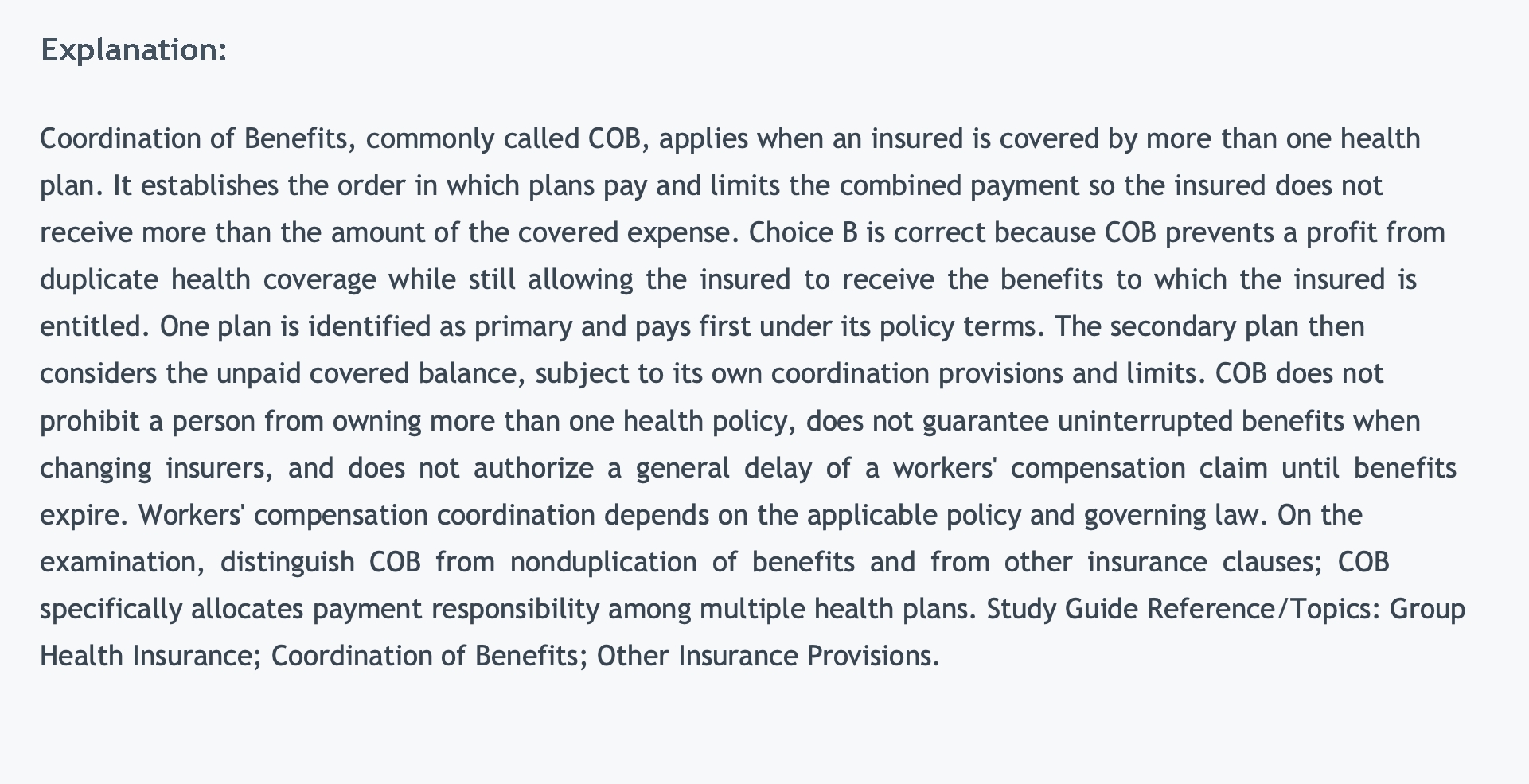
Nevada Insurance Licensing InsNV_Health02 COMPLETE STUDY GUIDE Page 15 of 149 Coordination of Benefits, commonly called COB, applies when an insured is covered by more than one health plan. It establishes the order in which plans pay and limits the combined payment so the insured does not receive more than the amount of the covered expense. Choice B is correct because COB prevents a profit from duplicate health coverage while still allowing the insured to receive the benefits to which the insured is entitled. One plan is identified as primary and pays first under its policy terms. The secondary plan then considers the unpaid covered balance, subject to its own coordination provisions and limits. COB does not prohibit a person from owning more than one health policy, does not guarantee uninterrupted benefits when changing insurers, and does not authorize a general delay of a workers' compensation claim until benefits expire. Workers' compensation coordination depends on the applicable policy and governing law. On the examination, distinguish COB from nonduplication of benefits and from other insurance clauses; COB specifically allocates payment responsibility among multiple health plans. Study Guide Reference/Topics: Group Health Insurance; Coordination of Benefits; Other Insurance Provisions.
Quiz

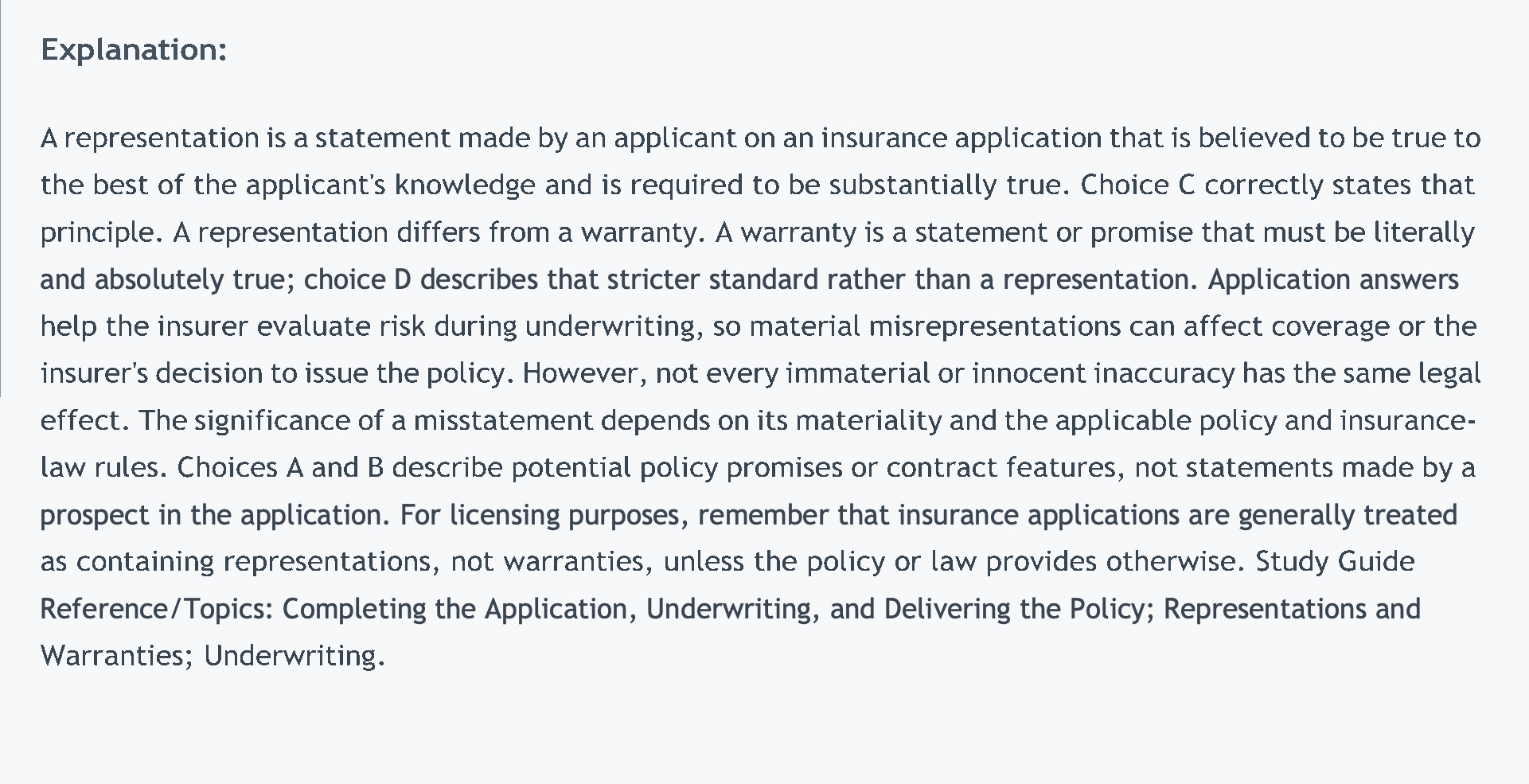
Nevada Insurance Licensing InsNV_Health02 COMPLETE STUDY GUIDE Page 16 of 149 and absolutely true; choice D describes that stricter standard rather than a representation. Application answers prospect in the application. For licensing purposes, remember that insurance applications are generally treated Reference/Topics: Completing the Application, Underwriting, and Delivering the Policy; Representations and
Quiz
The insurance company issues a policy and mails it to the insured, but the insured never receives it. Which of
the following statements is CORRECT about this situation?

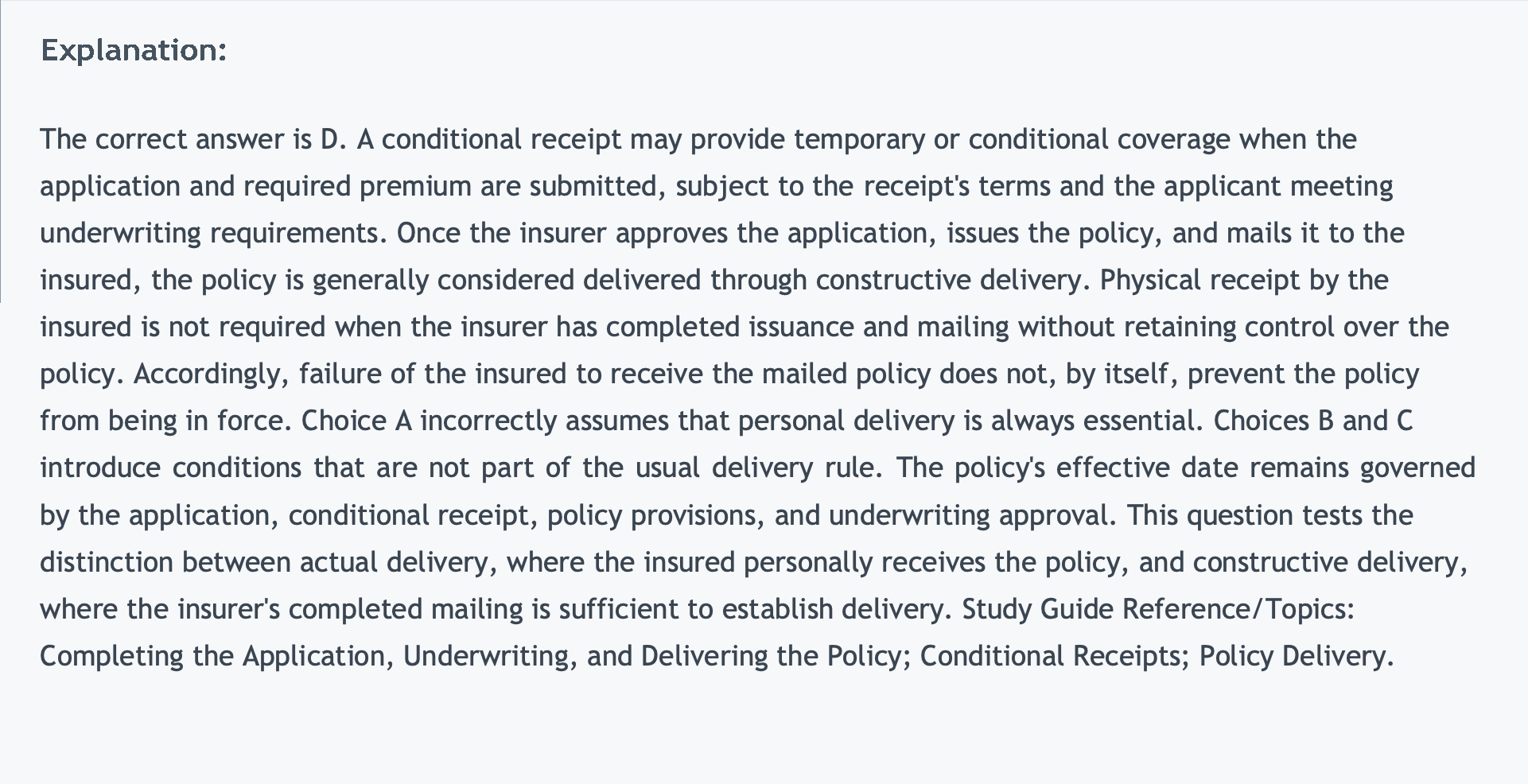
Nevada Insurance Licensing InsNV_Health02 COMPLETE STUDY GUIDE Page 17 of 149 The correct answer is D. A conditional receipt may provide temporary or conditional coverage when the application and required premium are submitted, subject to the receipt's terms and the applicant meeting underwriting requirements. Once the insurer approves the application, issues the policy, and mails it to the insured, the policy is generally considered delivered through constructive delivery. Physical receipt by the insured is not required when the insurer has completed issuance and mailing without retaining control over the policy. Accordingly, failure of the insured to receive the mailed policy does not, by itself, prevent the policy from being in force. Choice A incorrectly assumes that personal delivery is always essential. Choices B and C introduce conditions that are not part of the usual delivery rule. The policy's effective date remains governed by the application, conditional receipt, policy provisions, and underwriting approval. This question tests the distinction between actual delivery, where the insured personally receives the policy, and constructive delivery, where the insurer's completed mailing is sufficient to establish delivery. Study Guide Reference/Topics: Completing the Application, Underwriting, and Delivering the Policy; Conditional Receipts; Policy Delivery.









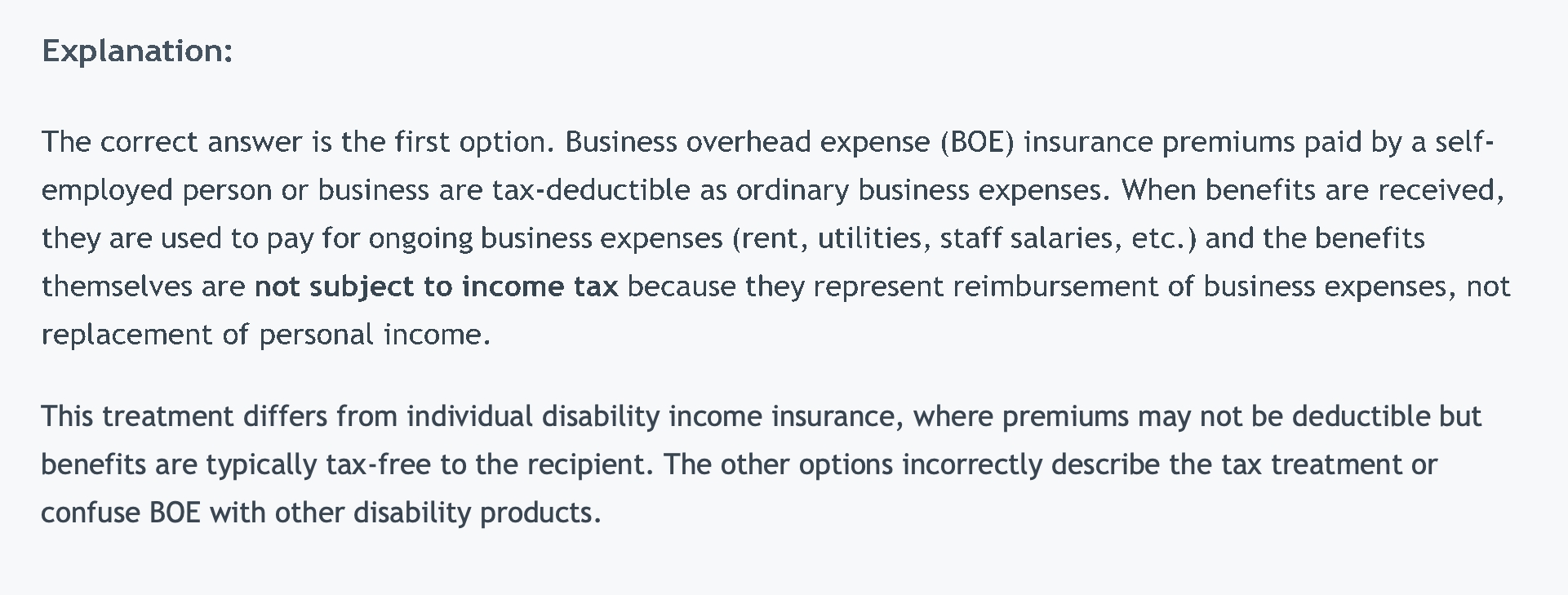
Nevada Insurance Licensing InsNV_Health02 COMPLETE STUDY GUIDE Page 18 of 149 This treatment differs from individual disability income insurance, where premiums may not be deductible but benefits are typically tax-free to the recipient. The other options incorrectly describe the tax treatment or confuse BOE with other disability products.
InsNV_Health02: Nevada Insurance Licensing NV Accident and Health Practice test unlocks all online simulator questions
Thank you for choosing the free version of the InsNV_Health02: Nevada Insurance Licensing NV Accident and Health practice test! Further deepen your knowledge on Nevada Insurance Licensing Simulator; by unlocking the full version of our InsNV_Health02: Nevada Insurance Licensing NV Accident and Health Simulator you will be able to take tests with over 129 constantly updated questions and easily pass your exam. 98% of people pass the exam in the first attempt after preparing with our 129 questions.
BUY NOWWhat to expect from our InsNV_Health02: Nevada Insurance Licensing NV Accident and Health practice tests and how to prepare for any exam?
The InsNV_Health02: Nevada Insurance Licensing NV Accident and Health Simulator Practice Tests are part of the Nevada Insurance Licensing Database and are the best way to prepare for any InsNV_Health02: Nevada Insurance Licensing NV Accident and Health exam. The InsNV_Health02: Nevada Insurance Licensing NV Accident and Health practice tests consist of 129 questions and are written by experts to help you and prepare you to pass the exam on the first attempt. The InsNV_Health02: Nevada Insurance Licensing NV Accident and Health database includes questions from previous and other exams, which means you will be able to practice simulating past and future questions. Preparation with InsNV_Health02: Nevada Insurance Licensing NV Accident and Health Simulator will also give you an idea of the time it will take to complete each section of the InsNV_Health02: Nevada Insurance Licensing NV Accident and Health practice test . It is important to note that the InsNV_Health02: Nevada Insurance Licensing NV Accident and Health Simulator does not replace the classic InsNV_Health02: Nevada Insurance Licensing NV Accident and Health study guides; however, the Simulator provides valuable insights into what to expect and how much work needs to be done to prepare for the InsNV_Health02: Nevada Insurance Licensing NV Accident and Health exam.
BUY NOWInsNV_Health02: Nevada Insurance Licensing NV Accident and Health Practice test therefore represents an excellent tool to prepare for the actual exam together with our Nevada Insurance Licensing practice test . Our InsNV_Health02: Nevada Insurance Licensing NV Accident and Health Simulator will help you assess your level of preparation and understand your strengths and weaknesses. Below you can read all the quizzes you will find in our InsNV_Health02: Nevada Insurance Licensing NV Accident and Health Simulator and how our unique InsNV_Health02: Nevada Insurance Licensing NV Accident and Health Database made up of real questions:
Info quiz:
- Quiz name:InsNV_Health02: Nevada Insurance Licensing NV Accident and Health
- Total number of questions:129
- Number of questions for the test:50
- Pass score:80%
You can prepare for the InsNV_Health02: Nevada Insurance Licensing NV Accident and Health exams with our mobile app. It is very easy to use and even works offline in case of network failure, with all the functions you need to study and practice with our InsNV_Health02: Nevada Insurance Licensing NV Accident and Health Simulator.
Use our Mobile App, available for both Android and iOS devices, with our InsNV_Health02: Nevada Insurance Licensing NV Accident and Health Simulator . You can use it anywhere and always remember that our mobile app is free and available on all stores.
Our Mobile App contains all InsNV_Health02: Nevada Insurance Licensing NV Accident and Health practice tests which consist of 129 questions and also provide study material to pass the final InsNV_Health02: Nevada Insurance Licensing NV Accident and Health exam with guaranteed success. Our InsNV_Health02: Nevada Insurance Licensing NV Accident and Health database contain hundreds of questions and Nevada Insurance Licensing Tests related to InsNV_Health02: Nevada Insurance Licensing NV Accident and Health Exam. This way you can practice anywhere you want, even offline without the internet.
BUY NOW