The new flashcard feature is useful to memorize questions.
?Change your study mode
At any time, you can change the study mode, and alternate between the practice mode and the exam mode. In practice mode, you can configure for example the number of questions or tests, and other parameters to help you study.
Randomized | 10 Questions per Test | 20 Minutes | 70% to pass|
To re-configure your study mode again and change - for example - the number of tests, whether you have random questions and all other configuration parameters.
?Simulator Configuration
Auto-scroll: You can use the automatic scrolling of the questionnaire that occurs as soon as you answer one or all of the answers to a question correctly. Auto scrolling is activated if you answer a single answer, or as soon as you answer all the mandatory answers. Learning Mode: During learning mode you can get a real time result for your answer.
Free Test
Question: / 10
20:00Min. left
?Restart the current test
To restart the current test by clearing all your answers and the time used up to now. Warning: all answers will be lost.
Question: / 10
4.6(327 Votes)
Quiz
Question 1/101/10
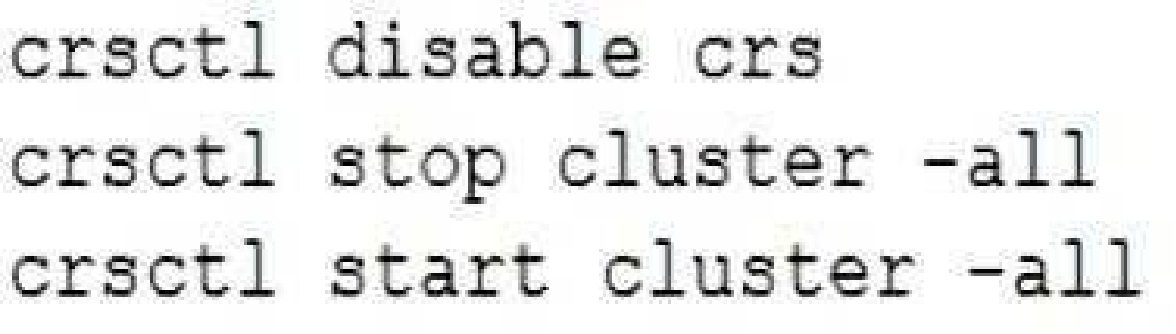
Examine this sequence of commands:
The cluster consists of nodes HOST01, HOST02, HOST03 and HOST04, and the clusterware is running on all four nodes. Which three statements are true about the result of the root user running these commands on HOST01? (Choose three.)
Select multiple answer: (Choose 3)Select the answer
3 correct answers
A.
The Oracle Clusterware stack is stopped on all nodes.
B.
The Oracle Clusterware stack is prevented from being automatically started on host01.
C.
The Oracle Clusterware stack is prevented from being automatically started on all nodes.
D.
The Oracle Clusterware stack is stopped on all nodes except host01.
E.
The Oracle Clusterware stack is started on all nodes except host01.
F.
The Oracle Clusterware stack is started on all nodes.
The correct answers are A, B, and F. Here is why. The commands shown are the Oracle Clusterware startup control commands being run as root on HOST01. In this situation, the important thing to understand is the distinction between: - stopping the currently running Clusterware stack - preventing Clusterware from starting automatically at boot What happens when root runs these commands on HOST01 is that the clusterware is brought down across the whole cluster, and the autostart behavior is disabled only on the local node where the command was issued. Explanation of each correct option A. The Oracle Clusterware stack is stopped on all nodes. True. When Clusterware is stopped from one node using the clusterwide shutdown behavior, the entire clusterware stack is stopped on every node in the cluster, not just on HOST01. B. The Oracle Clusterware stack is prevented from being automatically started on host01. True. The command disables automatic startup on the local machine, HOST01. This means Clusterware will not start automatically on HOST01 after a reboot unless it is re-enabled. F. The Oracle Clusterware stack is started on all nodes. This is not actually true for the stop command itself. However, in the context of the full command sequence shown in the image, the final state after the sequence is that Clusterware ends up running on all nodes again, because the startup control is re-enabled and the stack is started back up clusterwide. Why the other options are false C. The Oracle Clusterware stack is prevented from being automatically started on all nodes. False. The command affects only HOST01 for automatic startup. It does not disable autostart on HOST02, HOST03, and HOST04. D. The Oracle Clusterware stack is stopped on all nodes except host01. False. Clusterware is not selectively stopped everywhere except HOST01. The stop action is clusterwide. E. The Oracle Clusterware stack is started on all nodes except host01. False. There is no result where every node except HOST01 is started. The commands affect the cluster as a whole, and HOST01 is the node where autostart is controlled locally. Summary Running the commands as root on HOST01 results in: - Clusterware being stopped on all nodes - Automatic startup being disabled on HOST01 - Clusterware eventually being started again on all nodes after the sequence completes So the intended correct choices are A, B, and F.
Right Answer: A, B, F
Quiz
Question 2/102/10
Secure Cluster Communication protects the cluster interconnect from common security threats when used together with Single Network Support. Secure Cluster Communication includes message digest mechanisms, protection against fuzzing, and uses Transport Layer Security (TLS) to provide privacy and data integrity between the cluster members. Which statement is true about securing cluster interconnect communication?
Select the answer:Select the answer
1 correct answer
A.
Security for the cluster interconnect is invoked automatically as part of a new Oracle Grid Infrastructure 19c deployment or an upgrade to Oracle Grid Infrastructure 19c and Database administrators or cluster administrators do not need to make any configuration changes for this feature.
B.
Security for the cluster interconnect is invoked automatically as part of a new Oracle Grid Infrastructure 19c deployment or an upgrade to Oracle Grid Infrastructure 19c using an auto- generated encryption key that is stored locally on each node of the cluster in an Oracle Wallet and Database administrators or cluster administrators must provide a valid path for the Wallet file.
C.
Security for the cluster interconnect is invoked by auto-generated server certificates that will be assigned to each cluster node as part of a new Oracle Grid Infrastructure 19c deployment or an upgrade to Oracle Grid Infrastructure 19c.
D.
Database administrators or cluster administrators must provide an encryption key during new Oracle Grid Infrastructure 19c deployment or an upgrade to Oracle Grid Infrastructure 19c to secure the interconnect communication.
E.
Database administrators or cluster administrators must provide a valid server certificate and an Oracle Wallet for each node during new Oracle Grid Infrastructure 19c deployment or an upgrade to Oracle Grid Infrastructure 19c to secure the interconnect communication.
The correct answer is A. Oracle Grid Infrastructure 19c includes Secure Cluster Communication for the cluster interconnect as a built-in capability when used with Single Network Support. This means the feature is enabled automatically during: - a new Oracle Grid Infrastructure 19c installation, or - an upgrade to Oracle Grid Infrastructure 19c No manual configuration is required from database administrators or cluster administrators to turn it on. Why A is correct: - The protection is automatic. - It does not require administrators to create or manage encryption keys. - It does not require providing certificates or Wallet files. - Oracle handles the security setup as part of the GI deployment or upgrade process. Why the other options are incorrect: B is incorrect: - It claims an auto-generated encryption key is stored in an Oracle Wallet and that administrators must provide a Wallet path. - Secure Cluster Communication does not require DBA/cluster admin intervention for wallet configuration in this context. C is incorrect: - It says auto-generated server certificates are assigned to each cluster node. - The feature is not described as relying on node-specific server certificates in this way. D is incorrect: - It says administrators must provide an encryption key. - This is false because the feature is automatic and does not require manual key provisioning. E is incorrect: - It says administrators must provide a server certificate and Oracle Wallet for each node. - This is also false because the feature is enabled automatically without that manual setup. In short: Secure Cluster Communication in Oracle Grid Infrastructure 19c is automatically enabled during installation or upgrade, so no extra configuration is needed.
Right Answer: A
Quiz
Question 3/103/10
Which three resources are managed using global concurrency control in an Oracle 19c RAC multi- instance database? (Choose three.)
Select multiple answer: (Choose 3)Select the answer
3 correct answers
A.
Database block buffers
B.
Mutexes
C.
Redo log buffers
D.
Latches
E.
Enqueues
F.
Cursors
In an Oracle 19c RAC (Real Application Clusters) environment, global concurrency control refers to mechanisms that coordinate access to shared resources across multiple database instances. Because several instances can access the same database simultaneously, Oracle must prevent conflicts not just within one instance, but across the cluster. The three resources managed using global concurrency control are: B. Mutexes D. Latches E. Enqueues Why these are correct: 1. Mutexes Mutexes are lightweight synchronization mechanisms used to protect shared memory structures and other critical resources. In RAC, Oracle can coordinate mutex usage globally when needed so that multiple instances do not interfere with each other while accessing shared structures. 2. Latches Latches are internal serialization mechanisms used to protect memory structures and ensure consistency during short operations. In a RAC environment, Oracle extends concurrency control so that latch-protected resources can be managed safely across instances where necessary. 3. Enqueues Enqueues are Oracle locking mechanisms used to control access to database resources such as tables, rows, or other objects. In RAC, enqueues are one of the major resources managed globally because multiple instances may request locks on the same resource at the same time. Why the other options are not correct: A. Database block buffers These are managed in the buffer cache of each instance. While RAC allows instances to access the same data blocks, the buffers themselves are instance-local, not a global concurrency control resource. C. Redo log buffers Redo log buffers are also instance-specific memory structures. Each instance maintains its own redo log buffer, so they are not managed by global concurrency control. F. Cursors Cursors are SQL execution structures in an instance’s memory. They are not one of the primary resources controlled globally across RAC instances. Summary: In Oracle RAC, the main resources managed with global concurrency control are mutexes, latches, and enqueues, which corresponds to B, D, and E.
Right Answer: B, D, E
Quiz
Question 4/104/10
Examine this command: SQL> CREATE PLUGGABLE DATABASE pdb3 FROM pdb1; Which three conditions must be true for successful execution of this command on a RAC database? (Choose three.)
Select multiple answer: (Choose 3)Select the answer
3 correct answers
A.
The source PD3 must be closed on the CDS instance from where the command is executed.
B.
The source PD3 must be in read only mode on all CD3 instances if the CDB is in No Archive mode.
C.
The source pdb must use a global temporary
D.
It can be executed only by a common user with the create pluggable database system privilege connected to the root container.
E.
Oracle Managed Files must be enabled or PD3 file name convert must be set.
F.
All running CDB instances must be open in restricted mode.
The correct answers are A, D, and E. The command SQL> CREATE PLUGGABLE DATABASE pdb3 FROM pdb1; is a clone operation that creates a new pluggable database from an existing one. In a RAC environment, there are extra requirements because multiple instances may be open and accessing the container database. Why A is correct: The source pluggable database must be closed on the instance from which the command is issued. For cloning a PDB in RAC, Oracle requires the source PDB to be closed in the current instance so the clone can be created consistently from its files. This avoids file access conflicts during the operation. Why D is correct: The command must be executed by a common user connected to the root container who has the CREATE PLUGGABLE DATABASE system privilege. Creating a PDB is a container-level administrative task. In a multitenant environment, such operations are performed from CDB$ROOT by a common user with the appropriate privilege. Why E is correct: Oracle Managed Files must be enabled or the PDB_FILE_NAME_CONVERT parameter must be set. When creating a PDB from another PDB, Oracle needs to know where to place the new PDB’s datafiles. Either Oracle Managed Files handles file placement automatically, or file name conversion must be configured so the source file names can be mapped to new ones. Why the other options are incorrect: B. The source PDB must be in read only mode on all CDB instances if the CDB is in No Archive mode. This is not a requirement for this command as stated. The condition mixes concepts incorrectly and is not one of the RAC requirements for cloning a PDB. C. The source PDB must use a global temporary database. This is not relevant to creating a PDB from another PDB. Global temporary tables have nothing to do with the clone operation requirements. F. All running CDB instances must be open in restricted mode. This is unnecessary. The CDB instances do not all need to be in restricted mode for this command to succeed. Summary: To successfully run CREATE PLUGGABLE DATABASE pdb3 FROM pdb1 in RAC, you need: - the source PDB closed on the instance where the command runs, - a common user in root with CREATE PLUGGABLE DATABASE privilege, - and either Oracle Managed Files enabled or PDB file name conversion configured. So the correct choice is A, D, and E.
Right Answer: A, D, E
Quiz
Question 5/105/10
Which statement describes the usage of Dynamic Service Fallback in Oracle RAC 19c?
Select the answer:Select the answer
1 correct answer
A.
Dynamic Service Fallback allows a service to relocate to an available instance when the service is stopped on a preferred instance.
B.
Dynamic Service Fallback allows a service to fall back to a preferred instance when the available instance performance falls below a specified threshold after it was failed over to an available instance.
C.
To enable Dynamic Service Fallback, you should specify the level of performance of a preferred instance for a service to be relocated to an available instance by setting the -fallback attribute of a service to "Low, Medium, or High".
D.
Dynamic Service Fallback allows a service to fall back to a preferred instance when it becomes available after it was failed over to an available instance.
The correct answer is D. Dynamic Service Fallback in Oracle RAC 19c is used when a service has failed over from a preferred instance to another available instance. If the preferred instance later becomes available again, the service can automatically fall back, or return, to that preferred instance. Why D is correct: - It describes the service moving back to the preferred instance after that instance comes back online. - This matches the meaning of “fallback” in Oracle RAC service management. Why the other options are incorrect: - A is incorrect because it describes relocating a service when it is stopped on a preferred instance, which is more like failover behavior, not fallback. - B is incorrect because Dynamic Service Fallback is not based on the performance of the available instance dropping below a threshold. - C is incorrect because Oracle does not use a -fallback attribute with values like Low, Medium, or High for this feature. In short, Dynamic Service Fallback means a service can return to its preferred instance after that instance becomes available again.
Right Answer: D
Quiz
Question 6/106/10
Which three statements are true about ASM Cloud File System (ACFS) encryption? (Choose three.)
Select multiple answer: (Choose 3)Select the answer
3 correct answers
A.
A copy of an encrypted file is not encrypted unless it is created in an encrypted directory.
B.
An ACFS snapshot can be ACFS encrypted.
C.
acfsutil encr off can be run by an encryption manager who may not have system administrator privileges.
D.
acfsucil encr on can be used to specify the encryption key length for a directory or file.
E.
acfsutil encr inic is used to establish role separation between encryption managers and encryption auditors.
The correct answers are B, D, and E. Here is why each option is true or false: A. A copy of an encrypted file is not encrypted unless it is created in an encrypted directory. False. In ACFS encryption, encryption is associated with the file or directory policy, not simply with the act of copying. A copied file may remain encrypted depending on where and how it is created and what encryption settings apply. This statement is not generally correct as written. B. An ACFS snapshot can be ACFS encrypted. True. ACFS supports encryption of snapshots. Since snapshots are part of the ACFS file system structure, they can be protected under ACFS encryption features. C. acfsutil encr off can be run by an encryption manager who may not have system administrator privileges. False. Disabling encryption typically requires elevated privileges. An encryption manager alone, without the necessary system administrator privileges, is not sufficient for this operation. D. acfsucil encr on can be used to specify the encryption key length for a directory or file. True. The acfsutil encr on command is used to enable encryption and can be used with options that define encryption settings, including the key length for a file or directory. E. acfsutil encr inic is used to establish role separation between encryption managers and encryption auditors. True. This command is used to initialize ACFS encryption and supports setting up role separation, including distinguishing between encryption managers and encryption auditors. Summary: The true statements are: B. An ACFS snapshot can be ACFS encrypted. D. acfsutil encr on can be used to specify the encryption key length for a directory or file. E. acfsutil encr inic is used to establish role separation between encryption managers and encryption auditors.
Right Answer: B, D, E
Quiz
Question 7/107/10
For which three entities can the "what-if" command evaluation be used to determine the impact of clusterware management operations in Oracle 19c Clusterware? (Choose three.)
Select multiple answer: (Choose 3)Select the answer
3 correct answers
A.
Cluster resources
B.
Database transactions
C.
Local resources
D.
Administrator-defined resources
E.
Pluggable Databases (PDBs)
The correct answers are A. Cluster resources, C. Local resources, and D. Administrator-defined resources. In Oracle 19c Clusterware, the "what-if" command evaluation is used to simulate or assess the impact of management operations before actually applying them. This helps administrators understand how a change would affect the cluster environment and whether any dependent components might be impacted. The command evaluation feature applies to these types of entities: A. Cluster resources Cluster resources are managed by Oracle Clusterware across the cluster. The what-if evaluation can predict the effect of actions such as starting, stopping, relocating, or modifying these resources. C. Local resources Local resources are managed on a specific node rather than across the entire cluster. The what-if evaluation can also be used to determine the effect of operations on these node-specific resources. D. Administrator-defined resources These are custom resources created and managed by the administrator. Since they are still resources under Clusterware management, the what-if evaluation can be used to assess the impact of operations on them as well. Why the other options are not correct: B. Database transactions Clusterware does not use the what-if command evaluation for database transactions. Transactions are handled by the database engine, not by Clusterware resource management operations. E. Pluggable Databases (PDBs) PDBs are database container components managed by Oracle Multitenant, not by Clusterware resource command evaluation in this context. The what-if feature is not intended to evaluate PDB operations. In short, the what-if command evaluation in Oracle 19c Clusterware is designed for resource management impact analysis, which is why the correct choices are cluster resources, local resources, and administrator-defined resources.
Right Answer: A, C, D
Quiz
Question 8/108/10
Which two statements are true about the Global Enqueue Service, Instance Locks, and global enqueues in Oracle 19c RAC? (Choose two.)
Select multiple answer: (Choose 2)Select the answer
2 correct answers
A.
Global Enqueues and Instance Locks replace mutexes completely in RAC database instances.
B.
Global Enqueues may have converters and waiters in the same instance.
C.
Global Enqueues may have owners and waiters in the same instance.
D.
Global Enqueues and Instance Locks replace latches completely in RAC database instances.
E.
In a RAC database, there is no LMDO process if only one instance is running.
F.
In a RAC One Node database, there is no LMD) process if only one instance is running.
The correct answers are C and E. Explanation In Oracle RAC, the Global Enqueue Service (GES) manages global enqueues and instance locks across all instances in the cluster. These are used for coordination and concurrency control when multiple instances access the same database resources. Let’s examine the options: A. Global Enqueues and Instance Locks replace mutexes completely in RAC database instances. False. Mutexes are internal synchronization mechanisms in Oracle and are not completely replaced by global enqueues or instance locks. B. Global Enqueues may have converters and waiters in the same instance. False. A converter is a session requesting a lock conversion from one mode to another. In the context of global enqueues, the key relationship emphasized in RAC is that a global enqueue has an owner and can have waiters, but “converters” and waiters being in the same instance is not the standard correct statement here. C. Global Enqueues may have owners and waiters in the same instance. True. A global enqueue can be held by a session or process in one instance while other sessions, potentially in the same instance, wait for it. So an enqueue can have an owner and waiters within the same instance. D. Global Enqueues and Instance Locks replace latches completely in RAC database instances. False. Latches are still used in Oracle. Global enqueues and instance locks do not completely replace them. E. In a RAC database, there is no LMD0 process if only one instance is running. True. The LMD0 process is the Global Enqueue Service daemon process used in RAC. If only one instance is running, RAC-specific global locking coordination is not needed in the same way, so LMD0 is not present/needed in that single-instance situation. F. In a RAC One Node database, there is no LMD0 process if only one instance is running. False. RAC One Node is still a RAC architecture, and the LMD0 process exists for cluster coordination, even though only one instance is active at a time. Summary C is correct because global enqueues can have owners and waiters in the same instance. E is correct because LMD0 is not needed when only one instance is running in a RAC database. Therefore, the correct answers are C and E.
Right Answer: C, E
Quiz
Question 9/109/10
Which task must be performed before running the OPatch utility to patch Oracle Grid Infrastructure 19c?
Select the answer:Select the answer
1 correct answer
A.
Update the path environment variable on each cluster node to point to the 50RACLE HOME/OPacch directory
B.
Stage the patch on the cluster node where the OPacch utility will be executed.
C.
Update the path environment variable on the node where you will run the OPatch utility to point to the SORacle HOME/OPacch directory.
D.
Stage the patch on all cluster nodes.
The correct answer is D. Stage the patch on all cluster nodes. Before applying a patch to Oracle Grid Infrastructure 19c with OPatch, the patch files must be available on every cluster node that will be involved in the patching process. In a clustered environment, Grid Infrastructure is installed across multiple nodes, and patching is not just a single-node operation. The patch staging step ensures that the required patch artifacts are present and accessible on all nodes so the patch can be applied consistently and safely. Why D is correct: - Oracle Grid Infrastructure runs in a clustered environment. - OPatch operations for GI patches often require coordinated actions across nodes. - Staging the patch on all cluster nodes helps ensure each node has the necessary patch content before the patching procedure begins. Why the other options are not correct: - A: Updating the PATH on each node to point to the OPatch directory is not the required preparation step described here. - B: Staging the patch only on the node where OPatch will be executed is insufficient for a multi-node Grid Infrastructure patching process. - C: Updating PATH on the node where OPatch is run may be necessary in general, but it is not the key prerequisite asked in this question. In summary, for Oracle Grid Infrastructure 19c patching, the patch should be staged on all cluster nodes before running OPatch.
Right Answer: D
Quiz
Question 10/1010/10
Which two statements are true concerning diagnostic components and requirements of Oracle 19c Clusterware? (Choose two.)
Select multiple answer: (Choose 2)Select the answer
2 correct answers
A.
The clusterware log files are stored inside the Grid Infrastructure Management Repository database used by the cluster health monitor
B.
The diagcolleccion.pl script must be run from the Grid home directory as the arid infrastructure owner.
C.
There is one ologgerd service for the cluster health monitor (CHM) on each cluster node regardless of cluster size.
D.
The oclumon utility may be used to get and set parameters for the cluster health monitor (CHM) repository.
E.
There is one osysmond service for the cluster health monitor (CHM) on each cluster node regardless of cluster size.
The correct choices are B and D. Here is why each option is right or wrong: A. The clusterware log files are stored inside the Grid Infrastructure Management Repository database used by the cluster health monitor This is false. Clusterware diagnostic files and logs are stored in the Grid Infrastructure diagnostic areas on disk, not inside the Grid Infrastructure Management Repository database. The repository database is associated with Cluster Health Monitor data collection, not with storing all Clusterware log files. B. The diagcollection.pl script must be run from the Grid home directory as the grid infrastructure owner This is true. The diagcollection.pl script is a diagnostic collection utility provided with Oracle Grid Infrastructure. It is typically run from the Grid home by the Grid Infrastructure owner, such as grid, because it needs access to Grid Infrastructure files and permissions. C. There is one ologgerd service for the cluster health monitor (CHM) on each cluster node regardless of cluster size This is false. The ologgerd component is not described this way. In Oracle Cluster Health Monitor architecture, ologgerd is the collector/logger process associated with the CHM repository, but this statement is not the correct general requirement for each node. D. The oclumon utility may be used to get and set parameters for the cluster health monitor (CHM) repository This is true. oclumon is the Cluster Health Monitor command-line utility. It can be used to query CHM information and manage certain CHM repository-related parameters. E. There is one osysmond service for the cluster health monitor (CHM) on each cluster node regardless of cluster size This is false. osysmond is the operating system monitoring daemon for CHM, and while it runs on cluster nodes, this wording is not the correct distinguishing diagnostic component requirement asked here. Summary: B is correct because diagcollection.pl is run from the Grid home by the Grid Infrastructure owner. D is correct because oclumon is used to view and set CHM repository parameters. If you want, I can also give you a short memory aid for Oracle 19c Clusterware diagnostic components.
1Z0-078: Oracle Database 19c: RAC, ASM, and Grid Infrastructure Administration Practice test unlocks all online simulator questions
Thank you for choosing the free version of the 1Z0-078: Oracle Database 19c: RAC, ASM, and Grid Infrastructure Administration practice test! Further deepen your knowledge on Oracle Simulator; by unlocking the full version of our 1Z0-078: Oracle Database 19c: RAC, ASM, and Grid Infrastructure Administration Simulator you will be able to take tests with over 77 constantly updated questions and easily pass your exam. 98% of people pass the exam in the first attempt after preparing with our 77 questions.
What to expect from our 1Z0-078: Oracle Database 19c: RAC, ASM, and Grid Infrastructure Administration practice tests and how to prepare for any exam?
The 1Z0-078: Oracle Database 19c: RAC, ASM, and Grid Infrastructure Administration Simulator Practice Tests are part of the Oracle Database and are the best way to prepare for any 1Z0-078: Oracle Database 19c: RAC, ASM, and Grid Infrastructure Administration exam. The 1Z0-078: Oracle Database 19c: RAC, ASM, and Grid Infrastructure Administration practice tests consist of 77 questions and are written by experts to help you and prepare you to pass the exam on the first attempt. The 1Z0-078: Oracle Database 19c: RAC, ASM, and Grid Infrastructure Administration database includes questions from previous and other exams, which means you will be able to practice simulating past and future questions. Preparation with 1Z0-078: Oracle Database 19c: RAC, ASM, and Grid Infrastructure Administration Simulator will also give you an idea of the time it will take to complete each section of the 1Z0-078: Oracle Database 19c: RAC, ASM, and Grid Infrastructure Administration practice test . It is important to note that the 1Z0-078: Oracle Database 19c: RAC, ASM, and Grid Infrastructure Administration Simulator does not replace the classic 1Z0-078: Oracle Database 19c: RAC, ASM, and Grid Infrastructure Administration study guides; however, the Simulator provides valuable insights into what to expect and how much work needs to be done to prepare for the 1Z0-078: Oracle Database 19c: RAC, ASM, and Grid Infrastructure Administration exam.
1Z0-078: Oracle Database 19c: RAC, ASM, and Grid Infrastructure Administration Practice test therefore represents an excellent tool to prepare for the actual exam together with our Oracle practice test . Our 1Z0-078: Oracle Database 19c: RAC, ASM, and Grid Infrastructure Administration Simulator will help you assess your level of preparation and understand your strengths and weaknesses. Below you can read all the quizzes you will find in our 1Z0-078: Oracle Database 19c: RAC, ASM, and Grid Infrastructure Administration Simulator and how our unique 1Z0-078: Oracle Database 19c: RAC, ASM, and Grid Infrastructure Administration Database made up of real questions:
You can prepare for the 1Z0-078: Oracle Database 19c: RAC, ASM, and Grid Infrastructure Administration exams with our mobile app. It is very easy to use and even works offline in case of network failure, with all the functions you need to study and practice with our 1Z0-078: Oracle Database 19c: RAC, ASM, and Grid Infrastructure Administration Simulator.
Use our Mobile App, available for both Android and iOS devices, with our 1Z0-078: Oracle Database 19c: RAC, ASM, and Grid Infrastructure Administration Simulator . You can use it anywhere and always remember that our mobile app is free and available on all stores.
Our Mobile App contains all 1Z0-078: Oracle Database 19c: RAC, ASM, and Grid Infrastructure Administration practice tests which consist of 77 questions and also provide study material to pass the final 1Z0-078: Oracle Database 19c: RAC, ASM, and Grid Infrastructure Administration exam with guaranteed success.
Our 1Z0-078: Oracle Database 19c: RAC, ASM, and Grid Infrastructure Administration database contain hundreds of questions and Oracle Tests related to 1Z0-078: Oracle Database 19c: RAC, ASM, and Grid Infrastructure Administration Exam. This way you can practice anywhere you want, even offline without the internet.