The new flashcard feature is useful to memorize questions.
?Change your study mode
At any time, you can change the study mode, and alternate between the practice mode and the exam mode. In practice mode, you can configure for example the number of questions or tests, and other parameters to help you study.
Randomized | 10 Questions per Test | 20 Minutes | 70% to pass|
To re-configure your study mode again and change - for example - the number of tests, whether you have random questions and all other configuration parameters.
?Simulator Configuration
Auto-scroll: You can use the automatic scrolling of the questionnaire that occurs as soon as you answer one or all of the answers to a question correctly. Auto scrolling is activated if you answer a single answer, or as soon as you answer all the mandatory answers. Learning Mode: During learning mode you can get a real time result for your answer.
Free Test
Question: / 10
20:00Min. left
?Restart the current test
To restart the current test by clearing all your answers and the time used up to now. Warning: all answers will be lost.
Question: / 10
4.7(202 Votes)
Quiz
Question 1/101/10
When identifying devices for IoT classification purposes, which two methods does Prisma SD-WAN use to discover devices that are not directly connected to the branch ION? (Choose two.)
Select multiple answer: (Choose 2)Select the answer
2 correct answers
A.
LLDP
B.
CDP
C.
SNMP
D.
Syslog
Comprehensive and Detailed Explanation Prisma SD-WAN (formerly CloudGenix) integrates with Palo Alto Networks IoT Security to provide comprehensive visibility into all devices at a branch, including those that are not directly connected to the ION device. While the ION automatically detects and classifies devices connected directly to its interfaces via traffic inspection (DPI), DHCP, and ARP analysis, gaining visibility into off-branch devices (devices connected to downstream switches or access points) requires additional discovery mechanisms that can query the network infrastructure or ingest its logs. 1. SNMP (Simple Network Management Protocol): This is the primary active discovery method for off-branch devices. The Prisma SD-WAN ION device acts as a sensor that actively polls local network switches and wireless controllers using SNMP. By querying the ARP tables and MAC address tables (Bridge MIBs) of these intermediate network devices, the ION can identify endpoints that are connected to the switch ports, even if those endpoints are not currently sending traffic through the ION. This allows the system to map the topology and discover silent or lateral-traffic-only devices. 2. Syslog: In conjunction with SNMP, the IoT Security solution can utilize Syslog messages to discover and profile devices. Network infrastructure devices (like switches and WLAN controllers) can be configured to send Syslog messages to the collection point (which enables the IoT Security service) whenever a device connects or disconnects (e.g., port up/down events, DHCP snooping logs, or 802.1x authentication logs). These logs provide real-time data about device presence and identity (MAC/IP mappings) for devices that are not directly adjacent to the ION, ensuring 100% visibility across the branch network segments. LLDP (A) and CDP (B) are typically Link Layer discovery protocols used for discovering directly connected neighbors and do not propagate beyond the immediate link, making them unsuitable for discovering devices multiple hops away or behind a switch.
Right Answer: C, D
Quiz
Question 2/102/10
A network administrator is troubleshooting a critical SaaS application, “SuperSaaSApp”, that is experiencing connectivity issues. Initially, the configured active and backup paths for the application were reported as completely down at Layer 3. The Prisma SD-WAN system attempted to route traffic for the application over an L3 failure path that was explicitly configured as a Standard VPN to Prisma Access. However, users are still reporting a complete outage for the application and monitoring tools show application flows being dropped when attempting to use the Standard VPN L3 failure path, even though the tunnel itself appears to be up. The administrator suspects a policy misconfiguration related to how the Standard VPN path interacts with destination groups. What is the most likely reason for flows being dropped when attempting to use the Standard VPN L3 failure path?
Select the answer:Select the answer
1 correct answer
A.
The “Move Flows Forced” action was not enabled in the performance policy for “SuperSaaSApp”, preventing the system from actively shifting traffic to the L3 failure path.
B.
The path policy rule for “SuperSaaSApp” has the “Required” checkbox selected for its Service & DC Group, but no direct paths were configured alongside it, creating a conflict.
C.
The path policy rule explicitly designates a Standard VPN as the L3 failure path, but it does not include a designated Standard Services and DC Group, causing traffic to be dropped.
D.
The Standard VPN in the path policy was not configured to “Minimize Cellular Usage”, leading to the depletion of metered data and subsequent flow drops.
Comprehensive and Detailed Explanation According to Palo Alto Networks Prisma SD-WAN administrator documentation regarding Path Policy configuration, specific rules apply when utilizing Standard VPNs (IPSec tunnels to non-ION devices, such as Prisma Access or third-party firewalls) as an L3 Failure Path. When a Path Policy rule is configured, the administrator defines Active Paths, Backup Paths, and L3 Failure Paths. The L3 Failure Path is a "last resort" mechanism used when all Active and Backup paths are unavailable (Layer 3 down). If Standard VPN is selected as the L3 Failure Path type, the system explicitly requires that the administrator also associates it with a specific Standard Services and DC Group within that same policy rule. The ION device uses the Standard Services and DC Group to identify the specific remote endpoint (tunnel destination) where the traffic should be routed. Unlike a "Direct" (Internet) path which can simply route out to the WAN, a Standard VPN represents a logical tunnel. If the policy rule designates "Standard VPN" as the failure path but leaves the "Standard Services and DC Group" field empty or unselected, the ION effectively has a directive to "use a VPN" but lacks the instruction on which VPN group to use for this specific application context. Consequently, even if the IPSec tunnel to Prisma Access is physically up and stable, the policy engine cannot resolve the next hop for the "SuperSaaSApp" traffic, resulting in the packets being dropped. To resolve this, the administrator must edit the Path Policy rule to ensure the specific Standard Service/DC Group representing Prisma Access is checked/selected for the L3 Failure Path.
Right Answer: C
Quiz
Question 3/103/10
User-ID integration is configured for a Prisma SD-WAN deployment. Branch-1 has the user-to-IP mappings available, and User-1 is mapped to IP-1. To which two use cases can User-ID based zone-based firewall policies be applied? (Choose two.)
Select multiple answer: (Choose 2)Select the answer
2 correct answers
A.
User-1 accessing a SaaS application on direct internet and source User-ID based zone-based firewall rules on Branch-1 ION
B.
User-1 accessing a private application within Branch-1, and source User-ID based zone-based firewall rules on Branch-1 ION
C.
User-1 accessing a private application in data center via SD-WAN overlay, and destination User-ID based zone-based firewall rules on DC ION
D.
User-1 accessing a private application in Branch-2 via SD-WAN overlay, and destination User-ID based zone-based firewall rules on Branch-2 ION
Comprehensive and Detailed Explanation In Prisma SD-WAN (CloudGenix), Zone-Based Firewall (ZBFW) policies rely on the device's ability to map an IP address to a User-ID to enforce identity-based rules. The key to this question is understanding where the mapping exists and which direction the policy attributes (Source User vs. Destination User) apply to. 1. Mapping Location (Branch-1): The prompt states that Branch-1 has the user-to-IP mapping for User-1. For the most effective and scalable security enforcement, policies should be applied at the source (ingress) device where the traffic originates and where the user identity is known. This prevents unauthorized traffic from consuming WAN bandwidth only to be dropped at the destination. Therefore, the Branch-1 ION is the correct enforcement point for User-1's traffic. 2. Source vs. Destination User: User-1 is the Source: In all scenarios, User-1 is the initiator of the traffic. Therefore, the security rule must match on Source User-ID. Options C and D are incorrect because they suggest using Destination User-ID based rules to control User-1. Destination User-ID rules are used when the target of the traffic is a known user (e.g., VoIP calls to a specific user's phone), not when filtering based on the sender. Furthermore, relying on the DC or Branch-2 ION to enforce policies for User-1 would require the propagation of User-ID mappings across the overlay, whereas local enforcement at Branch-1 is the standard architectural model. 3. Valid Use Cases (A and B): Option A (SaaS/Internet): The Branch-1 ION acts as the internet gateway. It can use the local mapping (IP-1 = User-1) to allow or deny access to specific SaaS applications (Direct Internet Access) based on the user's identity (e.g., "Allow Marketing Group to access Social Media"). Option B (Internal Segmentation): The Branch-1 ION can enforce policies for traffic moving between local zones (e.g., from a "Users" VLAN to a "Servers" VLAN within the branch). Since the ION routes this traffic and holds the mapping, it can enforce Source User-ID policies to secure local private applications.
Right Answer: A, B
Quiz
Question 4/104/10
A site has two internet circuits: Circuit A with 500 Mbps capacity and Circuit B with 100 Mbps capacity. Which path policy configuration will ensure traffic is automatically shifted from a saturated circuit to the circuit with available bandwidth?
Select the answer:Select the answer
1 correct answer
A.
Circuit A as an active, Circuit B as a backup
B.
Circuit B as an active, Circuit A as a backup
C.
Both circuits under active path
D.
Circuit B as an L3 failure path
Comprehensive and Detailed Explanation In Prisma SD-WAN (CloudGenix), Path Policies control how application traffic is steered across WAN links. To ensure that traffic is automatically shifted from a saturated circuit to another circuit with available bandwidth, both circuits must be configured as Active Paths within the policy rule. When multiple paths are designated as "Active," the ION device treats them as a shared pool of available resources. The system continuously monitors the bandwidth utilization (capacity) and health (latency, jitter, loss) of all active links. If "Circuit A" (500 Mbps) becomes saturated or approaches its defined bandwidth limit, the ION's intelligent scheduler will automatically direct new application flows to "Circuit B" (100 Mbps) because it is a valid, healthy Active path with available capacity. This achieves effective load balancing and bandwidth aggregation. In contrast, configuring "Circuit B" as a Backup Path (Option A or B) creates a strict priority relationship. Traffic would only move to the Backup path if the Active path completely failed or violated its configured SLA (Path Quality Profile) significantly enough to be considered "down." Mere bandwidth saturation might not trigger an SLA failure immediately, potentially leading to dropped packets on the saturated link while the backup link remains idle. Therefore, placing Both circuits under active path is the correct configuration for dynamic capacity management.
Right Answer: C
Quiz
Question 5/105/10
What is the default action for real-time media applications if link performance is poor?
Select the answer:Select the answer
1 correct answer
A.
Drop the flow.
B.
Move flows.
C.
Apply Forward Error Correction (FEC).1
D.
Raise an alarm.
Comprehensive and Detailed Explanation According to the Prisma SD-WAN Performance Policy Default Behavior documentation, the default action configured for applications (including real-time media) when a path experiences poor performance (violates the SLA thresholds for latency, jitter, or packet loss) is to Move Flows. The Prisma SD-WAN ION device continuously monitors the health of all available paths. If the active path for a media application degrades and fails to meet the specified SLA, the default policy dictates that the traffic should be steered (moved) to an alternate, compliant path that meets the performance criteria. While Forward Error Correction (FEC) is a powerful feature available in Prisma SD-WAN to mitigate packet loss for real-time applications, it is an optional action that must be explicitly enabled or configured within the performance policy rules. It is not the default action in the base system configuration; the primary default mechanism for handling performance issues is to leverage the multi-path fabric to switch to a better link. Reference: Prisma SD-WAN Administrator's Guide: Performance Policy Default Behavior
Right Answer: B
Quiz
Question 6/106/10
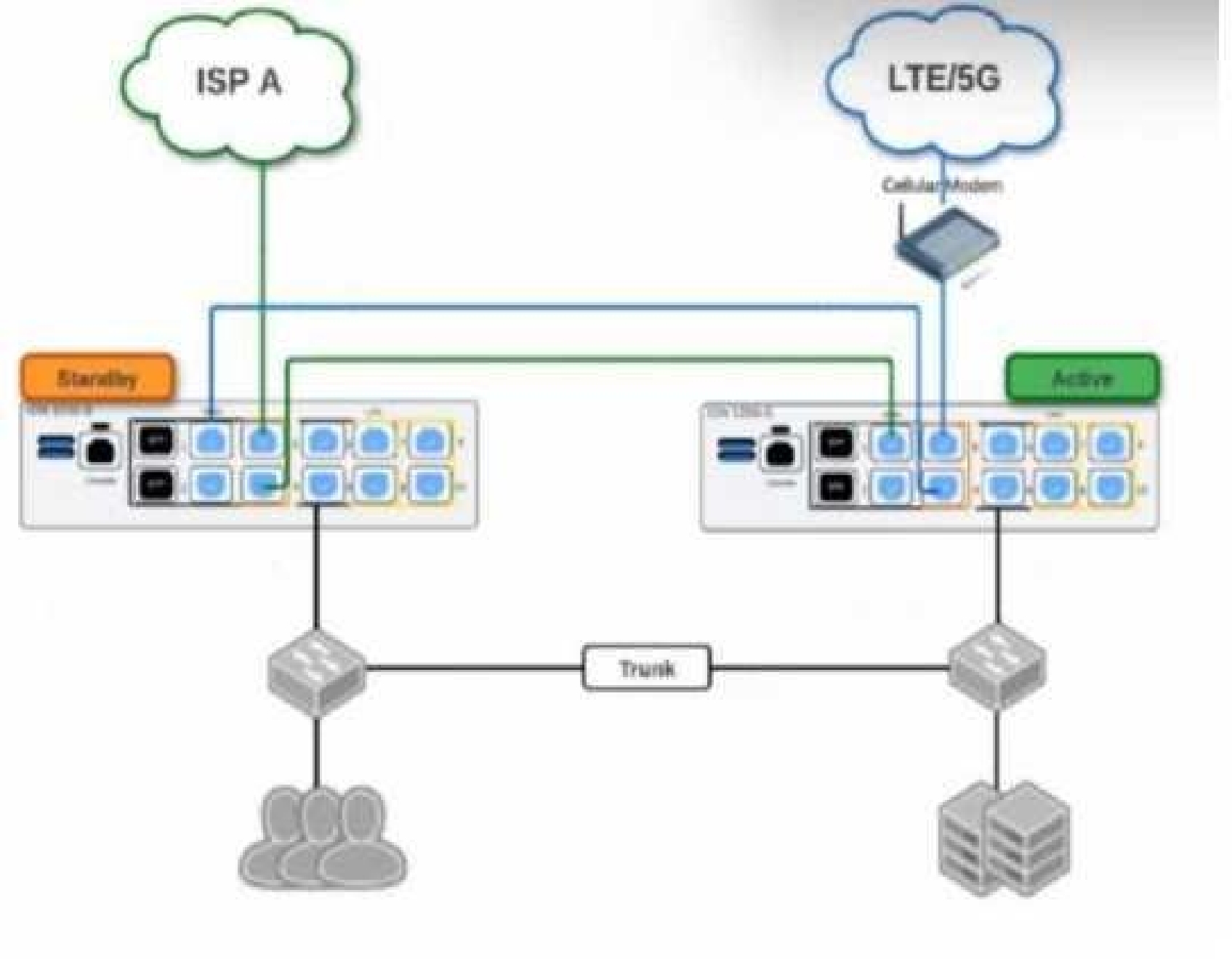
Based on the HA topology image below, which two statements describe the end-state when power is removed from the ION 1200-S labeled “Active”, assuming that the ION labeled “Standby” becomes the active ION? (Choose two.)
Select multiple answer: (Choose 2)Select the answer
2 correct answers
A.
Both the connection to ISP A and the connection to LTE/5G will be usable.
B.
The VRRP Virtual IP address assigned to any SVIs will be moved to the newly active ION.
C.
The newly active ION will send a gratuitous ARP to the LAN for the IP address of any SVIs.
D.
The connection to ISP A will be usable, but the connection to LTE/5G will not.
Comprehensive and Detailed Explanation This scenario depicts a High Availability (HA) topology utilizing the ION 1200-S model's Fail-to-Wire (bypass) capabilities to share WAN links between two devices without needing external switches for every WAN connection. 1. WAN Link Availability (Statement A): The diagram illustrates a "daisy-chain" cabling method supported by the ION 1200-S bypass pairs. ISP A (Green): Connects directly to the "Standby" (Left) unit first. Since the Standby unit remains powered on, it maintains direct access to ISP A. LTE/5G (Blue): Connects to the "Active" (Right) unit first. The connection then loops through a bypass pair on the Active unit to the Standby unit. When power is removed from the "Active" unit, the fail- to-wire relays on its Ethernet ports close physically. This creates a passive electrical bridge that connects the LTE modem directly to the Standby unit. The Standby unit (now becoming Active) will detect the link state change and successfully utilize the LTE connection. Therefore, both WAN links remain usable. 2. LAN Failover Mechanism (Statement C): Prisma SD-WAN ION devices typically use a VRRP-like mechanism for LAN redundancy. When the "Active" node fails (loses power), the "Standby" node stops receiving keepalives and promotes itself to the Active state. To ensure downstream switches and clients immediately send traffic to the new Active unit, it must update their ARP tables. It does this by broadcasting a Gratuitous ARP (GARP) packet for the Virtual IP (VIP) address of the Switch Virtual Interfaces (SVIs). This action informs the network that the MAC address associated with the Gateway I1P is now reachable via the port connected to the new Active ION.234
Right Answer: A, C
Quiz
Question 7/107/10
In a data center (DC) with two ION devices, all of the remote branch Prisma SD-WAN VPNs are active only on DC ION-1. Why are no VPNs active on DC ION-2?
Select the answer:Select the answer
1 correct answer
A.
The BGP core peer is down.
B.
The static route to core as a next hop is missing.
C.
The ION device is behind a NAT.
D.
The DC and branches are in a different domain.
Comprehensive and Detailed Explanation In a Prisma SD-WAN Data Center deployment, the operational state of the Secure Fabric VPNs (overlay tunnels) is directly tied to the health of the BGP Core Peer configuration.4 Core Peer Dependency: DC ION devices typically peer with the data center core switch (Core Router) via BGP to learn the subnets (prefixes) for the applications hosted in the DC. The Prisma SD-WAN controller monitors this BGP peering status.5 Controller Logic: If the BGP Core Peer on a DC ION goes down (or is not established), the controller automatically marks the VPN tunnels terminating at that specific ION as "Inactive".6 This is a fail-safe mechanism designed to prevent remote branches from sending traffic to a DC ION that has lost conne7ctivity to the internal data center network (and thus the applications). Scenario Analysis: In this scenario, DC ION-1 has active VPNs, meaning its BGP Core Peer is UP and it is successfully advertising reachability. DC ION-2 has no active VPNs, which strongly indicates that its BGP Core Peer is down.8 Because the controller sees the peer is down, it suppresses the tunnel establishment or marks existing tunnels as inactive to ensure traffic is only directed to the healthy node (ION-1).
Right Answer: A
Quiz
Question 8/108/10
Which statement is valid when integrating Prisma SD-WAN with Prisma Access remote networks?
Select the answer:Select the answer
1 correct answer
A.
Security policies for remote networks are configured in Prisma Access and pushed to Prisma SD- WAN for enforcement on the branch ION devices.
B.
Easy onboarding automatically recommends the closest preconfigured remote network security processing nodes and can be overridden manually.
C.
A branch with multiple internet circuits will automatically connect to Prisma Access on each circuit and will be used in an active/standby manner for internet-bound traffic.
D.
Bandwidth must be allocated to each Prisma Access remote network compute location, and this bandwidth is shared between all branches that terminate on this remote network node.
Comprehensive and Detailed Explanation When deploying Prisma Access for Remote Networks (connecting branch offices), the licensing and throughput model is based on aggregate bandwidth allocated to specific compute locations (regions). Bandwidth Allocation (Option D): Administrators must purchase and allocate a specific amount of bandwidth (e.g., 500 Mbps, 1 Gbps) to a Prisma Access "Compute Location" (e.g., US West, Europe Central). This allocated bandwidth is then shared as a pool among all the branch sites (Remote Networks) that onboard and terminate their IPSec tunnels at that specific location. The system does not allocate bandwidth on a strict per-site basis but rather enforces the limit on the aggregate throughput of the compute node itself. Policy Enforcement (Option A): Security policies for Prisma Access are enforced in the cloud (at the Prisma Access Service Processing Node), not pushed down to the branch ION devices for local enforcement. The ION device handles local segmentation (ZBFW) and traffic steering, but the "Remote Network" security stack resides in the cloud. Path Usage (Option C): Prisma SD-WAN is designed to utilize Active/Active paths. When a branch has multiple internet circuits connected to Prisma Access, the CloudBlade and ION automatically build tunnels on all compatible paths and can load-balance traffic across them based on application performance (SLA), rather than defaulting to a strict Active/Standby model for internet traffic.
Right Answer: D
Quiz
Question 9/109/10
What are two potential causes when a secondary public circuit has been added to the branch site, but the Prisma SD-WAN tunnel is not forming to the data center? (Choose two.)
Select multiple answer: (Choose 2)Select the answer
2 correct answers
A.
Interface role is not selected as “internet.”
B.
Circuit label is missing from interface type.
C.
DNS is not configured.
D.
Interface scope is set to “local.”
Comprehensive and Detailed Explanation In Prisma SD-WAN (formerly CloudGenix), the establishment of Secure Fabric (VPN) tunnels is automated but relies heavily on the correct definition of the Network Context for each interface. If a tunnel fails to form on a newly added s2econdary circuit, it is typically due to a misconfiguration in how the interface is defined in the ION portal. 1. Interface Scope (Statement D): The Scope setting on an interface determines its function in the network topology. Global Scope: This defines the interface as a WAN-facing port. The ION device will only attempt to build VPN tunnels (overlay) on interfaces configured with Global scope. Local Scope: This defines the interface as a LAN-facing port (for users, switches, or APs). If the administrator mistakenly sets the scope to "Local" for the new internet line, the ION treats it as a private LAN segment and will not initiate any tunnel negotiation or WAN signaling on that port. 2. Interface Role/Circuit Category (Statement A): Prisma SD-WAN uses Circuit Categories (often referred to as Interface Roles in general networking terms, or specifically "Circuit Category" in the ION UI) to determine peering logic. To form a tunnel over a public internet link to a Data Center, the circuit attached to the interface must be categorized as "Internet". The controller uses this category to match compatible endpoints. It knows that a "Private WAN" (MPLS) link cannot directly tunnel to an "Internet" link without a gateway. If the new circuit is not correctly selected/categorized as "Internet" (e.g., left undefined or set to a different category), the system will not attempt to build the standard IPSec overlay to the Data Center's public IP address.
Right Answer: A, D
Quiz
Question 10/1010/10
What is the number and structure of Prisma SD-WAN QoS queues supported per WAN interface?
Select the answer:Select the answer
1 correct answer
A.
12 queues 4 classes1 3 application criteria within each class
B.
16 queues 4 classes 4 application criteria with each class
C.
8 queues 1 priority queue 7 non-priority queues
D.
8 queues 2 classes 4 application criteria within each class
Comprehensive and Detailed Explanation The Prisma SD-WAN (ION) QoS engine utilizes a hierarchical queuing structure designed to provide granular control over application performance. Each WAN interface on an ION device supports a total of 16 QoS queues. This 16-queue structure is derived from a matrix of 4 Classes (often referred to as Priority Classes) multiplied by 4 Application Criteria (Traffic Types).2 4 Priority Classes: The system defines four high-level business priority categories:3 Platinum (Highest priority)4 Gold Silver Bronze (Lowest priority/Best Effort)5 4 Application Criteria (Sub-queues): Within each of the four priority classes, the system further categorizes traffic into four specific application types to ensure proper handling (e.g., ensuring voice doesn't get stuck behind bulk data even within the same priority level):6 Real-Time Video Real-Time Audio Transactional Bulk7 Calculation: 4 Priority Classes × 4 Application Types = 16 Total Queues per interface. This structure allows the scheduler to ensure that a "Platinum" voice call is prioritized over "Platinum" bulk data, and both are prioritized over "Gold" traffic.
SD-WAN-Engineer: Palo Alto Networks SD-WAN Engineer Practice test unlocks all online simulator questions
Thank you for choosing the free version of the SD-WAN-Engineer: Palo Alto Networks SD-WAN Engineer practice test! Further deepen your knowledge on Palo Alto Networks Simulator; by unlocking the full version of our SD-WAN-Engineer: Palo Alto Networks SD-WAN Engineer Simulator you will be able to take tests with over 57 constantly updated questions and easily pass your exam. 98% of people pass the exam in the first attempt after preparing with our 57 questions.
What to expect from our SD-WAN-Engineer: Palo Alto Networks SD-WAN Engineer practice tests and how to prepare for any exam?
The SD-WAN-Engineer: Palo Alto Networks SD-WAN Engineer Simulator Practice Tests are part of the Palo Alto Networks Database and are the best way to prepare for any SD-WAN-Engineer: Palo Alto Networks SD-WAN Engineer exam. The SD-WAN-Engineer: Palo Alto Networks SD-WAN Engineer practice tests consist of 57 questions and are written by experts to help you and prepare you to pass the exam on the first attempt. The SD-WAN-Engineer: Palo Alto Networks SD-WAN Engineer database includes questions from previous and other exams, which means you will be able to practice simulating past and future questions. Preparation with SD-WAN-Engineer: Palo Alto Networks SD-WAN Engineer Simulator will also give you an idea of the time it will take to complete each section of the SD-WAN-Engineer: Palo Alto Networks SD-WAN Engineer practice test . It is important to note that the SD-WAN-Engineer: Palo Alto Networks SD-WAN Engineer Simulator does not replace the classic SD-WAN-Engineer: Palo Alto Networks SD-WAN Engineer study guides; however, the Simulator provides valuable insights into what to expect and how much work needs to be done to prepare for the SD-WAN-Engineer: Palo Alto Networks SD-WAN Engineer exam.
SD-WAN-Engineer: Palo Alto Networks SD-WAN Engineer Practice test therefore represents an excellent tool to prepare for the actual exam together with our Palo Alto Networks practice test . Our SD-WAN-Engineer: Palo Alto Networks SD-WAN Engineer Simulator will help you assess your level of preparation and understand your strengths and weaknesses. Below you can read all the quizzes you will find in our SD-WAN-Engineer: Palo Alto Networks SD-WAN Engineer Simulator and how our unique SD-WAN-Engineer: Palo Alto Networks SD-WAN Engineer Database made up of real questions:
You can prepare for the SD-WAN-Engineer: Palo Alto Networks SD-WAN Engineer exams with our mobile app. It is very easy to use and even works offline in case of network failure, with all the functions you need to study and practice with our SD-WAN-Engineer: Palo Alto Networks SD-WAN Engineer Simulator.
Use our Mobile App, available for both Android and iOS devices, with our SD-WAN-Engineer: Palo Alto Networks SD-WAN Engineer Simulator . You can use it anywhere and always remember that our mobile app is free and available on all stores.
Our Mobile App contains all SD-WAN-Engineer: Palo Alto Networks SD-WAN Engineer practice tests which consist of 57 questions and also provide study material to pass the final SD-WAN-Engineer: Palo Alto Networks SD-WAN Engineer exam with guaranteed success.
Our SD-WAN-Engineer: Palo Alto Networks SD-WAN Engineer database contain hundreds of questions and Palo Alto Networks Tests related to SD-WAN-Engineer: Palo Alto Networks SD-WAN Engineer Exam. This way you can practice anywhere you want, even offline without the internet.