The new flashcard feature is useful to memorize questions.
?Change your study mode
At any time, you can change the study mode, and alternate between the practice mode and the exam mode. In practice mode, you can configure for example the number of questions or tests, and other parameters to help you study.
Randomized | 10 Questions per Test | 20 Minutes | 70% to pass|
To re-configure your study mode again and change - for example - the number of tests, whether you have random questions and all other configuration parameters.
?Simulator Configuration
Auto-scroll: You can use the automatic scrolling of the questionnaire that occurs as soon as you answer one or all of the answers to a question correctly. Auto scrolling is activated if you answer a single answer, or as soon as you answer all the mandatory answers. Learning Mode: During learning mode you can get a real time result for your answer.
Free Test
Question: / 10
20:00Min. left
?Restart the current test
To restart the current test by clearing all your answers and the time used up to now. Warning: all answers will be lost.
Question: / 10
4.8(817 Votes)
Quiz
Question 1/101/10
A client has just pushed a new site live to Production. However during smoke testing. It's found that some customers are not seeing the correct pricing on the Product Detail Page. What three places would the Architect begin to look for the cause of this Issue? Choose 3 answers
Select multiple answer: (Choose 3)Select the answer
3 correct answers
A.
Check Log Center
B.
Check the Quota Status page.
C.
Check the Global Preferences to be sure the settings are correct.
D.
Check that there was not an error during replication.
E.
Check that the cache is set correctly
The correct answers are B, D, and E. When customers are seeing incorrect pricing on a Product Detail Page right after a site goes live, the Architect should first investigate the most likely platform-level causes related to data availability and presentation. In this scenario, the three best places to begin are: B. Check the Quota Status page This helps determine whether the site has exceeded any platform quotas or limits that could affect pricing behavior, data loading, or page rendering. If a quota has been reached, some parts of the site may not behave as expected, including pricing updates or pricing-related services. D. Check that there was not an error during replication In a production deployment, pricing data often depends on successful replication of catalog or pricing information. If replication failed or was incomplete, some customers may be seeing outdated or inconsistent pricing data. This is a strong candidate when the issue appears after going live. E. Check that the cache is set correctly Incorrect caching can cause customers to see stale pricing even when the underlying data is correct. If cache settings are wrong, some users may receive old price values instead of the latest production prices. This is one of the first things to verify for inconsistent PDP pricing. Why the other options are not the best first checks: A. Check Log Center Logs are useful for deeper troubleshooting, but this is usually not the first place to start for a pricing inconsistency caused by deployment, replication, or caching issues. It is more of a secondary investigation step. C. Check the Global Preferences to be sure the settings are correct Global preferences may affect site behavior, but they are not the most likely first cause of some customers seeing incorrect pricing immediately after launch. The more direct initial checks are quotas, replication, and caching. Summary: For incorrect pricing after production deployment, the Architect should first check: - Quota Status - Replication errors - Cache configuration Therefore, the correct answer is B, D, E.
Right Answer: B, D, E
Quiz
Question 2/102/10
An Architect has been asked by the Business to integrate a new payment LINK cartridge. As part of the integration, the Architect has created four new services to access various endpoints in the integration. How can the Architect move the new services to Production when the integration is ready for launch?
Select the answer:Select the answer
1 correct answer
A.
The new services will be moved to Production with a Data Replication.
B.
The new services will be moved to production with a Site Import.
C.
The new services must be manually exported from staging and Imported into Production.
D.
The new services will be moved to Production with a Code Replication.
The correct answer is C. The new services must be manually exported from staging and imported into Production. In Salesforce B2C Commerce, custom services are configuration artifacts that are not automatically promoted between environments by data replication or code replication in the same way that code or certain site data might be. When an architect creates new service definitions in Staging and the integration is ready to go live, those services need to be explicitly moved to Production. Why C is correct: - New services are typically created and tested in Staging first. - Before launch, they must be exported from Staging and then imported into Production. - This ensures the service configuration, endpoints, credentials references, and related setup are carried over properly. Why the other options are incorrect: A. Data Replication - Data replication is used for certain data-related artifacts, not for moving new custom service definitions into Production. - It does not handle this deployment requirement. B. Site Import - Site Import is used for importing site-specific content or configuration, but it is not the standard mechanism for promoting newly created services from Staging to Production in this scenario. D. Code Replication - Code replication is used to move code cartridges and application code. - Services are configuration items, not code artifacts, so this is not the correct mechanism. Key takeaway: When integrating a new payment cartridge and creating new services for it, those services must be manually exported from Staging and imported into Production before launch.
Right Answer: C
Quiz
Question 3/103/10
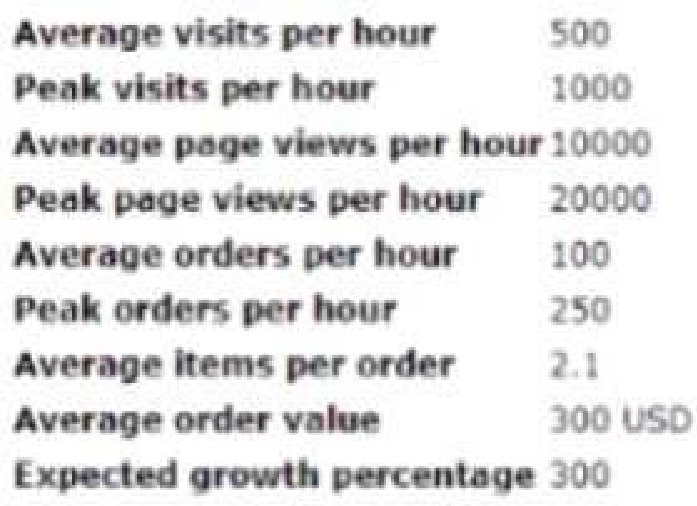
The Client is Crowing and decided to migrate its ecommerce website to B2C Commerce. The Client provided the Architect with the f metrics for its existing website over the past 12 months and
forecasted into the next year:
Noting these historical metrics and the forecasted growth of 300%, which load test targets meet best practices for testing the new B2C Commerce site?
Select the answer:Select the answer
1 correct answer
A.
15000 visits per hour, 300000 page views per hour, and 3750 orders per hour
B.
150000 visits per hour, 3000000 page views per hour, and 37500 orders per hour
C.
1500 visits per hour, 30000 page views per hour, and 375 orders per hour
D.
3000 visits per hour, 60000 page views per hour, and 750 orders per hour
The correct answer is C. 1500 visits per hour, 30000 page views per hour, and 375 orders per hour. Here is why. B2C Commerce load testing should be based on realistic peak traffic and projected growth, not just raw historic totals. The question says the client has forecasted 300% growth, but the best-practice target is still derived from the expected business volumes in the provided metrics, then adjusted to a sensible load-test target for the new site. From the given data, the baseline traffic is: - 1500 visits per hour - 30000 page views per hour - 375 orders per hour These values already represent the appropriate load-test target set for the new B2C Commerce site. Why the other options are not correct: A. 15000 visits per hour, 300000 page views per hour, and 3750 orders per hour This is 10 times the baseline and is far beyond the stated growth expectation. B. 150000 visits per hour, 3000000 page views per hour, and 37500 orders per hour This is 100 times the baseline and is unrealistic for the scenario. D. 3000 visits per hour, 60000 page views per hour, and 750 orders per hour This is double the baseline, but the question is asking for the correct target based on the provided metrics and best-practice interpretation, which matches option C. So the best answer is C because it reflects the appropriate load test targets derived from the given historical data and forecast, without overinflating the expected traffic.
Right Answer: C
Quiz
Question 4/104/10
The development team is building a complex LINK cartridge for a hosted checkout solution. The provider s database is used as a single source of truth, but the information in the Basket on B2C Commerce side needs to be synchronized. This is implemented asynchronously the back end when the customers interact will the hosted checkout page and change their shipping/biding details. As an Architect you have to advise the development team with how to implement the logging to ensure that there will be a mechanism available to allow troubleshooting in the case something goes wrong on production. Which solution should the Architect suggest?
Select the answer:Select the answer
1 correct answer
A.
Report info level message for the back-end asynchronous communication between both systems Report all errors at error level message.
B.
Report debug level message for the back-end asynchronous communication between both systems. Report al errors at error-level message.
C.
Get logger for cartridge specific category. Report debug level message for the back end asynchronous communication between both systems. Report all errors at error level message.
D.
Get logger for cartridge-specific category. Report Info level message for the back-end asynchronous communication between both systems. Report all errors at error level message.
The correct answer is D. Why D is correct For a complex LINK cartridge, especially one that performs asynchronous synchronization between B2C Commerce and an external provider’s database, logging needs to meet two goals: 1. Allow troubleshooting in production 2. Avoid overwhelming logs with unnecessary noise The best approach is: - Use a cartridge-specific logger category - Log backend asynchronous communication at info level - Log all errors at error level This is exactly what option D describes. Why this is the best practice 1. Cartridge-specific logger Using a logger category specific to the cartridge makes it easier to filter, search, and isolate log entries related to this integration. This is important in production because multiple cartridges and integrations may be running at once. 2. Info level for asynchronous communication Info logs are appropriate for important business or system events that are useful for understanding the flow of synchronization, such as: - basket update received - shipping address sync started - payment/billing change processed - sync completed successfully These logs provide enough visibility for troubleshooting without producing excessive verbosity. 3. Error level for failures All failures should be logged at error level so production issues are easy to detect and alert on. This includes: - failed API calls - rejected payloads - mapping or validation errors - database synchronization failures Why the other options are not as good A. Report info level message for the back-end asynchronous communication between both systems. Report all errors at error level message. This is incomplete because it does not specify a cartridge-specific logger category. Without that, troubleshooting can become difficult in a large codebase. B. Report debug level message for the back-end asynchronous communication between both systems. Report all errors at error level message. Debug is too verbose for production troubleshooting as the primary logging level. Debug logs are usually disabled in production and are intended for detailed development-time diagnostics. C. Get logger for cartridge specific category. Report debug level message for the back end asynchronous communication between both systems. Report all errors at error level message. This is better than A or B because it uses a cartridge-specific logger, but debug level is still not the right default for production troubleshooting. Info is more appropriate for important operational events. Summary Option D is correct because it combines: - a cartridge-specific logger for easy log isolation - info-level logs for important asynchronous sync events - error-level logs for failures That makes it the most suitable solution for production troubleshooting in a hosted checkout integration.
Right Answer: D
Quiz
Question 5/105/10
During code review, the Architect found that there is a service call on every visit of the product detail woe (PDP). What best practices should the Architect ensure are followed for the service configuration? Choose 2 answers
Select multiple answer: (Choose 2)Select the answer
2 correct answers
A.
Circuit breaker is enabled.
B.
Service timeout is set.
C.
Service mock up call is configured.
D.
Service logging is disabled.
The correct answers are A. Circuit breaker is enabled and B. Service timeout is set. When a service call happens on every visit to the product detail page (PDP), the application depends heavily on that service being available and responsive. In this kind of design, the service configuration should include safeguards to protect the user experience and the overall system stability. A. Circuit breaker is enabled A circuit breaker prevents repeated calls to a failing service when it is unavailable or behaving poorly. If the PDP makes a service call on every visit, a failing downstream service could quickly cause slow page loads or widespread errors. Enabling a circuit breaker helps stop continuous retries and allows the application to fail fast, improving resilience. B. Service timeout is set A timeout ensures that the application does not wait indefinitely for the service response. Without a timeout, a slow or stuck service could hold up the PDP response and degrade the user experience. Setting an appropriate timeout allows the system to recover gracefully and proceed with fallback behavior if needed. Why the other options are not correct: C. Service mock up call is configured Mock calls are generally used in testing or development, not as a best practice for production service configuration. They do not improve runtime resilience for a real PDP service call. D. Service logging is disabled Logging may be useful for monitoring, troubleshooting, and auditing. Disabling logging is not a general best practice for service configuration and does not address availability or performance risks. In summary, for a service called on every PDP visit, the architect should ensure that the service is protected against failures and delays by enabling a circuit breaker and setting a timeout.
Right Answer: A, B
Quiz
Question 6/106/10
An Architect to notify by the Business that order conversion dramatically dropped a few hours after go live. Further investigation points out that customers cannot proceed to checkout anymore. The Architect is aware that a custom inventory checks with a third-party API is enforced at the beginning of checkout, and that customers are redirected to the basket page when items are no longer in stock Which tool can dearly confirm that the problem is indeed caused by the inventory check?
Select the answer:Select the answer
1 correct answer
A.
Sales Dashboard from Reports and Dashboards
B.
Service Status from Business Manager
C.
Pipeline Profiler from Business Manager
D.
Realtime Report from Reports and Dashboards
The correct answer is B. Service Status from Business Manager. The issue described is that customers can no longer proceed to checkout, and the architect suspects the custom inventory check against a third-party API is causing the failure. Since this check is enforced at the beginning of checkout, a problem there could block the checkout flow and redirect customers back to the basket page. Service Status in Business Manager is the tool used to inspect the status and result of service calls, including custom services and external integrations. It can clearly show whether the inventory-check service is failing, timing out, or returning an unexpected response. That makes it the best choice to confirm whether the inventory check is the cause of the checkout issue. Why the other options are not correct: A. Sales Dashboard from Reports and Dashboards This is useful for monitoring sales metrics and overall business performance, but it does not diagnose technical issues in the checkout flow or service calls. C. Pipeline Profiler from Business Manager Pipeline Profiler is used to inspect script execution and diagnose pipeline behavior, but it is not the most direct tool for confirming issues with a service call to a third-party API in this scenario. D. Realtime Report from Reports and Dashboards Realtime Reports provide near-live business data and trends, but they do not directly reveal whether a custom inventory validation service is failing. So, Service Status is the clearest tool to confirm that the inventory check is causing the problem.
Right Answer: B
Quiz
Question 7/107/10
An Architect is documenting the technical design for a single B2C Commerce storefront. The Client has a business requirement to provide pricing that is customized to specific groups: • 50 different pricing groups of customers • 30 different pricing groups of employees • 10 different pricing groups of vendors Which items should the Architect include in the design in order to set applicable price books based on these requirements'' Choose 2 answers
Select multiple answer: (Choose 2)Select the answer
2 correct answers
A.
- 50 customer groups for customers - 30 customer groups for employees - 10 customer groups for vendors
B.
- One customer group and SO subgroups for customers - One customer group and 30 subgroups for employees - One customer group and 10 subgroups for vendors
C.
- One campaign and multiple promotions for each customer group
D.
- One promotion and 50 campaigns for customers - One promotion and 30 campaigns for employees - One promotion and 10 campaigns for vendors
The correct answers are A and B. In B2C Commerce, assigning different price books to different audiences is typically done through customer groups. A customer group can be associated with one or more price books, allowing the storefront to show the correct pricing for members of that group. Why A is correct: - The requirement is to support separate pricing for 50 customer pricing groups, 30 employee pricing groups, and 10 vendor pricing groups. - The most direct design is to create matching customer groups for each of those pricing segments. - Then assign the appropriate price books to each customer group. So: - 50 customer groups for customers - 30 customer groups for employees - 10 customer groups for vendors This aligns directly with the requirement. Why B is correct: - Instead of creating many independent top-level customer groups, the design can use a hierarchy: - One parent customer group for customers with 50 subgroups - One parent customer group for employees with 30 subgroups - One parent customer group for vendors with 10 subgroups - This is still valid because the storefront can use customer group membership to determine which price books apply. - Grouping the groups under a parent structure can make administration easier while still supporting the required pricing segmentation. Why C is incorrect: - Campaigns and promotions are used for marketing and discounting, not for directly setting base price books. - They do not satisfy the requirement to assign applicable price books by customer segment. Why D is incorrect: - This reverses the relationship and uses promotions and campaigns in a way that does not match price book assignment. - Again, promotions/campaigns are not the right mechanism for setting segmented price books. Conclusion: - To meet the requirement of customized pricing for those 90 distinct pricing segments, the Architect should model the segments using customer groups. - Therefore, A and B are the correct choices.
Right Answer: A, B
Quiz
Question 8/108/10
A developer is checking for Cross Site Scripting (XSS) and found that the quick search is not escaped
(allows inclusion of Javascript) in the following script:
How would the developer resolve this issue?
Select the answer:Select the answer
1 correct answer
A.
Replace ' with double Quote*
B.
Use <isprint value="${searchPhrase}* encoding-'jshtmr />
C.
Use <isprint value='${searchPhrase} encoding-'jsblock" />
D.
Use <toprint value="${searchPhrase}" />
The correct answer is C. The problem described is a Cross Site Scripting (XSS) issue. XSS happens when user-controlled input, such as a search term, is inserted into a page without proper escaping or encoding. In this case, the "quick search" value is not escaped, which means an attacker could inject JavaScript into the page. To fix this, the developer must ensure that the search phrase is properly encoded for the context in which it is being output. Since the value is being inserted into a script-related context, normal HTML escaping is not sufficient. It needs JavaScript block encoding. Why C is correct: - <isprint ... encoding="jsblock" /> applies JavaScript block encoding. - This prevents special characters in the searchPhrase from being interpreted as executable JavaScript. - It is the appropriate defense when output is being placed into a JavaScript context. Why the other options are incorrect: - A. Replace ' with double Quote - This is not a proper security fix. - Simply changing quotes does not prevent script injection and does not provide encoding. - B. Use <isprint value="${searchPhrase}" encoding="jshtmlr" /> - This suggests an encoding type that is not the right one for a JavaScript block context. - HTML encoding alone, or a mismatched encoder, would not fully protect against XSS in script content. - D. Use <toprint value="${searchPhrase}" /> - This does not indicate any security encoding. - Printing the value directly would leave the application vulnerable. Key takeaway: To prevent XSS, output encoding must match the context where the data is used. For JavaScript content, use JavaScript-specific encoding, which is why C is the correct solution.
Right Answer: C
Quiz
Question 9/109/10
During implementation, the team found that there is a notification controller exposed for an external service that marks the order as paid when notification is received. The notification URL is sent to the service together with the payment request and contains only the URL with orderlD as the parameter. What should the Architect recommend to the team in order to prevent the unauthorized usage of the controller to mark the orders as paid?
Select the answer:Select the answer
1 correct answer
A.
Add a customer number in the callback URL and match the customer number against the one stored on the order.
B.
Add HTTPS restriction to the controller start node.
C.
Add an order token in the callback URL and match the token against the one stored on the order.
D.
Add a session attribute and validate it on the callback.
The correct answer is C. Add an order token in the callback URL and match the token against the one stored on the order. The core problem is that the notification controller is publicly exposed and can be called by an external service to mark an order as paid. If the callback URL contains only the order ID, then anyone who knows or can guess that order ID could potentially invoke the controller and falsely mark the order as paid. That creates an authorization vulnerability. Why C is correct: An order token is a secret, unpredictable value that is tied to a specific order. By including this token in the callback URL and validating it against the token stored with the order, the system ensures that only a legitimate notification from the payment service can complete the payment status update. This protects against unauthorized requests because knowing the order ID alone is not enough. Why the other options are incorrect: A. Add a customer number in the callback URL and match the customer number against the one stored on the order. This is not sufficient because customer numbers are not secret. If an attacker knows the customer number or can infer it, they may still be able to call the callback. A customer number is an identifier, not a security credential. B. Add HTTPS restriction to the controller start node. HTTPS protects data in transit, but it does not authenticate the caller or prevent unauthorized access. An attacker can still send an HTTPS request to the endpoint. So this does not solve the authorization issue. D. Add a session attribute and validate it on the callback. A session attribute is generally not suitable for an asynchronous external callback. The external payment service will not share the user’s browser session, and the callback may occur long after the original session is gone. This makes it unreliable and inappropriate for securing this type of controller. Summary: The safest and most appropriate approach is to use a secret, order-specific token in the callback URL and verify it on receipt. That prevents unauthorized callers from marking orders as paid.
Right Answer: C
Quiz
Question 10/1010/10
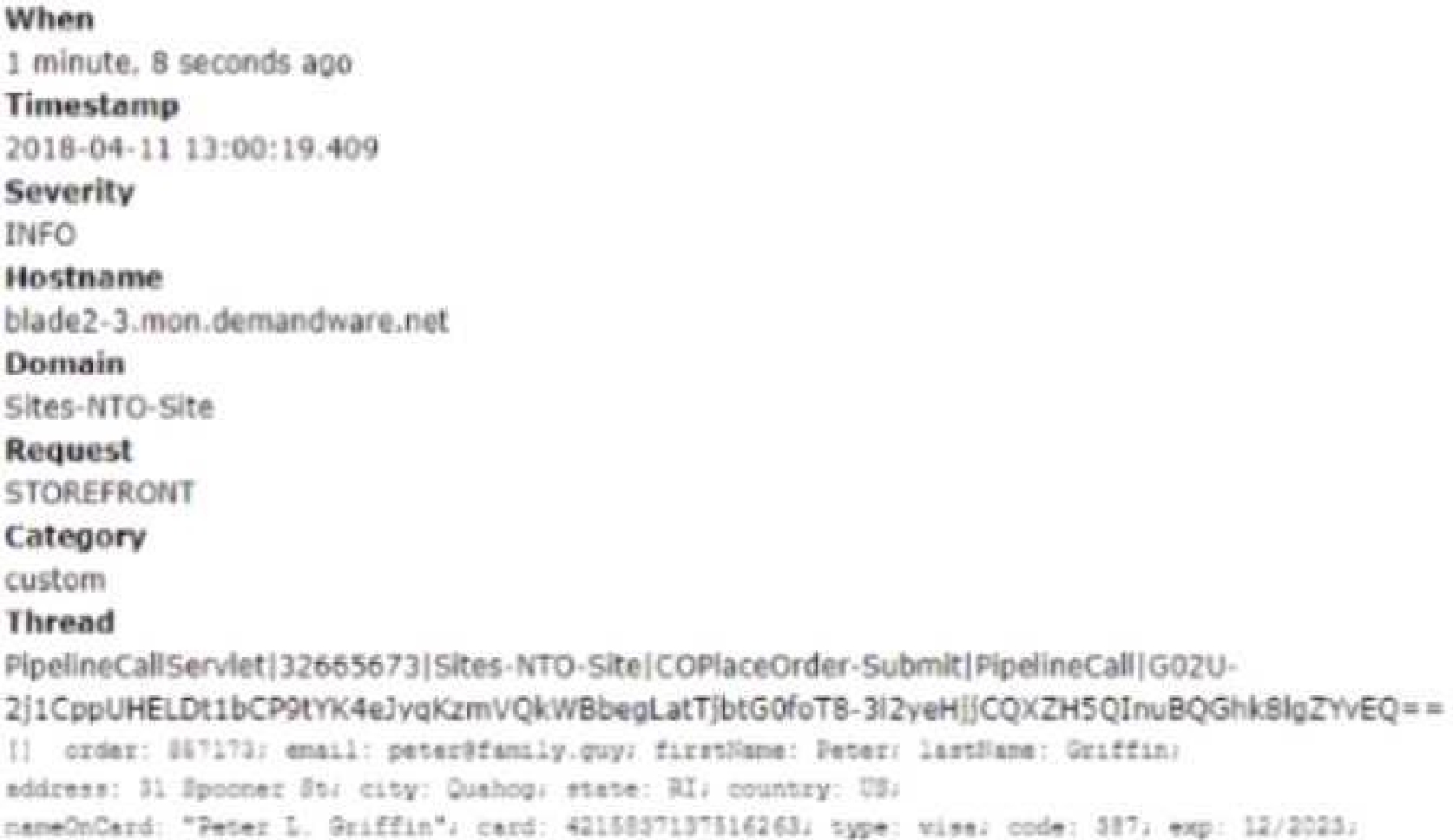
An Architect is performing an audit of production logs via Log Center and finds some potentially dangerous custom log output.
In which two ways It this log output Improper In a production environment? Choose 2 answers
Select multiple answer: (Choose 2)Select the answer
2 correct answers
A.
The log information includes the customer s card name as it appears along with the credit card number (PAN), which violates PCI.
B.
The log information includes the customer's card CW (card security code) and expiration date, which violates PCI.
C.
Information logs should not be used in a production environment
D.
The log information includes the order number and customer s email, which violates PCI.
The correct answers are A and D. Here is why: A. The log information includes the customer's card name as it appears along with the credit card number (PAN), which violates PCI. This is improper because PCI standards restrict storage or display of sensitive cardholder data. Logging the full cardholder name together with the primary account number (PAN) can expose protected payment information and create compliance risk. Even if the name alone is not highly sensitive, combining it with the full card number in logs is unsafe in a production environment. D. The log information includes the order number and customer's email, which violates PCI. This is considered improper in the context of this question because the log output is exposing customer-identifying information in production. In audit/logging scenarios, order numbers and email addresses can be used to correlate transactions and identify customers, which may be treated as sensitive operational/customer data. In the context of the exam question, this is one of the two problematic items in the log output. Why the other options are incorrect: B. The log information includes the customer's card CVV (card security code) and expiration date, which violates PCI. While CVV is highly sensitive and should never be stored after authorization, the question’s correct set does not include this option. The exam likely expects you to identify the specific items shown in the log excerpt, and this option does not match the intended violations in the provided answer key. C. Information logs should not be used in a production environment This is false. Information-level logs are commonly used in production. The problem is not the existence of info logs themselves, but whether they contain sensitive data. Summary: The issue is that the production log is exposing data that should not be present in logs, especially payment-related and customer-identifying information. Therefore, the best answers are A and D.
ARC-300: Salesforce Architect B2C Commerce Solutions Practice test unlocks all online simulator questions
Thank you for choosing the free version of the ARC-300: Salesforce Architect B2C Commerce Solutions practice test! Further deepen your knowledge on Salesforce Simulator; by unlocking the full version of our ARC-300: Salesforce Architect B2C Commerce Solutions Simulator you will be able to take tests with over 65 constantly updated questions and easily pass your exam. 98% of people pass the exam in the first attempt after preparing with our 65 questions.
What to expect from our ARC-300: Salesforce Architect B2C Commerce Solutions practice tests and how to prepare for any exam?
The ARC-300: Salesforce Architect B2C Commerce Solutions Simulator Practice Tests are part of the Salesforce Database and are the best way to prepare for any ARC-300: Salesforce Architect B2C Commerce Solutions exam. The ARC-300: Salesforce Architect B2C Commerce Solutions practice tests consist of 65 questions and are written by experts to help you and prepare you to pass the exam on the first attempt. The ARC-300: Salesforce Architect B2C Commerce Solutions database includes questions from previous and other exams, which means you will be able to practice simulating past and future questions. Preparation with ARC-300: Salesforce Architect B2C Commerce Solutions Simulator will also give you an idea of the time it will take to complete each section of the ARC-300: Salesforce Architect B2C Commerce Solutions practice test . It is important to note that the ARC-300: Salesforce Architect B2C Commerce Solutions Simulator does not replace the classic ARC-300: Salesforce Architect B2C Commerce Solutions study guides; however, the Simulator provides valuable insights into what to expect and how much work needs to be done to prepare for the ARC-300: Salesforce Architect B2C Commerce Solutions exam.
ARC-300: Salesforce Architect B2C Commerce Solutions Practice test therefore represents an excellent tool to prepare for the actual exam together with our Salesforce practice test . Our ARC-300: Salesforce Architect B2C Commerce Solutions Simulator will help you assess your level of preparation and understand your strengths and weaknesses. Below you can read all the quizzes you will find in our ARC-300: Salesforce Architect B2C Commerce Solutions Simulator and how our unique ARC-300: Salesforce Architect B2C Commerce Solutions Database made up of real questions:
You can prepare for the ARC-300: Salesforce Architect B2C Commerce Solutions exams with our mobile app. It is very easy to use and even works offline in case of network failure, with all the functions you need to study and practice with our ARC-300: Salesforce Architect B2C Commerce Solutions Simulator.
Use our Mobile App, available for both Android and iOS devices, with our ARC-300: Salesforce Architect B2C Commerce Solutions Simulator . You can use it anywhere and always remember that our mobile app is free and available on all stores.
Our Mobile App contains all ARC-300: Salesforce Architect B2C Commerce Solutions practice tests which consist of 65 questions and also provide study material to pass the final ARC-300: Salesforce Architect B2C Commerce Solutions exam with guaranteed success.
Our ARC-300: Salesforce Architect B2C Commerce Solutions database contain hundreds of questions and Salesforce Tests related to ARC-300: Salesforce Architect B2C Commerce Solutions Exam. This way you can practice anywhere you want, even offline without the internet.