The new flashcard feature is useful to memorize questions.
?Change your study mode
At any time, you can change the study mode, and alternate between the practice mode and the exam mode. In practice mode, you can configure for example the number of questions or tests, and other parameters to help you study.
Randomized | 10 Questions per Test | 20 Minutes | 70% to pass|
To re-configure your study mode again and change - for example - the number of tests, whether you have random questions and all other configuration parameters.
?Simulator Configuration
Auto-scroll: You can use the automatic scrolling of the questionnaire that occurs as soon as you answer one or all of the answers to a question correctly. Auto scrolling is activated if you answer a single answer, or as soon as you answer all the mandatory answers. Learning Mode: During learning mode you can get a real time result for your answer.
Free Test
Question: / 10
20:00Min. left
?Restart the current test
To restart the current test by clearing all your answers and the time used up to now. Warning: all answers will be lost.
Question: / 10
4.8(373 Votes)
Quiz
Question 1/101/10
You are a solution architect on a brownfield project where an SAP ECC 6.0 system is being migrated to SAP S/4HANA Cloud public edition. Two mission- critical legacy applications must be migrated to the new system. There is some debate on the project team as to the appropriate programming model to use: • Application 1 was originally written using classic ABAP. The underlying SAP tables that the application originally relied on have been removed and the data now exists in a new simplified table in SAP S/4HANA Cloud public edition (to which table extensions are not permitted). Additional data needed for the application resides in SAP Ariba. Remote interfaces exist for both to select the data. • Application 2 was originally written using Java and relied upon tables from the SAP ECC 6.0 system as well as SAP PLM 4.0. The PLM system will be retired; however, the SAP S/4HANA Cloud public edition instance has all the data needed for the application. No remote interfaces exist to select the data. Which of the following approaches should the customer use? Note: There are 2 correct answers to this question.
Select multiple answer: (Choose 2)Select the answer
2 correct answers
A.
Rewrite application 2 using the Cloud Application Programming Model
B.
Rewrite application 1 using the Cloud Application Programming Model
C.
Rewrite application 2 using the ABAP RESTful Application Programming Model
D.
Rewrite application 1 using the ABAP RESTful Application Programming Model
Option A is correct because rewriting Application 2 using the Cloud Application Programming Model (CAP) is suitable for modernizing the Java-based application. CAP is designed for developing cloud- native applications, allowing seamless integration with SAP S/4HANA Cloud, which contains all the necessary data for Application 2. This approach optimizes the application to leverage the cloud environment effectively. Option D is correct because rewriting Application 1 using the ABAP RESTful Application Programming Model (RAP) is appropriate since this application was originally built using classic ABAP. RAP is tailored for developing applications in SAP S/4HANA using ABAP and is ideal for applications that require integration with S/4HANA data models. Since Application 1 relies on data from a new simplified table in S/4HANA, RAP provides the necessary framework to support this integration. Option B is incorrect because rewriting Application 1 using the Cloud Application Programming Model is not optimal. CAP is primarily used for Java applications, whereas Application 1 is ABAP-based and would benefit more from RAP. Option C is incorrect because rewriting Application 2 using the ABAP RESTful Application Programming Model is not suitable. Since Application 2 was developed in Java, leveraging RAP, which is designed for ABAP applications, would not align with its original architecture. CAP is a more fitting choice for Java applications. References: • SAP S/4HANA Migration Guide • SAP Cloud Application Programming Model Documentation • SAP ABAP RESTful Application Programming Model Overview
Right Answer: A, D
Quiz
Question 2/102/10
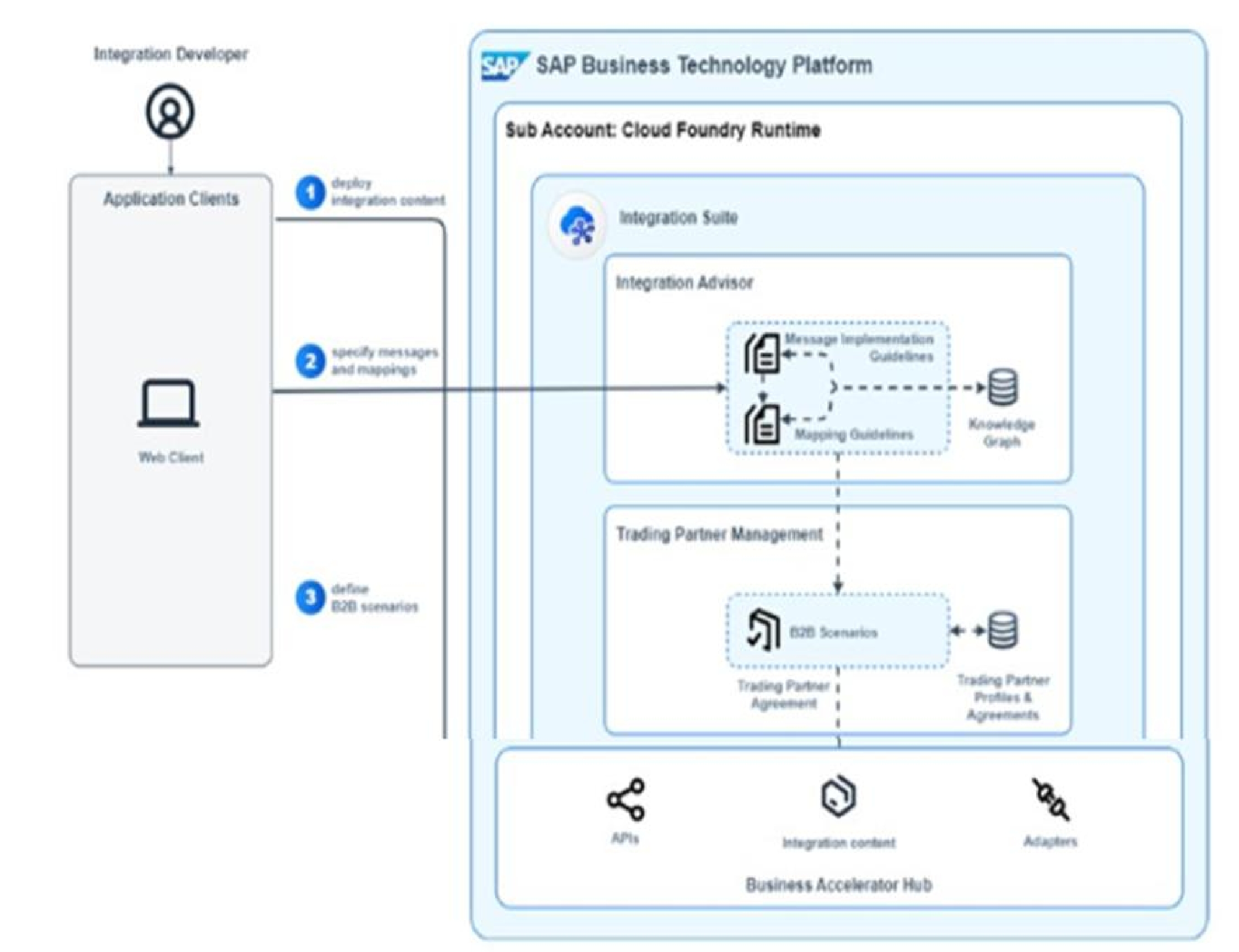
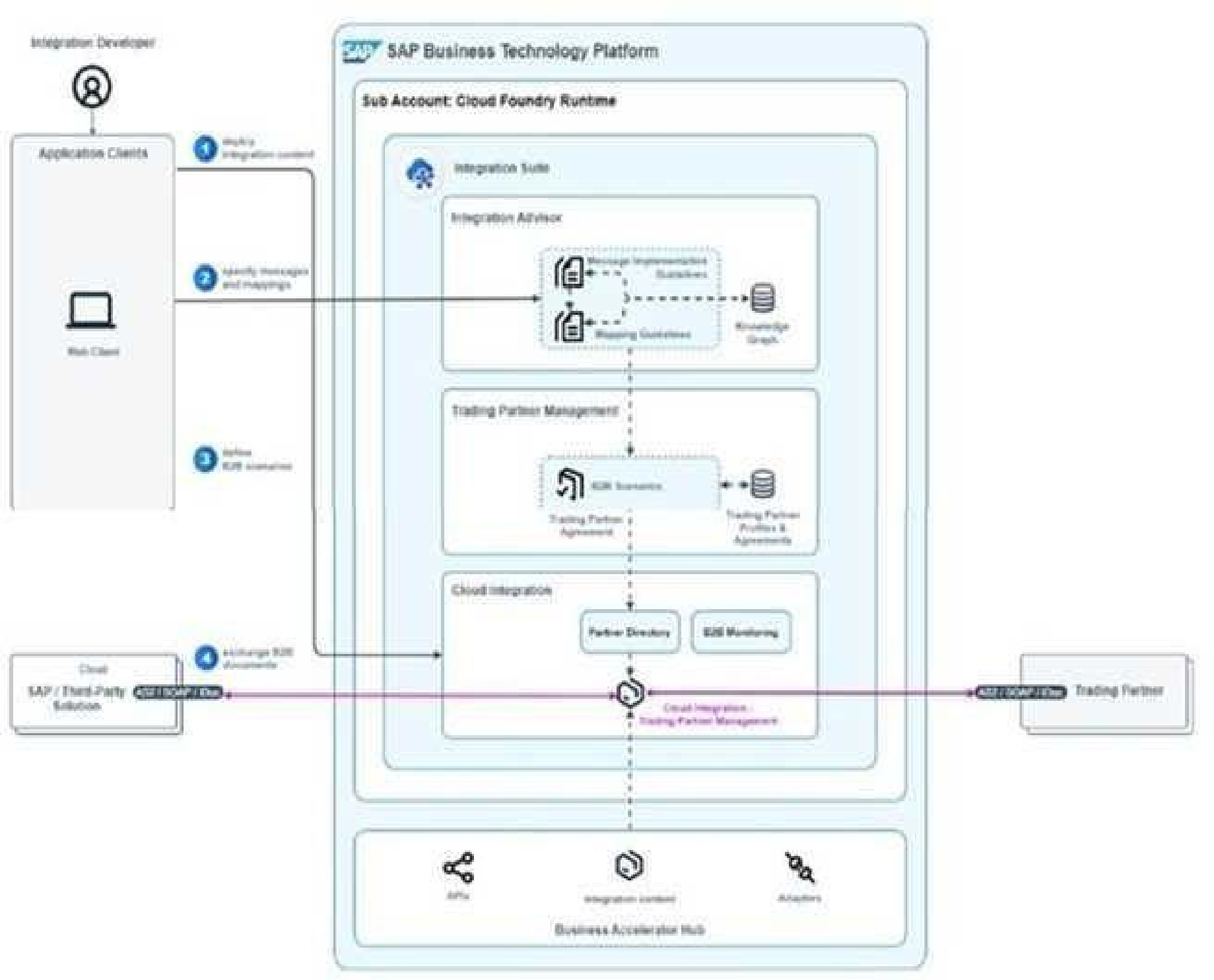
In which phase of the SAP Integration Solution Advisory Methodology is a technology mapping of customer use cases and SAP BTP integration services produced (for an example of a solution
architecture blueprint, see the attached diagram)?
Select the answer:Select the answer
1 correct answer
A.
Enable a practice of empowerment
B.
Define integration best practices
C.
Design your hybrid integration platform
D.
Assess your integration strategy
Option C is correct because the phase "Design your hybrid integration platform" focuses on creating a comprehensive integration architecture that aligns customer use cases with the relevant SAP Business Technology Platform (BTP) integration services. During this phase, technology mapping is performed to identify which integration services will best support the specific use cases, resulting in a solution architecture blueprint that outlines how these services will be utilized within the customer's environment. Option A is incorrect because "Enable a practice of empowerment" typically involves fostering a culture of innovation and self-sufficiency among teams but does not specifically address technology mapping or solution architecture. Option B is incorrect because "Define integration best practices" focuses on establishing guidelines and standards for integration but does not involve the actual mapping of customer use cases to specific integration services. Option D is incorrect because "Assess your integration strategy" involves evaluating the current integration landscape and identifying gaps or areas for improvement, but it does not produce the detailed technology mapping required for a solution architecture blueprint. References: • SAP Integration Solution Advisory Methodology Overview • SAP Business Technology Platform Integration Services Documentation
Right Answer: C
Quiz
Question 3/103/10
A company is decommissioning its legacy ERP system in favor of adopting SAP solutions. The company is not sure which specific solutions to adopt. The company has three main business goals: • Maintain several unique business processes. • Maintain the solutions with a small budget, and limited time and resources. • Integrate several non-SAP solutions. Which combination of solutions should the customer adopt?
Select the answer:Select the answer
1 correct answer
A.
SAP Lean IX | SAP S/4HANA on premise | SAP BTP
B.
SAP Signavio | SAP S/4HANA public edition | SAP Process Orchestration
C.
SAP Signavio | SAP S/4HANA Cloud public edition | SAP BTP
D.
SAP Lean IX | SAP S/4HANA Cloud private edition | SAP Process Orchestration
Option C is correct because adopting SAP Signavio, SAP S/4HANA Cloud public edition, and SAP BTP aligns well with the company's business goals: 1. Maintain several unique business processes: o SAP Signavio offers business process management and modeling capabilities, allowing the company to document, visualize, and optimize its unique business processes effectively. o SAP S/4HANA Cloud public edition supports extensive customization and configuration options, enabling the company to tailor its operations while benefiting from the standard features of SAP. 2. Maintain the solutions with a small budget, and limited time and resources: o The Cloud public edition typically has a lower total cost of ownership compared to on-premise solutions, as it reduces the need for extensive infrastructure and maintenance resources. o Using SAP BTP allows for rapid development and integration capabilities, which can help streamline processes and reduce overall implementation time and resource consumption. 3. Integrate several non-SAP solutions: o SAP BTP provides various tools and services for integration, enabling the company to connect and orchestrate data flows between SAP and non-SAP solutions easily. Option A is incorrect because SAP S/4HANA on premise would require more resources for maintenance and integration, which conflicts with the company's goal of maintaining a small budget and limited resources. Option B is incorrect because while SAP Signavio and SAP Process Orchestration can support business processes, the SAP S/4HANA public edition does not provide as many customization options as the Cloud public edition, potentially limiting the ability to maintain unique business processes. Option D is incorrect as SAP Lean IX and SAP S/4HANA Cloud private edition typically require more investment and management resources compared to the public edition, which may not align with the company's limited budget and resource constraints. References: • SAP Signavio Documentation • SAP S/4HANA Cloud Public Edition Overview • SAP Business Technology Platform Integration Services
Right Answer: C
Quiz
Question 4/104/10
A customer wants to verify the feasibility of the attached "proof of concept" design. They would prefer a zero (or minimal) upfront investment but want to seamlessly transition to a different pricing model while preserving their SAP BTP investments if the design works. As a solution architect, which pricing plan would you recommend to the customer?
Select the answer:Select the answer
1 correct answer
A.
Subscription
B.
Pay-As-You-Go for SAP BTP
C.
SAP BTPEA
D.
SAP BTP trial
Option B is correct because the Pay-As-You-Go for SAP BTP pricing model allows the customer to use SAP BTP services without a significant upfront investment. This model enables the customer to only pay for the resources and services they use, making it ideal for a proof of concept where costs need to be minimized initially. Additionally, if the design proves successful, the customer can continue to use the same services and seamlessly transition to a more extensive usage model without losing their investments in SAP BTP. Option A is incorrect because the Subscription model typically requires a commitment to pay a fixed amount upfront for a specific duration, which does not align with the customer’s preference for minimal upfront investment during the proof of concept phase. Option C is incorrect because SAP BTPEA (Business Technology Platform Enterprise Agreement) is designed for organizations with established usage patterns and does not cater to the need for zero upfront investment or flexibility in the early stages of a project. Option D is incorrect because the SAP BTP trial is a temporary solution meant for evaluation purposes. While it offers free access to BTP services, it is not a sustainable option for transitioning to a full-scale implementation once the proof of concept is validated. The trial does not guarantee that investments will be preserved once moving to a paid model. References: • SAP BTP Pricing Models Documentation • SAP Business Technology Platform Overview
Right Answer: B
Quiz
Question 5/105/10
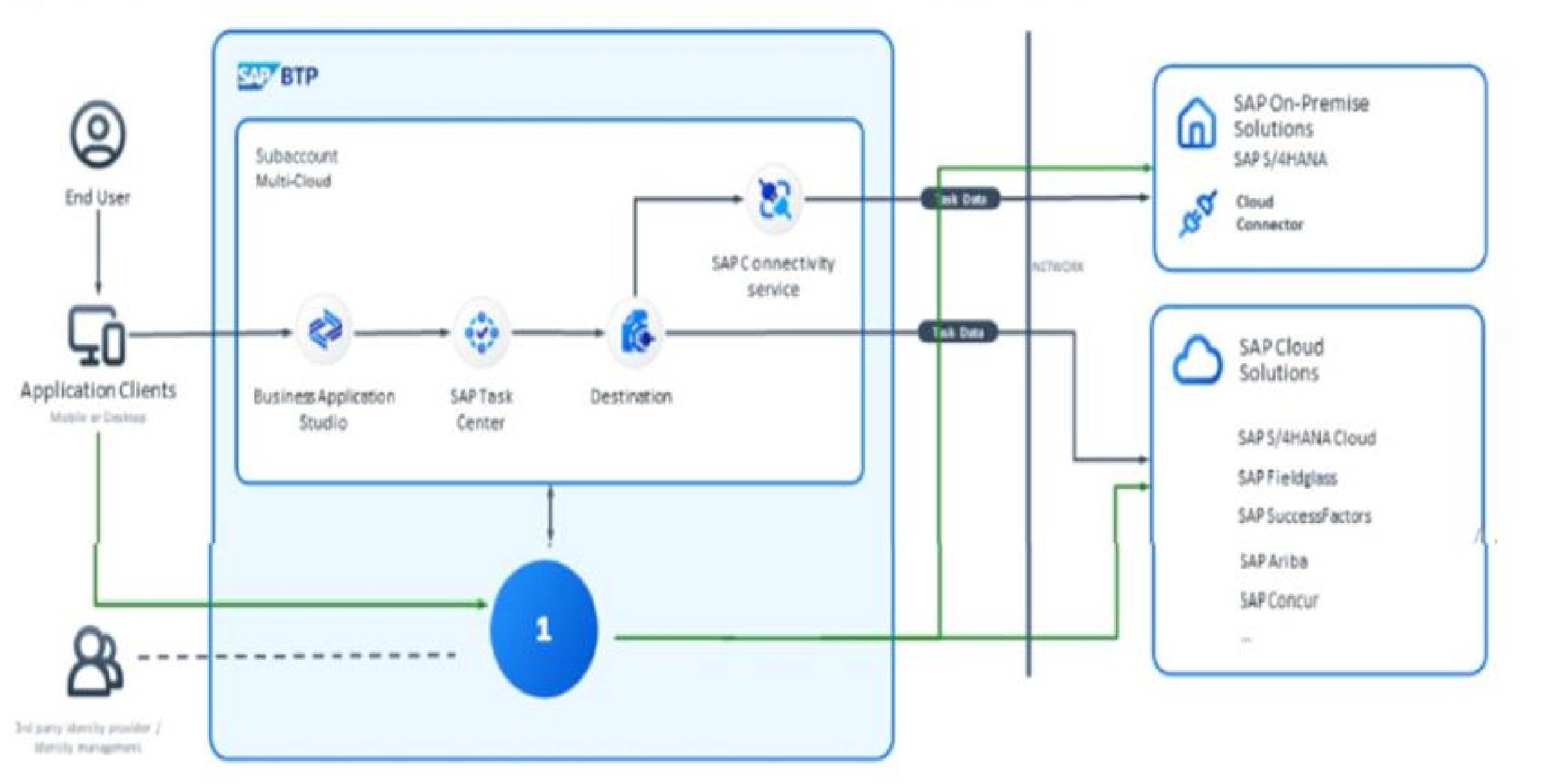
You are a solution architect and your client has recently completed a merger and acquisition. Your client uses SAP S/4HANA Cloud Public Edition and the acquired company is using SAP ECC 6.0. For business and legal reasons, the users of the acquired company cannot yet be added to the global user directory. The acquired users still need access to the custom application. Given the attached diagram, which solution would you recommend to your client in "1" to enable this
access?
Select the answer:Select the answer
1 correct answer
A.
SAP Secure Login Service for SAP GUI
B.
SAP Cloud Identity Services - Identity Provisioning
C.
SAP Authorization and Trust Management Service
D.
SAP Cloud Identity Services - Identity Authentication
Option D is correct because SAP Cloud Identity Services - Identity Authentication provides the necessary capabilities for managing user identities and enabling secure access to applications. This solution allows the acquired company’s users to authenticate themselves and access the custom application in the SAP S/4HANA Cloud Public Edition without needing to be added to the global user directory immediately. By leveraging identity authentication, the acquired users can gain access while complying with business and legal requirements. Option A is incorrect because the SAP Secure Login Service for SAP GUI primarily focuses on enhancing the security of logins for SAP GUI applications but does not address the identity management needs for the acquired users who cannot be added to the global user directory. Option B is incorrect because SAP Cloud Identity Services - Identity Provisioning is intended for provisioning user accounts and managing user access across different systems. However, since the acquired users cannot yet be added to the global user directory, this solution would not be feasible at this stage. Option C is incorrect because the SAP Authorization and Trust Management Service deals with managing authorizations and trust relationships but does not directly provide a means for users to authenticate or access applications. References: • SAP Cloud Identity Services Overview • SAP S/4HANA Cloud Security Guide • SAP Identity Authentication Service Documentation
Right Answer: D
Quiz
Question 6/106/10
As a solution architect, you are asked for your opinion on an optimal integration. You are told that the data resides in two places, SAP S/4HANA (on- premise) and third party APIs. You are also told the following requirements: • Periodically read the data from both systems, perform several transformations of the data, and forward the results to a business partner. • Monitoring is to be done by a dedicated group from IT with SAP products. • Maintenance of the integration part has a small budget, limited time, and limited resources. Which of the following solutions would you recommend as optimal for the design?
Select the answer:Select the answer
1 correct answer
A.
A custom SAP Fiori App and Grafana
B.
SAP Build Process Automation and SAP Solution Manager
C.
SAP Integration Suite and SAP Cloud ALM
D.
SAP Build Apps and SAP Cloud ALM
Option C is correct because the SAP Integration Suite provides a comprehensive integration platform that can easily connect on-premise systems like SAP S/4HANA with third-party APIs. It supports various integration scenarios, including data reading, transformation, and forwarding results. Additionally, it offers pre-built connectors and templates that can accelerate development, aligning well with the requirement for limited time and resources. Furthermore, SAP Cloud ALM is designed for application lifecycle management in the cloud and provides monitoring capabilities tailored for SAP environments. It allows the dedicated IT group to effectively monitor the integration processes and manage performance, which is critical for maintaining oversight with limited resources. Option A is incorrect because while a custom SAP Fiori app could provide a user interface, it does not address the integration and transformation of data from multiple sources effectively. Grafana is primarily used for monitoring and visualization, which does not meet the integration requirements. Option B is incorrect because SAP Build Process Automation is focused on automating business processes rather than integrating data across systems. While SAP Solution Manager is valuable for managing SAP landscapes, it does not provide the direct integration capabilities needed for the scenario. Option D is incorrect because SAP Build Apps focuses on building applications rather than handling integration scenarios. Although SAP Cloud ALM is beneficial for monitoring, the integration capabilities needed to connect SAP S/4HANA with third-party APIs are lacking without the use of the SAP Integration Suite. References: • SAP Integration Suite Documentation • SAP Cloud ALM Overview • SAP S/4HANA Integration Scenarios Guide
Right Answer: C
Quiz
Question 7/107/10
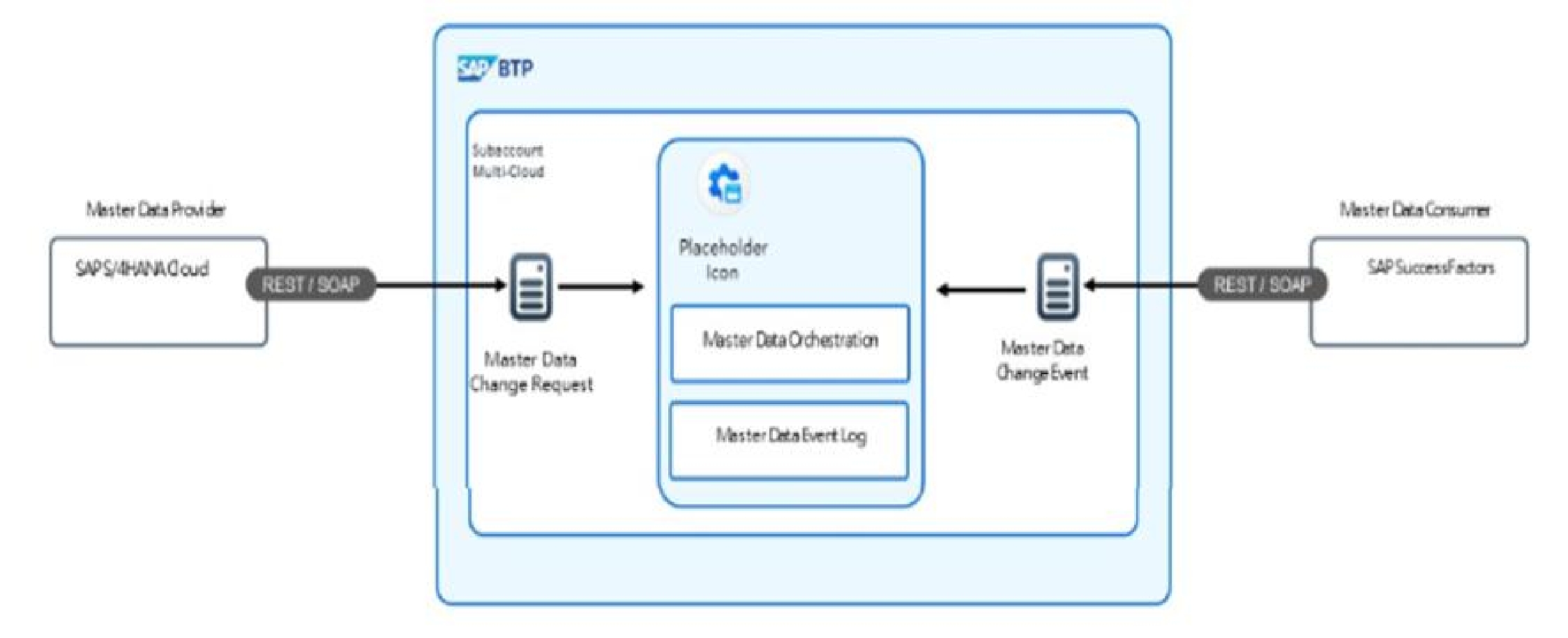
The customer is looking to use an SAP BTP service to replicate master data objects across connected business applications. The service should be based off of the process integration style and the integration use case pattern as defined in the SAP Integration Solution Advisory Methodology. The customer wants to use an SAP BTP service to synchronize the workforce person master data object between SAP S/4HANA Cloud and SAP SuccessFactors HXM Suite as part of the Hire to Retire process (for cloud deployment). They prefer a service that uses a "hub and spoke" model to enable the synchronization. Which of the following SAP solution should the customer use as the "Placeholder Icon" (see attached diagram)?
Select the answer:Select the answer
1 correct answer
A.
SAP NetWeaver Master Data Management
B.
SAP Master Data Governance
C.
SAP Cloud Integration
D.
SAP Master Data Integration
Option D is correct because SAP Master Data Integration is specifically designed for synchronizing master data across multiple systems in a "hub and spoke" model. This solution facilitates the integration of master data between different SAP and non-SAP systems, making it suitable for the scenario of synchronizing workforce person master data between SAP S/4HANA Cloud and SAP SuccessFactors HXM Suite. • Hub and Spoke Model: This model allows the customer to centralize data management and synchronization processes, which aligns with the customer’s requirement for a service that enables effective replication and integration of master data objects. Option A is incorrect because SAP NetWeaver Master Data Management (MDM) is an older solution that primarily focuses on data management rather than the modern integration capabilities required for cloud applications. Option B is incorrect because SAP Master Data Governance (MDG) is focused on the governance of master data rather than direct replication and synchronization processes between cloud applications in a hub and spoke model. Option C is incorrect because SAP Cloud Integration is generally used for integrating different cloud and on-premise applications but does not specifically address the master data replication and governance aspects needed for managing workforce person data in a centralized manner. References: • SAP Master Data Integration Overview • SAP Integration Solution Advisory Methodology • SAP SuccessFactors Integration Scenarios
Right Answer: D
Quiz
Question 8/108/10
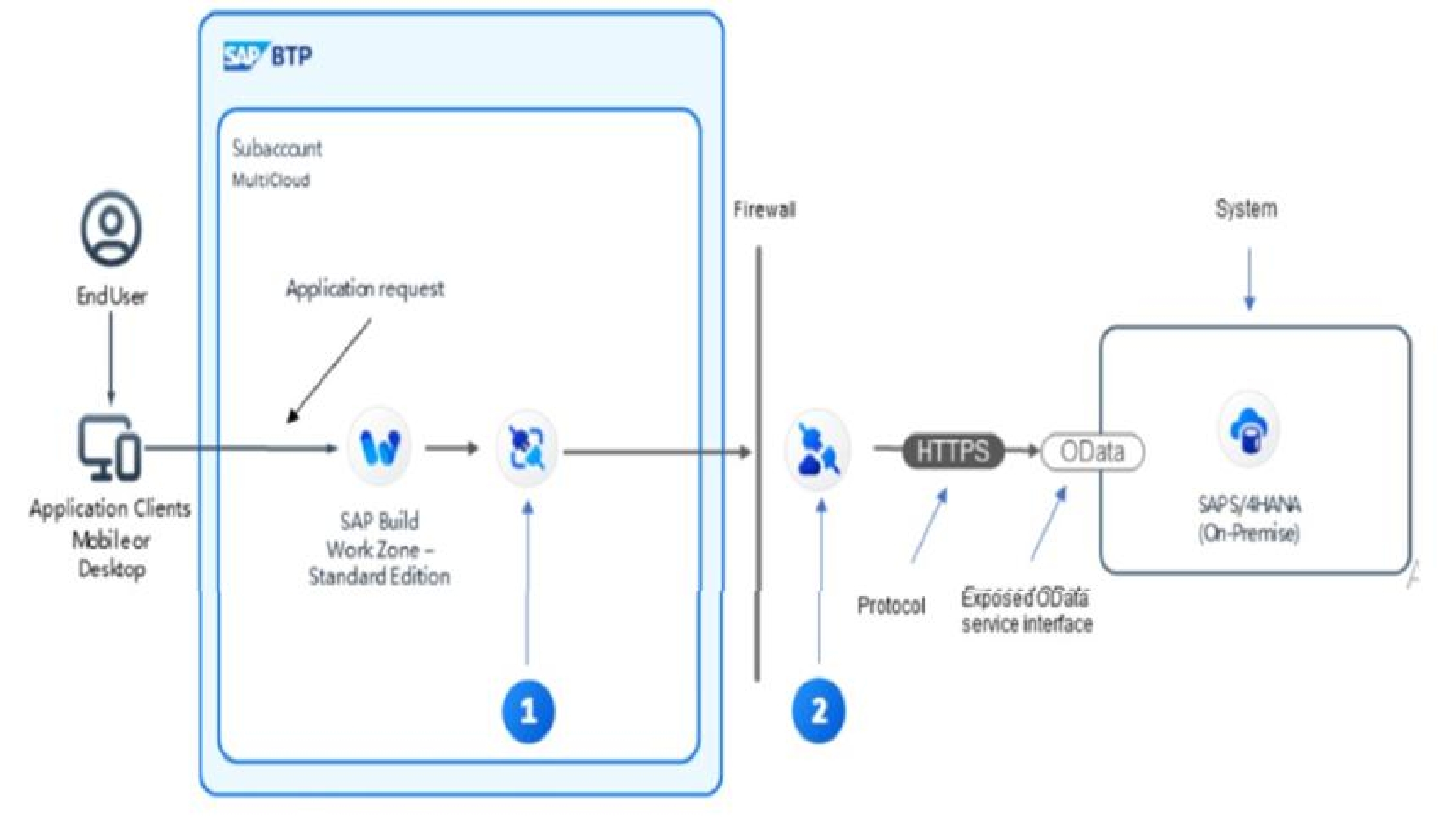
A customer wants to establish connectivity between applications being executed by end users and the on-premise backend system (SAP S/4HANA). Based on the attached diagram, which combination is necessary to establish the connectivity?
Select the answer:Select the answer
1 correct answer
A.
Cloud Connector for 1 and Destination Service for 2
B.
Connectivity Service for 1 and Cloud Connector for 2
C.
Custom Connector for 1 and Connectivity Service for 2
D.
Destination Service for 1 and Connectivity Service for 2
Option B is correct because establishing connectivity between end-user applications and an on-premise backend system like SAP S/4HANA typically requires both the Connectivity Service and the Cloud Connector. 1. Connectivity Service (for 1): This service is essential for managing and routing requests from the cloud to on-premise systems. It allows the applications to connect to backend services securely and efficiently. 2. Cloud Connector (for 2): The Cloud Connector serves as a link between SAP Business Technology Platform (BTP) and the on-premise system. It enables secure communication by establishing a secure tunnel and managing access to on-premise resources from cloud applications. The combination of these two services effectively enables a secure and manageable connectivity solution. Option A is incorrect because while the Cloud Connector is essential for connecting to on-premise systems, the Destination Service alone does not provide the necessary connectivity without the underlying connectivity mechanism. Option C is incorrect because a Custom Connector is typically not necessary for standard connectivity scenarios. Instead, using the provided services (Connectivity Service and Cloud Connector) is the best practice for integrating SAP systems. Option D is incorrect because although the Destination Service is useful for defining endpoints for applications, it does not directly establish connectivity to on-premise systems without the Cloud Connector. References: • SAP Cloud Connector Documentation • SAP Connectivity Service Overview • SAP Integration Guide for S/4HANA and Cloud Applications
Right Answer: B
Quiz
Question 9/109/10
Which part of the SAP Al architecture is responsible for providing the real-time, business-specific data to enable retrieval-augmented generation?
Select the answer:Select the answer
1 correct answer
A.
SAP HANA Cloud vector engine
B.
SAP Joule
C.
Generative Al hub
D.
SAP AI Core
Option A is correct because the SAP HANA Cloud vector engine plays a critical role in providing real- time, business-specific data that is necessary for retrieval-augmented generation (RAG). This component is designed to handle vector embeddings, allowing for efficient searching and retrieval of relevant data based on business contexts. By leveraging this capability, organizations can enhance their generative AI applications with accurate and contextually relevant information. Option B is incorrect because SAP Joule focuses on enabling intelligent automation and enhancing user experience but does not specifically handle the retrieval of real-time business data for generative processes. Option C is incorrect because the Generative AI hub serves as a platform for managing generative AI models and workflows, but it relies on other components (like the vector engine) to supply the necessary data for retrieval-augmented generation. Option D is incorrect because SAP AI Core provides foundational AI services and capabilities but is not solely responsible for retrieving real-time business-specific data needed for RAG. It supports various AI functionalities, while the vector engine is specifically tasked with data retrieval. References: • SAP AI Architecture Overview • SAP HANA Cloud Documentation • Retrieval-Augmented Generation Techniques in SAP AI
Right Answer: A
Quiz
Question 10/1010/10
A manufacturer wants to discuss the design of a solution that tracks and manages stock availability and movement of goods within a warehouse. They want to ensure that movements are aggregated for reporting purposes and that these reports can be used to optimize stock movements. They also want to use the newest solutions to build these reports. Which of the following solutions can be used together to fulfill the requirements? Note: There are 3 correct answers to this question.
Select multiple answer: (Choose 3)Select the answer
3 correct answers
A.
SAP Data Intelligence
B.
SAP HANA Service (SAP Regions) for SAP BTP
C.
SAP Analytics Cloud
D.
SAP Datasphere
E.
SAP HANA Cloud
Option C is correct because SAP Analytics Cloud provides robust reporting and analytics capabilities. It allows users to create interactive reports and dashboards, enabling the manufacturer to visualize stock movements and availability, and optimize operations based on insights derived from aggregated data. Option D is correct because SAP Datasphere (formerly known as SAP Data Warehouse Cloud) serves as a data management and integration solution. It allows for the integration of data from various sources, including warehouse management systems, enabling the aggregation and modeling of stock movement data for reporting purposes. Option E is correct because SAP HANA Cloud serves as an in-memory database service that provides the high-performance data processing capabilities needed for real-time analytics. It can support the storage and processing of data related to stock availability and movements, which is essential for generating the required reports efficiently. Option A is incorrect because SAP Data Intelligence focuses more on data integration and orchestration rather than direct reporting and analytics capabilities. While it can be beneficial in data management scenarios, it does not directly fulfill the reporting needs specified by the manufacturer. Option B is incorrect because while SAP HANA Service provides database capabilities, it does not encompass the complete solution required for reporting and data aggregation as effectively as the combination of options C, D, and E. References: • SAP Analytics Cloud Overview • SAP Datasphere Documentation • SAP HANA Cloud Features and Benefits
P_BTPA_2408: SAP Certified Professional - Solution Architect - SAP BTP Practice test unlocks all online simulator questions
Thank you for choosing the free version of the P_BTPA_2408: SAP Certified Professional - Solution Architect - SAP BTP practice test! Further deepen your knowledge on SAP Simulator; by unlocking the full version of our P_BTPA_2408: SAP Certified Professional - Solution Architect - SAP BTP Simulator you will be able to take tests with over 120 constantly updated questions and easily pass your exam. 98% of people pass the exam in the first attempt after preparing with our 120 questions.
What to expect from our P_BTPA_2408: SAP Certified Professional - Solution Architect - SAP BTP practice tests and how to prepare for any exam?
The P_BTPA_2408: SAP Certified Professional - Solution Architect - SAP BTP Simulator Practice Tests are part of the SAP Database and are the best way to prepare for any P_BTPA_2408: SAP Certified Professional - Solution Architect - SAP BTP exam. The P_BTPA_2408: SAP Certified Professional - Solution Architect - SAP BTP practice tests consist of 120 questions and are written by experts to help you and prepare you to pass the exam on the first attempt. The P_BTPA_2408: SAP Certified Professional - Solution Architect - SAP BTP database includes questions from previous and other exams, which means you will be able to practice simulating past and future questions. Preparation with P_BTPA_2408: SAP Certified Professional - Solution Architect - SAP BTP Simulator will also give you an idea of the time it will take to complete each section of the P_BTPA_2408: SAP Certified Professional - Solution Architect - SAP BTP practice test . It is important to note that the P_BTPA_2408: SAP Certified Professional - Solution Architect - SAP BTP Simulator does not replace the classic P_BTPA_2408: SAP Certified Professional - Solution Architect - SAP BTP study guides; however, the Simulator provides valuable insights into what to expect and how much work needs to be done to prepare for the P_BTPA_2408: SAP Certified Professional - Solution Architect - SAP BTP exam.
P_BTPA_2408: SAP Certified Professional - Solution Architect - SAP BTP Practice test therefore represents an excellent tool to prepare for the actual exam together with our SAP practice test . Our P_BTPA_2408: SAP Certified Professional - Solution Architect - SAP BTP Simulator will help you assess your level of preparation and understand your strengths and weaknesses. Below you can read all the quizzes you will find in our P_BTPA_2408: SAP Certified Professional - Solution Architect - SAP BTP Simulator and how our unique P_BTPA_2408: SAP Certified Professional - Solution Architect - SAP BTP Database made up of real questions:
Info quiz:
Quiz name:P_BTPA_2408: SAP Certified Professional - Solution Architect - SAP BTP
Total number of questions:120
Number of questions for the test:50
Pass score:80%
You can prepare for the P_BTPA_2408: SAP Certified Professional - Solution Architect - SAP BTP exams with our mobile app. It is very easy to use and even works offline in case of network failure, with all the functions you need to study and practice with our P_BTPA_2408: SAP Certified Professional - Solution Architect - SAP BTP Simulator.
Use our Mobile App, available for both Android and iOS devices, with our P_BTPA_2408: SAP Certified Professional - Solution Architect - SAP BTP Simulator . You can use it anywhere and always remember that our mobile app is free and available on all stores.
Our Mobile App contains all P_BTPA_2408: SAP Certified Professional - Solution Architect - SAP BTP practice tests which consist of 120 questions and also provide study material to pass the final P_BTPA_2408: SAP Certified Professional - Solution Architect - SAP BTP exam with guaranteed success.
Our P_BTPA_2408: SAP Certified Professional - Solution Architect - SAP BTP database contain hundreds of questions and SAP Tests related to P_BTPA_2408: SAP Certified Professional - Solution Architect - SAP BTP Exam. This way you can practice anywhere you want, even offline without the internet.