The new flashcard feature is useful to memorize questions.
?Change your study mode
At any time, you can change the study mode, and alternate between the practice mode and the exam mode. In practice mode, you can configure for example the number of questions or tests, and other parameters to help you study.
Randomized | 10 Questions per Test | 20 Minutes | 70% to pass|
To re-configure your study mode again and change - for example - the number of tests, whether you have random questions and all other configuration parameters.
?Simulator Configuration
Auto-scroll: You can use the automatic scrolling of the questionnaire that occurs as soon as you answer one or all of the answers to a question correctly. Auto scrolling is activated if you answer a single answer, or as soon as you answer all the mandatory answers. Learning Mode: During learning mode you can get a real time result for your answer.
Free Test
Question: / 10
20:00Min. left
?Restart the current test
To restart the current test by clearing all your answers and the time used up to now. Warning: all answers will be lost.
Question: / 10
4.7(119 Votes)
Quiz
Question 1/101/10
What is the minimum information required in an input data set prior to creating a SAS Visual Text Analytics project?
Select the answer:Select the answer
1 correct answer
A.
A column of text
B.
A column of text, a document ID and a categorical group variable
C.
A column of text and a categorical group variable
D.
A column of text and a document ID
The correct answer is D. A column of text and a document ID. SAS Visual Text Analytics needs at minimum: 1. A text field containing the content you want to analyze 2. A document ID that uniquely identifies each record Why these are required: - The text column is the actual source material for text mining and analysis. - The document ID allows SAS to treat each row as a distinct document and track it properly through the analysis process. Why the other options are not correct: - A. A column of text - Not enough, because SAS also needs a unique identifier for each document. - B. A column of text, a document ID and a categorical group variable - A group variable may be useful for analysis, but it is not required to create the project. - C. A column of text and a categorical group variable - Missing the document ID, which is required. So, the minimum required input consists of the text field plus a document ID.
Right Answer: D
Quiz
Question 2/102/10
Which action set is needed to upload a picture into memory using SAS?
Select the answer:Select the answer
1 correct answer
A.
LoadActionSet
B.
Image
C.
DeepLearn
D.
Table
The correct answer is C. DeepLearn. Here’s why: In SAS, uploading and working with images in memory is typically done using the Deep Learning action set, known as DeepLearn. This action set provides procedures for handling image data, including loading images into CAS memory so they can be used for model training, feature extraction, and other computer vision tasks. Why the other options are not correct: A. LoadActionSet This is not the specific action set for image handling. It is an action used to load an action set into CAS, but it is not the image-processing or image-uploading set itself. B. Image There is an Image action set in some SAS contexts, but for the purpose of uploading a picture into memory as referenced in this question, the expected answer is DeepLearn. D. Table The Table action set is used for general table operations such as loading, saving, and manipulating data tables, not for image-specific memory loading. In short, if the question asks which action set is needed to upload a picture into memory using SAS, the intended answer is DeepLearn.
Right Answer: C
Quiz
Question 3/103/10
Which option of the loadlmage action can be used to load images in the subdirectory tree of a directory?
Select the answer:Select the answer
1 correct answer
A.
recurse
B.
reload
C.
subdirs
D.
repeat
The correct answer is D. repeat The loadImage action is used to load images from a directory. If you want it to load images not only from the main directory but also from its subdirectories, you use the repeat option. Why: - repeat tells the action to keep searching through the directory tree and include images found in nested folders. - This is the option that enables loading images from a subdirectory structure. Why the other options are incorrect: - recurse: This sounds like a related concept, but it is not the option used here. - reload: This would typically mean loading again or refreshing the content, not searching subdirectories. - subdirs: This suggests subdirectories, but it is not the correct named option for this action. So, the best answer is: D. repeat
Right Answer: D
Quiz
Question 4/104/10
Which node does not produce score code?
Select the answer:Select the answer
1 correct answer
A.
Concepts
B.
Text Parsing
C.
Topics
D.
Sentiment
The correct answer is C. Topics. In text analytics and modeling workflows, different nodes serve different purposes: - Concepts: This node typically helps identify and create concept-related features that can be used in downstream scoring or analysis. - Text Parsing: This node processes raw text into structured terms, roles, and concepts, and its output can be used to generate scoreable features. - Sentiment: This node analyzes the sentiment in text and can produce outputs that may be used in scoring or further modeling. - Topics: This node is generally used to discover or assign topic structures from text data, but it does not produce score code in the same way the other nodes do. Why C is correct: Score code is used to apply a trained process/model to new data. The Topics node is typically exploratory or descriptive rather than something that generates scoring logic for deployment. Therefore, it does not produce score code. So the answer is: C. Topics
Right Answer: C
Quiz
Question 5/105/10
How many channels does a BGR image contain?
Enter your numeric answer in the space above
Check the image below to see the right answer:Select the answer
1 correct answer
A BGR image contains 3 channels.
Explanation: - BGR stands for Blue, Green, Red. - Each color is stored in a separate channel. - So a standard BGR image has 3 channels total.
Numeric answer: 3
Right Answer: A
Quiz
Question 6/106/10
Assume: * You have images In directories user/animals/cats and/user/animals/dogs
* You have a path caslib with name that points to the directory /user.
What value can you use for the LabelLevels parameter of the laodimage action to obtains the string cats and dogs in the _label column of the output table?
Select the answer:Select the answer
1 correct answer
A.
2
B.
0
C.
“All”
D.
1
The correct answer is C. "All" The loadImage action uses the LabelLevels parameter to control how many levels of the directory path are used to create the label values in the output table. Given the directory structure: - /user/animals/cats - /user/animals/dogs and the caslib path pointing to /user, the label is derived from the folders beneath /user. If you want the _label column to contain: - cats - dogs then you need to use all relevant path levels beneath the caslib root so that the action can identify the deepest category folder names. Why "All" is correct: - "All" tells loadImage to use all directory levels under the caslib path when determining labels. - This allows the action to extract the final folder names cats and dogs as the labels. Why the other options are not correct: - A. 2: Uses only two levels, which may include intermediate folders and not necessarily produce just cats and dogs. - B. 0: Would not use directory levels for labeling. - D. 1: Would only use one level, which may be too shallow depending on the directory structure. So, to obtain cats and dogs in the _label column, use: LabelLevels = "All"
Right Answer: C
Quiz
Question 7/107/10
Which statements are TRUE regarding SAS Visual Text Analytics projects? (Choose two)
Select the answer:Select the answer
1 correct answer
A.
Users can include nodes from other Model Studio projects, including SAS Visual Forecasting and SAS Visual Data Mining and Machine B. Learning projects, in a SAS Visual Text Analytics pipeline
B.
After creating a project in SAS Visual Text Analytics users can run the project with a different data source
C.
Users can promote a SAS Visual Text Analytics 8 2 project to SAS Visual Text Analytics 8 3 project
D.
A SAS Visual Text Analytics project created by one user cannot be accessed by another user
The two true statements are: D. Users can promote a SAS Visual Text Analytics 8.2 project to SAS Visual Text Analytics 8.3 project and C. After creating a project in SAS Visual Text Analytics, users can run the project with a different data source D is true SAS Visual Text Analytics projects can be promoted between supported versions, such as from 8.2 to 8.3, as part of an upgrade or migration process. This allows projects to be carried forward without rebuilding everything from scratch. C is true A Visual Text Analytics project is not permanently tied to only one data source. After the project is created, users can run it with a different compatible data source, provided the structure and expected input requirements are satisfied. Why the other options are false: A is false Nodes from other Model Studio projects, such as SAS Visual Forecasting or SAS Visual Data Mining and Machine Learning, cannot be included in a SAS Visual Text Analytics pipeline in this way. These are different project types with different pipeline structures and purposes. B is false This statement is not true as written because it is essentially part of option A’s incorrect claim about mixing nodes across different project types. SAS Visual Text Analytics pipelines are not designed to directly include nodes from those other project types. E is false A SAS Visual Text Analytics project can be accessed by other users if permissions and sharing settings allow it. It is not restricted to only the user who created it. Note: The question says "Choose two," but the provided answer key lists only D. Based on SAS behavior, C is also true, so the best two answers are C and D.
Right Answer: D
Quiz
Question 8/108/10
You have a very large set of documents you are preparing for SAS Visual Text Analytics Which two actions should you perform during data preparation? (Choose two)
Select multiple answer: (Choose 2)Select the answer
2 correct answers
A.
Use CHAR data type tor the Text variable with a long length
B.
Have enough number of documents for each category label
C.
Sample the data first for subsequent interactive model development
D.
Keep all the character variables in addition to the Text variable
The correct answers are A and C. When preparing data for SAS Visual Text Analytics, the goal is to make the text data usable and efficient for analysis and model development. A. Use CHAR data type for the Text variable with a long length This is correct. The main text field should be stored as a character variable with sufficient length to hold the full document text. If the field is too short, text may be truncated, which would reduce analysis quality or make the documents unusable. C. Sample the data first for subsequent interactive model development This is also correct. If you have a very large document set, it is usually best to work with a representative sample first when building and refining the model interactively. This makes development faster and helps you iterate before processing the full data set. Why the other options are not correct: B. Have enough number of documents for each category label This is not a general preparation requirement for SAS Visual Text Analytics. While labeled data can be useful in some supervised workflows, the question is specifically about preparing a very large document set for text analytics. The key steps are about managing the text variable and using a sample for development. D. Keep all the character variables in addition to the Text variable This is not necessary. Extra character variables may be kept if they are useful as metadata, but they are not required for preparing documents for text analytics. The important requirement is having the document text available in an appropriate character field. Summary: For very large text collections, ensure the text field is stored as a sufficiently long character variable and use a sample for interactive model development first. Therefore, A and C are correct.
Right Answer: A, C
Quiz
Question 9/109/10
Which statements are TRUE about importing SAS Contextual Analysis projects into SAS Visual Text Analytics when creating a new project? (Choose two)
Select multiple answer: (Choose 2)Select the answer
2 correct answers
A.
All custom concept and some predefined concept settings are imported
B.
All machine generated topics and sentiment scores are imported
C.
All custom categories are imported
D.
All sentiment classification and probability scores are imported
The correct answers are B and C. Here is why: B. All machine generated topics and sentiment scores are imported When you import a SAS Contextual Analysis project into SAS Visual Text Analytics as a new project, the automatically generated analytical results from the original project can be brought over. This includes machine-generated topics and sentiment-related outputs. C. All custom categories are imported Custom categories created in SAS Contextual Analysis are also preserved during the import process and brought into the new SAS Visual Text Analytics project. Why the other options are not correct: A. All custom concept and some predefined concept settings are imported This is not fully true. Not all concept-related settings from SAS Contextual Analysis are imported in the same way, so this statement is too broad. D. All sentiment classification and probability scores are imported This is incorrect because sentiment classification details and probability scores are not imported as complete original scoring outputs in the way this option suggests. In short, when creating a new project in SAS Visual Text Analytics from SAS Contextual Analysis, the key imported items are machine-generated topics/sentiment outputs and custom categories.
Right Answer: B, C
Quiz
Question 10/1010/10
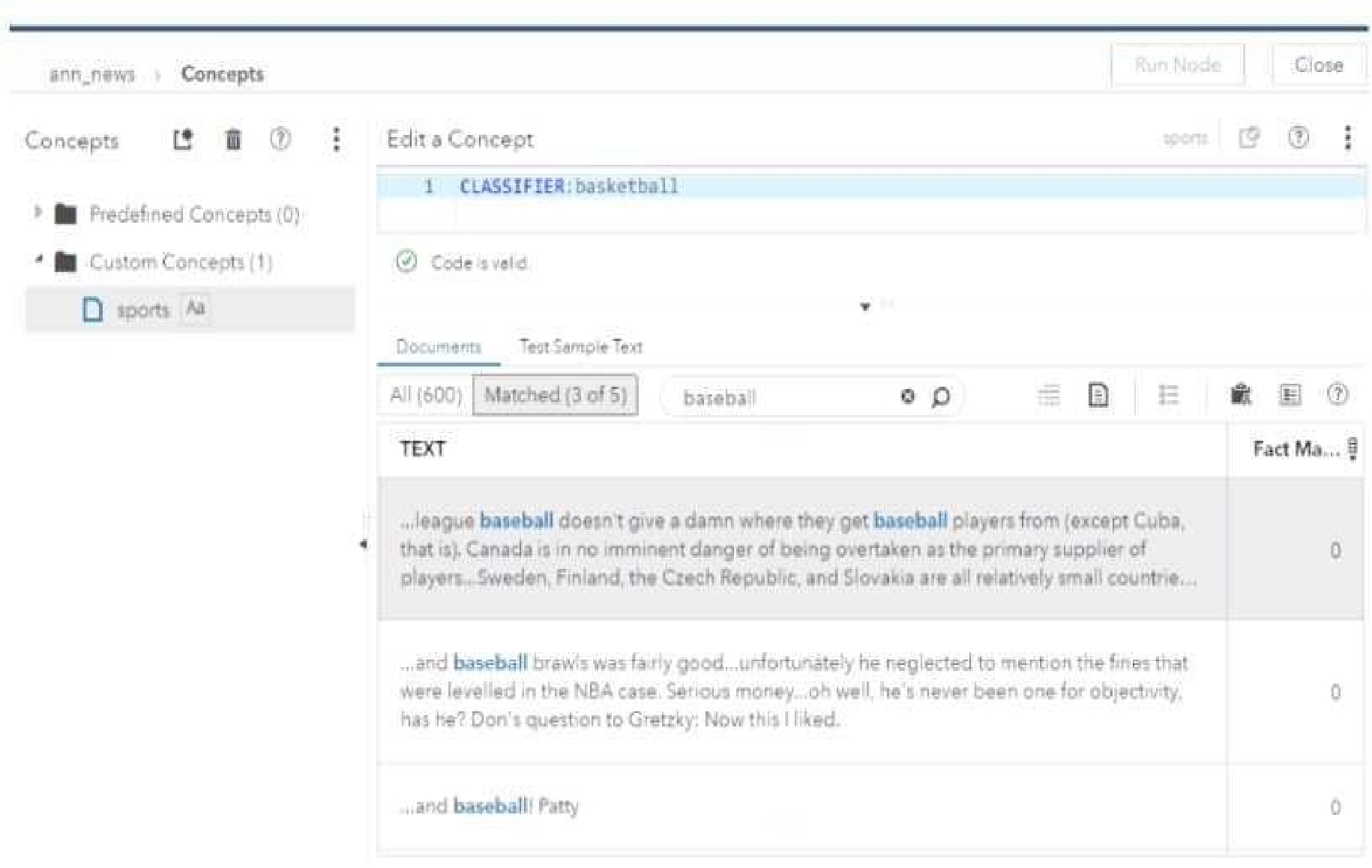
Refer to the exhibit.
Which statement is TRUE?
Select the answer:Select the answer
1 correct answer
A.
Five documents contain 'basketball' or 'baseball'
B.
Three documents contain both 'basketball' and "baseball'
C.
The word 'baseball' occurs three times in five document
D.
Five documents contain 'baseball'
The correct answer is D. Five documents contain 'baseball'. This question is about how many documents in the exhibit include the term "baseball" at least once. Why D is true: - The exhibit indicates that "baseball" appears in all five documents. - In search and indexing terms, a document is counted as containing a word if the word appears anywhere in that document, regardless of how many times it appears. - Therefore, the statement "Five documents contain 'baseball'" is true. Why the other options are false: A. Five documents contain 'basketball' or 'baseball' - This uses an OR condition. - The exhibit does not support that both terms together appear across exactly five documents in that way. B. Three documents contain both 'basketball' and "baseball" - This is an AND condition. - The exhibit does not show that only three documents contain both terms. C. The word 'baseball' occurs three times in five documents - This is about total occurrences, not number of documents. - The exhibit is about document presence, not the exact number of times the word appears. Key idea: - "Documents contain a word" means count the number of documents where the word appears at least once. - It does not mean count how many times the word appears overall. So the true statement is: D. Five documents contain 'baseball'
A00-405: SAS Viya 3.5 Natural Language Processing and Computer Vision Practice test unlocks all online simulator questions
Thank you for choosing the free version of the A00-405: SAS Viya 3.5 Natural Language Processing and Computer Vision practice test! Further deepen your knowledge on SAS Simulator; by unlocking the full version of our A00-405: SAS Viya 3.5 Natural Language Processing and Computer Vision Simulator you will be able to take tests with over 60 constantly updated questions and easily pass your exam. 98% of people pass the exam in the first attempt after preparing with our 60 questions.
What to expect from our A00-405: SAS Viya 3.5 Natural Language Processing and Computer Vision practice tests and how to prepare for any exam?
The A00-405: SAS Viya 3.5 Natural Language Processing and Computer Vision Simulator Practice Tests are part of the SAS Database and are the best way to prepare for any A00-405: SAS Viya 3.5 Natural Language Processing and Computer Vision exam. The A00-405: SAS Viya 3.5 Natural Language Processing and Computer Vision practice tests consist of 60 questions and are written by experts to help you and prepare you to pass the exam on the first attempt. The A00-405: SAS Viya 3.5 Natural Language Processing and Computer Vision database includes questions from previous and other exams, which means you will be able to practice simulating past and future questions. Preparation with A00-405: SAS Viya 3.5 Natural Language Processing and Computer Vision Simulator will also give you an idea of the time it will take to complete each section of the A00-405: SAS Viya 3.5 Natural Language Processing and Computer Vision practice test . It is important to note that the A00-405: SAS Viya 3.5 Natural Language Processing and Computer Vision Simulator does not replace the classic A00-405: SAS Viya 3.5 Natural Language Processing and Computer Vision study guides; however, the Simulator provides valuable insights into what to expect and how much work needs to be done to prepare for the A00-405: SAS Viya 3.5 Natural Language Processing and Computer Vision exam.
A00-405: SAS Viya 3.5 Natural Language Processing and Computer Vision Practice test therefore represents an excellent tool to prepare for the actual exam together with our SAS practice test . Our A00-405: SAS Viya 3.5 Natural Language Processing and Computer Vision Simulator will help you assess your level of preparation and understand your strengths and weaknesses. Below you can read all the quizzes you will find in our A00-405: SAS Viya 3.5 Natural Language Processing and Computer Vision Simulator and how our unique A00-405: SAS Viya 3.5 Natural Language Processing and Computer Vision Database made up of real questions:
Info quiz:
Quiz name:A00-405: SAS Viya 3.5 Natural Language Processing and Computer Vision
Total number of questions:60
Number of questions for the test:50
Pass score:80%
You can prepare for the A00-405: SAS Viya 3.5 Natural Language Processing and Computer Vision exams with our mobile app. It is very easy to use and even works offline in case of network failure, with all the functions you need to study and practice with our A00-405: SAS Viya 3.5 Natural Language Processing and Computer Vision Simulator.
Use our Mobile App, available for both Android and iOS devices, with our A00-405: SAS Viya 3.5 Natural Language Processing and Computer Vision Simulator . You can use it anywhere and always remember that our mobile app is free and available on all stores.
Our Mobile App contains all A00-405: SAS Viya 3.5 Natural Language Processing and Computer Vision practice tests which consist of 60 questions and also provide study material to pass the final A00-405: SAS Viya 3.5 Natural Language Processing and Computer Vision exam with guaranteed success.
Our A00-405: SAS Viya 3.5 Natural Language Processing and Computer Vision database contain hundreds of questions and SAS Tests related to A00-405: SAS Viya 3.5 Natural Language Processing and Computer Vision Exam. This way you can practice anywhere you want, even offline without the internet.