The new flashcard feature is useful to memorize questions.
?Change your study mode
At any time, you can change the study mode, and alternate between the practice mode and the exam mode. In practice mode, you can configure for example the number of questions or tests, and other parameters to help you study.
Randomized | 10 Questions per Test | 20 Minutes | 70% to pass|
To re-configure your study mode again and change - for example - the number of tests, whether you have random questions and all other configuration parameters.
?Simulator Configuration
Auto-scroll: You can use the automatic scrolling of the questionnaire that occurs as soon as you answer one or all of the answers to a question correctly. Auto scrolling is activated if you answer a single answer, or as soon as you answer all the mandatory answers. Learning Mode: During learning mode you can get a real time result for your answer.
Free Test
Question: / 10
20:00Min. left
?Restart the current test
To restart the current test by clearing all your answers and the time used up to now. Warning: all answers will be lost.
Question: / 10
4.9(472 Votes)
Quiz
Question 1/101/10
A content author will be using live copies on AEM. Which two factors must the content author now consider? (Choose two.)
Select multiple answer: (Choose 2)Select the answer
2 correct answers
A.
When the inheritance Is re-enabled, the page is automatically synchronized with the source.
B.
When (everting a canceled inheritance on a paragraph system, the order of components will be automatically restored from the blueprint.
C.
If the component is marked as a container, the cancellation and suspend actions do not apply to Its child components.
D.
Changes made locally to a component marked as a container will not be overwritten by the content of the blueprint on a rollout.
Option A,D are correct. In Adobe Experience Manager (AEM), when dealing with live copies, a content author must be aware of various factors related to the synchronization of content between the source (blueprint) and the live copies. Option A is correct because when inheritance is re-enabled on a live copy page, synchronization with the blueprint page occurs, which may include automatic updates to the live copy page's content. Option D is also correct because local changes made to a component marked as a container are protected during rollouts, meaning that these local changes will not be overwritten by content from the blueprint. The container concept in AEM allows for more granular control over which parts of the page are updated during synchronization. For Option B, the term 'paragraph system' seems incorrect. It should likely refer to 'paragraph systems' as in the ParSys (Paragraph System), a component that allows authors to add components to a page. There is no automatic restoration of the order of components from the blueprint upon re- enabling canceled inheritance; instead, components are managed according to the rules set in the rollout configurations. Option C is incorrect because the cancel and suspend actions can be applied to individual child components within a container. When inheritance is canceled for a container, the inheritance status of child components within that container can be controlled individually.
Right Answer: A, D
Quiz
Question 2/102/10
A developer wants to be able to execute the following query: SELECT *
FROM [ntbase] AS s WHERE s.status ='STARTED' Which two options are mandatory additions to the Index? (Choose two.)
Select multiple answer: (Choose 2)Select the answer
2 correct answers
A.
ntbase index rule
B.
status properly with property Index = false
C.
ntbase aggregate
D.
status property with propertylndex = true
Option A,D are correct. When creating a custom query in AEM's JCR (Java Content Repository), the query's performance is highly dependent on the indexing configuration. For the given query that selects all nodes with a 'status' property equal to 'STARTED' from the 'nt:base' node type, the index must be set up correctly: Option A, "nt:base index rule", is correct. The index rule for 'nt:base' must be added to define which properties of nodes of this type are indexed. Option D, "status property with propertyIndex = true", is also correct. This index ensures that queries filtering on the 'status' property are executed efficiently. The property index should be set to true, which means that this property is indexed and the query will use this index to filter the results. Option B is incorrect because setting the property index to false would mean that the property is not indexed, making the query less efficient since the repository would need to scan each node to find matches. Option C, "nt:base aggregate", is not mandatory. Aggregates are used to include properties of related nodes in the index, but they are not required for a simple property match like the one in the given query.
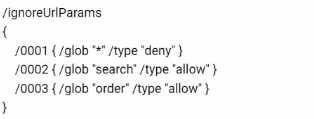
Option C is correct. Given the dispatcher configuration snippet provided in the image, we can understand the URL patterns that will be ignored (not cached) by the dispatcher. The configuration under /ignoreUrlParams shows patterns to match query parameters in the URLs: /0001 { /glob "*" /type "deny" } means that by default, all query parameters are ignored (not cached). /0002 { /glob "search" /type "allow" } specifically allows caching for URLs with the 'search' parameter. /0003 { /glob "order" /type "allow" } specifically allows caching for URLs with the 'order' parameter. Based on this, let's evaluate the options: A) /myproduct/myrecipe.html?search=searchparam — This URL will not be cached because the 'search' parameter is allowed, but the actual value 'searchparam' does not match any allow pattern. B) /myproduct/myrecipe.html?search=s&order=asc&brand=ad — This URL will not be cached because although 'search' and 'order' parameters are allowed, the 'brand' parameter is not allowed according to the configuration. C. /myproduct/myrecipe.html?brand=mybrand — This URL will be cached because there are no allowed parameters, so the default deny does not apply, and the page can be cached without considering the 'brand' parameter. Therefore, the page that will be cached on the dispatcher is the one in option C, as it does not contain any of the explicitly allowed query parameters ('search' or 'order'), and all other parameters are ignored by default.
Right Answer: C
Quiz
Question 4/104/10
A developer wants to see debug logs for SAML. Which logger must be created for this purpose?
Select the answer:Select the answer
1 correct answer
A.
com.adobe.granlte.debug.auth.saml
B.
com.adobe.sling.auth.saml
C.
com. adobe, granite.aulh.saml
Option C is correct. The correct logger to be created for debugging SAML (Security Assertion Markup Language) within AEM (Adobe Experience Manager) is the one pertaining to the Granite platform, which is part of AEM’s internal framework dealing with authentication. The Granite framework provides services that include user, group, and permission management, and is integral to AEM's SAML authentication process. Thus, the logger com.adobe.granite.auth.saml is the appropriate logger that should be created and configured to capture and display debug logs related to SAML authentication processes.
Right Answer: C
Quiz
Question 5/105/10
A developer has to enable the indexing of multiple properties asynchronously. Which type of index would the developer use?
Select the answer:Select the answer
1 correct answer
A.
Property
B.
Lucene
C.
Ordered
In AEM, Lucene is often used for indexing due to its powerful full-text search capabilities, and it also supports asynchronous indexing. Asynchronous indexing allows the system to handle other tasks while indexing is being processed in the background, which can improve performance and scalability. This is especially useful when multiple properties need to be indexed without impacting the immediate response times of the system. Therefore, when a developer needs to enable the indexing of multiple properties asynchronously, a Lucene index is the most suitable choice.
Right Answer: B
Quiz
Question 6/106/10
A developer wants to send a SAML Authentication Request to a specific URL of a system entity that creates, maintains, and manages identity information. Which property of SAML Authentication Handler configuration must be configured with this URL?
Select the answer:Select the answer
1 correct answer
A.
Identity Provider URL
B.
Path
C.
Default Redirect
Option A is correct. Within the SAML (Security Assertion Markup Language) Authentication Handler configuration in AEM, the property that must be configured with the URL of a system entity that manages identity information is the Identity Provider URL. The Identity Provider (IdP) is a core component of the SAML specification that is responsible for issuing authentication assertions and managing user identity information. Configuring the Identity Provider URL in the SAML Authentication Handler ensures that the authentication requests are directed correctly to the IdP.
Right Answer: A
Quiz
Question 7/107/10
Which two methods are used to update the cache? (Choose two.)
Select multiple answer: (Choose 2)Select the answer
2 correct answers
A.
Content Updates
B.
Restart on AEM Author Instance
C.
Restart on AEM Publish Instance
D.
Auto-invalidation on the Dispatcher
Option A,D are correct. Updating the cache in AEM is critical to ensure that users receive the most current content without unnecessary delays. Two common methods used to update the cache include: A) Content Updates - Content updates can trigger an invalidation or flush of the cache. When content is published or updated on the AEM author instance and replicated to the publish instance, the dispatcher cache can be set to automatically invalidate the affected pages. This ensures that the next request to these pages serves the latest content. D) Auto-invalidation on the Dispatcher - The dispatcher can be configured to automatically invalidate cached content under certain conditions, such as when a TTL (Time To Live) expires or when specific actions occur, such as a page activation or deactivation. This is often preferred to manual cache clearing as it can be more efficient and targeted to the specific content that has changed. Options B and C are incorrect because restarting the AEM Author or Publish instances does not directly relate to cache update methods. These actions are more associated with system maintenance or updates and would not be standard practice for updating cached content.
Right Answer: A, D
Quiz
Question 8/108/10
What is the out-of-the-box response of the dispatcher when requesting a URL which is defined as deny in /filter setting of the dispatcher?
Select the answer:Select the answer
1 correct answer
A.
400
B.
404
C.
403
Option C is correct. When the dispatcher encounters a URL that is defined as 'deny' in the /filter settings, the out-of-the- box response is typically a 403 Forbidden error. This HTTP status code indicates that the server understands the request but refuses to authorize it. This means the dispatcher configuration has rules set up to explicitly prevent access to certain patterns of URLs, and when such a pattern is matched, it will deny the request, resulting in a 403 response.
Right Answer: C
Quiz
Question 9/109/10
The SAML Authentication Handler is disabled by default, and the developer wants to enable this handler Which two properties must be at least one of the configured properties? (Choose two.)
Select multiple answer: (Choose 2)Select the answer
2 correct answers
A.
IDPURL
B.
Password of Key Store
C.
Identity Provider POST URL
D.
Service Provider Entity ID
Option A,D are correct. To enable the SAML (Security Assertion Markup Language) Authentication Handler in Adobe Experience Manager (AEM), certain critical properties need to be configured to establish the necessary trust and communication between the Identity Provider (IdP) and the Service Provider (SP, which in this case is AEM). A) IDPURL (Identity Provider URL) - This property is essential for configuring the SAML Authentication Handler as it specifies the URL of the Identity Provider. This URL is used by AEM to redirect authentication requests to the IdP. It is crucial for initiating the SAML SSO (Single Sign-On) process. D) Service Provider Entity ID - This is a unique identifier for the Service Provider (AEM in this context). It is used by the Identity Provider to recognize the Service Provider. The Entity ID is a key component of the SAML assertions and is used to ensure that the SAML responses are directed to the correct entity. B) Password of Key Store is important for securing the communication between IdP and SP by encrypting the SAML assertions, but it is not mandatory for the basic enablement of the SAML Authentication Handler. C) Identity Provider POST URL is used in scenarios where the SAML response from the IdP is sent via HTTP POST. While it's important for the SAML configuration, the initial enablement and basic functionality of the SAML Authentication Handler primarily depend on the IdP URL and the SP Entity ID.
Right Answer: A, D
Quiz
Question 10/1010/10
What is the correct resource type of the configuration node?
Select the answer:Select the answer
1 correct answer
A.
cq:Configuration
B.
slingOsgiConfig
C.
cq:OsgiConfig
Option B is correct. In Adobe Experience Manager, the correct resource type for an OSGi configuration node is sling:OsgiConfig. This resource type is used to define nodes in the repository that represent OSGi configurations. These configurations can then be read by OSGi components within AEM to configure their behavior according to the defined properties. Option A, cq:Configuration, is not used for OSGi configuration nodes. It might be used within the context of Context-Aware Configuration but not for defining OSGi configurations. Option C, cq:OsgiConfig, is not a valid resource type for OSGi configurations in AEM. The correct namespace for OSGi configurations in AEM is sling, hence sling:OsgiConfig.
AD0-E123: Adobe Experience Manager Sites Developer Professional Practice test unlocks all online simulator questions
Thank you for choosing the free version of the AD0-E123: Adobe Experience Manager Sites Developer Professional practice test! Further deepen your knowledge on Adobe Simulator; by unlocking the full version of our AD0-E123: Adobe Experience Manager Sites Developer Professional Simulator you will be able to take tests with over 50 constantly updated questions and easily pass your exam. 98% of people pass the exam in the first attempt after preparing with our 50 questions.
What to expect from our AD0-E123: Adobe Experience Manager Sites Developer Professional practice tests and how to prepare for any exam?
The AD0-E123: Adobe Experience Manager Sites Developer Professional Simulator Practice Tests are part of the Adobe Database and are the best way to prepare for any AD0-E123: Adobe Experience Manager Sites Developer Professional exam. The AD0-E123: Adobe Experience Manager Sites Developer Professional practice tests consist of 50 questions and are written by experts to help you and prepare you to pass the exam on the first attempt. The AD0-E123: Adobe Experience Manager Sites Developer Professional database includes questions from previous and other exams, which means you will be able to practice simulating past and future questions. Preparation with AD0-E123: Adobe Experience Manager Sites Developer Professional Simulator will also give you an idea of the time it will take to complete each section of the AD0-E123: Adobe Experience Manager Sites Developer Professional practice test . It is important to note that the AD0-E123: Adobe Experience Manager Sites Developer Professional Simulator does not replace the classic AD0-E123: Adobe Experience Manager Sites Developer Professional study guides; however, the Simulator provides valuable insights into what to expect and how much work needs to be done to prepare for the AD0-E123: Adobe Experience Manager Sites Developer Professional exam.
AD0-E123: Adobe Experience Manager Sites Developer Professional Practice test therefore represents an excellent tool to prepare for the actual exam together with our Adobe practice test . Our AD0-E123: Adobe Experience Manager Sites Developer Professional Simulator will help you assess your level of preparation and understand your strengths and weaknesses. Below you can read all the quizzes you will find in our AD0-E123: Adobe Experience Manager Sites Developer Professional Simulator and how our unique AD0-E123: Adobe Experience Manager Sites Developer Professional Database made up of real questions:
Info quiz:
Quiz name:AD0-E123: Adobe Experience Manager Sites Developer Professional
Total number of questions:50
Number of questions for the test:50
Pass score:80%
You can prepare for the AD0-E123: Adobe Experience Manager Sites Developer Professional exams with our mobile app. It is very easy to use and even works offline in case of network failure, with all the functions you need to study and practice with our AD0-E123: Adobe Experience Manager Sites Developer Professional Simulator.
Use our Mobile App, available for both Android and iOS devices, with our AD0-E123: Adobe Experience Manager Sites Developer Professional Simulator . You can use it anywhere and always remember that our mobile app is free and available on all stores.
Our Mobile App contains all AD0-E123: Adobe Experience Manager Sites Developer Professional practice tests which consist of 50 questions and also provide study material to pass the final AD0-E123: Adobe Experience Manager Sites Developer Professional exam with guaranteed success.
Our AD0-E123: Adobe Experience Manager Sites Developer Professional database contain hundreds of questions and Adobe Tests related to AD0-E123: Adobe Experience Manager Sites Developer Professional Exam. This way you can practice anywhere you want, even offline without the internet.