The new flashcard feature is useful to memorize questions.
?Change your study mode
At any time, you can change the study mode, and alternate between the practice mode and the exam mode. In practice mode, you can configure for example the number of questions or tests, and other parameters to help you study.
Randomized | 10 Questions per Test | 20 Minutes | 70% to pass|
To re-configure your study mode again and change - for example - the number of tests, whether you have random questions and all other configuration parameters.
?Simulator Configuration
Auto-scroll: You can use the automatic scrolling of the questionnaire that occurs as soon as you answer one or all of the answers to a question correctly. Auto scrolling is activated if you answer a single answer, or as soon as you answer all the mandatory answers. Learning Mode: During learning mode you can get a real time result for your answer.
Free Test
Question: / 10
20:00Min. left
?Restart the current test
To restart the current test by clearing all your answers and the time used up to now. Warning: all answers will be lost.
Question: / 10
4.7(815 Votes)
Quiz
Question 1/101/10
The primary characteristic of risk management is being
Select the answer:Select the answer
1 correct answer
A.
simple
B.
reactive
C.
unnatural
D.
all-inclusive
Risk management in software quality engineering aims to identify, assess, and mitigate risks that could affect project outcomes. The primary characteristic of effective risk management is that it should be all-inclusive. This means it should encompass all potential risk areas, including technical, project management, resource allocation, and external factors. An all-inclusive approach ensures that no significant risk is overlooked and that comprehensive strategies are in place to manage identified risks effectively. Reference: Software Quality Assurance: Principles and Practice by Nina S. Godbole. ASQ Software Quality Engineer Handbook.
Right Answer: D
Quiz
Question 2/102/10
Short-run SPC should be used in which of the following situations?
Select the answer:Select the answer
1 correct answer
A.
The coded data being used do not show significant shifts in the process.
B.
Regular SPC charts show the process to be out of control.
C.
Many different parts are made in small lots.
D.
The number of charts currently used needs to be increased to control the process better.
Short-run Statistical Process Control (SPC) is particularly useful in situations where many different parts are made in small lots. This is because traditional SPC methods may not be effective when production runs are short and the volume of data for individual parts is limited. Short-run SPC techniques allow for effective monitoring and control of processes that produce a variety of parts in small quantities by standardizing and coding data to detect shifts and trends over multiple short runs. Reference: Montgomery, D. C. (2009). Introduction to Statistical Quality Control. ASQ Quality Press: The Certified Quality Engineer Handbook.
Right Answer: C
Quiz
Question 3/103/10
Which of the following tools is used to plan for and avoid situations that might interfere with project implementation?
Select the answer:Select the answer
1 correct answer
A.
Affinity diagram
B.
Matrix diagram
C.
Interrelationship digraph
D.
Process decision program chan
The Process Decision Program Chart (PDPC) is a tool used to anticipate potential problems that could interfere with project implementation and to develop countermeasures to prevent or mitigate those problems. It is a structured method for mapping out every conceivable event and contingency that can occur in the course of a project, thus allowing project managers to plan for and avoid disruptions effectively. Reference: ASQ Quality Press: The Quality Toolbox. Total Quality Management by Dale H. Besterfield.
Right Answer: D
Quiz
Question 4/104/10
Failure to cite the significant contributions of other individuals in a final manuscript for publication violates which category of the ASQ Code of Ethics?
Select the answer:Select the answer
1 correct answer
A.
Fundamental Principles
B.
Relations with the Public
C.
Relations with Employers and Clients
D.
Relations with Peers
Failing to cite the significant contributions of other individuals in a final manuscript for publication violates the category of "Relations with Peers" in the ASQ Code of Ethics. This category emphasizes the importance of acknowledging and respecting the contributions of colleagues and collaborators in professional work. Proper citation practices are essential for maintaining professional integrity and fostering a collaborative environment within the professional community. Reference: ASQ Code of Ethics. Professional Ethics in Engineering by Mike W. Martin and Roland Schinzinger.
Right Answer: D
Quiz
Question 5/105/10
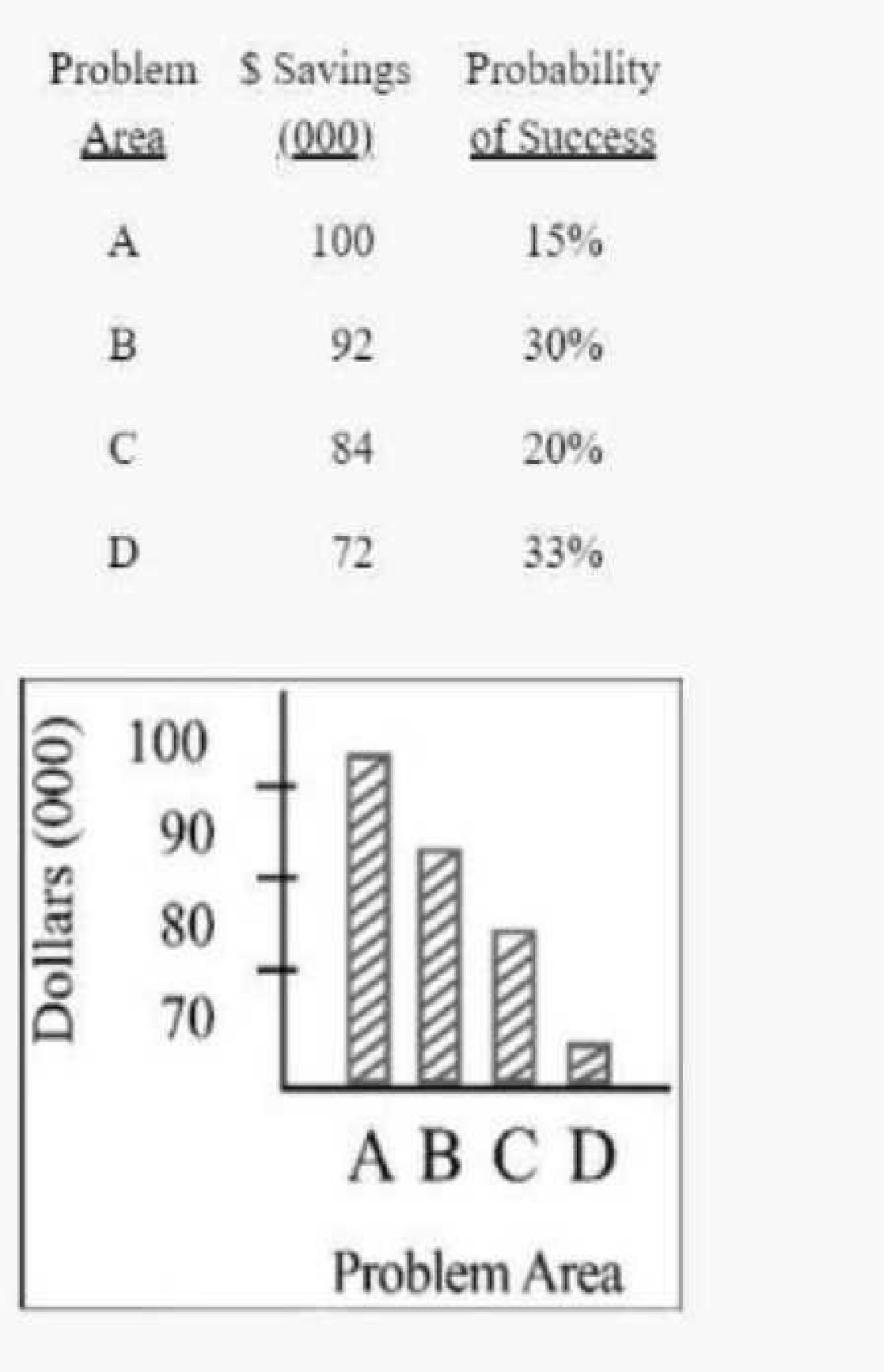
The following data sets were presented to top management.
Which problem area should be targeted for improvement first?
Select the answer:Select the answer
1 correct answer
A.
A
B.
B
C.
C
D.
D
To determine which problem area should be targeted for improvement first, we need to consider both the dollar savings and the probability of success. Calculating the expected savings (dollar savings multiplied by the probability of success) for each problem area gives us a clear picture: A: 100,000 * 0.15 = 15,000 B: 92,000 * 0.30 = 27,600 C: 84,000 * 0.20 = 16,800 D: 72,000 * 0.33 = 23,760 Problem Area B has the highest expected savings (27,600), making it the best target for initial improvement efforts based on the given data. Reference: Quality Management for Organizational Excellence by David L. Goetsch and Stanley Davis. ASQ Certified Manager of Quality/Organizational Excellence Handbook.
Right Answer: B
Quiz
Question 6/106/10
Which of the following types of planning uses a strategic planning process that relates idealistic goals to work strategy?
Select the answer:Select the answer
1 correct answer
A.
Yoji planning
B.
Hoshin planning
C.
Juran planning
D.
Deining planning
Hoshin planning, also known as Hoshin Kanri or policy deployment, is a strategic planning process that aligns an organization's functions and activities with its strategic objectives. It involves setting idealistic goals and linking them to actionable work strategies through a systematic approach. This method ensures that all levels of an organization are working harmoniously towards common objectives. Reference: Quality Management and Six Sigma by Shruti Bhat "Hoshin Kanri: Policy Deployment for Successful TQM" by Yoji Akao
Right Answer: B
Quiz
Question 7/107/10
Which of the following is most important to shaping the culture of an organization?
Select the answer:Select the answer
1 correct answer
A.
Geographic location
B.
Management philosophy
C.
Market share
D.
Implement ISO
Management philosophy is crucial in shaping the culture of an organization. It defines the values, beliefs, and principles that guide the behavior of its members. A strong, coherent management philosophy provides direction, motivates employees, and fosters a sense of identity and purpose within the organization. It influences decision-making, leadership styles, and the overall work environment. Reference: "Corporate Culture and Performance" by John P. Kotter and James L. Heskett "The Culture Engine" by S. Chris Edmonds
Right Answer: B
Quiz
Question 8/108/10
A material review board (MRB) gets its authority to act from which of the following functions?
Select the answer:Select the answer
1 correct answer
A.
Executive management
B.
Purchasing
C.
Engineering
D.
National or international standards
A material review board (MRB) gets its authority to act from executive management. The MRB is typically composed of representatives from various departments, including engineering, quality, and production, and is responsible for reviewing and making decisions on non-conforming materials. The authority given by executive management ensures that the MRB has the power to enforce quality standards and make necessary decisions. Reference: "Quality Control and Management" by James R. Evans and William M. Lindsay ASQ (American Society for Quality) guidelines
Right Answer: A
Quiz
Question 9/109/10
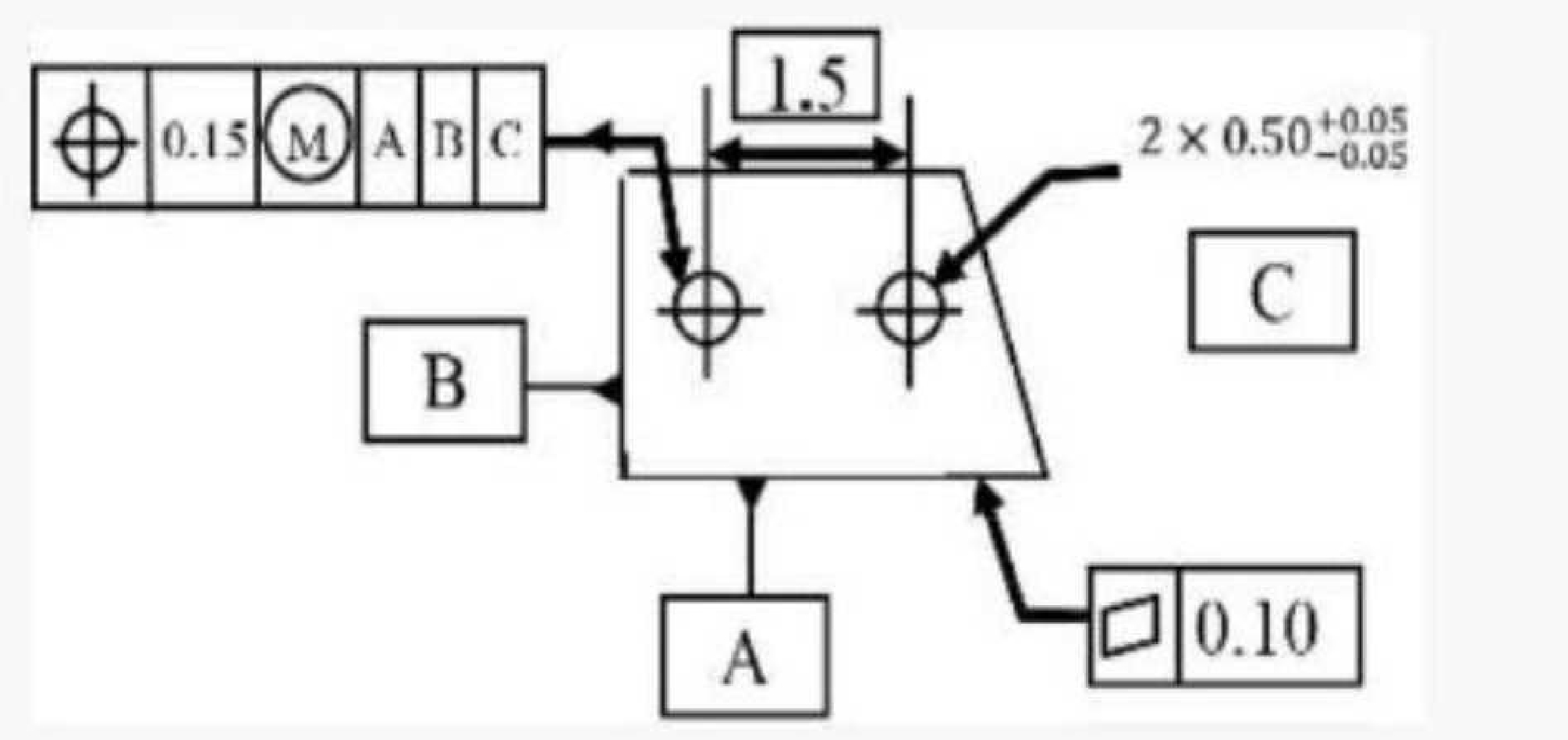
A in this drawing, the symbol is being used to indicate the
Select the answer:Select the answer
1 correct answer
A.
reference plane
B.
basic definition
C.
datum
D.
feature
In the provided drawing, the symbol marked "A" is being used to indicate a datum. A datum is a reference point, line, or surface used as a basis for measurement and to establish the location or orientation of other features. It serves as a starting point for dimensional control and ensures consistency in the manufacturing process. Reference: "Geometric Dimensioning and Tolerancing" by Alex Krulikowski ASME Y14.5 - 2009 (Dimensioning and Tolerancing)
Right Answer: C
Quiz
Question 10/1010/10
The producer's risk can be determined from the
Select the answer:Select the answer
1 correct answer
A.
acceptance quality limit (AQL)
B.
lot tolerance percent defective (LTPD)
C.
average outgoing quality limit (AOQL)
D.
rejectable quality level (RQL)
The producer's risk, also known as Type I error or alpha risk, is the risk of rejecting a lot that meets the acceptance criteria. It can be determined from the acceptance quality limit (AQL), which is the maximum percentage of defectives that is considered acceptable during random sampling of an inspection lot. The AQL is used in conjunction with sampling plans to assess the quality of a lot and make decisions about its acceptance or rejection. Reference: "Statistical Quality Control" by Douglas C. Montgomery ISO 2859-1: Sampling procedures for inspection by attributes
CQE: Quality Engineer Practice test unlocks all online simulator questions
Thank you for choosing the free version of the CQE: Quality Engineer practice test! Further deepen your knowledge on ASQ Simulator; by unlocking the full version of our CQE: Quality Engineer Simulator you will be able to take tests with over 172 constantly updated questions and easily pass your exam. 98% of people pass the exam in the first attempt after preparing with our 172 questions.
What to expect from our CQE: Quality Engineer practice tests and how to prepare for any exam?
The CQE: Quality Engineer Simulator Practice Tests are part of the ASQ Database and are the best way to prepare for any CQE: Quality Engineer exam. The CQE: Quality Engineer practice tests consist of 172 questions and are written by experts to help you and prepare you to pass the exam on the first attempt. The CQE: Quality Engineer database includes questions from previous and other exams, which means you will be able to practice simulating past and future questions. Preparation with CQE: Quality Engineer Simulator will also give you an idea of the time it will take to complete each section of the CQE: Quality Engineer practice test . It is important to note that the CQE: Quality Engineer Simulator does not replace the classic CQE: Quality Engineer study guides; however, the Simulator provides valuable insights into what to expect and how much work needs to be done to prepare for the CQE: Quality Engineer exam.
CQE: Quality Engineer Practice test therefore represents an excellent tool to prepare for the actual exam together with our ASQ practice test . Our CQE: Quality Engineer Simulator will help you assess your level of preparation and understand your strengths and weaknesses. Below you can read all the quizzes you will find in our CQE: Quality Engineer Simulator and how our unique CQE: Quality Engineer Database made up of real questions:
Info quiz:
Quiz name:CQE: Quality Engineer
Total number of questions:172
Number of questions for the test:50
Pass score:80%
You can prepare for the CQE: Quality Engineer exams with our mobile app. It is very easy to use and even works offline in case of network failure, with all the functions you need to study and practice with our CQE: Quality Engineer Simulator.
Use our Mobile App, available for both Android and iOS devices, with our CQE: Quality Engineer Simulator . You can use it anywhere and always remember that our mobile app is free and available on all stores.
Our Mobile App contains all CQE: Quality Engineer practice tests which consist of 172 questions and also provide study material to pass the final CQE: Quality Engineer exam with guaranteed success.
Our CQE: Quality Engineer database contain hundreds of questions and ASQ Tests related to CQE: Quality Engineer Exam. This way you can practice anywhere you want, even offline without the internet.