The new flashcard feature is useful to memorize questions.
?Change your study mode
At any time, you can change the study mode, and alternate between the practice mode and the exam mode. In practice mode, you can configure for example the number of questions or tests, and other parameters to help you study.
Randomized | 10 Questions per Test | 20 Minutes | 70% to pass|
To re-configure your study mode again and change - for example - the number of tests, whether you have random questions and all other configuration parameters.
?Simulator Configuration
Auto-scroll: You can use the automatic scrolling of the questionnaire that occurs as soon as you answer one or all of the answers to a question correctly. Auto scrolling is activated if you answer a single answer, or as soon as you answer all the mandatory answers. Learning Mode: During learning mode you can get a real time result for your answer.
Free Test
Question: / 10
20:00Min. left
?Restart the current test
To restart the current test by clearing all your answers and the time used up to now. Warning: all answers will be lost.
Question: / 10
4.9(791 Votes)
Quiz
Question 1/101/10
What is the MINIMUM clearance needed between the front of the telephone booth and any wall or fixture for most installations?
Select the answer:Select the answer
1 correct answer
A.
300 mm (12 in)
B.
450 mm (18 in)
C.
610 mm (24 in)
D.
914 mm (36 in)
E.
2.4 m (8 ft)
The correct answer is C. 610 mm (24 in). For most installations, a telephone booth needs enough clear space in front of it so a person can approach, use the phone comfortably, and have adequate accessibility and maneuvering room. The minimum clearance specified is 610 mm, which is 24 inches. Why the other options are incorrect: - A. 300 mm (12 in) is too little space for practical use. - B. 450 mm (18 in) is still below the required minimum. - D. 914 mm (36 in) provides more than the minimum, but it is not the minimum required. - E. 2.4 m (8 ft) is far more clearance than necessary. So, the minimum clearance needed is 610 mm (24 in).
Right Answer: C
Quiz
Question 2/102/10
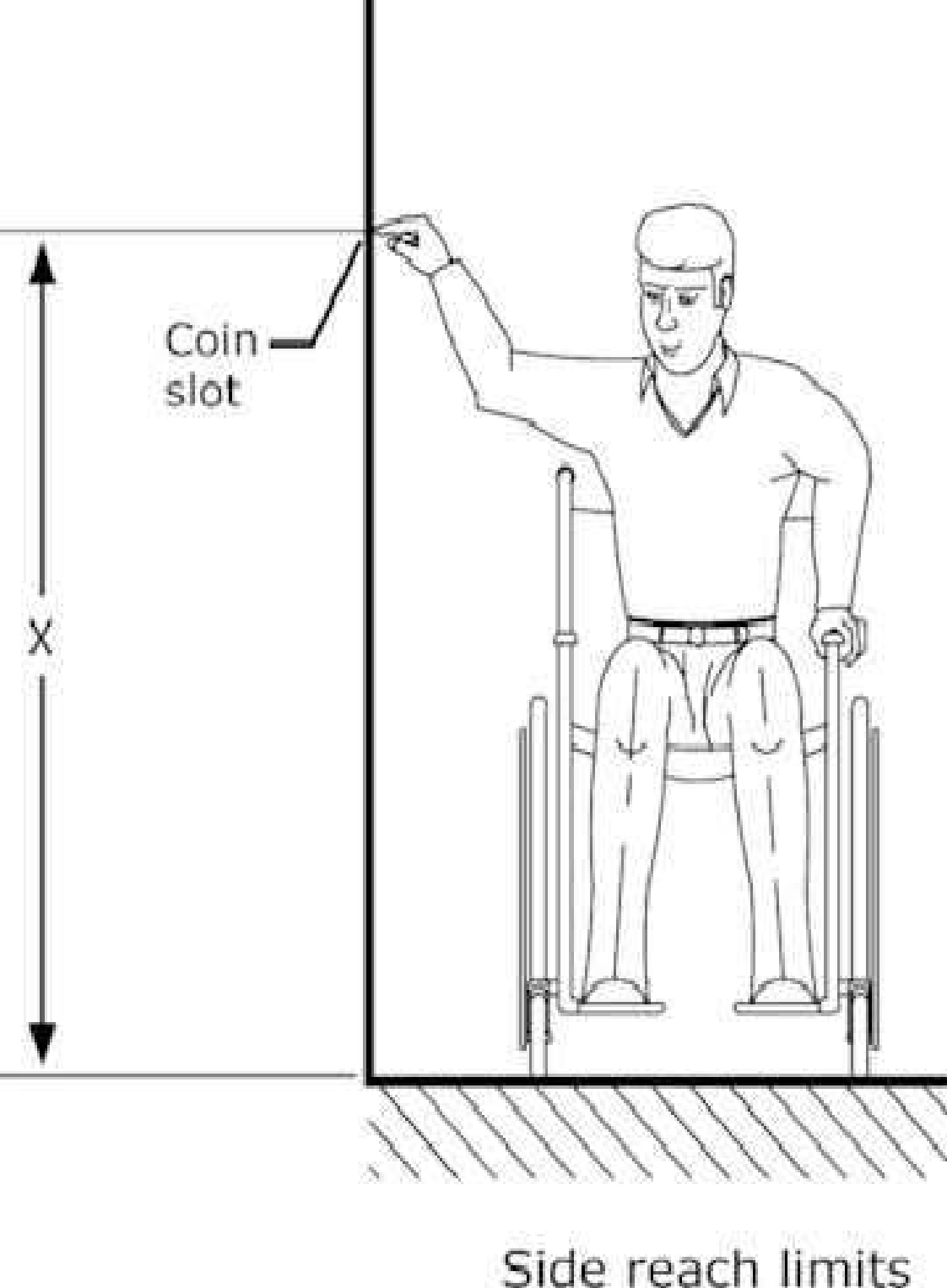
Exhibit:
A pay telephone using coins needs to be installed in a public are a. In the specifications, it is required that the telephone shall meet the ADA (Americans with Disability Act) requirement for side reach using a wheelchair. What will be the maximum reachable height or the value of "X"?
Select the answer:Select the answer
1 correct answer
A.
760 mm (30 in)
B.
864 mm (34 in)
C.
1170 mm (46 in)
D.
1220 mm (48 in)
E.
1370 mm (54 in)
The correct answer is E. 1370 mm (54 in). This question is asking about the ADA side reach requirement for a person using a wheelchair. In ADA accessibility guidelines, the maximum side reach height for operable parts depends on whether there is an obstruction and whether the person is reaching from the side. For an unobstructed side reach, the maximum high side reach is 54 inches, which is 1370 mm. This is the highest reachable operable part height allowed so that a person using a wheelchair can still access the telephone controls. Why the other options are incorrect: A. 760 mm (30 in) This is too low and is not the ADA maximum side reach height. B. 864 mm (34 in) This is also too low for the maximum side reach requirement. C. 1170 mm (46 in) This is closer, but still below the ADA maximum side reach limit. D. 1220 mm (48 in) This is a common accessibility dimension in some other contexts, but it is not the ADA maximum side reach height for this case. E. 1370 mm (54 in) This matches the ADA maximum side reach height for an unobstructed side reach from a wheelchair. Key point: For ADA accessibility, the highest operable part within side reach can be no more than 54 in (1370 mm) above the finished floor. So the correct answer is E.
Right Answer: E
Quiz
Question 3/103/10
A telephone facility and an electrical facility are required in a tunnel. To reduce the effects of EMI and eliminate the need for additional shielding of the cables, where would each facility be placed?
Select the answer:Select the answer
1 correct answer
A.
On opposite sides of the tunnel
B.
On the same sides of the tunnel
C.
Together on the same pathway for easy access and maintenance
D.
One on the top part and one on the bottom part of the same side of the tunnel
E.
On the exterior of the tunnel
The correct answer is A. On opposite sides of the tunnel. In a tunnel, telephone facilities and electrical facilities should be separated as much as practical because electrical systems can generate electromagnetic interference, or EMI. EMI can disrupt telephone or communication cables, causing noise, signal degradation, or loss of performance. Placing the two facilities on opposite sides of the tunnel helps in two important ways: 1. Reduces electromagnetic coupling When the telephone cables are physically separated from electrical cables, the magnetic and electric fields from the power system are less likely to affect the communication system. 2. Avoids the need for extra shielding If the cables were placed close together, additional shielding or special separation measures would likely be needed to protect the telephone system. By placing them on opposite sides, the natural physical distance helps reduce interference enough that extra shielding is not necessary. Why the other options are not correct: B. On the same sides of the tunnel This would increase the chance of EMI because the facilities would be closer together. C. Together on the same pathway for easy access and maintenance This is the worst choice for EMI control, because it puts communication and electrical systems too close together. D. One on the top part and one on the bottom part of the same side of the tunnel This provides some vertical separation, but not as much as placing them on opposite sides of the tunnel. It is less effective at minimizing EMI. E. On the exterior of the tunnel This is not a practical answer to the question, since the facilities are required in the tunnel. Conclusion: To minimize EMI and eliminate the need for extra shielding, the telephone and electrical facilities should be placed on opposite sides of the tunnel.
Right Answer: A
Quiz
Question 4/104/10
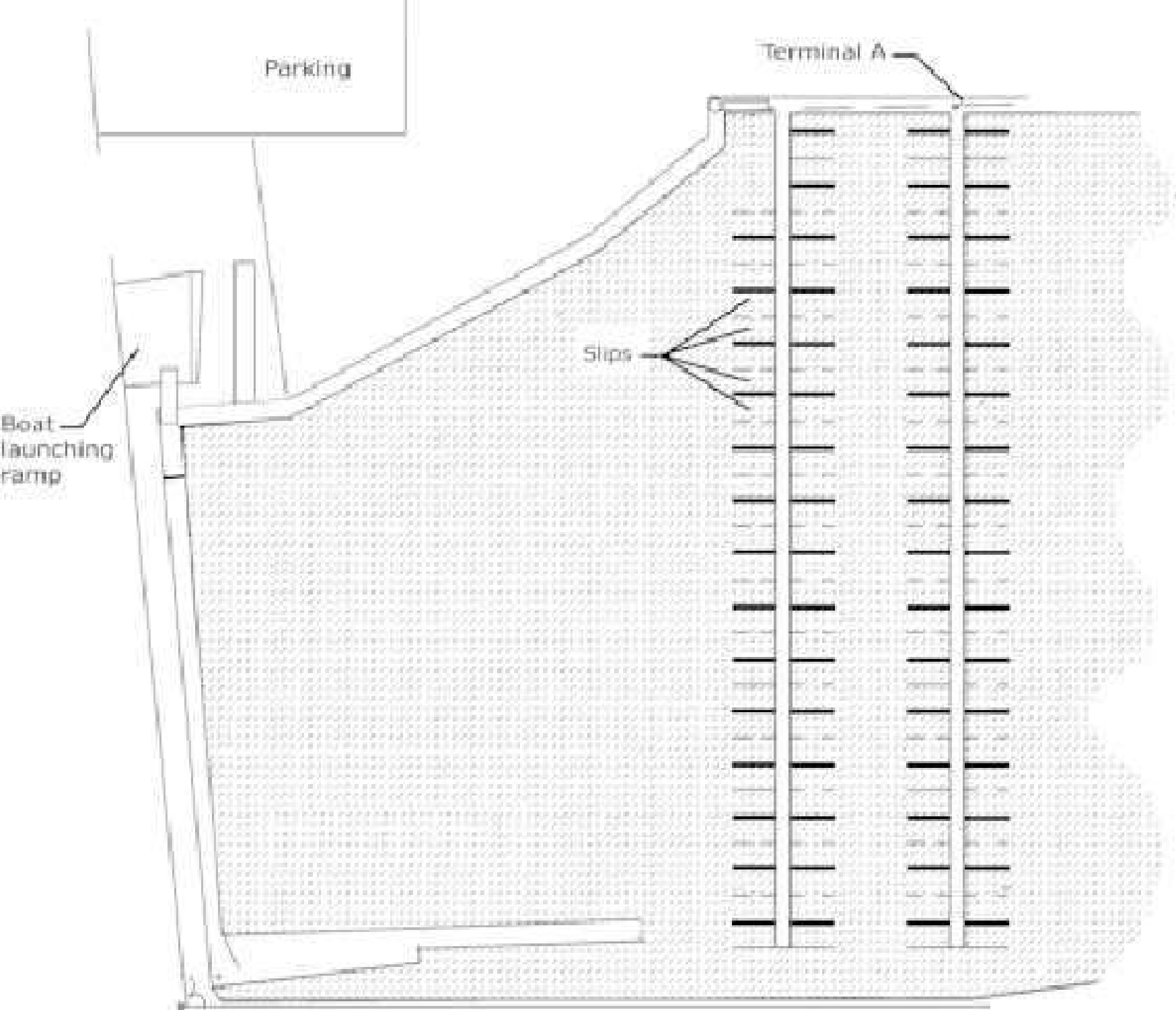
Exhibit:
In this future marina layout, what would be the pre-cabling guideline to follow for the terminal A?
Select the answer:Select the answer
1 correct answer
A.
Place distribution cable onto the dock and terminate in a suitable cabinet or enclosure. Run service drop to each boat slip.
B.
Provide one or two pair cables from the boat slips to a distribution terminal on the closest point of land.
C.
Pre-cable each boat slip during construction.
D.
For security, each run should be terminated in the patch panel/ cross-connect at the dockmaster or marina office.
The correct answer is A. In marina and dock cabling design, a future marina layout typically requires planning the cabling infrastructure so that service can be extended to each boat slip in a practical and maintainable way. For terminal A, the guideline is to place the distribution cable onto the dock and terminate it in a suitable cabinet or enclosure, then run the service drop to each boat slip. Why A is correct: - The main distribution cable should be brought to the dock in a protected, accessible location. - Terminating it in a cabinet or enclosure helps with maintenance, weather protection, and future expansion. - From that point, individual service drops can be run to the boat slips as needed. Why the other options are not correct: B. Provide one or two pair cables from the boat slips to a distribution terminal on the closest point of land. - This describes a possible wiring concept, but it is not the preferred guideline for the terminal A layout shown. - The question asks specifically for the pre-cabling guideline for terminal A in this future marina layout. C. Pre-cable each boat slip during construction. - This is generally not the best guideline because it can be inefficient, costly, and less flexible for future changes. - Marina cabling is usually planned with distribution points and service drops rather than hardwiring every slip independently during initial construction. D. For security, each run should be terminated in the patch panel/cross-connect at the dockmaster or marina office. - While the marina office may be involved in managing connectivity, terminating each dock run there is not the typical physical cabling guideline for this layout. - The dock infrastructure generally requires local termination points closer to the slips. In summary: The correct approach is to bring the distribution cable to the dock, terminate it in a suitable protected enclosure, and then extend service drops to the individual slips, which is exactly what option A describes.
Right Answer: A
Quiz
Question 5/105/10
Which type of protection for electrical power stations provide isolation against a rise in potential of station ground and also provide drainage protection against longitudinally-induced voltages?
Select the answer:Select the answer
1 correct answer
A.
Isolating transformers
B.
Neutralizing transformers
C.
Mutual drainage reactors
D.
Unit-type neutralizing transformers
E.
2-winding neutralizing transformers
The correct answer is A. Isolating transformers. An isolating transformer is used in power station protection systems to separate one part of the installation from another so that a rise in station ground potential does not directly transfer into the protected circuit. This helps prevent dangerous voltage differences during faults such as earth faults or lightning-related disturbances. In addition to isolating against ground potential rise, isolating transformers also help with drainage protection against longitudinally induced voltages. Longitudinally induced voltages are voltages that appear along the length of conductors, often due to electromagnetic coupling from nearby power lines or fault currents. The transformer provides a barrier that limits the transfer of these unwanted induced voltages into sensitive station circuits. Why the other options are not correct: B. Neutralizing transformers These are used to cancel or reduce certain induced voltages, but they are not the primary device for providing isolation against station ground potential rise. C. Mutual drainage reactors These are associated with draining or balancing induced currents, but they do not provide the same galvanic isolation as isolating transformers. D. Unit-type neutralizing transformers These are a specialized form of neutralizing arrangement, but again their main function is not station ground isolation. E. 2-winding neutralizing transformers These are intended for neutralization of induced voltages, but the option that specifically matches both isolation against ground potential rise and drainage protection is the isolating transformer. Therefore, the best answer is A. Isolating transformers.
Right Answer: A
Quiz
Question 6/106/10
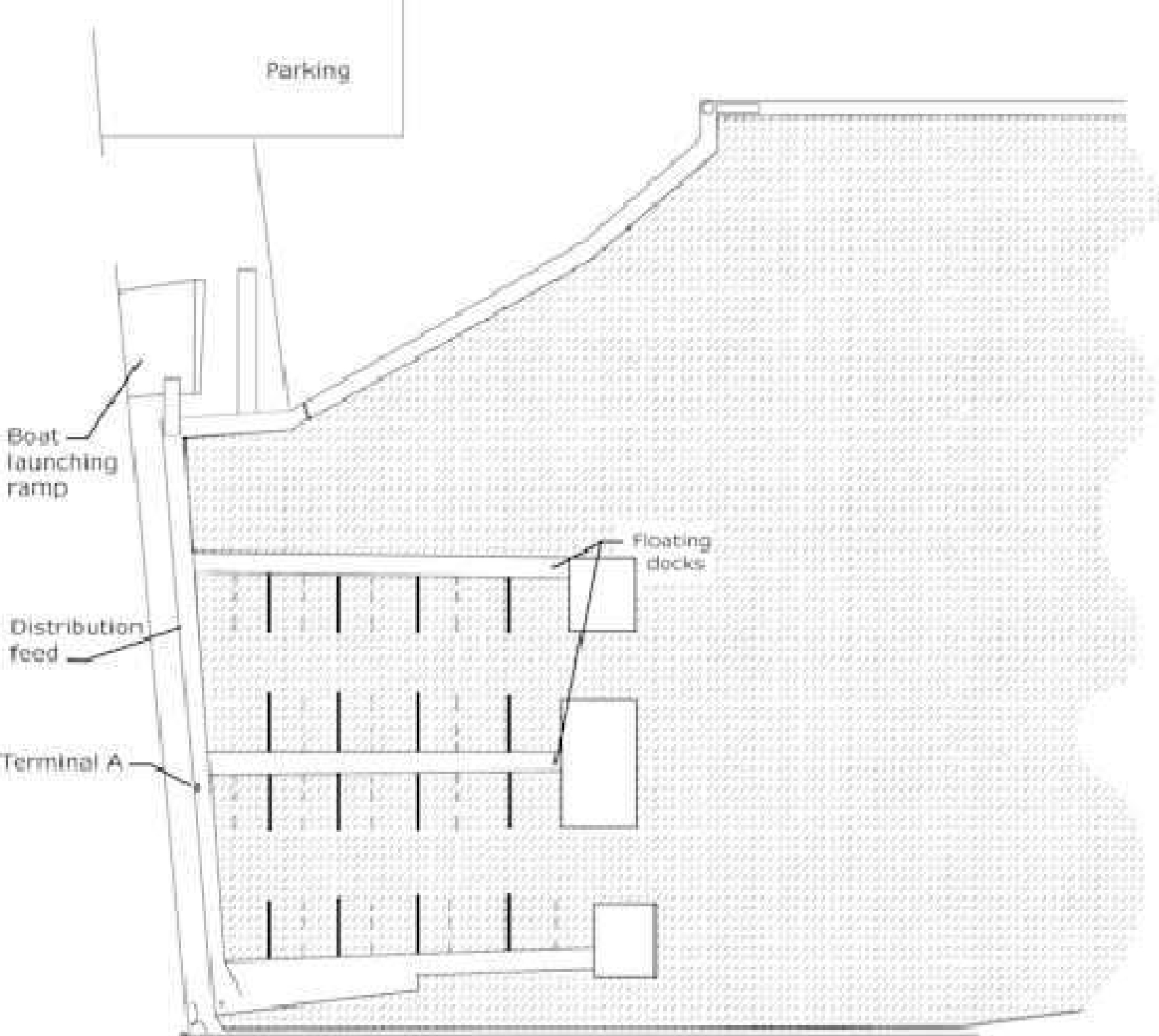
Exhibit:
In this future marina layout, assuming that there are fewer than 10 slips being cabled, what would be the pre-cabling guideline to follow for terminal A?
Select the answer:Select the answer
1 correct answer
A.
Installed one or two pair cables from the boat slips to a distribution terminal on the closest point of land.
B.
Place distribution cable onto the dock and terminate in a suitable cabinet or enclosure. Install service drop to each boat slip.
C.
Pre-cable each boat slip during construction.
D.
For security, each install should be terminated in the patch panel/cross-connect at the dockmaster or marina office.
The correct answer is A. The question asks about the pre-cabling guideline for terminal A in a future marina layout, assuming fewer than 10 slips are being cabled. In marina and dock wiring practices, when only a small number of boat slips are involved, the recommended approach is to run one- or two-pair cables from the boat slips to a distribution terminal located at the nearest point of land. This keeps the installation simple and efficient for a small number of connections. Why A is correct: - For fewer than 10 slips, a small-scale cabling approach is appropriate. - One- or two-pair cables are commonly used for limited service needs. - Terminating at a distribution terminal on the closest point of land is practical and reduces unnecessary infrastructure. Why the other options are incorrect: - B: This describes a more general dock distribution method, but it is not the specific pre-cabling guideline for a small number of slips. - C: Pre-cabling every slip during construction is more extensive than necessary for fewer than 10 slips. - D: Cross-connecting at the dockmaster or marina office is not the standard pre-cabling guideline for slip cabling. So, the best answer is A because it matches the recommended practice for a small marina cabling setup.
Right Answer: A
Quiz
Question 7/107/10
What is the air change requirement for a tunnel of 610 m (2000 ft) long with a diameter of 3.4 m (11 ft)?
Select the answer:Select the answer
1 correct answer
A.
One complete air change per hour
B.
Two complete air changes per hour
C.
Three complete air changes per hour
D.
Four complete air changes per hour
E.
Five complete air changes per hour
The correct answer is C. Three complete air changes per hour. A tunnel’s air change requirement is based on how much air must be replaced to maintain safe and usable conditions inside the tunnel. Longer tunnels need more ventilation because vehicle exhaust, heat, and pollutants accumulate more quickly. For a tunnel that is 610 m (2000 ft) long and 3.4 m (11 ft) in diameter, the ventilation standard corresponds to three complete air changes per hour. This means the entire volume of air in the tunnel should be replaced three times every hour. Why this makes sense: - The tunnel is long enough that stagnant air and exhaust buildup become significant concerns. - The diameter is relatively small, so the tunnel volume is limited, but ventilation still must be sufficient to remove contaminants. - Three air changes per hour is the standard requirement for a tunnel of this size. So the best choice is: C. Three complete air changes per hour
Right Answer: C
Quiz
Question 8/108/10
In new construction, what is the percentage of pay phones that must be equipped with volume controls?
Select the answer:Select the answer
1 correct answer
A.
4
B.
10
C.
25
D.
35
E.
50
The correct answer is C. 25 In new construction, accessibility requirements for public telephones (pay phones) specify that a certain percentage must have volume controls so that people with hearing loss can use them more effectively. The required percentage is 25 percent of the pay phones provided in the new construction setting. This means that out of every four pay phones installed, at least one must be equipped with a volume control feature. Why this matters: Volume controls help improve accessibility by allowing users to increase the sound level of the call. This is especially important for people with partial hearing loss or those who have difficulty hearing at standard phone volume levels. So, among the options given: A. 4 percent B. 10 percent C. 25 percent D. 35 percent E. 50 percent The correct choice is C. 25 percent.
Right Answer: C
Quiz
Question 9/109/10
Exhibit:
What does this international symbol stands for?
Select the answer:Select the answer
1 correct answer
A.
Teletypewriter/text telephone
B.
Public internet station
C.
Public telephone
D.
Public telephone with a shelfette
E.
Public telephone with access to high-speed internet connection
The correct answer is A. Teletypewriter/text telephone. This symbol is the international accessibility sign used to indicate a teletypewriter (TTY) or text telephone service. A TTY is a device that allows people who are deaf, hard of hearing, or speech-impaired to communicate over the telephone network by typing messages back and forth. Why the other options are incorrect: - B. Public internet station: This would usually be represented by a computer or internet-related symbol, not a TTY symbol. - C. Public telephone: A standard telephone symbol is typically used for public phone access. - D. Public telephone with a shelfette: This is not the standard meaning of the symbol shown. - E. Public telephone with access to high-speed internet connection: This would require a symbol suggesting internet access, which is not what is shown. So, the symbol specifically indicates availability of a teletypewriter/text telephone service.
Right Answer: A
Quiz
Question 10/1010/10
Coupling with electrical circuits can create inductive interference to telecommunications facilities. Which of the following can decrease the coupling effect?
Select the answer:Select the answer
1 correct answer
A.
Decrease the exposure length
B.
Make sure that the single-phase components add in phase
C.
Decrease the physical separation
D.
Increase the earth resistance
The correct answer is A. Decrease the exposure length. Inductive coupling happens when a telecommunications line is close to a power line or other electrical circuit carrying current. The changing magnetic field from the electrical circuit can induce unwanted voltage or current in the telecom facility. The amount of coupling depends on several factors, including: - How long the telecom line runs near the interfering circuit - The physical separation between the lines - The magnitude and phase of the current in the power circuit - Grounding and earth resistance conditions Why A is correct: - Exposure length is the length over which the telecom facility is parallel or otherwise significantly exposed to the electrical circuit. - If you decrease the exposure length, there is less opportunity for induction to occur. - Less shared length means less accumulated induced interference. Why the other options are incorrect: B. Make sure that the single-phase components add in phase - If the current components add in phase, the magnetic effects reinforce each other. - This increases, rather than decreases, the coupling. C. Decrease the physical separation - Bringing the circuits closer together increases the magnetic field strength at the telecom facility. - Smaller separation means stronger inductive coupling. D. Increase the earth resistance - Higher earth resistance generally worsens grounding effectiveness and can increase interference problems. - Better grounding usually helps reduce coupling effects, not higher resistance. Summary: To reduce inductive interference, one effective method is to reduce the length of parallel exposure between the electrical circuit and the telecommunications facility. That is why A is the correct answer.
RCDDv14.1: BICSI Registered Communications Distribution Designer Practice test unlocks all online simulator questions
Thank you for choosing the free version of the RCDDv14.1: BICSI Registered Communications Distribution Designer practice test! Further deepen your knowledge on BICSI Simulator; by unlocking the full version of our RCDDv14.1: BICSI Registered Communications Distribution Designer Simulator you will be able to take tests with over 319 constantly updated questions and easily pass your exam. 98% of people pass the exam in the first attempt after preparing with our 319 questions.
What to expect from our RCDDv14.1: BICSI Registered Communications Distribution Designer practice tests and how to prepare for any exam?
The RCDDv14.1: BICSI Registered Communications Distribution Designer Simulator Practice Tests are part of the BICSI Database and are the best way to prepare for any RCDDv14.1: BICSI Registered Communications Distribution Designer exam. The RCDDv14.1: BICSI Registered Communications Distribution Designer practice tests consist of 319 questions and are written by experts to help you and prepare you to pass the exam on the first attempt. The RCDDv14.1: BICSI Registered Communications Distribution Designer database includes questions from previous and other exams, which means you will be able to practice simulating past and future questions. Preparation with RCDDv14.1: BICSI Registered Communications Distribution Designer Simulator will also give you an idea of the time it will take to complete each section of the RCDDv14.1: BICSI Registered Communications Distribution Designer practice test . It is important to note that the RCDDv14.1: BICSI Registered Communications Distribution Designer Simulator does not replace the classic RCDDv14.1: BICSI Registered Communications Distribution Designer study guides; however, the Simulator provides valuable insights into what to expect and how much work needs to be done to prepare for the RCDDv14.1: BICSI Registered Communications Distribution Designer exam.
RCDDv14.1: BICSI Registered Communications Distribution Designer Practice test therefore represents an excellent tool to prepare for the actual exam together with our BICSI practice test . Our RCDDv14.1: BICSI Registered Communications Distribution Designer Simulator will help you assess your level of preparation and understand your strengths and weaknesses. Below you can read all the quizzes you will find in our RCDDv14.1: BICSI Registered Communications Distribution Designer Simulator and how our unique RCDDv14.1: BICSI Registered Communications Distribution Designer Database made up of real questions:
Info quiz:
Quiz name:RCDDv14.1: BICSI Registered Communications Distribution Designer
Total number of questions:319
Number of questions for the test:50
Pass score:80%
You can prepare for the RCDDv14.1: BICSI Registered Communications Distribution Designer exams with our mobile app. It is very easy to use and even works offline in case of network failure, with all the functions you need to study and practice with our RCDDv14.1: BICSI Registered Communications Distribution Designer Simulator.
Use our Mobile App, available for both Android and iOS devices, with our RCDDv14.1: BICSI Registered Communications Distribution Designer Simulator . You can use it anywhere and always remember that our mobile app is free and available on all stores.
Our Mobile App contains all RCDDv14.1: BICSI Registered Communications Distribution Designer practice tests which consist of 319 questions and also provide study material to pass the final RCDDv14.1: BICSI Registered Communications Distribution Designer exam with guaranteed success.
Our RCDDv14.1: BICSI Registered Communications Distribution Designer database contain hundreds of questions and BICSI Tests related to RCDDv14.1: BICSI Registered Communications Distribution Designer Exam. This way you can practice anywhere you want, even offline without the internet.