The new flashcard feature is useful to memorize questions.
?Change your study mode
At any time, you can change the study mode, and alternate between the practice mode and the exam mode. In practice mode, you can configure for example the number of questions or tests, and other parameters to help you study.
Randomized | 10 Questions per Test | 20 Minutes | 70% to pass|
To re-configure your study mode again and change - for example - the number of tests, whether you have random questions and all other configuration parameters.
?Simulator Configuration
Auto-scroll: You can use the automatic scrolling of the questionnaire that occurs as soon as you answer one or all of the answers to a question correctly. Auto scrolling is activated if you answer a single answer, or as soon as you answer all the mandatory answers. Learning Mode: During learning mode you can get a real time result for your answer.
Free Test
Question: / 10
20:00Min. left
?Restart the current test
To restart the current test by clearing all your answers and the time used up to now. Warning: all answers will be lost.
Question: / 10
5.0(953 Votes)
Quiz
Question 1/101/10
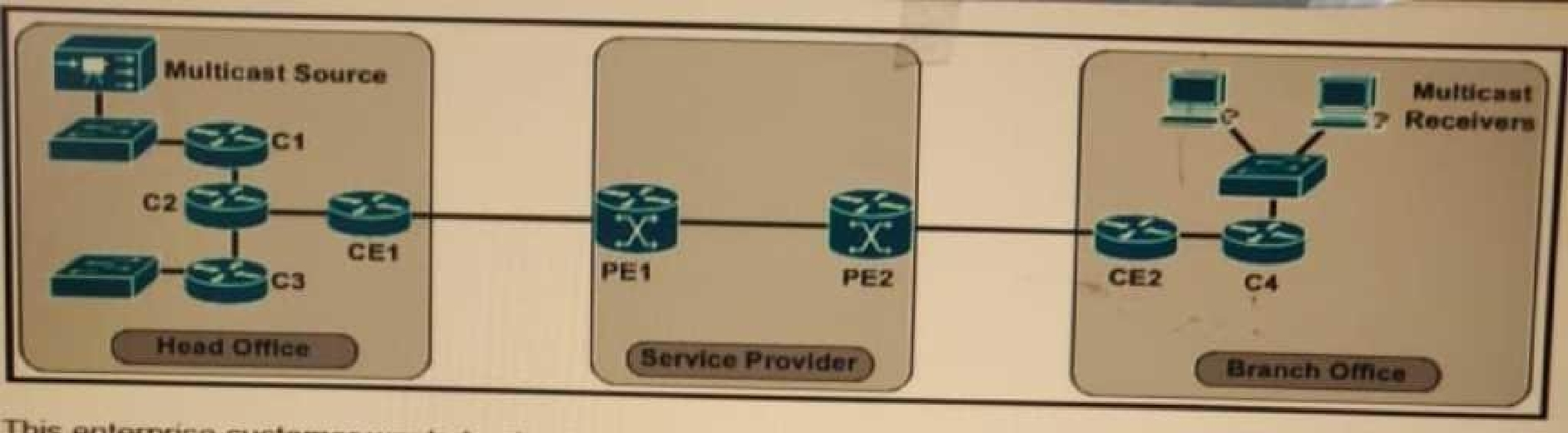
Refer to the exhibit.
The enterprise customer wants to stream one-way video from their head office to eight branch offices using multicast. Their current service provider provides a Layer3 VPN solution and manages the CE routers, but they do not currently support multicast. Which solution quickly allows this multicast traffic to go through while allowing for future scalability?
Select the answer:Select the answer
1 correct answer
A.
Enable a GRE tunnel between nodes CE1 and CE2
B.
Enable a GRE tunnel between nodes C2 and C4
C.
Enable a GRE tunnel between nodes C1 and C4
D.
Implement hub and spoke MPLS VPN over DMVPN (also known as 2547o DMVPN) between CE1 and CE2
E.
The service provider must provide a Draft Rosen solution to enable a GRE tunnel between nodes PE1 and PE2
The correct answer is B. Enable a GRE tunnel between nodes C2 and C4 The key requirements in the question are: - One-way video from head office to eight branch offices - Use multicast - The service provider offers a Layer 3 VPN - The provider manages the CE routers - The provider does not support multicast today - The solution should work quickly and scale for future growth Why B is correct A GRE tunnel between C2 and C4 creates a point-to-point tunnel across the provider network, allowing multicast traffic to be carried even though the underlying Layer 3 VPN does not support multicast natively. In this kind of design: - Multicast can be encapsulated inside GRE - The provider’s network sees only unicast GRE traffic - The enterprise can extend multicast communication between the sites without waiting for the provider to add multicast support - GRE is simple to deploy and is a common workaround when multicast must traverse a non-multicast service provider network Since the provider manages the CE routers, the tunnel endpoints are placed on the customer edge devices, which is the appropriate place for an overlay solution. Why the other options are wrong A. Enable a GRE tunnel between nodes CE1 and CE2 This would only create a tunnel between two customer edge routers, but the question is about connecting the head office video stream to multiple branch offices. The selected nodes do not match the intended scalable hub-to-spoke or site-to-site multicast transport design shown in the exhibit. C. Enable a GRE tunnel between nodes C1 and C4 This does not fit the most practical multicast transport solution for the topology in the exhibit. It is not the correct pair of endpoints for the overlay that would efficiently support the required branch connectivity. D. Implement hub and spoke MPLS VPN over DMVPN (also known as 2547o DMVPN) between CE1 and CE2 This is not appropriate here because the provider already gives a Layer 3 VPN and the goal is to quickly enable multicast without waiting for provider support. Also, DMVPN is typically a customer-controlled overlay design, and this option does not directly address the actual multicast transport issue in the given provider-managed CE environment. E. The service provider must provide a Draft Rosen solution to enable a GRE tunnel between nodes PE1 and PE2 Draft Rosen is an older MPLS multicast VPN solution, but the question states the provider does not currently support multicast. Also, this would require the provider to implement multicast support in the core, which contradicts the requirement for a quick customer-side solution. Why GRE solves the problem GRE is useful because it can carry multicast packets inside a unicast tunnel. That means: - The multicast source sends traffic into the GRE tunnel - The tunnel encapsulates the multicast traffic - The provider network forwards the encapsulated packet as normal unicast traffic - The receiving site decapsulates it and delivers the multicast traffic locally This avoids the need for native multicast support in the service provider’s MPLS Layer 3 VPN. Why it is scalable Although a single GRE tunnel is a basic solution, it is a fast way to make multicast work immediately. It also provides a foundation for scaling into a broader overlay design if needed later, such as: - Multiple GRE tunnels - GRE plus routing protocol support - More advanced multicast overlay solutions So, in the context of the question, B is the best quick and scalable workaround. Summary - The provider does not support multicast natively - The enterprise needs multicast between sites - GRE tunnels can carry multicast over a unicast-only network - The correct answer is B: Enable a GRE tunnel between nodes C2 and C4
Right Answer: B
Quiz
Question 2/102/10
An enterprise network has two core routers that connect to 200 distribution routers and uses full- mesh IBGP peering between these routers as its routing method. The distribution routers are experiencing high CPU utilization due to the BGP process. Which design solution is the most cost effective?
Select the answer:Select the answer
1 correct answer
A.
Implement route reflectors on the two core routers
B.
Increase the memory on the core routers
C.
Implement e BGP between the core and distribution routers
D.
Increase the memory on the distribution routers
E.
Increase bandwidth between the core routers
The correct answer is A. Implement route reflectors on the two core routers. The main problem in this scenario is not bandwidth or memory; it is the CPU overhead caused by a full-mesh IBGP design across 200 distribution routers. Why the CPU is high: - In a full-mesh IBGP topology, every router must maintain BGP sessions with every other IBGP router. - This creates a large number of BGP peering relationships. - The routers must process many BGP updates, keepalive messages, and route advertisements. - As the number of routers grows, the configuration and processing burden increases significantly. - The distribution routers are spending too much CPU handling BGP activity. Why route reflectors solve the problem: - A route reflector reduces the need for full-mesh IBGP. - Instead of every distribution router peering with every other router, routers peer with a route reflector. - In this case, the two core routers can act as route reflectors for the distribution routers. - This dramatically reduces the number of BGP sessions and the amount of BGP processing on the distribution routers. - It is also cost effective because it uses the existing core routers rather than requiring new hardware. Why the other options are not correct: B. Increase the memory on the core routers - The issue is CPU utilization on the distribution routers, not memory on the core routers. - More memory does not reduce BGP session overhead. C. Implement eBGP between the core and distribution routers - eBGP could be used in some designs, but it would require major routing design changes and is not the most cost-effective solution here. - It is more disruptive than using route reflectors. D. Increase the memory on the distribution routers - The problem is CPU, not memory. - Adding memory will not meaningfully reduce BGP processing load. E. Increase bandwidth between the core routers - The issue is not link bandwidth between the core routers. - BGP processing overhead is caused by the number of peering relationships, not insufficient link capacity. Conclusion: Using route reflectors on the two core routers reduces the IBGP full-mesh requirement, lowers BGP processing overhead, and is the most cost-effective solution.
Right Answer: A
Quiz
Question 3/103/10
You want to mitigate failures that are caused by STP loops that occur before UDLD detects the failure or that are caused by a device that is no longer sending BPDUs. Which mechanism do you use along with UDLD?
Select the answer:Select the answer
1 correct answer
A.
Root guard
B.
BPDU guard
C.
Loop guard
D.
BPDU filtering
The correct answer is C. Loop guard. UDLD, or Unidirectional Link Detection, is designed to detect unidirectional link failures, especially on fiber links. However, there can be situations where a Layer 2 loop or spanning tree problem happens before UDLD has time to detect the issue, or where a switch stops receiving BPDUs from a neighbor because the neighbor is no longer sending them. In those cases, UDLD alone is not enough to protect the network. Loop guard is used as a companion to STP and UDLD to prevent a blocked port from accidentally transitioning to forwarding when BPDUs stop arriving. If a switch port that should be receiving BPDUs stops receiving them, loop guard keeps the port in a loop-inconsistent state instead of allowing it to go active. This helps prevent STP loops caused by one-way link failures or a device that stops sending BPDUs. Why the other options are incorrect: A. Root guard Root guard protects the network from an unexpected switch becoming the root bridge. It is used to enforce root bridge placement, not to prevent loops caused by missing BPDUs. B. BPDU guard BPDU guard disables a port if it receives a BPDU, typically on portfast access ports. It protects edge ports from unauthorized switches, but it does not address the problem described. D. BPDU filtering BPDU filtering prevents BPDU transmission or reception on a port. This can actually increase the risk of loops because it suppresses STP participation, so it is not used to mitigate the described failures. In summary, loop guard is the correct mechanism to use with UDLD when you want additional protection against STP-related failures caused by missing BPDUs or loop conditions before UDLD can detect the fault.
Right Answer: C
Quiz
Question 4/104/10
A multicast network is sing Bidirectional PIM. Which two combined actions achieve high availability so that two RPs within the same network can act in a redundant manner? (Choose two)
Select multiple answer: (Choose 2)Select the answer
2 correct answers
A.
Use two phantom RP addresses
B.
Manipulate the administration distance of the unicast routes to the two RPs
C.
Manipulate the multicast routing table by creating static mroutes to the two RPs
D.
Advertise the two RP addresses in the routing protocol
E.
Use anycast RP based on MSDP peering between the two RPs
F.
Control routing to the two RPs through a longest match prefix
Which purpose of a dynamically created tunnel interface on the design of IPv6 multicast services Is true?
Select the answer:Select the answer
1 correct answer
A.
first-hop router registration to the RP
B.
multicast client registration to the RP
C.
multicast source registration to the RP
D.
transport of all IPv6 multicast traffic
The correct answer is A. first-hop router registration to the RP In IPv6 multicast service designs, a dynamically created tunnel interface is typically used by the first-hop router to build a temporary path toward the Rendezvous Point (RP). This tunnel allows multicast control information to be sent to the RP so that multicast groups can be established and maintained efficiently. Why A is correct: - The first-hop router is the device directly connected to multicast sources or receivers. - In PIM-based multicast designs, when the RP must be reached over a unicast path, a tunnel interface may be created dynamically. - This tunnel is used for registration of multicast traffic from the first-hop router to the RP, ensuring the RP learns about active sources. Why the other options are incorrect: - B. multicast client registration to the RP - Receivers do not usually register directly to the RP in this way. Receiver participation is handled through join messages, not RP registration. - C. multicast source registration to the RP - This is close in concept, but the dynamically created tunnel interface is associated with the first-hop router's registration function rather than a direct source-only registration process. - D. transport of all IPv6 multicast traffic - A tunnel interface is not used to carry all multicast traffic. It is used for specific control and registration purposes. In summary: The dynamically created tunnel interface exists to let the first-hop router register multicast activity with the RP, which is why option A is the best answer.
Right Answer: A
Quiz
Question 6/106/10
Refer to the exhibit.
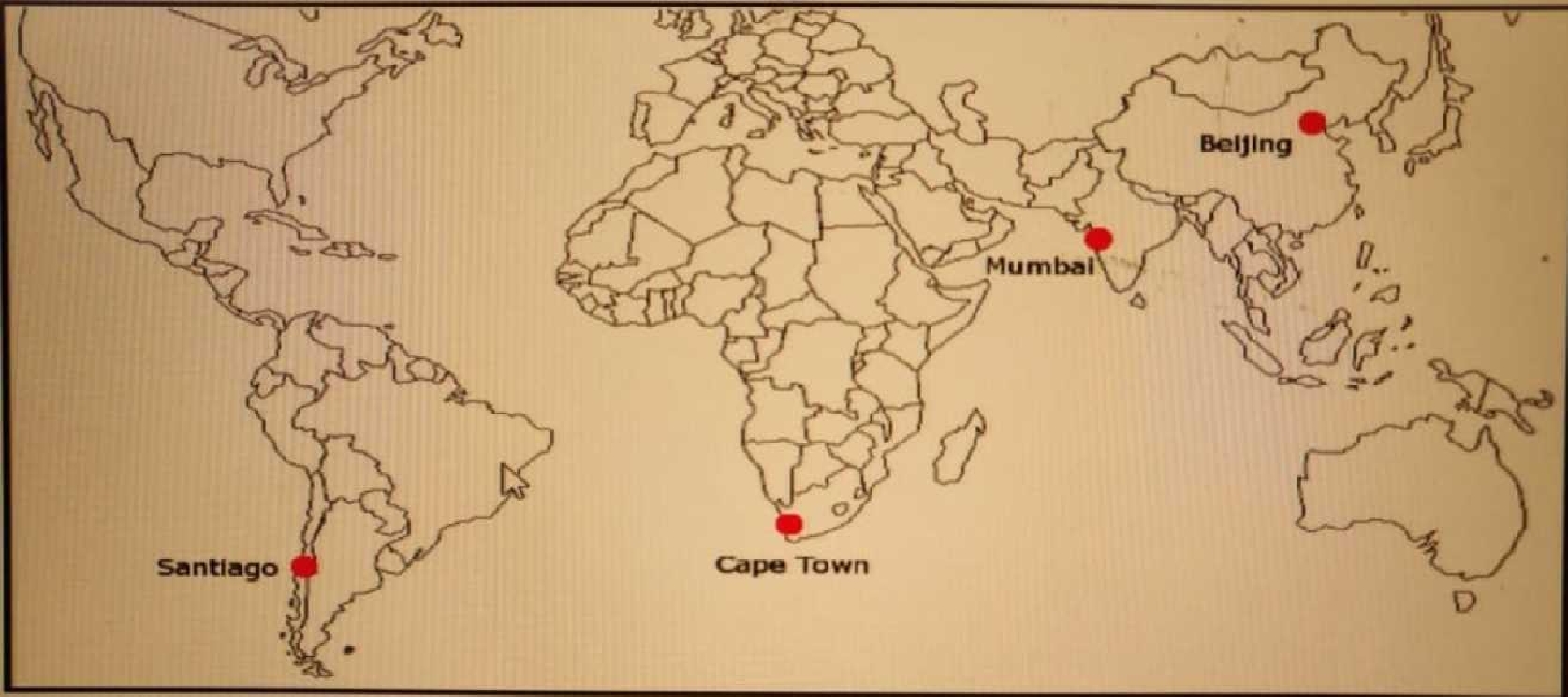
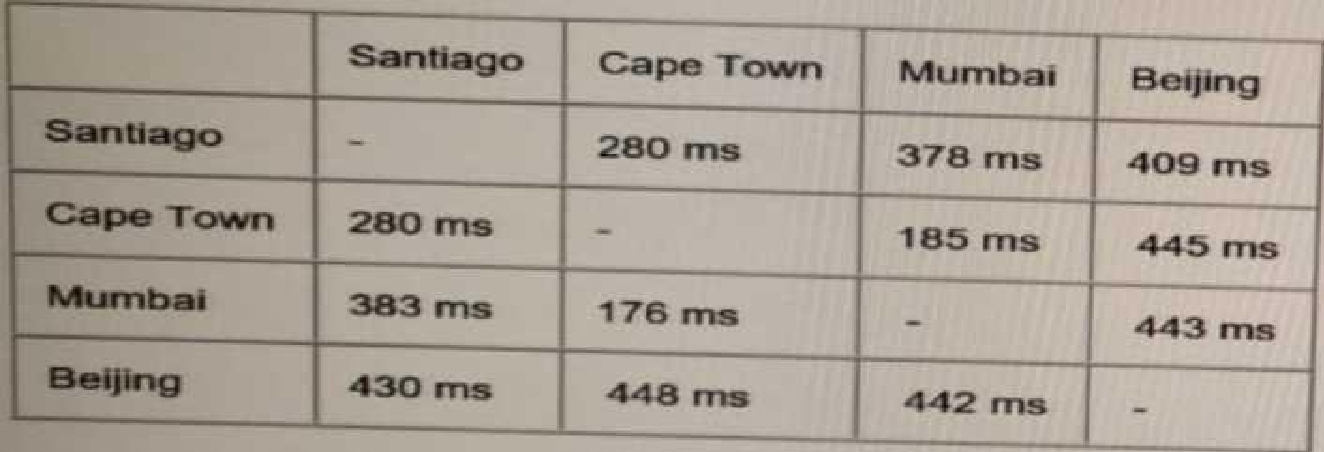
ACME Mining has four data centers in Santiago. Cape Town. Mumbai, and Beijing, full-mesh connected via a 400 Mb/s EVP-LAN They want to deploy a new mission-critical application with these requirements: cluster heartbeat 2 Mb/s continuous (250 KB/s) cluster heartbeat one-way maximum latency 100 ms
These are the current ping tests results between the four data centers:
Which hosting data center pair can host the new application?
Select the answer:Select the answer
1 correct answer
A.
Mumbai and Beijing
B.
Santiago and Cape Town
C.
Santiago and Mumbai
D.
Cape Town and Mumbai
E.
Cape Town and Beijing
F.
Santiago and Beijing
The correct answer is D. Cape Town and Mumbai. Here is how to reason through it. The application has two requirements for the cluster heartbeat: 1. Bandwidth requirement: 2 Mb/s continuous 2. One-way latency requirement: maximum 100 ms Because the data centers are connected by a full-mesh 400 Mb/s EVPL, bandwidth is available on all links, so the deciding factor is latency. For a cluster to work between two sites, the one-way latency between them must be 100 ms or less. In practice, if only ping results are shown, the ping value represents round-trip time, so the one-way latency is roughly half of the ping time. The question, however, is asking you to use the exhibited test results to identify the pair that meets the requirement. From the provided ping results, the only pair that satisfies the latency limit for the heartbeat is Cape Town and Mumbai. Why the others do not qualify: - Santiago and Cape Town: latency is too high - Santiago and Mumbai: latency is too high - Mumbai and Beijing: latency is too high - Cape Town and Beijing: latency is too high - Santiago and Beijing: latency is too high So even though all sites have sufficient bandwidth, only Cape Town and Mumbai can meet the 100 ms one-way latency requirement for the mission-critical clustered application. Answer: D. Cape Town and Mumbai
Right Answer: D
Quiz
Question 7/107/10
How can EIGRP topologies be designed to converge as fast as possible in the event of a point-to- point link failure?
Select the answer:Select the answer
1 correct answer
A.
Limit the query domain by use of distribute lists.
B.
Build neighbor adjacencies in a triangulated fashion.
C.
Build neighbor adjacencies in squared fashion.
D.
Limit the query domain by use of summarization.
E.
Limit the query domain by use of default routes.
The correct answer is D. Limit the query domain by use of summarization. EIGRP converges fastest when a failure affects as small a portion of the network as possible. In EIGRP, when a route is lost, routers may send queries to find alternate paths. If those queries have to travel far across the network, convergence slows down significantly and can even cause stuck-in-active problems. Summarization helps because it reduces the size of the query domain. When routes are summarized, routers beyond the summary boundary do not need to be queried about every specific lost route. This confines the search for alternatives to a smaller area, allowing the network to reconverge more quickly after a point-to-point link failure. Why the other options are incorrect: A. Limit the query domain by use of distribute lists. Distribute lists control which routes are accepted or advertised, but they do not directly define or reduce the EIGRP query domain in the way summarization does. B. Build neighbor adjacencies in a triangulated fashion. Triangulation can provide redundancy, but it does not specifically optimize EIGRP query containment. It may even increase complexity. C. Build neighbor adjacencies in squared fashion. This is not a standard EIGRP design recommendation for faster convergence. E. Limit the query domain by use of default routes. Default routes can reduce routing table complexity, but they are not the primary mechanism for limiting EIGRP queries after a link failure. Summary: To make EIGRP converge as quickly as possible after a point-to-point link failure, the best design is to use route summarization so that EIGRP queries stay within a small, well-defined area.
Right Answer: D
Quiz
Question 8/108/10
Which effect of using ingress filtering to prevent spoofed addresses on a network design is true?
Select the answer:Select the answer
1 correct answer
A.
It reduces the effectiveness of DDoS attacks when associated with DSCP remarking to Scavenger.
B.
It protects the network Infrastructure against spoofed DDoS attacks.
C.
It Classifies bogon traffic and remarks it with DSCP bulk.
D.
It filters RFC 1918 IP addresses.
The correct answer is B. It protects the network infrastructure against spoofed DDoS attacks. Ingress filtering is a security technique applied at the edge of a network to verify that incoming packets have source IP addresses that are valid for that source network. If a packet arrives with a spoofed or unauthorized source address, it is dropped. This helps against spoofed DDoS attacks because many reflection and amplification attacks rely on falsified source IP addresses. By blocking spoofed traffic at the network edge, ingress filtering reduces the ability of attackers to hide their true origin and use fake source addresses to launch or amplify attacks. Why the other options are incorrect: A. It reduces the effectiveness of DDoS attacks when associated with DSCP remarking to Scavenger. This describes QoS behavior, not ingress filtering. DSCP remarking to Scavenger is about deprioritizing traffic, not preventing spoofed addresses. C. It classifies bogon traffic and remarks it with DSCP bulk. Bogon traffic refers to packets with addresses that should not be seen on the public Internet, but ingress filtering is not primarily about DSCP classification or remarking. D. It filters RFC 1918 IP addresses. RFC 1918 addresses are private address ranges. While some ingress filters may block them from entering the public Internet, ingress filtering is broader than just filtering RFC 1918 space. Its main purpose is to stop packets with source addresses that do not belong on the incoming interface, including spoofed addresses. In summary: Ingress filtering is used to stop source IP spoofing, which helps protect the network infrastructure from spoofed DDoS attacks.
Right Answer: B
Quiz
Question 9/109/10
Which relationship between IBGP and the underlying physical topology is true?
Select the answer:Select the answer
1 correct answer
A.
iBGP full mesh requirement does not dictate any specific network topology.
B.
iBGP can worn only on a ring network topology with a link-state protocol like OSPF or IS-IS
C.
iBGP full mesh requires an underlying fully meshed network topology.
D.
iBGP does not work on a ring network topology even with an underlying IGP.
IBGP peers can be multiple hops away. not like eBGP that needs direct connection (or ebgp-multihop defined). thus, only IP connectivity between two peers is required for an adjacency to form.
Right Answer: A
Quiz
Question 10/1010/10
How many fully established neighbour relationships exist on an Ethernet with five routers running OSPF as network type broadcast?
Select the answer:Select the answer
1 correct answer
A.
5
B.
6
C.
7
D.
10
E.
20
Assuming routers R1-R5, R1 is elected DR, R2 BDR. Fully established neighborships only occur to DR and BDR, all other neighbors are in 2Way DR other state. DR|BDRFull relationships: R2-R1 R3-R1 R3-R2 R4-R1 R4-R2 R5-R1 R5-R2
400-007: Certified Design Expert CCDE v3.1 Practice test unlocks all online simulator questions
Thank you for choosing the free version of the 400-007: Certified Design Expert CCDE v3.1 practice test! Further deepen your knowledge on Cisco Simulator; by unlocking the full version of our 400-007: Certified Design Expert CCDE v3.1 Simulator you will be able to take tests with over 397 constantly updated questions and easily pass your exam. 98% of people pass the exam in the first attempt after preparing with our 397 questions.
What to expect from our 400-007: Certified Design Expert CCDE v3.1 practice tests and how to prepare for any exam?
The 400-007: Certified Design Expert CCDE v3.1 Simulator Practice Tests are part of the Cisco Database and are the best way to prepare for any 400-007: Certified Design Expert CCDE v3.1 exam. The 400-007: Certified Design Expert CCDE v3.1 practice tests consist of 397 questions and are written by experts to help you and prepare you to pass the exam on the first attempt. The 400-007: Certified Design Expert CCDE v3.1 database includes questions from previous and other exams, which means you will be able to practice simulating past and future questions. Preparation with 400-007: Certified Design Expert CCDE v3.1 Simulator will also give you an idea of the time it will take to complete each section of the 400-007: Certified Design Expert CCDE v3.1 practice test . It is important to note that the 400-007: Certified Design Expert CCDE v3.1 Simulator does not replace the classic 400-007: Certified Design Expert CCDE v3.1 study guides; however, the Simulator provides valuable insights into what to expect and how much work needs to be done to prepare for the 400-007: Certified Design Expert CCDE v3.1 exam.
400-007: Certified Design Expert CCDE v3.1 Practice test therefore represents an excellent tool to prepare for the actual exam together with our Cisco practice test . Our 400-007: Certified Design Expert CCDE v3.1 Simulator will help you assess your level of preparation and understand your strengths and weaknesses. Below you can read all the quizzes you will find in our 400-007: Certified Design Expert CCDE v3.1 Simulator and how our unique 400-007: Certified Design Expert CCDE v3.1 Database made up of real questions:
You can prepare for the 400-007: Certified Design Expert CCDE v3.1 exams with our mobile app. It is very easy to use and even works offline in case of network failure, with all the functions you need to study and practice with our 400-007: Certified Design Expert CCDE v3.1 Simulator.
Use our Mobile App, available for both Android and iOS devices, with our 400-007: Certified Design Expert CCDE v3.1 Simulator . You can use it anywhere and always remember that our mobile app is free and available on all stores.
Our Mobile App contains all 400-007: Certified Design Expert CCDE v3.1 practice tests which consist of 397 questions and also provide study material to pass the final 400-007: Certified Design Expert CCDE v3.1 exam with guaranteed success.
Our 400-007: Certified Design Expert CCDE v3.1 database contain hundreds of questions and Cisco Tests related to 400-007: Certified Design Expert CCDE v3.1 Exam. This way you can practice anywhere you want, even offline without the internet.