The new flashcard feature is useful to memorize questions.
?Change your study mode
At any time, you can change the study mode, and alternate between the practice mode and the exam mode. In practice mode, you can configure for example the number of questions or tests, and other parameters to help you study.
Randomized | 10 Questions per Test | 20 Minutes | 70% to pass|
To re-configure your study mode again and change - for example - the number of tests, whether you have random questions and all other configuration parameters.
?Simulator Configuration
Auto-scroll: You can use the automatic scrolling of the questionnaire that occurs as soon as you answer one or all of the answers to a question correctly. Auto scrolling is activated if you answer a single answer, or as soon as you answer all the mandatory answers. Learning Mode: During learning mode you can get a real time result for your answer.
Free Test
Question: / 10
20:00Min. left
?Restart the current test
To restart the current test by clearing all your answers and the time used up to now. Warning: all answers will be lost.
Question: / 10
4.6(201 Votes)
Quiz
Question 1/101/10
An administrator must design a fault-tolerant IT environment for applications. Which techniques meet this requirement?
Select the answer:Select the answer
1 correct answer
A.
Active/Passive for Compute -NIC Teaming for Network -Dual disks for storage
B.
Active/Active for Compute -Link Aggregation for Network -Erasure Coding for storage
C.
Active/Passive for Compute -Spanning for Network -Dynamic Disk Sparing for storage
D.
Active/Standby for Compute -Multipathing for Network -RAID for storage
The correct answer is B. Fault tolerance means the system should keep operating even if one component fails. To design a fault-tolerant IT environment, each major area should have a technique that provides redundancy and continuous service. Why B is correct: - Active/Active for Compute: More than one server is actively handling workload at the same time. If one fails, the others continue running the application. - Link Aggregation for Network: Multiple network links are combined into one logical connection. If one link fails, traffic can continue over the remaining links. - Erasure Coding for Storage: Data is split and stored with redundant parity information. If a storage component fails, the data can still be reconstructed. Why the other options are not the best fit: - A. Active/Passive for Compute - NIC Teaming for Network - Dual disks for storage Active/passive can provide failover, but dual disks is not as robust as erasure coding. This is more of a high-availability design than a stronger fault-tolerant one. - C. Active/Passive for Compute - Spanning for Network - Dynamic Disk Sparing for storage Spanning is not a fault-tolerance technique for networks. It is generally related to extending storage across disks, and this option does not match fault-tolerant networking. - D. Active/Standby for Compute - Multipathing for Network - RAID for storage Active/standby can support failover, and RAID helps storage redundancy, but "multipathing for network" is not the standard term; multipathing is usually for storage paths, not network connectivity. This makes the option incorrect. In summary: Option B correctly combines redundancy and failover methods across compute, network, and storage, making it the best answer for a fault-tolerant environment.
Right Answer: B
Quiz
Question 2/102/10
Which condition triggers a warning level alert?
Select the answer:Select the answer
1 correct answer
A.
Service has failed.
B.
Service has been created.
C.
Service instance is ready to use.
D.
Service is approaching resource usage limit.
The correct answer is D. Service is approaching resource usage limit. A warning level alert is used to indicate that something is not yet critical, but it may become a problem soon if no action is taken. In this case, a service approaching its resource usage limit suggests that it is nearing a threshold such as CPU, memory, storage, or quota limits. This is exactly the kind of situation that warrants a warning, because it gives administrators time to respond before the service actually fails. Why the other options are incorrect: A. Service has failed. This would typically trigger a critical or error-level alert, not just a warning, because the service is already down. B. Service has been created. This is a normal informational event, not an alert condition. C. Service instance is ready to use. This is also a normal status update indicating success, not a warning. So, D is the best choice because warning alerts are meant to signal potential issues before they become serious.
Right Answer: D
Quiz
Question 3/103/10
What is a key responsibility of a security governance board?
Select the answer:Select the answer
1 correct answer
A.
Defining the cloud service catalog
B.
Assessing assets with realistic valuations
C.
Assessing the cloud provider’s capability to provide logs
D.
Defining access rights for users
The correct answer is D. Defining access rights for users. A security governance board is responsible for setting direction, policies, and oversight for an organization’s security program. One of its key roles is to establish high-level rules about who should have access to what resources, based on business needs, risk, and compliance requirements. Why D is correct: - Access control is a core governance concern. - The board helps define security policy, including how access should be granted, reviewed, and revoked. - It ensures that access rights align with organizational risk management and regulatory obligations. Why the other options are not correct: - A. Defining the cloud service catalog - This is more of a service management or cloud operations function, not a security governance responsibility. - B. Assessing assets with realistic valuations - This is more related to risk management, asset management, or financial analysis than governance board duties. - C. Assessing the cloud provider’s capability to provide logs - This is typically part of vendor evaluation, due diligence, or security architecture review, not the primary role of the governance board. In short, a security governance board focuses on high-level security policy and oversight, and defining access rights for users is a fundamental part of that responsibility.
Right Answer: D
Quiz
Question 4/104/10
What is the primary driver of application transformation?
Select the answer:Select the answer
1 correct answer
A.
Drive adoption of a DevOps culture
B.
Integrate legacy applications
C.
Retire legacy applications
D.
Develop innovative IT solutions
The correct answer is A. Drive adoption of a DevOps culture. Application transformation is mainly about changing how applications are built, delivered, and operated so that they can support faster innovation, greater agility, and better alignment between development and operations teams. The primary driver behind this transformation is usually the adoption of a DevOps culture. Why A is correct: - DevOps brings development and operations teams together. - It encourages collaboration, automation, continuous integration, continuous delivery, and faster feedback. - This cultural shift helps organizations modernize application delivery and improve speed, quality, and reliability. - Without this cultural and process change, technical modernization efforts are often less effective. Why the other options are less correct: - B. Integrate legacy applications - This can be part of application modernization, but it is not the primary driver of transformation. - Integration is a tactic, not the main reason transformation happens. - C. Retire legacy applications - Retiring old applications may be one outcome of transformation, but it is not the primary driver. - The goal is broader than simply removing legacy systems. - D. Develop innovative IT solutions - Innovation is often a result of application transformation, but not the main driver. - DevOps culture enables the organization to create innovative solutions more effectively. In summary: The key driver of application transformation is the shift to a DevOps culture because it changes how teams work and enables the speed, automation, and collaboration needed for modern application delivery.
Right Answer: A
Quiz
Question 5/105/10
What term refers to the entry points from which an attack can be launched?
Select the answer:Select the answer
1 correct answer
A.
Attack surface
B.
Attack factor
C.
Attack vector
The correct answer is A. Attack surface. The attack surface is the total set of points where an attacker can try to enter or affect a system. These entry points can include software vulnerabilities, exposed services, user interfaces, open ports, APIs, weak passwords, and even human users. In other words, it describes the places an attack can be launched from or the ways a system can be reached and targeted. A larger attack surface generally means more opportunities for an attacker. Why not the other options: B. Attack factor is not a standard cybersecurity term for entry points of an attack. C. Attack vector refers to the specific path or method used to carry out an attack, such as phishing, malware, or SQL injection. It is related, but it is not the same as the overall set of entry points. So, if the question asks for the term referring to the entry points from which an attack can be launched, the best answer is attack surface.
Right Answer: A
Quiz
Question 6/106/10
What is a characteristic of a converged infrastructure?
Select the answer:Select the answer
1 correct answer
A.
Eliminates CAPEX
B.
Eliminates OPEX
C.
Does not require a separate storage array
D.
Enables rapid scalability
A converged infrastructure is a pre-integrated IT environment that combines compute, storage, networking, and virtualization into a single, managed system. The key idea is that these components are packaged and tested together to simplify deployment and administration. The correct answer is C. Does not require a separate storage array. Why C is correct: In a converged infrastructure, storage is typically built into the overall system design rather than being deployed as a standalone, separate storage array that must be independently managed. This integration reduces complexity and makes the infrastructure easier to deploy and maintain. Why the other options are incorrect: A. Eliminates CAPEX This is incorrect because converged infrastructure does not eliminate capital expenditures. It may reduce upfront planning complexity and improve efficiency, but hardware and software still must be purchased. B. Eliminates OPEX This is incorrect because operational expenses are not eliminated. Converged infrastructure can help reduce operational overhead through simpler management, but ongoing costs still remain. D. Enables rapid scalability This can be a benefit of converged infrastructure, but it is not the defining characteristic in this question. Rapid scalability is more commonly emphasized as a benefit of hyper-converged infrastructure or cloud-based systems. Summary: The defining characteristic here is that converged infrastructure integrates storage into the system, so it does not require a separate storage array.
Right Answer: C
Quiz
Question 7/107/10
What is true about change management?
Select the answer:Select the answer
1 correct answer
A.
Defines SLA compliance
B.
Triggers alerts
C.
Monitors compliance
The correct answer is C. Monitors compliance. Here’s why: Change management is the process used to control, review, and approve changes to systems or services in a way that reduces risk and keeps everything aligned with organizational policies. A key part of this process is making sure changes are carried out according to approved procedures and standards. In other words, it helps monitor compliance. Why the other options are not correct: A. Defines SLA compliance An SLA, or Service Level Agreement, is typically defined as part of service management or contract/service design processes, not change management. Change management may help ensure changes do not violate an SLA, but it does not define SLA compliance. B. Triggers alerts Triggering alerts is more commonly associated with monitoring, event management, or incident management. While a change may lead to alerts in some systems, that is not the main purpose of change management. C. Monitors compliance This is correct because change management ensures that changes follow approved rules, policies, and controls. It provides oversight and helps confirm that changes remain compliant with required standards. In short, change management is about controlling and tracking changes, and a major function of that is monitoring compliance.
Right Answer: C
Quiz
Question 8/108/10
What term refers to businesses that cautiously and gradually embrace digital transformation?
Select the answer:Select the answer
1 correct answer
A.
Digital Evaluators
B.
Digital Laggards
C.
Digital Leaders
D.
Digital Adopters
The correct answer is B. Digital Laggards. Digital laggards are businesses that are slow to adopt new digital technologies. They tend to be cautious, conservative, and gradual in embracing digital transformation. Instead of quickly investing in or experimenting with new digital tools, they usually wait until technologies are well established and proven. Why the other options are not correct: A. Digital Evaluators This is not the standard term for businesses that cautiously adopt digital transformation. C. Digital Leaders Digital leaders are companies that actively and quickly embrace digital transformation, often setting trends rather than following them. D. Digital Adopters This is a broader term for businesses that adopt digital tools, but it does not specifically imply the slow, cautious approach described in the question. So, because the question describes businesses that cautiously and gradually embrace digital transformation, the best answer is Digital Laggards.
Right Answer: B
Quiz
Question 9/109/10
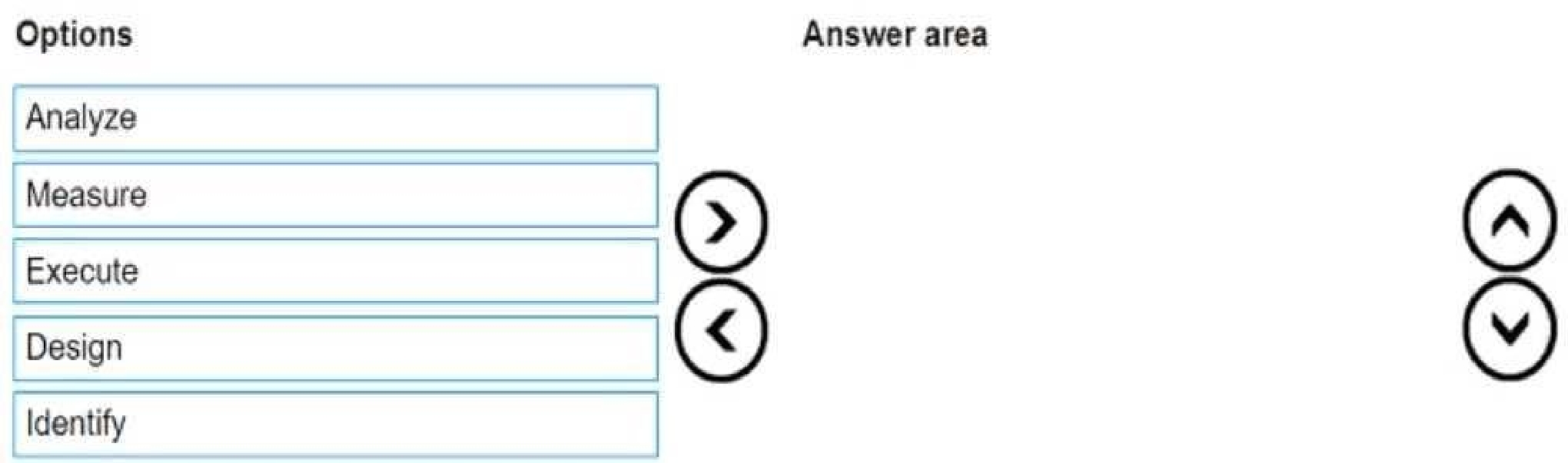
DRAG DROP
What is the correct order of the business continuity plan principles?
Check the image below to see the right answer:Select the answer
1 correct answer
Identify - Analyze - Design - Measure - Execute.
Right Answer: A
Quiz
Question 10/1010/10
A cloud service provider must improve the utilization of resources by sharing them with multiple customers. What mechanism should the cloud provider deploy to prevent one consumer from accessing the virtual machines of another consumer?
Select the answer:Select the answer
1 correct answer
A.
Distributed switching
B.
Secure multitenancy
C.
Pooling of resources
D.
Raw disk mapping
The correct answer is B. Secure multitenancy. A cloud service provider that shares infrastructure among multiple customers is operating in a multitenant environment. In this setup, different customers use the same physical hardware, but their workloads, data, and virtual machines must remain isolated from one another. Secure multitenancy is the mechanism that provides this isolation. It ensures that one tenant cannot access another tenant’s virtual machines, storage, memory, or data. This is critical in cloud environments because resource sharing improves utilization, but it also creates security risks unless strong separation is enforced. Why the other options are incorrect: A. Distributed switching This refers to network traffic management across distributed systems. It helps with connectivity and performance, but it does not specifically enforce tenant isolation between virtual machines. C. Pooling of resources Resource pooling is a core cloud characteristic where resources are shared among multiple users. However, pooling alone does not prevent one consumer from accessing another consumer’s virtual machines. In fact, it is the reason isolation mechanisms are needed. D. Raw disk mapping This is a storage configuration where a virtual machine can directly access a physical disk or storage device. It is not a security mechanism for preventing cross-tenant access. In summary, because the provider wants to share resources while preventing unauthorized access between customers, secure multitenancy is the correct choice.
D-CIS-FN-01: Dell-EMC Dell Cloud Infrastructure and Services Foundations v2 Practice test unlocks all online simulator questions
Thank you for choosing the free version of the D-CIS-FN-01: Dell-EMC Dell Cloud Infrastructure and Services Foundations v2 practice test! Further deepen your knowledge on Dell-EMC Simulator; by unlocking the full version of our D-CIS-FN-01: Dell-EMC Dell Cloud Infrastructure and Services Foundations v2 Simulator you will be able to take tests with over 152 constantly updated questions and easily pass your exam. 98% of people pass the exam in the first attempt after preparing with our 152 questions.
What to expect from our D-CIS-FN-01: Dell-EMC Dell Cloud Infrastructure and Services Foundations v2 practice tests and how to prepare for any exam?
The D-CIS-FN-01: Dell-EMC Dell Cloud Infrastructure and Services Foundations v2 Simulator Practice Tests are part of the Dell-EMC Database and are the best way to prepare for any D-CIS-FN-01: Dell-EMC Dell Cloud Infrastructure and Services Foundations v2 exam. The D-CIS-FN-01: Dell-EMC Dell Cloud Infrastructure and Services Foundations v2 practice tests consist of 152 questions and are written by experts to help you and prepare you to pass the exam on the first attempt. The D-CIS-FN-01: Dell-EMC Dell Cloud Infrastructure and Services Foundations v2 database includes questions from previous and other exams, which means you will be able to practice simulating past and future questions. Preparation with D-CIS-FN-01: Dell-EMC Dell Cloud Infrastructure and Services Foundations v2 Simulator will also give you an idea of the time it will take to complete each section of the D-CIS-FN-01: Dell-EMC Dell Cloud Infrastructure and Services Foundations v2 practice test . It is important to note that the D-CIS-FN-01: Dell-EMC Dell Cloud Infrastructure and Services Foundations v2 Simulator does not replace the classic D-CIS-FN-01: Dell-EMC Dell Cloud Infrastructure and Services Foundations v2 study guides; however, the Simulator provides valuable insights into what to expect and how much work needs to be done to prepare for the D-CIS-FN-01: Dell-EMC Dell Cloud Infrastructure and Services Foundations v2 exam.
D-CIS-FN-01: Dell-EMC Dell Cloud Infrastructure and Services Foundations v2 Practice test therefore represents an excellent tool to prepare for the actual exam together with our Dell-EMC practice test . Our D-CIS-FN-01: Dell-EMC Dell Cloud Infrastructure and Services Foundations v2 Simulator will help you assess your level of preparation and understand your strengths and weaknesses. Below you can read all the quizzes you will find in our D-CIS-FN-01: Dell-EMC Dell Cloud Infrastructure and Services Foundations v2 Simulator and how our unique D-CIS-FN-01: Dell-EMC Dell Cloud Infrastructure and Services Foundations v2 Database made up of real questions:
Info quiz:
Quiz name:D-CIS-FN-01: Dell-EMC Dell Cloud Infrastructure and Services Foundations v2
Total number of questions:152
Number of questions for the test:50
Pass score:80%
You can prepare for the D-CIS-FN-01: Dell-EMC Dell Cloud Infrastructure and Services Foundations v2 exams with our mobile app. It is very easy to use and even works offline in case of network failure, with all the functions you need to study and practice with our D-CIS-FN-01: Dell-EMC Dell Cloud Infrastructure and Services Foundations v2 Simulator.
Use our Mobile App, available for both Android and iOS devices, with our D-CIS-FN-01: Dell-EMC Dell Cloud Infrastructure and Services Foundations v2 Simulator . You can use it anywhere and always remember that our mobile app is free and available on all stores.
Our Mobile App contains all D-CIS-FN-01: Dell-EMC Dell Cloud Infrastructure and Services Foundations v2 practice tests which consist of 152 questions and also provide study material to pass the final D-CIS-FN-01: Dell-EMC Dell Cloud Infrastructure and Services Foundations v2 exam with guaranteed success.
Our D-CIS-FN-01: Dell-EMC Dell Cloud Infrastructure and Services Foundations v2 database contain hundreds of questions and Dell-EMC Tests related to D-CIS-FN-01: Dell-EMC Dell Cloud Infrastructure and Services Foundations v2 Exam. This way you can practice anywhere you want, even offline without the internet.