The new flashcard feature is useful to memorize questions.
?Change your study mode
At any time, you can change the study mode, and alternate between the practice mode and the exam mode. In practice mode, you can configure for example the number of questions or tests, and other parameters to help you study.
Randomized | 10 Questions per Test | 20 Minutes | 70% to pass|
To re-configure your study mode again and change - for example - the number of tests, whether you have random questions and all other configuration parameters.
?Simulator Configuration
Auto-scroll: You can use the automatic scrolling of the questionnaire that occurs as soon as you answer one or all of the answers to a question correctly. Auto scrolling is activated if you answer a single answer, or as soon as you answer all the mandatory answers. Learning Mode: During learning mode you can get a real time result for your answer.
Free Test
Question: / 10
20:00Min. left
?Restart the current test
To restart the current test by clearing all your answers and the time used up to now. Warning: all answers will be lost.
Question: / 10
4.8(763 Votes)
Quiz
Question 1/101/10
Which of the following countermeasure can specifically protect against both the MAC Flood and MAC Spoofing attacks?
Select the answer:Select the answer
1 correct answer
A.
Configure Port Security on the switch
B.
Configure Port Recon on the switch
C.
Configure Switch Mapping
D.
Configure Multiple Recognition on the switch
The correct answer is A. Configure Port Security on the switch. MAC Flood attacks and MAC Spoofing attacks both target how a switch learns and uses MAC addresses. 1. MAC Flood attack A MAC flood attack tries to overwhelm the switch’s MAC address table by sending a large number of fake source MAC addresses. If the table gets filled up, the switch may start behaving like a hub and flooding traffic out of many ports. This can expose traffic to attackers. 2. MAC Spoofing attack A MAC spoofing attack happens when an attacker pretends to be another device by using its MAC address. This can allow the attacker to bypass restrictions, impersonate a trusted host, or intercept traffic. Why Port Security helps Port Security is a switch feature that limits which MAC addresses are allowed on a port and how many MAC addresses can be learned on that port. It can: - Restrict the number of MAC addresses per port - Allow only specific MAC addresses - Shut down or restrict a port if a violation occurs This helps against both attacks because: - Against MAC Flooding: limiting the number of MAC addresses prevents an attacker from filling the MAC table with many fake addresses - Against MAC Spoofing: allowing only approved MAC addresses makes it harder for an attacker to impersonate another device Why the other options are incorrect B. Configure Port Recon on the switch This is not a standard switch security feature used to stop these attacks. C. Configure Switch Mapping This is not a typical countermeasure for MAC flooding or spoofing. D. Configure Multiple Recognition on the switch This is not a valid or standard protection mechanism for these attacks. Conclusion Port Security is the most specific and effective countermeasure among the options because it directly limits MAC learning on switch ports and enforces MAC address control, protecting against both MAC Flood and MAC Spoofing attacks.
Right Answer: A
Quiz
Question 2/102/10
Jimmy, an attacker, knows that he can take advantage of poorly designed input validation routines to create or alter SQL commands to gain access to private data or execute commands in the database. What technique does Jimmy use to compromise a database?
Select the answer:Select the answer
1 correct answer
A.
Jimmy can submit user input that executes an operating system command to compromise a target system
B.
Jimmy can gain control of system to flood the target system with requests, preventing legitimate users from gaining access
C.
Jimmy can utilize an incorrect configuration that leads to access with higher-than expected privilege of the database
D.
Jimmy can utilize this particular database threat that is an SQL injection technique to penetrate a target system
The correct answer is D. Jimmy is exploiting poorly designed input validation to insert or alter SQL commands. This is the classic definition of SQL injection. SQL injection happens when an attacker sends specially crafted input that the application incorrectly treats as part of a SQL query. This can allow the attacker to: - read private data, - modify or delete database records, - bypass authentication, - or execute unauthorized database commands. Why the other options are incorrect: A. This describes command injection, where user input is used to execute operating system commands, not SQL commands. B. This describes a denial-of-service attack, where the goal is to overwhelm a system and block legitimate access. C. This refers to privilege escalation due to incorrect configuration, not SQL injection. So, because Jimmy is manipulating SQL statements through unsafe input handling, the correct technique is SQL injection, which is option D.
Right Answer: D
Quiz
Question 3/103/10
This IDS defeating technique works by splitting a datagram (or packet) into multiple fragments and the IDS will not spot the true nature of the fully assembled datagram. The datagram is not reassembled until it reaches its final destination. It would be a processor-intensive task for IDS to reassemble all fragments itself, and on a busy system the packet will slip through the IDS onto the network. What is this technique called?
Select the answer:Select the answer
1 correct answer
A.
IP Routing or Packet Dropping
B.
IDS Spoofing or Session Assembly
C.
IP Fragmentation or Session Splicing
D.
IP Splicing or Packet Reassembly
The correct answer is C. IP Fragmentation or Session Splicing. This question describes a method used to evade an intrusion detection system (IDS) by breaking a packet or datagram into smaller fragments. The IDS may inspect each fragment separately and fail to recognize the full malicious payload because the complete packet is not reassembled until it reaches the destination host. Why this works: - Attackers split malicious data into multiple fragments. - The IDS has to inspect and possibly reassemble all fragments to understand the full content. - Reassembling many fragments can be resource-intensive. - On a busy network, the IDS may miss the attack or fail to reconstruct the full packet in time. - The target machine, however, will reassemble the fragments and receive the complete payload. This technique is commonly called: - IP fragmentation when referring to the general process of breaking packets into fragments. - Session splicing when referring to an IDS evasion technique where data is split across multiple packets or segments to avoid detection. Why the other options are incorrect: - A. IP Routing or Packet Dropping: This does not describe fragment-based IDS evasion. - B. IDS Spoofing or Session Assembly: These are not the standard terms for this attack method. - D. IP Splicing or Packet Reassembly: “Packet reassembly” is part of how fragments are handled, but the term “IP splicing” is not the correct name for the evasion technique in this context. So the best answer is C, because the question is describing an IDS evasion technique based on fragmenting traffic and delaying full reassembly until the destination host.
Right Answer: C
Quiz
Question 4/104/10
If a competitor wants to cause damage to your organization, steal critical secrets, or put you out of business, they just have to find a job opening, prepare someone to pass the interview, have that
person hired, and they will be in the organization.
How would you prevent such type of attacks?
Select the answer:Select the answer
1 correct answer
A.
It is impossible to block these attacks
B.
Hire the people through third-party job agencies who will vet them for you
C.
Conduct thorough background checks before you engage them
D.
Investigate their social networking profiles
The correct answer is C. Conduct thorough background checks before you engage them. The scenario describes a type of insider threat or infiltration attack. In this case, a competitor could deliberately place someone inside your organization by helping them get hired. Once inside, that person could access sensitive information, steal secrets, sabotage operations, or otherwise harm the business. The best prevention method from the options given is to conduct thorough background checks before hiring. Background screening helps verify a candidate’s identity, employment history, education, criminal record where legally permitted, references, and other relevant information. This reduces the chance of hiring someone with malicious intent or a falsified identity. Why the other options are not correct: A. It is impossible to block these attacks This is false. While no defense is perfect, organizations can significantly reduce the risk through screening, access controls, monitoring, and security policies. B. Hire the people through third-party job agencies who will vet them for you Using an agency does not guarantee safety. The organization still remains responsible for its own hiring due diligence. A third party may help, but it is not as direct or reliable as proper internal background checks. D. Investigate their social networking profiles Social media checks can sometimes provide useful insights, but they are not sufficient as a primary defense. They are only one small part of a broader vetting process and can be misleading or incomplete. In summary, thorough background checks are the most effective choice listed because they help detect risks before the person is hired and gains access to your organization.
Right Answer: C
Quiz
Question 5/105/10
This type of Port Scanning technique splits TCP header into several packets so that the packet filters are not able to detect what the packets intends to do.
Select the answer:Select the answer
1 correct answer
A.
UDP Scanning
B.
IP Fragment Scanning
C.
Inverse TCP flag scanning
D.
ACK flag scanning
The correct answer is B. IP Fragment Scanning. This scanning technique works by splitting the TCP header across multiple IP fragments. Because many packet filters and intrusion detection systems inspect only the first fragment or have difficulty reassembling fragmented packets correctly, the scanner can hide the true intent of the packet. Why this works: - A normal TCP packet contains the full TCP header in one piece. - In IP Fragment Scanning, the packet is broken into smaller fragments. - Filters may not detect the malicious or probing nature of the traffic if they cannot reconstruct the full packet. - This makes it harder for security devices to identify that the packet is being used for port scanning. Why the other options are incorrect: - A. UDP Scanning: This uses UDP packets to check whether ports are open, but it does not involve splitting headers into fragments. - C. Inverse TCP flag scanning: This uses unusual TCP flag combinations to probe ports, but not fragmentation. - D. ACK flag scanning: This uses ACK packets to map firewall rules or check filtering behavior, but again does not involve splitting the TCP header. So the key clue in the question is “splits TCP header into several packets,” which directly points to IP Fragment Scanning.
Right Answer: B
Quiz
Question 6/106/10
Joel and her team have been going through tons of garbage, recycled paper, and other rubbish in order to find some information about the target they are attempting to penetrate. How would you call this type of activity?
Select the answer:Select the answer
1 correct answer
A.
Dumpster Diving
B.
Scanning
C.
CI Gathering
D.
Garbage Scooping
The correct answer is A. Dumpster Diving. Dumpster diving is the act of searching through trash, discarded documents, recycled paper, or other waste materials to find useful information. In a security or intelligence context, attackers may do this to collect details such as passwords, internal memos, phone numbers, network diagrams, or other sensitive data that people or organizations have thrown away without properly destroying. In this question, Joel and her team are going through garbage, recycled paper, and rubbish to find information about a target. That matches the definition of dumpster diving exactly. Why the other options are incorrect: - B. Scanning: This usually refers to probing systems, ports, networks, or documents electronically, not searching through trash. - C. CI Gathering: This could mean competitive intelligence gathering or similar collection activities, but it is too broad and does not specifically describe retrieving information from discarded waste. - D. Garbage Scooping: This is not a standard term for this type of activity. So the best and correct answer is A. Dumpster Diving.
Right Answer: A
Quiz
Question 7/107/10
Anonymizer sites access the Internet on your behalf, protecting your personal information from disclosure. An anonymizer protects all of your computer's identifying information while it surfs for you, enabling you to remain at least one step removed from the sites you visit. You can visit Web sites without allowing anyone to gather information on sites visited by you. Services that provide anonymity disable pop-up windows and cookies, and conceal visitor's IP address. These services typically use a proxy server to process each HTTP request. When the user requests a Web page by clicking a hyperlink or typing a URL into their browser, the service retrieves and displays the information using its own server. The remote server (where the requested Web page resides) receives information on the anonymous Web surfing service in place of your information. In which situations would you want to use anonymizer? (Select 3 answers)
Select multiple answer: (Choose 3)Select the answer
3 correct answers
A.
Increase your Web browsing bandwidth speed by using Anonymizer
B.
To protect your privacy and Identity on the Internet
C.
To bypass blocking applications that would prevent access to Web sites or parts of sites that you want to visit.
D.
Post negative entries in blogs without revealing your IP identity
The correct answer is B, C, and D. Here’s why each option is right or wrong: A. Increase your Web browsing bandwidth speed by using Anonymizer This is not a typical reason to use an anonymizer. In fact, an anonymizer or proxy often adds an extra step between you and the website, which can slow browsing down rather than speed it up. Its purpose is privacy and access control, not performance improvement. B. To protect your privacy and Identity on the Internet This is a primary use of an anonymizer. It hides your IP address and other identifying details from the websites you visit, helping protect your identity and personal information. C. To bypass blocking applications that would prevent access to Web sites or parts of sites that you want to visit. This is another common use. Because the anonymizer acts as an intermediary, it can help users access sites that are blocked by filters, restrictions, or local network controls. D. Post negative entries in blogs without revealing your IP identity This is also a reason someone might use an anonymizer, though it is not a positive or ethical use case. It allows a user to post content without exposing their real IP address, which hides their location or identity. Summary: An anonymizer is mainly used to protect privacy and conceal identity, and it can also help bypass restrictions. It is not generally used to increase browsing speed. Answer: B, C, D
Right Answer: B, C, D
Quiz
Question 8/108/10
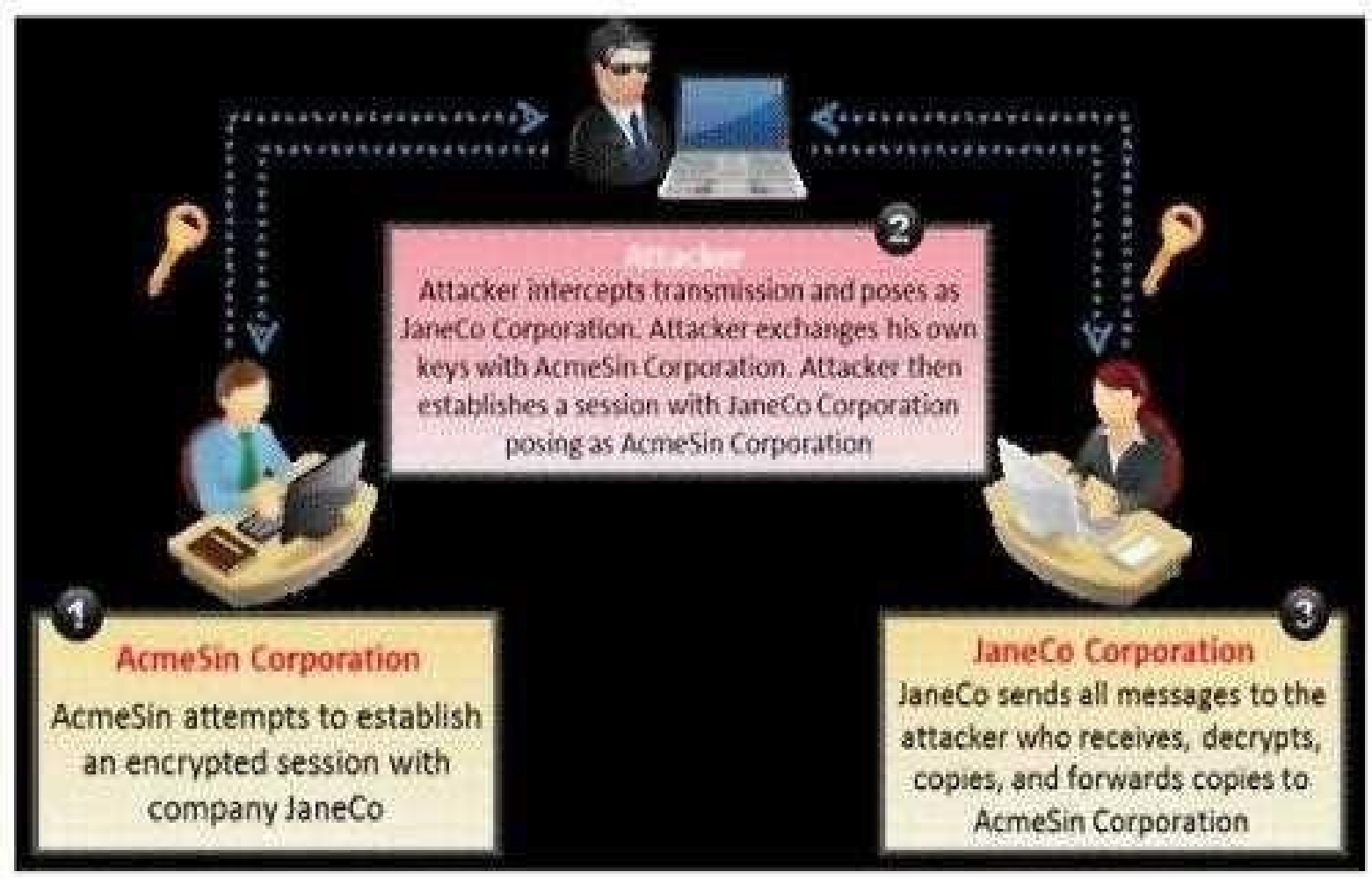
What type of attack is shown in the following diagram?
Select the answer:Select the answer
1 correct answer
A.
Man-in-the-Middle (MiTM) Attack
B.
Session Hijacking Attack
C.
SSL Spoofing Attack
D.
Identity Stealing Attack
The correct answer is A. Man-in-the-Middle (MiTM) Attack. A Man-in-the-Middle attack happens when an attacker secretly places themselves between two communicating parties and intercepts, relays, or possibly alters the communication without either side realizing it. In a typical diagram, you would see the attacker positioned between the victim and the intended destination, such as a client and a server. Why this fits the diagram: - The attacker is shown intercepting traffic between two legitimate endpoints. - The communication appears to pass through the attacker rather than going directly from one party to the other. - This setup is the classic visual representation of a MiTM attack. Why the other options are incorrect: - B. Session Hijacking Attack: This usually involves stealing or taking over an existing session token or session ID. It is related to impersonation after a session is established, but the diagram specifically shows interception between two parties, which is broader and more characteristic of MiTM. - C. SSL Spoofing Attack: This refers to tricking a victim into believing they have a secure SSL/TLS connection when they do not. While SSL spoofing can be part of a MiTM scenario, the general attack shown is best identified as MiTM. - D. Identity Stealing Attack: This is a broader term and could include many methods of stealing credentials or impersonating someone. It does not specifically describe the interception of communication shown in the diagram. In summary: The key clue is the attacker positioned between two communicating parties, which is the defining feature of a Man-in-the-Middle attack.
Right Answer: A
Quiz
Question 9/109/10
Jack Hacker wants to break into Brown Co.'s computers and obtain their secret double fudge cookie recipe. Jack calls Jane, an accountant at Brown Co., pretending to be an administrator from Brown Co. Jack tells Jane that there has been a problem with some accounts and asks her to verify her password with him ''just to double check our records.'' Jane does not suspect anything amiss, and parts with her password. Jack can now access Brown Co.'s computers with a valid user name and password, to steal the cookie recipe. What kind of attack is being illustrated here?
Select the answer:Select the answer
1 correct answer
A.
Reverse Psychology
B.
Reverse Engineering
C.
Social Engineering
D.
Spoofing Identity
E.
Faking Identity
The correct answer is C. Social Engineering. This scenario is a classic example of social engineering, which is when an attacker manipulates a person into revealing confidential information or performing an action that compromises security. In this case, Jack does not hack the system directly. Instead, he deceives Jane by pretending to be an administrator and convinces her to disclose her password. Why this is social engineering: - The attack targets the human, not the computer system. - The attacker uses deception, trust, and persuasion. - The goal is to trick the victim into giving up sensitive information voluntarily. Why the other choices are incorrect: - A. Reverse Psychology: This involves encouraging someone to do the opposite of what is requested, which is not what happens here. - B. Reverse Engineering: This means analyzing a product or system to figure out how it works, which is unrelated to tricking a person. - D. Spoofing Identity: This can involve pretending to be someone else, but the broader attack here is the manipulation of Jane into giving away her password. The best answer is social engineering. - E. Faking Identity: This is not a standard cybersecurity term for this kind of attack. In short, Jack is using deception to exploit Jane’s trust, which is exactly what social engineering is.
Right Answer: C
Quiz
Question 10/1010/10
How do you defend against ARP Spoofing? Select three.
Select multiple answer: (Choose 3)Select the answer
3 correct answers
A.
Use ARPWALL system and block ARP spoofing attacks
B.
Tune IDS Sensors to look for large amount of ARP traffic on local subnets
C.
Use private VLANS
D.
Place static ARP entries on servers, workstation and routers
ARPwall is used in protecting against ARP spoofing. Incorrect answer: IDS option may works fine in case of monitoring the traffic from outside the network but not from internal hosts.
CPEH-001: GAQM Certified Professional Ethical Hacker (CPEH) Practice test unlocks all online simulator questions
Thank you for choosing the free version of the CPEH-001: GAQM Certified Professional Ethical Hacker (CPEH) practice test! Further deepen your knowledge on GAQM Simulator; by unlocking the full version of our CPEH-001: GAQM Certified Professional Ethical Hacker (CPEH) Simulator you will be able to take tests with over 878 constantly updated questions and easily pass your exam. 98% of people pass the exam in the first attempt after preparing with our 878 questions.
What to expect from our CPEH-001: GAQM Certified Professional Ethical Hacker (CPEH) practice tests and how to prepare for any exam?
The CPEH-001: GAQM Certified Professional Ethical Hacker (CPEH) Simulator Practice Tests are part of the GAQM Database and are the best way to prepare for any CPEH-001: GAQM Certified Professional Ethical Hacker (CPEH) exam. The CPEH-001: GAQM Certified Professional Ethical Hacker (CPEH) practice tests consist of 878 questions and are written by experts to help you and prepare you to pass the exam on the first attempt. The CPEH-001: GAQM Certified Professional Ethical Hacker (CPEH) database includes questions from previous and other exams, which means you will be able to practice simulating past and future questions. Preparation with CPEH-001: GAQM Certified Professional Ethical Hacker (CPEH) Simulator will also give you an idea of the time it will take to complete each section of the CPEH-001: GAQM Certified Professional Ethical Hacker (CPEH) practice test . It is important to note that the CPEH-001: GAQM Certified Professional Ethical Hacker (CPEH) Simulator does not replace the classic CPEH-001: GAQM Certified Professional Ethical Hacker (CPEH) study guides; however, the Simulator provides valuable insights into what to expect and how much work needs to be done to prepare for the CPEH-001: GAQM Certified Professional Ethical Hacker (CPEH) exam.
CPEH-001: GAQM Certified Professional Ethical Hacker (CPEH) Practice test therefore represents an excellent tool to prepare for the actual exam together with our GAQM practice test . Our CPEH-001: GAQM Certified Professional Ethical Hacker (CPEH) Simulator will help you assess your level of preparation and understand your strengths and weaknesses. Below you can read all the quizzes you will find in our CPEH-001: GAQM Certified Professional Ethical Hacker (CPEH) Simulator and how our unique CPEH-001: GAQM Certified Professional Ethical Hacker (CPEH) Database made up of real questions:
Info quiz:
Quiz name:CPEH-001: GAQM Certified Professional Ethical Hacker (CPEH)
Total number of questions:878
Number of questions for the test:50
Pass score:80%
You can prepare for the CPEH-001: GAQM Certified Professional Ethical Hacker (CPEH) exams with our mobile app. It is very easy to use and even works offline in case of network failure, with all the functions you need to study and practice with our CPEH-001: GAQM Certified Professional Ethical Hacker (CPEH) Simulator.
Use our Mobile App, available for both Android and iOS devices, with our CPEH-001: GAQM Certified Professional Ethical Hacker (CPEH) Simulator . You can use it anywhere and always remember that our mobile app is free and available on all stores.
Our Mobile App contains all CPEH-001: GAQM Certified Professional Ethical Hacker (CPEH) practice tests which consist of 878 questions and also provide study material to pass the final CPEH-001: GAQM Certified Professional Ethical Hacker (CPEH) exam with guaranteed success.
Our CPEH-001: GAQM Certified Professional Ethical Hacker (CPEH) database contain hundreds of questions and GAQM Tests related to CPEH-001: GAQM Certified Professional Ethical Hacker (CPEH) Exam. This way you can practice anywhere you want, even offline without the internet.