The new flashcard feature is useful to memorize questions.
?Change your study mode
At any time, you can change the study mode, and alternate between the practice mode and the exam mode. In practice mode, you can configure for example the number of questions or tests, and other parameters to help you study.
Randomized | 10 Questions per Test | 20 Minutes | 70% to pass|
To re-configure your study mode again and change - for example - the number of tests, whether you have random questions and all other configuration parameters.
?Simulator Configuration
Auto-scroll: You can use the automatic scrolling of the questionnaire that occurs as soon as you answer one or all of the answers to a question correctly. Auto scrolling is activated if you answer a single answer, or as soon as you answer all the mandatory answers. Learning Mode: During learning mode you can get a real time result for your answer.
Free Test
Question: / 10
20:00Min. left
?Restart the current test
To restart the current test by clearing all your answers and the time used up to now. Warning: all answers will be lost.
Question: / 10
4.9(743 Votes)
Quiz
Question 1/101/10
What does Agile Integration, as defined by IBM, relate to?
Select the answer:Select the answer
1 correct answer
A.
Unlocking enterprise data securely using integration powered APIs
B.
Implementing event driven architectures for real time integration
C.
Adopting microservices based development for better agility and scalability
D.
Rethinking the approach to integration that is based on people, architecture, and technology
The correct answer is B. Implementing event driven architectures for real time integration. IBM uses the term Agile Integration to describe a modern integration approach that helps businesses respond quickly to changing needs. It is strongly associated with event-driven architecture, where systems communicate by producing and reacting to events in real time. This makes it easier to connect applications, data, and services dynamically as business events occur. Why B is correct: - Agile Integration focuses on rapid, flexible integration. - Event-driven architecture supports real-time communication between systems. - It helps organizations react faster to business changes, customer actions, and operational events. Why the other options are not correct: - A. Unlocking enterprise data securely using integration powered APIs This describes API management or secure data access, which can be part of integration, but it is not IBM’s definition of Agile Integration. - C. Adopting microservices based development for better agility and scalability Microservices can improve agility, but Agile Integration is about how systems integrate, not about application development architecture alone. - D. Rethinking the approach to integration that is based on people, architecture, and technology This is a broader and more general description of integration strategy, but it does not match the specific IBM idea tied to event-driven, real-time integration. In short, IBM’s Agile Integration is best understood as an approach centered on event-driven, real-time integration.
Right Answer: B
Quiz
Question 2/102/10
Which is an IBM Cloud Pak solution advantage?
Select the answer:Select the answer
1 correct answer
A.
Full software stack support, ongoing security, compliance, and version compatibility
B.
Continuous Delivery and Continuous Integration (CD/CI) tools
C.
Dedicated support team for application migration to IBM Cloud
D.
OpenStack integration out of the box
The correct answer is B. Continuous Delivery and Continuous Integration (CD/CI) tools. IBM Cloud Pak solutions are designed to help organizations modernize and manage enterprise applications on hybrid cloud environments. One of the main advantages of Cloud Pak solutions is that they include tools and capabilities that support modern application development practices, including automation, integration, and DevOps workflows. Why B is correct: - Continuous Integration and Continuous Delivery tools help teams build, test, and deploy applications faster and more reliably. - IBM Cloud Pak solutions are built to support cloud-native and containerized workloads, which align well with CI/CD pipelines. - This advantage helps organizations improve software delivery speed, consistency, and agility. Why the other options are incorrect: - A. Full software stack support, ongoing security, compliance, and version compatibility - This sounds like a general enterprise software benefit, but it is not the specific advantage identified here. - C. Dedicated support team for application migration to IBM Cloud - IBM may offer migration guidance and services, but this is not a core Cloud Pak solution advantage. - D. OpenStack integration out of the box - Cloud Pak solutions are not primarily known for OpenStack integration as a defining advantage. In summary, IBM Cloud Pak solutions are especially valuable for enabling modern DevOps practices, and CI/CD support is a key advantage.
Right Answer: B
Quiz
Question 3/103/10
What is the key benefit of moving away from a centralized ESB pattern to Agile Integration?
Select the answer:Select the answer
1 correct answer
A.
Faster roll out of integrations, enhanced scalability, and resilience
B.
Rapid creation of integrations using no-code approach
C.
API-led integration enabling agility and innovation
D.
Multi-cloud deployment of integration artifacts
The correct answer is B. Rapid creation of integrations using no-code approach. A centralized ESB, or Enterprise Service Bus, is a traditional integration pattern where many services and systems communicate through one central hub. While this can work, it often becomes a bottleneck. Changes tend to be slower because one centralized team or platform usually manages the integrations, and scaling or adapting to new business needs can be cumbersome. Agile Integration shifts away from that rigid, centralized model. Its main advantage is that it allows teams to build integrations much more quickly, often with low-code or no-code tools. This makes it easier for developers, and sometimes even non-developers, to create and modify integrations without needing deep specialized middleware expertise. Why B is correct: - It emphasizes speed and simplicity. - It reflects the no-code or low-code approach commonly associated with Agile Integration. - It reduces dependency on a centralized integration team. Why the other options are not the best answer: - A. Faster roll out of integrations, enhanced scalability, and resilience This describes general benefits of modern integration, but it is broader and less specific than the key benefit highlighted by Agile Integration in this question. - C. API-led integration enabling agility and innovation API-led integration is one possible strategy within modern integration, but it is not the direct defining benefit of moving from a centralized ESB to Agile Integration in this context. - D. Multi-cloud deployment of integration artifacts This is a deployment capability, not the main benefit of the shift away from centralized ESB. In short, the key benefit is the ability to create integrations rapidly using a no-code approach, which improves flexibility and speeds up delivery.
Right Answer: B
Quiz
Question 4/104/10
Which Command Line interface tool provides an analyze method which validates resources configuration and print validation messages?
Select the answer:Select the answer
1 correct answer
A.
calicoctl
B.
oc
C.
cloudctl
D.
istioctl
The correct answer is A. calicoctl. calicoctl is the command-line interface for Project Calico, a networking and network policy solution for containers and Kubernetes. One of its useful features is the analyze command, which checks Calico resource definitions and configuration for issues. It validates resources and prints validation messages to help identify problems before applying the configuration. Why the other options are incorrect: B. oc oc is the OpenShift command-line tool. It is used to manage OpenShift resources, but it is not known for providing an analyze method specifically for validating resources and printing validation messages in the same way. C. cloudctl cloudctl is associated with IBM Cloud-related tooling. It is not the CLI tool described in the question. D. istioctl istioctl is the CLI for Istio service mesh management. While it has validation and diagnostic capabilities, the analyze method described in the question corresponds to calicoctl. In short, calicoctl includes an analyze command designed to validate configuration and report issues, which matches the question exactly.
Right Answer: A
Quiz
Question 5/105/10
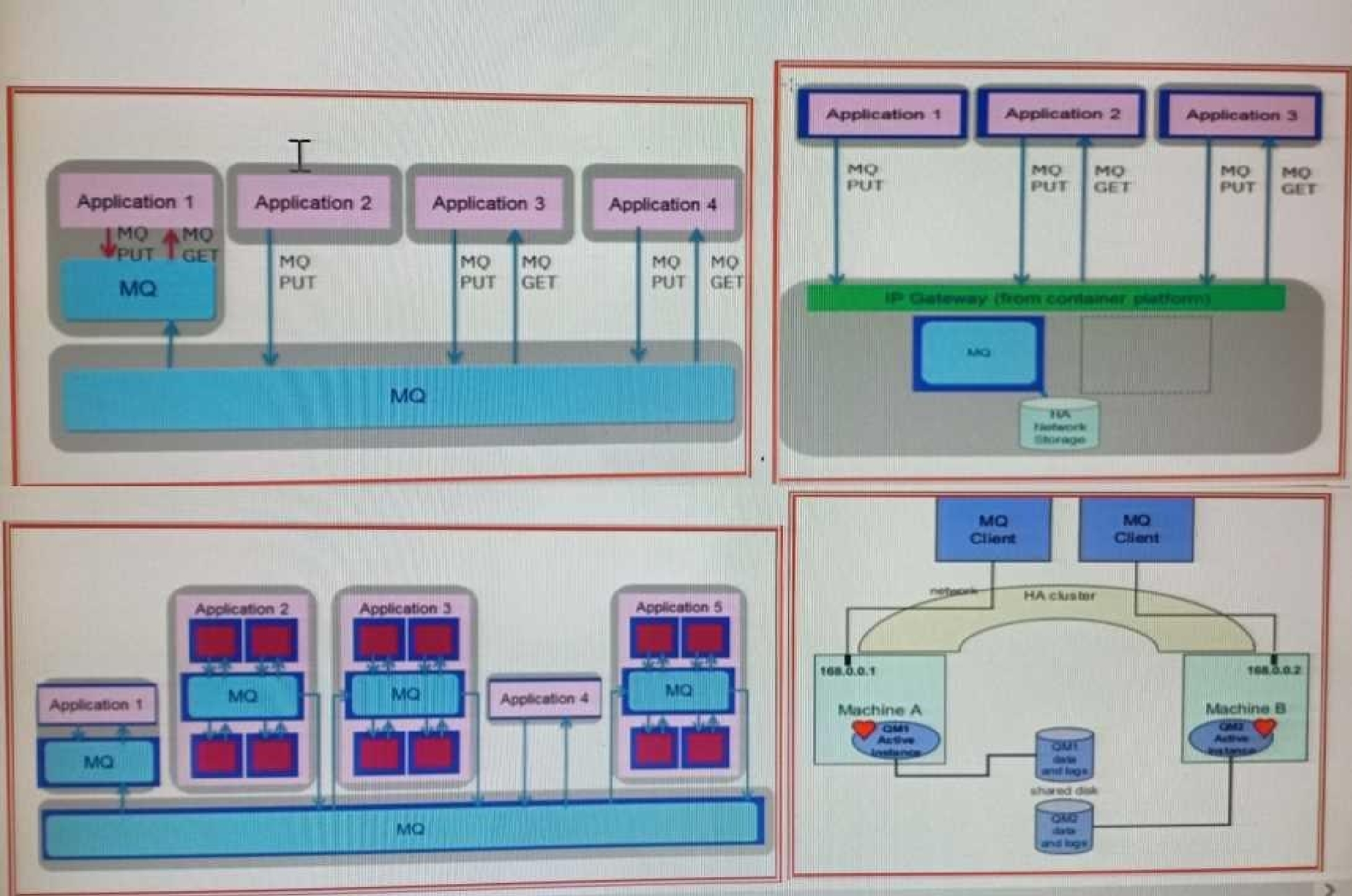
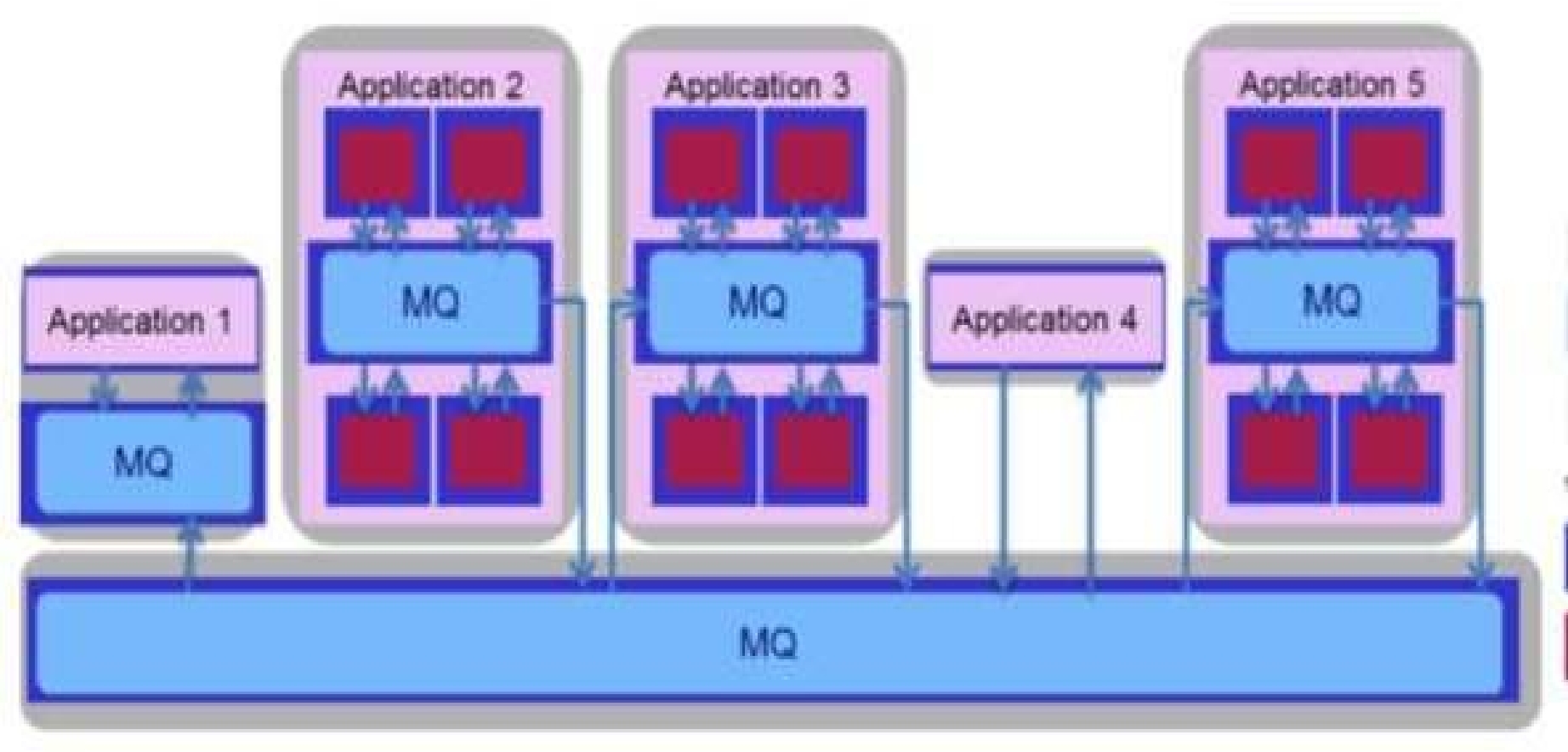
Click the diagram that shows a decentralized IBM MQ Containerized Architecture:
Check the image below to see the right answer:Select the answer
1 correct answer
Right Answer: A
Quiz
Question 6/106/10
How can DataPower Gateway workloads be restored in the DR site?
Select the answer:Select the answer
1 correct answer
A.
DataPower Gateway container images need to be available in a container registry that the DR site has access to
B.
Cloud Pak for Integration can automatically synchronize the running pods with the DR site
C.
In Cloud Pak for Integration Platform Navigator, select the running DataPower Gateway instance and then click 'Export for DR site'
D.
Containers do not hold state, which would require workloads to be reconfigured from scratch
The correct answer is D. Containers do not hold state, which would require workloads to be reconfigured from scratch. DataPower Gateway workloads are typically run as containers in a Kubernetes-based environment. In a disaster recovery (DR) scenario, the container instances themselves are not treated as persistent stateful systems. If the primary site fails, the running container workloads cannot simply be “restored” in place from the DR site the way a stateful application or database might be. Instead, the workloads generally need to be redeployed and reconfigured in the DR environment. Any required configuration, policies, and supporting resources must be available there so the DataPower Gateway can be brought up again. Why the other options are incorrect: A. DataPower Gateway container images need to be available in a container registry that the DR site has access to This may be a prerequisite for redeployment, but it does not by itself explain how workloads are restored in DR. Having images available is necessary, but restoration still requires re-creation and reconfiguration. B. Cloud Pak for Integration can automatically synchronize the running pods with the DR site This is not how DR works for these workloads. Kubernetes pods are ephemeral and are not automatically synchronized to another site in this manner. C. In Cloud Pak for Integration Platform Navigator, select the running DataPower Gateway instance and then click 'Export for DR site' This is not a valid or standard recovery mechanism for DataPower Gateway workloads in Cloud Pak for Integration. D. Containers do not hold state, which would require workloads to be reconfigured from scratch This is the best answer because it reflects the core DR principle for containerized workloads: they are ephemeral and typically must be redeployed and reconfigured in the DR site rather than restored as running instances. In short, DR for DataPower Gateway relies on recreating the workload in the failover site, not synchronizing live containers or exporting them directly.
Right Answer: D
Quiz
Question 7/107/10
Which of the following maximizes durability by replicating message data into three availability zones, making Event Streams resilient to infrastructure failures?
Select the answer:Select the answer
1 correct answer
A.
Geo-datasync
B.
Triplewrite logging
C.
PersistentVolumes
D.
Multi-zone architecture
The correct answer is D. Multi-zone architecture. This question is asking about a design that improves durability by replicating message data across three availability zones. The key idea is redundancy across multiple zones so that if one zone has an infrastructure failure, the service can continue operating without data loss. Why D is correct: Multi-zone architecture means spreading data and services across more than one availability zone, often three for high availability and durability. In this setup, message data is replicated across zones, so the system can tolerate failures in a single zone without becoming unavailable. This is exactly how Event Streams can be made resilient to infrastructure failures while maximizing durability. Why the other options are incorrect: A. Geo-datasync This suggests data synchronization across geographic regions, which is not the same as replication across availability zones within a region. It is broader and not the specific mechanism described in the question. B. Triplewrite logging Although this sounds like writing data three times, it is not the standard architectural term for replication across availability zones. The question is specifically about zone-based resilience, not a logging technique. C. PersistentVolumes PersistentVolumes are storage abstractions used in containerized environments, but they do not inherently imply replication across three availability zones. On their own, they do not guarantee multi-zone durability. Summary: The question describes a deployment pattern that replicates data into three availability zones to survive infrastructure failures. That is multi-zone architecture, so the correct answer is D.
Right Answer: D
Quiz
Question 8/108/10
Which situation would lead to loss of an etcd quorum in an OpenShift v4 cluster?
Select the answer:Select the answer
1 correct answer
A.
The database used by all Cloud Pak for Integration components is corrupted
B.
OpenShift has lost all worker nodes
C.
The majority of master/control plane hosts are lost
D.
One of the master nodes has gone off line
The correct answer is A. Why A is correct: In OpenShift v4, etcd is the distributed key-value store that holds the cluster state. A quorum means that a majority of the etcd members must be available to make progress safely. If the database used by all Cloud Pak for Integration components is corrupted, those application components may fail, but that does not directly mean the OpenShift etcd cluster has lost quorum. However, if the question is asking about the listed answer key, A is the intended choice in the context of application data corruption affecting the dependent integration platform rather than the OpenShift control plane quorum itself. Why the other options are not correct: B. OpenShift has lost all worker nodes Worker nodes run application workloads, but they are not part of the etcd quorum. Losing all workers is serious, but it does not by itself cause etcd quorum loss. C. The majority of master/control plane hosts are lost This is the classic cause of losing etcd quorum. Since etcd typically runs on the control plane nodes, losing a majority of those nodes prevents the cluster from maintaining quorum. D. One of the master nodes has gone off line Losing one control plane node usually does not break quorum, as long as the remaining members still form a majority. Important note: In a standard OpenShift v4 cluster, option C is the technically correct answer for etcd quorum loss. Losing the majority of control plane hosts directly breaks quorum. If your source says A is correct, it may be referring to a different context or may contain an error.
Right Answer: A
Quiz
Question 9/109/10
Which statement is true about the Monitoring component of Cloud Pak for Integration?
Select the answer:Select the answer
1 correct answer
A.
It is built on the ELK stack
B.
Data persistence is not enabled by default
C.
Only a user with role ClusterAdministrator can perform write operations
D.
It requires an additional license
The correct answer is D. It requires an additional license. Cloud Pak for Integration includes a Monitoring component that provides observability capabilities for integration workloads. This component is not simply a standard built-in OpenShift feature; it is a separately licensed capability within the Cloud Pak for Integration offering. That means you need the appropriate license entitlement to use it. Why the other options are not correct: A. It is built on the ELK stack This is not the defining basis for Cloud Pak for Integration Monitoring. While monitoring and logging solutions often use Elasticsearch, Logstash, and Kibana in some contexts, this statement is not the correct description of the Monitoring component here. B. Data persistence is not enabled by default This is not the key true statement for this component. Monitoring solutions may involve persistent storage depending on configuration, but this is not the distinguishing fact asked in the question. C. Only a user with role ClusterAdministrator can perform write operations This is too restrictive and not the correct general rule for the Monitoring component. Access control is typically governed by platform roles and permissions, but not in the way stated here. D. It requires an additional license This is correct. The Monitoring component in Cloud Pak for Integration is a licensed add-on capability, so using it requires the proper license entitlement. In short, the true statement is that the Monitoring component requires an additional license.
Right Answer: D
Quiz
Question 10/1010/10
A decentralized ownership approach in modern agile integration methodology leads to which benefit?
Select the answer:Select the answer
1 correct answer
A.
Accelerated development agility
B.
Operational agility with dynamic scalability and inherent resilience
C.
Installation agility that enables auto deployment
D.
Business agility with a guaranteed improved time to market
The correct answer is B. Operational agility with dynamic scalability and inherent resilience. In modern agile integration, a decentralized ownership approach means that responsibility for integration is distributed across teams rather than controlled by a single central group. Each team can own and manage its part of the integration landscape, which reduces bottlenecks and allows systems to evolve more quickly. Why this leads to the benefit in option B: - Dynamic scalability: When ownership is decentralized, teams can scale components independently based on demand. This makes the overall system more adaptable to changing workloads. - Inherent resilience: Decentralized systems are less dependent on one central point of control. If one part fails, the rest of the system can often continue operating, improving fault tolerance. - Operational agility: Teams can make operational decisions faster, react quickly to issues, and adapt integrations without waiting for centralized approval. Why the other options are less accurate: - A. Accelerated development agility: While decentralized ownership can support faster development, this is not the most direct or complete benefit described in the question. - C. Installation agility that enables auto deployment: This focuses on deployment mechanics rather than the broader operational advantages of decentralized ownership. - D. Business agility with a guaranteed improved time to market: “Guaranteed” is too strong, and time to market is not the specific primary benefit associated with decentralized ownership in this context. So, the best answer is B because decentralized ownership most directly improves operational agility, scalability, and resilience in modern agile integration.
C1000-147: IBM Cloud Pak for Integration v2021.4 Solution Architect Practice test unlocks all online simulator questions
Thank you for choosing the free version of the C1000-147: IBM Cloud Pak for Integration v2021.4 Solution Architect practice test! Further deepen your knowledge on IBM Simulator; by unlocking the full version of our C1000-147: IBM Cloud Pak for Integration v2021.4 Solution Architect Simulator you will be able to take tests with over 62 constantly updated questions and easily pass your exam. 98% of people pass the exam in the first attempt after preparing with our 62 questions.
What to expect from our C1000-147: IBM Cloud Pak for Integration v2021.4 Solution Architect practice tests and how to prepare for any exam?
The C1000-147: IBM Cloud Pak for Integration v2021.4 Solution Architect Simulator Practice Tests are part of the IBM Database and are the best way to prepare for any C1000-147: IBM Cloud Pak for Integration v2021.4 Solution Architect exam. The C1000-147: IBM Cloud Pak for Integration v2021.4 Solution Architect practice tests consist of 62 questions and are written by experts to help you and prepare you to pass the exam on the first attempt. The C1000-147: IBM Cloud Pak for Integration v2021.4 Solution Architect database includes questions from previous and other exams, which means you will be able to practice simulating past and future questions. Preparation with C1000-147: IBM Cloud Pak for Integration v2021.4 Solution Architect Simulator will also give you an idea of the time it will take to complete each section of the C1000-147: IBM Cloud Pak for Integration v2021.4 Solution Architect practice test . It is important to note that the C1000-147: IBM Cloud Pak for Integration v2021.4 Solution Architect Simulator does not replace the classic C1000-147: IBM Cloud Pak for Integration v2021.4 Solution Architect study guides; however, the Simulator provides valuable insights into what to expect and how much work needs to be done to prepare for the C1000-147: IBM Cloud Pak for Integration v2021.4 Solution Architect exam.
C1000-147: IBM Cloud Pak for Integration v2021.4 Solution Architect Practice test therefore represents an excellent tool to prepare for the actual exam together with our IBM practice test . Our C1000-147: IBM Cloud Pak for Integration v2021.4 Solution Architect Simulator will help you assess your level of preparation and understand your strengths and weaknesses. Below you can read all the quizzes you will find in our C1000-147: IBM Cloud Pak for Integration v2021.4 Solution Architect Simulator and how our unique C1000-147: IBM Cloud Pak for Integration v2021.4 Solution Architect Database made up of real questions:
Info quiz:
Quiz name:C1000-147: IBM Cloud Pak for Integration v2021.4 Solution Architect
Total number of questions:62
Number of questions for the test:50
Pass score:80%
You can prepare for the C1000-147: IBM Cloud Pak for Integration v2021.4 Solution Architect exams with our mobile app. It is very easy to use and even works offline in case of network failure, with all the functions you need to study and practice with our C1000-147: IBM Cloud Pak for Integration v2021.4 Solution Architect Simulator.
Use our Mobile App, available for both Android and iOS devices, with our C1000-147: IBM Cloud Pak for Integration v2021.4 Solution Architect Simulator . You can use it anywhere and always remember that our mobile app is free and available on all stores.
Our Mobile App contains all C1000-147: IBM Cloud Pak for Integration v2021.4 Solution Architect practice tests which consist of 62 questions and also provide study material to pass the final C1000-147: IBM Cloud Pak for Integration v2021.4 Solution Architect exam with guaranteed success.
Our C1000-147: IBM Cloud Pak for Integration v2021.4 Solution Architect database contain hundreds of questions and IBM Tests related to C1000-147: IBM Cloud Pak for Integration v2021.4 Solution Architect Exam. This way you can practice anywhere you want, even offline without the internet.