Quiz AI-200: Microsoft Developing AI Cloud Solutions on Azure
Quiz
Background
Proseware Inc. develops AI-powered knowledge management solutions for enterprise customers.
The company is modernizing its platform to support semantic search, intelligent document retrieval,
and real-time partner integrations.
The engineering team uses Python and Azure SDKs. The architecture is being redesigned to support
containerized microservices, vector search workloads, and serverless backend processing.
Planned Application Architecture
Microservices are containerized by using Docker.
Code for containerized microservices and Azure Function apps is developed locally but stored in a
GitHub repository.
Custom images for containerized microservices are stored in Azure Container Registry (ACR).
Base images are stored in Docker Hub. Custom images must be rebuilt automatically whenever
their base images are updated.
Azure Cosmos DB for NoSQL stores documents, metadata, and vector embeddings.
Azure Functions generate vector embeddings of Azure Cosmos DB for NoSQL-hosted documents
and send messages to Service Bus to trigger search index updates.
Azure Container Apps (ACA) apps host backend API services that provide semantic search across
Azure Cosmos DB for NoSQL documents. API services process Service Bus messages and update
search indexes.
Azure Kubernetes Service (AKS) processes batch vector embedding regeneration for existing Azure
Cosmos DB for NoSQL documents (whenever the embedding model is changed).
An extranet-facing containerized webhook allows business partners to submit documents to be
processed by internal AI workflows for semantic search and retrieval.
Monitoring:
Telemetry generated by Azure resources is sent to Azure Monitor.
A Log Analytics workspace is used to collect ACA apps logs, AKS container logs, and Azure Functions
apps logs.
Monitoring of Azure Functions is currently implemented hy using Azure Application Insights SDK
instrumentation.
Business Requirements
Embeddings for new or updated Azure Cosmos DB for NoSQL–hosted documents must be
automatically generated.
Backend API services must scale automatically during business hours.
Cold start delay of backend APIs must be minimized.
Secrets must be stored outside of container images.
Developers must be able to correlate telemetry across Azure Functions hosts and apps.
All tracing must be implemented by using OpenTelemetry SDK instrumentation.
Development efforts must be minimized.
Technical Requirements
Container images must be built automatically and validated before code updates are merged into
the main branch.
Image build automation must run inside the Azure Container Registry, eliminating dependency on
local developer machines and external build services.
Dependency of image builds on local developer machines must be eliminated.
Event-driven scaling in ACA must occur based on the number of pending messages in the Azure
Service Bus queue.
Azure Cosmos DB for NoSQL RU consumption must be minimized.
Vector similarity search must use embeddings stored in Azure Cosmos DB for NoSQL.
The partner-facing containerized webhook service must run on Azure App Service.
Secrets must NOT be stored in container images, source control, or application configuration
directly. They must be accessed securely at runtime.
All secrets must be stored centrally in Azure Key Vault and accessed at runtime through a managed
identity.
Azure App Service must supply secrets at runtime without relying on external services.
Resources and workloads must be deployed by using Bicep templates through an automated,
version-controlled pipeline. Local and command-line deployments must be eliminated to ensure
repeatable, auditable deployments.
Known issues
RU consumption spikes during vector similarity queries.
failed pipeline that supports declarative infrastructure deployment. What should you use?
Quiz
Background
Proseware Inc. develops AI-powered knowledge management solutions for enterprise customers.
The company is modernizing its platform to support semantic search, intelligent document retrieval,
and real-time partner integrations.
The engineering team uses Python and Azure SDKs. The architecture is being redesigned to support
containerized microservices, vector search workloads, and serverless backend processing.
Planned Application Architecture
Microservices are containerized by using Docker.
Code for containerized microservices and Azure Function apps is developed locally but stored in a
GitHub repository.
Custom images for containerized microservices are stored in Azure Container Registry (ACR).
Base images are stored in Docker Hub. Custom images must be rebuilt automatically whenever
their base images are updated.
Azure Cosmos DB for NoSQL stores documents, metadata, and vector embeddings.
Azure Functions generate vector embeddings of Azure Cosmos DB for NoSQL-hosted documents
and send messages to Service Bus to trigger search index updates.
Azure Container Apps (ACA) apps host backend API services that provide semantic search across
Azure Cosmos DB for NoSQL documents. API services process Service Bus messages and update
search indexes.
Azure Kubernetes Service (AKS) processes batch vector embedding regeneration for existing Azure
Cosmos DB for NoSQL documents (whenever the embedding model is changed).
An extranet-facing containerized webhook allows business partners to submit documents to be
processed by internal AI workflows for semantic search and retrieval.
Monitoring:
Telemetry generated by Azure resources is sent to Azure Monitor.
A Log Analytics workspace is used to collect ACA apps logs, AKS container logs, and Azure Functions
apps logs.
Monitoring of Azure Functions is currently implemented hy using Azure Application Insights SDK
instrumentation.
Business Requirements
Embeddings for new or updated Azure Cosmos DB for NoSQL–hosted documents must be
automatically generated.
Backend API services must scale automatically during business hours.
Cold start delay of backend APIs must be minimized.
Secrets must be stored outside of container images.
Developers must be able to correlate telemetry across Azure Functions hosts and apps.
All tracing must be implemented by using OpenTelemetry SDK instrumentation.
Development efforts must be minimized.
Technical Requirements
Container images must be built automatically and validated before code updates are merged into
the main branch.
Image build automation must run inside the Azure Container Registry, eliminating dependency on
local developer machines and external build services.
Dependency of image builds on local developer machines must be eliminated.
Event-driven scaling in ACA must occur based on the number of pending messages in the Azure
Service Bus queue.
Azure Cosmos DB for NoSQL RU consumption must be minimized.
Vector similarity search must use embeddings stored in Azure Cosmos DB for NoSQL.
The partner-facing containerized webhook service must run on Azure App Service.
Secrets must NOT be stored in container images, source control, or application configuration
directly. They must be accessed securely at runtime.
All secrets must be stored centrally in Azure Key Vault and accessed at runtime through a managed
identity.
Azure App Service must supply secrets at runtime without relying on external services.
Resources and workloads must be deployed by using Bicep templates through an automated,
version-controlled pipeline. Local and command-line deployments must be eliminated to ensure
repeatable, auditable deployments.
Known issues
RU consumption spikes during vector similarity queries.
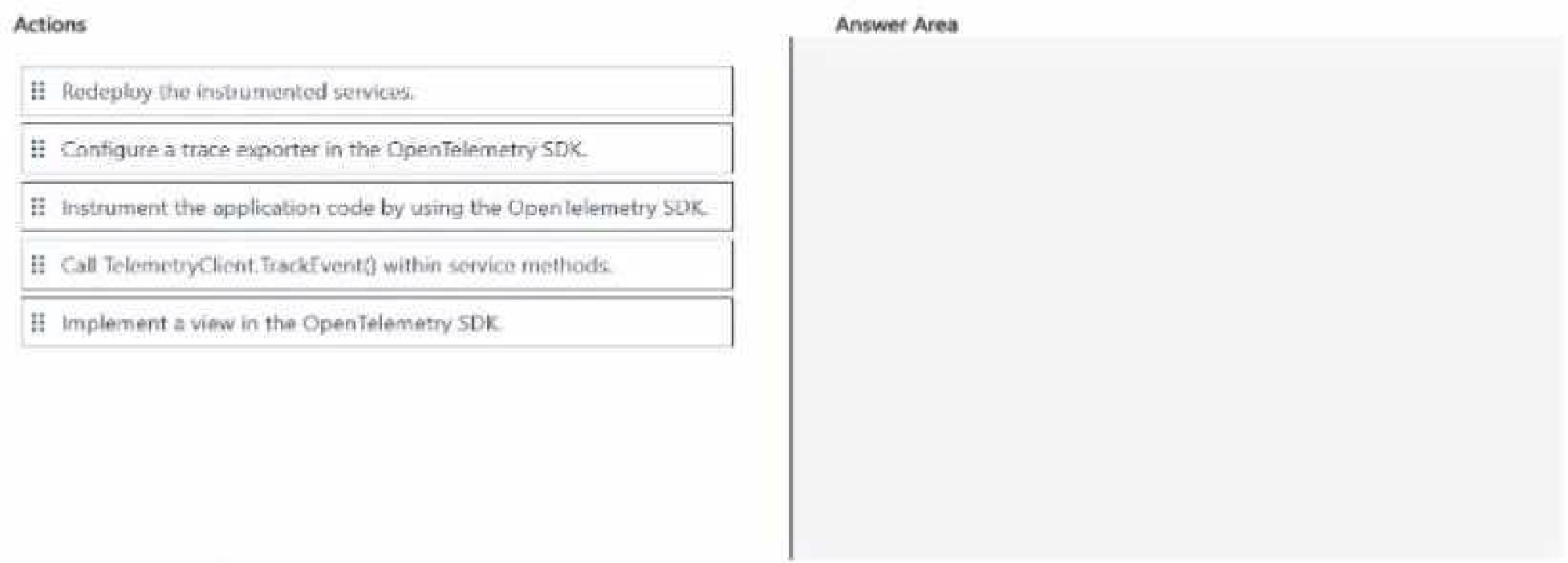
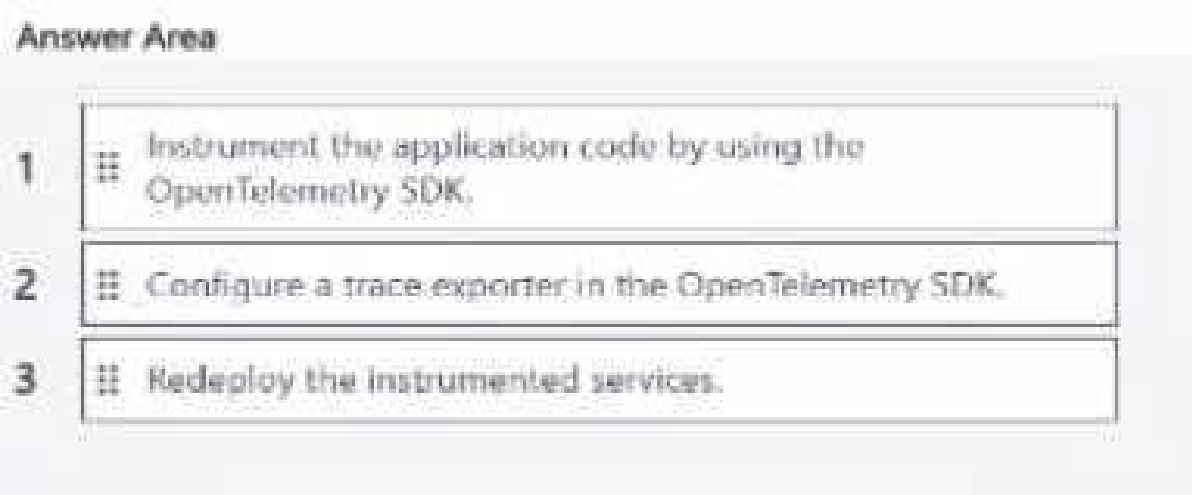
You need to implement trace correlation according to the business requirements.
Which three actions should you perform in sequence? To answer, move the appropriate actions from
the list of actions to the answer area and arrange them in the correct order.
NOTE: More than one order of answer choices is correct. You will receive credit for any of the correct
orders you select.
Quiz
Background
Proseware Inc. develops AI-powered knowledge management solutions for enterprise customers.
The company is modernizing its platform to support semantic search, intelligent document retrieval,
and real-time partner integrations.
The engineering team uses Python and Azure SDKs. The architecture is being redesigned to support
containerized microservices, vector search workloads, and serverless backend processing.
Planned Application Architecture
Microservices are containerized by using Docker.
Code for containerized microservices and Azure Function apps is developed locally but stored in a
GitHub repository.
Custom images for containerized microservices are stored in Azure Container Registry (ACR).
Base images are stored in Docker Hub. Custom images must be rebuilt automatically whenever
their base images are updated.
Azure Cosmos DB for NoSQL stores documents, metadata, and vector embeddings.
Azure Functions generate vector embeddings of Azure Cosmos DB for NoSQL-hosted documents
and send messages to Service Bus to trigger search index updates.
Azure Container Apps (ACA) apps host backend API services that provide semantic search across
Azure Cosmos DB for NoSQL documents. API services process Service Bus messages and update
search indexes.
Azure Kubernetes Service (AKS) processes batch vector embedding regeneration for existing Azure
Cosmos DB for NoSQL documents (whenever the embedding model is changed).
An extranet-facing containerized webhook allows business partners to submit documents to be
processed by internal AI workflows for semantic search and retrieval.
Monitoring:
Telemetry generated by Azure resources is sent to Azure Monitor.
A Log Analytics workspace is used to collect ACA apps logs, AKS container logs, and Azure Functions
apps logs.
Monitoring of Azure Functions is currently implemented hy using Azure Application Insights SDK
instrumentation.
Business Requirements
Embeddings for new or updated Azure Cosmos DB for NoSQL–hosted documents must be
automatically generated.
Backend API services must scale automatically during business hours.
Cold start delay of backend APIs must be minimized.
Secrets must be stored outside of container images.
Developers must be able to correlate telemetry across Azure Functions hosts and apps.
All tracing must be implemented by using OpenTelemetry SDK instrumentation.
Development efforts must be minimized.
Technical Requirements
Container images must be built automatically and validated before code updates are merged into
the main branch.
Image build automation must run inside the Azure Container Registry, eliminating dependency on
local developer machines and external build services.
Dependency of image builds on local developer machines must be eliminated.
Event-driven scaling in ACA must occur based on the number of pending messages in the Azure
Service Bus queue.
Azure Cosmos DB for NoSQL RU consumption must be minimized.
Vector similarity search must use embeddings stored in Azure Cosmos DB for NoSQL.
The partner-facing containerized webhook service must run on Azure App Service.
Secrets must NOT be stored in container images, source control, or application configuration
directly. They must be accessed securely at runtime.
All secrets must be stored centrally in Azure Key Vault and accessed at runtime through a managed
identity.
Azure App Service must supply secrets at runtime without relying on external services.
Resources and workloads must be deployed by using Bicep templates through an automated,
version-controlled pipeline. Local and command-line deployments must be eliminated to ensure
repeatable, auditable deployments.
Known issues
RU consumption spikes during vector similarity queries.
Which two actions should you perform? Each correct answer presents part of the solution. Choose
two.
NOTE: Each correct selection is worth one point.
Quiz
Background
Proseware Inc. develops AI-powered knowledge management solutions for enterprise customers.
The company is modernizing its platform to support semantic search, intelligent document retrieval,
and real-time partner integrations.
The engineering team uses Python and Azure SDKs. The architecture is being redesigned to support
containerized microservices, vector search workloads, and serverless backend processing.
Planned Application Architecture
Microservices are containerized by using Docker.
Code for containerized microservices and Azure Function apps is developed locally but stored in a
GitHub repository.
Custom images for containerized microservices are stored in Azure Container Registry (ACR).
Base images are stored in Docker Hub. Custom images must be rebuilt automatically whenever
their base images are updated.
Azure Cosmos DB for NoSQL stores documents, metadata, and vector embeddings.
Azure Functions generate vector embeddings of Azure Cosmos DB for NoSQL-hosted documents
and send messages to Service Bus to trigger search index updates.
Azure Container Apps (ACA) apps host backend API services that provide semantic search across
Azure Cosmos DB for NoSQL documents. API services process Service Bus messages and update
search indexes.
Azure Kubernetes Service (AKS) processes batch vector embedding regeneration for existing Azure
Cosmos DB for NoSQL documents (whenever the embedding model is changed).
An extranet-facing containerized webhook allows business partners to submit documents to be
processed by internal AI workflows for semantic search and retrieval.
Monitoring:
Telemetry generated by Azure resources is sent to Azure Monitor.
A Log Analytics workspace is used to collect ACA apps logs, AKS container logs, and Azure Functions
apps logs.
Monitoring of Azure Functions is currently implemented hy using Azure Application Insights SDK
instrumentation.
Business Requirements
Embeddings for new or updated Azure Cosmos DB for NoSQL–hosted documents must be
automatically generated.
Backend API services must scale automatically during business hours.
Cold start delay of backend APIs must be minimized.
Secrets must be stored outside of container images.
Developers must be able to correlate telemetry across Azure Functions hosts and apps.
All tracing must be implemented by using OpenTelemetry SDK instrumentation.
Development efforts must be minimized.
Technical Requirements
Container images must be built automatically and validated before code updates are merged into
the main branch.
Image build automation must run inside the Azure Container Registry, eliminating dependency on
local developer machines and external build services.
Dependency of image builds on local developer machines must be eliminated.
Event-driven scaling in ACA must occur based on the number of pending messages in the Azure
Service Bus queue.
Azure Cosmos DB for NoSQL RU consumption must be minimized.
Vector similarity search must use embeddings stored in Azure Cosmos DB for NoSQL.
The partner-facing containerized webhook service must run on Azure App Service.
Secrets must NOT be stored in container images, source control, or application configuration
directly. They must be accessed securely at runtime.
All secrets must be stored centrally in Azure Key Vault and accessed at runtime through a managed
identity.
Azure App Service must supply secrets at runtime without relying on external services.
Resources and workloads must be deployed by using Bicep templates through an automated,
version-controlled pipeline. Local and command-line deployments must be eliminated to ensure
repeatable, auditable deployments.
Known issues
RU consumption spikes during vector similarity queries.
requirements.
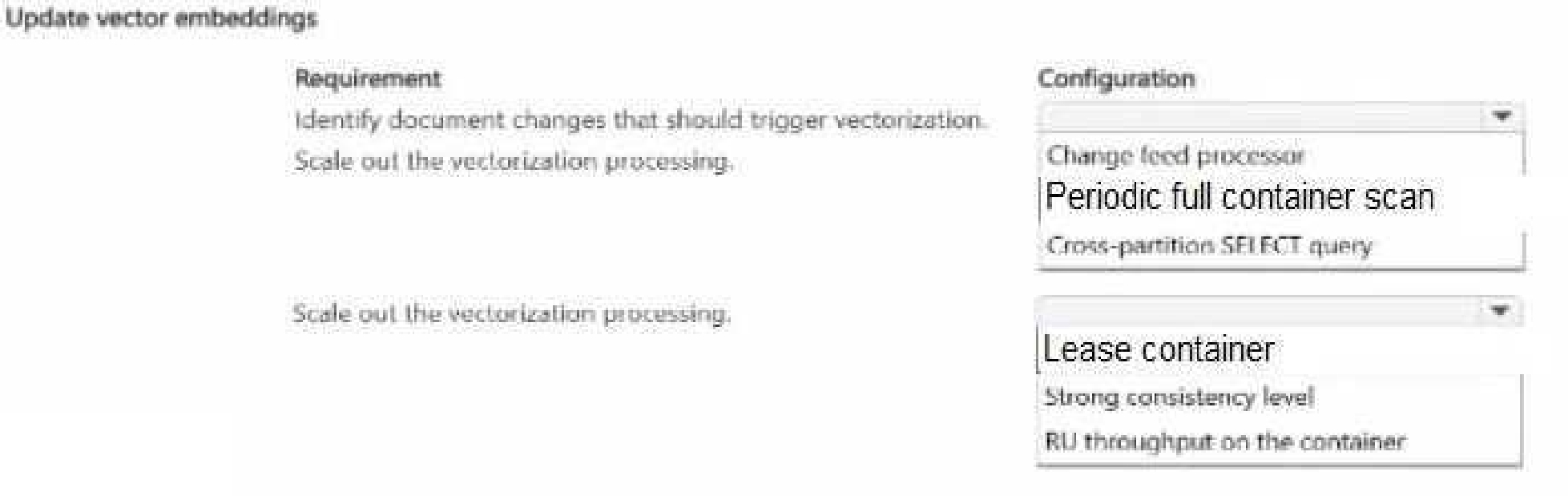
Which information should you use? To answer, select the appropriate option in the answer area.
NOTE: Each correct select is worth one point.

Quiz
Background
Proseware Inc. develops AI-powered knowledge management solutions for enterprise customers.
The company is modernizing its platform to support semantic search, intelligent document retrieval,
and real-time partner integrations.
The engineering team uses Python and Azure SDKs. The architecture is being redesigned to support
containerized microservices, vector search workloads, and serverless backend processing.
Planned Application Architecture
Microservices are containerized by using Docker.
Code for containerized microservices and Azure Function apps is developed locally but stored in a
GitHub repository.
Custom images for containerized microservices are stored in Azure Container Registry (ACR).
Base images are stored in Docker Hub. Custom images must be rebuilt automatically whenever
their base images are updated.
Azure Cosmos DB for NoSQL stores documents, metadata, and vector embeddings.
Azure Functions generate vector embeddings of Azure Cosmos DB for NoSQL-hosted documents
and send messages to Service Bus to trigger search index updates.
Azure Container Apps (ACA) apps host backend API services that provide semantic search across
Azure Cosmos DB for NoSQL documents. API services process Service Bus messages and update
search indexes.
Azure Kubernetes Service (AKS) processes batch vector embedding regeneration for existing Azure
Cosmos DB for NoSQL documents (whenever the embedding model is changed).
An extranet-facing containerized webhook allows business partners to submit documents to be
processed by internal AI workflows for semantic search and retrieval.
Monitoring:
Telemetry generated by Azure resources is sent to Azure Monitor.
A Log Analytics workspace is used to collect ACA apps logs, AKS container logs, and Azure Functions
apps logs.
Monitoring of Azure Functions is currently implemented hy using Azure Application Insights SDK
instrumentation.
Business Requirements
Embeddings for new or updated Azure Cosmos DB for NoSQL–hosted documents must be
automatically generated.
Backend API services must scale automatically during business hours.
Cold start delay of backend APIs must be minimized.
Secrets must be stored outside of container images.
Developers must be able to correlate telemetry across Azure Functions hosts and apps.
All tracing must be implemented by using OpenTelemetry SDK instrumentation.
Development efforts must be minimized.
Technical Requirements
Container images must be built automatically and validated before code updates are merged into
the main branch.
Image build automation must run inside the Azure Container Registry, eliminating dependency on
local developer machines and external build services.
Dependency of image builds on local developer machines must be eliminated.
Event-driven scaling in ACA must occur based on the number of pending messages in the Azure
Service Bus queue.
Azure Cosmos DB for NoSQL RU consumption must be minimized.
Vector similarity search must use embeddings stored in Azure Cosmos DB for NoSQL.
The partner-facing containerized webhook service must run on Azure App Service.
Secrets must NOT be stored in container images, source control, or application configuration
directly. They must be accessed securely at runtime.
All secrets must be stored centrally in Azure Key Vault and accessed at runtime through a managed
identity.
Azure App Service must supply secrets at runtime without relying on external services.
Resources and workloads must be deployed by using Bicep templates through an automated,
version-controlled pipeline. Local and command-line deployments must be eliminated to ensure
repeatable, auditable deployments.
Known issues
RU consumption spikes during vector similarity queries.
requirements.
What should you use?
Quiz
in Azure Cosmos DB.
You need to configure Always Encrypted to encrypt the sensitive data inside the application.
What should you do first?
Quiz
The solution must:
Validate incoming request data and return results immediately to the caller.
Support Microsoft Entra ID authentication.
Scale automatically under variable load.
You need to implement a trigger.
Which trigger should you implement?
Quiz
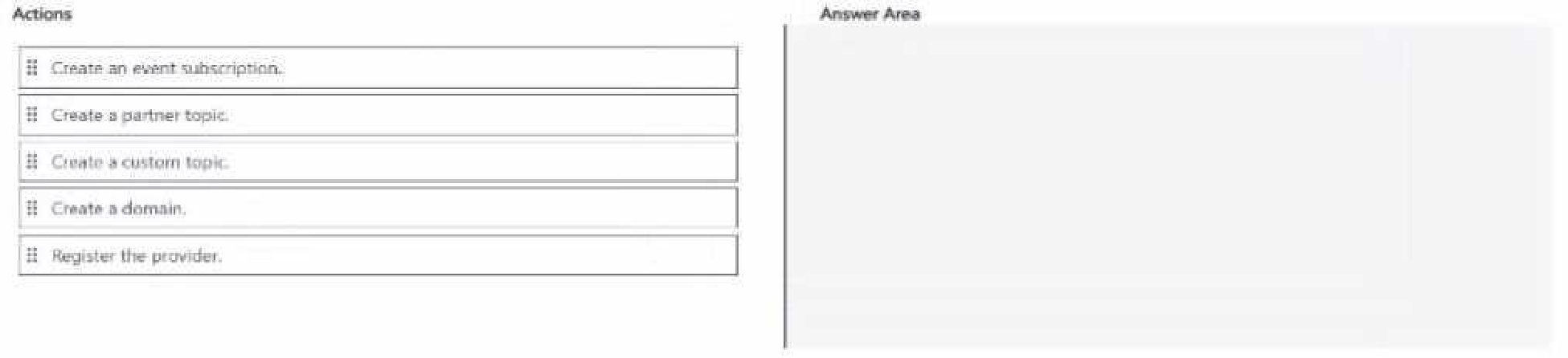
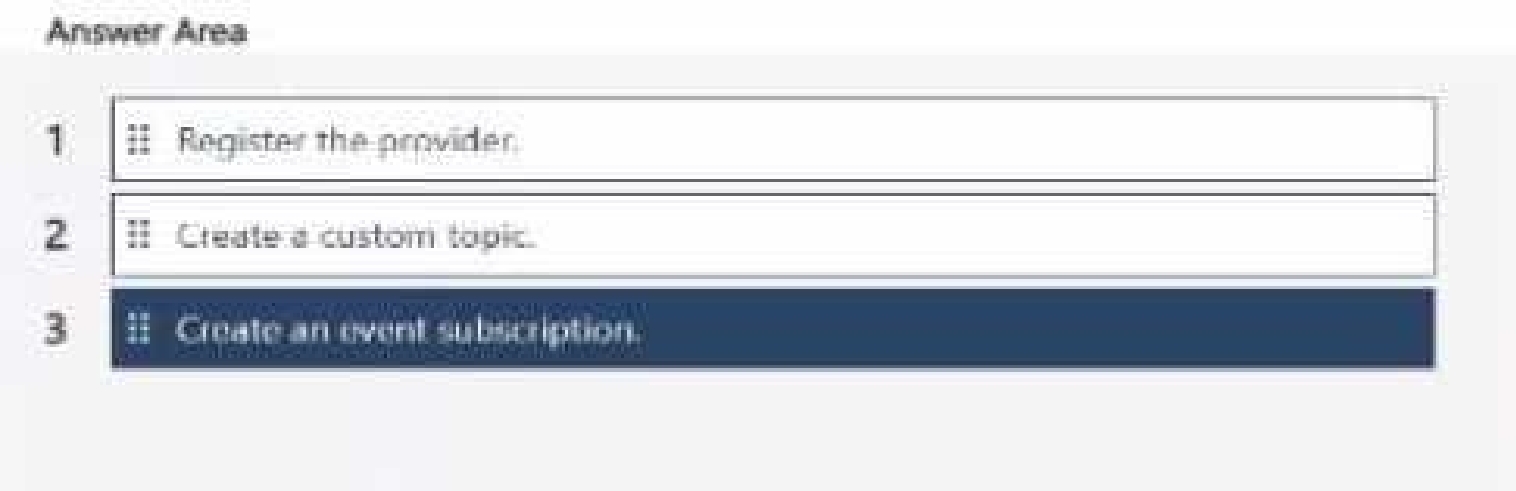
You have a newly provisioned Azure subscription. You are designing a custom Event Grid workflow
for AI inference events.
You need to implement the Event Grid components to support routing of high-confidence events to a
downstream processor.
Which three actions should you perform in sequence? To answer, move the appropriate actions from
the list of actions to the answer area and arrange them in the correct order.
Quiz
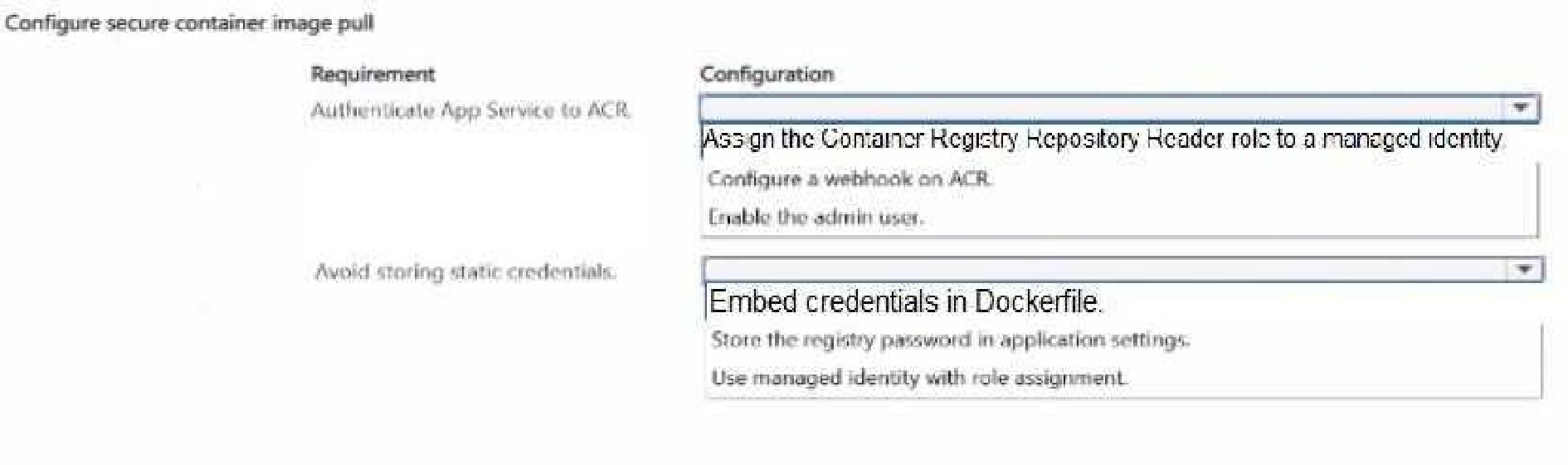
App Service must authenticate to ACR to pull the image.
The solution must NOT store static registry credentials.
You need to configure the secure image pull authentication.
Which configurations should you use? To answer, select the appropriate options in the answer area.
NOTE: Each correct selection is worth one point.

Quiz
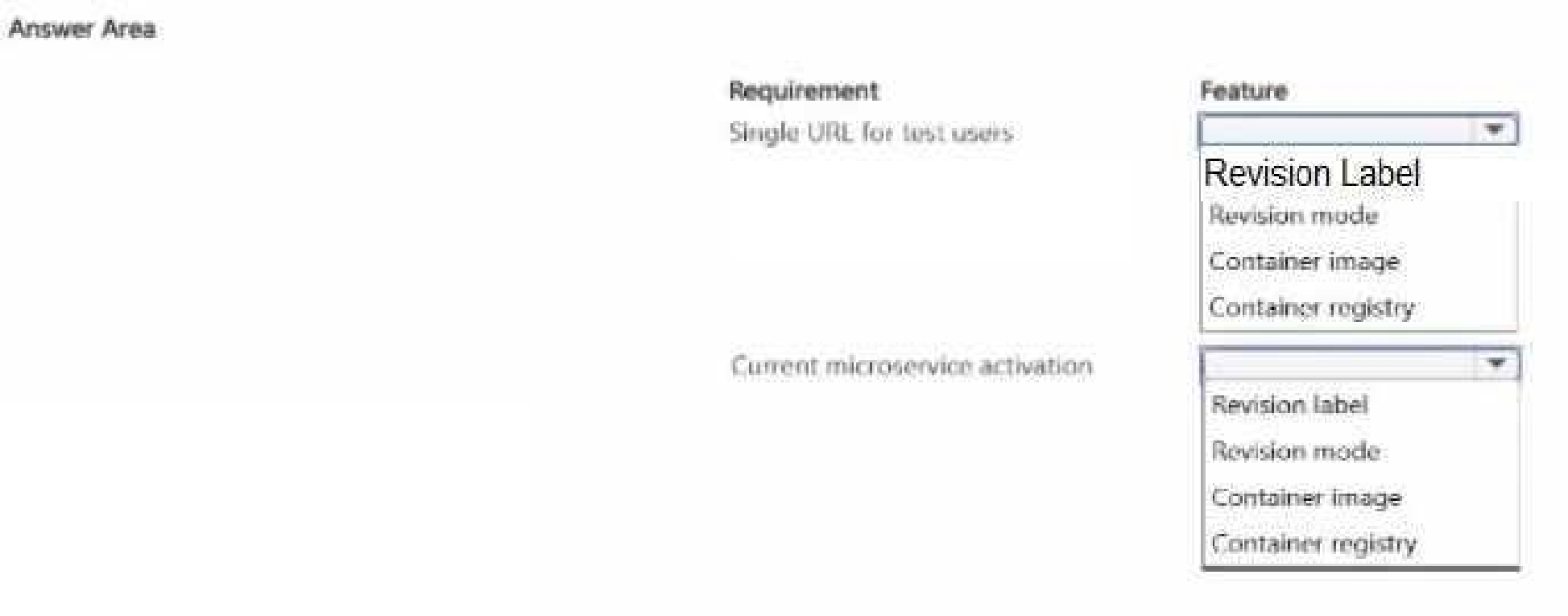
traffic has been enabled for the Microservices.
A deployed micro service must be updated to allow uses to test new features. You have the following
requirements:
* Enable and maintain a single URL for the updated microservice to provide to test users.
* Update the microservice that corresponds to the current microservice version.
You need to configure Azure Container Apps.
Which features should configure? To answer, select the appropriate options in the answer area.
NOTE: Each correct selection is worth one point.

AI-200: Microsoft Developing AI Cloud Solutions on Azure Practice test unlocks all online simulator questions
Thank you for choosing the free version of the AI-200: Microsoft Developing AI Cloud Solutions on Azure practice test! Further deepen your knowledge on Microsoft Simulator; by unlocking the full version of our AI-200: Microsoft Developing AI Cloud Solutions on Azure Simulator you will be able to take tests with over 50 constantly updated questions and easily pass your exam. 98% of people pass the exam in the first attempt after preparing with our 50 questions.
BUY NOWWhat to expect from our AI-200: Microsoft Developing AI Cloud Solutions on Azure practice tests and how to prepare for any exam?
The AI-200: Microsoft Developing AI Cloud Solutions on Azure Simulator Practice Tests are part of the Microsoft Database and are the best way to prepare for any AI-200: Microsoft Developing AI Cloud Solutions on Azure exam. The AI-200: Microsoft Developing AI Cloud Solutions on Azure practice tests consist of 50 questions and are written by experts to help you and prepare you to pass the exam on the first attempt. The AI-200: Microsoft Developing AI Cloud Solutions on Azure database includes questions from previous and other exams, which means you will be able to practice simulating past and future questions. Preparation with AI-200: Microsoft Developing AI Cloud Solutions on Azure Simulator will also give you an idea of the time it will take to complete each section of the AI-200: Microsoft Developing AI Cloud Solutions on Azure practice test . It is important to note that the AI-200: Microsoft Developing AI Cloud Solutions on Azure Simulator does not replace the classic AI-200: Microsoft Developing AI Cloud Solutions on Azure study guides; however, the Simulator provides valuable insights into what to expect and how much work needs to be done to prepare for the AI-200: Microsoft Developing AI Cloud Solutions on Azure exam.
BUY NOWAI-200: Microsoft Developing AI Cloud Solutions on Azure Practice test therefore represents an excellent tool to prepare for the actual exam together with our Microsoft practice test . Our AI-200: Microsoft Developing AI Cloud Solutions on Azure Simulator will help you assess your level of preparation and understand your strengths and weaknesses. Below you can read all the quizzes you will find in our AI-200: Microsoft Developing AI Cloud Solutions on Azure Simulator and how our unique AI-200: Microsoft Developing AI Cloud Solutions on Azure Database made up of real questions:
Info quiz:
- Quiz name:AI-200: Microsoft Developing AI Cloud Solutions on Azure
- Total number of questions:50
- Number of questions for the test:50
- Pass score:80%
You can prepare for the AI-200: Microsoft Developing AI Cloud Solutions on Azure exams with our mobile app. It is very easy to use and even works offline in case of network failure, with all the functions you need to study and practice with our AI-200: Microsoft Developing AI Cloud Solutions on Azure Simulator.
Use our Mobile App, available for both Android and iOS devices, with our AI-200: Microsoft Developing AI Cloud Solutions on Azure Simulator . You can use it anywhere and always remember that our mobile app is free and available on all stores.
Our Mobile App contains all AI-200: Microsoft Developing AI Cloud Solutions on Azure practice tests which consist of 50 questions and also provide study material to pass the final AI-200: Microsoft Developing AI Cloud Solutions on Azure exam with guaranteed success. Our AI-200: Microsoft Developing AI Cloud Solutions on Azure database contain hundreds of questions and Microsoft Tests related to AI-200: Microsoft Developing AI Cloud Solutions on Azure Exam. This way you can practice anywhere you want, even offline without the internet.
BUY NOW