Quiz DP-750: Microsoft Implementing Data Engineering Solutions Using Azure Databricks
Quiz
Overview
Contoso has a single Azure Databricks workspace named Workspace1 in the West US Azure region.
Workspace1 is enabled for Unity Catalog.
Workspace1 contains all-purpose clusters for both development and production workloads.
The company's Azure environment contains:
• In the West US, Central US, and East US Azure regions, Azure event hubs that stream telemetry
data and an Azure Data Lake Storage Gen2 account in each region for each hub
• A single Azure SQL database in the West US region that hosts enterprise resource planning (ERP)
data
• An Azure Database for PostgreSQL server in the West US region that stores operational
maintenance data
Company information
Contoso, Inc. is a renewable energy provider that operates solar and wind farms across North
America.
Data Environment
Contoso ingests the following operational and business data:
• Telemetry data: More than 40,000 loT sensors across 28 sites emit JSON telemetry events every
few seconds. Each site sends the events to the nearest event hub, which writes the data into the
corresponding Data Lake Storage Gen2 account. These files frequently experience schema drift.
• Maintenance logs: Maintenance systems generate historical repair logs, daily incremental updates,
technician notes, and unstructured attachments that are stored in the Data Lake Storage Gen2
accounts.
• Operational maintenance data: Structured operational maintenance data is stored on the Azure
Database for
PostgreSQL server.
• External weather data: Hourly weather forecasts are retrieved from a REST API and written to the
Data Lake Storage Gen2 accounts.
• ERP data: Daily CSV extracts of 50 to 100 GB contain equipment metadata, work orders, and
purchase order information.
Problem Statements
The company's existing analytics environment has several issues:
Ingestion
• Telemetry pipelines fall behind during peak loads.
• Telemetry ingestion fails when schema drift occurs.
• Streaming pipelines reprocess events after a pipeline restarts.
Compute
• Production and development workloads run on the same all-purpose clusters.
• Production and development workloads do NOT support autoscaling or workload isolation.
Governance
• The ERP data is duplicated across systems and development teams.
• Naming conventions are inconsistent across development teams, regions, and products.
• Ownership of the loT sensors changes over time, and analysts must track the full history of the
ownership.
• Occasionally, equipment manufacturers must correct data-entry mistakes in equipment names.
Historical values are NOT required.
Pipeline operations
• Pipelines lack resiliency, alerting, and centralized scheduling.
Planned Changes
Contoso plans to implement the following changes:
• Implement scalable data pipeline orchestration.
• Create a managed analytics catalog in Unity Catalog.
• Implement a consistent approach to creating curated datasets.
• Establish a centralized governance model across ingestion, cleansed, and curated layers.
• Grant data engineers access to the ERP tables by using minimal development effort.
• Adopt a compute strategy that isolates production workloads and supports autoscaling.
• Adopt a slowly changing dimension (SCD) approach to address current data modeling issues.
Technical Requirements
Contoso identifies the following environment and compute requirements:
• Ensure that production ingestion workloads run on compute clusters that can scale automatically
during telemetry spikes.
• Provide fast and consistent performance for business intelligence (Bl) workloads.
• Prevent development activity from affecting production pipelines.
• Production ingestion workloads must run as scheduled, non-interactive pipelines rather than on
shared interactive development clusters.
Contoso identifies the following data ingestion and processing requirements:
• Auto-scale ingestion pipelines to handle bursty workloads.
• Handle schema drift for the maintenance and telemetry data.
• Ingest file-based telemetry data by using minimal operational effort.
• Store all the ingested data in a format that supports incremental processing.
• Support the continuous ingestion of telemetry data from the event hubs by using exactly-once
semantics.
• Support the ingestion of the structured maintenance data from the Azure Database for PostgreSQL
server.
• Build a new telemetry pipeline that ingests raw events from the event hubs, cleanses the data, and
publishes curated tables to Unity Catalog.
• Ensure that the Apache Spark Structured Streaming pipelines reading from the event hubs write
the data into a managed Delta table named telemetry.raw_events. The pipelines must support
schema drift and resume processing after failures without reprocessing the data.
Contoso identifies the following data modeling and optimization requirements:
• Build curated tables that standardize business logic.
• Overwrite equipment metadata attributes, such as name, manufacturer, model, and
commissioning date, when the attributes change. Historical values are NOT required.
Contoso identifies the following pipeline deployment and operation requirements: |^ • Orchestrate
multi-step ingestion and transformation workflows.
• Define a clear execution order and dependencies.
• Automatically retry failed steps and notify operators.
• Schedule ingestion and transformation workloads consistently.
Governance Requirements
Contoso identifies the following governance requirements:
• Centralize the metadata catalog.
• Provide isolated development areas that follow standard naming conventions.
• Establish a consistent structure for organizing raw, cleansed, and curated data.
• Provide a read-only mechanism to reference the ERP data through a foreign catalog.
Business Requirements
Contoso identifies the following business requirements:
• Improve ingestion reliability and reduce operational effort.
• Standardize data definitions across development teams.
Each task must contain only the appropriate logic for its step in the pipeline. The solution must
support the planned changes and meet the data ingestion and processing requirements.
What should you do?
Quiz
Overview
Contoso has a single Azure Databricks workspace named Workspace1 in the West US Azure region.
Workspace1 is enabled for Unity Catalog.
Workspace1 contains all-purpose clusters for both development and production workloads.
The company's Azure environment contains:
• In the West US, Central US, and East US Azure regions, Azure event hubs that stream telemetry
data and an Azure Data Lake Storage Gen2 account in each region for each hub
• A single Azure SQL database in the West US region that hosts enterprise resource planning (ERP)
data
• An Azure Database for PostgreSQL server in the West US region that stores operational
maintenance data
Company information
Contoso, Inc. is a renewable energy provider that operates solar and wind farms across North
America.
Data Environment
Contoso ingests the following operational and business data:
• Telemetry data: More than 40,000 loT sensors across 28 sites emit JSON telemetry events every
few seconds. Each site sends the events to the nearest event hub, which writes the data into the
corresponding Data Lake Storage Gen2 account. These files frequently experience schema drift.
• Maintenance logs: Maintenance systems generate historical repair logs, daily incremental updates,
technician notes, and unstructured attachments that are stored in the Data Lake Storage Gen2
accounts.
• Operational maintenance data: Structured operational maintenance data is stored on the Azure
Database for
PostgreSQL server.
• External weather data: Hourly weather forecasts are retrieved from a REST API and written to the
Data Lake Storage Gen2 accounts.
• ERP data: Daily CSV extracts of 50 to 100 GB contain equipment metadata, work orders, and
purchase order information.
Problem Statements
The company's existing analytics environment has several issues:
Ingestion
• Telemetry pipelines fall behind during peak loads.
• Telemetry ingestion fails when schema drift occurs.
• Streaming pipelines reprocess events after a pipeline restarts.
Compute
• Production and development workloads run on the same all-purpose clusters.
• Production and development workloads do NOT support autoscaling or workload isolation.
Governance
• The ERP data is duplicated across systems and development teams.
• Naming conventions are inconsistent across development teams, regions, and products.
• Ownership of the loT sensors changes over time, and analysts must track the full history of the
ownership.
• Occasionally, equipment manufacturers must correct data-entry mistakes in equipment names.
Historical values are NOT required.
Pipeline operations
• Pipelines lack resiliency, alerting, and centralized scheduling.
Planned Changes
Contoso plans to implement the following changes:
• Implement scalable data pipeline orchestration.
• Create a managed analytics catalog in Unity Catalog.
• Implement a consistent approach to creating curated datasets.
• Establish a centralized governance model across ingestion, cleansed, and curated layers.
• Grant data engineers access to the ERP tables by using minimal development effort.
• Adopt a compute strategy that isolates production workloads and supports autoscaling.
• Adopt a slowly changing dimension (SCD) approach to address current data modeling issues.
Technical Requirements
Contoso identifies the following environment and compute requirements:
• Ensure that production ingestion workloads run on compute clusters that can scale automatically
during telemetry spikes.
• Provide fast and consistent performance for business intelligence (Bl) workloads.
• Prevent development activity from affecting production pipelines.
• Production ingestion workloads must run as scheduled, non-interactive pipelines rather than on
shared interactive development clusters.
Contoso identifies the following data ingestion and processing requirements:
• Auto-scale ingestion pipelines to handle bursty workloads.
• Handle schema drift for the maintenance and telemetry data.
• Ingest file-based telemetry data by using minimal operational effort.
• Store all the ingested data in a format that supports incremental processing.
• Support the continuous ingestion of telemetry data from the event hubs by using exactly-once
semantics.
• Support the ingestion of the structured maintenance data from the Azure Database for PostgreSQL
server.
• Build a new telemetry pipeline that ingests raw events from the event hubs, cleanses the data, and
publishes curated tables to Unity Catalog.
• Ensure that the Apache Spark Structured Streaming pipelines reading from the event hubs write
the data into a managed Delta table named telemetry.raw_events. The pipelines must support
schema drift and resume processing after failures without reprocessing the data.
Contoso identifies the following data modeling and optimization requirements:
• Build curated tables that standardize business logic.
• Overwrite equipment metadata attributes, such as name, manufacturer, model, and
commissioning date, when the attributes change. Historical values are NOT required.
Contoso identifies the following pipeline deployment and operation requirements: |^ • Orchestrate
multi-step ingestion and transformation workflows.
• Define a clear execution order and dependencies.
• Automatically retry failed steps and notify operators.
• Schedule ingestion and transformation workloads consistently.
Governance Requirements
Contoso identifies the following governance requirements:
• Centralize the metadata catalog.
• Provide isolated development areas that follow standard naming conventions.
• Establish a consistent structure for organizing raw, cleansed, and curated data.
• Provide a read-only mechanism to reference the ERP data through a foreign catalog.
Business Requirements
Contoso identifies the following business requirements:
• Improve ingestion reliability and reduce operational effort.
• Standardize data definitions across development teams.
ingestion and processing requirements.
What should you do?
Quiz
Overview
Contoso has a single Azure Databricks workspace named Workspace1 in the West US Azure region.
Workspace1 is enabled for Unity Catalog.
Workspace1 contains all-purpose clusters for both development and production workloads.
The company's Azure environment contains:
• In the West US, Central US, and East US Azure regions, Azure event hubs that stream telemetry
data and an Azure Data Lake Storage Gen2 account in each region for each hub
• A single Azure SQL database in the West US region that hosts enterprise resource planning (ERP)
data
• An Azure Database for PostgreSQL server in the West US region that stores operational
maintenance data
Company information
Contoso, Inc. is a renewable energy provider that operates solar and wind farms across North
America.
Data Environment
Contoso ingests the following operational and business data:
• Telemetry data: More than 40,000 loT sensors across 28 sites emit JSON telemetry events every
few seconds. Each site sends the events to the nearest event hub, which writes the data into the
corresponding Data Lake Storage Gen2 account. These files frequently experience schema drift.
• Maintenance logs: Maintenance systems generate historical repair logs, daily incremental updates,
technician notes, and unstructured attachments that are stored in the Data Lake Storage Gen2
accounts.
• Operational maintenance data: Structured operational maintenance data is stored on the Azure
Database for
PostgreSQL server.
• External weather data: Hourly weather forecasts are retrieved from a REST API and written to the
Data Lake Storage Gen2 accounts.
• ERP data: Daily CSV extracts of 50 to 100 GB contain equipment metadata, work orders, and
purchase order information.
Problem Statements
The company's existing analytics environment has several issues:
Ingestion
• Telemetry pipelines fall behind during peak loads.
• Telemetry ingestion fails when schema drift occurs.
• Streaming pipelines reprocess events after a pipeline restarts.
Compute
• Production and development workloads run on the same all-purpose clusters.
• Production and development workloads do NOT support autoscaling or workload isolation.
Governance
• The ERP data is duplicated across systems and development teams.
• Naming conventions are inconsistent across development teams, regions, and products.
• Ownership of the loT sensors changes over time, and analysts must track the full history of the
ownership.
• Occasionally, equipment manufacturers must correct data-entry mistakes in equipment names.
Historical values are NOT required.
Pipeline operations
• Pipelines lack resiliency, alerting, and centralized scheduling.
Planned Changes
Contoso plans to implement the following changes:
• Implement scalable data pipeline orchestration.
• Create a managed analytics catalog in Unity Catalog.
• Implement a consistent approach to creating curated datasets.
• Establish a centralized governance model across ingestion, cleansed, and curated layers.
• Grant data engineers access to the ERP tables by using minimal development effort.
• Adopt a compute strategy that isolates production workloads and supports autoscaling.
• Adopt a slowly changing dimension (SCD) approach to address current data modeling issues.
Technical Requirements
Contoso identifies the following environment and compute requirements:
• Ensure that production ingestion workloads run on compute clusters that can scale automatically
during telemetry spikes.
• Provide fast and consistent performance for business intelligence (Bl) workloads.
• Prevent development activity from affecting production pipelines.
• Production ingestion workloads must run as scheduled, non-interactive pipelines rather than on
shared interactive development clusters.
Contoso identifies the following data ingestion and processing requirements:
• Auto-scale ingestion pipelines to handle bursty workloads.
• Handle schema drift for the maintenance and telemetry data.
• Ingest file-based telemetry data by using minimal operational effort.
• Store all the ingested data in a format that supports incremental processing.
• Support the continuous ingestion of telemetry data from the event hubs by using exactly-once
semantics.
• Support the ingestion of the structured maintenance data from the Azure Database for PostgreSQL
server.
• Build a new telemetry pipeline that ingests raw events from the event hubs, cleanses the data, and
publishes curated tables to Unity Catalog.
• Ensure that the Apache Spark Structured Streaming pipelines reading from the event hubs write
the data into a managed Delta table named telemetry.raw_events. The pipelines must support
schema drift and resume processing after failures without reprocessing the data.
Contoso identifies the following data modeling and optimization requirements:
• Build curated tables that standardize business logic.
• Overwrite equipment metadata attributes, such as name, manufacturer, model, and
commissioning date, when the attributes change. Historical values are NOT required.
Contoso identifies the following pipeline deployment and operation requirements: |^ • Orchestrate
multi-step ingestion and transformation workflows.
• Define a clear execution order and dependencies.
• Automatically retry failed steps and notify operators.
• Schedule ingestion and transformation workloads consistently.
Governance Requirements
Contoso identifies the following governance requirements:
• Centralize the metadata catalog.
• Provide isolated development areas that follow standard naming conventions.
• Establish a consistent structure for organizing raw, cleansed, and curated data.
• Provide a read-only mechanism to reference the ERP data through a foreign catalog.
Business Requirements
Contoso identifies the following business requirements:
• Improve ingestion reliability and reduce operational effort.
• Standardize data definitions across development teams.
Which SCD type should you use to support the planned data modeling changes? To answer, drag the
appropriate types to the correct issues. Each type may be used once, more than once, or not at all.
You may need to drag the split bar between panes or scroll to view content.
NOTE: Each correct selection is worth one point.
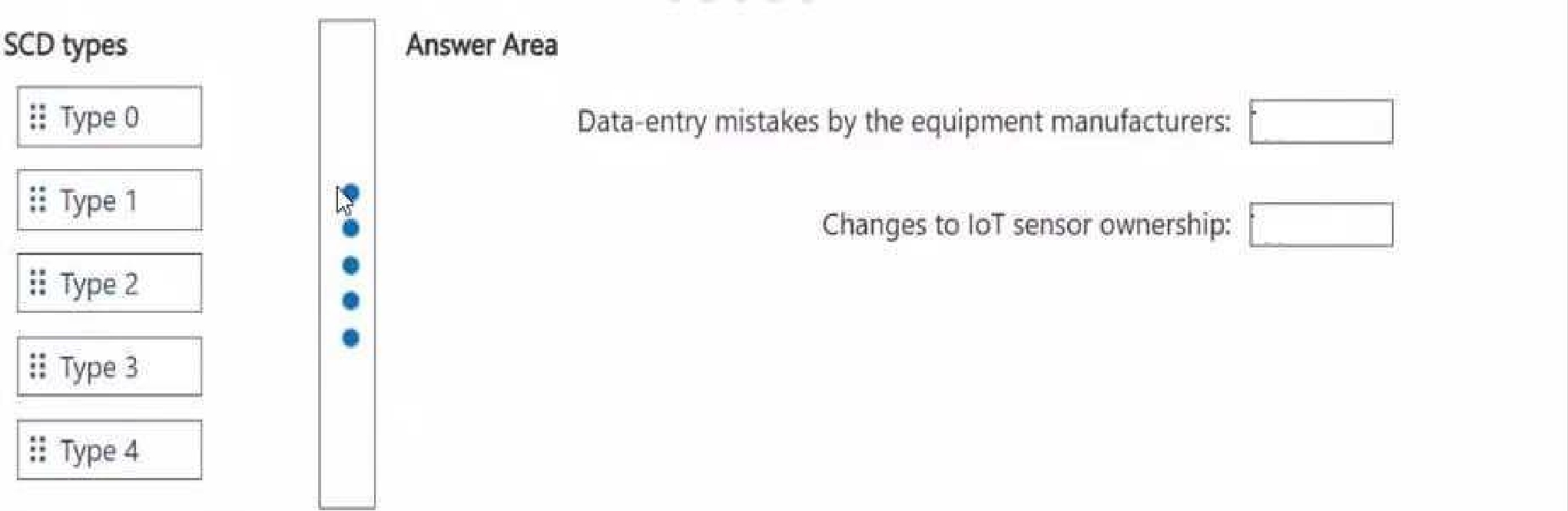
history.
SCD Type 1 overwrites the existing record whenever an attribute changes — no history is kept.
Contoso's requirement for equipment metadata (name, manufacturer, model, commissioning date)
states 'historical values are NOT required,' which is the textbook definition of Type 1. A MERGE INTO
with WHEN MATCHED THEN UPDATE handles this cleanly in Delta Lake.
SCD Type 2 creates a new row for each change, preserving the full history through effective-date or
version columns. Contoso requires that 'analysts must track the full history of ownership' as sensors
change hands over time — that full audit trail is only possible with Type 2. Type 3 (keeping just the
previous value in an extra column) would lose earlier ownership records, so it doesn't satisfy the 'full
history' requirement.
Reference: [https://learn.microsoft.com/en-us/azure/databricks/delta/merge](https://learn.microsoft.com/en-us/azure/databricks/delta/merge)
Quiz
Overview
Contoso has a single Azure Databricks workspace named Workspace1 in the West US Azure region.
Workspace1 is enabled for Unity Catalog.
Workspace1 contains all-purpose clusters for both development and production workloads.
The company's Azure environment contains:
• In the West US, Central US, and East US Azure regions, Azure event hubs that stream telemetry
data and an Azure Data Lake Storage Gen2 account in each region for each hub
• A single Azure SQL database in the West US region that hosts enterprise resource planning (ERP)
data
• An Azure Database for PostgreSQL server in the West US region that stores operational
maintenance data
Company information
Contoso, Inc. is a renewable energy provider that operates solar and wind farms across North
America.
Data Environment
Contoso ingests the following operational and business data:
• Telemetry data: More than 40,000 loT sensors across 28 sites emit JSON telemetry events every
few seconds. Each site sends the events to the nearest event hub, which writes the data into the
corresponding Data Lake Storage Gen2 account. These files frequently experience schema drift.
• Maintenance logs: Maintenance systems generate historical repair logs, daily incremental updates,
technician notes, and unstructured attachments that are stored in the Data Lake Storage Gen2
accounts.
• Operational maintenance data: Structured operational maintenance data is stored on the Azure
Database for
PostgreSQL server.
• External weather data: Hourly weather forecasts are retrieved from a REST API and written to the
Data Lake Storage Gen2 accounts.
• ERP data: Daily CSV extracts of 50 to 100 GB contain equipment metadata, work orders, and
purchase order information.
Problem Statements
The company's existing analytics environment has several issues:
Ingestion
• Telemetry pipelines fall behind during peak loads.
• Telemetry ingestion fails when schema drift occurs.
• Streaming pipelines reprocess events after a pipeline restarts.
Compute
• Production and development workloads run on the same all-purpose clusters.
• Production and development workloads do NOT support autoscaling or workload isolation.
Governance
• The ERP data is duplicated across systems and development teams.
• Naming conventions are inconsistent across development teams, regions, and products.
• Ownership of the loT sensors changes over time, and analysts must track the full history of the
ownership.
• Occasionally, equipment manufacturers must correct data-entry mistakes in equipment names.
Historical values are NOT required.
Pipeline operations
• Pipelines lack resiliency, alerting, and centralized scheduling.
Planned Changes
Contoso plans to implement the following changes:
• Implement scalable data pipeline orchestration.
• Create a managed analytics catalog in Unity Catalog.
• Implement a consistent approach to creating curated datasets.
• Establish a centralized governance model across ingestion, cleansed, and curated layers.
• Grant data engineers access to the ERP tables by using minimal development effort.
• Adopt a compute strategy that isolates production workloads and supports autoscaling.
• Adopt a slowly changing dimension (SCD) approach to address current data modeling issues.
Technical Requirements
Contoso identifies the following environment and compute requirements:
• Ensure that production ingestion workloads run on compute clusters that can scale automatically
during telemetry spikes.
• Provide fast and consistent performance for business intelligence (Bl) workloads.
• Prevent development activity from affecting production pipelines.
• Production ingestion workloads must run as scheduled, non-interactive pipelines rather than on
shared interactive development clusters.
Contoso identifies the following data ingestion and processing requirements:
• Auto-scale ingestion pipelines to handle bursty workloads.
• Handle schema drift for the maintenance and telemetry data.
• Ingest file-based telemetry data by using minimal operational effort.
• Store all the ingested data in a format that supports incremental processing.
• Support the continuous ingestion of telemetry data from the event hubs by using exactly-once
semantics.
• Support the ingestion of the structured maintenance data from the Azure Database for PostgreSQL
server.
• Build a new telemetry pipeline that ingests raw events from the event hubs, cleanses the data, and
publishes curated tables to Unity Catalog.
• Ensure that the Apache Spark Structured Streaming pipelines reading from the event hubs write
the data into a managed Delta table named telemetry.raw_events. The pipelines must support
schema drift and resume processing after failures without reprocessing the data.
Contoso identifies the following data modeling and optimization requirements:
• Build curated tables that standardize business logic.
• Overwrite equipment metadata attributes, such as name, manufacturer, model, and
commissioning date, when the attributes change. Historical values are NOT required.
Contoso identifies the following pipeline deployment and operation requirements: |^ • Orchestrate
multi-step ingestion and transformation workflows.
• Define a clear execution order and dependencies.
• Automatically retry failed steps and notify operators.
• Schedule ingestion and transformation workloads consistently.
Governance Requirements
Contoso identifies the following governance requirements:
• Centralize the metadata catalog.
• Provide isolated development areas that follow standard naming conventions.
• Establish a consistent structure for organizing raw, cleansed, and curated data.
• Provide a read-only mechanism to reference the ERP data through a foreign catalog.
Business Requirements
Contoso identifies the following business requirements:
• Improve ingestion reliability and reduce operational effort.
• Standardize data definitions across development teams.
Which ingestion option should you recommend for each data source? To answer, drag the
appropriate options to the correct data sources. Each option may be used once, more than once, or
not at all. You may need to drag the split bar between panes or scroll to view content.
NOTE: Each correct selection is worth one point.
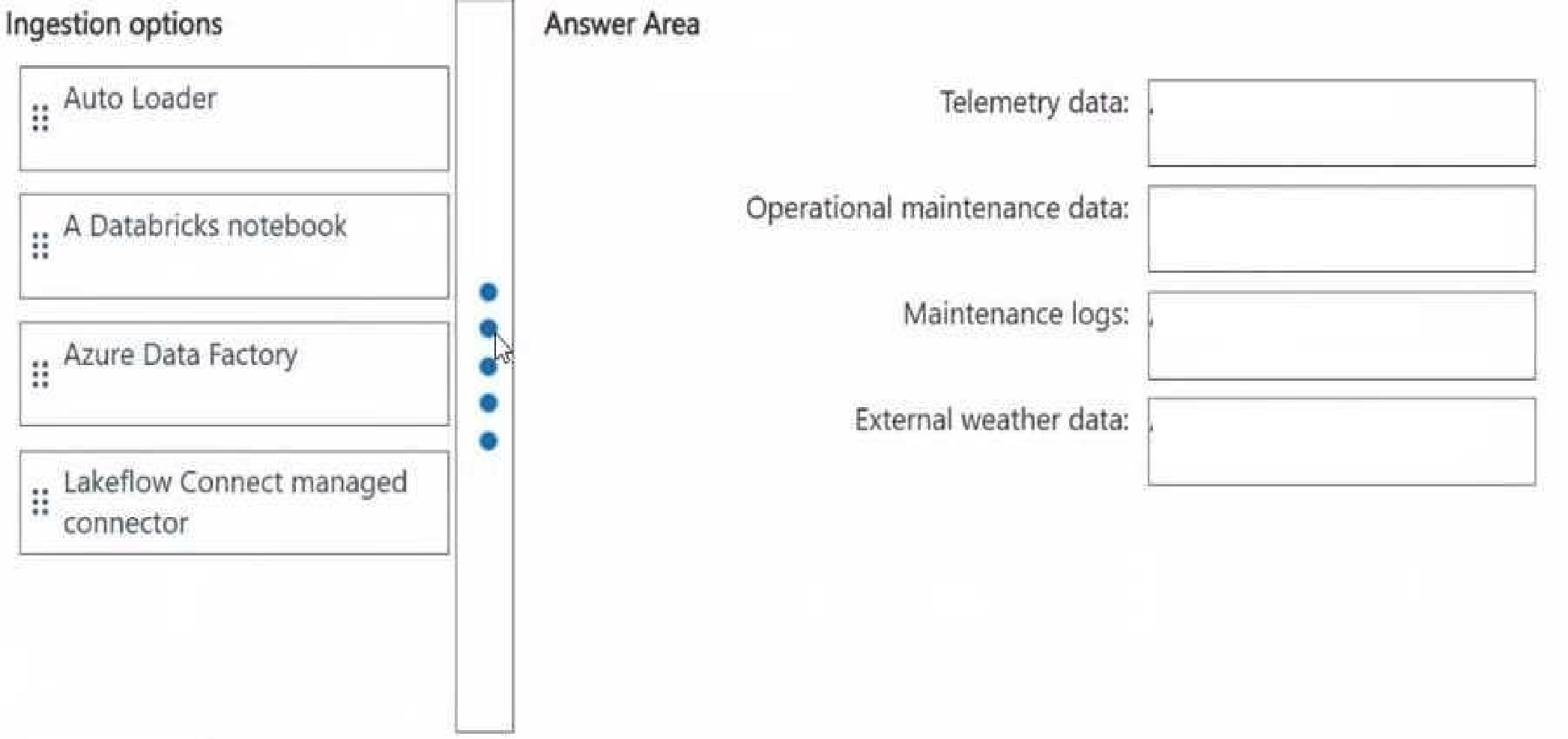
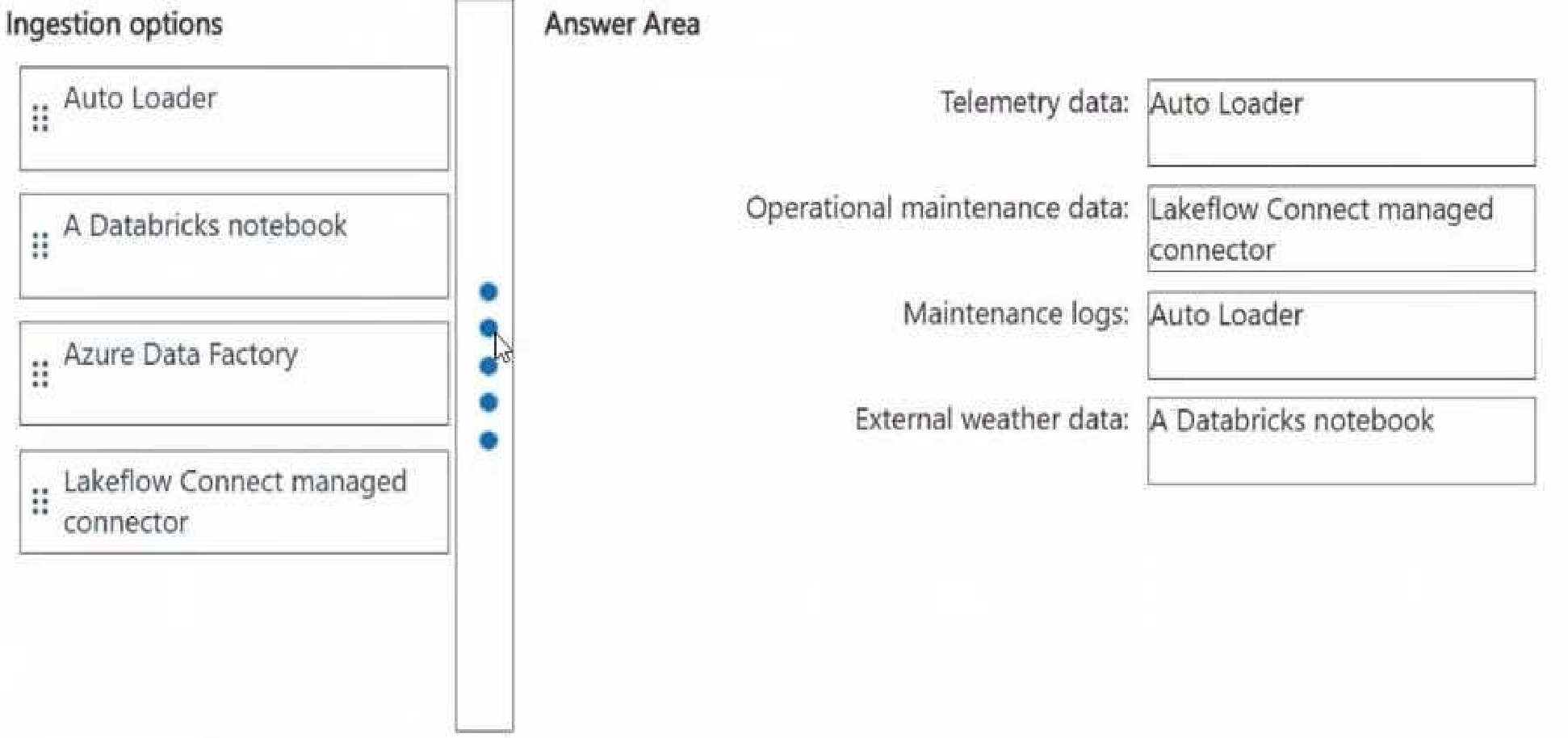
The right ingestion tool depends on the source characteristics:
File-based telemetry and maintenance data → Auto Loader (cloudFiles). It monitors ADLS Gen2 for
new arrivals, handles schema inference and evolution for the frequent schema drift, and requires
minimal operational effort.
Real-time telemetry from Event Hubs → Spark Structured Streaming with the azure-eventhubs-spark
connector. This provides exactly-once semantics and checkpoint-based recovery, satisfying 'resume
processing after failures without reprocessing.'
Structured maintenance data from PostgreSQL → JDBC connector. Databricks supports direct JDBC
reads from relational databases with pushdown predicates.
Daily CSV ERP extracts (50–100 GB) → COPY INTO or Auto Loader. Both support idempotent
incremental batch loading into Delta tables with minimal code.
Reference: [https://learn.microsoft.com/en-us/azure/databricks/ingestion/auto-loader/](https://learn.microsoft.com/en-us/azure/databricks/ingestion/auto-loader/)
Quiz
Overview
Contoso has a single Azure Databricks workspace named Workspace1 in the West US Azure region.
Workspace1 is enabled for Unity Catalog.
Workspace1 contains all-purpose clusters for both development and production workloads.
The company's Azure environment contains:
• In the West US, Central US, and East US Azure regions, Azure event hubs that stream telemetry
data and an Azure Data Lake Storage Gen2 account in each region for each hub
• A single Azure SQL database in the West US region that hosts enterprise resource planning (ERP)
data
• An Azure Database for PostgreSQL server in the West US region that stores operational
maintenance data
Company information
Contoso, Inc. is a renewable energy provider that operates solar and wind farms across North
America.
Data Environment
Contoso ingests the following operational and business data:
• Telemetry data: More than 40,000 loT sensors across 28 sites emit JSON telemetry events every
few seconds. Each site sends the events to the nearest event hub, which writes the data into the
corresponding Data Lake Storage Gen2 account. These files frequently experience schema drift.
• Maintenance logs: Maintenance systems generate historical repair logs, daily incremental updates,
technician notes, and unstructured attachments that are stored in the Data Lake Storage Gen2
accounts.
• Operational maintenance data: Structured operational maintenance data is stored on the Azure
Database for
PostgreSQL server.
• External weather data: Hourly weather forecasts are retrieved from a REST API and written to the
Data Lake Storage Gen2 accounts.
• ERP data: Daily CSV extracts of 50 to 100 GB contain equipment metadata, work orders, and
purchase order information.
Problem Statements
The company's existing analytics environment has several issues:
Ingestion
• Telemetry pipelines fall behind during peak loads.
• Telemetry ingestion fails when schema drift occurs.
• Streaming pipelines reprocess events after a pipeline restarts.
Compute
• Production and development workloads run on the same all-purpose clusters.
• Production and development workloads do NOT support autoscaling or workload isolation.
Governance
• The ERP data is duplicated across systems and development teams.
• Naming conventions are inconsistent across development teams, regions, and products.
• Ownership of the loT sensors changes over time, and analysts must track the full history of the
ownership.
• Occasionally, equipment manufacturers must correct data-entry mistakes in equipment names.
Historical values are NOT required.
Pipeline operations
• Pipelines lack resiliency, alerting, and centralized scheduling.
Planned Changes
Contoso plans to implement the following changes:
• Implement scalable data pipeline orchestration.
• Create a managed analytics catalog in Unity Catalog.
• Implement a consistent approach to creating curated datasets.
• Establish a centralized governance model across ingestion, cleansed, and curated layers.
• Grant data engineers access to the ERP tables by using minimal development effort.
• Adopt a compute strategy that isolates production workloads and supports autoscaling.
• Adopt a slowly changing dimension (SCD) approach to address current data modeling issues.
Technical Requirements
Contoso identifies the following environment and compute requirements:
• Ensure that production ingestion workloads run on compute clusters that can scale automatically
during telemetry spikes.
• Provide fast and consistent performance for business intelligence (Bl) workloads.
• Prevent development activity from affecting production pipelines.
• Production ingestion workloads must run as scheduled, non-interactive pipelines rather than on
shared interactive development clusters.
Contoso identifies the following data ingestion and processing requirements:
• Auto-scale ingestion pipelines to handle bursty workloads.
• Handle schema drift for the maintenance and telemetry data.
• Ingest file-based telemetry data by using minimal operational effort.
• Store all the ingested data in a format that supports incremental processing.
• Support the continuous ingestion of telemetry data from the event hubs by using exactly-once
semantics.
• Support the ingestion of the structured maintenance data from the Azure Database for PostgreSQL
server.
• Build a new telemetry pipeline that ingests raw events from the event hubs, cleanses the data, and
publishes curated tables to Unity Catalog.
• Ensure that the Apache Spark Structured Streaming pipelines reading from the event hubs write
the data into a managed Delta table named telemetry.raw_events. The pipelines must support
schema drift and resume processing after failures without reprocessing the data.
Contoso identifies the following data modeling and optimization requirements:
• Build curated tables that standardize business logic.
• Overwrite equipment metadata attributes, such as name, manufacturer, model, and
commissioning date, when the attributes change. Historical values are NOT required.
Contoso identifies the following pipeline deployment and operation requirements: |^ • Orchestrate
multi-step ingestion and transformation workflows.
• Define a clear execution order and dependencies.
• Automatically retry failed steps and notify operators.
• Schedule ingestion and transformation workloads consistently.
Governance Requirements
Contoso identifies the following governance requirements:
• Centralize the metadata catalog.
• Provide isolated development areas that follow standard naming conventions.
• Establish a consistent structure for organizing raw, cleansed, and curated data.
• Provide a read-only mechanism to reference the ERP data through a foreign catalog.
Business Requirements
Contoso identifies the following business requirements:
• Improve ingestion reliability and reduce operational effort.
• Standardize data definitions across development teams.
must meet the data ingestion and processing requirements.
How should you complete the code segment? To answer, select the appropriate options in the
answer area.
NOTE: Each correct selection is worth one point.
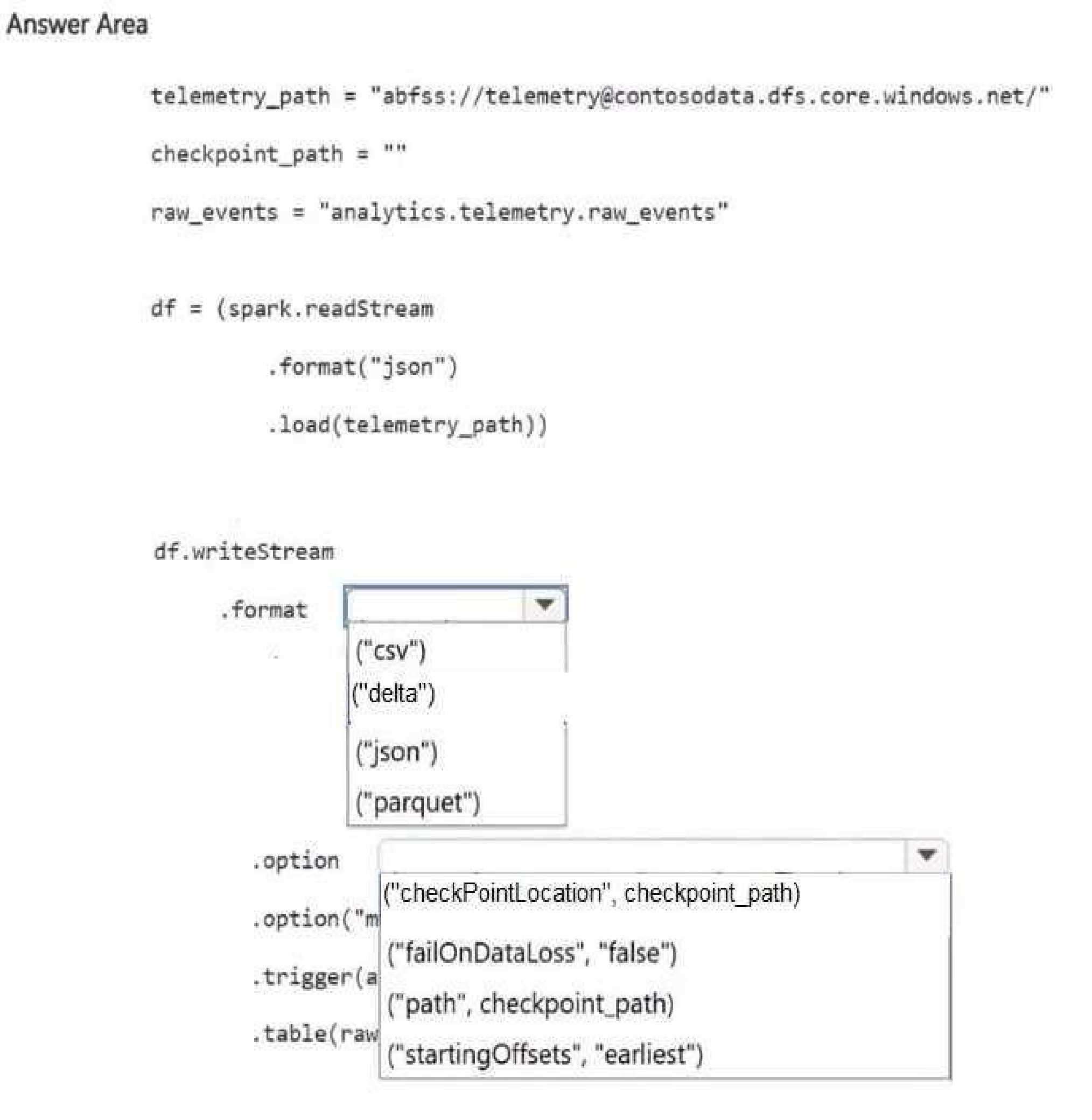
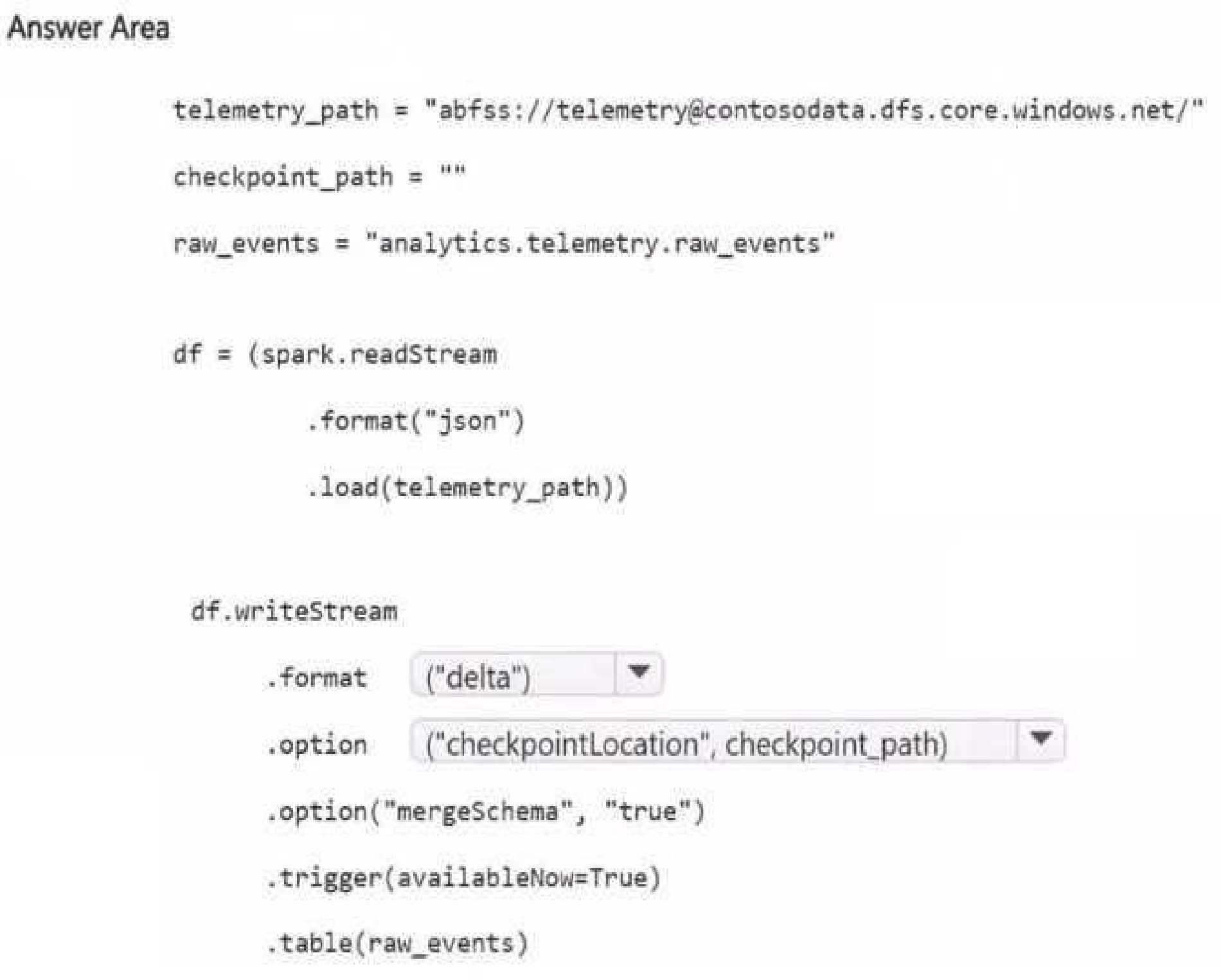
The solution requires spark.readStream with format('cloudFiles') for Auto Loader, paired with
.writeStream using mergeSchema=true and a checkpointLocation.
Auto Loader's cloudFiles source incrementally processes new JSON files without rescanning the
entire directory. The mergeSchema option handles schema drift — when sensors add new fields, the
target Delta table schema expands automatically instead of throwing a parse error. This directly
addresses Contoso's requirement to 'support schema drift.'
The checkpointLocation is what gives the pipeline its resilience. Databricks writes the stream's
committed offset and schema state to that path. If the cluster restarts, the engine reads the
checkpoint and picks up exactly where it left off — no events are reprocessed, satisfying 'exactly-
once semantics' and 'resume processing after failures without reprocessing the data.'
Without a checkpoint, the stream would restart from the beginning on every cluster bounce, which is
precisely the problem Contoso is trying to eliminate.
Reference: [https://learn.microsoft.com/en-us/azure/databricks/ingestion/auto-loader/schema](https://learn.microsoft.com/en-us/azure/databricks/ingestion/auto-loader/schema)
Quiz
Overview
Contoso has a single Azure Databricks workspace named Workspace1 in the West US Azure region.
Workspace1 is enabled for Unity Catalog.
Workspace1 contains all-purpose clusters for both development and production workloads.
The company's Azure environment contains:
• In the West US, Central US, and East US Azure regions, Azure event hubs that stream telemetry
data and an Azure Data Lake Storage Gen2 account in each region for each hub
• A single Azure SQL database in the West US region that hosts enterprise resource planning (ERP)
data
• An Azure Database for PostgreSQL server in the West US region that stores operational
maintenance data
Company information
Contoso, Inc. is a renewable energy provider that operates solar and wind farms across North
America.
Data Environment
Contoso ingests the following operational and business data:
• Telemetry data: More than 40,000 loT sensors across 28 sites emit JSON telemetry events every
few seconds. Each site sends the events to the nearest event hub, which writes the data into the
corresponding Data Lake Storage Gen2 account. These files frequently experience schema drift.
• Maintenance logs: Maintenance systems generate historical repair logs, daily incremental updates,
technician notes, and unstructured attachments that are stored in the Data Lake Storage Gen2
accounts.
• Operational maintenance data: Structured operational maintenance data is stored on the Azure
Database for
PostgreSQL server.
• External weather data: Hourly weather forecasts are retrieved from a REST API and written to the
Data Lake Storage Gen2 accounts.
• ERP data: Daily CSV extracts of 50 to 100 GB contain equipment metadata, work orders, and
purchase order information.
Problem Statements
The company's existing analytics environment has several issues:
Ingestion
• Telemetry pipelines fall behind during peak loads.
• Telemetry ingestion fails when schema drift occurs.
• Streaming pipelines reprocess events after a pipeline restarts.
Compute
• Production and development workloads run on the same all-purpose clusters.
• Production and development workloads do NOT support autoscaling or workload isolation.
Governance
• The ERP data is duplicated across systems and development teams.
• Naming conventions are inconsistent across development teams, regions, and products.
• Ownership of the loT sensors changes over time, and analysts must track the full history of the
ownership.
• Occasionally, equipment manufacturers must correct data-entry mistakes in equipment names.
Historical values are NOT required.
Pipeline operations
• Pipelines lack resiliency, alerting, and centralized scheduling.
Planned Changes
Contoso plans to implement the following changes:
• Implement scalable data pipeline orchestration.
• Create a managed analytics catalog in Unity Catalog.
• Implement a consistent approach to creating curated datasets.
• Establish a centralized governance model across ingestion, cleansed, and curated layers.
• Grant data engineers access to the ERP tables by using minimal development effort.
• Adopt a compute strategy that isolates production workloads and supports autoscaling.
• Adopt a slowly changing dimension (SCD) approach to address current data modeling issues.
Technical Requirements
Contoso identifies the following environment and compute requirements:
• Ensure that production ingestion workloads run on compute clusters that can scale automatically
during telemetry spikes.
• Provide fast and consistent performance for business intelligence (Bl) workloads.
• Prevent development activity from affecting production pipelines.
• Production ingestion workloads must run as scheduled, non-interactive pipelines rather than on
shared interactive development clusters.
Contoso identifies the following data ingestion and processing requirements:
• Auto-scale ingestion pipelines to handle bursty workloads.
• Handle schema drift for the maintenance and telemetry data.
• Ingest file-based telemetry data by using minimal operational effort.
• Store all the ingested data in a format that supports incremental processing.
• Support the continuous ingestion of telemetry data from the event hubs by using exactly-once
semantics.
• Support the ingestion of the structured maintenance data from the Azure Database for PostgreSQL
server.
• Build a new telemetry pipeline that ingests raw events from the event hubs, cleanses the data, and
publishes curated tables to Unity Catalog.
• Ensure that the Apache Spark Structured Streaming pipelines reading from the event hubs write
the data into a managed Delta table named telemetry.raw_events. The pipelines must support
schema drift and resume processing after failures without reprocessing the data.
Contoso identifies the following data modeling and optimization requirements:
• Build curated tables that standardize business logic.
• Overwrite equipment metadata attributes, such as name, manufacturer, model, and
commissioning date, when the attributes change. Historical values are NOT required.
Contoso identifies the following pipeline deployment and operation requirements: |^ • Orchestrate
multi-step ingestion and transformation workflows.
• Define a clear execution order and dependencies.
• Automatically retry failed steps and notify operators.
• Schedule ingestion and transformation workloads consistently.
Governance Requirements
Contoso identifies the following governance requirements:
• Centralize the metadata catalog.
• Provide isolated development areas that follow standard naming conventions.
• Establish a consistent structure for organizing raw, cleansed, and curated data.
• Provide a read-only mechanism to reference the ERP data through a foreign catalog.
Business Requirements
Contoso identifies the following business requirements:
• Improve ingestion reliability and reduce operational effort.
• Standardize data definitions across development teams.
The solution must meet the environment and compute requirements.
What should you recommend for each type of workload? To answer, select the appropriate options
in the answer area.
NOTE: Each correct selection is worth one point.
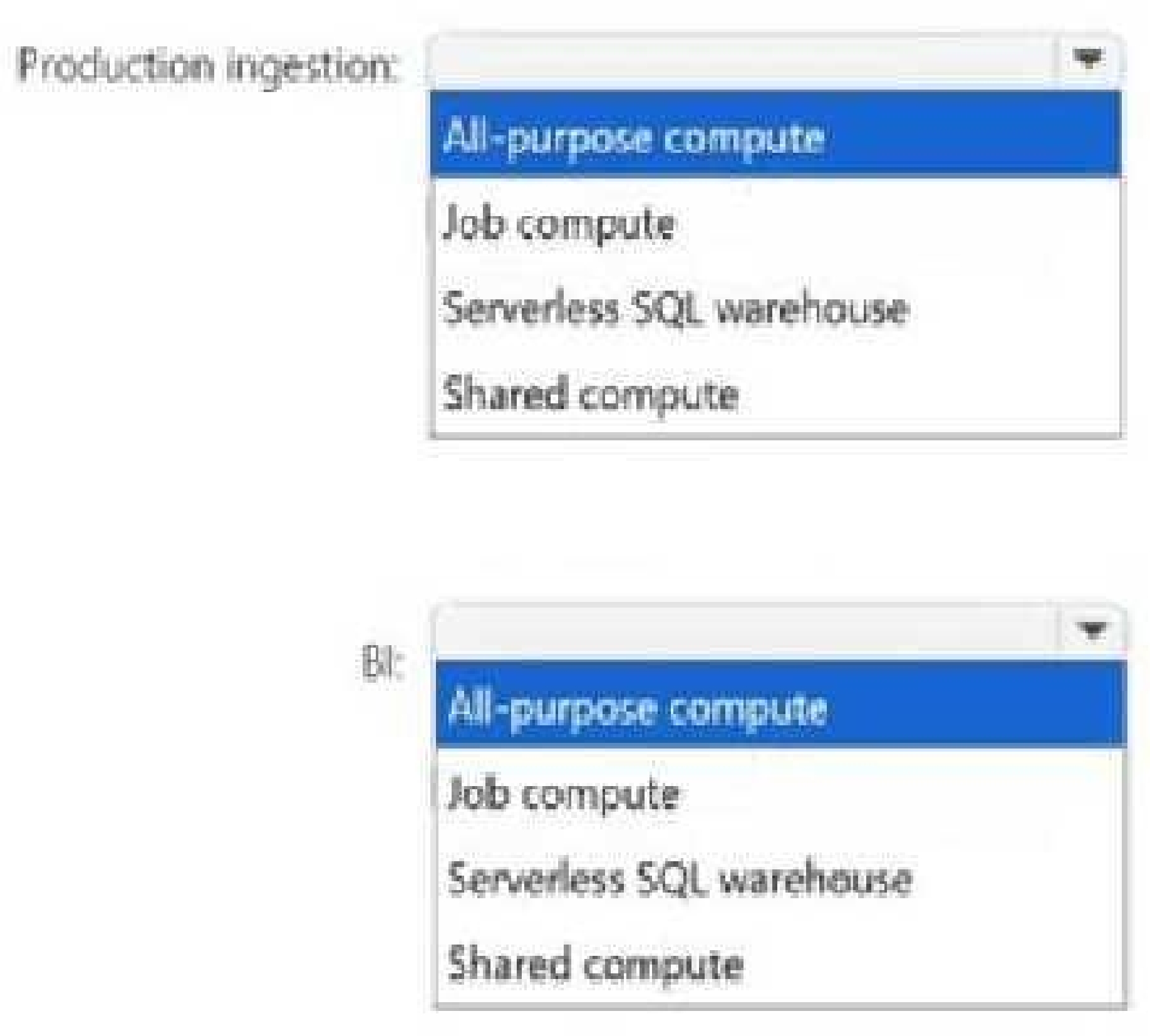
BI: Serverless SQL warehouse
Job compute is designed for automated production workloads executed through Lakeflow Jobs. Its
lifecycle can be tied to the job run, providing workload isolation and avoiding the cost of maintaining
an interactive all-purpose cluster continuously. It is therefore appropriate for scheduled ingestion
and transformation processing. A serverless SQL warehouse is designed for BI and Databricks SQL
workloads. It provides rapid startup, automatic infrastructure management, scaling, and optimized
SQL-query execution for dashboards and reporting tools. All-purpose compute is intended primarily
for interactive notebook development and exploration, while shared compute does not provide the
same job-specific isolation or SQL-serving experience. Consequently, job compute should support
production ingestion, and a serverless SQL warehouse should serve the BI workload.
Quiz
Cluser1 that will be used to ingest data.
You need to install the required libraries on Cluster 1. The solution must use Unity Catalog for access
control. What should you do?
Quiz
You have an Azure Databticks workspace that contains an all-purpose compute cluster named
Cluster1. Cluser1 is used for
interactive development.
You need to configure Cluster1 to meet the following requirements:
• Automatically add and remove worker nodes based on workload demand
• Automatically shut down when the cluster has been idle for a specific period.
What should you configure for each requirement? To answer, drag the appropriate options to the
correct requirements. Each option may be used once, more than once, or not at all. You may need to
drag the split bar between panes or scroll to view content
NOTE: Each correct selection is worth one point.
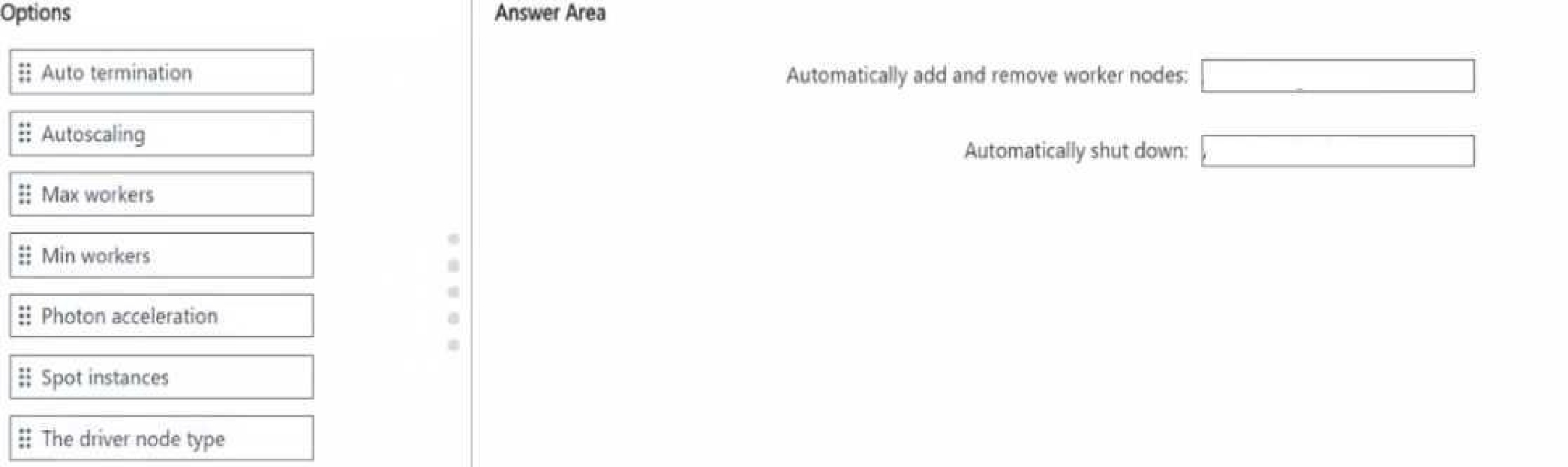
Autoscaling handles the first requirement — dynamically adding workers when the workload is
heavy and removing them when it lightens. You set a minimum and maximum node count, and
Databricks adjusts the cluster size between those bounds based on task queue depth.
Auto-termination handles the second — the cluster shuts itself down after a configurable idle period
(e.g., 30 minutes with no active queries), preventing wasted spend on a development cluster left
running overnight.
These two settings are independent and complementary: autoscaling manages horizontal elasticity
during active use, while auto-termination manages complete shutdown during inactivity. Both are
configured in the cluster creation UI under the Compute section.
Reference: [https://learn.microsoft.com/en-us/azure/databricks/compute/configure#autoscaling](https://learn.microsoft.com/en-us/azure/databricks/compute/configure#autoscaling)
Quiz
metastore1. Metastore1 contains a catalog named catalog 1.
You need to create a new schema named schema2 that meets the following requirements:
• Is contained in catalog1
• Uses abfss://containergstorageaccount.dfs.core.windows.net/data as the Managed location
Which SQL statement should you execute?
Quiz
You need to create an external volume named Volume1 in an existing schema. Volume1 must expose
files from an Azure Storage container. The solution must meet the following requirements:
• Ensure that authentication does NOT require storing credentials in Databricks
• Ensure that users can access the files, but NOT modify the files.
• Follow the principle of least privilege
Which type of authentication should you configure, and which permission should you grant to the
users? To answer, select the appropriate options in the answer area.
NOTE: Each correct selection is worth one point.
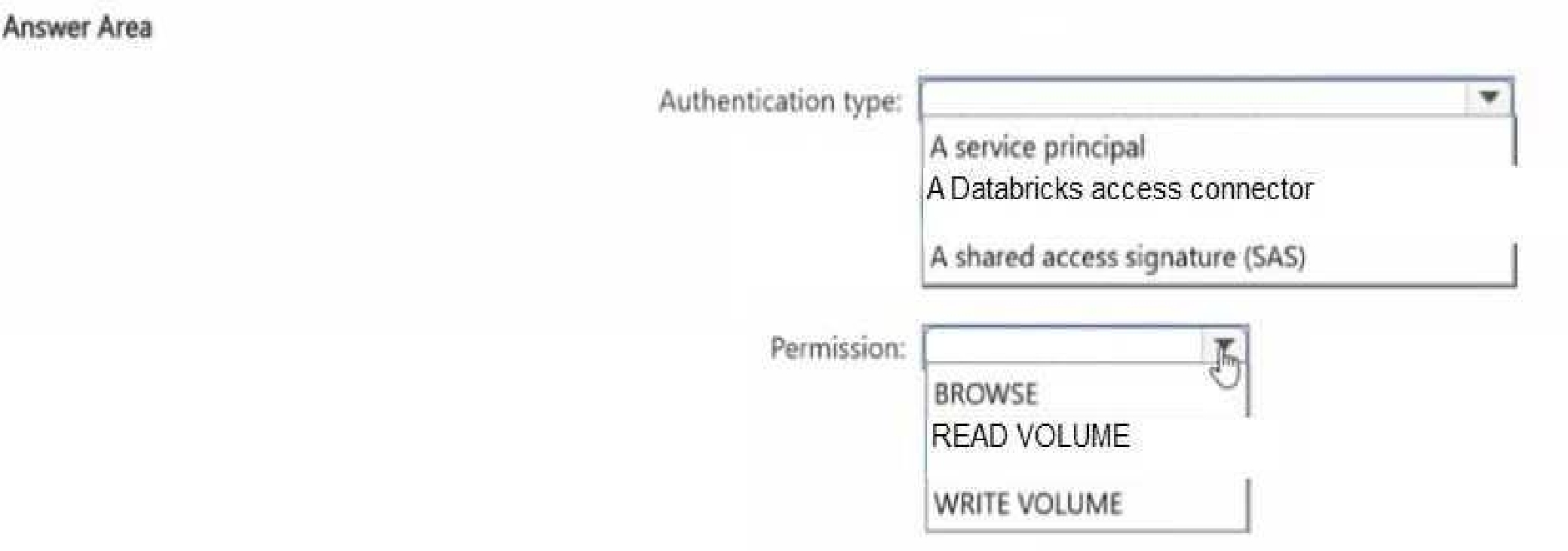
Access Connector wraps an Azure-managed identity so Databricks can authenticate to Azure Storage
without any credentials being stored in the workspace. The cloud security team controls the identity
through Azure RBAC — there are no secrets to rotate or leak inside Databricks.
For the permission, READ FILES on the volume is exactly right. It allows users to read and list files
through the volume path while blocking writes, deletes, and modifications. This is the minimum
necessary access, honouring the principle of least privilege.
WRITE FILES would allow modifications, contradicting 'users can access but NOT modify.' ALL
PRIVILEGES grants far more than needed. Service principals with stored client secrets would mean
credentials inside Databricks, violating the 'does not require storing credentials' requirement.
Reference: [https://learn.microsoft.com/en-us/azure/databricks/connect/unity-catalog/volumes](https://learn.microsoft.com/en-us/azure/databricks/connect/unity-catalog/volumes)
DP-750: Microsoft Implementing Data Engineering Solutions Using Azure Databricks Practice test unlocks all online simulator questions
Thank you for choosing the free version of the DP-750: Microsoft Implementing Data Engineering Solutions Using Azure Databricks practice test! Further deepen your knowledge on Microsoft Simulator; by unlocking the full version of our DP-750: Microsoft Implementing Data Engineering Solutions Using Azure Databricks Simulator you will be able to take tests with over 91 constantly updated questions and easily pass your exam. 98% of people pass the exam in the first attempt after preparing with our 91 questions.
BUY NOWWhat to expect from our DP-750: Microsoft Implementing Data Engineering Solutions Using Azure Databricks practice tests and how to prepare for any exam?
The DP-750: Microsoft Implementing Data Engineering Solutions Using Azure Databricks Simulator Practice Tests are part of the Microsoft Database and are the best way to prepare for any DP-750: Microsoft Implementing Data Engineering Solutions Using Azure Databricks exam. The DP-750: Microsoft Implementing Data Engineering Solutions Using Azure Databricks practice tests consist of 91 questions and are written by experts to help you and prepare you to pass the exam on the first attempt. The DP-750: Microsoft Implementing Data Engineering Solutions Using Azure Databricks database includes questions from previous and other exams, which means you will be able to practice simulating past and future questions. Preparation with DP-750: Microsoft Implementing Data Engineering Solutions Using Azure Databricks Simulator will also give you an idea of the time it will take to complete each section of the DP-750: Microsoft Implementing Data Engineering Solutions Using Azure Databricks practice test . It is important to note that the DP-750: Microsoft Implementing Data Engineering Solutions Using Azure Databricks Simulator does not replace the classic DP-750: Microsoft Implementing Data Engineering Solutions Using Azure Databricks study guides; however, the Simulator provides valuable insights into what to expect and how much work needs to be done to prepare for the DP-750: Microsoft Implementing Data Engineering Solutions Using Azure Databricks exam.
BUY NOWDP-750: Microsoft Implementing Data Engineering Solutions Using Azure Databricks Practice test therefore represents an excellent tool to prepare for the actual exam together with our Microsoft practice test . Our DP-750: Microsoft Implementing Data Engineering Solutions Using Azure Databricks Simulator will help you assess your level of preparation and understand your strengths and weaknesses. Below you can read all the quizzes you will find in our DP-750: Microsoft Implementing Data Engineering Solutions Using Azure Databricks Simulator and how our unique DP-750: Microsoft Implementing Data Engineering Solutions Using Azure Databricks Database made up of real questions:
Info quiz:
- Quiz name:DP-750: Microsoft Implementing Data Engineering Solutions Using Azure Databricks
- Total number of questions:91
- Number of questions for the test:50
- Pass score:80%
You can prepare for the DP-750: Microsoft Implementing Data Engineering Solutions Using Azure Databricks exams with our mobile app. It is very easy to use and even works offline in case of network failure, with all the functions you need to study and practice with our DP-750: Microsoft Implementing Data Engineering Solutions Using Azure Databricks Simulator.
Use our Mobile App, available for both Android and iOS devices, with our DP-750: Microsoft Implementing Data Engineering Solutions Using Azure Databricks Simulator . You can use it anywhere and always remember that our mobile app is free and available on all stores.
Our Mobile App contains all DP-750: Microsoft Implementing Data Engineering Solutions Using Azure Databricks practice tests which consist of 91 questions and also provide study material to pass the final DP-750: Microsoft Implementing Data Engineering Solutions Using Azure Databricks exam with guaranteed success. Our DP-750: Microsoft Implementing Data Engineering Solutions Using Azure Databricks database contain hundreds of questions and Microsoft Tests related to DP-750: Microsoft Implementing Data Engineering Solutions Using Azure Databricks Exam. This way you can practice anywhere you want, even offline without the internet.
BUY NOW