20:00

Free Test
/ 10

Quiz

1/10
Your organization is undergoing a digital transformation initiative and plans to migrate workloads to Azure.
The security architecture team needs to establish a Zero Trust security model across cloud and on-premises
environments. You are tasked with designing a solution that implements continuous verification of user
identities and device compliance before granting access to resources.
Which combination of Azure services and strategies should you prioritize to support a Zero Trust
architecture?
Select the answer
1 correct answer
A.
Azure AD with Conditional Access policies, Microsoft Defender for Cloud for continuous compliance monitoring, and device attestation via Intune
B.
Azure Key Vault for storing credentials, Azure Policy for resource tagging, and Azure ExpressRoute for encrypted network connectivity
C.
Azure Firewall with DDoS Protection, Azure Load Balancer for traffic distribution, and Azure Service Endpoints for private connectivity
D.
Azure Bastion for remote access, Azure Sentinel for log aggregation, and Azure Information Protection for data classification
E.
Azure Virtual Network peering, Azure VPN Gateway for site-to-site connectivity, and Network Security Groups for east-west traffic control

Quiz

2/10
A financial services company processes sensitive customer payment data and must comply with PCI DSS,
SOC 2, and regional data protection regulations. The security team is designing a data protection solution for
applications running on Azure that requires encryption of data in transit and at rest, access logging, and
ability to enforce customer-specific data residency requirements.
Which set of capabilities and services should be included in your design to meet these compliance
requirements?
Select the answer
1 correct answer
A.
Azure Storage encryption with customer-managed keys, Application Gateway with TLS termination, Azure Key Vault for key management, and Azure Policy for data residency enforcement
B.
Azure SQL Transparent Data Encryption (TDE), Azure VPN Gateway for site-to-site encryption, Shared Access Signatures for access control, and Azure Blob Storage geo-redundancy
C.
Azure Disk Encryption for virtual machines, Azure Service Bus for message encryption, Azure Cosmos DB with built-in encryption, and Azure Monitor for compliance tracking
D.
Azure Information Protection labels, Azure Advanced Threat Protection for threat detection, Azure Backup encryption, and Azure Site Recovery for disaster recovery
E.
Azure App Service Managed Identity, Azure Dedicated Host for compute isolation, Azure Private Endpoints for network security, and Azure Blueprints for resource deployment

Quiz

3/10
Your organization operates a hybrid cloud infrastructure with critical workloads on both on-premises servers
and Azure. A recent security assessment identified that the current network segmentation is insufficient and
lateral movement is not adequately monitored. You need to design an infrastructure security solution that
implements network microsegmentation, detects anomalous traffic patterns, and provides unified visibility
across all environments.
Which technologies and approaches should you implement to address these infrastructure security gaps?
Select the answer
1 correct answer
A.
Network Security Groups and Azure Firewall for perimeter defense, Azure Sentinel for centralized logging, and Application Security Groups for workload-based segmentation
B.
Azure Virtual Network with subnets, Azure DDoS Protection Standard, and VPN Gateway encryption for inter-environment connectivity
C.
Azure Firewall with application rules, Network Security Groups with service tags, Application Security Groups for microsegmentation, and Microsoft Defender for Cloud for continuous network monitoring and threat detection
D.
Azure ExpressRoute for dedicated connectivity, Network Watcher for packet capture, and Azure Load Balancer for traffic distribution
E.
Virtual WAN for hub-and-spoke topology, Azure Route Server for dynamic routing, and Private Link for private connectivity to Azure services

Quiz

4/10
An enterprise organization is designing security operations capabilities to detect and respond to cyber
threats in real-time. The security team operates across multiple time zones and needs a solution that
correlates security events from various sources (endpoints, networks, cloud services, and identity systems),
automates incident response workflows, and provides threat intelligence enrichment to reduce detection
time.
Which combination of capabilities and services should be included in your Security Operations Center (SOC)
design?
Select the answer
1 correct answer
A.
Azure Sentinel for SIEM/SOAR, Microsoft Defender for Endpoint for endpoint detection and response, Microsoft Defender for Cloud Apps for cloud security, and Microsoft Threat Intelligence integration for enrichment
B.
Azure Monitor for log aggregation, Application Insights for application performance monitoring, Log Analytics for data analysis, and Azure Advisor for security recommendations
C.
Azure Security Center for compliance assessment, Microsoft Defender for Identity for user behavior analytics, Azure Information Protection for data classification, and Azure Governance for policy management
D.
Microsoft Intune for device management, Azure AD for identity and access management, Windows Defender for antimalware, and Azure Backup for data protection
E.
Azure Policy for regulatory compliance, Azure Blueprints for infrastructure templates, Azure Resource Graph for asset inventory, and Azure Cost Management for security investment analysis

Quiz

5/10
Your organization is building a secure development and deployment pipeline for cloud-native applications.
The architecture must implement security controls throughout the application lifecycle, from code scanning
through deployment, and enforce least-privilege access to secrets and credentials. Developers require
automated deployment capabilities, but security policies must prevent unauthorized code changes and
enforce compliance scanning before production release.
Which set of technologies should you integrate into your application security design?
Select the answer
1 correct answer
A.
Azure DevOps with branch protection and build validation gates, Microsoft Defender for DevOps for code and dependency scanning, Azure Key Vault for secrets management with role-based access control, and policy enforcement through Azure Pipelines approvals
B.
GitHub Actions for CI/CD automation, Docker container scanning, Azure Container Registry with webhook triggers, and Docker Content Trust for image signing
C.
Azure App Service with deployment slots, Azure Application Gateway for web application firewall protection, Azure SQL Database with Transparent Data Encryption, and Azure Monitor for runtime logging
D.
Azure API Management for API security, Azure Front Door for DDoS protection, Azure Cosmos DB for secure data storage, and Application Insights for performance monitoring
E.
Azure Functions for serverless compute, Azure Logic Apps for workflow automation, Azure Service Bus for message encryption, and Azure Event Grid for event routing

Quiz

6/10
A healthcare organization must design an identity and access management solution that supports
compliance with HIPAA and other healthcare regulations. The solution must enforce strong authentication for
all users, enable risk-based adaptive access policies, integrate with legacy on-premises systems, and provide
comprehensive audit logging for access to sensitive patient data. The organization also requires self-service
password management to reduce helpdesk burden.
Which capabilities should you implement as part of your identity architecture design?
Select the answer
1 correct answer
A.
Azure AD (Entra ID) with passwordless sign-in, Conditional Access policies based on sign-in risk and location, Azure AD Connect for hybrid identity, Azure AD Privileged Identity Management (PIM) for administrative access, and unified audit logging in Azure Sentinel
B.
Azure AD B2C for external user management, Multi-Factor Authentication via SMS and email, Application Proxy for legacy application access, and Azure AD Self-Service Password Reset (SSPR) for user management
C.
Windows Server Active Directory with multi-factor authentication, Group Policy Objects for access control, Azure Key Vault for credential storage, and Windows Event Logs for audit trails
D.
Azure AD roles and assignments, Azure DevOps for identity provisioning, Azure Access Reviews for quarterly audits, and Azure Policy for identity governance
E.
Microsoft Identity Manager (MIM) for identity synchronization, Smart Card authentication, on-premises Active Directory Federation Services (AD FS), and manual audit log reviews for compliance

Quiz

7/10
You need to recommend a solution to meet the security requirements for the InfraSec group.
What should you use to delegate the access?
Select the answer
1 correct answer
A.
a subscription
B.
a custom role-based access control (RBAC) role
C.
a resource group
D.
a management group

Quiz

8/10
You need to recommend a solution to scan the application code. The solution must meet the application
development requirements. What should you include in the recommendation?
Select the answer
1 correct answer
A.
Azure Key Vault
B.
GitHub Advanced Security
C.
Application Insights in Azure Monitor
D.
Azure DevTest Labs

Quiz

9/10
You need to recommend a solution to resolve the virtual machine issue. What should you include in the
recommendation? (Choose Two)
Select the answer
2 correct answers
A.
Onboard the virtual machines to Microsoft Defender for Endpoint.
B.
Onboard the virtual machines to Azure Arc.
C.
Create a device compliance policy in Microsoft Endpoint Manager.
D.
Enable the Qualys scanner in Defender for Cloud.

Quiz

10/10
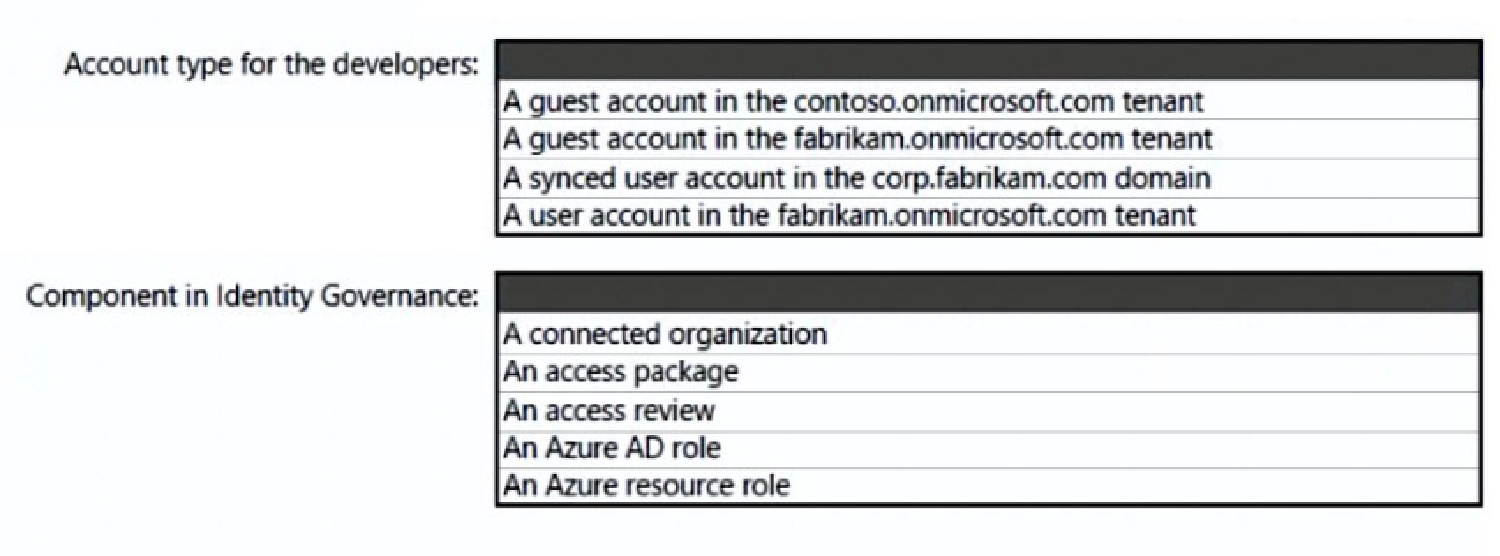
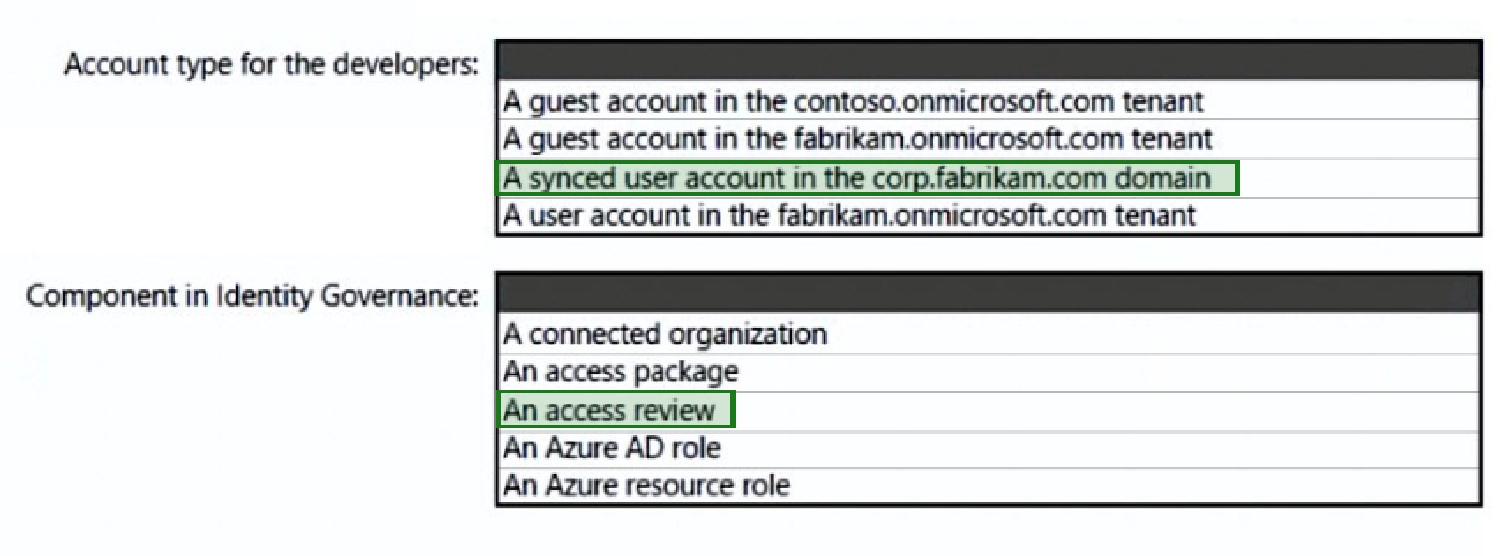
What should you create in Azure AD to meet the Contoso developer requirements?


QUESTION IMAGE:

Certification Exam SC-100: Microsoft Cybersecurity Architect Microsoft Microsoft-SC-100 1-1438439540

ANSWER: CORRECT AREA HIGHLIGHTED
Certification Exam SC-100: Microsoft Cybersecurity Architect Microsoft Microsoft-SC-100 2-1173240563
Select the answer
1 correct answer
Answer A: Create an app registration in Azure AD (now Microsoft Entra ID).

An app registration represents the application’s identity in the directory. It gives the application a client ID and lets developers configure how it authenticates, such as setting redirect URIs and adding a client secret or certificate. Developers can also use the registration to request the API permissions the application needs.

A service principal is the application’s tenant-specific identity, used when the application is granted access in a tenant. For setting up an application for development, the app registration is the appropriate starting point.
Looking for more questions?Buy now

SC-100: Microsoft Cybersecurity Architect Practice test unlocks all online simulator questions

Thank you for choosing the free version of the SC-100: Microsoft Cybersecurity Architect practice test! Further deepen your knowledge on Microsoft Simulator; by unlocking the full version of our SC-100: Microsoft Cybersecurity Architect Simulator you will be able to take tests with over 246 constantly updated questions and easily pass your exam. 98% of people pass the exam in the first attempt after preparing with our 246 questions.

BUY NOW

What to expect from our SC-100: Microsoft Cybersecurity Architect practice tests and how to prepare for any exam?

The SC-100: Microsoft Cybersecurity Architect Simulator Practice Tests are part of the Microsoft Database and are the best way to prepare for any SC-100: Microsoft Cybersecurity Architect exam. The SC-100: Microsoft Cybersecurity Architect practice tests consist of 246 questions and are written by experts to help you and prepare you to pass the exam on the first attempt. The SC-100: Microsoft Cybersecurity Architect database includes questions from previous and other exams, which means you will be able to practice simulating past and future questions. Preparation with SC-100: Microsoft Cybersecurity Architect Simulator will also give you an idea of the time it will take to complete each section of the SC-100: Microsoft Cybersecurity Architect practice test . It is important to note that the SC-100: Microsoft Cybersecurity Architect Simulator does not replace the classic SC-100: Microsoft Cybersecurity Architect study guides; however, the Simulator provides valuable insights into what to expect and how much work needs to be done to prepare for the SC-100: Microsoft Cybersecurity Architect exam.

BUY NOW

SC-100: Microsoft Cybersecurity Architect Practice test therefore represents an excellent tool to prepare for the actual exam together with our Microsoft practice test . Our SC-100: Microsoft Cybersecurity Architect Simulator will help you assess your level of preparation and understand your strengths and weaknesses. Below you can read all the quizzes you will find in our SC-100: Microsoft Cybersecurity Architect Simulator and how our unique SC-100: Microsoft Cybersecurity Architect Database made up of real questions:

Info quiz:

  • Quiz name:SC-100: Microsoft Cybersecurity Architect
  • Total number of questions:246
  • Number of questions for the test:50
  • Pass score:80%

You can prepare for the SC-100: Microsoft Cybersecurity Architect exams with our mobile app. It is very easy to use and even works offline in case of network failure, with all the functions you need to study and practice with our SC-100: Microsoft Cybersecurity Architect Simulator.

Use our Mobile App, available for both Android and iOS devices, with our SC-100: Microsoft Cybersecurity Architect Simulator . You can use it anywhere and always remember that our mobile app is free and available on all stores.

Our Mobile App contains all SC-100: Microsoft Cybersecurity Architect practice tests which consist of 246 questions and also provide study material to pass the final SC-100: Microsoft Cybersecurity Architect exam with guaranteed success. Our SC-100: Microsoft Cybersecurity Architect database contain hundreds of questions and Microsoft Tests related to SC-100: Microsoft Cybersecurity Architect Exam. This way you can practice anywhere you want, even offline without the internet.

BUY NOW