Quiz SC-900: Microsoft Security Compliance and Identity Fundamentals
Quiz
associated to data protection and regulatory standards?
Quiz
NOTE: Each correct selection is worth one point.
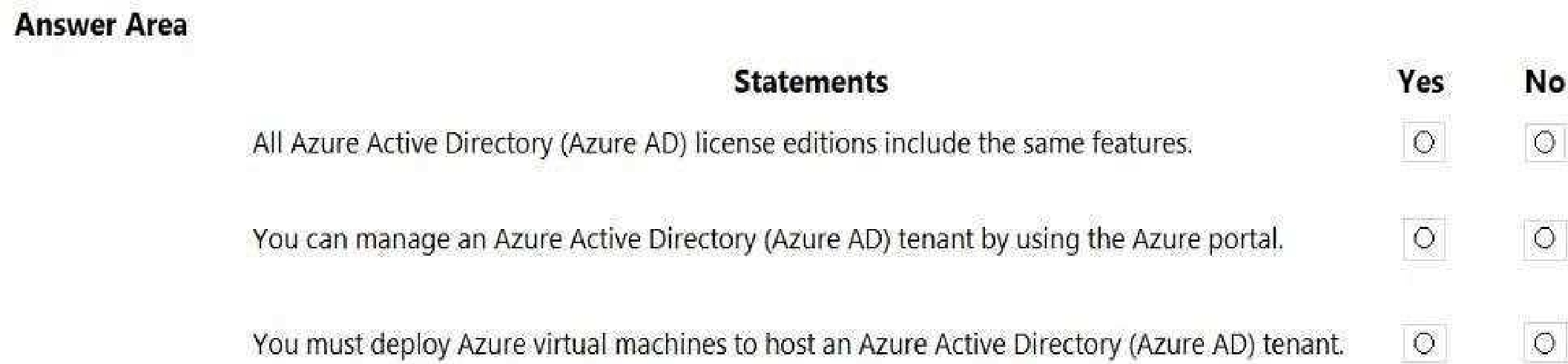
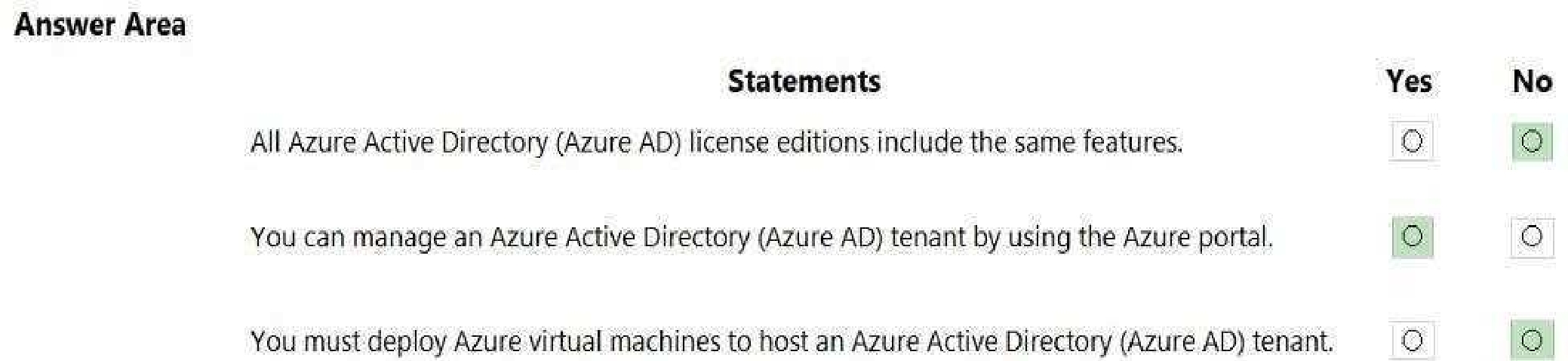
Microsoft Learn explains that Azure Active Directory (now Microsoft Entra ID) is a Microsoft-managed
identity and access management service delivered from the cloud. It does not require you to
provision or host infrastructure such as virtual machines; the directory is operated as a service by
Microsoft, and tenants are created and administered within Microsoft’s cloud environment. The
official learning paths further clarify that administration is performed through the Azure portal (the
Entra/Microsoft Entra admin center and Azure portal blades), PowerShell, and Graph—so managing
a tenant in the Azure portal is fully supported.
Regarding licensing, Microsoft’s SCI study materials detail that Azure AD/Entra ID is offered in
multiple editions (Free, Microsoft 365 apps edition, Premium P1, and Premium P2). Each edition
unlocks different capabilities: for example, features like Conditional Access are in Premium tiers;
Identity Protection and Privileged Identity Management (PIM) are P2 capabilities. Because
capabilities vary by tier, the statement that all license editions include the same features is incorrect.
Putting this together: feature parity across editions is not the case (No); tenant management in the
Azure portal is supported (Yes); and you do not need to deploy Azure VMs to host an Azure AD/Entra
ID tenant (No).
Quiz
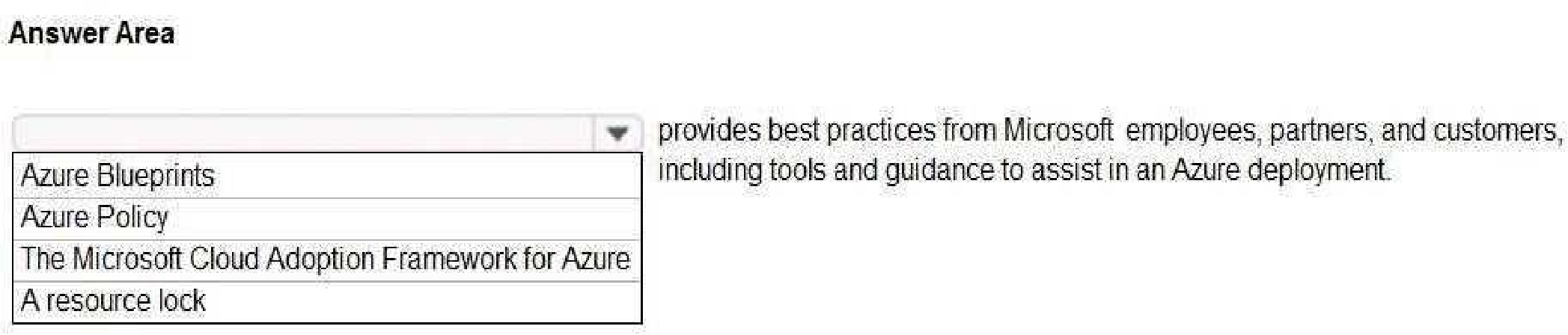
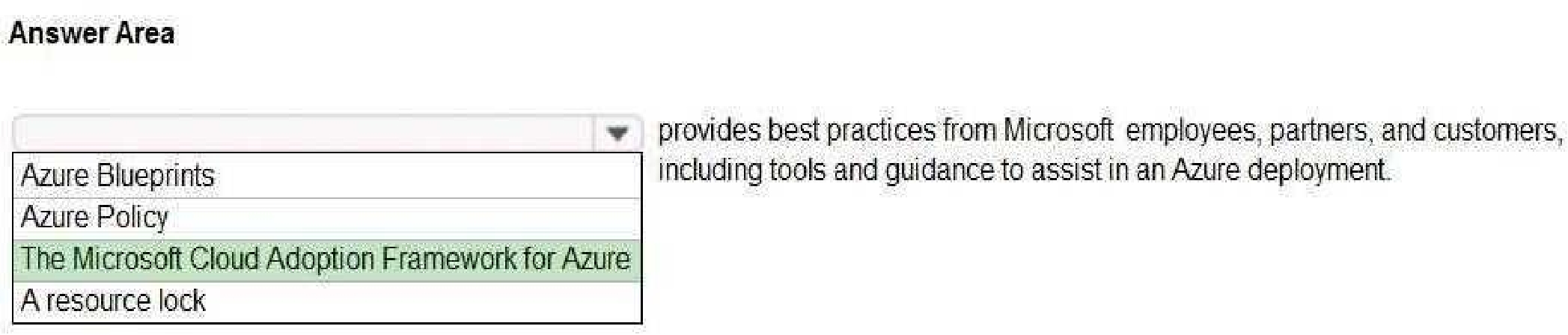
In Microsoft’s official guidance, the Microsoft Cloud Adoption Framework for Azure (CAF) is
described as the end-to-end approach that “provides best practices, documentation, and tools” to
help organizations create and implement business and technology strategies for cloud adoption. The
framework aggregates field experience from “Microsoft employees, partners, and customers” and
offers prescriptive guidance across strategy, planning, readiness, governance, security, and
management to ensure a secure and compliant Azure landing zone. Within SCI-aligned materials,
CAF is highlighted as the authoritative body of guidance that helps organizations reduce risk by
aligning cloud architecture, identity, security, and compliance controls with Zero Trust principles and
regulatory needs. It enables teams to map security baselines, identity governance (e.g., using
Microsoft Entra and Conditional Access), and compliance controls (e.g., data protection and
regulatory mappings) into deployment blueprints and policy-driven guardrails.
By contrast, Azure Blueprints package artifacts (policies, RBAC, templates) for consistent
deployments; Azure Policy enforces and audits configuration through policy definitions; and resource
locks prevent accidental modification or deletion. While these are important technical controls, the
statement in the question explicitly refers to a body of best practices and guidance that assists an
Azure deployment end to end—this is precisely the role of the Microsoft Cloud Adoption Framework
for Azure.
Reference:
[https://docs.microsoft.com/en-us/azure/cloud-adoption-framework/get-started/](https://docs.microsoft.com/en-us/azure/cloud-adoption-framework/get-started/)
Quiz
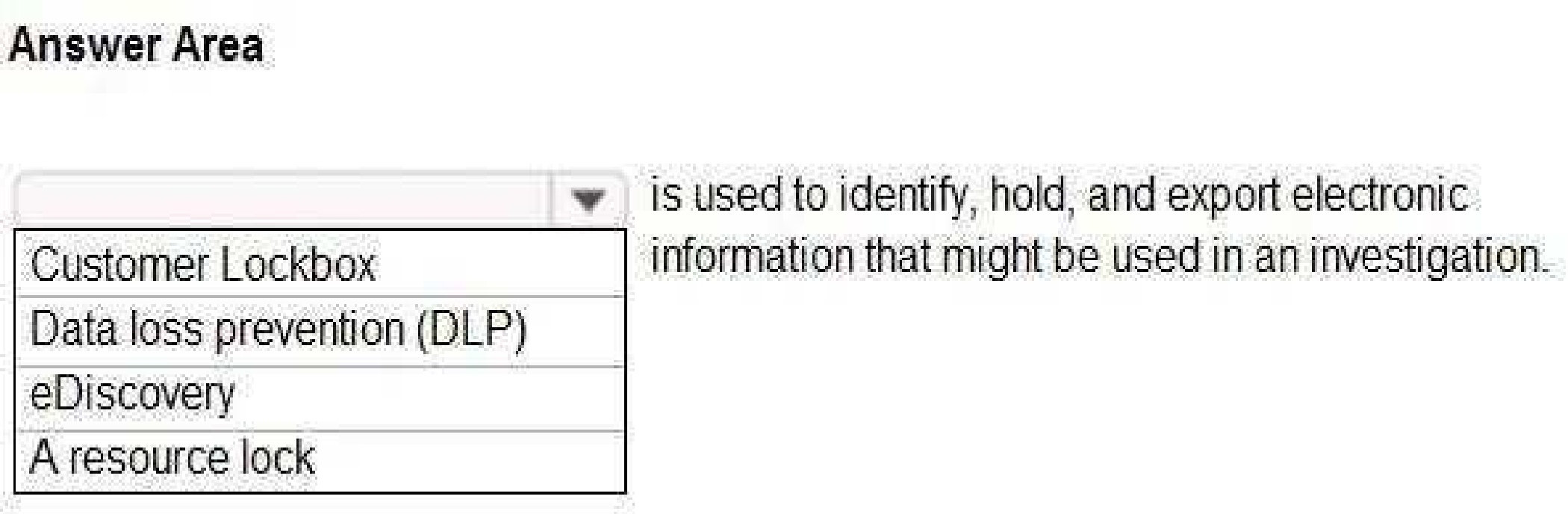
In Microsoft Purview, eDiscovery is the purpose-built compliance solution for legal and investigative
workflows. Microsoft’s SCI materials describe eDiscovery as the tool that enables organizations to
identify, preserve/hold, collect, review, and export potentially relevant content across Microsoft 365
services. Official guidance explains that eDiscovery (Standard) “provides search, hold, and export
capabilities” for content in Exchange, SharePoint, OneDrive, Teams, and more. Another description
states that eDiscovery (Premium) helps you “identify, preserve, collect, review, analyze, and export
content” for legal matters and internal investigations. These capabilities are designed to support the
eDiscovery lifecycle by allowing admins and case managers to: create cases, define custodians and
non-custodial data sources, run targeted searches, apply legal holds to prevent data alteration or
deletion, perform review and analytics, and export responsive data packages for counsel or
regulators.
By contrast, Data Loss Prevention (DLP) protects sensitive information from accidental or
inappropriate sharing; Customer Lockbox governs Microsoft engineer access to your data for
support; and resource locks protect Azure resources from accidental deletion or modification.
Therefore, the Microsoft SCI control that is explicitly used to identify, hold, and export electronic
information for an investigation is Microsoft Purview eDiscovery.
Quiz


In Microsoft’s Security, Compliance, and Identity learning content and product documentation,
Intune administration is performed in the dedicated Intune portal that, for exam and study-guide
purposes, is referred to as the Microsoft Endpoint Manager admin center. Microsoft explains that
“Microsoft Intune is a cloud-based service that focuses on mobile device management (MDM) and
mobile application management (MAM)” and that “administrators manage Intune in the Intune
(Endpoint Manager) admin center, where you configure device enrollment, compliance, apps, and
endpoint security.” The admin experience consolidates device, app, and policy management,
including device compliance policies, configuration profiles, app protection policies, software update
rings, and endpoint security baselines, all from this portal.
By contrast, the Azure Active Directory admin center (Microsoft Entra admin center) is designed for
identity and access tasks (users, groups, roles, Conditional Access), not full device/app management.
The Microsoft 365 compliance center is focused on data governance and risk (DLP, information
protection, eDiscovery, audit), while the Microsoft 365 security center/Defender portal is for security
operations and threat protection. Therefore, when the sentence states, “You can manage Microsoft
Intune by using the…,” the correct completion—aligned with Microsoft SCI study materials—is
Microsoft Endpoint Manager admin center, the portal intentionally built for Intune device and app
lifecycle management.
Quiz
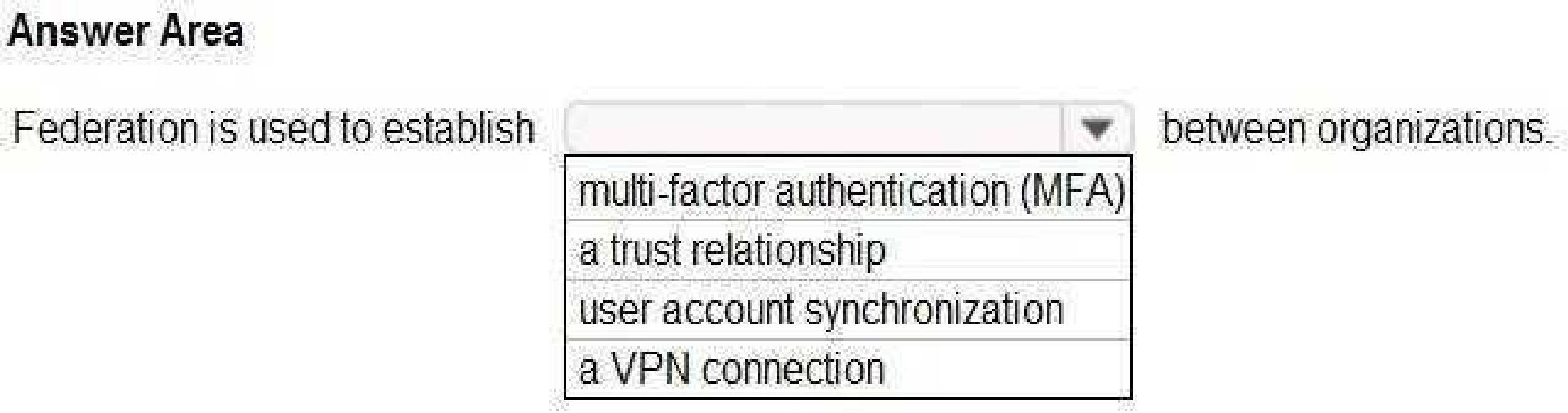
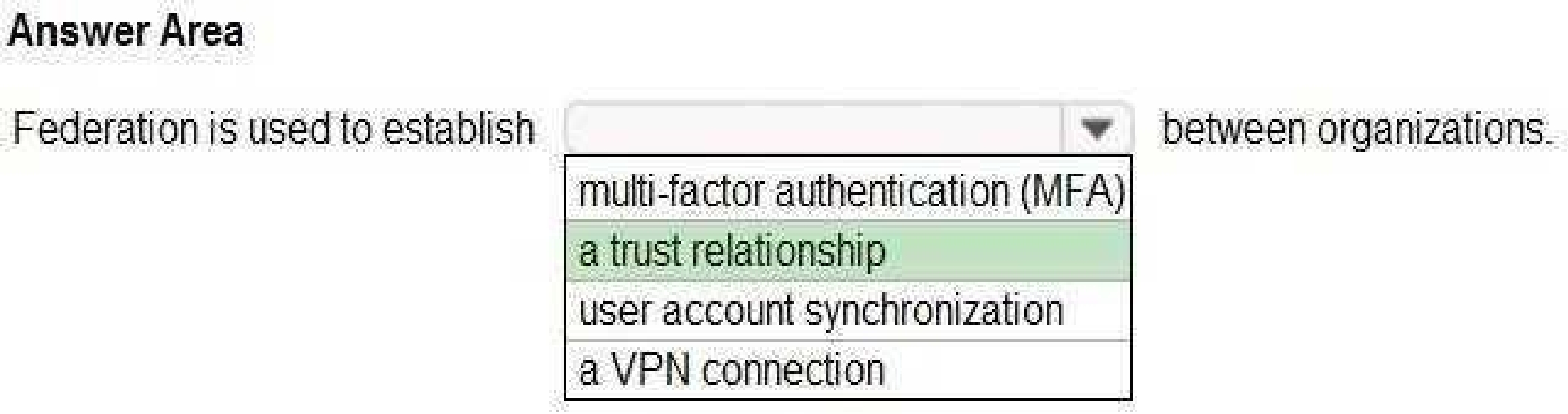
In Microsoft identity and access scenarios, federation is explicitly defined as a mechanism to create
trust between autonomous organizations so that identities authenticated in one can be accepted by
another. Microsoft describes this as: “Federation is a collection of domains that have established
trust.” In a federation, “this trust relationship lets each organization accept the other’s user
authentication” and enables access to resources without the need to duplicate user accounts or
require separate credentials. Within Azure AD/Microsoft Entra and AD FS guidance, Microsoft further
explains that federation enables “claims-based access across security boundaries” and “allows users
to access applications in a partner organization using their existing credentials.” These statements
underline that the purpose of federation is to establish a trust relationship across identity providers
or directories, not to provide multi-factor authentication, synchronize accounts, or build network
tunnels. MFA is an authentication strength that can be applied on top of federated sign-in, user
account synchronization is handled by services like Microsoft Entra Connect (Azure AD Connect), and
VPNs provide network connectivity, not identity trust. Therefore, the completion that aligns with
Microsoft SCI documentation is that federation establishes a trust relationship between
organizations.
Quiz
NOTE: Each correct selection is worth one point.
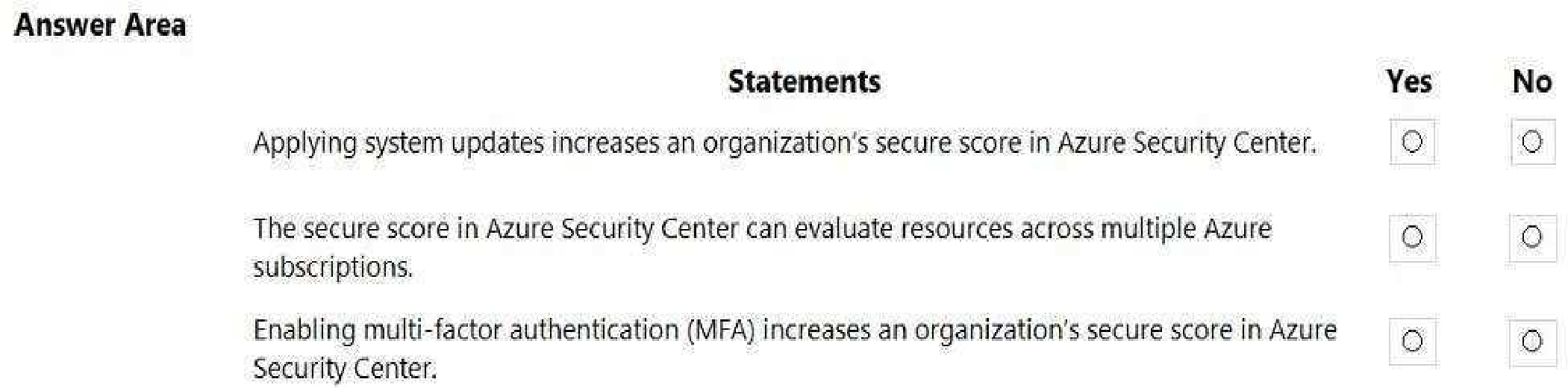
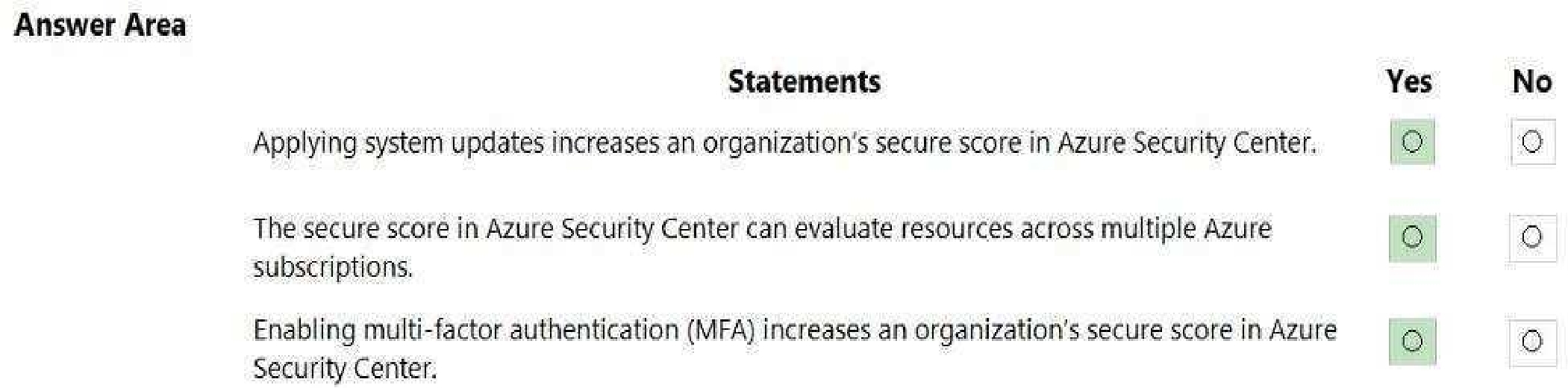
In Microsoft Defender for Cloud (formerly Azure Security Center), Secure score is defined as “a
measurement of an organization’s security posture; the higher the score, the lower the identified
risk.” Microsoft states that Defender for Cloud provides security recommendations that “help you
harden your resources and increase your secure score.” Among these recommendations is “Apply
system updates” for virtual machines—Microsoft describes it as ensuring that “machines should
have the latest security updates installed”, and completing this action adds points to your secure
score because it remediates a vulnerability class (missing patches).
Defender for Cloud also supports wide scope evaluation: you can “view and manage the secure score
across subscriptions and management groups,” allowing organizations with multiple Azure
subscriptions to see an aggregated and per-scope score and track improvement actions consistently.
Identity protections are part of Defender for Cloud’s recommendations as well. Under the Azure
Security Benchmark controls, Defender for Cloud includes the recommendation that “MFA should be
enabled on accounts with owner permissions on your subscription.” Implementing this MFA control
earns secure-score points because it mitigates high-impact identity risks.
Therefore, applying system updates (Yes), evaluating across multiple subscriptions (Yes), and
enabling MFA (Yes) all increase or contribute to an organization’s secure score in Azure Security
Center/Defender for Cloud.
Quiz
source?
Quiz
regulatory standard, such as International Organization for Standardization (ISO)?
Quiz
managing?
SC-900: Microsoft Security Compliance and Identity Fundamentals Practice test unlocks all online simulator questions
Thank you for choosing the free version of the SC-900: Microsoft Security Compliance and Identity Fundamentals practice test! Further deepen your knowledge on Microsoft Simulator; by unlocking the full version of our SC-900: Microsoft Security Compliance and Identity Fundamentals Simulator you will be able to take tests with over 211 constantly updated questions and easily pass your exam. 98% of people pass the exam in the first attempt after preparing with our 211 questions.
BUY NOWWhat to expect from our SC-900: Microsoft Security Compliance and Identity Fundamentals practice tests and how to prepare for any exam?
The SC-900: Microsoft Security Compliance and Identity Fundamentals Simulator Practice Tests are part of the Microsoft Database and are the best way to prepare for any SC-900: Microsoft Security Compliance and Identity Fundamentals exam. The SC-900: Microsoft Security Compliance and Identity Fundamentals practice tests consist of 211 questions and are written by experts to help you and prepare you to pass the exam on the first attempt. The SC-900: Microsoft Security Compliance and Identity Fundamentals database includes questions from previous and other exams, which means you will be able to practice simulating past and future questions. Preparation with SC-900: Microsoft Security Compliance and Identity Fundamentals Simulator will also give you an idea of the time it will take to complete each section of the SC-900: Microsoft Security Compliance and Identity Fundamentals practice test . It is important to note that the SC-900: Microsoft Security Compliance and Identity Fundamentals Simulator does not replace the classic SC-900: Microsoft Security Compliance and Identity Fundamentals study guides; however, the Simulator provides valuable insights into what to expect and how much work needs to be done to prepare for the SC-900: Microsoft Security Compliance and Identity Fundamentals exam.
BUY NOWSC-900: Microsoft Security Compliance and Identity Fundamentals Practice test therefore represents an excellent tool to prepare for the actual exam together with our Microsoft practice test . Our SC-900: Microsoft Security Compliance and Identity Fundamentals Simulator will help you assess your level of preparation and understand your strengths and weaknesses. Below you can read all the quizzes you will find in our SC-900: Microsoft Security Compliance and Identity Fundamentals Simulator and how our unique SC-900: Microsoft Security Compliance and Identity Fundamentals Database made up of real questions:
Info quiz:
- Quiz name:SC-900: Microsoft Security Compliance and Identity Fundamentals
- Total number of questions:211
- Number of questions for the test:50
- Pass score:80%
You can prepare for the SC-900: Microsoft Security Compliance and Identity Fundamentals exams with our mobile app. It is very easy to use and even works offline in case of network failure, with all the functions you need to study and practice with our SC-900: Microsoft Security Compliance and Identity Fundamentals Simulator.
Use our Mobile App, available for both Android and iOS devices, with our SC-900: Microsoft Security Compliance and Identity Fundamentals Simulator . You can use it anywhere and always remember that our mobile app is free and available on all stores.
Our Mobile App contains all SC-900: Microsoft Security Compliance and Identity Fundamentals practice tests which consist of 211 questions and also provide study material to pass the final SC-900: Microsoft Security Compliance and Identity Fundamentals exam with guaranteed success. Our SC-900: Microsoft Security Compliance and Identity Fundamentals database contain hundreds of questions and Microsoft Tests related to SC-900: Microsoft Security Compliance and Identity Fundamentals Exam. This way you can practice anywhere you want, even offline without the internet.
BUY NOW