The new flashcard feature is useful to memorize questions.
?Change your study mode
At any time, you can change the study mode, and alternate between the practice mode and the exam mode. In practice mode, you can configure for example the number of questions or tests, and other parameters to help you study.
Randomized | 10 Questions per Test | 20 Minutes | 70% to pass|
To re-configure your study mode again and change - for example - the number of tests, whether you have random questions and all other configuration parameters.
?Simulator Configuration
Auto-scroll: You can use the automatic scrolling of the questionnaire that occurs as soon as you answer one or all of the answers to a question correctly. Auto scrolling is activated if you answer a single answer, or as soon as you answer all the mandatory answers. Learning Mode: During learning mode you can get a real time result for your answer.
Free Test
Question: / 10
20:00Min. left
?Restart the current test
To restart the current test by clearing all your answers and the time used up to now. Warning: all answers will be lost.
Question: / 10
5.0(122 Votes)
Quiz
Question 1/101/10
An account buyer receives an email notification that their order has been approved and they can pay for the order. Once they click the associated link, it brings them to the B2B Checkout Payment After Approval layout. Which two are valid statements regarding the B2B Checkout Payment After Approval layout? (Choose two.)
Select multiple answer: (Choose 2)Select the answer
2 correct answers
A.
This is an out-of-the-box layout that provides payment options for orders requiring approval
B.
The layout is of type Checkout and is displayed to account shoppers only
C.
The layout allows the buyer to modify the order details and input payment information
D.
The layout is only displayed when the order status is PENDING_PAYMENT
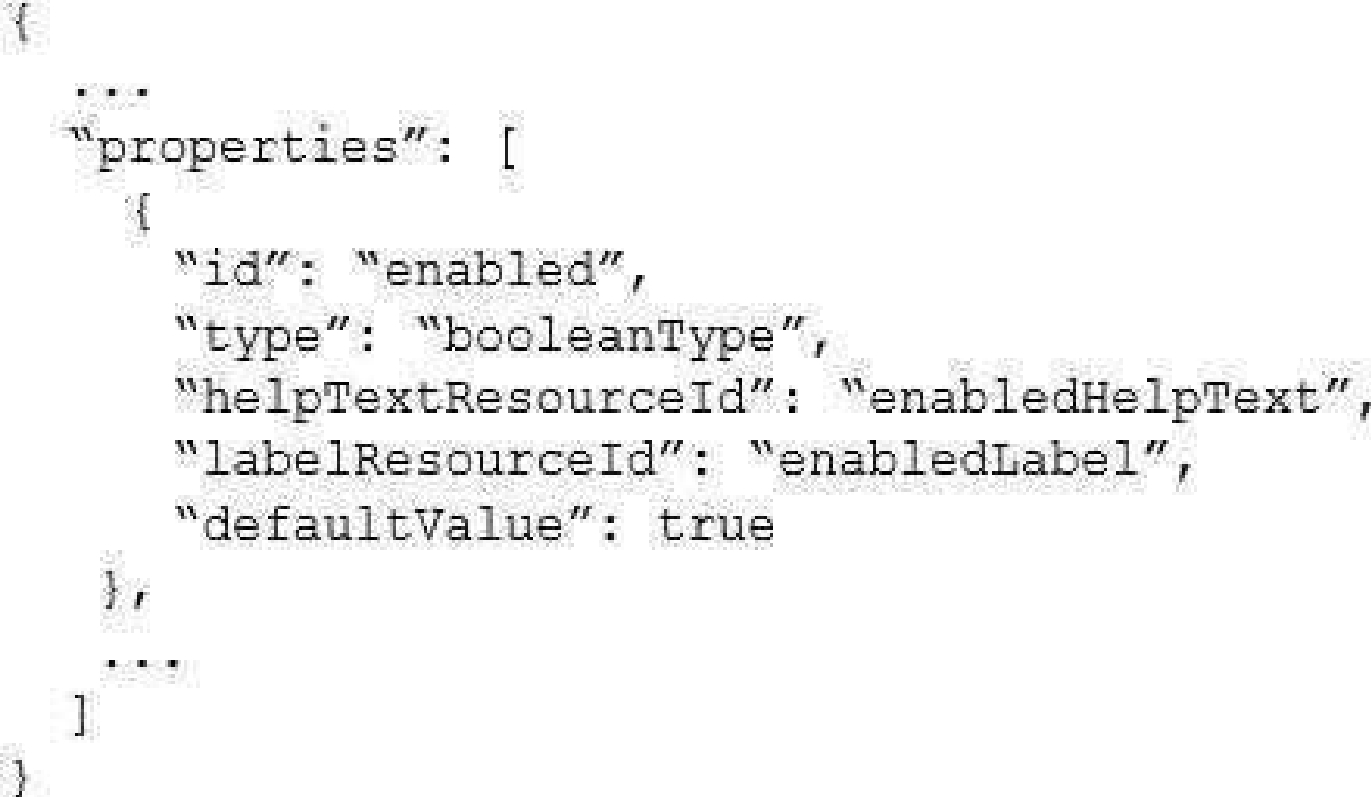
Given the example widget configuration definition:
Which two statements are correct? (Choose two.)
Select multiple answer: (Choose 2)Select the answer
2 correct answers
A.
You can reference the configuration in the widget JavaScript as widget.enabled()
B.
The widget configuration setting does not have a default value
C.
You can reference the configuration in the widget JavaScript as site.enabled()
D.
The value can be either true or false
E.
The widget configuration setting will appear as a dropdown
The correct answers are D and E. A widget configuration definition typically creates a configurable field for the widget, and in this case the setting is a boolean type. A boolean configuration means the value can only be one of two possible states: true or false. That makes option D correct. Also, boolean configuration fields are usually presented in the widget editor as a dropdown or similar selector with two choices, such as true and false or yes and no. Therefore, option E is also correct. Why the other options are incorrect: A. You can reference the configuration in the widget JavaScript as widget.enabled() This is not the usual way to access widget configuration values. Widget configuration is generally accessed through the widget instance or a configuration object, not by calling widget.enabled() as a function. B. The widget configuration setting does not have a default value This cannot be concluded from the information given. Many widget configurations can define a default value, so this statement is not necessarily true. C. You can reference the configuration in the widget JavaScript as site.enabled() This is incorrect because site.enabled() would imply a site-level setting, not a widget-level configuration setting. In summary: - D is correct because the value is boolean. - E is correct because boolean settings are shown as a dropdown.
Right Answer: D, E
Quiz
Question 3/103/10
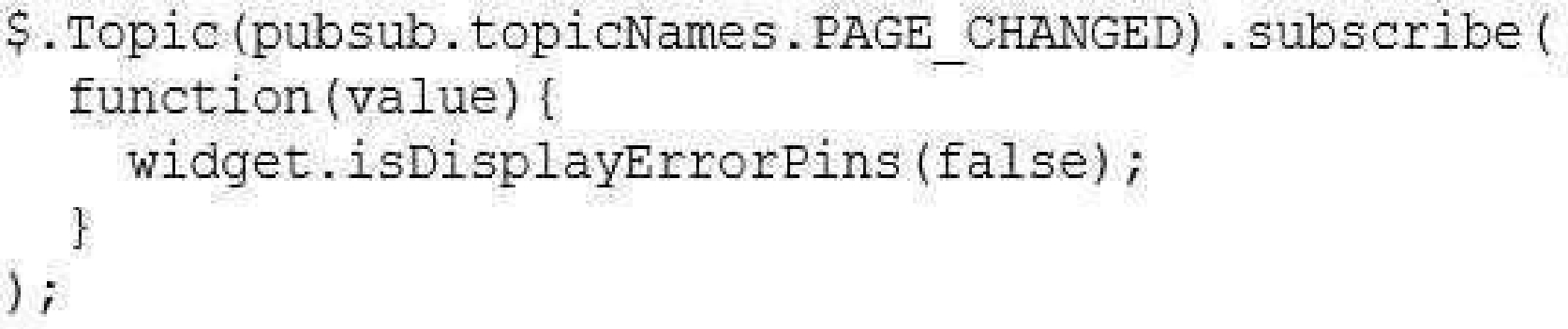
Given the example snippet of custom widget JavaScript:
What are two correct statements about this code? (Choose two.)
Select multiple answer: (Choose 2)Select the answer
2 correct answers
A.
Creates a new PAGE_CHANGED topic available for subscription
B.
Uses the PubSub library to publish to a topic
C.
Changes the page when the inline function runs
D.
Runs the inline function when the subscribed event fires
E.
Uses the PubSub library to subscribe to a topic
The correct answers are A and B. The code shown in the custom widget JavaScript is using a publish/subscribe pattern, which is commonly implemented with a PubSub library. In this pattern, one part of the code publishes an event to a topic, and other parts of the application can subscribe to that topic and react when the event is triggered. Why A is correct: A. Creates a new PAGE_CHANGED topic available for subscription The snippet defines or references a topic named PAGE_CHANGED. In PubSub-based code, a topic is a named channel used for communication between components. Once this topic is defined and published, other code can subscribe to it. Why B is correct: B. Uses the PubSub library to publish to a topic The code is using the PubSub mechanism to send a message/event to the PAGE_CHANGED topic. This is the publish part of publish/subscribe. Why the other options are incorrect: C. Changes the page when the inline function runs The inline function does not directly change the page itself. Instead, it publishes an event or message. Any actual page change would be handled by code that subscribes to the topic, not by the inline function alone. D. Runs the inline function when the subscribed event fires This is the opposite of what is happening. The inline function is the publisher, not the subscriber. It does not wait for an event to fire; it triggers the event by publishing to the topic. E. Uses the PubSub library to subscribe to a topic The snippet is not showing a subscription. A subscription would involve registering a callback to run when a topic is published. Here, the code is publishing, not subscribing. In summary: The code creates or uses a PAGE_CHANGED topic and publishes to it using PubSub, so A and B are correct.
Right Answer: A, B
Quiz
Question 4/104/10
The design of a particular B2B storefront implementation has three supported locales. When configuring the Profile Navigation – Account Shoppers settings, which statement describes how to configure the option name to handle the different languages?
Select the answer:Select the answer
1 correct answer
A.
Type the names for each language directly into the field, using a comma delimited format
B.
Configure three different Profile Navigation – Account Shoppers widget instances, one for each locale
C.
Specify the option names using the Administration UI on the Setting Page
D.
Configure using Text Snippets on Design page after selecting the respective language
A company is setting up multiple country-specific sites that have unique emails, separate payment gateways and shipping methods by country, and other site-specific settings. They share Oracle integrations (e.g. Oracle Retail Order Management System Cloud, Oracle Loyalty Cloud, Oracle Customer Experience Cloud). They plan to add sites in the Administration UI. Based on their use case, when should they create the additional sites to minimize the changes they need to make?
Select the answer:Select the answer
1 correct answer
A.
At any time, because updates to shared configuration to the default site alter the child sites.
B.
Create the additional sites before configuring anything on the default site.
C.
Configure the Oracle integrations for the default site and then create additional sites.
D.
Configure the default site fully and then add the additional sites.
The correct answer is A. This scenario is about creating multiple country-specific sites that need some settings to be different for each site, while still sharing Oracle integrations such as: - Oracle Retail Order Management System Cloud - Oracle Loyalty Cloud - Oracle Customer Experience Cloud The key point is how site configuration inheritance works in the Administration UI. In this setup, shared configuration on the default site is inherited by child sites. That means if you configure something on the default site and then create additional sites, those new sites can use the shared configuration without requiring you to repeat the setup. Changes made to shared configuration on the default site will also be reflected in the child sites where applicable. Why A is correct: - The company can create the additional sites at any time. - The important part is that shared configuration on the default site flows to the child sites. - This minimizes duplication and reduces the amount of work needed for shared integrations and settings. Why the other options are not the best choice: B. Create the additional sites before configuring anything on the default site. - This is not necessary. - You do not need to create the child sites first to minimize changes. C. Configure the Oracle integrations for the default site and then create additional sites. - This is partially reasonable, but too limited. - The question asks about all site setup, not only Oracle integrations. - The more complete principle is that shared configuration can be updated on the default site and inherited by the child sites, so timing is not restricted to just after integration setup. D. Configure the default site fully and then add the additional sites. - This is a common approach in some systems, but not the best answer here. - In this case, creating the sites after full configuration is not required to minimize changes. - The system allows shared configuration updates to the default site to affect child sites, so the sites can be created at any time. Conclusion: Because shared configuration from the default site updates the child sites, the company can create the additional sites at any time while still minimizing changes. Therefore, A is correct.
Right Answer: A
Quiz
Question 6/106/10
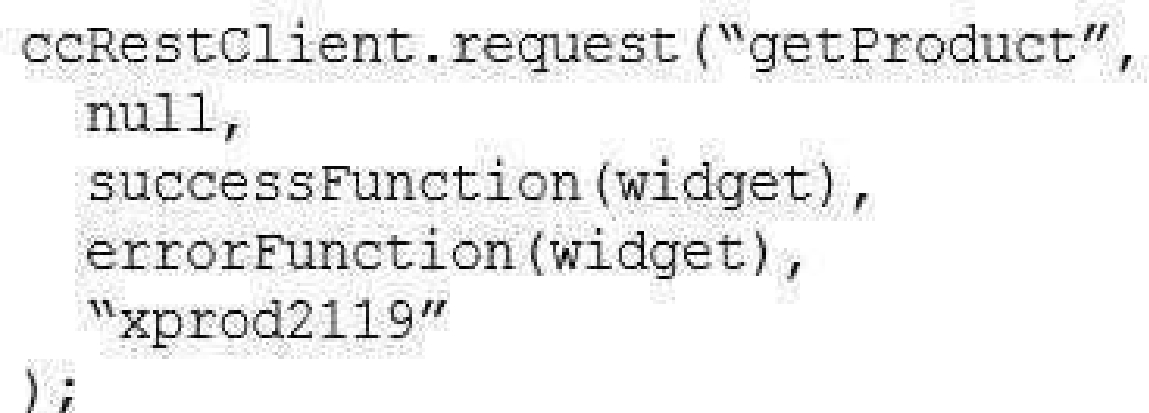
Given this widget JavaScript snippet using the CCRestClient library:
What is the URL of the created request to Commerce Cloud?
Select the answer:Select the answer
1 correct answer
A.
GET /ccstore/v1/products
B.
GET /ccstore/v1/products/xprod2119
C.
POST /ccstore/v1/products
D.
PUT /ccstore/v1/products/xprod2119
E.
GET/ccstore/v1/products?getProduct=xprod2119
The correct answer is A. GET /ccstore/v1/products The CCRestClient library builds requests based on the REST endpoint configured in the widget JavaScript code. In this case, the snippet is creating a request to the products collection endpoint, not to a specific product resource. Why A is correct: - /ccstore/v1/products is the standard Commerce Cloud endpoint for retrieving the product list or product collection. - A GET request means the code is reading data, not creating or updating it. - Since no product ID is appended to the path, it is not requesting a single product such as xprod2119. Why the other options are incorrect: - B. GET /ccstore/v1/products/xprod2119 This would target one specific product by ID, but the snippet is not constructing a resource-specific URL. - C. POST /ccstore/v1/products POST would indicate creating a new product, which is not what the code does. - D. PUT /ccstore/v1/products/xprod2119 PUT is used for updating a specific resource, which also does not match the snippet. - E. GET/ccstore/v1/products?getProduct=xprod2119 This is not the standard format used here. The request is not being built with a query parameter like that. Conclusion: The widget code creates a GET request to the products collection endpoint: GET /ccstore/v1/products
Right Answer: A
Quiz
Question 7/107/10
Your customer has a B2B Storefront instance designed to have three English language sites: North America, European Union, and Asia. What two components will the storefront developers need to configure to support one or more sites? (Choose two.)
Select multiple answer: (Choose 2)Select the answer
2 correct answers
A.
The settings for each layout to specify one or more sites valid for that layout
B.
Associated component text snippets that are valid for each site
C.
The layout components to include branding, images, and page content that are specific for the site
D.
The profile Navigation – Account Shoppers widget instance settings to specify a URL entry for each layout per site
The correct answers are C and D. In a B2B Storefront setup with multiple sites such as North America, European Union, and Asia, developers need to make sure the storefront can present site-specific content and navigation behavior. The two components that typically need configuration are: C. The layout components to include branding, images, and page content that are specific for the site This is correct because each site may need its own branding, images, promotions, and localized page content. Layout components are used to control what the storefront looks like and how content is presented for each site. If the storefront supports multiple sites, the layout must be configured so that the right site shows the right content. D. The profile Navigation – Account Shoppers widget instance settings to specify a URL entry for each layout per site This is correct because navigation widgets often need site-specific URL mappings. The account/shoppers navigation widget can be configured with URL entries so that users are directed to the correct pages depending on which site they are using. This is important in a multi-site storefront where each site may have different routes or landing pages. Why the other options are not correct: A. The settings for each layout to specify one or more sites valid for that layout This is not the main component typically configured for supporting multiple storefront sites. While site assignment may exist in some systems, the question is asking about the storefront developer components needed to support one or more sites, and layout validity settings are not the key requirement here. B. Associated component text snippets that are valid for each site This is not the best answer because text snippets are generally used for localized text or labels, not for enabling multi-site storefront support itself. They may help with language or site-specific wording, but they are not one of the core components needed to support multiple sites in this context. Summary: To support multiple English-language storefront sites, developers need to configure: - Site-specific layout components for branding, images, and page content - Navigation widget instance settings with site-specific URL entries So the correct answers are C and D.
Right Answer: C, D
Quiz
Question 8/108/10
A developer is customizing the payment methods widget to enable the shopper to store a credit card when checking out. The widget needs to add three properties to the payments object of the JSON authorization request when creating the order: saveCard(Boolean) nickname(String) setAsDefault(Boolean) Each of the properties needs to be bound to a particular view model for the properties to be added to the payments object. Which is the correct view model?
Select the answer:Select the answer
1 correct answer
A.
orderViewModel
B.
widgetPaymentViewModel
C.
cartViewModel
D.
paymentViewModel
The correct answer is B. widgetPaymentViewModel The question is asking about customizing the payment methods widget so that extra fields are added to the payments object in the JSON authorization request when an order is created. The three properties are: - saveCard(Boolean) - nickname(String) - setAsDefault(Boolean) These are all related to the payment widget’s UI behavior and the shopper’s card-saving preferences, not to the overall order or cart data. Why widgetPaymentViewModel is correct: - The widgetPaymentViewModel is the view model specifically associated with the payment widget. - It manages payment-method-specific data entered or selected by the shopper. - Since the three properties must be bound to a particular view model so they can be included in the payments object, they belong in the payment widget’s own view model. Why the other options are incorrect: A. orderViewModel - This is typically used for order-level data, such as order status, totals, or order submission details. - It is too broad and not specific enough for payment widget-specific fields. C. cartViewModel - This view model is focused on cart contents, line items, quantities, promotions, and similar shopping cart information. - It is not the right place for payment card-saving properties. D. paymentViewModel - This sounds close, but in this context the specific correct view model is the widgetPaymentViewModel. - The question emphasizes customization of the payment methods widget, which aligns directly with the widget-specific view model. Conclusion: Because the properties are tied to the payment methods widget and must be added to the payments object during authorization, they should be bound to widgetPaymentViewModel.
Right Answer: B
Quiz
Question 9/109/10
The Profile Navigation – Account Shoppers widget instance settings specifies the storefront role of
buyer for the Account Address Book.
Note that the storefront role for the /accountaddressbook URL is specified as buyer. Which configuration step is needed to allow a delegated administrator the privilege to create, edit, and delete account addresses?
Select the answer:Select the answer
1 correct answer
A.
Nothing needs to be configured. The account Addresses widget will automatically provide additional create, edit, and delete privileges for delegated administrators.
B.
Modify the settings for the Account Address Book and specify the storefront role of admin.
C.
The Account Addresses widget will need to be customized to perform this functionality.
D.
Create an additional Account Address Book layout that allows delegated administrators the privilege to perform the tasks.
The correct answer is D. Create an additional Account Address Book layout that allows delegated administrators the privilege to perform the tasks. The key detail in the question is that the /accountaddressbook URL is currently configured with the storefront role buyer. That means the existing Account Address Book layout is intended for buyer users, not delegated administrators. In this type of setup, storefront role determines which layout and permissions are applied to a user. Since delegated administrators need different capabilities, such as creating, editing, and deleting account addresses, they cannot simply use the buyer layout if that layout does not grant those actions. Why the other options are incorrect: A. Nothing needs to be configured. This is incorrect because delegated administrators do not automatically receive extra privileges just because they access the same widget or page. The existing configuration is role-based. B. Modify the settings for the Account Address Book and specify the storefront role of admin. This is too broad and not the right approach. The question indicates that the current widget instance is already set for buyer. To support delegated administrators, a separate role-specific layout is needed rather than changing the existing one to admin. C. The Account Addresses widget will need to be customized. This is unnecessary. The problem is not that the widget lacks the ability; it is that the correct layout/role configuration is missing. Customization of the widget itself is not required. D. Create an additional Account Address Book layout that allows delegated administrators the privilege to perform the tasks. This is correct because delegated administrators need their own storefront-role-specific layout that grants the required permissions. Creating an additional layout allows the system to present the appropriate functionality to that role without affecting the buyer layout. Summary: Because the current Account Address Book is configured for the buyer storefront role, a separate layout must be created for delegated administrators so they can have create, edit, and delete access to account addresses.
Right Answer: D
Quiz
Question 10/1010/10
What are two reasons to use the CC-Storage library to save data objects in local storage? (Choose two.)
Select multiple answer: (Choose 2)Select the answer
2 correct answers
A.
to support browsers using private browsing mode
B.
to support Firefox browsers only
C.
to support Chrome browsers only
D.
to support iOS devices using Safari
The correct answers are A and D. Why A is correct: CC-Storage is used to save data objects in local storage in a way that can handle browsers using private browsing mode. In private mode, some browsers restrict or limit normal local storage behavior. Using a library like CC-Storage helps your application work more reliably in those cases. Why D is correct: CC-Storage also helps with iOS devices using Safari. Safari on iOS has known limitations and inconsistencies with local storage, especially in certain modes or contexts. The library is used to provide better compatibility and safer storage handling on those devices. Why B is incorrect: CC-Storage is not specific to Firefox browsers only. It is meant to address broader browser compatibility issues, not just one browser. Why C is incorrect: CC-Storage is not specific to Chrome browsers only. It is also not limited to a single browser; it is intended for compatibility across multiple environments. In summary: The two reasons to use CC-Storage are to support browsers in private browsing mode and to support iOS devices using Safari.
1Z0-1068-25: Oracle CX Commerce 2025 Implementation Essentials Practice test unlocks all online simulator questions
Thank you for choosing the free version of the 1Z0-1068-25: Oracle CX Commerce 2025 Implementation Essentials practice test! Further deepen your knowledge on Oracle Simulator; by unlocking the full version of our 1Z0-1068-25: Oracle CX Commerce 2025 Implementation Essentials Simulator you will be able to take tests with over 70 constantly updated questions and easily pass your exam. 98% of people pass the exam in the first attempt after preparing with our 70 questions.
What to expect from our 1Z0-1068-25: Oracle CX Commerce 2025 Implementation Essentials practice tests and how to prepare for any exam?
The 1Z0-1068-25: Oracle CX Commerce 2025 Implementation Essentials Simulator Practice Tests are part of the Oracle Database and are the best way to prepare for any 1Z0-1068-25: Oracle CX Commerce 2025 Implementation Essentials exam. The 1Z0-1068-25: Oracle CX Commerce 2025 Implementation Essentials practice tests consist of 70 questions and are written by experts to help you and prepare you to pass the exam on the first attempt. The 1Z0-1068-25: Oracle CX Commerce 2025 Implementation Essentials database includes questions from previous and other exams, which means you will be able to practice simulating past and future questions. Preparation with 1Z0-1068-25: Oracle CX Commerce 2025 Implementation Essentials Simulator will also give you an idea of the time it will take to complete each section of the 1Z0-1068-25: Oracle CX Commerce 2025 Implementation Essentials practice test . It is important to note that the 1Z0-1068-25: Oracle CX Commerce 2025 Implementation Essentials Simulator does not replace the classic 1Z0-1068-25: Oracle CX Commerce 2025 Implementation Essentials study guides; however, the Simulator provides valuable insights into what to expect and how much work needs to be done to prepare for the 1Z0-1068-25: Oracle CX Commerce 2025 Implementation Essentials exam.
1Z0-1068-25: Oracle CX Commerce 2025 Implementation Essentials Practice test therefore represents an excellent tool to prepare for the actual exam together with our Oracle practice test . Our 1Z0-1068-25: Oracle CX Commerce 2025 Implementation Essentials Simulator will help you assess your level of preparation and understand your strengths and weaknesses. Below you can read all the quizzes you will find in our 1Z0-1068-25: Oracle CX Commerce 2025 Implementation Essentials Simulator and how our unique 1Z0-1068-25: Oracle CX Commerce 2025 Implementation Essentials Database made up of real questions:
You can prepare for the 1Z0-1068-25: Oracle CX Commerce 2025 Implementation Essentials exams with our mobile app. It is very easy to use and even works offline in case of network failure, with all the functions you need to study and practice with our 1Z0-1068-25: Oracle CX Commerce 2025 Implementation Essentials Simulator.
Use our Mobile App, available for both Android and iOS devices, with our 1Z0-1068-25: Oracle CX Commerce 2025 Implementation Essentials Simulator . You can use it anywhere and always remember that our mobile app is free and available on all stores.
Our Mobile App contains all 1Z0-1068-25: Oracle CX Commerce 2025 Implementation Essentials practice tests which consist of 70 questions and also provide study material to pass the final 1Z0-1068-25: Oracle CX Commerce 2025 Implementation Essentials exam with guaranteed success.
Our 1Z0-1068-25: Oracle CX Commerce 2025 Implementation Essentials database contain hundreds of questions and Oracle Tests related to 1Z0-1068-25: Oracle CX Commerce 2025 Implementation Essentials Exam. This way you can practice anywhere you want, even offline without the internet.