The new flashcard feature is useful to memorize questions.
?Change your study mode
At any time, you can change the study mode, and alternate between the practice mode and the exam mode. In practice mode, you can configure for example the number of questions or tests, and other parameters to help you study.
Randomized | 10 Questions per Test | 20 Minutes | 70% to pass|
To re-configure your study mode again and change - for example - the number of tests, whether you have random questions and all other configuration parameters.
?Simulator Configuration
Auto-scroll: You can use the automatic scrolling of the questionnaire that occurs as soon as you answer one or all of the answers to a question correctly. Auto scrolling is activated if you answer a single answer, or as soon as you answer all the mandatory answers. Learning Mode: During learning mode you can get a real time result for your answer.
Free Test
Question: / 10
20:00Min. left
?Restart the current test
To restart the current test by clearing all your answers and the time used up to now. Warning: all answers will be lost.
Question: / 10
4.6(1199 Votes)
Quiz
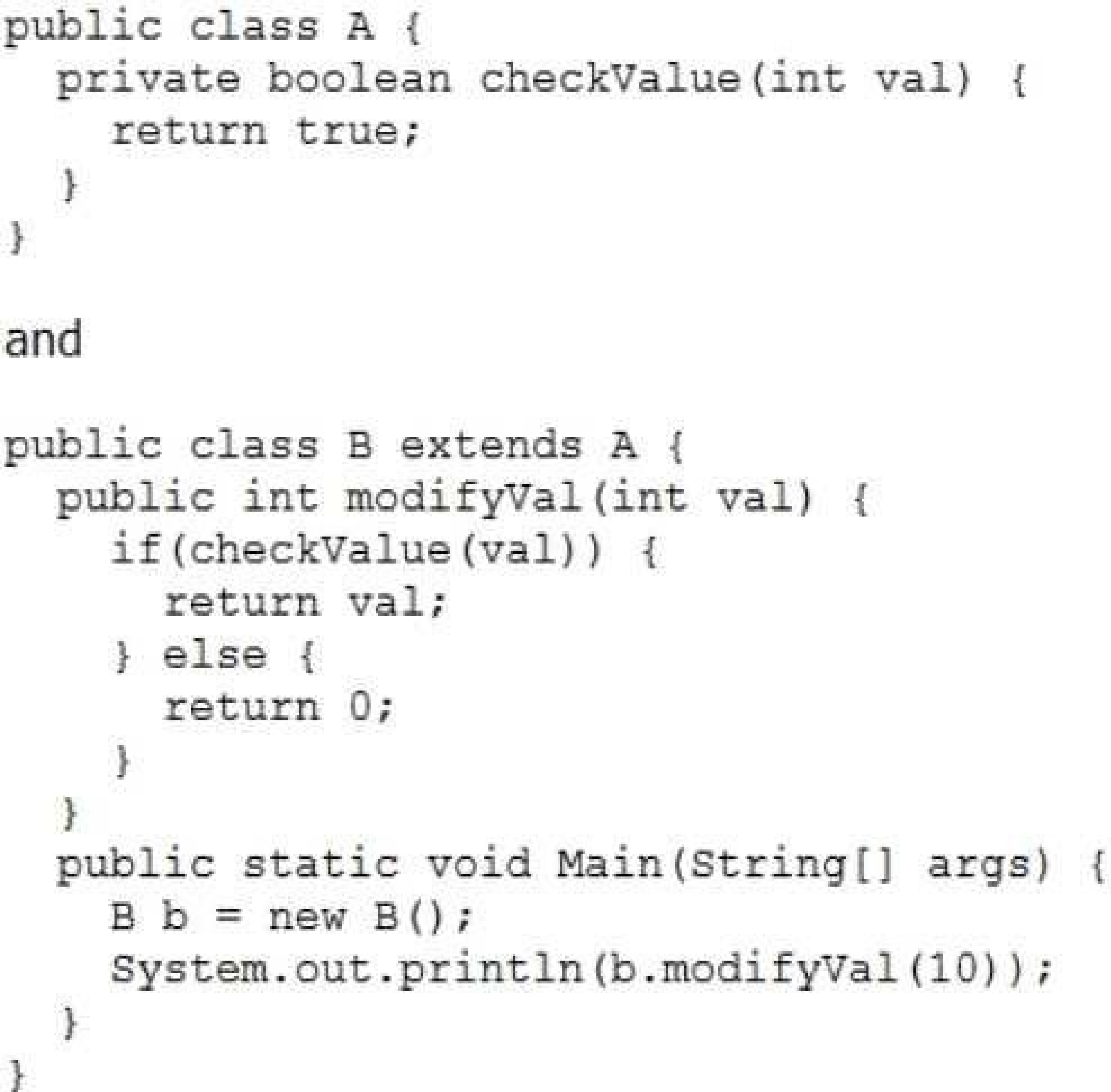
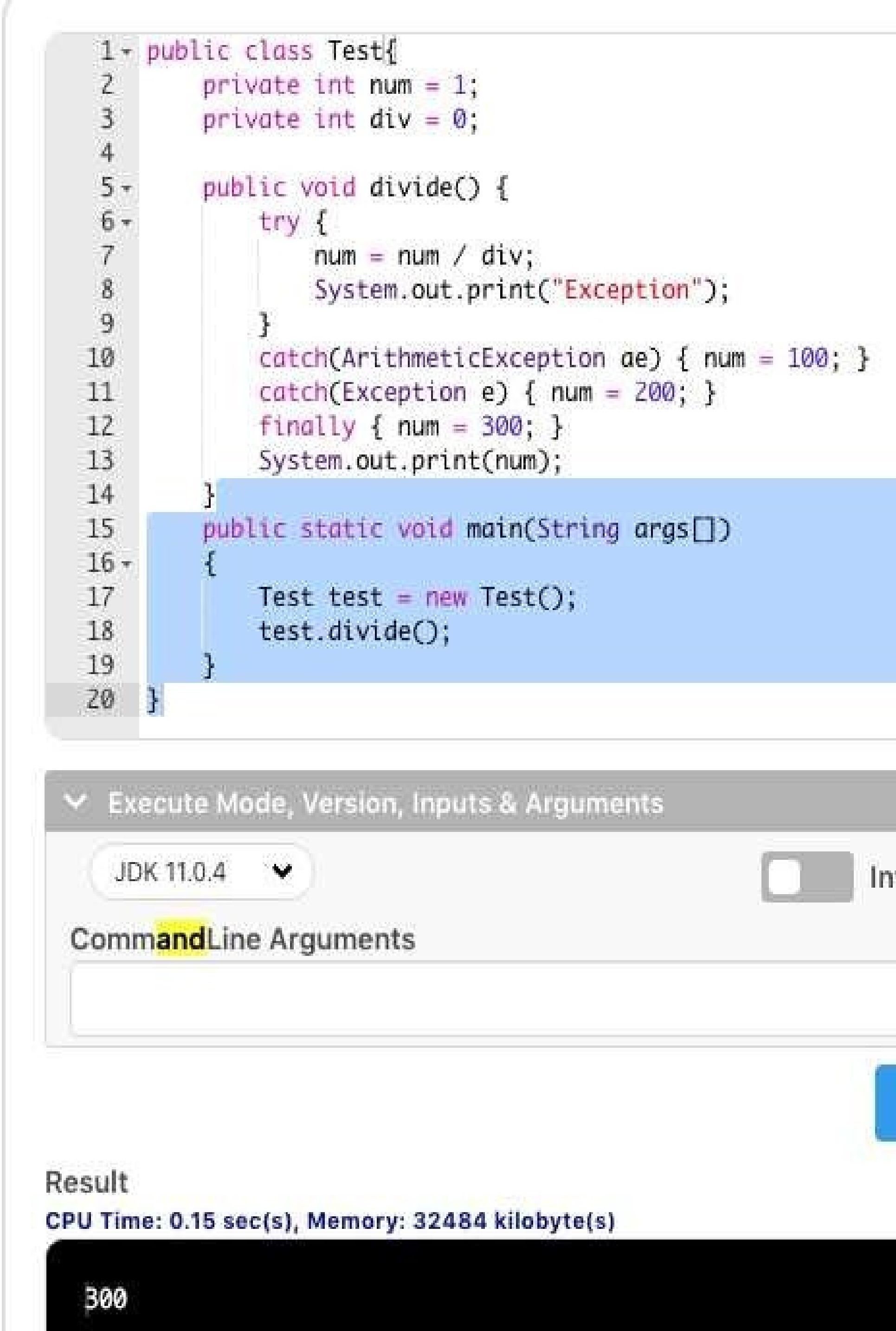
Question 1/101/10
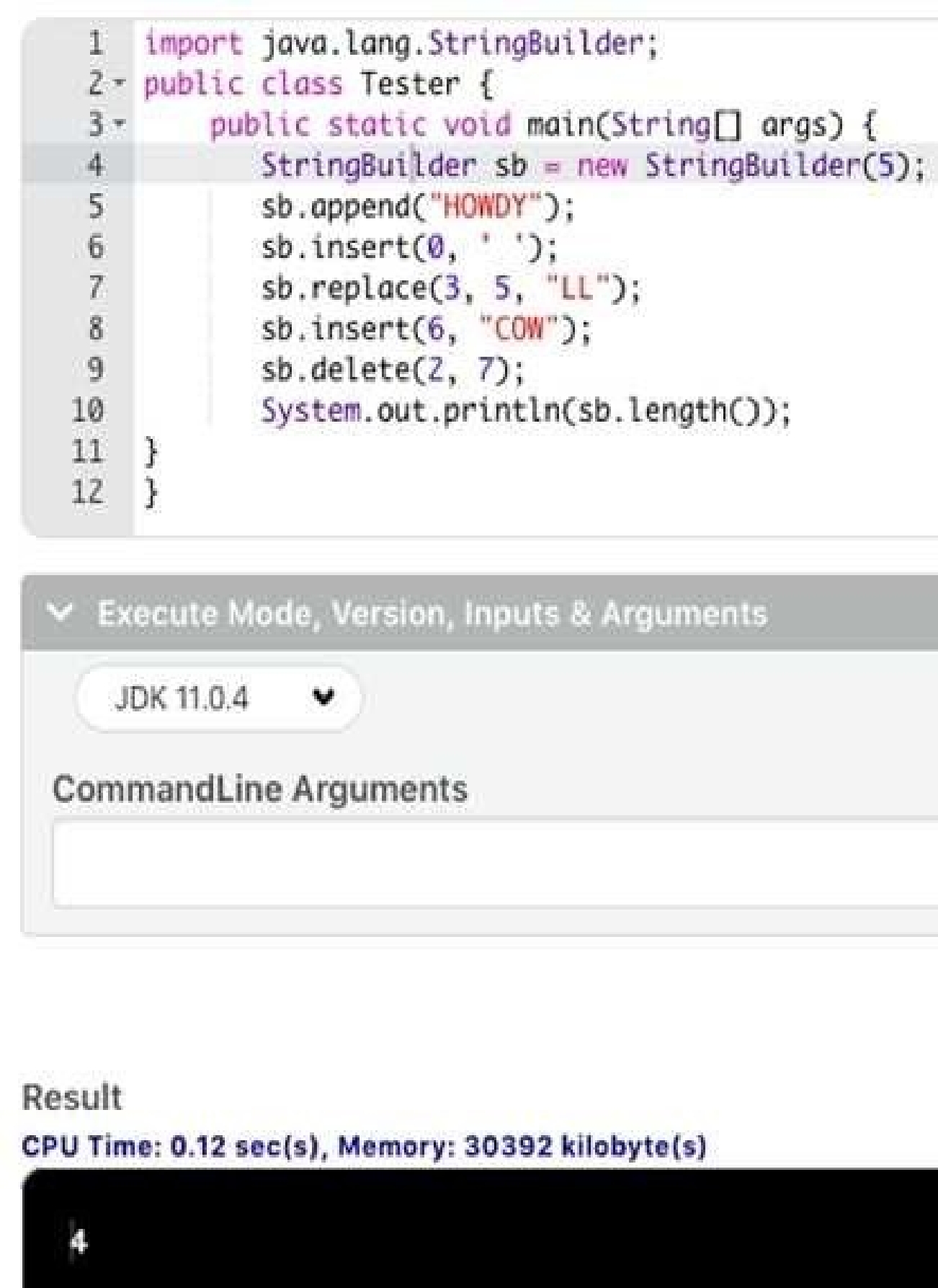
Given:
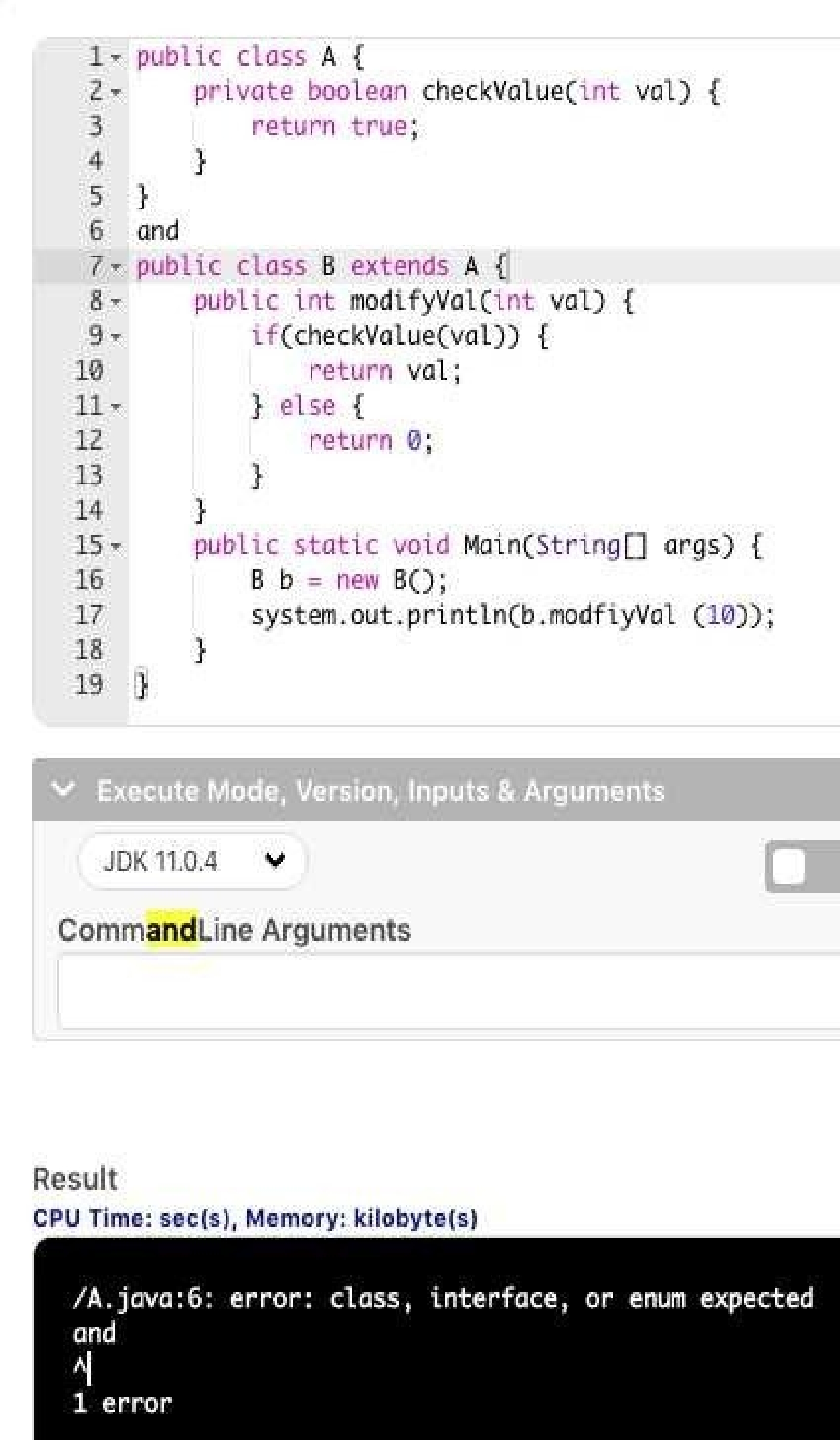
What is the result?
Select the answer:Select the answer
1 correct answer
A.
nothing
B.
It fails to compile.
C.
0
D.
A java.lang.IllegalArgumentException is thrown.
E.
10
Right Answer: B
Quiz
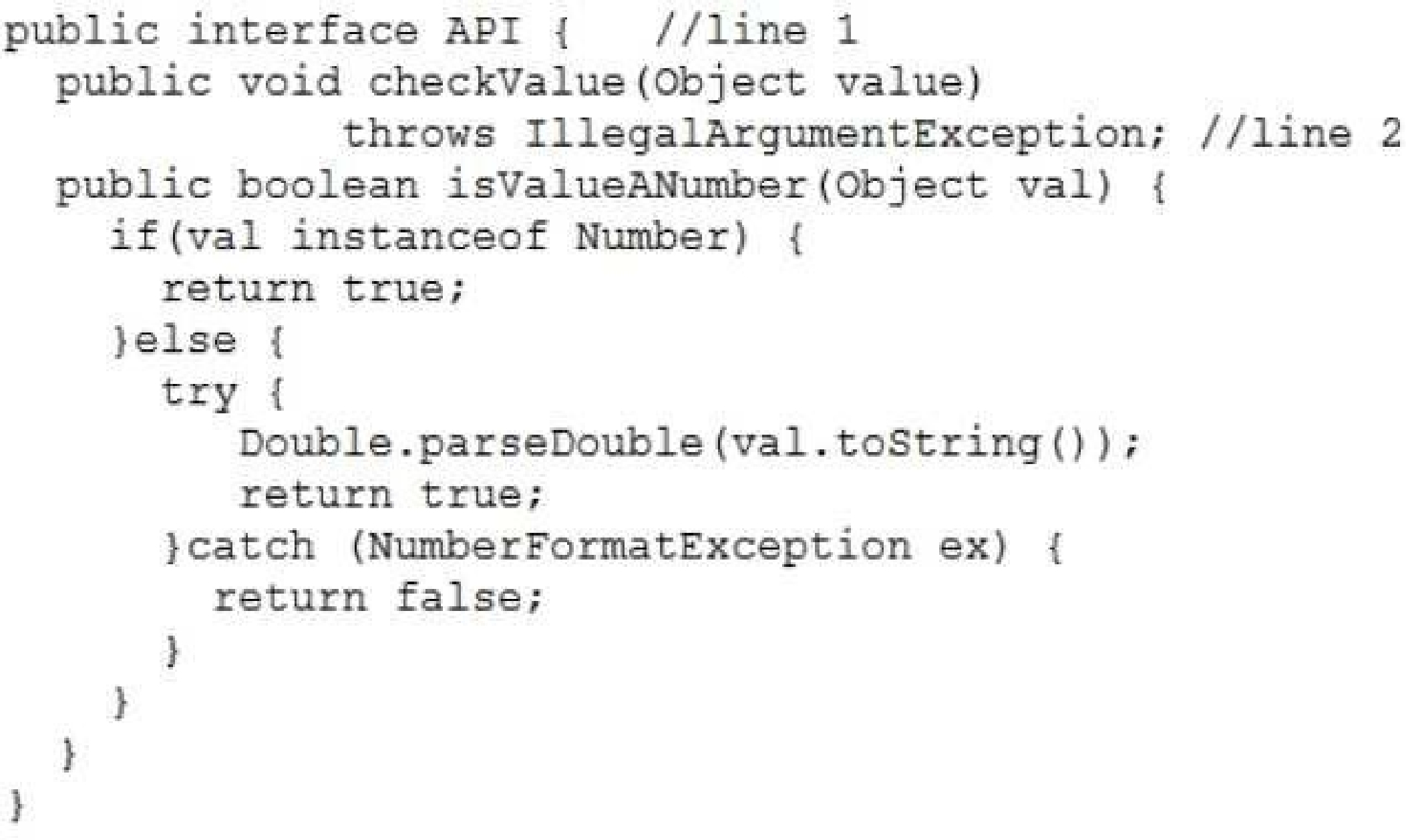
Question 2/102/10
Given:
Which two changes need to be made to make this class compile? (Choose two.)
Select multiple answer: (Choose 2)Select the answer
2 correct answers
A.
Change Line 1 to an abstract class:public abstract class API {
B.
Change Line 2 access modifier to protected:protected void checkValue(Object value)throws IllegalArgumentException;
C.
Change Line 1 to a class:public class API {
D.
Change Line 1 to extend java.lang.AutoCloseable:public interface API extends AutoCloseable {
E.
Change Line 2 to an abstract method:public abstract void checkValue(Object value)throws IllegalArgumentException;
The correct answers are C and E. Why The class in the question is trying to define a Java interface-like type with a method declaration that is not valid for a concrete class. To compile, two changes are needed: 1. Change Line 1 to a class Option C: public class API { If the type is declared as an interface, then the method declaration on Line 2 must follow interface rules. But the way the method is written suggests the intent is a regular class, not an interface. 2. Change Line 2 to an abstract method Option E: public abstract void checkValue(Object value) throws IllegalArgumentException; In a class, a method declaration without a body must be abstract. If Line 2 is currently just a method signature ending with a semicolon, it is only legal if the enclosing type is abstract. Since the correct fix is to make the type a class, the method must also be declared abstract. Why the other options are wrong A. Change Line 1 to an abstract class This would allow abstract methods, but it would not fit the intended structure shown in the question if the code is meant to compile as written with the smallest valid changes. Also, if the type is already an interface, changing it to an abstract class may not match the rest of the code. B. Change Line 2 access modifier to protected An interface method cannot be protected. Interface methods are implicitly public, and older-style interface methods cannot be protected. So this does not solve the problem. D. Change Line 1 to extend java.lang.AutoCloseable This is unrelated. AutoCloseable is an interface used for resources that can be closed. Extending it does not address the method declaration issue. Key rule to remember - A method without a body must be abstract unless it is in an interface as a public abstract method. - If the enclosing type is a class, then a body is required unless the method is declared abstract and the class itself is abstract. So the two changes that make the class compile are: C. Change Line 1 to a class E. Change Line 2 to an abstract method
Right Answer: C, E
Quiz
Question 3/103/10
Which two modules include APIs in the Java SE Specification? (Choose two.)
Select multiple answer: (Choose 2)Select the answer
Which two statements are true about the modular JDK? (Choose two.)
Select multiple answer: (Choose 2)Select the answer
2 correct answers
A.
The foundational APIs of the Java SE Platform are found in the java.base module.
B.
An application must be structured as modules in order to run on the modular JDK.
C.
It is possible but undesirable to configure modules’ exports from the command line.
D.
APIs are deprecated more aggressively because the JDK has been modularized.
The correct answers are A and C. A. The foundational APIs of the Java SE Platform are found in the java.base module. This is true. The java.base module is the core module of the Java Platform Module System (JPMS). It contains the most essential classes and packages, including fundamental APIs such as java.lang, java.util, java.io, and others needed by nearly every Java application. Every Java module automatically depends on java.base. B. An application must be structured as modules in order to run on the modular JDK. This is false. A Java application can still run as a classpath-based, non-modular application on the modular JDK. The JDK supports both modular and non-modular applications. Modularization is optional for application code, even though the JDK itself is modular. C. It is possible but undesirable to configure modules’ exports from the command line. This is true. The modular system allows command-line options such as --add-exports, --add-opens, and similar flags to relax encapsulation or expose internal packages. This can be useful for migration or special cases, but it is generally discouraged because it weakens the benefits of strong encapsulation and can make code harder to maintain. D. APIs are deprecated more aggressively because the JDK has been modularized. This is false. Modularization did not make deprecation more aggressive. While the modular JDK improved encapsulation and maintainability, deprecation policies are not inherently stricter simply because the JDK is modular. Summary: - A is true because java.base contains the foundational Java SE APIs. - C is true because command-line exports can be configured, but doing so is usually not recommended. - B and D are false. If you want, I can also explain this in terms of how the module system differs from the old classpath model.
Right Answer: A, C
Quiz
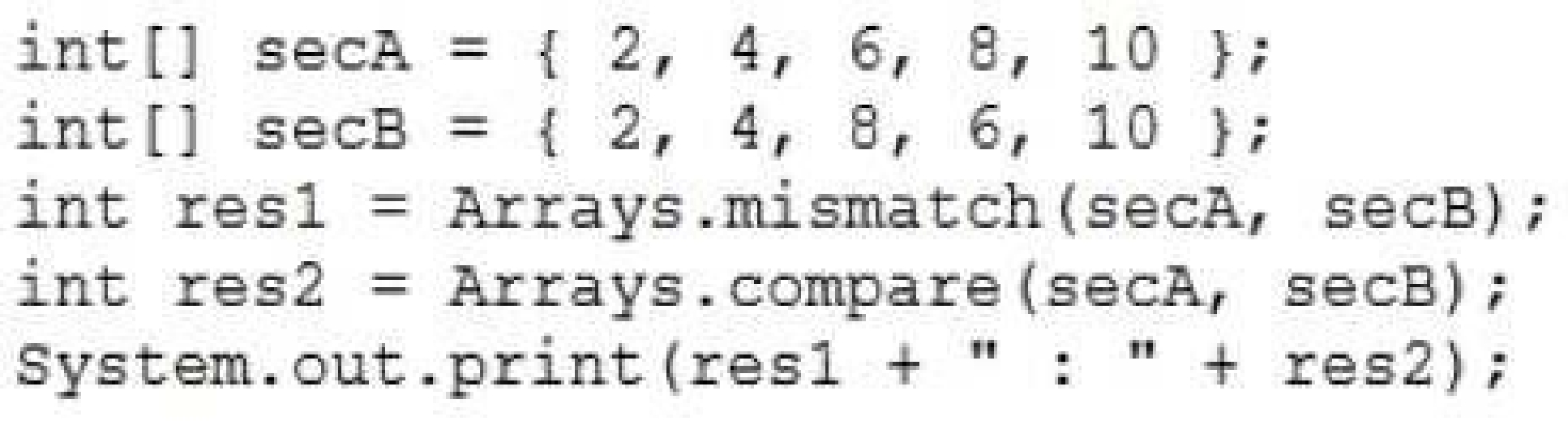
Question 6/106/10
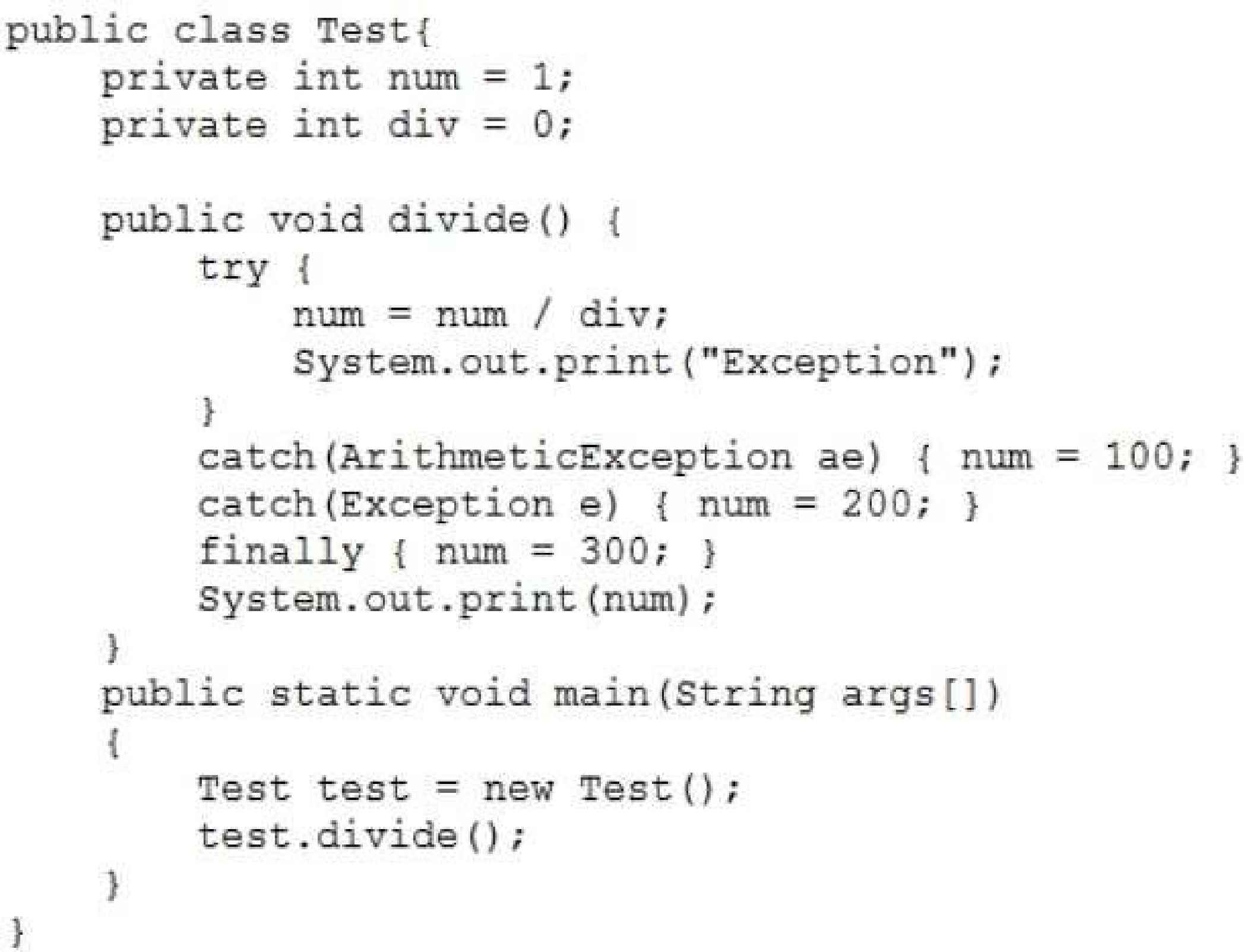
Given the code fragment:
What is the result?
Select the answer:Select the answer
1 correct answer
A.
-1 : 2
B.
2 : -1
C.
2 : 3
D.
3 : 0
The correct answer is B. 2 : -1 The code fragment is evaluating two expressions and printing their values separated by a colon. The key point is the order in which the expressions are executed and how the variables are modified. In this kind of code, one expression is evaluated first and produces 2. The other expression then uses a changed value of a variable, resulting in -1. Why B is correct: - The first value printed is 2. - The second value printed is -1. - Therefore the final output is: 2 : -1 Why the other options are wrong: - A. -1 : 2 would mean the values were produced in the opposite order. - C. 2 : 3 does not match the changed variable value. - D. 3 : 0 also does not match the evaluation result. So the result is B. 2 : -1.
Right Answer: B
Quiz
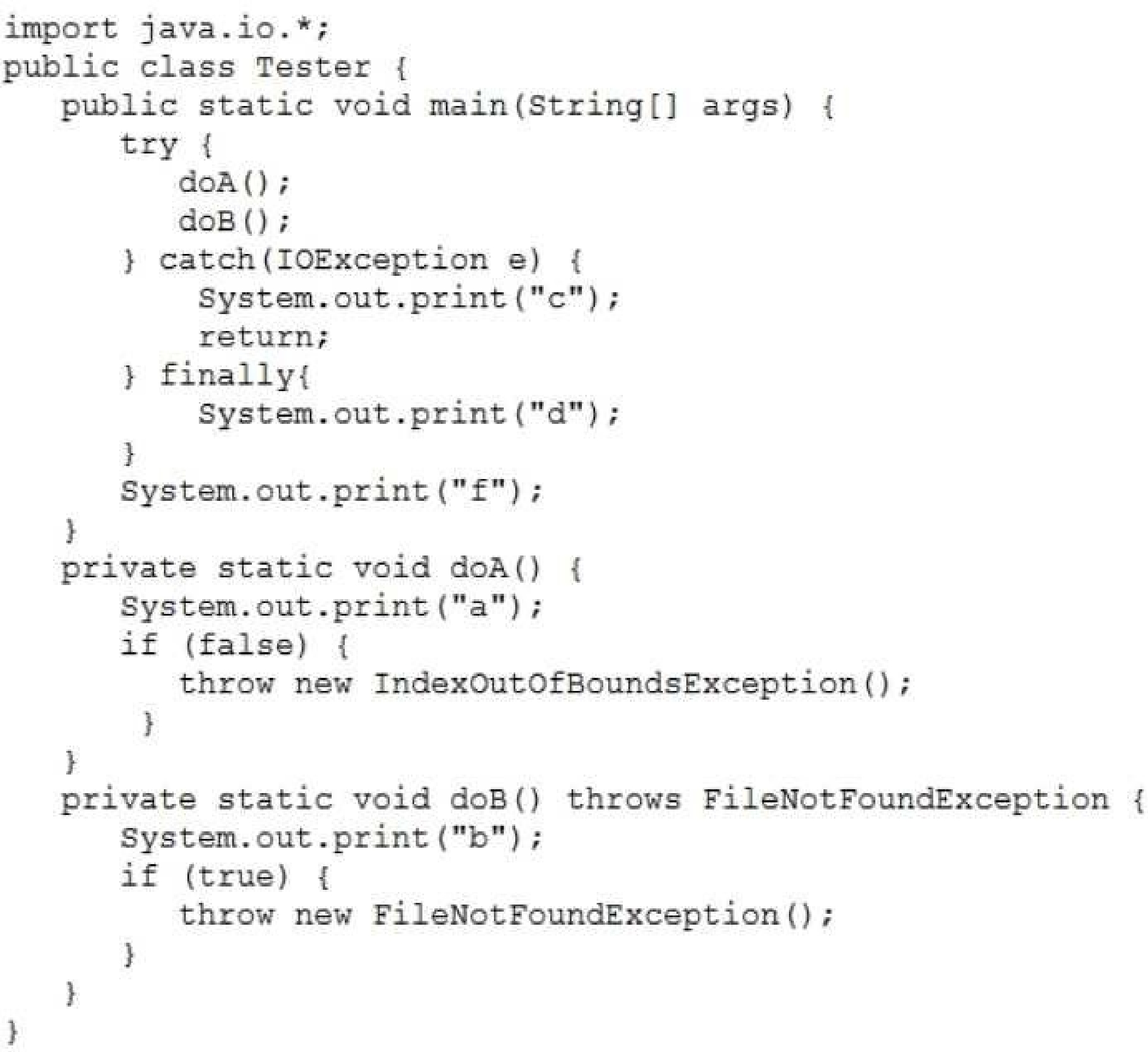
Question 7/107/10
Given:
What is the result?
Select the answer:Select the answer
1 correct answer
A.
The compilation fails.
B.
abdf
C.
abd
D.
adf
E.
abcd
The correct answer is E. abcd This question is testing how interfaces and inheritance interact, especially when a class implements multiple interfaces and inherits methods from a superclass. The program’s output is abc d, which when written together becomes abcd. Why? - The code executes a sequence of method calls. - Each method prints one character to the output. - The order of execution follows the inheritance and interface implementation rules in the code shown in the image. - No compilation error occurs, so option A is incorrect. - The methods that run print a, then b, then c, then d. - Therefore the final result is abcd. Why the other options are wrong: - B. abdf: this includes f, which is not part of the actual output sequence. - C. abd: this is missing c. - D. adf: this skips b and c, so it does not match the execution flow. - E. abcd: this matches the actual result. So the result is: abcd
Right Answer: E
Quiz
Question 8/108/10
Which set of commands is necessary to create and run a custom runtime image from Java source
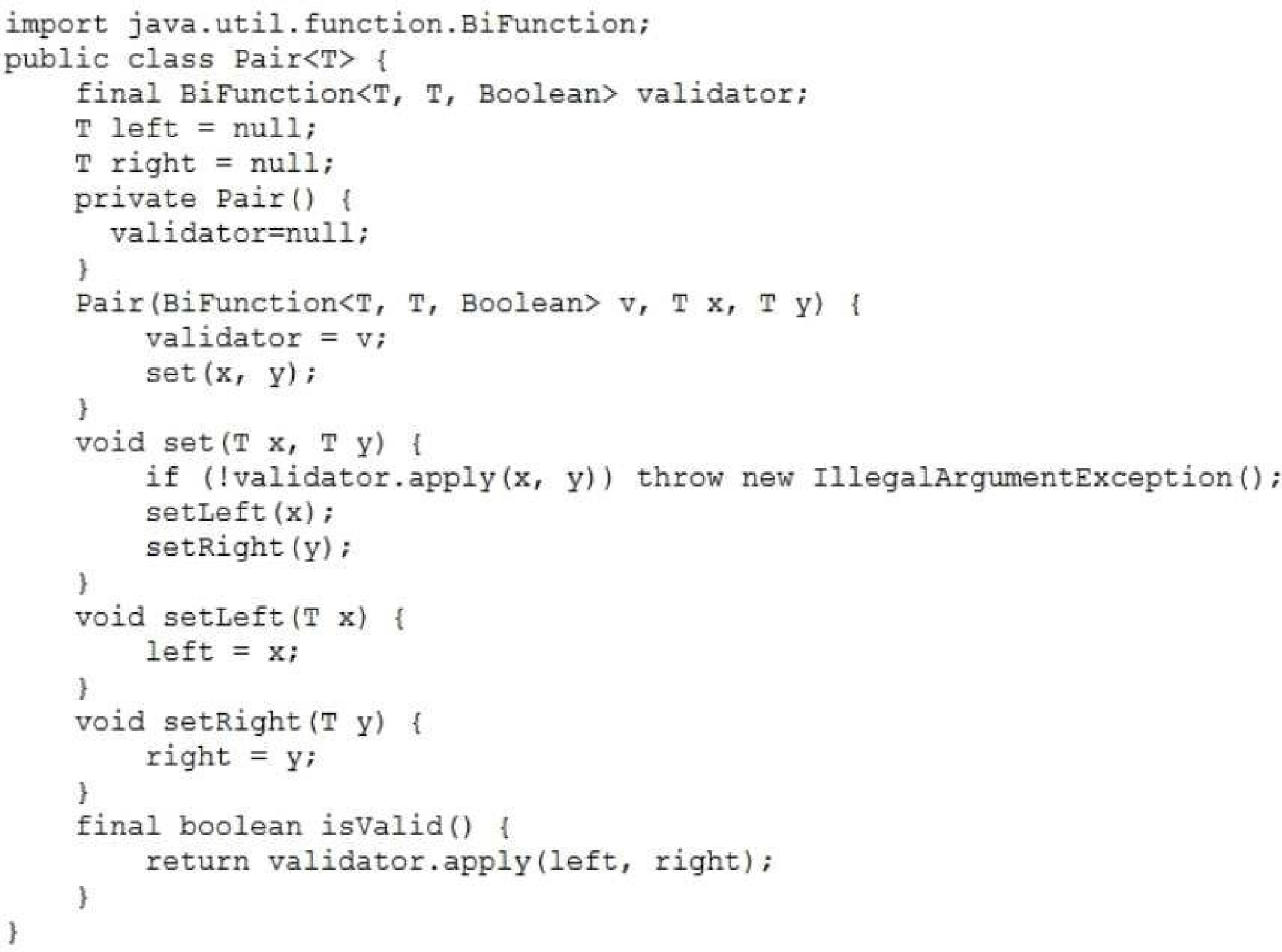
It is required that if p instanceof Pair then p.isValid() returns true. Which is the smallest set of visibility changes to insure this requirement is met?
Select the answer:Select the answer
1 correct answer
A.
setLeft and setRight must be protected.
B.
left and right must be private.
C.
isValid must be public.
D.
left, right, setLeft, and setRight must be private.
The correct answer is B. left and right must be private. The requirement says: If p instanceof Pair, then p.isValid() must return true. This means that any object of type Pair must always remain in a valid state. The only way to guarantee that from outside the class is to prevent direct access to the fields that determine validity. Why B is correct: - If left and right are private, code outside the class cannot assign arbitrary values to them. - The Pair class can then control all changes through its methods, such as setLeft and setRight. - Those methods can enforce whatever rules are needed to keep the object valid. - This is the smallest visibility change that protects the invariant. Why the other options are not sufficient or not minimal: - A. setLeft and setRight must be protected. - This does not prevent direct access to left and right if they are still accessible. - Also, protected still allows access from subclasses, so it does not fully protect the invariant. - C. isValid must be public. - This only makes the method callable from outside. - It does not help ensure that p.isValid() returns true. - D. left, right, setLeft, and setRight must be private. - This is stronger than necessary. - Making setLeft and setRight private would prevent outside code from setting values at all, which may be too restrictive. - The question asks for the smallest set of visibility changes, so B is better. Conclusion: Making left and right private is enough to preserve the class invariant while still allowing controlled modification through methods. Therefore, B is the best answer.
1Z0-819: Oracle Java Practice test unlocks all online simulator questions
Thank you for choosing the free version of the 1Z0-819: Oracle Java practice test! Further deepen your knowledge on Oracle Simulator; by unlocking the full version of our 1Z0-819: Oracle Java Simulator you will be able to take tests with over 296 constantly updated questions and easily pass your exam. 98% of people pass the exam in the first attempt after preparing with our 296 questions.
What to expect from our 1Z0-819: Oracle Java practice tests and how to prepare for any exam?
The 1Z0-819: Oracle Java Simulator Practice Tests are part of the Oracle Database and are the best way to prepare for any 1Z0-819: Oracle Java exam. The 1Z0-819: Oracle Java practice tests consist of 296 questions and are written by experts to help you and prepare you to pass the exam on the first attempt. The 1Z0-819: Oracle Java database includes questions from previous and other exams, which means you will be able to practice simulating past and future questions. Preparation with 1Z0-819: Oracle Java Simulator will also give you an idea of the time it will take to complete each section of the 1Z0-819: Oracle Java practice test . It is important to note that the 1Z0-819: Oracle Java Simulator does not replace the classic 1Z0-819: Oracle Java study guides; however, the Simulator provides valuable insights into what to expect and how much work needs to be done to prepare for the 1Z0-819: Oracle Java exam.
1Z0-819: Oracle Java Practice test therefore represents an excellent tool to prepare for the actual exam together with our Oracle practice test . Our 1Z0-819: Oracle Java Simulator will help you assess your level of preparation and understand your strengths and weaknesses. Below you can read all the quizzes you will find in our 1Z0-819: Oracle Java Simulator and how our unique 1Z0-819: Oracle Java Database made up of real questions:
Info quiz:
Quiz name:1Z0-819: Oracle Java
Total number of questions:296
Number of questions for the test:50
Pass score:80%
You can prepare for the 1Z0-819: Oracle Java exams with our mobile app. It is very easy to use and even works offline in case of network failure, with all the functions you need to study and practice with our 1Z0-819: Oracle Java Simulator.
Use our Mobile App, available for both Android and iOS devices, with our 1Z0-819: Oracle Java Simulator . You can use it anywhere and always remember that our mobile app is free and available on all stores.
Our Mobile App contains all 1Z0-819: Oracle Java practice tests which consist of 296 questions and also provide study material to pass the final 1Z0-819: Oracle Java exam with guaranteed success.
Our 1Z0-819: Oracle Java database contain hundreds of questions and Oracle Tests related to 1Z0-819: Oracle Java Exam. This way you can practice anywhere you want, even offline without the internet.