The new flashcard feature is useful to memorize questions.
?Change your study mode
At any time, you can change the study mode, and alternate between the practice mode and the exam mode. In practice mode, you can configure for example the number of questions or tests, and other parameters to help you study.
Randomized | 10 Questions per Test | 20 Minutes | 70% to pass|
To re-configure your study mode again and change - for example - the number of tests, whether you have random questions and all other configuration parameters.
?Simulator Configuration
Auto-scroll: You can use the automatic scrolling of the questionnaire that occurs as soon as you answer one or all of the answers to a question correctly. Auto scrolling is activated if you answer a single answer, or as soon as you answer all the mandatory answers. Learning Mode: During learning mode you can get a real time result for your answer.
Free Test
Question: / 10
20:00Min. left
?Restart the current test
To restart the current test by clearing all your answers and the time used up to now. Warning: all answers will be lost.
Question: / 10
4.6(1195 Votes)
Quiz
Question 1/101/10
A global media organization is working on a project which lets users upload their videos on their site. After upload is complete, the video should be automatically processed by an Al algorithm. The algorithm will try to recognize actions in the videos so that it can be used to show related advertisements in future. The development team wants to focus on writing Al code and don't want to worry about underlying infrastructure for high-availability, scalability, security and monitoring. Which OCI services should you recommend for this project?
Select the answer:Select the answer
1 correct answer
A.
Use OCI Events service for triggering automatic processing of video, Oracle Container Engine for Kubernetes (OKE) and OCI Digital Assistant
B.
Use Oracle Container Engine for Kubernetes (OKE) for deployment of Al Code, OCI Notifications and Object Storage
C.
Use OCI Resource Manager to manage the underlying infrastructure, OCI Functions and OCI Events service.
D.
Use Object Storage for storing videos, OCI Events service and OCI Functions
Oracle Functions is a fully managed, multi-tenant, highly scalable, on-demand, Functions-as-a-Service platform. It is built on enterprise-grade Oracle Cloud Infrastructure and powered by the Fn Project open source engine. Use Oracle Functions (sometimes abbreviated to just Functions) when you want to focus on writing code to meet business needs. The serverless and elastic architecture of Oracle Functions means there's no infrastructure administration or software administration for you to perform. You don't provision or maintain compute instances, and operating system software patches and upgrades are applied automatically. Oracle Functions simply ensures your app is highly-available, scalable, secure, and monitored. With Oracle Functions, you can write code in Java, Python, Node, Go, and Ruby (and for advanced use cases, bring your own Dockerfile, and Graal VM). You can then deploy your code, call it directly or trigger it in response to events, and get billed only for the resources consumed during the execution. You can create automation based on state changes for your Oracle Cloud Infrastructure resources by using event types, rules, and actions. When the function is executing inside the container, the function can read from and write to other resources and services running in the same subnet (for example, Database as a Service). The function can also read from and write to other shared resources (for example, Object Storage), and other Oracle Cloud Services.
Right Answer: D
Quiz
Question 2/102/10
An OCI Architect is working on a solution consisting of analysis of data from clinical trials of a pharmaceutical company. The data is being stored in OCI Autonomous Data Warehouse (ADW) having 8 CPU Cores and 70 TB of storage. The architect is planning to setup autoscaling to respond to dynamic changes in the workload. Which of the following needs to be considered while configuring auto scaling? Choose two
Select multiple answer: (Choose 2)Select the answer
2 correct answers
A.
Enabling auto scaling does not change the concurrency and parallelism settings
B.
Auto scaling also scales IO throughput linearly along with CPU
C.
The database memory SGA and PGA will not get affected by the changes in the number of CPUs during auto scaling
D.
The maximum CPU cores that will be automatically allocated for this database is 16 CPUs
Auto scaling is enabled by default when you create an Autonomous Database instance or you can use Scale Up/Down on the Oracle Cloud Infrastructure console to enable or disable auto scaling. With auto scaling enabled the database can use up to three times more CPU and IO resources than specified by the number of OCPUs currently shown in the Scale Up/Down dialog. When auto scaling is enabled, if your workload requires additional CPU and IO resources the database automatically uses the resources without any manual intervention required. Enabling auto scaling does not change the concurrency and parallelism settings for the predefined services IO throughput depends on the number of CPUs you provision and scales linearly with the number of CPUs.
Right Answer: A, B
Quiz
Question 3/103/10
You are responsible for migrating your on premises legacy databases on 11.2.0.4 version to Autonomous Transaction Processing Dedicated (ATP-D) In Oracle Cloud Infrastructure (OCI). As a solution architect, you need to plan your migration approach. Which two options do you need to implement together to migrate your on premises databases to OCI?
Select multiple answer: (Choose 2)Select the answer
2 correct answers
A.
Use Oracle Data Guard to keep on premises database always active during migration
B.
Retain changes to Oracle shipped privileges, stored procedures or views In the on-premises databases.
C.
Use Oracle GoldenGate replication to keep on premises database online during migration.
D.
Convert on-premises databases to PDB, upgrade to 19c, and encrypt Migration.
E.
Retain all legacy structures and unsupported features (e.g. taw U>Bs) In the onuses databases for migration.
Autonomous Database is an Oracle Managed and Secure environment. A physical database can't simply be migrated to autonomous because: - Database must be converted to PDB, upgraded to 19c, and encrypted - Any changes to Oracle shipped privileges, stored procedures or views must be removed - All legacy structures and unsupported features must be removed (e.g. legacy LOBs) GoldenGate replication can be used to keep database online during migration
Right Answer: C, D
Quiz
Question 4/104/10
You are working as a cloud engineer for an IoT startup company which is developing a health monitoring pet collar for dogs and cats. The company collects biometric Information of the pet every second and then sends it to Oracle Cloud Infrastructure (OCI) Your task is to come up with an architecture which will accept and process the monitoring data as well as provide complete trends and health reports to the pet owners. The portal should be highly available, durable, and scalable with an additional feature for showing real time biometric data analytics. which architecture will help you meet this requirement?
Select the answer:Select the answer
1 correct answer
A.
Use OCI Streaming Service to collect the incoming biometric data. Use Oracle Functions to process the date and show the results on a real-time dashboard and store the results lo OCI Object Storage Store the data In OCI Autonomous Data warehouse (ADW) to handle analytics.
B.
Launch an open source Hadoop cluster to collect the Incoming biometrics data Use an Open source Fluentd cluster to analyze the- data me results to OCI Autonomous Transaction Processing (ADW)to handle complex analytics
C.
Create an OCI Object Storage bucket to collect the incoming biometric data from the smart pet collar Fetch the data horn OC\ Object storage to OCI Autonomous Data Warehouse (ADW) every day and run analytics Jobs with it
D.
Use OCI Streaming Service to collect the incoming biometric data. Use an open source Hadoop cluster to analyze the data horn streaming service. Store the results to OCI Autonomous Data warehouse (ADW) to handle complex analytics.
Right Answer: A
Quiz
Question 5/105/10
A new International hacktivfst group based in London, launched a wide scale cyber attacks Including SQL Injection and Cross-Site Scripting (XSS) across multiple websites which are hosted in Oracle Cloud Infrastructure (OCI). As an IT consultant, you must configure a Web Application Firewall (WAF) to protect these website against the attacks. How should you configure your WAF to protect the website against those attacks?
Select the answer:Select the answer
1 correct answer
A.
Enable an Access Rule that contains XSS Filters Categories and SQL Filters Categories.
B.
Enable a Protection Rule to block the attacks based on HTTP Headers that contain XSS and SQL strings.
C.
Enable a Protection Rule that contains XSS Filters Categories and SQL Filters Categories.
D.
Enable an Access Rule to block the IP Address range from London.
E.
Enable a Protection Rule to block requests that came from London.
Right Answer: A
Quiz
Question 6/106/10
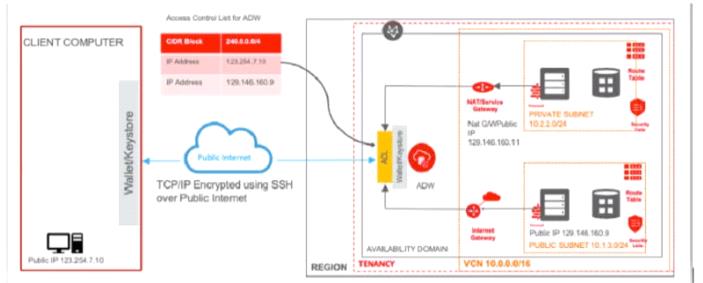
You have designed and deployed your Autonomous Data Warehouse (ADW) such that it is accessible from your on-premises data center and servers running on both private and public networks in Oracle Cloud Infrastructure (OCI).
As you are testing the connectivity to your ADW database from the different access paths, you notice that the sewer lunninq on the private network is unable to connect to ADW. Which two steps do you need to take to enable connectivity from the server on the private network to ADW?
Select multiple answer: (Choose 2)Select the answer
2 correct answers
A.
Add an entry in the Security List of the ADW allowing ingress traffic for C10R block 10.2.2.0/24
B.
Add an entry in the route table (associated with the private subnet) with destination of 0.0.0.0/: target type of NAT Gateway, add a stateful egress rule to the security list (associated with the private subnet) with destination of 0.0.0.0./0 and for all IP protocols.
C.
Add an entry in the access table list of ASW for CIDR block 10.2.2.0/24.
D.
Add an entry in the route table (associated with the private subnet) with destination of 0.0.0.0./0; target type of internet Gateway, add a stateful egress in the security list (associated with the private subnet) with destination of 0.0.0.0/0 and for all IP protocols.
E.
Add an entry in the access control list of ADW for IP address 129.146.160.11
There are 3 connections to ADW 1- Connecting to (ADW) from Public Internet 2- Connecting to ADW (via NAT or Service Gateway) from a server running on a private subnet in OCI (in the same tenancy) 3- Connecting to ADW (via internet Gateway) from a server running on a public subnet in OCI (in the same tenancy
Right Answer: B, E
Quiz
Question 7/107/10
You are trying to delete a compartment. The delete operation is falling and you need to troubleshoot the problem. Which step should NOT be considered when troubleshooting this issue?
Select the answer:Select the answer
1 correct answer
A.
Verify that there are no policies In the root compartment that reference the compartment you are trying to delete.
B.
Verify that you have removed all resources from the compartment.
C.
Make sure you have at least one more compartment in your tenancy other than the root compartment.
D.
Search for resources in the compartment for each region that your tenancy is subscribed to.
Right Answer: A
Quiz
Question 8/108/10
You are working as a security consultant with a global insurance organization which is using Microsoft Azure Active Directory (AD) as identity provided to manager user login/passwords. When a user logs in to Oracle Cloud infrastructure (OCI) console, it should get authenticated by Azure AD. Which set of steps are required to configure at OCI side in order to get it enabled
Select the answer:Select the answer
1 correct answer
A.
Setup Azure AD as an Enterprise Application, map Azure AD users and groups and policies to OCI groups and users
B.
Setup Azure AD as an Identity Provider, Import users and groups from Azure AD to OCI, set up IAM policies to govern access to Azure AD groups
C.
Setup Azure AD as an Enterprise Application, configure OCI for single sign-on, map Azure AD groups to OCI groups, set up the IAM policies to govern access to Azure AD groups
D.
Setup Azure AD as an Identity Provider, map Azure AD groups to OCI groups, set up the IAM policies to govern access to Azure AD groups
Federating with Microsoft Azure Active Directory To federate with Azure AD, you set up Oracle Cloud Infrastructure as a basic SAML single sign-on application in Azure AD. To set up this application, you perform some steps in the Oracle Cloud Infrastructure Console and some steps in Azure AD. Following is the general process an administrator goes through to set up the federation. Details for each step are given in the next section. In Oracle Cloud Infrastructure, download the federation metadata document. In Azure AD, set up Oracle Cloud Infrastructure Console as an enterprise application. In Azure AD, configure the Oracle Cloud Infrastructure enterprise application for single sign-on. In Azure AD, set up the user attributes and claims. In Azure AD, download the Azure AD SAML metadata document. In Azure AD, assign user groups to the application. In Oracle Cloud Infrastructure, set up Azure AD as an identity provider. In Oracle Cloud Infrastructure, map your Azure AD groups to Oracle Cloud Infrastructure groups. In Oracle Cloud Infrastructure, set up the IAM policies to govern access for your Azure AD groups. Share the Oracle Cloud Infrastructure sign-in URL with your user
Right Answer: D
Quiz
Question 9/109/10
You are a solutions architect for a global health care company which has numerous data centers around the globe. Due to the ever growing data that your company is storing, you were Instructed to set up a durable, cost effective solution to archive you data from your existing on- premises tape based backup Infrastructure to Oracle Cloud Infrastructure (OCI). What is the most-effective mechanism to Implement this requirement?
Select the answer:Select the answer
1 correct answer
A.
Use the File Storage Service in OCI and copy the data from your existing tape based backup to the shared file system
B.
Setup an on premises OCI Storage Gateway which will back up your data to OCI Object Storage Archive tier.(Correct)
C.
Setup an on premises OCI Storage Gateway which will back up your data to OCI object Storage Standard tier. Use Object Storage life cycle policy management to move any data older than 30 days from Standard to Archive tier.
D.
Setup an on-promises OCI Storage Gateway which will back up your data to OCI Object Storage Standard
E.
Setup fastConnect to connect your on premises network to your OCI VCN and use rsync tool to copy your data to OCI Object Storage Archive tier.
Oracle Cloud Infrastructure offers two distinct storage tiers for you to store your unstructured data. Use the Object Storage Standard tier for data to which you need fast, immediate, and frequent access. Use the Archive Storage service's Archive tier for data that you access infrequently, but which must be preserved for long periods of time. Both storage tiers use the same manageable resources (for example, objects and buckets). The difference is that when you upload a file to Archive Storage, the object is immediately archived. Before you can access an archived object, you must first restore the object to the Standard tier. you can use Storage Gateway to move files to Oracle Cloud Infrastructure Archive Storage as a cost effective backup solution. You can move individual files and compressed or uncompressed ZIP or TAR archives. Storing secondary copies of data is an ideal use case for Storage Gateway.
Right Answer: B
Quiz
Question 10/1010/10
A cost conscious fashions design company which sells bags, clothes, and other luxury items has recently decided to more all of the their on-premises infrastructure Oracle Cloud Infrastructure (OCI), One of their on-premises application is running on an NGINX server and the Oracle Database is
running in a 2 node Oracle Real Application Clusters (RAC) configuration. Based on cost considerations, what is an effective mechanism to migrate the customer application to OCI and set up regular automated backups?
Select the answer:Select the answer
1 correct answer
A.
Launch a compute Instance and run a NGINX server to host the application. Deploy a 2 node VM DB Systems with oracle RAC enabled import the on premises database to OCI VM DB Systems using oracle Data Pump and then enable automatic backups.
B.
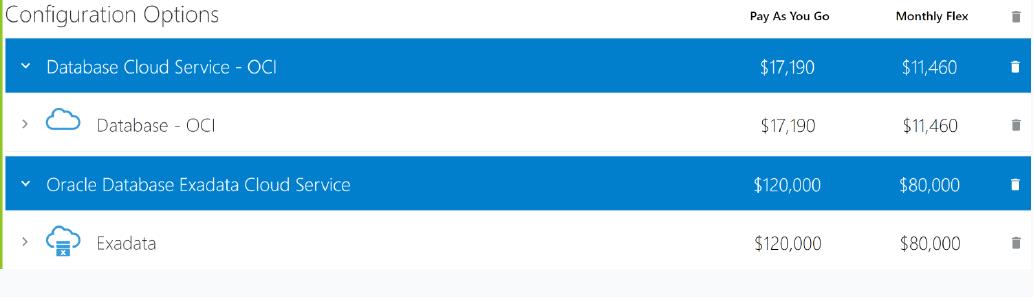
Launch a compute Instance and run an NGINX server to host the application. Deploy Exadata Quarter Rack, enable automatic backups and import the database using Oracle Data Pump.
C.
Launch a compute Instance for both the NGINX application server and the database server. Attach block volumes on the database server compute instance and enable backup policy to backup the block volumes.
D.
Launch a Compute instance and run a NGINX Server to host the application. Deploy a 2 node VM DB Systems with Oracle RAC enabled Import the on premises database to OCI VM DB Systems using data pump and then enable automatic backup- Also, enable Oracle Data Guard on the database server
1z0-997: Oracle Cloud Infrastructure 2019 Architect Professional Practice test unlocks all online simulator questions
Thank you for choosing the free version of the 1z0-997: Oracle Cloud Infrastructure 2019 Architect Professional practice test! Further deepen your knowledge on Oracle Simulator; by unlocking the full version of our 1z0-997: Oracle Cloud Infrastructure 2019 Architect Professional Simulator you will be able to take tests with over 75 constantly updated questions and easily pass your exam. 98% of people pass the exam in the first attempt after preparing with our 75 questions.
What to expect from our 1z0-997: Oracle Cloud Infrastructure 2019 Architect Professional practice tests and how to prepare for any exam?
The 1z0-997: Oracle Cloud Infrastructure 2019 Architect Professional Simulator Practice Tests are part of the Oracle Database and are the best way to prepare for any 1z0-997: Oracle Cloud Infrastructure 2019 Architect Professional exam. The 1z0-997: Oracle Cloud Infrastructure 2019 Architect Professional practice tests consist of 75 questions and are written by experts to help you and prepare you to pass the exam on the first attempt. The 1z0-997: Oracle Cloud Infrastructure 2019 Architect Professional database includes questions from previous and other exams, which means you will be able to practice simulating past and future questions. Preparation with 1z0-997: Oracle Cloud Infrastructure 2019 Architect Professional Simulator will also give you an idea of the time it will take to complete each section of the 1z0-997: Oracle Cloud Infrastructure 2019 Architect Professional practice test . It is important to note that the 1z0-997: Oracle Cloud Infrastructure 2019 Architect Professional Simulator does not replace the classic 1z0-997: Oracle Cloud Infrastructure 2019 Architect Professional study guides; however, the Simulator provides valuable insights into what to expect and how much work needs to be done to prepare for the 1z0-997: Oracle Cloud Infrastructure 2019 Architect Professional exam.
1z0-997: Oracle Cloud Infrastructure 2019 Architect Professional Practice test therefore represents an excellent tool to prepare for the actual exam together with our Oracle practice test . Our 1z0-997: Oracle Cloud Infrastructure 2019 Architect Professional Simulator will help you assess your level of preparation and understand your strengths and weaknesses. Below you can read all the quizzes you will find in our 1z0-997: Oracle Cloud Infrastructure 2019 Architect Professional Simulator and how our unique 1z0-997: Oracle Cloud Infrastructure 2019 Architect Professional Database made up of real questions:
Info quiz:
Quiz name:1z0-997: Oracle Cloud Infrastructure 2019 Architect Professional
Total number of questions:75
Number of questions for the test:50
Pass score:80%
You can prepare for the 1z0-997: Oracle Cloud Infrastructure 2019 Architect Professional exams with our mobile app. It is very easy to use and even works offline in case of network failure, with all the functions you need to study and practice with our 1z0-997: Oracle Cloud Infrastructure 2019 Architect Professional Simulator.
Use our Mobile App, available for both Android and iOS devices, with our 1z0-997: Oracle Cloud Infrastructure 2019 Architect Professional Simulator . You can use it anywhere and always remember that our mobile app is free and available on all stores.
Our Mobile App contains all 1z0-997: Oracle Cloud Infrastructure 2019 Architect Professional practice tests which consist of 75 questions and also provide study material to pass the final 1z0-997: Oracle Cloud Infrastructure 2019 Architect Professional exam with guaranteed success.
Our 1z0-997: Oracle Cloud Infrastructure 2019 Architect Professional database contain hundreds of questions and Oracle Tests related to 1z0-997: Oracle Cloud Infrastructure 2019 Architect Professional Exam. This way you can practice anywhere you want, even offline without the internet.