The new flashcard feature is useful to memorize questions.
?Change your study mode
At any time, you can change the study mode, and alternate between the practice mode and the exam mode. In practice mode, you can configure for example the number of questions or tests, and other parameters to help you study.
Randomized | 10 Questions per Test | 20 Minutes | 70% to pass|
To re-configure your study mode again and change - for example - the number of tests, whether you have random questions and all other configuration parameters.
?Simulator Configuration
Auto-scroll: You can use the automatic scrolling of the questionnaire that occurs as soon as you answer one or all of the answers to a question correctly. Auto scrolling is activated if you answer a single answer, or as soon as you answer all the mandatory answers. Learning Mode: During learning mode you can get a real time result for your answer.
Free Test
Question: / 10
20:00Min. left
?Restart the current test
To restart the current test by clearing all your answers and the time used up to now. Warning: all answers will be lost.
Question: / 10
5.0(205 Votes)
Quiz
Question 1/101/10
U+ Bank observes that some customers receive the same credit card offer multiple times within a short period, which results in dissatisfaction. The bank wants to suppress a specific credit card offer if it has been shown three times within seven days. What should you configure in the Contact Policy to prevent a specific credit card offer from being shown to a customer more than three times in seven days?
Select the answer:Select the answer
1 correct answer
A.
Set the Tracking Level to Group and the Outcome Type to Impressions.
B.
Set the Tracking Level to Group and the Outcome Type to Clicks.
C.
Set the Tracking Level to Action and the Outcome Type to Impressions.
D.
Set the Tracking Level to Action and the Outcome Type to Clicks.
The correct answer is C. Set the Tracking Level to Action and the Outcome Type to Impressions. The goal is to stop one specific credit card offer from being shown to the same customer more than three times within seven days. In other words, the bank wants to control how often that particular offer is displayed, not how often it is clicked. Why C is correct: - Tracking Level: Action - An Action represents a specific offer or next-best-action item. - Since the bank wants to suppress one specific credit card offer, the policy must track that individual offer at the Action level. - Outcome Type: Impressions - Impressions count how many times the offer is shown to the customer. - Because the issue is repeated display of the same offer, impressions are the correct metric. - With this setup, the Contact Policy can suppress the offer after it has been presented three times within the configured seven-day window. Why the other options are incorrect: - A. Group + Impressions - Group tracking applies to a broader category of offers, not a single specific offer. - This would suppress all offers in the group, which is too broad for this requirement. - B. Group + Clicks - Clicks measure customer interactions, not how often the offer is shown. - Also, Group is still too broad. - D. Action + Clicks - Action is correct because it targets the specific offer. - But Clicks is wrong because the problem is about repeated exposure, not clicks. Key takeaway: - Use Action when you want to control a single specific offer. - Use Impressions when you want to limit how many times that offer is shown. So the right configuration is: Tracking Level = Action Outcome Type = Impressions
Right Answer: C
Quiz
Question 2/102/10
A mortgage company defines a new suppression policy to limit promotional emails for home loan offers. The policy is complete, but it must be applied to all to home loan actions. The implementation team must associate this policy with the appropriate business structure. Where should the team associate the contact policy to apply it to home loan promotions?
Select the answer:Select the answer
1 correct answer
A.
The Engagement policy tab to apply the policy to home loan action group.
B.
The Contact policy configuration to update outcome tracking preferences only.
C.
The Constraints tab to edit customer contact limits for email channels.
D.
The Designer settings to modify global suppression rules for home loan action group.
The correct answer is A. The Engagement policy tab to apply the policy to home loan action group. A contact policy is used to control how often or under what conditions customers can be contacted for a particular type of marketing or promotional action. In this case, the mortgage company has created a suppression policy to limit promotional emails for home loan offers, and the policy must now be linked to the correct business structure so it actually takes effect for those promotions. Why A is correct: The Engagement policy tab is where you associate a contact policy with an action group, such as a home loan action group. This is the right place to apply suppression or contact frequency rules to a specific set of promotional actions. Since the goal is to control promotional emails for home loan offers, attaching the policy to the home loan action group ensures the policy governs those interactions. Why the other options are incorrect: B. The Contact policy configuration to update outcome tracking preferences only. This is not the right place for applying suppression rules to promotional actions. Outcome tracking preferences deal with how results are recorded, not with enforcing contact restrictions. C. The Constraints tab to edit customer contact limits for email channels. Although this sounds related to contact limits, it is not the correct configuration area for associating a policy with a specific business action group. The question asks where to associate the policy so it applies to home loan promotions, which is done through engagement policy association, not just channel constraints. D. The Designer settings to modify global suppression rules for home loan action group. Designer settings are for broader design or rule configuration, not for linking a contact policy to a specific action group. Global suppression rules are too broad and do not match the need to target home loan promotions through the proper policy association. Summary: To apply the suppression policy to home loan promotional emails, the team should associate it in the Engagement policy tab with the home loan action group. That is why A is the best answer.
Right Answer: A
Quiz
Question 3/103/10
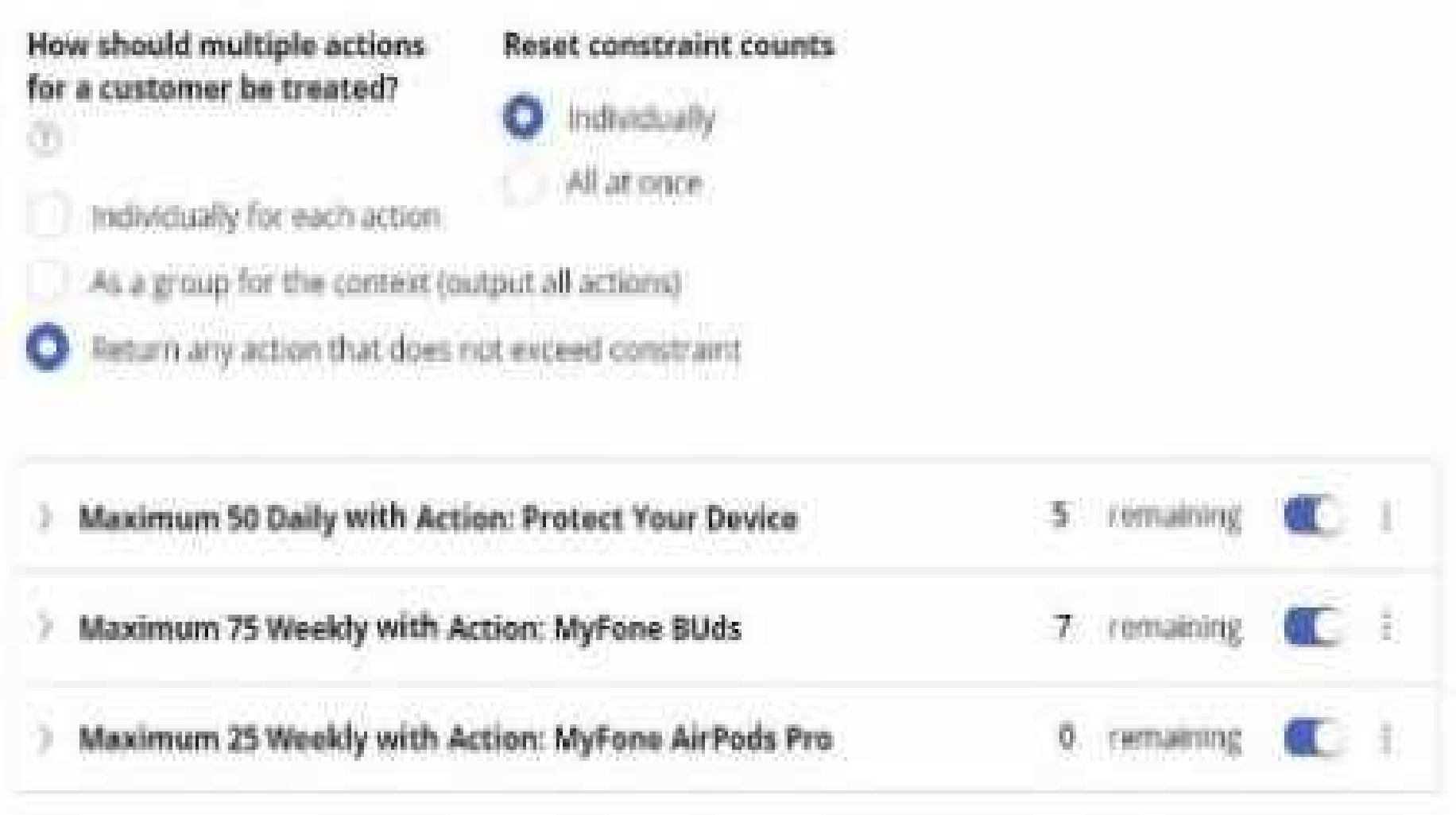
In the following figure, a volume constraint uses the Return any action that does not exceed constraint mode with the three following action type constraints that have remaining limits: 1. Maximum 50 Daily with Action: Protect Your Device, 5 remaining 2. Maximum 75 Daily with Action: MyFone Buds, 7 remaining 3. Maximum 25 Daily with Action: MyFone AirPods Pro, 0 remaining A customer, CUST-01, qualifies for all the three actions. Given this scenario, how many actions does
the system select for CUST-01 in the outbound run?
Select the answer:Select the answer
1 correct answer
A.
3
B.
0
C.
2
D.
1
The correct answer is C. 2 The system uses a volume constraint in Return any action mode, which means it can select any qualifying action as long as that action still has remaining capacity under its individual limit. Here are the three available action type constraints: 1. Protect Your Device - Maximum daily limit: 50 - Remaining: 5 - This action can still be selected. 2. MyFone Buds - Maximum daily limit: 75 - Remaining: 7 - This action can still be selected. 3. MyFone AirPods Pro - Maximum daily limit: 25 - Remaining: 0 - This action cannot be selected because its limit is already exhausted. Since CUST-01 qualifies for all three actions, the system can select only the actions that still have remaining capacity. That means 2 actions are eligible and can be selected. Therefore, the system selects 2 actions for CUST-01 in the outbound run.
Right Answer: C
Quiz
Question 4/104/10
A financial services organization introduces a new policy that limits each customer to two promotional emails per month. To meet compliance requirements, the implementation team must configure this limit in the Next-Best-Action Designer. Which configuration steps achieve the desired email frequency limit?
Select the answer:Select the answer
1 correct answer
A.
Set customer contact limits for the email channel with a two-message monthly restriction.
B.
Configure an engagement policy that applies email limits to customer groups only.
C.
Create a suppression policy that uses a two-email threshold and a monthly tracking period.
D.
Establish context-level limits that track two monthly interactions across channels.
The correct answer is A. Why A is correct: In Next-Best-Action Designer, customer contact limits are used to control how many times a customer can be contacted through a specific channel over a defined period. Since the policy is about limiting promotional emails to two per month, the correct configuration is to set a customer contact limit for the email channel with a monthly cap of two messages. This directly enforces the requirement: - Channel-specific control: email only - Quantity limit: two - Time period: monthly Why the other options are incorrect: B. Configure an engagement policy that applies email limits to customer groups only. This is too broad and not the right mechanism. Engagement policies are used for governing treatment selection and prioritization, but “customer groups only” does not precisely enforce an individual customer-level monthly email cap. C. Create a suppression policy that uses a two-email threshold and a monthly tracking period. Suppression policies are generally used to block actions under certain conditions, but this is not the standard configuration for setting a straightforward per-customer channel contact frequency limit in NBA Designer. The question specifically asks for the configuration steps that achieve the email frequency limit, which points to contact limits. D. Establish context-level limits that track two monthly interactions across channels. This is not correct because the policy is for promotional emails, not all channels. “Across channels” would incorrectly restrict other contact types, and context-level limits are not the right fit for a channel-specific email cap. Key takeaway: For a monthly limit on promotional emails per customer, configure customer contact limits for the email channel. This is the most direct and appropriate way to implement the requirement in Next-Best-Action Designer.
Right Answer: A
Quiz
Question 5/105/10
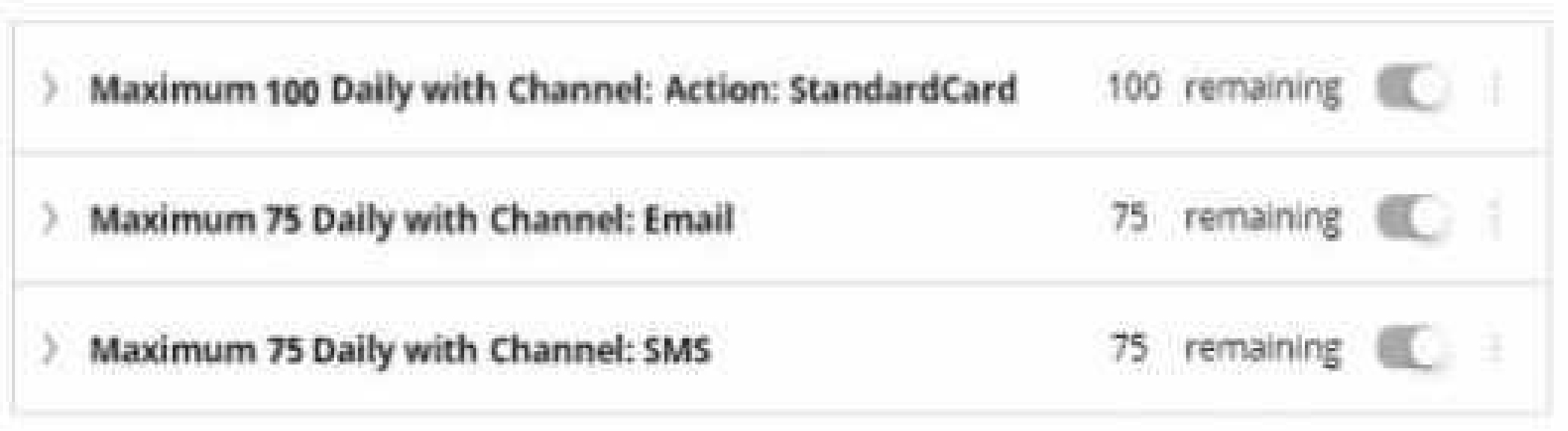
An outbound run identifies 150 Standard card offers, 75 on email, and 75 on the SMS channel. If the
following volume constraint Is applied, how many actions are delivered by the outbound run?
Select the answer:Select the answer
1 correct answer
A.
75 emails 25 SMSes
B.
100
C.
75 SMSes and 25 emails
D.
150
The correct answer is B. 100 The outbound run finds 150 Standard card offers in total: - 75 are assigned to the email channel - 75 are assigned to the SMS channel A volume constraint limits how many actions can actually be delivered. Based on the constraint shown in the question, only 100 actions can be sent in total. So even though 150 offers were identified, the outbound run delivers only 100 actions overall. Therefore, the correct answer is: B. 100
Right Answer: B
Quiz
Question 6/106/10
A customer qualifies for Standard card (priority 60), Rewards card {priority 40), and Premium card {priority 30). Standard card volume is exhausted. Rewards card has remaining volume, and Premium card has remaining volume. The system uses "Return any action that does not exceed constraint" mode. Which actions does the customer receive in this scenario?
Select the answer:Select the answer
1 correct answer
A.
Standard card only as highest priority action
B.
No actions due to Standard card volume exhaustion
C.
Premium card only as lowest priority available action
D.
Rewards card and Premium card as available actions
The correct answer is D. Rewards card and Premium card as available actions. The key rule here is the “Return any action that does not exceed constraint” mode. In this mode, the system does not stop just because the highest-priority eligible action is unavailable. Instead, it returns any qualifying actions that still satisfy the constraints, such as available volume. Let’s break down the situation: 1. The customer qualifies for all three actions: - Standard card, priority 60 - Rewards card, priority 40 - Premium card, priority 30 2. Check volume availability: - Standard card: exhausted, so it cannot be returned - Rewards card: has remaining volume - Premium card: has remaining volume 3. Apply the mode: - Since the system returns any action that does not exceed constraint, it will exclude only the action that violates the constraint. - Standard card is excluded because its volume is exhausted. - Rewards card and Premium card remain eligible and available. Why the other options are wrong: - A. Standard card only as highest priority action - Incorrect because Standard card has no remaining volume. - B. No actions due to Standard card volume exhaustion - Incorrect because the system does not discard all actions just because the top-priority one is unavailable. - C. Premium card only as lowest priority available action - Incorrect because Rewards card also has remaining volume, so it should be returned too. Therefore, the customer receives both Rewards card and Premium card.
Right Answer: D
Quiz
Question 7/107/10
U+Bank presents various credit card offers to Its customers on Its website. The bank uses AI to prioritize the offers according to customer behavior. After the introduction of the Gold credit card offer, the offer click-through propensity decreased to 0.42. What does the decrease in the propensity value most likely indicate?
Select the answer:Select the answer
1 correct answer
A.
Similar customers purchase other offers.
B.
Similar customers show interest in the offer.
C.
Similar customers ignore the offer.
D.
Similar customers do not qualify for the offer.
The correct answer is C. Similar customers ignore the offer. In this context, "click-through propensity" refers to the likelihood that customers will click on a credit card offer when it is shown to them. A propensity value of 0.42 means the predicted interest or engagement with the Gold credit card offer has decreased. A decrease in propensity most likely means that customers who are similar to the target customer are less likely to respond positively to the offer. In other words, they are ignoring it or showing less interest in clicking it. Why the other options are not correct: A. Similar customers purchase other offers. This is not implied by a decrease in click-through propensity. It only suggests lower engagement with this specific offer, not that they are choosing other offers instead. B. Similar customers show interest in the offer. This is the opposite of what a lower propensity value indicates. D. Similar customers do not qualify for the offer. Qualification is about eligibility, not click-through behavior. The question is about propensity, which measures likelihood of interaction, not whether customers meet the requirements. So, the best interpretation of the decrease is that similar customers are ignoring the offer.
Right Answer: C
Quiz
Question 8/108/10
MyCo,a telecom company, recently introduced a new mobile handset offer, MyFone 14 Pro, for its premium customers. As the bank has financial targets to meet, the business decides to boost the MyFone 14 Pro offer. As a decisioning architect, how can you ensure that the MyFonel4 Pro offer is prioritized over other offers7
Select the answer:Select the answer
1 correct answer
A.
Increase the business weight of the MyFone 14 Pro offer.
B.
Increase the business value of the MyFone 14 Pro offer.
C.
Increase the context weight of the MyFone 14 Pro offer.
D.
Increase the starting propensity of the MyFone 14 Pro offer.
The correct answer is A. Increase the business weight of the MyFone 14 Pro offer. In a decisioning or offer-prioritization context, an offer’s ranking is typically influenced by factors such as business weight, business value, context weight, and starting propensity. Among these, business weight is the setting that directly affects how strongly an offer is prioritized relative to others when the system is choosing which offer to present. Why A is correct: - Business weight is used to control the relative importance of an offer in the overall decisioning process. - If MyCo wants MyFone 14 Pro to be selected more often than competing offers, increasing its business weight makes it more likely to rise above the others in ranking. - This is the most direct way to ensure prioritization of that specific offer. Why the other options are not the best answer: B. Increase the business value of the MyFone 14 Pro offer. - Business value usually represents the expected commercial benefit or worth of the offer. - While increasing it may make the offer more attractive in analysis or scoring, it does not necessarily directly prioritize the offer in the same way business weight does. C. Increase the context weight of the MyFone 14 Pro offer. - Context weight is tied to how well the offer fits the current customer or situational context. - This affects contextual relevance, not overall business-driven prioritization. D. Increase the starting propensity of the MyFone 14 Pro offer. - Starting propensity is generally a baseline probability or initial likelihood score. - It can influence the offer score, but it is not the primary setting used to explicitly prioritize an offer over others in business terms. Conclusion: To make MyFone 14 Pro take precedence over other offers, the decisioning architect should increase its business weight, which is why A is the correct answer.
Right Answer: A
Quiz
Question 9/109/10
As a decisioning architect, how can you optimize the strategies that are based on Insights that you gain from the AI Insight feature in the Customer Profile Viewer?
Select the answer:Select the answer
1 correct answer
A.
By understanding how engagement policies are being used and why certain actions are filtered
B.
By integrating social media analytics into the Customer Profile Viewer
C.
By understanding how action performance is used and why new actions are required
D.
By generating automated marketing campaigns based on customer data
The correct answer is A. By understanding how engagement policies are being used and why certain actions are filtered. The AI Insight feature in the Customer Profile Viewer helps a decisioning architect understand why certain actions are available or filtered out for a customer. This is important because strategies in decisioning are often governed by engagement policies, which control which actions can be selected based on business rules, eligibility, constraints, and prioritization logic. By reviewing these insights, you can: - See how engagement policies are applied - Understand why specific actions were excluded or suppressed - Identify whether the strategy is behaving as intended - Optimize the strategy by adjusting policy rules, action eligibility, or prioritization logic Why the other options are incorrect: - B. Integrating social media analytics into the Customer Profile Viewer This is unrelated to AI Insight and the strategy optimization process described. - C. By understanding how action performance is used and why new actions are required Action performance may be useful for broader analysis, but the question specifically refers to insights from AI Insight in the Customer Profile Viewer, which focuses on policy usage and action filtering. - D. By generating automated marketing campaigns based on customer data This describes campaign generation, not strategy optimization based on AI Insight. In short, AI Insight helps you understand the decisioning logic behind action filtering, enabling you to refine engagement policies and improve strategy performance.
Right Answer: A
Quiz
Question 10/1010/10
MyCo, a telecom company, notices that when customers call to check on bill status, 80% of the time, they received the wrong offer promotion, leading to customer dissatisfaction. The company decides to boost customers' needs in the prioritization formula, to Improve sales in the current quarter. Which arbitration factor do you configure to implement the requirement?
Select the answer:Select the answer
1 correct answer
A.
Context weighting
B.
Business value
C.
Propensity
D.
Business weighting
The correct answer is A. Context weighting. The question describes a situation where MyCo wants to change how offers are prioritized when a customer calls about bill status. The key requirement is to “boost customers’ needs in the prioritization formula” so that the system can improve sales in the current quarter. This is a prioritization or arbitration scenario, where multiple factors are used to decide which offer should be presented. Since the company wants to increase the importance of the customer’s current situation or needs, the factor that controls how much the current context influences the ranking is context weighting. Why A is correct: - Context weighting adjusts the importance of contextual signals such as customer behavior, interaction type, or current situation. - In this case, the customer calling to check bill status is an important context signal. - By increasing the weight of this context, the system is more likely to choose offers that better match the customer’s immediate needs. Why the other options are not correct: - B. Business value - This refers to the value or priority of a business outcome, such as revenue or margin. - It does not specifically tune how customer needs or contextual signals affect offer selection. - C. Propensity - Propensity means the likelihood that a customer will respond positively to an offer. - It measures customer response probability, but it is not the factor used to “boost customer needs” in the prioritization formula. - D. Business weighting - This would relate to giving more or less importance to business objectives. - The question specifically asks about boosting customer needs, which is tied to context rather than business priority. Conclusion: Since the company wants to emphasize customer needs in the prioritization formula, the correct arbitration factor to configure is context weighting.
PEGACPDC25V1: Pegasystems Certified Pega Decisioning Consultant 25 Practice test unlocks all online simulator questions
Thank you for choosing the free version of the PEGACPDC25V1: Pegasystems Certified Pega Decisioning Consultant 25 practice test! Further deepen your knowledge on Pegasystems Simulator; by unlocking the full version of our PEGACPDC25V1: Pegasystems Certified Pega Decisioning Consultant 25 Simulator you will be able to take tests with over 104 constantly updated questions and easily pass your exam. 98% of people pass the exam in the first attempt after preparing with our 104 questions.
What to expect from our PEGACPDC25V1: Pegasystems Certified Pega Decisioning Consultant 25 practice tests and how to prepare for any exam?
The PEGACPDC25V1: Pegasystems Certified Pega Decisioning Consultant 25 Simulator Practice Tests are part of the Pegasystems Database and are the best way to prepare for any PEGACPDC25V1: Pegasystems Certified Pega Decisioning Consultant 25 exam. The PEGACPDC25V1: Pegasystems Certified Pega Decisioning Consultant 25 practice tests consist of 104 questions and are written by experts to help you and prepare you to pass the exam on the first attempt. The PEGACPDC25V1: Pegasystems Certified Pega Decisioning Consultant 25 database includes questions from previous and other exams, which means you will be able to practice simulating past and future questions. Preparation with PEGACPDC25V1: Pegasystems Certified Pega Decisioning Consultant 25 Simulator will also give you an idea of the time it will take to complete each section of the PEGACPDC25V1: Pegasystems Certified Pega Decisioning Consultant 25 practice test . It is important to note that the PEGACPDC25V1: Pegasystems Certified Pega Decisioning Consultant 25 Simulator does not replace the classic PEGACPDC25V1: Pegasystems Certified Pega Decisioning Consultant 25 study guides; however, the Simulator provides valuable insights into what to expect and how much work needs to be done to prepare for the PEGACPDC25V1: Pegasystems Certified Pega Decisioning Consultant 25 exam.
PEGACPDC25V1: Pegasystems Certified Pega Decisioning Consultant 25 Practice test therefore represents an excellent tool to prepare for the actual exam together with our Pegasystems practice test . Our PEGACPDC25V1: Pegasystems Certified Pega Decisioning Consultant 25 Simulator will help you assess your level of preparation and understand your strengths and weaknesses. Below you can read all the quizzes you will find in our PEGACPDC25V1: Pegasystems Certified Pega Decisioning Consultant 25 Simulator and how our unique PEGACPDC25V1: Pegasystems Certified Pega Decisioning Consultant 25 Database made up of real questions:
You can prepare for the PEGACPDC25V1: Pegasystems Certified Pega Decisioning Consultant 25 exams with our mobile app. It is very easy to use and even works offline in case of network failure, with all the functions you need to study and practice with our PEGACPDC25V1: Pegasystems Certified Pega Decisioning Consultant 25 Simulator.
Use our Mobile App, available for both Android and iOS devices, with our PEGACPDC25V1: Pegasystems Certified Pega Decisioning Consultant 25 Simulator . You can use it anywhere and always remember that our mobile app is free and available on all stores.
Our Mobile App contains all PEGACPDC25V1: Pegasystems Certified Pega Decisioning Consultant 25 practice tests which consist of 104 questions and also provide study material to pass the final PEGACPDC25V1: Pegasystems Certified Pega Decisioning Consultant 25 exam with guaranteed success.
Our PEGACPDC25V1: Pegasystems Certified Pega Decisioning Consultant 25 database contain hundreds of questions and Pegasystems Tests related to PEGACPDC25V1: Pegasystems Certified Pega Decisioning Consultant 25 Exam. This way you can practice anywhere you want, even offline without the internet.