The new flashcard feature is useful to memorize questions.
?Change your study mode
At any time, you can change the study mode, and alternate between the practice mode and the exam mode. In practice mode, you can configure for example the number of questions or tests, and other parameters to help you study.
Randomized | 10 Questions per Test | 20 Minutes | 70% to pass|
To re-configure your study mode again and change - for example - the number of tests, whether you have random questions and all other configuration parameters.
?Simulator Configuration
Auto-scroll: You can use the automatic scrolling of the questionnaire that occurs as soon as you answer one or all of the answers to a question correctly. Auto scrolling is activated if you answer a single answer, or as soon as you answer all the mandatory answers. Learning Mode: During learning mode you can get a real time result for your answer.
Free Test
Question: / 10
20:00Min. left
?Restart the current test
To restart the current test by clearing all your answers and the time used up to now. Warning: all answers will be lost.
Question: / 10
5.0(693 Votes)
Quiz
Question 1/101/10
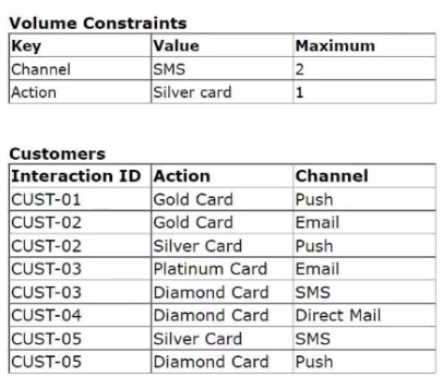
A volume constraint uses the Return any action that does not exceed constraint mode. The following tables show the configuration of the volume constraints and the list of customers in the outbound segment:
The outbound run selects customers in the following order to apply the volume constraints: CUST-01, CUST-02, CUST-03, and CUST-05. Based on the configuration of the volume constraints for each channel, which offer does CUST-05 receive?
Select the answer:Select the answer
1 correct answer
A.
None
B.
Silver card and Diamond card
C.
Diamond card
D.
Silver card
CUST-05 receives the Diamond card offer because it is the only action that does not exceed the volume constraint for the email channel. The Silver card offer has already reached its limit of 2 emails per day, so it is not eligible for CUST-05. The volume constraint mode Return any action that does not exceed means that any action that meets the eligibility and suitability criteria and does not violate the volume constraint will be returned, even if there are other actions with higher priority or propensity. Verified Reference: Certified Pega Decisioning Consultant | Pega Academy, Volume constraints
Right Answer: C
Quiz
Question 2/102/10
A financial institution has created a new policy that states the company will not send more than 500 emails per day. Which option allows you to implement the requirement?
Select the answer:Select the answer
1 correct answer
A.
Suppression rules
B.
Outbound channel limits
C.
Applicability rules
D.
Volume constraints
Volume constraints allow you to limit the number of times an action is presented to customers across one or more channels. You can use volume constraints to implement a policy that restricts the number of emails sent per day. Outbound channel limits are used to limit the number of customers contacted per channel per run, not per day. Suppression rules are used to exclude customers from receiving an action based on certain conditions, such as opt-out preferences or recent purchases. Applicability rules are used to determine whether an action is relevant for a customer based on their profile or context, not based on the number of times the action is presented. Verified Reference: Certified Pega Decisioning Consultant | Pega Academy, Volume constraints
Right Answer: D
Quiz
Question 3/103/10
Which of the following reasons explains why a customer might receive an action that they already accepted?
Select the answer:Select the answer
1 correct answer
A.
The action suitability conditions are not defined.
B.
The volume constraint is not set to exclude previously accepted offers.
C.
The suppression rules are not defined to exclude previously accepted actions.
D.
The actions are filtered based on eligibility.
A customer might receive an action that they already accepted if the volume constraint for that action is not configured to exclude previously accepted offers. This option can be enabled by selecting the Exclude previously accepted actions checkbox in the volume constraint configuration. The action suitability conditions are used to determine whether an action is suitable for a customer based on their propensity, priority, or other criteria, not based on their previous responses. The suppression rules are used to exclude customers from receiving an action based on certain conditions, such as opt-out preferences or recent purchases, not based on their previous responses. The actions are filtered based on eligibility before applying the volume constraints, so this option does not explain why a customer might receive an action that they already accepted. Verified Reference: Certified Pega Decisioning Consultant | Pega Academy, Volume constraints
Right Answer: B
Quiz
Question 4/104/10
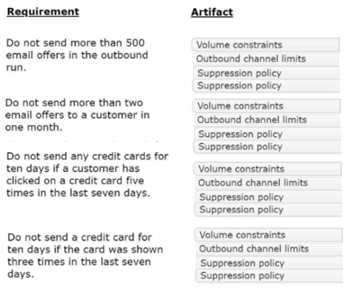
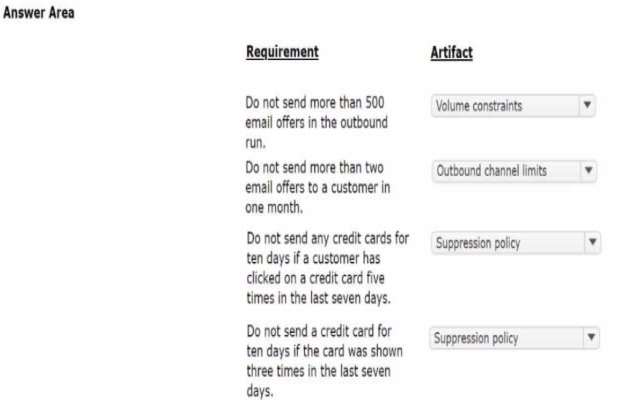
HOTSPOT U+ Bank's marketing department currently promotes various credit card offers by sending emails to qualified customers. The bank wants to limit the number of offers that customers can receive over a given period of time. In the Answer Area, select the correct artifact you use to implement each requirement.
Check the image below to see the right answer:Select the answer
1 correct answer
Right Answer: A
Quiz
Question 5/105/10
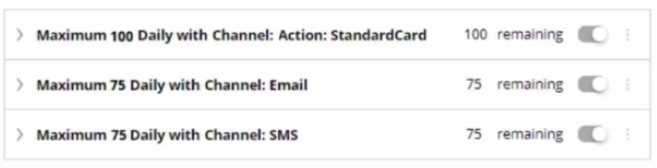
An outbound run identifies 150 Standard card offers, 75 on email, and 75 on the SMS channel. If the following volume constraint is applied, how many actions are delivered by the outbound run?
Select the answer:Select the answer
1 correct answer
A.
150
B.
75 emails 25 SMSes
C.
75 SMSes and 25 emails
D.
100
The outbound run delivers 75 emails and 25 SMSes for the Standard card offer because the volume constraint is set to limit the number of actions per channel per day. The email channel has a limit of 75 actions per day, so all 75 email offers are delivered. The SMS channel has a limit of 25 actions per day, so only 25 SMS offers are delivered. The remaining 50 SMS offers are not delivered because they exceed the volume constraint.
Right Answer: B
Quiz
Question 6/106/10
U+ Bank's marketing department currently promotes various home loan offers to qualified customers. Now, the bank does not want to show offers on a customer's account page if the customer has already received three home loan offers in the last two weeks. What do you need to define to implement the business requirement?
Select the answer:Select the answer
1 correct answer
A.
Applicability rules
B.
Customer contact limits
C.
Suppression policy
D.
Volume constraints
A suppression policy allows you to define conditions that prevent customers from receiving an act ion or a group of actions. You can use a suppression policy to implement the requirement that customers do not see home loan offers on their account page if they have already received three home loan offers in the last two weeks. You can configure the suppression policy to suppress the home loan group based on the number of times the customer received any action from that group in the past 14 days. Applicability rules are used to determine whether an action is relevant for a customer based on their profile or context, not based on the number of times they received an action. Customer contact limits are used to limit the number of times a customer can be contacted per channel per time period, not based on the number of times they received an action. Volume constraints are used to limit the number of times an action is presented to customers across one or more channels, not based on the number of times they received an action. Verified Reference: [Certified Pega Decisioning Consultant | Pega Academy], Suppression policies
Right Answer: C
Quiz
Question 7/107/10
The U+ Bank marketing department currently promotes various home loan offers to qualified customers. Now, the bank does not want customers to receive more than four promotional emails per quarter, regardless of past responses to that action by the customer. Which option allows you to implement the business requirement?
Select the answer:Select the answer
1 correct answer
A.
Volume constraints
B.
Outbound channel limits
C.
Suppression policies
D.
Suitability rules
Volume constraints allow you to limit the number of times an action is presented to customers across one or more channels. You can use volume constraints to implement the requirement that customers do not receive more than four promotional emails per quarter, regardless of past responses to that action by the customer. You can configure the volume constraint to limit the number of actions per channel per quarter and select the option to ignore previous responses. Outbound channel limits are used to limit the number of customers contacted per channel per run, not per quarter. Suppression policies are used to exclude customers from receiving an action based on certain conditions, such as opt-out preferences or recent purchases, not based on the number of times the action is presented. Suitability rules are used to determine whether an action is suitable for a customer based on their propensity, priority, or other criteria, not based on the number of times the action is presented.
Right Answer: A
Quiz
Question 8/108/10
U+ Bank has recently defined two contact policies: 1. Suppress a group of credit card offers for 30 days if any credit card offer is rejected three times in any channel in the past 15 days. 2. Suppress the Reward card offer, part of the credit card group, for 7 days if it is rejected twice in any channel in the last 7 days. Paul, an existing U+ Bank customer, no longer sees the Reward card offer. What is the reason that Paul cannot see the offer?
Select the answer:Select the answer
1 correct answer
A.
Paul rejected the Reward card offer once in contact center.
B.
Paul rejected the Reward card offer once on the web channel.
C.
Paul rejected other credit card offers twice on the web channel and once in contact center.
D.
Paul rejected other credit card offers once on the web channel and once in the contact center.
Paul cannot see the Reward card offer because he rejected other credit card offers twice on the web channel and once in contact center in the past 15 days. This triggers the first contact policy that suppresses a group of credit card offers for 30 days if any credit card offer is rejected three times in any channel in the past 15 days. The Reward card offer is part of the credit card group, so it is suppressed for Paul for 30 days. The second contact policy that suppresses the Reward card offer for 7 days if it is rejected twice in any channel in the last 7 days does not apply because Paul did not reject the Reward card offer twice in any channel in the last 7 days. Verified Reference: [Certified Pega Decisioning Consultant | Pega Academy], Suppression policies system Following is the description of the image that was sent with question no:5: This is a screenshot of a table with four columns and two rows. The table has a header row with white text on a blue background. The header row reads “Constraint name”, “Constraint mode”, “Constraint value”, and “Channel”. The second row has black text on a white background. The second row reads “Standard card”, “Return any action that does not exceed”, “100”, and “Daily”. The table has a gray border and a light blue background.
Right Answer: C
Quiz
Question 9/109/10
A bank has been running traditional marketing campaigns for many years. One such campaign sends an offer email to qualified customers on day one. On day five, the bank presents a similar offer if the first email is ignored. If you re-implement this requirement by using the always-on outbound customer engagement paradigm, how do you approach this scenario?
Select the answer:Select the answer
1 correct answer
A.
Create two segments to identify the target audience for each of the two offer emails: day one, and day five. Set up two schedules per day for the two segments.
B.
Create an action with a flow that contains two Send Email shapes, one for each email. Set appropriate wait times between the shapes.
C.
Configure the primary schedule to run daily and let the artificial intelligence (AI) choose the best action based on engagement policies.
D.
Configure a primary schedule for the original offer email and setup an ad-hoc schedule to send the second email.
The always-on outbound customer engagement paradigm relies on AI to select the best action for each customer at any given time, based on their profile, context, and behavior. You do not need to create separate segments or schedules for different offers or timings. You can configure the primary schedule to run daily and let the AI choose the best action based on engagement policies, such as contact policies, eligibility rules, suitability rules, and arbitration. The AI will also learn from the customer responses and optimize the action selection over time.
Right Answer: C
Quiz
Question 10/1010/10
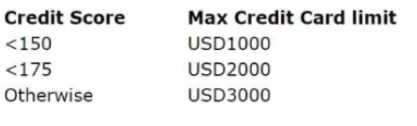
L)+ Bank uses Pega Customer Decision Hub™ to approve credit card limit changes requested by customers automatically. A scorecard model determines the customer credit score. The automatic approval of credit card limits are processed based on the following criteria set by the bank.
The bank wants to change the threshold value for the USD2000 credit limit from <175 to <200. How do you implement this change?
Select the answer:Select the answer
1 correct answer
A.
Change the cutoff value in the Results tab of the scorecard decision component.
B.
Change in the strategy the condition from .pxSegment <=175 to .pxSegment <=200.
C.
Map the score value in the decision strategy to <=200.
D.
Change the cutoff value in the Results tab of the scorecard model.
The scorecard model determines the customer credit score based on various factors, such as income, expenses, assets, liabilities, etc. The scorecard model has a Results tab where you can define the cutoff values for different segments based on the credit score. To change the threshold value for the USD2000 credit limit from <175 to <200, you need to change the cutoff value in the Results tab of the scorecard model. Changing the cutoff value in the scorecard decision component, changing the condition in the strategy, or mapping the score value in the decision strategy will not affect the credit score calculation or segmentation.
PEGACPDC88V1: Pegasystems Certified Pega Decisioning Consultant 8.8 Practice test unlocks all online simulator questions
Thank you for choosing the free version of the PEGACPDC88V1: Pegasystems Certified Pega Decisioning Consultant 8.8 practice test! Further deepen your knowledge on Pegasystems Simulator; by unlocking the full version of our PEGACPDC88V1: Pegasystems Certified Pega Decisioning Consultant 8.8 Simulator you will be able to take tests with over 59 constantly updated questions and easily pass your exam. 98% of people pass the exam in the first attempt after preparing with our 59 questions.
What to expect from our PEGACPDC88V1: Pegasystems Certified Pega Decisioning Consultant 8.8 practice tests and how to prepare for any exam?
The PEGACPDC88V1: Pegasystems Certified Pega Decisioning Consultant 8.8 Simulator Practice Tests are part of the Pegasystems Database and are the best way to prepare for any PEGACPDC88V1: Pegasystems Certified Pega Decisioning Consultant 8.8 exam. The PEGACPDC88V1: Pegasystems Certified Pega Decisioning Consultant 8.8 practice tests consist of 59 questions and are written by experts to help you and prepare you to pass the exam on the first attempt. The PEGACPDC88V1: Pegasystems Certified Pega Decisioning Consultant 8.8 database includes questions from previous and other exams, which means you will be able to practice simulating past and future questions. Preparation with PEGACPDC88V1: Pegasystems Certified Pega Decisioning Consultant 8.8 Simulator will also give you an idea of the time it will take to complete each section of the PEGACPDC88V1: Pegasystems Certified Pega Decisioning Consultant 8.8 practice test . It is important to note that the PEGACPDC88V1: Pegasystems Certified Pega Decisioning Consultant 8.8 Simulator does not replace the classic PEGACPDC88V1: Pegasystems Certified Pega Decisioning Consultant 8.8 study guides; however, the Simulator provides valuable insights into what to expect and how much work needs to be done to prepare for the PEGACPDC88V1: Pegasystems Certified Pega Decisioning Consultant 8.8 exam.
PEGACPDC88V1: Pegasystems Certified Pega Decisioning Consultant 8.8 Practice test therefore represents an excellent tool to prepare for the actual exam together with our Pegasystems practice test . Our PEGACPDC88V1: Pegasystems Certified Pega Decisioning Consultant 8.8 Simulator will help you assess your level of preparation and understand your strengths and weaknesses. Below you can read all the quizzes you will find in our PEGACPDC88V1: Pegasystems Certified Pega Decisioning Consultant 8.8 Simulator and how our unique PEGACPDC88V1: Pegasystems Certified Pega Decisioning Consultant 8.8 Database made up of real questions:
You can prepare for the PEGACPDC88V1: Pegasystems Certified Pega Decisioning Consultant 8.8 exams with our mobile app. It is very easy to use and even works offline in case of network failure, with all the functions you need to study and practice with our PEGACPDC88V1: Pegasystems Certified Pega Decisioning Consultant 8.8 Simulator.
Use our Mobile App, available for both Android and iOS devices, with our PEGACPDC88V1: Pegasystems Certified Pega Decisioning Consultant 8.8 Simulator . You can use it anywhere and always remember that our mobile app is free and available on all stores.
Our Mobile App contains all PEGACPDC88V1: Pegasystems Certified Pega Decisioning Consultant 8.8 practice tests which consist of 59 questions and also provide study material to pass the final PEGACPDC88V1: Pegasystems Certified Pega Decisioning Consultant 8.8 exam with guaranteed success.
Our PEGACPDC88V1: Pegasystems Certified Pega Decisioning Consultant 8.8 database contain hundreds of questions and Pegasystems Tests related to PEGACPDC88V1: Pegasystems Certified Pega Decisioning Consultant 8.8 Exam. This way you can practice anywhere you want, even offline without the internet.