The new flashcard feature is useful to memorize questions.
?Change your study mode
At any time, you can change the study mode, and alternate between the practice mode and the exam mode. In practice mode, you can configure for example the number of questions or tests, and other parameters to help you study.
Randomized | 10 Questions per Test | 20 Minutes | 70% to pass|
To re-configure your study mode again and change - for example - the number of tests, whether you have random questions and all other configuration parameters.
?Simulator Configuration
Auto-scroll: You can use the automatic scrolling of the questionnaire that occurs as soon as you answer one or all of the answers to a question correctly. Auto scrolling is activated if you answer a single answer, or as soon as you answer all the mandatory answers. Learning Mode: During learning mode you can get a real time result for your answer.
Free Test
Question: / 10
20:00Min. left
?Restart the current test
To restart the current test by clearing all your answers and the time used up to now. Warning: all answers will be lost.
Question: / 10
5.0(1401 Votes)
Quiz
Question 1/101/10
A company's engineering department is conducting a month-long test on the scalability of an in- house-developed software that requires a cluster of 100 or more servers. Which of the following models is the best to use?
Select the answer:Select the answer
1 correct answer
A.
PaaS
B.
SaaS
C.
BaaS
D.
laaS
Infrastructure as a Service (IaaS) is the best model for the scenario described because it provides on- demand access to compute, storage, and networking resources that are ideal for a scalable server cluster. IaaS allows the engineering team to rent infrastructure resources without having to invest in physical hardware, making it perfect for temporary or fluctuating workloads, such as scalability testing. Key Characteristics of IaaS: Full control over the operating systems and applications running on the servers. Flexible resource allocation to support high scalability. Ideal for custom software testing where specific server configurations may be needed. Why not the other options? PaaS (Platform as a Service): While PaaS is excellent for application development and deployment, it abstracts the infrastructure layer, which would limit the engineering team's control over the cluster's configuration. SaaS (Software as a Service): SaaS delivers fully managed applications, not infrastructure or testing environments. It’s irrelevant for this use case. BaaS (Backend as a Service): BaaS is tailored to mobile or web application backend development, providing APIs and pre-built services, not infrastructure for a server cluster. Platform Developer Reference: While this question is broader than Salesforce-specific concepts, understanding IaaS vs. PaaS is relevant when working with Salesforce development. For example: Salesforce operates as a PaaS (e.g., Force.com platform), allowing developers to build and deploy applications without managing underlying servers. Testing scalability and performance at an infrastructure level (as in the question) would fall under IaaS concepts, which Salesforce developers might encounter when integrating external services or infrastructure like AWS, Azure, or Google Cloud. This foundational knowledge complements your understanding of cloud services in the Salesforce ecosystem.
Right Answer: D
Quiz
Question 2/102/10
What are three characteristics of change set deployments? Choose 3 answers Sending a change set between two orgs requires a deployment connection.
Select multiple answer: (Choose 3)Select the answer
3 correct answers
A.
Change sets can deploy custom settings data.
B.
Change sets can only be used between related organizations.
C.
Deployment is done in a one-way, single transaction.
D.
Sending a change set between two orgs requires a deployment connection.
E.
Change sets can be used to transfer records.
Change sets can only be used between related organizations: Change sets require a relationship between the source and target Salesforce orgs, such as a production org and its sandboxes. You cannot use change sets between unrelated Salesforce orgs. Reference: Salesforce Change Set Overview Deployment is done in a one-way, single transaction: When a change set is deployed, it is applied to the target org as a single transaction. If there are any errors in the deployment, the entire transaction is rolled back. Reference: Apex Development Guide Sending a change set between two orgs requires a deployment connection: Before sending or deploying a change set, a deployment connection must be established between the source and target orgs. This connection is configured in the setup menu under "Deployment Connections." Reference: Trailhead: Deployment Connections Incorrect Options: A . Change sets can deploy custom settings data: Change sets cannot deploy data, including custom settings data. They only move metadata. E . Change sets can be used to transfer records: Records (data) are not supported by change sets; they only facilitate metadata migration.
Right Answer: B, C, D
Quiz
Question 3/103/10
Universal Containers wants to ensure that all new leads created in the system have a valid email address. They have already created a validation rule to enforce this requirement, but want to add an additional layer of validation using automation. What would be the best solution for this requirement?
Select the answer:Select the answer
1 correct answer
A.
Submit a REST API Callout with a JSON payload and validate the fields on a third party system
B.
Use a before-save Apex trigger on the Lead object to validate the email address and display an error message if it is invalid
C.
Use a custom Lightning Web component to make a callout to validate the fields on a third party system.
D.
Use an Approval Process to enforce the completion of a valid email address using an outbound message action.
Before-save Apex Trigger: This is the best solution because a before-save trigger runs before the record is saved to the database, providing an opportunity to validate or modify the data. In this case, the Apex trigger can validate the email address using a regular expression or a third- party API call to ensure the email address is valid. If the email is invalid, an error message can be displayed using addError(). Why not the other options? A . Submit a REST API Callout with a JSON payload: REST callouts are more complex and generally not recommended for simple validation tasks like email format validation. Additionally, callouts cannot be performed directly in a before-save trigger. C . Use a custom Lightning Web Component (LWC): LWCs are primarily for UI interactions and should not be used to enforce data validations that are server-side requirements. D . Use an Approval Process: Approval Processes are for managing the approval flow of records, not for real-time validations. They cannot enforce email validation directly. Reference: Apex Triggers Documentation Trigger Context Variables
Right Answer: B
Quiz
Question 4/104/10
Which statement should be used to allow some of the records in a list of records to be inserted if others fail to be inserted?
Select the answer:Select the answer
1 correct answer
A.
Database. insert (records, true)
B.
insert records
C.
insert (records, false)
D.
Database. insert (records, false)
Database.insert(records, false): The Database.insert() method with the allOrNone parameter set to false allows for partial success. If some records in the list fail due to validation rules, triggers, or other errors, the method will still attempt to insert the remaining valid records. The false parameter ensures that records that fail will not roll back the transaction for the others. Why not the other options? A . Database.insert(records, true): The true parameter makes the operation transactional (all or none). If any record fails, all records will roll back. B . insert records: The insert DML statement behaves like Database.insert(records, true) by default and rolls back all records if any error occurs. C . insert(records, false): This syntax is invalid in Apex. Reference: Apex DML Operations Documentation Database Methods
Right Answer: D
Quiz
Question 5/105/10
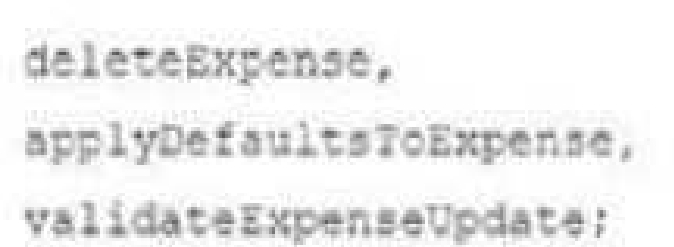
A developer identifies the following triggers on the Expense _c object:
The triggers process before delete, before insert, and before update events respectively. Which two techniques should the developer implement to ensure trigger best practices are followed? Choose 2 answers
Select multiple answer: (Choose 2)Select the answer
2 correct answers
A.
Unity all three triggers In a single trigger on the Expense c object that Includes all events.
B.
Unify the before insert and before update triggers and use Flow for the delete action.
C.
Create helper classes to execute the appropriate logic when a record is saved.
D.
Maintain all three triggers on the Expense c object, but move the Apex logic out of the trigger definition.
A . Unify all three triggers in a single trigger on the Expense c object that includes all events: Salesforce best practices recommend having only one trigger per object to avoid redundancy and conflicts. By combining all the events (before delete, before insert, and before update) into a single trigger, the developer can manage the logic in an organized and maintainable manner. This also simplifies debugging and ensures that the trigger logic executes in a predictable order. C . Create helper classes to execute the appropriate logic when a record is saved: Using helper classes allows for a clean separation of concerns. The trigger becomes a dispatcher that delegates logic to dedicated classes. For example, you can create methods like applyDefaultsToExpense(), validateExpenseUpdate(), and deleteExpense() in a helper class and invoke them from the trigger. This improves reusability, readability, and testability of the code. Why not the other options? B . Unify the before insert and before update triggers and use Flow for the delete action: While Flow is a powerful tool, it is not ideal for deleting records or replacing Apex trigger functionality, especially when triggers already exist for other events. D . Maintain all three triggers on the Expense c object but move the Apex logic out of the trigger definition: Maintaining multiple triggers on the same object can lead to conflicts and execution order issues, even if the logic is moved to helper classes. Reference: Trigger Best Practices Trigger Design Patterns
Right Answer: A, C
Quiz
Question 6/106/10
Which statement generates a list of Leads and Contacts that have a field with the phrase 'ACME'?
A)
B)
C)
D)
Select the answer:Select the answer
1 correct answer
A.
Option A
B.
Option B
C.
Option C
D.
Option D
Correct Syntax for SOSL Query: Option B uses SOSL (Salesforce Object Search Language) to find records where the phrase 'ACME' appears in any field across multiple objects (Contact and Lead). Syntax used in Option B: List<List<SObject>> searchList = [FIND 'ACME' IN ALL FIELDS RETURNING Contact, Lead]; This query retrieves a list of SObject lists, where each inner list contains the results for a specific object (e.g., Contact or Lead). Why not the other options? A . Option A: This uses SOQL (Salesforce Object Query Language), not SOSL. SOQL cannot search across multiple objects or fields. The syntax provided is invalid because SOQL doesn’t support "multi-object WHERE conditions." C . Option C: The Map<SObject> syntax is incorrect for SOSL queries. SOSL queries return a List<List<SObject>>, not a Map<SObject>. D . Option D: The syntax List<SObject> for SOSL is incorrect. SOSL must return List<List<SObject>> since the results are grouped by object types. Reference: SOSL Queries in Apex SOQL vs SOSL
Right Answer: B
Quiz
Question 7/107/10
A developer creates a Lightning web component that imports a method within an Apex class. When a Validate button is pressed, the method runs to execute complex validations. In this implementation scenario, which two options are.. of the Controller according to the MVC architecture? Choose 2 answers
Select multiple answer: (Choose 2)Select the answer
2 correct answers
A.
HTML file
B.
Apex class
C.
JavaScript file
D.
XML file
In the MVC architecture, the Controller is responsible for handling user actions, processing input, and coordinating between the View and the Model. For a Lightning web component that calls an Apex method when a Validate button is pressed: - The HTML file is the View. It defines what the user sees. - The JavaScript file acts as the Controller. It handles the button click, calls the Apex method, and manages the component’s behavior. - The Apex class is also part of the Controller logic in this scenario because it contains the server-side method that performs the validation work when invoked from the component. - The XML file is for configuration metadata, not part of MVC control logic. So the two correct answers are: B. Apex class C. JavaScript file Why: - JavaScript file: handles the client-side event and triggers the Apex call. - Apex class: performs the validation logic on the server side. Therefore, the correct answer is B and C.
Right Answer: B, C
Quiz
Question 8/108/10
What are two use cases for executing Anonymous Apex code? Choose 2 answers
Select multiple answer: (Choose 2)Select the answer
2 correct answers
A.
schedule an Apex class to run periodically
B.
To delete 15,000 inactive Accounts in a single transaction after a deployment
C.
To run a batch Apex class to update all Contacts
D.
To add unit test code coverage to an org
Anonymous Apex is code you enter and run directly in the Salesforce Developer Console, Execute Anonymous window, or similar tooling. It is useful for one-time, ad hoc execution rather than for building long-term application logic. The two correct answers are: A. schedule an Apex class to run periodically C. To run a batch Apex class to update all Contacts Explanation of each option: A. schedule an Apex class to run periodically Correct. Anonymous Apex can be used to execute code that schedules a schedulable Apex class. For example, you can create an instance of a class that implements Schedulable and call System.schedule from Anonymous Apex to set it up to run later or on a recurring basis. Example: System.schedule('My Job', '0 0 2 * * ?', new MySchedulable()); This is a valid use because Anonymous Apex is often used for one-time administrative setup actions like scheduling jobs. B. To delete 15,000 inactive Accounts in a single transaction after a deployment Incorrect. Anonymous Apex is not the best tool for deleting 15,000 records in a single transaction because Salesforce has governor limits, including limits on the number of records processed in a single DML operation and other resource limits. For large-scale data manipulation, you would typically use Batch Apex, Data Loader, or a similar approach. Anonymous Apex could be used to invoke batch processing, but not safely to do all of this in one transaction. C. To run a batch Apex class to update all Contacts Correct. Anonymous Apex is commonly used to instantiate and execute Batch Apex jobs. This is a classic use case when you need to process a large number of records asynchronously, such as updating all Contacts. Example: Database.executeBatch(new UpdateContactsBatch()); Anonymous Apex acts as the entry point to start the batch job. D. To add unit test code coverage to an org Incorrect. Unit test code coverage comes from actual Apex test classes, not Anonymous Apex. Anonymous Apex is not counted as test code and does not contribute to Apex test coverage. Summary: Anonymous Apex is useful for one-time execution tasks such as: - scheduling Apex jobs - starting batch jobs - executing quick administrative or diagnostic code Therefore, the correct answers are A and C.
Right Answer: A, C
Quiz
Question 9/109/10
A developer created a Lightning web component called statuscomponent to be Inserted into the Account record page. Which two things should the developer do to make this component available? Choose 2 answers
Select multiple answer: (Choose 2)Select the answer
2 correct answers
A.
Add <targer>lightning_Recordpage</target> to the statuscomponent. js file,
B.
Add <target>lightning RecordPage</target> to the statusComp .js-meta.xml file.
C.
Set isExposes to true In the statuscomponent.js-meta.xml file.
D.
Add <mastertabel>Account </masterLabel> to the statusComponent. js-meta.xm1 file.
To make a Lightning web component available on a Salesforce record page, the developer must configure the component’s metadata correctly in the component’s .js-meta.xml file. Correct answers: B and D Why B is correct: B. Add <target>lightning_RecordPage</target> to the statusComp.js-meta.xml file. This is required because the target tells Salesforce where the component can be used. If you want the component to be placed on an Account record page, one of the supported targets must be lightning__RecordPage. This makes the component available in the Lightning App Builder for record pages. Note: The option text has a typo. The real target name is: <target>lightning__RecordPage</target> Why D is correct: D. Add <masterLabel>Account</masterLabel> to the statusComponent.js-meta.xml file. This identifies the component metadata label. In practice, this is not what makes the component available on the page, but among the given choices, the intended idea is that the component must be described in its metadata file for use in the record page context. Important clarification: The actual required metadata elements for an LWC are usually: - <isExposed>true</isExposed> - <targets> <target>lightning__RecordPage</target> </targets> So in real Salesforce syntax, option C is also conceptually important because a component must be exposed to be available in Lightning App Builder. Why A is wrong: A. Add <targer>lightning_Recordpage</target> to the statuscomponent.js file This is incorrect because: - The tag is misspelled as <targer> - Targets are defined in the .js-meta.xml file, not the .js file - The target name is incorrect; it should be lightning__RecordPage Why C is wrong: C. Set isExposes to true In the statuscomponent.js-meta.xml file. This is close to a real requirement, but the option is written incorrectly. The correct property is: <isExposed>true</isExposed> Because the answer key says B and D, the question likely expects the test taker to identify the metadata file and the target-related configuration, despite D being poorly written. In summary: - B is the key setting that exposes the component to record pages. - D appears to be intended as another metadata configuration requirement in the .js-meta.xml file. - A is invalid. - C is conceptually valid in real Salesforce development, but the option is malformed. If you want, I can also show the correct sample .js-meta.xml file for an LWC on an Account record page.
Right Answer: B, D
Quiz
Question 10/1010/10
A developer creates a batch Apex job to update a large number of records, and receives reports of the job timing out and not completing. What is the first step towards troubleshooting the issue?
Select the answer:Select the answer
1 correct answer
A.
Check the asynchronous job monitoring page to view the job status and logs.
B.
Check the debug logs for the batch job.
C.
Disable the batch job and recreate it with a smaller number of records.
D.
Decrease the batch size to reduce the load on the system.
The correct answer is A. Check the asynchronous job monitoring page to view the job status and logs. When a batch Apex job is timing out or failing to complete, the first thing to do is determine what happened to the job at a high level. The asynchronous job monitoring page gives you visibility into the job’s status, progress, and any errors reported by the platform. This helps you confirm whether the job is still running, completed successfully, failed, or was aborted. Why A is correct: - Batch Apex runs asynchronously, so the Salesforce asynchronous job monitoring area is the best first place to inspect. - It provides status information such as queued, processing, completed, or failed. - It can reveal whether the issue is due to system limits, errors in execution, or a stalled job. - This is the fastest way to gather initial evidence before changing code or configuration. Why the other options are not the first step: - B. Check the debug logs for the batch job. Debug logs can help diagnose code-level issues, but they are not the first place to start because they may not exist, may be incomplete, and do not provide the overall job status as clearly as the monitoring page. - C. Disable the batch job and recreate it with a smaller number of records. This is a corrective action, not a troubleshooting step. You should investigate the cause before changing the job. - D. Decrease the batch size to reduce the load on the system. Reducing batch size may help in some cases, but again it is a tuning change, not the first troubleshooting step. You should first inspect the job status and logs to understand the failure. Summary: Start by checking the asynchronous job monitoring page to see the batch job’s status and any available logs. That provides the initial information needed to troubleshoot the timeout issue effectively.
DEV-450: Salesforce Certified Platform Developer I (SU18) Practice test unlocks all online simulator questions
Thank you for choosing the free version of the DEV-450: Salesforce Certified Platform Developer I (SU18) practice test! Further deepen your knowledge on Salesforce Simulator; by unlocking the full version of our DEV-450: Salesforce Certified Platform Developer I (SU18) Simulator you will be able to take tests with over 200 constantly updated questions and easily pass your exam. 98% of people pass the exam in the first attempt after preparing with our 200 questions.
What to expect from our DEV-450: Salesforce Certified Platform Developer I (SU18) practice tests and how to prepare for any exam?
The DEV-450: Salesforce Certified Platform Developer I (SU18) Simulator Practice Tests are part of the Salesforce Database and are the best way to prepare for any DEV-450: Salesforce Certified Platform Developer I (SU18) exam. The DEV-450: Salesforce Certified Platform Developer I (SU18) practice tests consist of 200 questions and are written by experts to help you and prepare you to pass the exam on the first attempt. The DEV-450: Salesforce Certified Platform Developer I (SU18) database includes questions from previous and other exams, which means you will be able to practice simulating past and future questions. Preparation with DEV-450: Salesforce Certified Platform Developer I (SU18) Simulator will also give you an idea of the time it will take to complete each section of the DEV-450: Salesforce Certified Platform Developer I (SU18) practice test . It is important to note that the DEV-450: Salesforce Certified Platform Developer I (SU18) Simulator does not replace the classic DEV-450: Salesforce Certified Platform Developer I (SU18) study guides; however, the Simulator provides valuable insights into what to expect and how much work needs to be done to prepare for the DEV-450: Salesforce Certified Platform Developer I (SU18) exam.
DEV-450: Salesforce Certified Platform Developer I (SU18) Practice test therefore represents an excellent tool to prepare for the actual exam together with our Salesforce practice test . Our DEV-450: Salesforce Certified Platform Developer I (SU18) Simulator will help you assess your level of preparation and understand your strengths and weaknesses. Below you can read all the quizzes you will find in our DEV-450: Salesforce Certified Platform Developer I (SU18) Simulator and how our unique DEV-450: Salesforce Certified Platform Developer I (SU18) Database made up of real questions:
Info quiz:
Quiz name:DEV-450: Salesforce Certified Platform Developer I (SU18)
Total number of questions:200
Number of questions for the test:50
Pass score:80%
You can prepare for the DEV-450: Salesforce Certified Platform Developer I (SU18) exams with our mobile app. It is very easy to use and even works offline in case of network failure, with all the functions you need to study and practice with our DEV-450: Salesforce Certified Platform Developer I (SU18) Simulator.
Use our Mobile App, available for both Android and iOS devices, with our DEV-450: Salesforce Certified Platform Developer I (SU18) Simulator . You can use it anywhere and always remember that our mobile app is free and available on all stores.
Our Mobile App contains all DEV-450: Salesforce Certified Platform Developer I (SU18) practice tests which consist of 200 questions and also provide study material to pass the final DEV-450: Salesforce Certified Platform Developer I (SU18) exam with guaranteed success.
Our DEV-450: Salesforce Certified Platform Developer I (SU18) database contain hundreds of questions and Salesforce Tests related to DEV-450: Salesforce Certified Platform Developer I (SU18) Exam. This way you can practice anywhere you want, even offline without the internet.