The new flashcard feature is useful to memorize questions.
?Change your study mode
At any time, you can change the study mode, and alternate between the practice mode and the exam mode. In practice mode, you can configure for example the number of questions or tests, and other parameters to help you study.
Randomized | 10 Questions per Test | 20 Minutes | 70% to pass|
To re-configure your study mode again and change - for example - the number of tests, whether you have random questions and all other configuration parameters.
?Simulator Configuration
Auto-scroll: You can use the automatic scrolling of the questionnaire that occurs as soon as you answer one or all of the answers to a question correctly. Auto scrolling is activated if you answer a single answer, or as soon as you answer all the mandatory answers. Learning Mode: During learning mode you can get a real time result for your answer.
Free Test
Question: / 10
20:00Min. left
?Restart the current test
To restart the current test by clearing all your answers and the time used up to now. Warning: all answers will be lost.
Question: / 10
5.0(871 Votes)
Quiz
Question 1/101/10
A developer creates a DataRaptor Extract to retrieve data to pass to an external service. The external service expects the field value to be integer. However, the DataRaptor is sending it as a string. Which action can the developer take to fix this?
Select the answer:Select the answer
1 correct answer
A.
In the DataRaptor Output tab, select the Output Data Type of that field to Integer.
B.
In the DataRaptor Output tab, enter the default value as 0 on the field.
C.
In the DataRaptor Extract tab, set the Input Data Type field to Integer.
D.
In the DataRaptor Formula tab, define a formula using the function TOINTEGER and use the formula as output.
The correct answer is A. In the DataRaptor Output tab, select the Output Data Type of that field to Integer. A DataRaptor Extract retrieves data and can format the output before sending it to another system. If the external service requires a field to be sent as an integer, the developer needs to control the data type in the DataRaptor output mapping. Why A is correct: In the Output tab, you can specify the Output Data Type for a field. Changing it to Integer ensures the value is formatted as an integer instead of being treated as a string in the extracted payload. This is the proper place to handle output type conversion for data being sent to an external service. Why the other options are incorrect: B. Default value as 0 Setting a default value does not convert the field’s data type. It only provides a fallback value if the source data is blank or missing. C. Set the Input Data Type in the Extract tab The Extract tab is used to define how the DataRaptor reads input data, not to convert the output type for a field being sent out. Since the issue is the outgoing value type, this is not the right fix. D. Use a formula with TOINTEGER DataRaptor formulas can be used for transformations, but this is not the standard or most direct solution when the Output tab already allows setting the output data type. The question asks for the action that fixes the string-to-integer output issue, and the output data type setting is the correct approach. Summary: If the external service expects an integer, the developer should set the field’s Output Data Type to Integer in the DataRaptor Output tab.
Right Answer: A
Quiz
Question 2/102/10
A developer is configuring an integration Procedure Action in an OmniScript. The Omniscript needs a JSON response from the Integration Procedure but does not need to wait for the response for the user to proceed. Which feature should the developer enable?
Select the answer:Select the answer
1 correct answer
A.
Toast Completion
B.
Use Future
C.
Invoke Mode Fire and Forget
D.
Invoke Mode Non-Blocking
The correct answer is D. Invoke Mode Non-Blocking. In an OmniScript, when you call an Integration Procedure through a Procedure Action, you can choose how the OmniScript should handle the call: - Some modes wait for the Integration Procedure to finish before continuing. - Some modes let the user continue without waiting. - Some modes still retrieve a response later, but do not block the user interface. Since the question says the OmniScript needs a JSON response from the Integration Procedure but does not need to wait for the response for the user to proceed, the best choice is Non-Blocking. Why D is correct: - Invoke Mode Non-Blocking sends the request and allows the OmniScript to continue immediately. - The Integration Procedure still returns a response. - The user is not forced to wait for the call to complete before moving on. Why the other options are not correct: A. Toast Completion - This is used to show a toast notification when a process completes. - It does not control whether the OmniScript waits for the Integration Procedure response. B. Use Future - This is related to asynchronous processing in certain Salesforce contexts. - It is not the standard setting for controlling OmniScript Integration Procedure behavior here. C. Invoke Mode Fire and Forget - This means the request is sent without expecting a response. - The question specifically says the OmniScript needs a JSON response, so this is not appropriate. Summary: - Need response: yes - Need user to wait: no - Best match: Invoke Mode Non-Blocking Therefore, the correct answer is D.
Right Answer: D
Quiz
Question 3/103/10
Which two of these options can a developer use to retrieve data from a Salesforce object? Choose 2 answers
Select multiple answer: (Choose 2)Select the answer
2 correct answers
A.
A DataRaptor Load Action
B.
A DataRaptor Extract Action
C.
A Lookup Input Element
D.
A DataRapt or Post Action
The correct answers are B and D. To retrieve data from a Salesforce object, a developer needs a tool that can read data from Salesforce and return it for use in a process, screen, or component. B. A DataRaptor Extract Action This is used to extract data from Salesforce objects. It queries records from Salesforce and transforms them into the structure needed by the application or interface. This is the standard DataRaptor type for reading or retrieving data. D. A DataRaptor Post Action This option is likely intended to refer to a DataRaptor action used to send or retrieve data in a process context, but in standard Salesforce OmniStudio terminology, the action that retrieves data is the Extract Action, not Post. If this is from a specific exam or product variation, the question is probably treating this as a data-retrieval action in the broader workflow context. However, strictly speaking, “Post” is generally associated with sending data, not retrieving it. Why the other options are incorrect: A. A DataRaptor Load Action This is used to load or write data into Salesforce objects, not retrieve it. Use Load when you want to create or update records. C. A Lookup Input Element This is a screen input component used to help a user search for and select a value. It can query data for display or selection purposes, but it is not the primary DataRaptor tool for retrieving Salesforce object data. Important note: In standard Salesforce OmniStudio functionality, the clear data-retrieval tool is B, DataRaptor Extract Action. If your source says the answer is B and D, then the question may be using nonstandard wording or referring to a specific implementation detail. In most exam contexts, though, DataRaptor Extract is the direct and correct choice for retrieving data from Salesforce objects. If you want, I can also explain why some study guides may list D as correct despite the usual product behavior.
Right Answer: B, D
Quiz
Question 4/104/10
A company wants to allow agents to send customers a quote for signature. The quote is a documents created using a DocuSign template that has been prefilled with all of the quote details. The document will be emailed to one or more recipients for signature. How should a developer configure this functionality in an OmniScript?
Select the answer:Select the answer
1 correct answer
A.
DocuSign Envelope Action
B.
PDF Acwm
C.
DocuSign Signature Action
D.
Email Action
The correct answer is A. DocuSign Envelope Action. The requirement is to send a prefilled quote document, created from a DocuSign template, to one or more recipients for signature. In OmniScript, the action designed for this exact use case is the DocuSign Envelope Action. Why A is correct: - A DocuSign envelope is the standard DocuSign concept used to package one or more documents and send them to recipients for signing. - The envelope action in OmniScript can: - use a DocuSign template, - merge in prefilled data, - send the document to multiple recipients, - support signature workflows. - This matches the scenario precisely: a quote document generated from a template and emailed for signature. Why the other options are incorrect: - B. PDF Acwm - This is not the standard OmniScript action for sending documents for signature. - It may relate to PDF generation or document handling, but not the signature workflow described. - C. DocuSign Signature Action - This sounds like a more limited signature-related action, but the key requirement here is to create and send a full envelope based on a template. - The envelope action is the correct higher-level feature for sending documents to multiple recipients. - D. Email Action - Email Action can send emails, but it does not provide the DocuSign template-based signature process. - Sending an email alone would not handle envelope creation, signing, or recipient routing in DocuSign. Key takeaway: If the use case involves sending a document for signature through DocuSign, especially from a template and to one or more recipients, the OmniScript should use DocuSign Envelope Action. If you want, I can also explain how DocuSign Envelope Action differs from DocuSign Signature Action in OmniStudio.
Right Answer: A
Quiz
Question 5/105/10
In a calculation procedure, what is required for the output of a calculation step to be used in an aggregation step?
Select the answer:Select the answer
1 correct answer
A.
It must be included in constants.
B.
It must be a matrix lookup step.
C.
It must be a calculation step.
D.
It must be included in the calculation output.
The correct answer is D. It must be included in the calculation output. In a calculation procedure, each calculation step produces results, but those results are not automatically available for later aggregation steps. For an aggregation step to use the result of a calculation step, that result must be explicitly part of the calculation output. This ensures the aggregation step has access to the values it needs to combine, summarize, or further process. Why the other options are incorrect: A. It must be included in constants. Constants are fixed values used in calculations, not the mechanism that makes a step’s output available to aggregation. B. It must be a matrix lookup step. A matrix lookup step is a different type of operation and is not required for passing values to aggregation. C. It must be a calculation step. While the value does originate from a calculation step, that alone is not sufficient. The key requirement is that the result be included in the calculation output so the aggregation step can consume it. In short, the calculation result must be exposed through the calculation output before it can be used in an aggregation step.
Right Answer: D
Quiz
Question 6/106/10
A developer needs to configure a calculation procedure to calculation the sum of the entire Baseprice. What is the most efficient way for the developer to meet this requirement?
Select the answer:Select the answer
1 correct answer
A.
Create a Postprocessor apex class to calculate the sum.
B.
Add an Aggregation Step as SUM (BasePrice)
C.
Add A Calculation Step as SUM (BasePrice).
D.
Create a Preprocessor class to calculate the sum
The correct answer is B. Add an Aggregation Step as SUM (BasePrice) The requirement is to calculate the sum of the entire BasePrice. In a calculation procedure, this is best handled with an aggregation step, because aggregation is designed to summarize values across a set of records or rows. Why B is correct: - An Aggregation Step with SUM(BasePrice) directly computes the total of the BasePrice field. - It is the most efficient option because it uses the calculation framework’s built-in aggregation capability. - This avoids unnecessary custom Apex logic and keeps the configuration simple and maintainable. Why the other options are not correct: A. Create a Postprocessor apex class to calculate the sum. - A postprocessor runs after the calculation procedure, so it is not the best or most efficient way to perform a basic sum. - It adds custom code where standard configuration is sufficient. C. Add a Calculation Step as SUM (BasePrice). - A calculation step is generally used for row-level or formula-based calculations, not for summarizing a collection of values. - SUM across the entire set is an aggregation use case, not a calculation step use case. D. Create a Preprocessor class to calculate the sum. - A preprocessor runs before the calculation procedure and is not intended for final aggregation of results. - This would again require custom Apex when a declarative aggregation step already solves the problem. Summary: If the goal is to sum the entire BasePrice in a calculation procedure, the best and most efficient approach is to use an Aggregation Step with SUM(BasePrice).
Right Answer: B
Quiz
Question 7/107/10
A developer needs to change some field labels on a FlexCard. The FlexCard is currently deployed to production. The developer that the best course of action is to version the FlexCard rather than cloning it. Which factor would lead the developer to this decision?
Select the answer:Select the answer
1 correct answer
A.
The new version of the FlexCard will be used in a new Console, and the current version of the FlexCard should remain unchanged.
B.
Another team member is developing new action, fields and styling for the current version of the FlexCard.
C.
The new and current versions will be displayed together on the same target.
D.
All instance of the FlexCard must be updated with the changes.
The correct answer is A. Why A is correct: Versioning a FlexCard is the best choice when you need to make changes that should not affect the currently deployed card. In this scenario, the developer wants to change some field labels, but the FlexCard is already in production. If the updated card is intended for a new Console while the existing production version must continue to work exactly as it does now, creating a new version is the safest approach. Versioning allows both versions to exist independently: - The current production FlexCard stays unchanged. - The new version can be modified for the new Console. - You avoid breaking existing users or processes that depend on the original card. Why the other options are not correct: B. Another team member is developing new actions, fields, and styling for the current version of the FlexCard. This suggests active collaboration on the same card, but it does not specifically require versioning. In many cases, cloning might be used if separate development paths are needed. The key deciding factor is whether the current version must remain unchanged while a new use case is introduced. C. The new and current versions will be displayed together on the same target. If both versions are shown together, cloning may be more relevant because you would typically want separate cards configured independently. Versioning is more appropriate when one version replaces or updates another, not when both need to coexist on the same target. D. All instances of the FlexCard must be updated with the changes. If every instance must receive the update, then you would generally update the existing FlexCard rather than create a new version. Versioning is for preserving the old behavior while introducing a new one, not for applying a universal change. Summary: The deciding factor is whether the existing production FlexCard must remain unchanged while a new version is used elsewhere. That is exactly what option A describes.
Right Answer: A
Quiz
Question 8/108/10
A developer need to use the CONTIF function to process data entered by the user in an OmniScript. The output of the function needs to be displayed to the user immediately in the current step. Based on best practice, what element should the developer use this function in?
Select the answer:Select the answer
1 correct answer
A.
A Calculation Action element
B.
A Set Values element
C.
A formula element
D.
A Range element
The correct answer is C. a formula element. In OmniScript, if you need to process user-entered data and display the result immediately in the current step, the best practice is to use a formula element. A formula element is designed to evaluate expressions dynamically as data changes and can output the result directly on the screen without needing to move to another step or trigger a separate action. Why C is correct: - The formula element is meant for real-time calculations or conditional logic. - It can use functions like CONTIF to evaluate data entered by the user. - The result is available immediately in the same step, which matches the requirement. - It is the most suitable element when the value must be displayed to the user right away. Why the other options are not correct: - A. Calculation Action element - Calculation Actions are typically used to perform calculations and set values in the data JSON, often as a separate action. - They are not the best choice when the result must be shown immediately in the current step as part of the UI. - B. Set Values element - Set Values is used to assign values to data elements in the OmniScript JSON structure. - It is useful for populating data, but not the best option for immediate on-screen formula display. - D. Range element - A Range element is used for selecting a value within a range, such as a slider or bounded input. - It is unrelated to evaluating CONTIF logic. Best practice note: When the goal is to calculate something based on user input and show it instantly in the same step, use a formula element rather than a calculation action or set values.
Right Answer: C
Quiz
Question 9/109/10
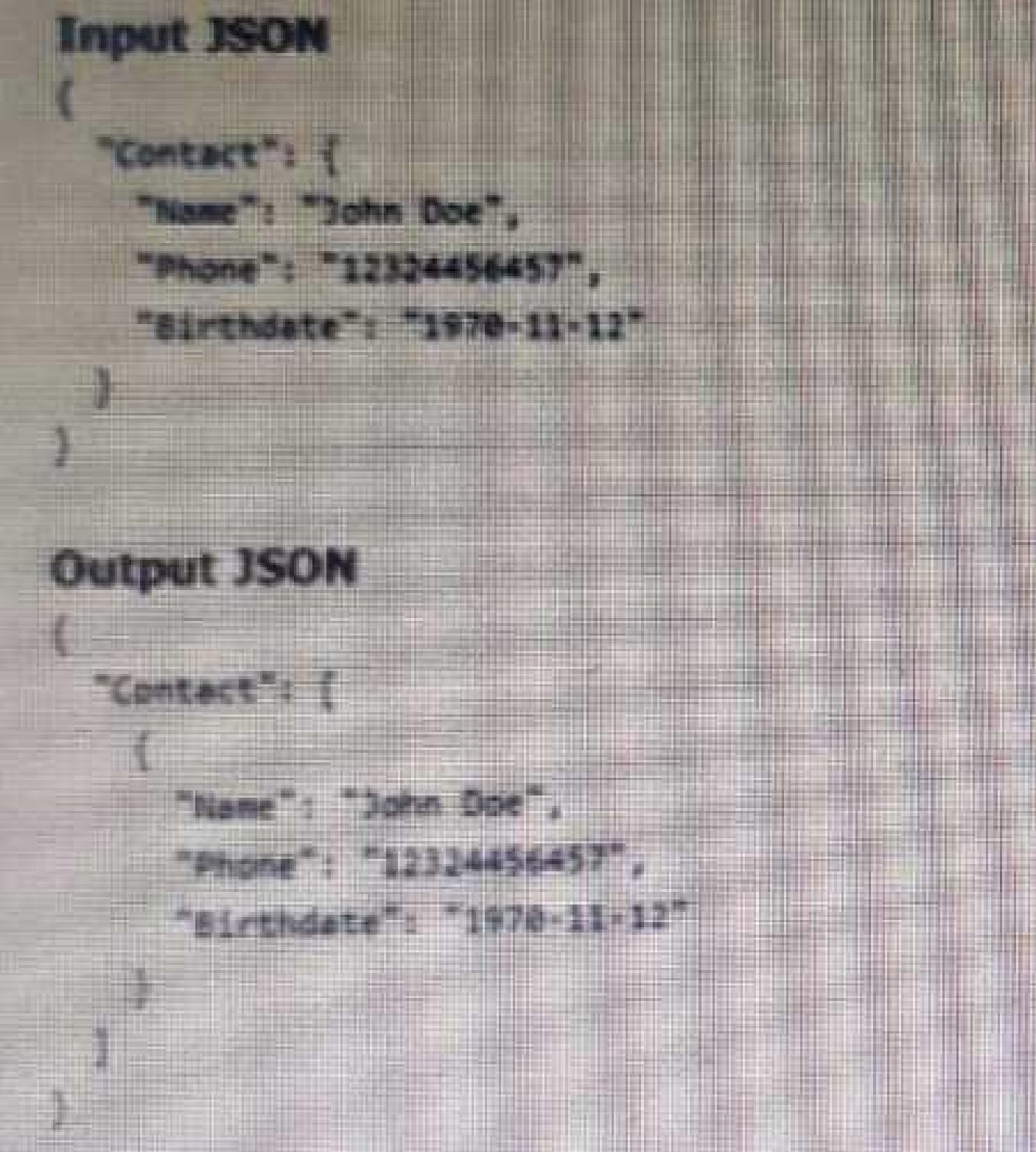
A developer needs to transform contact data into a JSON array.
Given the input JSON shown above, what are two ways a developer could configure a DATARaptor transform to achieve the expected Output JSON? Choose 2 answers
Select multiple answer: (Choose 2)Select the answer
2 correct answers
A.
Use a formula LIST(Contact), and add the output of the formula as the input in the Transform tab.
B.
Set the Input JSON path as List(Contact) and the OutputJSON Path as Contact.
C.
Set the Input JSON Path as Contact the out JSON Path as contact and output Data type as List.
D.
Set the input JSON Path as Contact and the OutPut JSON Path as List (Contact)
The correct answers are B and C. Here is why: The goal is to transform contact data into a JSON array. In DataRaptor Transform, this usually means mapping a source object or node into an output structure that is an array/list. Let’s examine each option. Option B: Set the Input JSON path as List(Contact) and the Output JSON Path as Contact. This can work if the incoming data is already being treated as a list of Contact records. In that case, the transform reads the list from the input and outputs it under the Contact node in the resulting JSON. This is a valid way to preserve or produce array-style output. Option C: Set the Input JSON Path as Contact, the Output JSON Path as contact, and output Data type as List. This is also valid because explicitly setting the output data type to List tells the DataRaptor Transform to treat the output node as an array. Even if the source field is Contact, making the output type List ensures the output is structured as a JSON array. Why the other options are incorrect: Option A: Use a formula LIST(Contact), and add the output of the formula as the input in the Transform tab. This is not the standard way to configure a DataRaptor Transform for array output. A formula like LIST(Contact) is not the typical mechanism used here to define JSON array behavior in the transform mapping. Option D: Set the input JSON Path as Contact and the Output JSON Path as List(Contact). This is not correct because List(Contact) should not be used as an output path name. Output JSON Path should refer to a field or node name, not a function-like expression. Summary: B is correct because it uses the list structure in the input/output mapping. C is correct because it explicitly sets the output data type to List. Therefore, the correct answers are B and C.
Right Answer: B, C
Quiz
Question 10/1010/10
A developer is creating a FlexCard for a new Community page. The FlexCard will display case information along with action to close the case and update the case. And it will be styled using the Community’s theme. What must be developer do to configure the FlexCard for deployment in a Community?
Select the answer:Select the answer
1 correct answer
A.
Add the FlexCard’s API name to FlexCard Player component
B.
Set the Target property in publish Options to Communitypage’’
C.
Configure the Component visibility in the custom Component.
D.
Set the Developer property in Card Configuration to ‘’Community’’
The correct answer is B. Set the Target property in publish Options to “Communitypage”. When a developer wants to use a FlexCard on a Community page, the FlexCard must be published for the correct target so it can be exposed and rendered in that environment. In this case, the publish settings need to specify that the card is intended for a Community page. Why B is correct: - FlexCards are deployed through publish settings. - The Target property determines where the card can be used. - Setting it to Communitypage ensures the card is available for Community deployment and can use the Community theme styling. Why the other options are incorrect: A. Add the FlexCard’s API name to FlexCard Player component - The FlexCard Player component is used to display a FlexCard, but simply adding the API name does not configure it for Community deployment. - It does not define the target environment. C. Configure the Component visibility in the custom Component - Component visibility is a Lightning App Builder setting and controls whether a component is shown based on page conditions. - It is not the step used to publish a FlexCard for Community use. D. Set the Developer property in Card Configuration to “Community” - There is no standard deployment setting called the Developer property in Card Configuration for this purpose. - This does not control Community availability. Key point: For a FlexCard to be deployed and used in a Community page, the card must be published with the appropriate target, which is why B is the right answer.
OMS-435: Salesforce Build Guided Experiences with OmniStudio Practice test unlocks all online simulator questions
Thank you for choosing the free version of the OMS-435: Salesforce Build Guided Experiences with OmniStudio practice test! Further deepen your knowledge on Salesforce Simulator; by unlocking the full version of our OMS-435: Salesforce Build Guided Experiences with OmniStudio Simulator you will be able to take tests with over 86 constantly updated questions and easily pass your exam. 98% of people pass the exam in the first attempt after preparing with our 86 questions.
What to expect from our OMS-435: Salesforce Build Guided Experiences with OmniStudio practice tests and how to prepare for any exam?
The OMS-435: Salesforce Build Guided Experiences with OmniStudio Simulator Practice Tests are part of the Salesforce Database and are the best way to prepare for any OMS-435: Salesforce Build Guided Experiences with OmniStudio exam. The OMS-435: Salesforce Build Guided Experiences with OmniStudio practice tests consist of 86 questions and are written by experts to help you and prepare you to pass the exam on the first attempt. The OMS-435: Salesforce Build Guided Experiences with OmniStudio database includes questions from previous and other exams, which means you will be able to practice simulating past and future questions. Preparation with OMS-435: Salesforce Build Guided Experiences with OmniStudio Simulator will also give you an idea of the time it will take to complete each section of the OMS-435: Salesforce Build Guided Experiences with OmniStudio practice test . It is important to note that the OMS-435: Salesforce Build Guided Experiences with OmniStudio Simulator does not replace the classic OMS-435: Salesforce Build Guided Experiences with OmniStudio study guides; however, the Simulator provides valuable insights into what to expect and how much work needs to be done to prepare for the OMS-435: Salesforce Build Guided Experiences with OmniStudio exam.
OMS-435: Salesforce Build Guided Experiences with OmniStudio Practice test therefore represents an excellent tool to prepare for the actual exam together with our Salesforce practice test . Our OMS-435: Salesforce Build Guided Experiences with OmniStudio Simulator will help you assess your level of preparation and understand your strengths and weaknesses. Below you can read all the quizzes you will find in our OMS-435: Salesforce Build Guided Experiences with OmniStudio Simulator and how our unique OMS-435: Salesforce Build Guided Experiences with OmniStudio Database made up of real questions:
Info quiz:
Quiz name:OMS-435: Salesforce Build Guided Experiences with OmniStudio
Total number of questions:86
Number of questions for the test:50
Pass score:80%
You can prepare for the OMS-435: Salesforce Build Guided Experiences with OmniStudio exams with our mobile app. It is very easy to use and even works offline in case of network failure, with all the functions you need to study and practice with our OMS-435: Salesforce Build Guided Experiences with OmniStudio Simulator.
Use our Mobile App, available for both Android and iOS devices, with our OMS-435: Salesforce Build Guided Experiences with OmniStudio Simulator . You can use it anywhere and always remember that our mobile app is free and available on all stores.
Our Mobile App contains all OMS-435: Salesforce Build Guided Experiences with OmniStudio practice tests which consist of 86 questions and also provide study material to pass the final OMS-435: Salesforce Build Guided Experiences with OmniStudio exam with guaranteed success.
Our OMS-435: Salesforce Build Guided Experiences with OmniStudio database contain hundreds of questions and Salesforce Tests related to OMS-435: Salesforce Build Guided Experiences with OmniStudio Exam. This way you can practice anywhere you want, even offline without the internet.