The new flashcard feature is useful to memorize questions.
?Change your study mode
At any time, you can change the study mode, and alternate between the practice mode and the exam mode. In practice mode, you can configure for example the number of questions or tests, and other parameters to help you study.
Randomized | 10 Questions per Test | 20 Minutes | 70% to pass|
To re-configure your study mode again and change - for example - the number of tests, whether you have random questions and all other configuration parameters.
?Simulator Configuration
Auto-scroll: You can use the automatic scrolling of the questionnaire that occurs as soon as you answer one or all of the answers to a question correctly. Auto scrolling is activated if you answer a single answer, or as soon as you answer all the mandatory answers. Learning Mode: During learning mode you can get a real time result for your answer.
Free Test
Question: / 10
20:00Min. left
?Restart the current test
To restart the current test by clearing all your answers and the time used up to now. Warning: all answers will be lost.
Question: / 10
5.0(183 Votes)
Quiz
Question 1/101/10
A large business-to-consumer (B2C) customer is planning to implement Salesforce CRM to become a
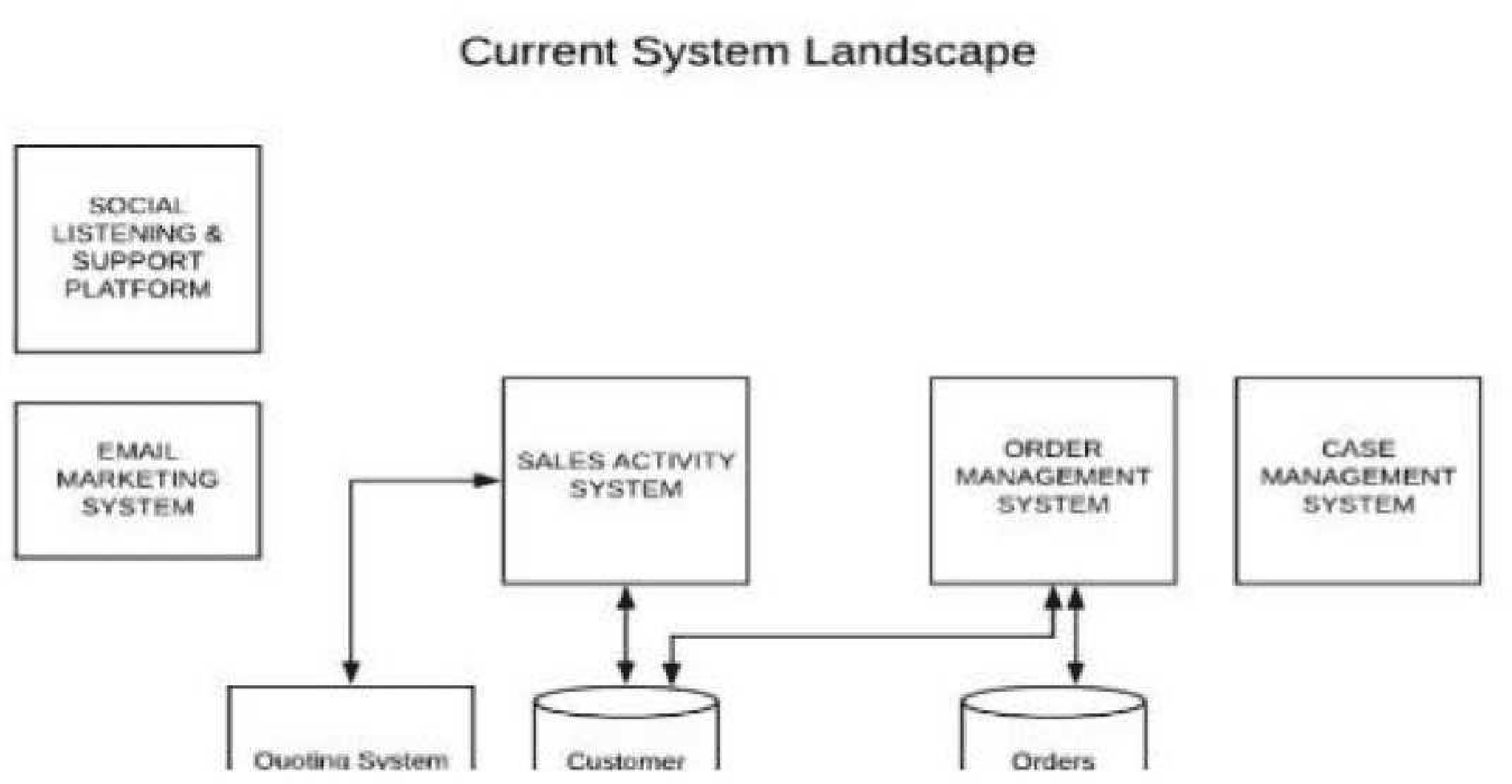
customer-centric enterprise. Below is the B2C customer's current system landscape diagram.
The goals for implementing Salesforce include: Develop a 360-degree view of the customer. Leverage Salesforce capabilities for marketing, sales, and service processes. Reuse Enterprise capabilities built for quoting and order management processes. Which three systems from the current system landscape can be retired with the implementation of Salesforce?
Select the answer:Select the answer
1 correct answer
A.
Order Management, Case Management, and Email Marketing
B.
Sales Activity, Order Management, and Case Management
C.
Email Marketing, Sales Activity, and Case Management
Comprehensive and Detailed 250 to 350 words of Explanation From Salesforce Pl14atform Integration Architect documents: In the rol15e of a Salesforce Platform Integration Architect, evaluating a legacy landscape requires a clinical mapping of current system functions against Salesforce’s native capabilities, while strictly adhering to the "Constraints and Goals" provided by the business. The objective here is to maximize the ROI of the Salesforce implementation by consolidating redundant systems into the core platform. According to Goal 2, the business intends to utilize Salesforce for Marketing, Sales, and Service processes. Salesforce is architected to handle these three domains through its core clouds: Marketing Cloud (replacing the legacy Email Marketing System), Sales Cloud (replacing the Sales Activity System), and Service Cloud (replacing the Case Management System). By consolidating these three specific functions into Salesforce, the organization achieves Goal 1, which is the creation of a 360- degree view of the customer. When these activities occur on a single platform, the data is unified, eliminating the silos that existed in the previous landscape. However, the architect must also respect the technical constraints defined in Goal 3, which explicitly states the need to reuse enterprise capabilities built for quoting and order management. In architectural design, this designates the "Quoting System" and the "Order Management System" as systems of record that must remain in the future-state landscape. These systems likely contain complex, proprietary logic or are tightly coupled with back-end ERP systems like SAP Business Suite, making them "non-negotiable" for retirement at this stage. Therefore, because Email Marketing, Sales Activity, and Case Management map directly to Salesforce’s primary strengths and are not excluded by the "reuse" requirement, they are the three systems that should be retired. This strategic retirement simplifies the integration architecture, allowing the architect to focus on building robust integration patterns (such as Request-Reply or Fire- and-Forget) between Salesforce and the remaining Quoting and Order Management systems.
Right Answer: C
Quiz
Question 2/102/10
An integration architect has built a solution using REST API, updating Account, Contact, and other related information. The data volumes have increased, resulting in higher API calls consumed, and some days the limits are exceeded. A decision was made to decrease the number of API calls using bulk updates. The customer prefers to continue using REST API to avoid architecture changes. Which REST API composite resources should the integration architect use to allow up to 200 records in one API call?
Select the answer:Select the answer
1 correct answer
A.
Batch
B.
SObject Tree
C.
Composite
When designing high-volume integrations, the Salesforce Platform Integration Architect must distinguish between standard REST resources and "Composite" resources to optimize API consumption. The Salesforce REST API provides several composite resources to group multiple operations into a single call, thereby reducing the overhead of multiple HTTP requests and helping to stay within daily API limits. According to Salesforce documentation on Composite Resources, the sObject Tree resource (/services/data/vXX.X/composite/tree/) is specifically designed to handle multiple records in a single request. While it is primarily marketed for creating complex hierarchies (parent-child relationships), it has a unique limit that allows for up to 200 records to be processed in a single call. These records can even be unrelated records of the same type. This is a significant advantage over the standard Batch and Composite resources. The Composite resource and the Batch resource both have a much lower limit of 25 subrequests per call. While each subrequest in a Batch call could technically be a collection operation, the question specifically asks for the resource that natively supports the "200 records" threshold preferred for bulk-style updates within the REST framework. By utilizing the sObject Tree resource, the architect can bundle 200 record updates into a single transaction, effectively reducing API consumption by a factor of 200 compared to individual REST calls. This aligns with the requirement to avoid major architectural changes (like switching to the Bulk API 2.0) while solving the immediate problem of exceeding daily governor limits. In the context of the Integration Architect exam, understanding these specific payload limits is crucial for selecting the most efficient "Request-Reply" or "Data Synchronization" pattern.
Right Answer: B
Quiz
Question 3/103/10
A business requires automating the check and updating of the phone number type classification (mobile vs. landline) for all incoming calls delivered to its phone sales agents. The following conditions exist: At peak, the call center can receive up to 100,000 calls per day. The phone number type classification is a service provided by an external service API. Business is flexible with timing and frequency to check and update the records (throughout the night or every 6-12 hours is sufficient). A Remote-Call-In pattern and/or Batch Synchronization (Replication via ETL: System -> Salesforce) are determined to work with a middleware hosted on customer premise. In order to implement these patterns and mechanisms, which component should an integration architect recommend?
Select the answer:Select the answer
1 correct answer
A.
ConnectedApp configured in Salesforce to authenticate the middleware
B.
An API Gateway that authenticates requests from Salesforce into the middleware (ETL/ESB)
C.
Remote Site Settings configured in Salesforce to authenticate the middleware
In this scenario, the architecture involves a Remote-Call-In pattern or Batch Synchronization, where an external system (the middleware or ETL tool) initiates communication with Salesforce to update records. For any external system to securely access Salesforce APIs and perform these updates, it must be authenticated and authorized. The Connected App is the foundational framework that allows an external application to integrate with Salesforce using APIs and standard protocols, such as OAuth 2.0 and SAML. By configuring a Connected App, the architect can define which permissions (Scopes) the middleware has, such as the ability to access data via the REST or Bulk API. This is the correct choice because the middleware needs to "log in" to Salesforce to push the phone classification data back into the Account or Contact records. Option B, an API Gateway, is typically used to manage and secure requests going out of an organization to external services, or to provide a facade for on-premise APIs; it does not handle the inbound authentication into Salesforce itself. Option C, Remote Site Settings, is a configuration used solely to permit Salesforce to make outbound calls to a specific external URL (for example, if Salesforce were calling the phone classification service directly via Apex). Given that the business is flexible with timing (allowing for nightly or 12-hour syncs) and handles 100,000 calls, a Batch Synchronization pattern via an ETL tool is highly efficient. The ETL tool will authenticate against the Connected App using a secure OAuth flow (such as the JWT Bearer Flow for server-to-server integration), retrieve the new phone numbers, call the external classification API, and then bulk-update the Salesforce records. This setup ensures a secure, scalable, and manageable integration that respects Salesforce's security architecture while meeting the high-volume data requirements of the call center.
Right Answer: A
Quiz
Question 4/104/10
A company captures orders and needs to send them to the Order fulfillment system. The user is not required to have confirmation from the Order fulfillment system. Which system constraint question should be considered when designing an integration to send orders from Salesforce to a fulfillment system?
Select the answer:Select the answer
1 correct answer
A.
What latency is acceptable for orders to reach the fulfillment system?
B.
Can the fulfillment system implement a contract-first Outbound Messaging interface?
C.
Which system will validate order shipping addresses?
When designing an integration where the user does not require immediate confirmation, the architect is moving away from a synchronous "Request-Reply" pattern toward an asynchronous "Fire- and-Forget"16 or "Batch Processing" pattern. In such scenarios, the most critical architectural constraint is defining the latency requirements. Latency dictates the technical choice of the integration tool. If the fulfillment system needs the order within seconds of creation to begin a high-speed picking process, the architect might choose Salesforce Outbound Messaging or an Apex Callout triggered by a Platform Event. If the system only needs to process orders once an hour or overnight, a Batch ETL process is more appropriate. Understanding the acceptable delay (latency) ensures that the solution meets business expectations without over-engineering for real-time performance where it isn't required. While Option B (Outbound Messaging) is a valid technical capability, it is a specific solution rather than a high-level "system constraint question" that drives the initial design phase. Option C (Address Validation) is a functional requirement regarding data integrity, but it does not define the architectural framework of the integration as effectively as latency does. By identifying the latency threshold, the architect can determine if the integration should be near real-time, hourly, or daily, which in turn influences how the system handles error recovery, retries, and transaction volumes.
Right Answer: A
Quiz
Question 5/105/10
Northern Trail Outfitters requires an integration to be set up between one of its Salesforce orgs and an External Data Source using Salesforce Connect. The External Data Source supports Open Data Protocol. Which configuration should an integration architect recommend be implemented in order to secure requests coming from Salesforce?
Select the answer:Select the answer
1 correct answer
A.
Configure a certificate for OData connection.
B.
Configure Special Compatibility for OData connection.
C.
Configure Identity Type for OData connection.
Salesforce Connect is a powerful tool for data virtualization, allowing users to view and manage data in external systems (via OData) as if it were stored natively in Salesforce. However, a critical security decision during the setup of an External Data Source is determining the Identity Type. The Identity Type determines how the external system authenticates the Salesforce user. There are two primary options: Named Principal: Every Salesforce user accesses the external system using the same set of credentials. This is easier to maintain but provides less granular security tracking in the target system. Per User: Each individual Salesforce user must provide their own credentials for the external system. This ensures that the data visible in Salesforce respects the user's specific permissions in the external source. Configuring the Identity Type is the fundamental way an architect secures OData requests because it defines the authentication boundary between the platforms. While certificates (Option A) can be used for transport layer security, the "Identity Type" configuration is the specific Salesforce Connect setting that governs how a session is authorized. Option B (Special Compatibility) is a technical setting used to handle non-standard OData implementations and does not directly relate to securing the request. By recommending the correct Identity Type, the architect ensures that the integration adheres to the "Principle of Least Privilege," ensuring that users only see the external data they are authorized to access.
Right Answer: C
Quiz
Question 6/106/10
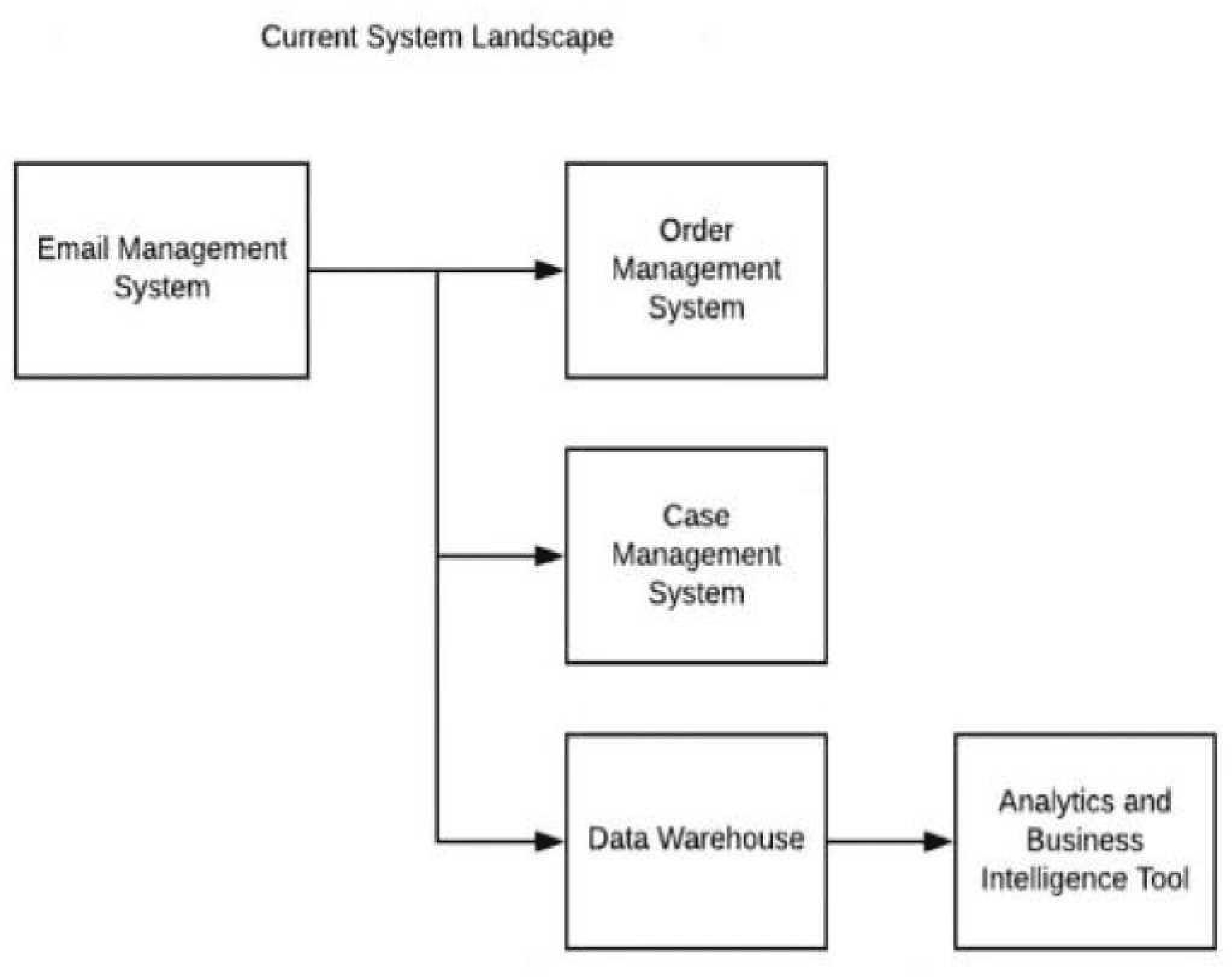
An enterprise customer is planning to implement Salesforce to support case management.
Below is their current system landscape diagram. Considering Salesforce capabilities, what should the integration architect evaluate when integrating Salesforce with the current system landscape?
Select the answer:Select the answer
1 correct answer
A.
Integrate Salesforce with Data Warehouse, Order Management and Email Management System.
B.
Integrate Salesforce with Order Management System, Data Warehouse and Case Management System.
C.
Integrate Salesforce with Email Management System, Order Management System and Case Management System.
An Integration Architect's primary responsibility when evaluating a landscape for a new Salesforce implementation is to identify the system of record for each business process and determine which legacy systems will be replaced by Salesforce. In this scenario, the customer is implementing Salesforce specifically to support case management. According to the provided landscape diagram, the Case Management System currently exists as a standalone entity. Since Salesforce Service Cloud provides native, best-in-class case management capabilities, this legacy system is the primary candidate for retirement. Retiring the legacy Case Management system avoids data fragmentation and ensures that Salesforce serves as the single source of truth for support interactions. However, for Salesforce to function effectively as a new case management hub, it must integrate with the remaining surrounding systems: Email Management System: This system likely handles inbound customer communications. An architect must evaluate integrating this with Salesforce (via Email-to-Case or a specialized connector) so that incoming emails automatically generate or update cases. Order Management System (OMS): Support agents often need to view order history or status to resolve customer inquiries. Integrating Salesforce with the OMS allows for a 360-degree view, enabling agents to see relevant order data directly within the Salesforce case console. Data Warehouse: For long-term reporting, trend analysis, and a unified customer profile, case data from Salesforce needs to be pushed to the Data Warehouse. This ensures that the Analytics and Business Intelligence Tool downstream can report on support metrics alongside other enterprise data. Therefore, the architect should evaluate integrations with the Data Warehouse, Order Management, and Email Management System. Option B and C are incorrect because they suggest integrating with the "Case Management System," which is the very system being superseded by Salesforce's native capabilities. By focusing on the integration of these three supporting systems, the architect ensures a seamless transition where Salesforce is fully enriched with the necessary external data to drive support excellence.
Right Answer: A
Quiz
Question 7/107/10
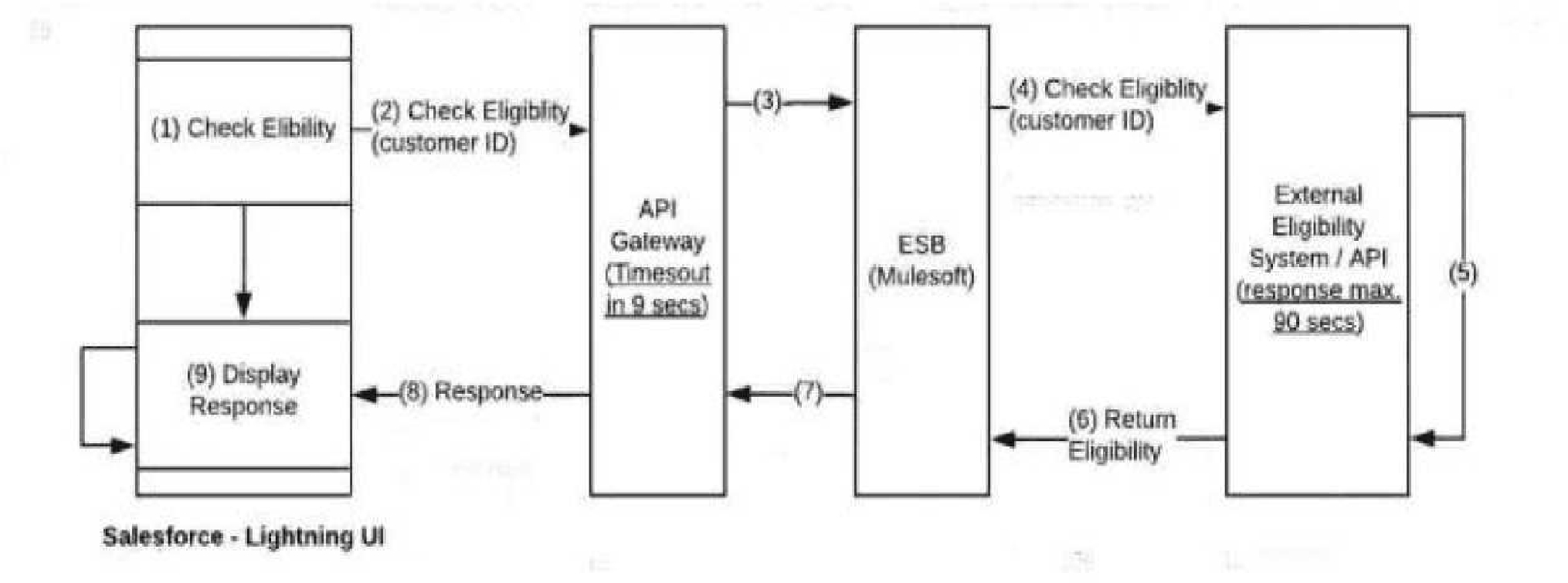
An enterprise architect has requested the Salesforce integration architect to review the following (see diagram and description) and provide recommendations after carefully considering all constraints of the enterprise systems and Salesforce Platform limits. About 3,000 phone sales agents use a Salesforce Lightning user interface (UI) concurrently to check eligibility of a customer for a qualifying offer. There are multiple eligibility systems that provide this service and are hosted externally. Their current response times could take up to 90 seconds to process and return. These eligibility systems are accessed through APIs orchestrated via ESB (MuleSoft). All requests from Salesforce traverse the customer's API Gateway layer, which imposes a timeout
constraint of 9 seconds.
Which recommendation should the integration architect make?
Select the answer:Select the answer
1 correct answer
A.
Recommend synchronous Apex callouts from Lightning UI to External Systems via Mule and implement polling on an API Gat8eway timeout.
B.
Implement a "Check Update” button that passes a requestID received from ESB (user action needed).
C.
Create a platform event in Salesforce via Remote Call-In and use the empAPI in the Lightning UI to serve 3,000 concurrent users when responses are received by Mule.
In this architectural scenario, the Integration Architect must navigate two critical technical "bottlenecks": the 9-second API Gateway timeout and the 90-second backend processing time. Since the backend takes significantly longer than the gateway allows for a synchronous connection, a standard Request-Reply pattern will fail. Furthermore, having 3,000 concurrent agents perform synchronous callouts would risk hitting Salesforce's concurrent long-running request limits. The most scalable and user-friendly solution is to implement an Asynchronous Request-Reply pattern using Platform Events and the empAPI. When an agent clicks "Check Eligibility," Salesforce sends an initial asynchronous request to the ESB (MuleSoft). The ESB immediately acknowledges receipt with a 202 Accepted status, freeing up the Salesforce UI thread and avoiding the API Gateway’s 9-second timeout. Once the backend eligibility system completes its 90-second process, MuleSoft acts as a client to Salesforce, performing a Remote Call-In to publish a specific Platform Event containing the result and the original Request ID. On the frontend, the Lightning UI uses the empAPI (Enterprise Messaging Platform API) to subscribe to the streaming channel for that Platform Event. Because the empAPI uses CometD technology to maintain a single long-lived connection, it can efficiently push the response to the agent's screen the moment it arrives, without requiring the agent to manually refresh or click a "Check Update" button (as suggested in Option B). This provides a "real-time" feel despite the long backend latency. Option A is non-viable because synchronous polling would exacerbate the load on the API Gateway and likely lead to governance limit issues within Salesforce. By using Platform Events and empAPI, the architect ensures the solution remains within Salesforce's execution limits while providing a seamless, automated experience for a high-volume call center environment.
Right Answer: C
Quiz
Question 8/108/10
Northern Trail Outfitters is in the final stages of merging two Salesforce orgs, but needs to keep the retiring org available for a short period of time for lead management as it is connected to multiple public website forms. The sales department has requested that new leads are available in the new Salesforce instance within 30 minutes. Which approach requires the least amount of development effort?
Select the answer:Select the answer
1 correct answer
A.
Call the Salesforce REST API to insert the lead into the target system.
B.
Use the Tooling API with Process Builder to insert leads in real time.
C.
Use the Composite REST API to aggregate multiple leads in a single call.
In an org merger scenario, a Salesforce Platform Integration Architect must often design interim solutions that balance speed of delivery with minimal development overhead. The requirement here is for leads to be synced within a 30-minute window. This is a relatively low-latency requirement that does not strictly necessitate a real-time, event-driven architecture, which typically requires more complex infrastructure like Platform Events or middleware. Option A, calling the Salesforce REST API to insert leads into the target system, represents the standard, most straightforward approach. Since both systems are Salesforce orgs, the retiring org can be configured to make an outbound REST call to the new org's standard Lead endpoint. This can be achieved with a small amount of Apex code (such as a trigger or an invocable method called by a Flow). This approach is considered the "least development effort" because it leverages the standard REST API, which is already enabled and authenticated via a Connected App in the target org. It requires no custom API development in the target system and uses standard JSON payloads. Option B is incorrect because the Tooling API is intended for managing metadata, system settings, and developer tools, not for standard transactional data movement like Lead insertion. Option C, using the Composite REST API, is an optimization technique designed to group multiple requests into a single call to save on API limits. While efficient for high-volume scenarios, it introduces additional development complexity regarding payload construction and bulk error handling that exceeds the "least effort" requirement for a simple Lead sync. Therefore, a standard REST call is the most direct path to meeting the 30-minute SLA with minimal coding.
Right Answer: A
Quiz
Question 9/109/10
A subscription-based media company's system landscape forces many subscribers to maintain multiple accounts and to log in more than once. An Identity and Access Management (IAM) system, which supports SAML and OpenID, was recently implemented to improve the subscriber experience through self-registration and single sign-on (SSO). The IAM system must integrate with Salesforce to give new self-service customers instant access to Salesforce Community Cloud.
Select the answer:Select the answer
1 correct answer
A.
OpenID Connect Authentication Provider and Just-in-Time (JIT) provisioning1
B.
OpenID Connect Authentication Provider and Registration Handler2
C.
SAML SSO and Registration Handler
To provide "instant access" and a seamless experience for Community (Experience Cloud) users, the architect must choose an authentication and provisioning strategy that handles user creation on-the- fly. While both SAML and OpenID Connect (OIDC) are viable for SSO, OpenID Connect is the modern standard for consumer-facing "Social" or external identity integrations because it is built on OAuth 2.0. The critical component for "self-service" is the Registration Handler. When an OpenID Connect Authentication Provider is configured in Salesforce, you must associate it with an Apex class that implements the Auth.RegistrationHandler interface. This handler is executed during the SSO flow if the user does not already exist. It provides the architect with full programmatic control to: Match the incoming identity to an existing Contact or Account. Create a new Contact record if one doesn't exist. Provision a new User record with the correct Profile, Permission Sets, and Locale settings. Link the User to the correct Account hierarchy, which is vital for Community security models. Option A suggests Just-in-Time (JIT) provisioning, which is a declarative way to create users. However, JIT is often too rigid for Experience Cloud requirements, as it has limited ability to perform complex data lookups or handle the specific linking of Contacts to Accounts required for external users. Option C is technically mismatched in common Salesforce terminology; while SAML uses JIT, the Registration Handler is the native, specific mechanism designed to work with Authentication Providers (like OIDC). By using B, the company ensures that a subscriber logging in for the first time via the IAM system is instantly and accurately provisioned in Salesforce, eliminating the need for multiple accounts.
Right Answer: B
Quiz
Question 10/1010/10
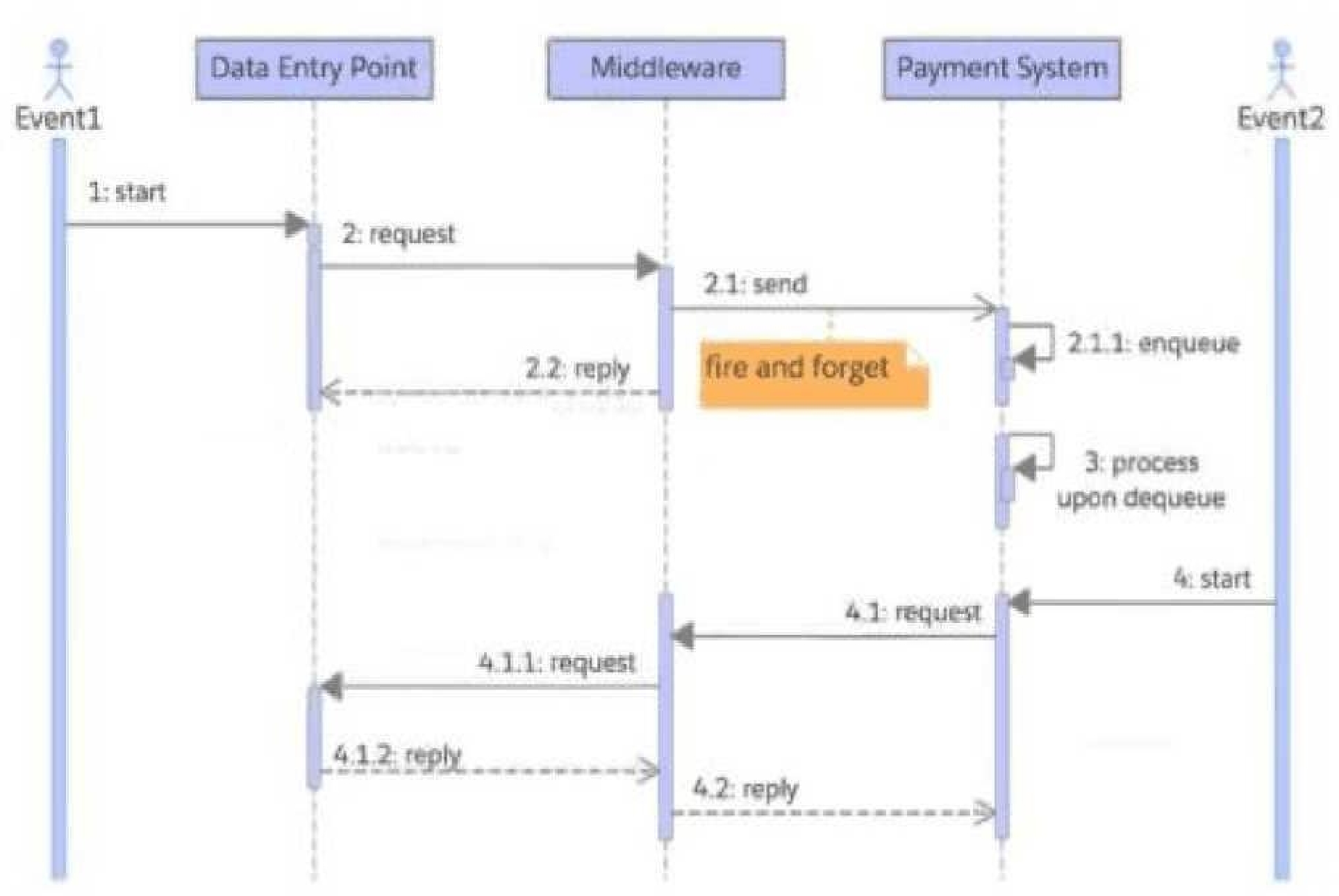
A company accepts payment requests 24/7. Once the company accepts a payment request, its service level agreement (SLA) requires it to make sure each payment request is processed by its Payment System. The company tracks payment requests using a globally unique identifier created at
the Data Entry Point. The company's simplified flow is as shown in the diagram.
The company encounters intermittent update errors when two or more processes try to update the same Payment Request record at the same time. Which recommendation should an integration architect make to improve the company's SLA and update conflict handling?
Select the answer:Select the answer
1 correct answer
A.
Middleware should coordinate request delivery and payment processing.
B.
Payment System and Middleware should automatically retry requests.
C.
Payment System sho46uld process a payment request only once.
In high-concurrency environments like 24/7 payment processing, a common architectural failure is "race conditions," where multiple threads attempt to update the same record simultaneously. To resolve this while strictly adhering to a Service Level Agreement (SLA), the Integration Architect must shift the responsibility of orchestration to a central "nervous system"—the Middleware (e.g., MuleSoft or an ESB). According to Salesforce Integration best practices, Middleware coordination is essential for managing the state and sequencing of asynchronous messages. By having the Middleware coordinate request delivery, it can implement a "Sequential Processing" or "First-In-First-Out" (FIFO) queue logic. This ensures that even if the Data Entry Point pushes requests at high speed, the Middleware can throttle or serialize the calls to the Payment System, preventing the record-locking errors and update conflicts mentioned in the scenario. Furthermore, the globally unique identifier created at the Data Entry Point allows the Middleware to perform Idempotency checks. If a duplicate request arrives or an error occurs, the Middleware can use this ID to verify the status before attempting another update, ensuring that the "exactly-once" processing requirement of the SLA is met without creating duplicate payment records or conflicting status updates. While Option B suggests retries—which are necessary for a "Fire-and-Forget" pattern—retrying without central coordination often exacerbates update conflicts rather than solving them. Option C (processing once) is a result of a well-designed system, but it does not provide the mechanism to handle the specific update conflicts described. By recommending that the Middleware coordinate the entire flow, the architect provides a robust solution that manages delivery, handles retries gracefully, and ensures data integrity across the system landscape.
Plat-Arch-204: Salesforce Certified Platform Integration Architect Practice test unlocks all online simulator questions
Thank you for choosing the free version of the Plat-Arch-204: Salesforce Certified Platform Integration Architect practice test! Further deepen your knowledge on Salesforce Simulator; by unlocking the full version of our Plat-Arch-204: Salesforce Certified Platform Integration Architect Simulator you will be able to take tests with over 129 constantly updated questions and easily pass your exam. 98% of people pass the exam in the first attempt after preparing with our 129 questions.
What to expect from our Plat-Arch-204: Salesforce Certified Platform Integration Architect practice tests and how to prepare for any exam?
The Plat-Arch-204: Salesforce Certified Platform Integration Architect Simulator Practice Tests are part of the Salesforce Database and are the best way to prepare for any Plat-Arch-204: Salesforce Certified Platform Integration Architect exam. The Plat-Arch-204: Salesforce Certified Platform Integration Architect practice tests consist of 129 questions and are written by experts to help you and prepare you to pass the exam on the first attempt. The Plat-Arch-204: Salesforce Certified Platform Integration Architect database includes questions from previous and other exams, which means you will be able to practice simulating past and future questions. Preparation with Plat-Arch-204: Salesforce Certified Platform Integration Architect Simulator will also give you an idea of the time it will take to complete each section of the Plat-Arch-204: Salesforce Certified Platform Integration Architect practice test . It is important to note that the Plat-Arch-204: Salesforce Certified Platform Integration Architect Simulator does not replace the classic Plat-Arch-204: Salesforce Certified Platform Integration Architect study guides; however, the Simulator provides valuable insights into what to expect and how much work needs to be done to prepare for the Plat-Arch-204: Salesforce Certified Platform Integration Architect exam.
Plat-Arch-204: Salesforce Certified Platform Integration Architect Practice test therefore represents an excellent tool to prepare for the actual exam together with our Salesforce practice test . Our Plat-Arch-204: Salesforce Certified Platform Integration Architect Simulator will help you assess your level of preparation and understand your strengths and weaknesses. Below you can read all the quizzes you will find in our Plat-Arch-204: Salesforce Certified Platform Integration Architect Simulator and how our unique Plat-Arch-204: Salesforce Certified Platform Integration Architect Database made up of real questions:
You can prepare for the Plat-Arch-204: Salesforce Certified Platform Integration Architect exams with our mobile app. It is very easy to use and even works offline in case of network failure, with all the functions you need to study and practice with our Plat-Arch-204: Salesforce Certified Platform Integration Architect Simulator.
Use our Mobile App, available for both Android and iOS devices, with our Plat-Arch-204: Salesforce Certified Platform Integration Architect Simulator . You can use it anywhere and always remember that our mobile app is free and available on all stores.
Our Mobile App contains all Plat-Arch-204: Salesforce Certified Platform Integration Architect practice tests which consist of 129 questions and also provide study material to pass the final Plat-Arch-204: Salesforce Certified Platform Integration Architect exam with guaranteed success.
Our Plat-Arch-204: Salesforce Certified Platform Integration Architect database contain hundreds of questions and Salesforce Tests related to Plat-Arch-204: Salesforce Certified Platform Integration Architect Exam. This way you can practice anywhere you want, even offline without the internet.