The new flashcard feature is useful to memorize questions.
?Change your study mode
At any time, you can change the study mode, and alternate between the practice mode and the exam mode. In practice mode, you can configure for example the number of questions or tests, and other parameters to help you study.
Randomized | 10 Questions per Test | 20 Minutes | 70% to pass|
To re-configure your study mode again and change - for example - the number of tests, whether you have random questions and all other configuration parameters.
?Simulator Configuration
Auto-scroll: You can use the automatic scrolling of the questionnaire that occurs as soon as you answer one or all of the answers to a question correctly. Auto scrolling is activated if you answer a single answer, or as soon as you answer all the mandatory answers. Learning Mode: During learning mode you can get a real time result for your answer.
Free Test
Question: / 10
20:00Min. left
?Restart the current test
To restart the current test by clearing all your answers and the time used up to now. Warning: all answers will be lost.
Question: / 10
5.0(1056 Votes)
Quiz
Question 1/101/10
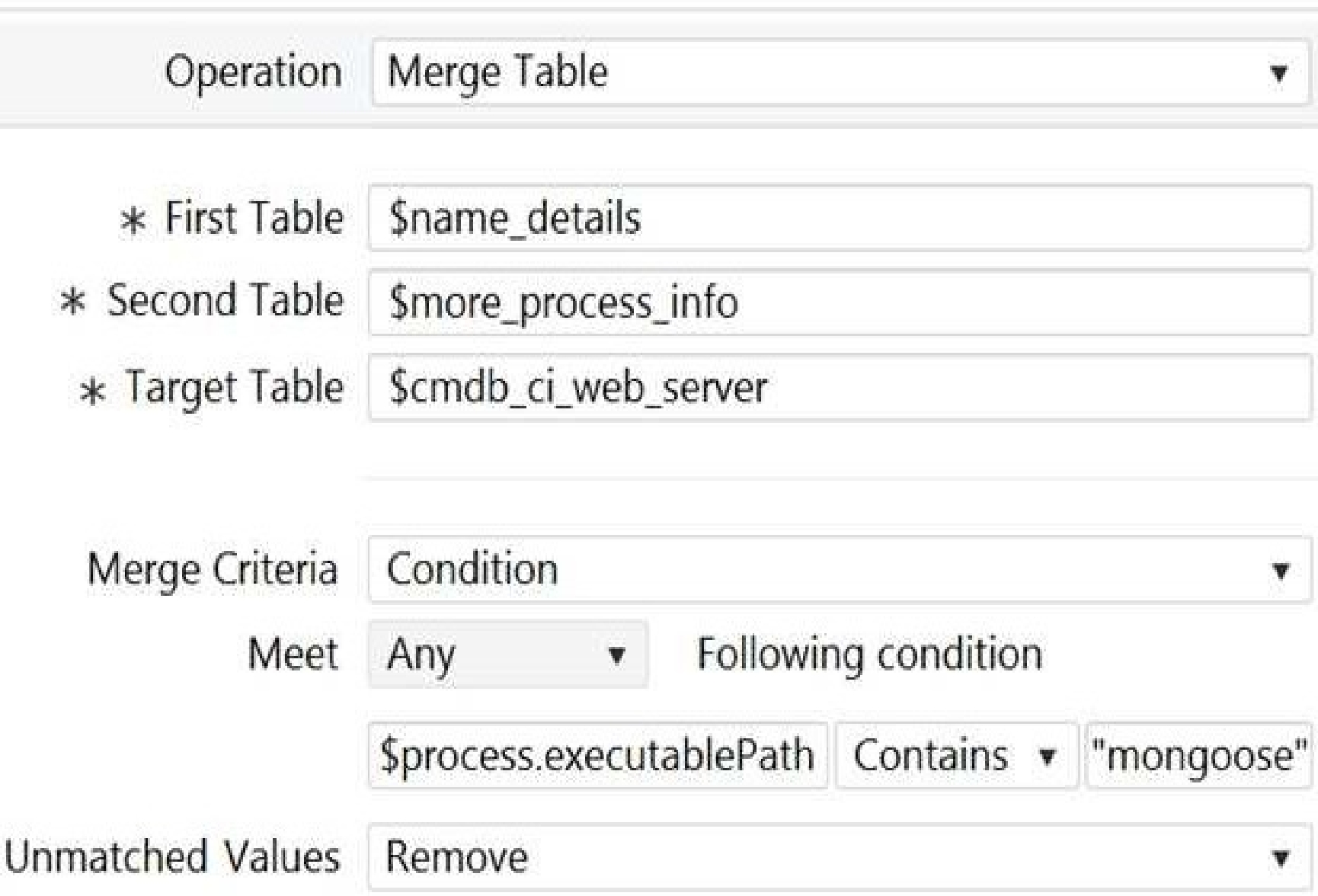
Refer to the exhibit.
Based on this image, which of the following statements are true? (Choose three.)
Select multiple answer: (Choose 3)Select the answer
3 correct answers
A.
Attributes from two tables populate a table with the same name as a ServiceNow CMDB table.
B.
This operation is more than likely a part of a step on a pattern set to Application Pattern Type.
C.
If a value is unmatched, it is still merged into the Target Table.
D.
For this operation to run, there must be some data in the process.executablePath variable.
E.
This is a horizontal pattern of type "infrastructure."
A is true because the target table $cmdb_ci_web_server is a ServiceNow CMDB table that stores information about web servers1. B is true because the merge table operation is typically used for application patterns, which are horizontal patterns that discover applications and their dependencies. The condition on the process.executablePath variable suggests that the operation is looking for a specific application (mongoose) running on the web servers. D is true because the merge table operation requires at least one matching field value between the two source tables1. In this case, the process.executablePath variable is the matching field, and it must contain “mongoose” for the operation to run. Reference: 1: Merge tables - Product Documentation: San Diego - Now Support Portal 3: Product Documentation | ServiceNow [4]: Discovery Patterns - Product Documentation: San Diego - Now Support Portal
Right Answer: A, B, D
Quiz
Question 2/102/10
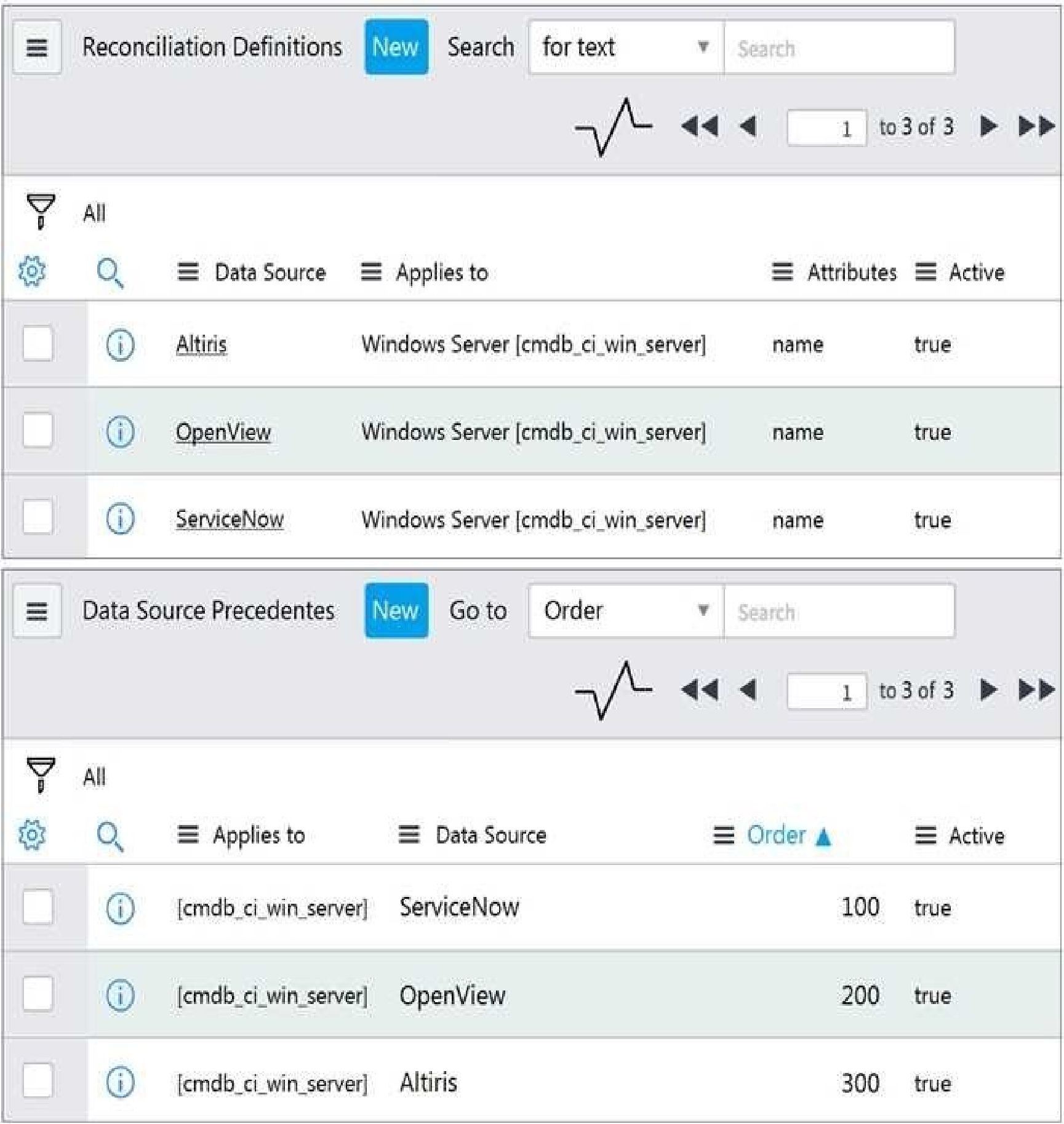
Refer to the exhibit.
Based on the following images, which choice best describes what occurs if Discovery sets the name attribute of a discovered Windows Server CI to 'Windows1' and then Altiris discovery runs detecting 'Windows2' for the name attribute on the same CI?
Select the answer:Select the answer
1 correct answer
A.
The name of the CI stays 'Windows1'.
B.
The name of the CI changes to 'Windows2'.
C.
The name of the CI does not populate with either discovery.
D.
The CI is not discovered because Discovery is not listed in either image.
In ServiceNow Discovery, the reconciliation process is governed by precedence rules. These rules determine which data source’s information will be retained if there are conflicts when multiple sources discover the same CI. In this case, Altiris has a higher order of precedence (300) compared to ServiceNow (100), as seen in the “Data Source Precedents” section of the image. Therefore, if Altiris discovers ‘Windows2’ for the name attribute on the same CI after ServiceNow sets it to ‘Windows1’, the name will change to ‘Windows2’ due to Altiris’s higher precedence. Reference: The explanation is inferred from understanding how reconciliation and data source precedents work in ServiceNow Discovery, though not directly quoted from specific documents. You can find more information on these topics in the following links: Reconciliation Data source precedents
Right Answer: B
Quiz
Question 3/103/10
For the Parse Variable pattern operation, what is required to have two different parsing methods to populate variables?
Select the answer:Select the answer
1 correct answer
A.
Two different Debug Mode sessions.
B.
A tabular and a scalar variable.
C.
Two different steps.
D.
Two different Define Parsing selections on the same step.
The Parse Variable pattern operation allows you to extract information from the output of a previous operation and save it in a variable. You can choose from different parsing methods, such as JSON File, XML File, Regular Expression, or Custom Script. To have two different parsing methods to populate variables, you need to use two different steps, each with a different Define Parsing selection. For example, you can use one step to parse a JSON file and another step to parse an XML file. You cannot use two different parsing methods on the same step, as the Define Parsing selection is unique for each step. Reference: Parse command output: This article explains how to use the Parse command output operation and the different parsing methods available. Pattern Designer: Parse Variable - JSON File gives error: This article provides a troubleshooting tip for using the JSON File parsing method. Examples of EVAL scripts used in Discovery patterns: This article provides some examples of custom scripts that can be used for the Custom Script parsing method.
Right Answer: C
Quiz
Question 4/104/10
Which best describes Discovery schedule of type Configuration Item?
Select the answer:Select the answer
1 correct answer
A.
Verifies Configuration Item data from the scanned IP ranges against the data in the CMDB.
B.
Creates only a list of discovered IPs in both IPv4 and IPv6 formats.
C.
Collects complete information from the scanned IP ranges and sends it to the CMDB.
D.
Directly populates records in the assets table.
A Discovery schedule of type Configuration Item collects complete information from the scanned IP ranges and sends it to the CMDB. This type of schedule runs a series of probes and sensors to identify and classify the devices and applications on the network, and to create or update the corresponding configuration items in the CMDB. A Discovery schedule of type Configuration Item can also run patterns to discover more details and relationships about the configuration items. Reference: ServiceNow Discovery Overview Create a Discovery schedule Discovery schedule types
Right Answer: C
Quiz
Question 5/105/10
When installing a MID Server on a Windows platform, which right must be associated when creating a Service Account?
Select the answer:Select the answer
1 correct answer
A.
Local Admin
B.
Domain Admin
C.
MID Server User Role
D.
Log on as service
The Service Account for the MID Server must have the Log on as service right on the Windows platform. This right allows the MID Server to run as a Windows service and communicate with the ServiceNow instance. The Service Account does not need to have local or domain admin rights, as these are not required for the MID Server functionality. The MID Server User Role is a role on the ServiceNow instance, not on the Windows platform, and it is used to control the access and permissions of the MID Server on the instance. Reference: Correcting MID Server Windows service account user and permissions What is a ServiceNow MID Server and how does it work? Configure Windows MID Server service credentials
Right Answer: D
Quiz
Question 6/106/10
Which of the below choices are needed for Quick Discovery? (Choose two.)
Select multiple answer: (Choose 2)Select the answer
2 correct answers
A.
MID Server
B.
Discovery Schedule
C.
PID
D.
Target IP
Quick Discovery is a wizard that helps you get up and running with Discovery quickly. It discovers both physical and logical components, including virtual machines, servers, storage, databases, applications, and more. To use Quick Discovery, you need to have a MID Server installed and configured, and provide a target IP range or subnet to scan. You do not need to create a Discovery Schedule or a PID for Quick Discovery. Reference: ServiceNow Discovery Data Sheet, Discovery Quick Start
Right Answer: A, D
Quiz
Question 7/107/10
In order to use Debug from the Pattern Designer, you must have what?
Select the answer:Select the answer
1 correct answer
A.
a proxy server
B.
a discoverable CI
C.
the admin role
D.
Service Mapping installed
Debug mode is a feature of the Pattern Designer that allows you to test and troubleshoot your patterns in real time. To activate Debug mode, you need to have the admin role or a role that includes the pattern_designer_debug permission. Debug mode is not available for users who only have the pattern_designer_read permission1. Reference: 1: Activate pattern Debug mode - Product Documentation: San Diego - ServiceNow
Right Answer: C
Quiz
Question 8/108/10
A discovery runs against a Windows Server returning the following attribute values for the first time: name = WindowsSN1 serial_number = 12321 A subsequent discovery is ran against a different Windows Server returning the following attribute values: name = WindowsSN2 serial_number = 12321 With only base system CI Identifiers configured, which of the following is true?
Select the answer:Select the answer
1 correct answer
A.
A Windows Server CI is created, then updated with WindowsSN2 as the name.
B.
Two Windows Sewer CIs are created, with WindowsSN1 AND WindowsSN2 for names.
C.
Two Windows Server CIs are created, without serial_number values.
D.
A Windows Server CI is created, then updated with WindowsSN1 as the name.
The correct answer is B. Two Windows Server CIs are created, with WindowsSN1 and WindowsSN2 for names. This question is about how CI identification works during discovery when only the base system CI identifiers are configured. Key points: - The first discovery finds a Windows Server with: - name = WindowsSN1 - serial_number = 12321 - The second discovery finds a different Windows Server with: - name = WindowsSN2 - serial_number = 12321 At first glance, the two servers share the same serial number. However, the question says that only base system CI identifiers are configured. In this setup, the discovery/identification logic is not using the serial number alone to merge the records into one CI. Instead, it treats the discovered servers as separate configuration items based on the identifier rules in place. Why B is correct: - Since the system does not have an identifier configuration that causes these two discoveries to resolve to the same CI, each discovered Windows Server is created as its own CI. - The names remain distinct: - one CI is created with WindowsSN1 - another CI is created with WindowsSN2 Why the other options are incorrect: A. A Windows Server CI is created, then updated with WindowsSN2 as the name. - This would imply both discoveries were matched to the same CI. - But with only base system CI identifiers configured, that match does not happen here. C. Two Windows Server CIs are created, without serial_number values. - The question does not indicate that serial_number is excluded from storage. - The issue is identification, not whether the attribute is saved. D. A Windows Server CI is created, then updated with WindowsSN1 as the name. - This would again mean both discoveries matched one CI, which is not the behavior described. Conclusion: Because only the base system CI identifiers are configured, the two Windows Server discoveries are treated as separate records, resulting in two CIs with different names. Therefore, B is correct.
Right Answer: B
Quiz
Question 9/109/10
Which choice represents the three best ways of extending Discovery?
Select the answer:Select the answer
1 correct answer
A.
Orchestration, Classifiers, Discovery Patterns
B.
Fingerprinting, Classifiers, Discovery Patterns
C.
Orchestration, Classifiers, Probes & Sensors
D.
Classifiers, Probes & Sensors, Discovery Patterns
E.
Classifiers, Fingerprinting, Probes & Sensors
ServiceNow Discovery can be extended in three main ways: Classifiers, Probes & Sensors, and Discovery Patterns. Classifiers are used to identify the type of device or application that is being discovered, based on the information returned by a probe. Probes are commands or scripts that are executed on the target device or application to collect data. Sensors are scripts that process the data collected by probes and create or update configuration items (CIs) in the CMDB. Discovery Patterns are graphical representations of the discovery process that can be customized or created to discover specific types of devices or applications, using classifiers, probes, and sensors as building blocks. Reference: Discovery overview - Product Documentation: Vancouver - Now Support Portal Create a Discovery CI classification - Product Documentation: Vancouver - Now Support Portal Discovery probes and sensors - Product Documentation: Vancouver - Now Support Portal Discovery patterns - Product Documentation: Vancouver - Now Support Portal
CIS-Discovery: ServiceNow Certified Implementation Specialist - Discovery Practice test unlocks all online simulator questions
Thank you for choosing the free version of the CIS-Discovery: ServiceNow Certified Implementation Specialist - Discovery practice test! Further deepen your knowledge on ServiceNow Simulator; by unlocking the full version of our CIS-Discovery: ServiceNow Certified Implementation Specialist - Discovery Simulator you will be able to take tests with over 125 constantly updated questions and easily pass your exam. 98% of people pass the exam in the first attempt after preparing with our 125 questions.
What to expect from our CIS-Discovery: ServiceNow Certified Implementation Specialist - Discovery practice tests and how to prepare for any exam?
The CIS-Discovery: ServiceNow Certified Implementation Specialist - Discovery Simulator Practice Tests are part of the ServiceNow Database and are the best way to prepare for any CIS-Discovery: ServiceNow Certified Implementation Specialist - Discovery exam. The CIS-Discovery: ServiceNow Certified Implementation Specialist - Discovery practice tests consist of 125 questions and are written by experts to help you and prepare you to pass the exam on the first attempt. The CIS-Discovery: ServiceNow Certified Implementation Specialist - Discovery database includes questions from previous and other exams, which means you will be able to practice simulating past and future questions. Preparation with CIS-Discovery: ServiceNow Certified Implementation Specialist - Discovery Simulator will also give you an idea of the time it will take to complete each section of the CIS-Discovery: ServiceNow Certified Implementation Specialist - Discovery practice test . It is important to note that the CIS-Discovery: ServiceNow Certified Implementation Specialist - Discovery Simulator does not replace the classic CIS-Discovery: ServiceNow Certified Implementation Specialist - Discovery study guides; however, the Simulator provides valuable insights into what to expect and how much work needs to be done to prepare for the CIS-Discovery: ServiceNow Certified Implementation Specialist - Discovery exam.
CIS-Discovery: ServiceNow Certified Implementation Specialist - Discovery Practice test therefore represents an excellent tool to prepare for the actual exam together with our ServiceNow practice test . Our CIS-Discovery: ServiceNow Certified Implementation Specialist - Discovery Simulator will help you assess your level of preparation and understand your strengths and weaknesses. Below you can read all the quizzes you will find in our CIS-Discovery: ServiceNow Certified Implementation Specialist - Discovery Simulator and how our unique CIS-Discovery: ServiceNow Certified Implementation Specialist - Discovery Database made up of real questions:
You can prepare for the CIS-Discovery: ServiceNow Certified Implementation Specialist - Discovery exams with our mobile app. It is very easy to use and even works offline in case of network failure, with all the functions you need to study and practice with our CIS-Discovery: ServiceNow Certified Implementation Specialist - Discovery Simulator.
Use our Mobile App, available for both Android and iOS devices, with our CIS-Discovery: ServiceNow Certified Implementation Specialist - Discovery Simulator . You can use it anywhere and always remember that our mobile app is free and available on all stores.
Our Mobile App contains all CIS-Discovery: ServiceNow Certified Implementation Specialist - Discovery practice tests which consist of 125 questions and also provide study material to pass the final CIS-Discovery: ServiceNow Certified Implementation Specialist - Discovery exam with guaranteed success.
Our CIS-Discovery: ServiceNow Certified Implementation Specialist - Discovery database contain hundreds of questions and ServiceNow Tests related to CIS-Discovery: ServiceNow Certified Implementation Specialist - Discovery Exam. This way you can practice anywhere you want, even offline without the internet.