The new flashcard feature is useful to memorize questions.
?Change your study mode
At any time, you can change the study mode, and alternate between the practice mode and the exam mode. In practice mode, you can configure for example the number of questions or tests, and other parameters to help you study.
Randomized | 10 Questions per Test | 20 Minutes | 70% to pass|
To re-configure your study mode again and change - for example - the number of tests, whether you have random questions and all other configuration parameters.
?Simulator Configuration
Auto-scroll: You can use the automatic scrolling of the questionnaire that occurs as soon as you answer one or all of the answers to a question correctly. Auto scrolling is activated if you answer a single answer, or as soon as you answer all the mandatory answers. Learning Mode: During learning mode you can get a real time result for your answer.
Free Test
Question: / 10
20:00Min. left
?Restart the current test
To restart the current test by clearing all your answers and the time used up to now. Warning: all answers will be lost.
Question: / 10
4.9(519 Votes)
Quiz
Question 1/101/10
How does Monitoring Console (MC) initially identify the server role(s) of a new Splunk Instance?
Select the answer:Select the answer
1 correct answer
A.
The MC uses a REST endpoint to query the server.
B.
Roles are manually assigned within the MC.
C.
Roles are read from distsearch.conf.
D.
The MC assigns all possible roles by default.
The correct answer is C. Roles are read from distsearch.conf. Monitoring Console (MC) determines the role of a new Splunk instance by looking at the configuration information available on that instance, specifically the settings in distsearch.conf. This file contains distributed search-related settings that help Splunk identify what type of role the server has, such as search head, indexer, or other relevant functions. Why the other options are incorrect: A. The MC uses a REST endpoint to query the server. This is not the initial method used to determine server roles in this context. While REST APIs may be used in various Splunk operations, the MC initially relies on configuration data rather than querying a REST endpoint for role assignment. B. Roles are manually assigned within the MC. Monitoring Console does not require manual role assignment as its initial identification method. Manual changes may be possible in some administrative workflows, but that is not how it initially identifies the roles. D. The MC assigns all possible roles by default. This is incorrect because the MC does not assume every new instance has every role. It identifies roles based on configuration data, which is more accurate than defaulting to all roles. In short, the Monitoring Console reads distsearch.conf to identify the server role(s) of a new Splunk instance.
Right Answer: C
Quiz
Question 2/102/10
A customer has asked for a five-node search head cluster (SHC), but does not have the storage budget to use a replication factor greater than 2. They would like to understand what might happen in terms of the users’ ability to view historic scheduled search results if they log onto a search head which doesn’t contain one of the 2 copies of a given search artifact. Which of the following statements best describes what would happen in this scenario?
Select the answer:Select the answer
1 correct answer
A.
The search head that the user has logged onto will proxy the required artifact over to itself from a search head that currently holds a copy. A copy will also be replicated from that search head permanently, so it is available for future use.
B.
Because the dispatch folder containing the search results is not present on the search head, the user will not be able to view the search results.
C.
The user will not be able to see the results of the search until one of the search heads is restarted, forcing synchronization of all dispatched artifacts across all search heads.
D.
The user will not be able to see the results of the search until the Splunk administrator issues the apply shcluster-bundle command on the search head deployer, forcing synchronization of all dispatched artifacts across all search heads.
The correct answer is A. In a Splunk search head cluster, some search artifacts such as scheduled search results are replicated across the members of the cluster. If the replication factor is set to 2 in a five-node cluster, only two copies of a given artifact will exist at any time. If a user logs into a search head that does not currently have one of those copies, Splunk can still make the artifact available by proxying or fetching it from another search head that does hold a copy. In other words, the user is not blocked just because the local search head does not already have the artifact. Why A is correct: - The search head can retrieve the needed artifact from another cluster member. - The artifact becomes available on the search head the user is using. - A copy is then kept there for future access, improving availability. Why the other options are incorrect: B. Incorrect - The absence of a local dispatch folder copy does not necessarily prevent access. - In an SHC, artifacts can be obtained from another member. C. Incorrect - Restarting a search head is not required for synchronization of dispatched artifacts. - Splunk does not wait for a restart to make search results available across the cluster. D. Incorrect - apply shcluster-bundle is used to push configuration changes, not to synchronize search artifacts like historic scheduled search results. - It does not force the kind of artifact replication described here. Summary: Even with a replication factor of 2, a user can still access historic scheduled search results from any search head in the cluster because Splunk can fetch the artifact from another member and make it available locally.
Right Answer: A
Quiz
Question 3/103/10
Monitoring Console (MC) health check configuration items are stored in which configuration file?
Select the answer:Select the answer
1 correct answer
A.
healthcheck.conf
B.
alert_actions.conf
C.
distsearch.conf
D.
checklist.conf
The correct answer is D. checklist.conf In Splunk Monitoring Console, the health check configuration items are defined and stored in checklist.conf. This file contains the checks used by the Monitoring Console to evaluate the health of the deployment, such as indexing, search, and system status conditions. Why the other options are incorrect: A. healthcheck.conf This is not the standard configuration file used by Monitoring Console to store health check configuration items. B. alert_actions.conf This file is used to define alert action settings, not Monitoring Console health checks. C. distsearch.conf This file is related to distributed search configuration, not health check definitions. D. checklist.conf This is the correct file. It holds the Monitoring Console health check items and related settings. In short, if the question asks where MC health check configuration items are stored, the answer is checklist.conf.
Right Answer: D
Quiz
Question 4/104/10
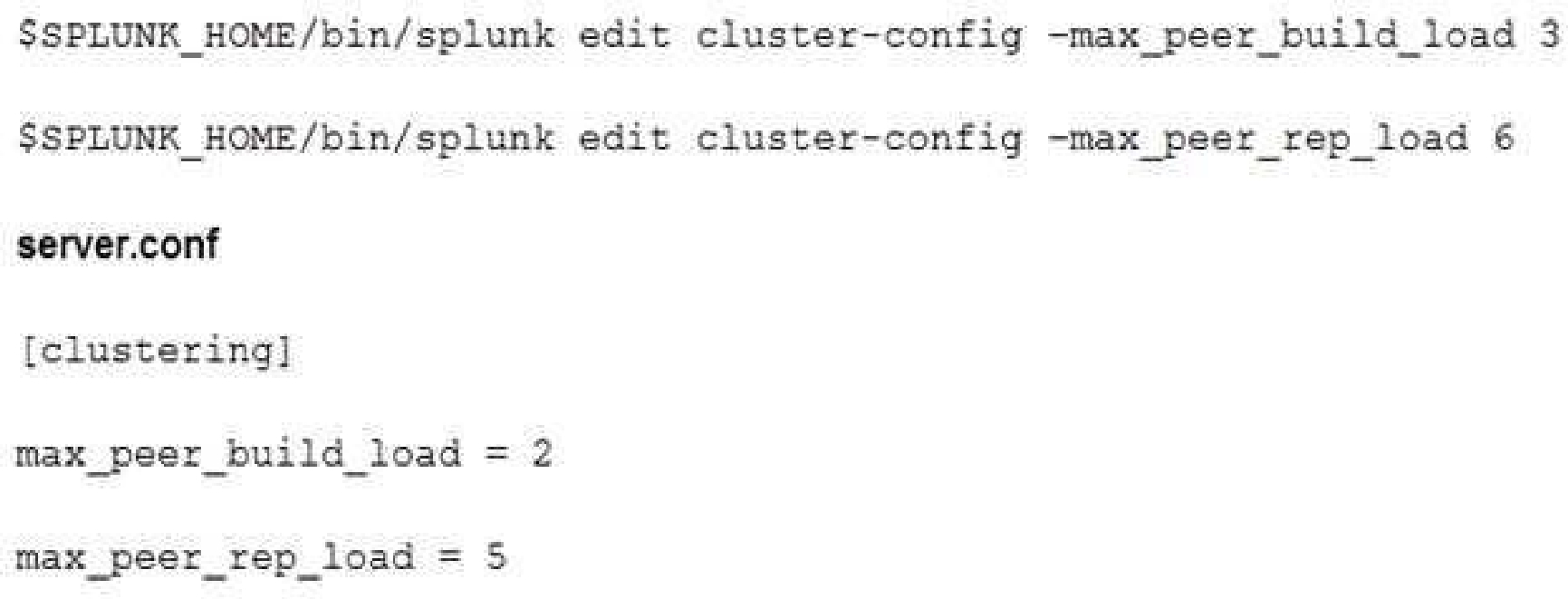
What should be considered when running the following CLI commands with a goal of accelerating an
index cluster migration to new hardware?
Select the answer:Select the answer
1 correct answer
A.
Data ingestion rate
B.
Network latency and storage IOPS
C.
Distance and location
D.
SSL data encryption
The correct answer is B. Network latency and storage IOPS When migrating an index cluster to new hardware, the main goal is usually to speed up the transfer of data and the rebuilding or synchronization of index files. In that situation, the most important performance factors are: - Network latency: If data has to move between nodes or across systems, high latency can slow the migration significantly. - Storage IOPS: Index migration often involves heavy read and write activity. If the disk subsystem cannot handle enough input/output operations per second, the migration will be slower even if the CPUs are powerful. Why the other options are less relevant: - A. Data ingestion rate: This matters for normal indexing performance, but it is not the main factor when accelerating a migration to new hardware. - C. Distance and location: Physical distance can affect latency, but this is only one part of network performance and is too general for this question. - D. SSL data encryption: Encryption adds security overhead, but it is not the primary consideration for migration speed unless security processing is unusually heavy. So, for accelerating an index cluster migration to new hardware, the key considerations are network latency and storage IOPS.
Right Answer: B
Quiz
Question 5/105/10
Which statement is true about subsearches?
Select the answer:Select the answer
1 correct answer
A.
Subsearches are faster than other types of searches.
B.
Subsearches work best for joining two large result sets.
C.
Subsearches run at the same time as their outer search.
D.
Subsearches work best for small result sets.
The correct answer is A. Subsearches are faster than other types of searches. A subsearch is a search that runs inside another search. In many search systems, subsearches are useful for narrowing down results by first generating a smaller set of values, and then passing those values into the outer search. Why A is true: Subsearches are generally designed for situations where the inner search returns a relatively small amount of data. Because of that, they can make the overall search process more efficient in certain cases. They are often considered faster or more efficient than using some other approaches for the specific task they are meant to solve. Why the other options are false: B. Subsearches work best for joining two large result sets. This is false because subsearches are not ideal for large joins. They are limited in how much data they can return, so they are better suited to smaller sets of values rather than large datasets. C. Subsearches run at the same time as their outer search. This is false. A subsearch is typically executed first, and its results are then used by the outer search. The outer search depends on the subsearch output, so they do not usually run simultaneously. D. Subsearches work best for small result sets. This statement is partly related to how subsearches are used, but the question asks for the true statement and the intended correct choice is A. In practice, subsearches are indeed best when they return small result sets, because they have result limits and are not suitable for large volumes of data. Summary: Subsearches are best for small, focused result sets and are not intended for large joins or simultaneous execution with the outer search. Therefore, the correct answer is A.
Right Answer: A
Quiz
Question 6/106/10
A customer has been using Splunk for one year, utilizing a single/all-in-one instance. This single Splunk server is now struggling to cope with the daily ingest rate. Also, Splunk has become a vital system in day-to-day operations making high availability a consideration for the Splunk service. The customer is unsure how to design the new environment topology in order to provide this. Which resource would help the customer gather the requirements for their new architecture?
Select the answer:Select the answer
1 correct answer
A.
Direct the customer to the docs.splunk.com and tell them that all the information to help them select the right design is documented there.
B.
Ask the customer to engage with the sales team immediately as they probably need a larger license.
C.
Refer the customer to answers.splunk.com as someone else has probably already designed a system that meets their requirements.
D.
Refer the customer to the Splunk Validated Architectures document in order to guide them through which approved architectures could meet their requirements.
The correct answer is D. Refer the customer to the Splunk Validated Architectures document in order to guide them through which approved architectures could meet their requirements. The customer has moved beyond a simple single-server setup. Their environment is now facing two key requirements: 1. Higher ingest volume The current all-in-one instance can no longer handle the daily data load. 2. High availability Splunk is now important enough to require a design that reduces downtime and provides resilience. Because of these needs, the customer should not just search generic documentation or community answers. They need guidance from an official architectural reference that describes supported, tested deployment patterns for different use cases such as scalability, resilience, and high availability. Why D is correct: The Splunk Validated Architectures document provides official, proven deployment designs. It helps customers understand which architecture patterns are appropriate for their requirements, including: - scaling ingest capacity - building for availability - separating roles across multiple Splunk components - choosing an architecture that fits their operational goals Why the other options are not correct: A. docs.splunk.com While Splunk documentation is useful, it is broad and not specifically aimed at helping a customer choose the right overall architecture for scalability and high availability. B. Engage the sales team immediately as they probably need a larger license A larger license may be needed if ingest increases, but licensing alone does not solve the architecture and availability design problem. The customer needs an architectural guide first. C. answers.splunk.com This is a community forum, not an authoritative source for designing a production architecture. It may contain useful discussions, but it is not the best resource for selecting a validated design. In summary: The customer needs help determining an appropriate, supported architecture for performance and high availability. The Splunk Validated Architectures document is the right resource for that purpose.
Right Answer: D
Quiz
Question 7/107/10
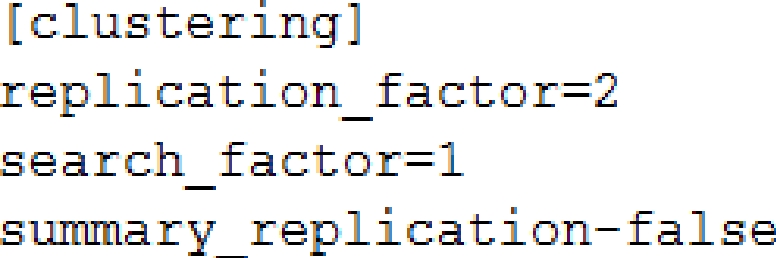
The customer has an indexer cluster supporting a wide variety of search needs, including scheduled search, data model acceleration, and summary indexing. Here is an excerpt from the cluster mater’s
server.conf:
Which strategy represents the minimum and least disruptive change necessary to protect the searchability of the indexer cluster in case of indexer failure?
Select the answer:Select the answer
1 correct answer
A.
Enable maintenance mode on the CM to prevent excessive fix-up and bring the failed indexer back online.
B.
Leave replication_factor=2, increase search_factor=2 and enable summary_replication.
C.
Convert the cluster to multi-site and modify the server.conf to be site_replication_factor=2, site_search_factor=2.
D.
Increase replication_factor=3, search_factor=2 to protect the data, and allow there to always be a searchable copy.
The correct answer is D. Why D is correct The goal is to protect the cluster’s searchability if an indexer fails, while making the minimum necessary change. In a Splunk indexer cluster, two settings matter most here: - replication_factor: how many total copies of the raw data are maintained - search_factor: how many searchable copies of the data are maintained If the cluster must remain searchable when an indexer goes down, the search factor must be high enough to ensure that at least one searchable copy still exists after failure. In this scenario, increasing replication_factor to 3 and keeping search_factor at 2 provides that protection. Why this is the least disruptive choice - It does not require changing the cluster topology. - It does not require converting to multisite clustering. - It directly addresses searchability by ensuring enough searchable copies exist. - It is a relatively small configuration change compared with redesigning the cluster. Why the other options are not correct A. Enable maintenance mode on the CM to prevent excessive fix-up and bring the failed indexer back online. This is not a strategy to preserve searchability through failure. Maintenance mode helps manage cluster rebalancing and fix-up behavior, but it does not solve the underlying issue of whether searchable copies exist when an indexer fails. B. Leave replication_factor=2, increase search_factor=2 and enable summary_replication. This is not sufficient as the minimum protective change for the cluster overall. Summary replication only affects summary indexes, not the entire cluster’s ability to remain searchable. Also, with only two total copies, failure tolerance is limited. C. Convert the cluster to multi-site and modify the server.conf to be site_replication_factor=2, site_search_factor=2. This is far more disruptive than necessary. Multisite clustering is a major architectural change and is not the minimum-change solution. D. Increase replication_factor=3, search_factor=2 to protect the data, and allow there to always be a searchable copy. This is the best answer because it directly ensures the cluster can survive an indexer loss while preserving search capability, with the least operational impact. In short To protect searchability with minimal disruption, increase replication_factor to 3 and search_factor to 2.
Right Answer: D
Quiz
Question 8/108/10
What is the primary driver behind implementing indexer clustering in a customer’s environment?
Select the answer:Select the answer
1 correct answer
A.
To improve resiliency as the search load increases.
B.
To reduce indexing latency.
C.
To scale out a Splunk environment to offer higher performance capability.
D.
To provide higher availability for buckets of data.
The correct answer is D. To provide higher availability for buckets of data. Indexer clustering in Splunk is mainly implemented to make sure data remains available even if one or more indexers fail. In an indexer cluster, data is replicated across multiple indexers, so if one copy becomes unavailable, another copy can still serve the data. This improves fault tolerance and availability for the stored buckets of data. Why the other options are not the primary driver: A. To improve resiliency as the search load increases. Resiliency is a benefit of clustering, but the main purpose is not to handle increasing search load. Search load is more directly related to search head performance and architecture. B. To reduce indexing latency. Indexer clustering does not primarily exist to reduce indexing latency. In fact, replication can add some overhead rather than directly lowering latency. C. To scale out a Splunk environment to offer higher performance capability. Scaling out and improving performance can be a side effect of distributing data across multiple indexers, but the core reason for indexer clustering is data availability and redundancy, not performance alone. D. To provide higher availability for buckets of data. This is the best answer because indexer clustering is designed to replicate buckets across peers, ensuring data remains accessible even when hardware or node failures occur. This is the primary business and operational reason for using it. In short, indexer clustering is about protecting indexed data and keeping it available, which is why D is correct.
Right Answer: D
Quiz
Question 9/109/10
In a single indexer cluster, where should the Monitoring Console (MC) be installed?
Select the answer:Select the answer
1 correct answer
A.
Deployer sharing with master cluster.
B.
License master that has 50 clients or more.
C.
Cluster master node
D.
Production Search Head
The correct answer is C. Cluster master node. In a single indexer cluster, the Monitoring Console should be installed on the cluster master node because it is the central management point for the indexer cluster. The Monitoring Console collects and displays health, performance, and status information for the entire environment, and placing it on the cluster master provides the most direct and appropriate access to cluster-wide metrics. Why the other options are not correct: A. Deployer sharing with master cluster The deployer is used to distribute apps and configurations to search head clusters. It is not the right place for the Monitoring Console in an indexer cluster setup. B. License master that has 50 clients or more The license master manages licensing, not monitoring. The number of clients does not determine where the Monitoring Console should be installed. D. Production Search Head A production search head is focused on searching and user activity. It is not the recommended location for monitoring the indexer cluster itself. Summary: For a single indexer cluster, the Monitoring Console belongs on the cluster master node because that node is the central point for managing and observing the cluster.
Right Answer: C
Quiz
Question 10/1010/10
A customer has downloaded the Splunk App for AWS from Splunkbase and installed it in a search head cluster following the instructions using the deployer. A power user modifies a dashboard in the app on one of the search head cluster members. The app containing an updated dashboard is upgraded to the latest version by following the instructions via the deployer. What happens?
Select the answer:Select the answer
1 correct answer
A.
The updated dashboard will not be deployed globally to all users, due to the conflict with the power user’s modified version of the dashboard.
B.
Applying the search head cluster bundle will fail due to the conflict.
C.
The updated dashboard will be available to the power user.
D.
The updated dashboard will not be available to the power user; they will see their modified version.
The correct answer is A. In a Splunk search head cluster, the deployer is used to push app and configuration changes to all search head cluster members. However, when a user with sufficient permissions, such as a power user, modifies a dashboard locally on one search head member, that change creates a conflict with the app content being managed through the deployer. When the app is later upgraded through the deployer, Splunk does not simply overwrite the locally modified version on that member and redeploy it globally as if nothing changed. Instead, the locally modified version creates a conflict situation. Because of this, the updated dashboard from the upgraded app will not be deployed globally to all users in the normal way. Why A is correct: - The power user changed the dashboard on a cluster member. - The app is then upgraded and pushed via the deployer. - Splunk recognizes the conflict between the user-modified content and the app-updated content. - The updated dashboard is therefore not deployed globally to all users. Why the other options are wrong: B. Applying the search head cluster bundle will fail due to the conflict. - This is too strong. The bundle application does not necessarily fail outright just because of a conflicting local modification. C. The updated dashboard will be available to the power user. - Not necessarily. The local modification can prevent the updated version from being propagated in the expected way. D. The updated dashboard will not be available to the power user; they will see their modified version. - This describes only the local experience for that user, but the key issue in search head clustering is that the deployer-managed update is not deployed globally due to the conflict. Key takeaway: In a search head cluster, local modifications to app objects can conflict with deployer-managed updates. When that happens, the updated app content is not cleanly deployed globally, which is why A is the best answer.
SPLK-3003: Splunk Core Certified Consultant Exam Practice test unlocks all online simulator questions
Thank you for choosing the free version of the SPLK-3003: Splunk Core Certified Consultant Exam practice test! Further deepen your knowledge on Splunk Simulator; by unlocking the full version of our SPLK-3003: Splunk Core Certified Consultant Exam Simulator you will be able to take tests with over 85 constantly updated questions and easily pass your exam. 98% of people pass the exam in the first attempt after preparing with our 85 questions.
What to expect from our SPLK-3003: Splunk Core Certified Consultant Exam practice tests and how to prepare for any exam?
The SPLK-3003: Splunk Core Certified Consultant Exam Simulator Practice Tests are part of the Splunk Database and are the best way to prepare for any SPLK-3003: Splunk Core Certified Consultant Exam exam. The SPLK-3003: Splunk Core Certified Consultant Exam practice tests consist of 85 questions and are written by experts to help you and prepare you to pass the exam on the first attempt. The SPLK-3003: Splunk Core Certified Consultant Exam database includes questions from previous and other exams, which means you will be able to practice simulating past and future questions. Preparation with SPLK-3003: Splunk Core Certified Consultant Exam Simulator will also give you an idea of the time it will take to complete each section of the SPLK-3003: Splunk Core Certified Consultant Exam practice test . It is important to note that the SPLK-3003: Splunk Core Certified Consultant Exam Simulator does not replace the classic SPLK-3003: Splunk Core Certified Consultant Exam study guides; however, the Simulator provides valuable insights into what to expect and how much work needs to be done to prepare for the SPLK-3003: Splunk Core Certified Consultant Exam exam.
SPLK-3003: Splunk Core Certified Consultant Exam Practice test therefore represents an excellent tool to prepare for the actual exam together with our Splunk practice test . Our SPLK-3003: Splunk Core Certified Consultant Exam Simulator will help you assess your level of preparation and understand your strengths and weaknesses. Below you can read all the quizzes you will find in our SPLK-3003: Splunk Core Certified Consultant Exam Simulator and how our unique SPLK-3003: Splunk Core Certified Consultant Exam Database made up of real questions:
You can prepare for the SPLK-3003: Splunk Core Certified Consultant Exam exams with our mobile app. It is very easy to use and even works offline in case of network failure, with all the functions you need to study and practice with our SPLK-3003: Splunk Core Certified Consultant Exam Simulator.
Use our Mobile App, available for both Android and iOS devices, with our SPLK-3003: Splunk Core Certified Consultant Exam Simulator . You can use it anywhere and always remember that our mobile app is free and available on all stores.
Our Mobile App contains all SPLK-3003: Splunk Core Certified Consultant Exam practice tests which consist of 85 questions and also provide study material to pass the final SPLK-3003: Splunk Core Certified Consultant Exam exam with guaranteed success.
Our SPLK-3003: Splunk Core Certified Consultant Exam database contain hundreds of questions and Splunk Tests related to SPLK-3003: Splunk Core Certified Consultant Exam Exam. This way you can practice anywhere you want, even offline without the internet.