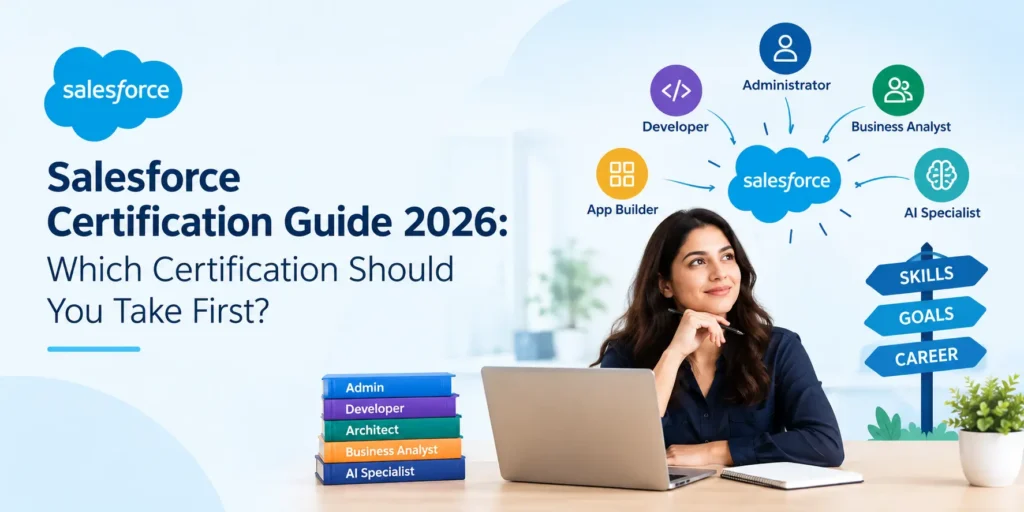
Salesforce Certification Guide 2026: Which Certification Should You Take First?
10 min.
05/11/2026
05/11/2026
Choosing your first Salesforce credential can be confusing. There are exams for administrators, developers, and AI specialists. Each one tests different skills and supports a different career goal, and taking the wrong exam first can cost you time and money.
A clear plan can give the right choice. You need to know what each role involves, and which skills employers expect you to use. In this guide, we will discuss Salesforce certifications and explain how to build a study plan based on your career goals.
Choosing the Right First Certification for Salesforce
First of all, figure out the kind of activity you prefer – it may be system administration or coding. The choice will depend on your preferences and current skills. Remember these four factors when scheduling your exam:
Your career goals – choose a certification that will lead you to the profession you dream of;
Your current knowledge level and previous experience;
Study hours per week;
Your ability to practice key skills while preparing for the exam.
Lastly, be sure to review the most recent edition of the exam guide. That’s because the subject matter and conditions could be different from previous years.
Salesforce Certification Comparison: Which Exam Fits Your Career?
The table below compares six popular starting points. The difficulty levels and study times are estimates. They are not official exam ratings.
Certification
Best suited for
Coding needed
Estimated study time
Platform Foundations
Complete beginners
No
2–4 weeks
Platform Administrator
CRM administrators
No
6–10 weeks
Platform App Builder
App builders
Usually No
6–10 weeks
Platform Developer
Software developers
Yes
8–14 weeks
Business Analyst
Business and operations professionals
No
4–8 weeks
Agentforce Specialist
AI and automation professionals
Usually No
6–10 weeks
These estimates assume regular study and some practical work. You may need longer if the platform is new to you.
1. Platform Administrator: Best for CRM Management
Salesforce Admin certification is one of the best certifications for those aspiring to become business system administrators. Administrators help teams make sense of customer data, and perform their day-to-day activities.
You will learn about user accounts, and automation. However, you must also understand the impact of the various settings on the end-users.
Your main study areas should include:
User accounts, and permission sets.
Data records, and fields.
Reports and dashboards.
Data import and cleanup.
Approval processes and automation.
System settings and security.
Practical project: Create a sample sales system. Add users, and build a report that shows monthly sales. This project will help you connect exam topics with real tasks.
Career direction: CRM Administrator, Junior Administrator, or CRM Support Specialist.
2. Platform App Builder: Ideal for Developing Business Applications
Platform App Builder is ideal for those individuals who would like to build useful applications without having to use code for all modifications. With this platform, you will be able to develop data fields and perform repetitive tasks. This test will check how well you are able to select appropriate features from within the application.
Areas to focus on include:
Custom objects and fields.
Record relationships.
Forms and page layouts.
Automation through Flow.
Data access and validation.
Testing and deployment of apps.
Real-life project: Create a leave application app. This app will allow employees to submit leave applications and will allow managers to approve the requests.
Job path: App Builder or Business System Specialist.
Administration knowledge is helpful before this exam. But it is not a required first step.
3. Platform Developer: Best for Programming Careers
The developer route is designed for people who want to write code and build custom features. You will need programming knowledge and an understanding of how the platform stores and processes data. You should also know how to test your work and protect sensitive information.
Study these areas:
Apex programming.
Database queries using SOQL.
Triggers and classes.
Lightning Web Components.
Testing and error handling.
Application security.
Practical project: Build a custom feature that updates related customer records when a sales record changes. Also, write tests to check that it works correctly.
Career direction: Junior Salesforce Developer, or Software Engineer.
Beginners with no coding background should learn basic programming before preparing for this exam.
4. Business Analyst: Best for Business-Focused Careers
Business analysts help companies understand problems and plan software changes. They work with users and technical teams. This role suits people who enjoy asking questions and writing clear requirements.
The exam covers topics such as:
Working with business teams.
Gathering and checking requirements.
Mapping business processes.
Writing user stories.
Planning changes.
Checking whether a solution meets business needs.
Practical project: Choose a sales process that uses manual spreadsheets. Map the current steps, and write requirements for moving the process into a CRM system.
Career direction: Business Analyst, or Business Process Analyst.
This is a useful option for people moving from operations or project coordination into technology.
5. Agentforce Specialist: Best for AI-Focused Work
Agentforce Specialist focuses on AI agents that can support business tasks. These tools can answer questions and carry out defined actions.
You need to understand how agents receive instructions and respond to users. You must also know when human review is needed.
Prepare for topics such as:
AI agent setup and configuration.
Instructions and permitted actions.
Data access and security.
Testing agent responses.
Monitoring results.
Human approval and review.
Real-world project: Create a customer service agent that responds to frequent queries by relying on information that is authorized. Assess how it handles missing information and when human intervention is needed.
Career direction: AI Automation Specialist, or Agentforce Administrator.
This exam may suit someone with prior CRM knowledge better than a complete beginner. The official credential description expects a strong understanding of platform configuration.
6. Platform Foundations: Best for Complete Beginners
Platform Foundations provides a basic introduction to customer relationship management and the Salesforce platform. It is aimed at people with fundamental platform knowledge and up to six months of user experience.
You will learn about:
CRM basics and business uses.
Customer records and data.
Basic system features.
Reports and dashboards.
How different teams share information.
Practical project: Create sample customer records and build a simple report. Then explain how a sales team could use that report.
Career direction: Entry-level CRM Support, Sales Operations Assistant, or a later move into administration. This credential can help you build confidence before taking a more focused exam.
Exam Cost, Format, and Registration
Examination costs and requirements vary based on the credential sought. Most professional credentials have traditionally had a registration fee of around US$200 anda test fee of around US$100, prior to taxes. Don’t make the assumption that these fees apply to all examinations in 2026.
For instance, the older version of the Administrator examination guide had 60 scored items, five unscored items, 105 minutes, and 65% passing mark. The above data is historical and should be validated using the current exam guide.
Before paying, check the following details for your chosen exam:
Exam detail
What you should confirm
Registration fee
Current price and local taxes
Exam format
Question types and total questions
Time limit
Minutes allowed to complete the exam
Passing score
Minimum score required
Retake fee
Cost and waiting period
Delivery
Online or test-centre options
Prerequisites
Any certification you must already hold
Maintenance
Tasks needed to keep the credential active
Start with the official Salesforce certification catalog. Select your credential and open its current exam guide. Don’t rely on old screenshots. That’s because certification policies can change between exam versions.
Sample Practice Questions
Try these sample questions before moving to the full interactive quiz below. Each question includes the correct answer and explanation, similar to what you will experience in a complete PDII.
1. A developer is asked to develop a new AppFxchange application. A feature of the program creates Survey records when a Case reaches a certain stage and is of a certain Record Type. This feature needs to be configurable, as different Salesforce instances require Surveys at different times. Additionally, the out-of-the-box AppExchange app needs to come with a set of best practice settings that apply to most customers. What should the developer use to store and package the custom configuration settings for the app?
Custom objects
Custom settings
✓ Custom metadata
Custom labels
Custom metadata is best for storing configurable settings. It's deployable, packageable, and upgradeable. Allows different configurations for different instances. Reference: Custom Metadata Types
2. Universal Containers develops a Visualforce page that requires the inclusion of external JavaScript and C55 files. They want to ensure efficient loading and caching of the page. Which feature should be utilized to achieve this goal?
ActionFunction
PageBlockTable
✓ Static resources
RemoteAction
Static resources are ideal for efficient loading and caching of external files in Visualforce. They allow bundling and minimizing HTTP requests. Reference: Using Static Resources
How to Build a Salesforce Certification Path Based on Your Career Goals
A good Salesforce certification path should lead towards a specific role. Your second exam should build on skills you already use. Here are four practical routes.
Route 1: CRM Administration
Platform Administrator
Platform App Builder
Platform Administrator II
Start with system management. Build skills in reports, security, and automation. Move into app building when your work involves custom business tools. Consider advanced administration after gaining practical knowledge.
Route 2: Software Development
Start with Platform Developer. Build applications and learn how to test them. Later, study advanced development and system design. Architecture credentials may become useful when you begin planning large systems. Check their prerequisites before choosing them.
Route 3: Business Analysis
Start with Business Analyst if you already understand business processes. Build skills in requirements and communication.
You can then add Platform Administrator to improve your technical understanding. This combination can help you work more closely with system teams.
Route 4: AI and Automation
Build a foundation in CRM data and system security. Study Agentforce Specialist when you understand how business processes work. You can then focus on agent testing, and safe use of business data. These routes are suggestions rather than required sequences.
An Eight-Week Study Plan for Your First Certification
A realistic schedule makes preparation easier. The plan below works best for someone studying around seven to ten hours each week. You can extend it when you need more practice.
Week
Main task
Your goal
1
Read the exam guide
Understand the topics and requirements
2
Study platform basics
Learn the main tools and terms
3
Practise core features
Complete basic tasks without help
4
Study advanced topics
Work on security, data, or role-specific skills
5
Build a small project
Apply what you have learned
6
Take practice tests
Identify weak areas
7
Review mistakes
Improve your understanding
8
Final revision
Decide whether you are ready to book
Use a simple weekly routine. Spend three days learning new topics, and one day reviewing. Leave another day for rest.
Don’t book an exam only because you have completed eight weeks. You should explain why a solution works and complete common tasks independently.
How to Prepare Without Being Wasteful
Effective preparation entails studying and reviewing. Knowing an answer through memorisation may be useful for recognising the question. But that will not improve your skills for the workplace.
Follow these guidelines:
Study the official guide first. Identify all the topics and their relevance in the exam.
Practice all the topics. Apply this in a learning environment where you can try out various features safely.
Create a project. Select any business issue and find a solution.
Build a project: Solve a real business problem.
Take timed exams: Practice time management and question analysis.
Review mistakes: Understand the correct answers.
Focus on weak areas: Spend more time on difficult topics.
Keep a study log: Track topics and learning gaps.
Common Mistakes to Avoid
A certification can support your career. But it cannot replace practical ability. Avoid these mistakes when preparing:
Choosing an exam because it seems popular rather than useful for your career.
Taking several exams without building practical skills.
Using outdated study material.
Memorising practice questions without understanding the answers.
Ignoring exam fees and maintenance rules.
Applying for jobs without projects that show your skills.
The Salesforce Admin certification may be a good starting point. But it will not suit every learner. Someone with programming skills may benefit more from a developer route. A business professional may prefer analysis or administration. Choose the credential that supports the work you want to do.
Conclusion
The first certificate must be aligned with your abilities and career aspirations. If you are interested in administration, it is for managing CRM systems, and app development for creating apps for business. Business analysis and artificial intelligence are alternative areas of activity that may interest you.
Spending some time comparing and preparing for the exam may turn out to be helpful. You may also refer to Certification Exam to get more practice. Having a plan and doing your homework will enable you to put your knowledge into practice.
FAQs
1. Which Salesforce certification is best for beginners in 2026?
Platform Foundations is a suitable introduction for people with limited platform knowledge. Platform Administrator is a practical first choice for those who want to manage CRM systems. Choose based on your career goals and current skills.
2. What is the preparation period for Salesforce Admin certification?
It takes six to ten weeks for a beginner to be ready for the test, depending on previous experience, and practical skills.
3. Is it possible to get a job based on one Salesforce certification?
With one certification, you may have a chance to get an entry-level position, but nothing more. Your projects, and problem-solving skills will be checked by the company.
4. Are there any expiration dates for Salesforce certifications?
Many certificates require constant updating, otherwise, they will become invalid. Salesforce says that certified professionals must update their certificate each year.
Here are the most popular certification exams... Try them now!