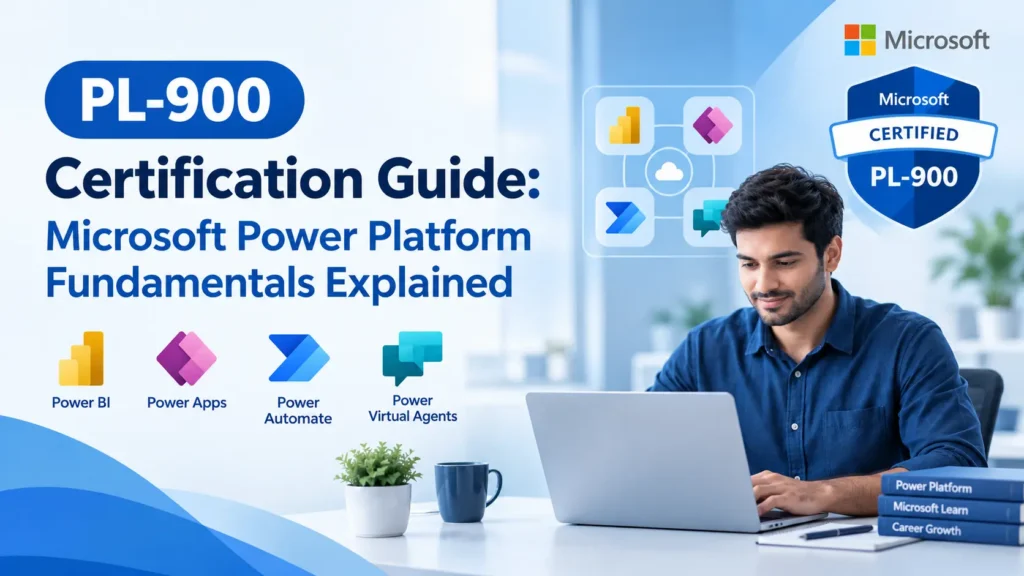
PL-900 Certification Guide: Microsoft Power Platform Fundamentals Explained
7 min.
16/10/2026
16/10/2026
Low-code skills have moved from a bonus to a baseline expectation. Teams build their own apps without waiting for a developer. Managers automate approvals in an afternoon. Support staff design chatbots that answer routine questions around the clock. Microsoft’s official starting point for all of this is the PL-900 certification, a beginner-level credential that shows a candidate understands what the Power Platform does and why organizations rely on it.
The exam changed in a big way on July 24, 2026. Many online guides still describe the older outline, so candidates who study from them can walk into the test underprepared. This guide covers the current version: what the exam measures, how it works, how to prepare, and where the credential can lead.
What Is Exam PL-900?
Exam PL-900 is formally named Microsoft Power Platform Fundamentals. Passing it earns the Microsoft Certified: Power Platform Fundamentals badge. Microsoft rates the level as beginner. No coding background is needed, and no earlier certification is required. The questions lean conceptual, so candidates describe features and use cases rather than build solutions from scratch.
Microsoft frames the target candidate as someone who wants to develop tailored business solutions, make better use of data through Dataverse and connectors, speed up results with AI features in Power Apps, automate processes with Power Automate, and create agents with Copilot Studio. The exam is not a prerequisite for any role-based Power Platform certification. The PL-900 certification still gives a clean foundation for those next steps.
Four pieces do most of the work. Power Apps is the face of a solution, the screen a person actually touches. Power Automate is the movement, the flows that carry information from one service to another. Dataverse is the storage, the place where business data lives in organized tables. Copilot Studio is the conversation, where agents answer questions and complete tasks. Connectors tie the whole setup to outside services. Once that picture is clear, most exam questions start to feel familiar.
Who Should Consider It
The PL-900 certification suits a wide mix of people. The most common profiles include:
Business analysts who want a structured way to learn the platform their organization has adopted
Operations and project managers who want to recognize which tasks automation can take over
Sales and pre-sales professionals at Microsoft partners, where Power Platform questions come up in many client conversations
Students and career changers searching for a first Microsoft credential in the low-code space
Office professionals who already build advanced spreadsheets and want to move into apps and flows
What Changed in July 2026
Microsoft refreshed the skills outline on July 24, 2026. Copilot Studio agents now fill an entire domain. Power Pages lost its dedicated domain, and the older objective about extending business solutions disappeared. Power Apps and Power Automate also shifted from build tasks toward describing capabilities and AI-assisted creation.
That matters for study habits. Any resource built around Power Virtual Agents or Power Pages site creation reflects an earlier exam. Check the “skills measured as of” date in the official study guide before trusting a course, a video, or a practice test.
Skills Measured in the Current Exam
The outline splits the exam into five domains. Microsoft weights them as follows:
Describe the business value of Microsoft Power Platform: 5 to 10 percent.
Manage the Microsoft Power Platform environment: 20 to 25 percent.
Demonstrate the capabilities of Power Apps: 20 to 25 percent.
Demonstrate the capabilities of Power Automate: 20 to 25 percent.
Describe features and capabilities of agents in Microsoft Copilot Studio: 20 to 25 percent.
Business value. This domain carries the smallest weight, yet it sets the vocabulary for everything else. Candidates should be able to explain the purpose of Power Apps, Power Automate, Dataverse, connectors, Power Pages, generative AI features, and Copilot Studio. Short domain. Easy points.
Managing the environment. Many candidates lose marks here. The domain starts with Dataverse: how it differs from a traditional database, how tables, columns, and relationships fit together, what forms and views do, and where business logic and Power Fx come in. It then moves to governance. Expect questions on environments, the security model, data privacy and accessibility, monitoring and analytics, and application lifecycle management with pipelines.
Power Apps. Questions center on choosing the right app type. Canvas apps give a maker full control over layout, which suits custom screens and task-focused tools. Model-driven apps grow out of Dataverse data and structure, which suits process-heavy business applications. The outline also names Plan designer and code apps, and it asks how AI helps create canvas and model-driven apps, including the vibe experience.
Power Automate. This area splits into cloud flows and desktop flows. Cloud flows connect online services through triggers and actions. Desktop flows handle repetitive work on a local machine. Candidates should recognize common scenarios such as approvals, Teams and Outlook activity, SharePoint and Forms automation, and document processing. AI-assisted creation and editing of both flow types also appears.
Copilot Studio. This domain now carries as much weight as Power Apps or Power Automate. The exam covers use cases for agents, conversation paths built with topics, knowledge sources, and tools such as MCP servers and agent flows. Publishing through channels is part of it. The management side adds Microsoft Agent 365, usage and adoption monitoring, and agent evaluations. Because the domain is new, fewer study materials exist, so hands-on practice matters even more.
Exam Format and Logistics
Knowing the practical details removes surprises on test day. The essentials are:
Duration: 45 minutes
Passing score: 700 on a scale of 1000
Delivery: proctored, scheduled through Pearson VUE, with a separate route for students and educators
Fee: $99 USD in the United States, with pricing set by country or region
Retakes: allowed 24 hours after a first attempt, with longer waits for later attempts
Languages: 12, including English, Spanish, German, French, Japanese, and Arabic
Prerequisites: none
Validity: Fundamentals credentials do not expire and need no renewal
How to Prepare
A focused plan beats random reading. This sequence works for most beginners:
Read the official study guide first and note the date of the skills outline.
Work through the free self-paced learning paths on Microsoft Learn.
Build something small in each tool, such as a canvas app, a simple approval flow, and a basic Copilot Studio agent.
Take the free practice assessment to see the style and wording of real questions.
Launch the exam sandbox to get comfortable with the interface and interactive question types.
Review weak domains, then book the exam once practice results stay steady.
Many candidates need a few weeks of steady effort. People with earlier Microsoft 365 experience may move faster.
Common Mistakes
A handful of avoidable errors cost candidates points more often than hard content does. Watch for these:
Studying from material built around the pre-July 2026 outline
Skipping Dataverse because it feels like background plumbing, even though it anchors a full domain
Mixing up canvas apps and model-driven apps
Treating Copilot Studio as a minor topic when it can carry up to a quarter of the exam
Memorizing definitions without ever opening the tools
Ignoring governance topics such as environments, security, and pipelines
Booking the exam before practice scores are consistent
Is It Worth Earning?
Is the credential worth the effort? For most beginners, yes. The PL-900 certification has a modest exam fee, never expires, and signals to employers that a candidate speaks the language of low-code and automation. Honesty matters here too. It is a foundational credential, not a substitute for project experience, and it does not teach deep security or advanced development. Anyone aiming at consultant or developer work should treat it as step one. The role-based Power Platform certifications build on the same ideas with far more depth.
Conclusion
Earning the PL-900 certification takes clear planning, current study material, and real practice inside the tools. The exam rewards candidates who understand how Power Apps, Power Automate, Dataverse, and Copilot Studio fit together, not those who memorize lists. Our mission at Certification Exam is to make preparation like this simpler and more practical. Visit our website atCertification Exam to explore more certification guides and take the next step in your IT career.
Here are the most popular certification exams... Try them now!